1. INTRODUCTION
Product configurators represent one of the most successful applications of artificial intelligence principles (Stumptner, Reference Stumptner1997; Sabin & Weigel, Reference Sabin and Weigel1998; Blecker et al., Reference Blecker, Abdelkafi, Kreutler and Friedrich2004). A product configurator is a software-based expert system that supports the users in the specification of customized products by providing design choices for the user while restricting how different elements and their properties may be combined. Thus, the use of configurator technology means that product specification tasks, which normally require human experts, can be automated. In many cases, product configurators have been used for automating the creation of quote prices, sales prices, bills of materials, and other product specifications.
Product configurators can be divided into two main classes: those used for the specification of products that are traditionally mass produced and those aimed at products that are traditionally engineered (Haug et al., Reference Haug, Ladeby and Edwards2009). Configuration of products that are traditionally mass produced implies very little complexity of the knowledge base of the configurator compared to configurators aimed at engineered products, which can include thousands of rules for how elements and properties may be combined. The focus of this paper is on configurators that support products that typically require engineering work for each customer order. In engineering-oriented companies, the use of product configurators has resulted in a range of benefits such as shorter lead times, improved quality of product specifications, preservation of knowledge, use of fewer resources for specifying products, optimized products, less routine work, improved certainty of delivery, and less time needed for training new employees (Felfernig et al., Reference Felfernig, Jannach, Zanker, Kent and Selic2000; Forza & Salvador, Reference Forza and Salvador2002a; Ardissono et al., Reference Ardissono, Felfernig, Friedrich, Goy, Jannach, Petrone, Schäfer and Zanker2003; Hvam, Reference Hvam2004; Piller et al., Reference Piller, Moeslein and Stotko2004; Helo, Reference Helo2006).
Configurators can automate much of the work of human experts in sales and design processes, which implies that large reductions of lead times can be achieved. Lead time reduction is actually one of the most mentioned effects of using product configurators, as the literature review in the subsequent section of this paper shows. However, although this type of effect is often mentioned, only little empirical evidence has been provided. It seems that no major studies that investigate such effects in a detailed manner have been carried out. Furthermore, the few studies that do provide quantitative descriptions of lead time reductions as a consequence of using configurators are not fully comparable because of unclear research methods and different focus. Thus, existing research does not provide a basis for making solid generalizations about lead time reductions in successful product configurator projects. To contribute to the knowledge of the effects of configurators on lead times, this paper answers the question: What are the effects of using configurators in terms of reduction of lead time duration and man hours in engineering-oriented companies? The question is answered based on studies of 14 companies.
The remainder of the paper is structured as follows. Section 2 investigates relevant literature on reduction of lead times as a consequence of using product configurators, and Section 3 discusses the changes of business processes implied by the use of configurators. Section 4 describes the method applied for conducting the study of 14 companies, an Section 5 presents the results of the study. The paper ends with a conclusion in Section 6.
2. LITERATURE STUDY
The literature study has the purpose of clarifying what existing configurator research has to say about the effects of product configurators. The literature was found by searching relevant databases of academic journals (including all Institute for Scientific Information indexed papers), conference proceedings, and PhD projects. The search terms used were “configurator” and “product configuration,” with results delimited to relevant areas of research. More than 100 configuration-related papers were found. However, the majority of this literature deals with proposition of methods, tools, and techniques, whereas empirically based studies of the effects of configurators in the companies using this technology are rare. The literature presented in the following subsection is based on two delimitations: it includes only literature that deals explicitly with product configuration/configurators; it includes only literature that deals with the effects of configurators in engineering-oriented companies. To illustrate the vagueness of descriptions of the effects of configurators found in most relevant research, the following subsection provides quotes from the relevant papers.
2.1. Literature
Barker et al. (Reference Barker, O'Connor, Bachant and Soloway1989) describe the configurators at Digital Equipment Corporation. These configurators are used to validate the technical correctness (configurability) of customer orders and to guide the actual assembly of these orders, that is, computers and computer room layout and networks. They mention that “overall the net return to Digital is estimated to be in excess of $40 million per year.” Furthermore, the effects of the configurator are mentioned: “contributing to customer satisfaction, lower costs, and higher productivity”; “ensures that complete, consistently configured systems are shipped to the customer”; “simplifies field and manufacturing training needs and avoids confusion about new products that can delay time-to-market significantly”; “increases manufacturing's flexibility”; “increased the technical accuracy of orders entering manufacturing”; “assures that when the components of the order come together for the first time at the customer site the system will work”; and “major positive impact on cycle times, inventory levels, and manufacturing costs.”
Heatley et al. (Reference Heatley, Agraval and Tanniru1995) describe the case of Carrier Corporation, a major air-conditioning manufacturer. Carrier introduced a configurator that is capable of configuring a set of part numbers for a particular air-conditioning equipment series based on customer request. The configurator was conceived for use by salespeople to support the process of filling orders. Heatley et al. describe a number of effects of the configurator, for example, the order throughput cycle was reduced from 6 days to 1 day, the number of manufacturable orders increased from 40% to 100%, and the incidence of pricing errors in orders was reduced from 80% to none. In relation to sales, among others, the following benefits are mentioned: elimination of nonvalue added overhead, reduced warranty and factory rework by $100,000 annually, improved customer satisfaction, improved morale of sales force, and a doubling of the sales engineers' selling time.
Ariano and Dagnino (Reference Ariano and Agnino1996) describe a case in which a manufacturer of modular wooden office furniture applies a configurator for the creation of bills of materials. They mention the following benefits achieved from the configurator: “a new and more organized way of structuring the company's product line”; “allows for a more consistent, faster, easier, and more comprehensive way to enter an order”; “while the order is entered, the system verifies that the configuration of the products is correct and compatible with the company's offerings”; “helps in quoting an accurate pricing to the company's products”; and “implies a reduction in the duplication of information, pricing deviations, and configuration inconsistencies.”
Fleischanderl et al. (Reference Fleischanderl, Friedrich, Haselböck, Schreiner and Stumptner1998) from Siemens describe the use of the Lava configurator for configuring large telecommunication systems. They state that process gains implied a return on investment within the first year of use. In addition, they claim that the configurator has “improved the quality of the configuration results,” helps with “avoiding error-prone manual editing of parameters,” has “revealed numerous errors, such as cables having wrong length codes,” and “makes the knowledge about the EWSD [telecommunication systems] configuration explicit.”
Forza and Salvador (Reference Forza and Salvador2002a) present a case study of a small company that produces voltage transformers. They mention the following effects of the introduction of a configurator: a “reduction to almost zero of the errors in the configurations released by the sales office”; “reducing the total time necessary for generating the tender”; made it “possible to recover a notable volume of man-hours, which freed part of the sales personnel for tasks with greater additional value”; “made it possible to increase technical productivity, both as regards product documentation release and design activities”; an “increase in technical department productivity”; a “formalization of the company knowledge”; and enabling “the transformation of individual competencies into organizational competencies.” Finally, they state that “product configurators reduce the risk to lose a strategic competence because of departure of a key employee.”
Forza and Salvador (Reference Forza and Salvador2002b) present a case study concerning the implementation of product configuration software in a small manufacturing company that produces mold bases for plastics molding and punching bases for metal sheet punching. The implementation of the product configuration software resulted in two main kinds of advantages: reduction of manned activities in the tendering process (tendering lead time from 5–6 days to 1 day) and an increase in the level of correctness of product information (almost 100%). They state that the configurator “in turn would reduce the eventual distortions in the company–customer communication channel, reducing the chance of delivering a product that does not conform to the customer needs” and “the pay-off for the customers, besides the positive effect of better coordination, is the reduced time in generating product specifications and drawings.” Finally, they argue that the case study shows that the company obtained both a rapid payback of the investment in configuration technology as well as a competitive advantage, and the configurator can be propagated to departments not directly involved in the implementation. In addition, the resulting new workflow can also affect the organization of the customers, that is, interfirm coordination.
Raatikainen et al. (Reference Raatikainen, Soininen, Männistö, Matilla and van der Linden2004) present results of a case study undertaken in two companies that develop and deploy configurable software product families. They state that for both companies the configurable software product family approach “seemed an efficient way to systemize the software development and enable an efficient control of versions and variants in a set of systems,” but that “neither of the companies had estimates of investment payback times or other economic justifications when compared with, for example, project-based software development.” They further claim that the configurable software product family approach “enabled the companies to delay variability binding to installation and even operation time” and “by using the configurators, the companies were able to deploy products in such a way that, in practice, there is no software engineering knowledge needed.” Finally, they argue that their study shows that it is feasible to systematically develop families of software and manage the variability within the software family.
Hvam et al. (Reference Hvam, Riis and Malis2002, Reference Hvam, Malis, Hansen and Riis2004) describe the configurator project of Demex Electric, a Danish manufacturer of electronic switchboards. Hvam et al. (Reference Hvam, Riis and Malis2002) summarize the effects of introducing a configurator in Demex Electric/Solar A/S as a “reduction of lead time from 3–4 days to 10 minutes when generating quotes,” “up to 10% reduction of materials,” and a “huge reduction in specification hours.”
Hvam (Reference Hvam2004, Reference Hvam2006b) describes the case of American Power Conversion (APC), a producer of data center infrastructure such as uninterruptible power supplies, battery racks, power distribution units, racks, cooling equipment, and accessories. APC uses configurators for working out quotations and manufacturing specifications. On the effects of the configurators it is mentioned that “products are sold through the product configuration system, which makes it possible for APC to control a huge amount of sales personnel around the world”; “the product configuration, including the work out of quotations and manufacturing specifications, is carried out by the configuration system saving considerably resources”; “the lead time for making quotations and manufacturing specifications is reduced from weeks to hours”; and “the product configuration systems make it easier to introduce new versions of the products to the sales personnel and the customers.” In the context of large complex infrastructure systems for data centers, Hvam (Reference Hvam2006b) states that the use of mass customization and configurators has implied a “reduction of the overall delivery time for a complete system from around 400 to 16 days.”
Hvam (Reference Hvam2004, Reference Hvam2006a) and Hvam et al. (Reference Hvam, Pape and Nielsen2006) describe the case of FLSmidth, a manufacturer of large processing plants for cement production. Hvam (Reference Hvam2006a) states that the application of a configurator “has enabled FLSmidth to reduce resources for the elaboration of quotations by 50%”; “means that sales representatives do not have to burden engineering specialists with the elaboration of budget quotations”; implied that “the period from a client request to the signing of the final contract has been considerably reduced”; “enables FLSmidth to respond to all requests with a quotation”; implies “more structured negotiations with the customer”; implies that “budget quotations become more homogeneous and of better quality”; “ensures that the sales person obtains all the necessary information before the budget quotation is made”; “means that a quotation can be made at an early stage with only very little customer input”; implies “it becomes possible to simulate different solutions for the customer”; “enables the company to optimise the cement plant in relation to parts already constructed and in use within the FLS group”; implies that “customers can be led to select FLSmidth standard solutions instead of specialised/customised solutions”; and is “a major means of internal knowledge sharing.” Hvam (Reference Hvam2004) states that “a gap analysis indicated that the lead time for making budget quotations could be reduced from 3–5 weeks to 1–2 days, the resources spent could be reduced from 15–25 man-days to 1–2 man-days,” and Hvam et al. (Reference Hvam, Pape and Nielsen2006) state that “the usage of engineering resources for developing a budget quotation is reduced from 5 MW to 0.2 MW, and the lead time is lowered from several weeks to a few days.”
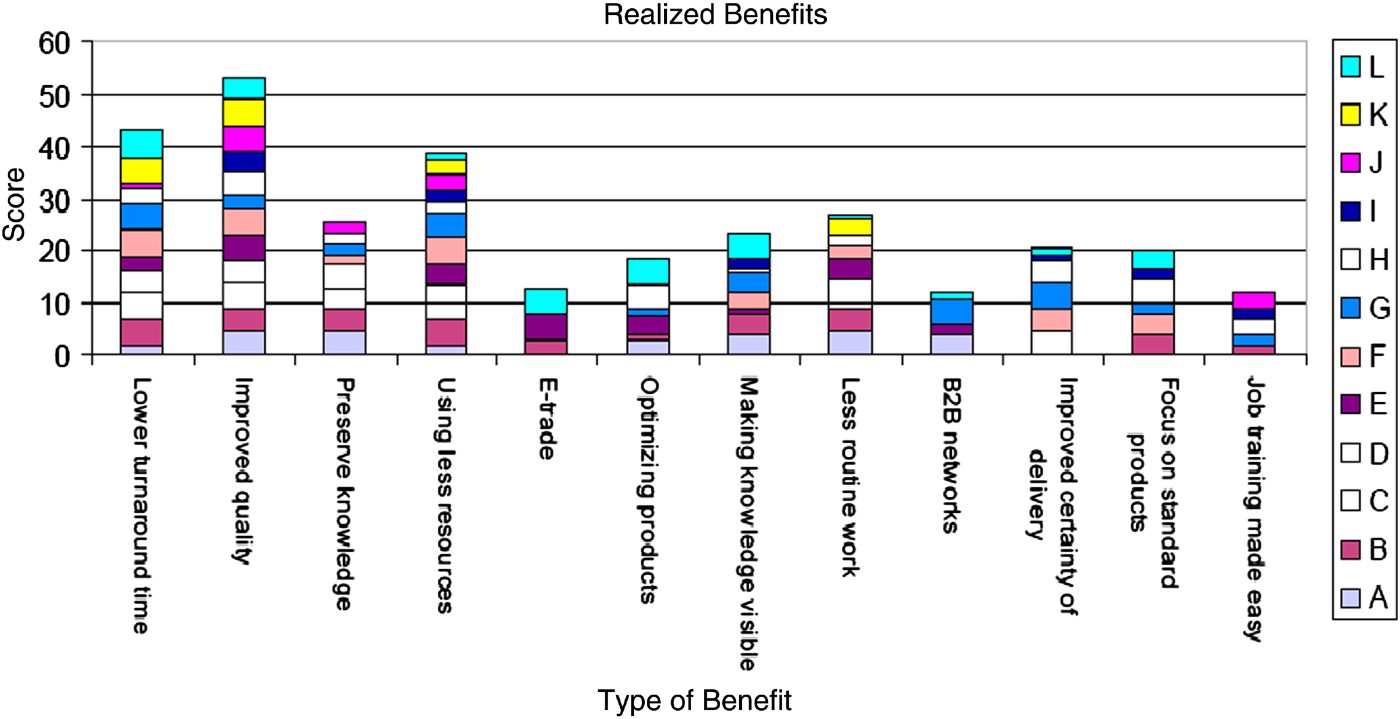
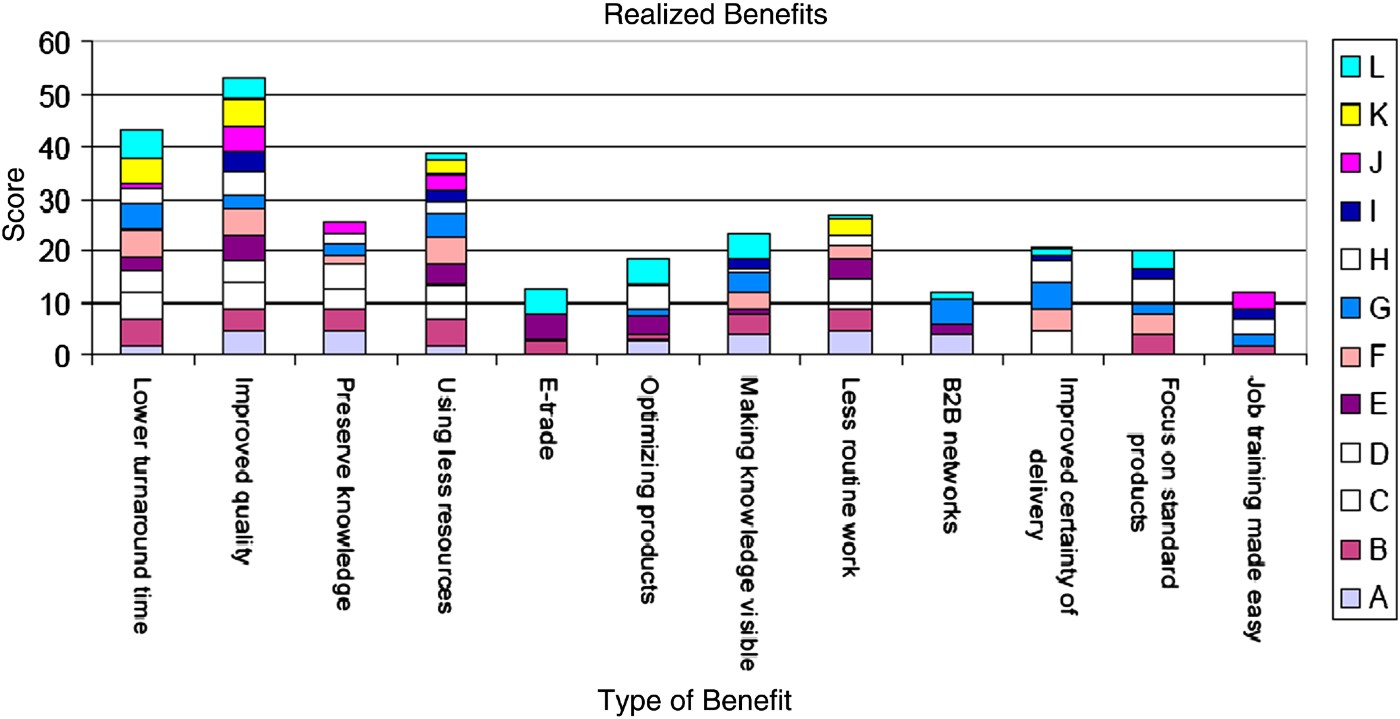
A contribution to a more general picture of the effects of product configurators in engineering-oriented companies is offered by a Danish research project on product configuration (Edwards et al., Reference Edwards, Hvam, Pedersen, Møldrup and Møller2005) and the papers that emerged from this project. The project was carried out during the period of 2003 to 2004 and includes studies of 12 Danish firms that were using product configurators at the time of the investigation. Based on this project, Pedersen and Edwards (Reference Pedersen and Edwards2004) present the results of the 12 companies' answers to the realized effects of their configurator projects, as shown in Figure 1. The firms gave scores from 1 to 5 (1 = very small and 5 = very large) and 0 = without influence. As seen, the three top scorers are lower turnaround time (average ~ 3.6), improved quality (average ~ 4.4), and less use of resources (average ~ 3.3).
The benefits realized from configurator projects (Pedersen & Edwards, Reference Pedersen and Edwards2004). [A color version of this figure can be viewed online at journals.cambridge.org/aie]
Forza et al. (Reference Forza, Trentin and Salvador2006) present a case study of a company that produces electric motors. The case shows how the right grouping of components (into kits) has enabled the company to implement a product configurator and to postpone product differentiation along the material flow. They state that the configurator “enhances product assortment communication”; “makes it easier and faster to explore the solution space offered by the company”; “enables a faster, accurate generation of a feasible offer without consulting the technical office”; “enables a faster, accurate creation of product code, BOM, and production cycle”; “allows storage of a large amount of customer data collected during the exploration and configuration phases”; and “allows rapid retrieval of past configurations for maintenance or repair purposes.”
Petersen et al. (Reference Petersen, Jorgensen, Hvolby and Nielsen2007) describe the case of Aalborg Industries, a company that specializes in steam and heat generating equipment for maritime and industrial applications. The company has implemented a product configurator to render the sales-delivery process more efficient. Petersen at al. (2007) state that because of the configurator the company is “gaining significant benefits, and has learned much about the challenges of implementing product configuration in ETO.”
Hong et al. (Reference Hong, Hu, Xue, Tu and Xiong2008) describe the case of Gienow Windows and Doors, a Canadian manufacturing company of windows and doors. This company has introduced a configurator with the purpose of modeling the designs based on customer needs, creating requirements of materials, machines, and personnel, and identifying the optimal production schedule. Hong et al. (Reference Hong, Hu, Xue, Tu and Xiong2008) state that “the lead time from a customer order to the product delivery has been reduced to 3 weeks compared to the average of 2 months in this industry.”
Ladeby (Reference Ladeby2009) describes the configurator project at NNE Pharmaplan, a Danish supplier of systems, consultancy, and engineering services to the international pharmaceutical and biotechnical industry. The configurator is primarily a three-dimensional visualization system for plant layout, and it does not produce prices or detailed bills of materials. It is stated that a main benefit of the system is that “a customer should not wait for weeks before he sees drawings and illustrations of what has been agreed upon.”
Ladeby (Reference Ladeby2009) describes the configurator project of GEA Niro, an international engineering company within the area of design and supply of spray drying plants. According to Ladeby (Reference Ladeby2009), the configurator of GEA Niro focuses on the quotation phase, and it is used in about 50% of the first quotations sent out to customers. He states that “the process of making quotations has become more standardised and formalised,” “product knowledge has become more standardised,” and the sales person “gets the whole quotation served on a plate and sends it to the customer.” It is also mentioned that “preservation of knowledge has been a motivation for the configurator project.”
2.2. Literature summary
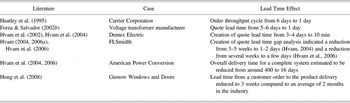
As shown in the literature review in the previous section, most literature based on studies of configurator projects is rather vague when it comes to describing the effects of such projects in terms of the effects on business process length and resource consumption. Although much such literature talks about large reductions of lead times and similar, it is actually unclear if such reductions represent, for example, 10% or 99%. The six cases with the most accurately described effects of configurators on lead times are summarized in Table 1.
Literature with quantified estimates of lead time reductions

In the first four of the six cases in Table 1, it is clear that configurators have had massive effects on lead times in the quotation phase, that is, configurators in these cases are estimated to have reduced lead times between 65% and 99.4%. The last two cases refer to other types of lead times for which reason the reductions are not directly comparable. Thus, only four comparable cases were found.
3. DEFINITIONS
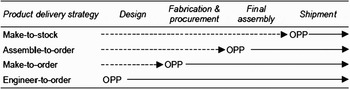
As a basis for carrying out the studies of the effects of product configurators, first some basic definitions were set forth on how relevant business processes could be affected. As mentioned, this paper focuses on what is referred to as “engineering-oriented companies.” In this paper the term is used to describe engineer-to-order (ETO) companies, and the part of the assembly-to-order (ATO) and make-to-order (MTO) companies in which each customer order requires some engineering work, that is, companies that are not pure ATO or MTO but in between ETO and ATO or MTO (Olhager, Reference Olhager2003). Figure 2 shows the four traditional types of product delivery strategies.
The order penetration point (OPP; Olhager, Reference Olhager2003).

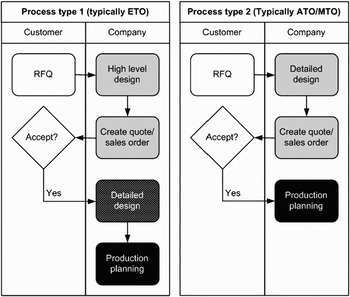
In ETO companies a product is often defined in two major turns, namely, a high-level design in the sales phase and a detailed design phase upon acceptance of an offer. Typically configurators are only used for high-level design in ETO companies, because it would be extremely time consuming to define the solution space at a detailed level. An example of this is the FLSmidth case (Hvam, Reference Hvam2004, Reference Hvam2006a). At FLSmidth, potential customers provide some requirements (i.e., a form of high-level design) that FLSmidth, by using a configurator, converts into a high-level design and based on this a quote. If the quote is accepted, detailed design is initiated. In contrast, often in ATO companies that typically deal with somewhat simpler products, the detailed design is defined during the sales phase as a basis for calculating the price. An example of such a company is APC (Hvam, Reference Hvam2004, Reference Hvam2006b). At APC, configurators can produce a quote at a detailed design level, for example, for some of their emergency power supply systems (Hvam, Reference Hvam2006b). When focusing on the process from RFQ (request for quotation) to production planning, the two discussed process types can be illustrated in a principle manner as seen in Figure 3. The gray boxes symbolize the processes normally automated (or at least partly) by configurator technology, wheres the black boxes show processes that in principle could be automated but typically are not (Hvam et al., Reference Hvam, Malis, Hansen and Riis2004, Reference Hvam, Mortensen and Riis2008; Edwards et al., Reference Edwards, Hvam, Pedersen, Møldrup and Møller2005). The color of the process “detailed design” is gray and black because the “simple” part of the engineering work in this process is often automated due to the overlap between high-level and detailed design.
Engineering-oriented customizers' processes. ETO, engineer-to-order companies; ATO, assembly-to-order companies; MTO, make-to-order companies; RFQ, request for quotation.

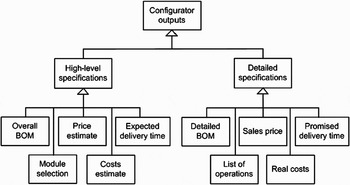
As seen in Figure 3, at the quote creation stage of process type 1, only high-level design has been carried out, whereas in process type 2 detailed design has been made at this stage. To illustrate the difference between the configurator outputs of such processes, this paper proposes a division based on the level of detail of the output, which is illustrated in a class diagram in Figure 4.
The main configurator output types.

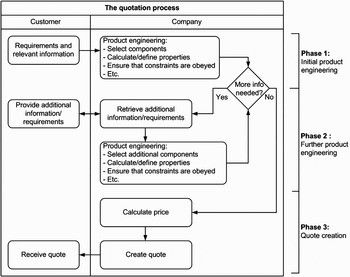
In engineering-oriented companies, the quote creation phase often lasts days or weeks without the use of configurators. For example, at APC the quote process for emergency power supply systems lasted weeks before the use of configurators, and the gains from automating the quotation process at APC implied a reduction of the quote lead time of more than 90% (Hvam et al., Reference Hvam2006b). This reduction can be explained by the fact that the majority of the work associated with this process has been automated. However, the question is exactly which processes do configurators automate or reduce the duration of? To understand this question better, Figure 5 shows a generalized illustration of a quotation process. This is subsequently discussed.
The quotation process.

As seen in Figure 5, the quotation generation process can be divided into three phases: initial product specification, further product specification, and quote creation. Besides the duration of the processes included in the figure, time can be added for waiting, handovers, and other internal communication. The use of configurators can affect all these activities. In phase 1, a configurator directly reduces the duration of the process termed “product engineering.” In many cases, configurators almost fully automate this phase. Subsequently, the duration of this process is reduced to the time it takes for the configurator to generate the relevant specifications, that is, minutes or seconds. In many cases, phase 2 comes into play when a need for further information occurs during the product engineering. Because a configurator works as a check list for needed information, a configurator may imply that phase 2 can be avoided or at least limit the number of loops in this phase. Normally phase 3 is also automated by a configurator, at least the part of calculating sales prices. Thus, it is also possible to significantly reduce the duration of phase 3.
4. RESEARCH METHOD
To investigate the effects of product configurators on the lead times of engineering-oriented companies, a study of the use of product configurators in the Danish industry was carried out during spring and early summer of 2009. The study was carried out as structured interviews of employees with knowledge of the configurator projects. The main reason for using interviews instead of a Web-based or paper-based questionnaire survey is that the area in focus is characterized by much unclear terminology. Therefore, the chosen approach allowed for the interviewer to clarify the meaning of questions not understood.
A total of 26 companies were interviewed. For this paper a sample of 14 companies was selected based on ability to estimate the effects on lead times from the use of configurators, and use of configurators that focus on products that are traditionally engineered. All these 14 companies produce business-to-business products, and in 9 of the 14 companies, several configurators were in operation. In the context of counting the number of configurators, a single configurator was defined as an operable software application that has an individual knowledge base. In most cases, such configurators were created by using the same standard configurator software shells. To be able to compare the data obtained from the different companies while focusing on relatively recent projects, the companies were told to focus on a configurator developed recently, preferably as complex and widely used as possible.
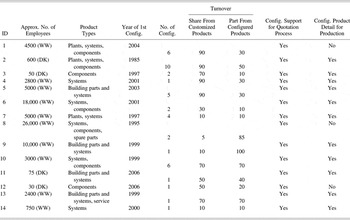
Table 2 shows the background information on the companies included and their configurators. As seen in Table 2, 11 of the 14 companies apply configurators for quotations and for creating the manufacturing basis, but 3 of these only use configurators for the quotation phase. Table 2 also shows the ratio between configured products (i.e., defined by use of a configurator) and customized products (i.e., user-specific products, not necessarily defined by using a configurator). Note that the percentage of configured products in 8 of the cases is smaller than the number of customized products, in 4 cases all customized products are configurable, and in 2 cases the number of configured products are higher than the percentage of customized products. The explanation for the latter phenomenon is that standard products are sold via a configurator; that is, it is the combination of products that is customized, not the products themselves.
Background information

Note: WW, worldwide; DK, Denmark.
5. RESULTS
This section presents the results of the study related to quotation and manufacturing, which are subsequently discussed.
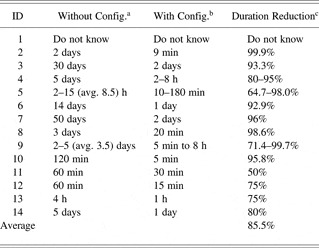
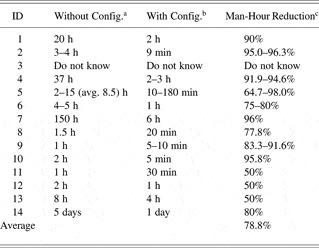
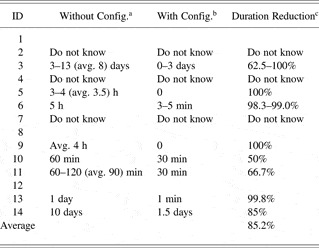
Table 3 and Table 4 show the companies' answers to the effects of configurators for the creation of quotes as measured in duration and man-hour consumption, respectively. Note that the numbers represent generalized estimates made by key personnel.
Effects of the process duration on the quotation process

aDuration of the creation of a quote before using the configurator.
bDuration of the creation of a quote using the configurator.
cReduction of the duration of the creation of a quote.
Effects on the quotation process in man-hours

aMan-hours used for the creation of a quote before using the configurator.
bMan-hours used for the creation of a quote using the configurator.
cReduction of the man-hours used for the creation of a quote.
As seen in Table 3, the lead time reductions estimated were rather significant. More specifically, 12 of the 13 companies that were able to answer this question provided estimates of a 75% to 99.9% reduction of quotation lead time. One company estimated a 50% reduction, but it should be noted that the original lead time in this case was only 60 min; therefore, the 30 min remaining may be related mainly to customer interaction. In general, the number of man-hours saved is a little lower than the lead time reduction, that is, 85.5% versus 78.8%. This difference may be explained by the fact that configurators cause fewer handovers. Fewer handovers imply less waiting time between tasks, which is time wherein no human action is required. Thus, the lead time is reduced whereas the use of man-hours is not, under the assumption that relevant personnel carries out other tasks while waiting.
Table 5 shows the estimates of the effects configurator use on the duration of the process of creating detailed product specifications as a basis for production.
Effects on the process of creating product specifications for manufacturing

aDuration of the creation of the product specifications for manufacturing before using the configurator.
bDuration of the creation of the product specifications for manufacturing using the configurator.
cReduction of the duration of time for creation of the product specifications for manufacturing.
As can be seen, 8 of the 11 companies that use configurator output as a basis for manufacturing were able to answer the question of lead time reduction in the product specification part of the production process. The average of these reductions was 85.2%. The high average reduction estimated can be explained by the fact that the configurator in the 8 companies produces most (if not all) of the product specifications needed for production during the quotation phase.
6. CONCLUSION
This paper has provided new insight into how product configurators may have an impact on business processes in engineering-oriented companies, more specifically, the impact of configurators on the quotation and production preparation processes.
This paper first reviewed the literature in order to clarify the effects of product configurators on lead times. However, despite including more than 100 papers in the review, only six cases were identified in which reports of lead time reductions in a quantitative manner were provided. Next the paper presented the result of structured interviews with 14 companies on the effects of product configurators on lead times. For quotation processes, the use of configurators in 12 of the 14 companies implied a 75% to 99.9% reduction of quotation lead time, whereas the last 2 companies experienced a 50% reduction or were not able to answer, respectively. The average lead time reduction relating to the creation of quotes was 85.5%, and the average man-hours saved represented a reduction of 78.8%. Concerning the creation of detailed product design specifications, 11 companies had this focus, and of these, 8 were able to answer the question of lead time reduction. The average size of these estimates of lead time reductions was 85.2%.
The results of this paper clearly show that engineering companies that successfully implement product configurators can achieve significant lead time and man-hour reductions in processes relating to quotation and production preparation. However, the creation of configurators is often a risky and highly time-consuming project. Thus, even if a 90% reduction of lead time and man-hours is achieved, this may still be an unprofitable project if the costs of achieving this are too high. In this context, note that configurators need continuous updates as the product assortment changes that may result in high maintenance costs. Therefore, instead of being blinded by the impressive effects of configurators documented by this study, this paper recommends to carefully estimate the expected costs before initiating such a project.
Based on the configurator literature identified in the literature review, it seems that the study presented in this paper is the first major study that has investigated in a detailed manner the impact of product configurators on business processes related to the creation of quotes and manufacturing-related product specifications. More specifically, only 6 cases in which such effects have been quantified were found in literature. Thus, the data from the 14 cases of this paper represent a significant contribution to configuration literature.
Anders Haug is an Assistant Professor in the Department of Entrepreneurship and Relationship Management at the University of Southern Denmark. He received his PhD from the Technical University of Denmark. Dr. Haug's research focuses on information systems, knowledge engineering, product configuration, and knowledge management from an industrial perspective. He has published a long list of papers on these topics in international journals and at international conferences and has years of practical experience from projects in these areas.
Lars Hvam is a Professor at the Technical University of Denmark. He has been working on product configuration for more than 15 years as a teacher, researcher, and consultant for more than 15 configuration projects in large industrial companies. He has supervised 8 PhD projects on the construction and application of configuration systems and has been the project leader for 4 large research projects on product configuration. Dr. Hvam is also the founder and current chairman of the Product Modelling Association (www.productmodels.org), whose aim is to disseminate knowledge of the possibilities offered by product configuration.
Niels Henrik Mortensen is a Professor at the Technical University of Denmark. He has been engaged in research into and teaching of product configuration for 10 years. Dr. Mortensen has also been a consultant for more than 15 configuration projects for companies in Denmark and abroad. He is the supervisor for six PhD students within this field. Prof. Mortensen is a member of the board of the Product Modelling Association.