This article examines financial aspects of the recent funding-model changes at Hungarian universities, using Corvinus University of Budapest (CUB) as a case study. Although the broader political implications of these funding-model changes have received much media attention, discussions about their potential financial impacts have been sidelined. We argue that the funding-model change in the case of CUB would allow the university to increase its financial resources (and thus its autonomy); however, the university would need to actively manage the investment portfolio of its endowment.
In recent years, the Hungarian government has attempted to exert greater control over academic institutions in the country. Its successful campaign to push the Central European University out of the country has been well documented (Enyedi Reference Enyedi2019), and it also has eroded the independence of the research institutes of the Hungarian Academy of Sciences. These actions were labeled by critics as government attacks against academic freedom (Human Rights Watch 2019). Given this context, it is somewhat surprising that the government simultaneously increased the autonomy of other academic institutions, starting with a “model change” at CUB, which was announced in 2018. CUB’s restructure was meant to be the pilot project of the government’s broader ambitions to transform the structure and funding of higher education in Hungary. CUB, previously known as the Budapest University of Economic Sciences, generally has been viewed as the country’s leading higher-education institution in social sciences, economics, and business studies, with especially strong programs in international relations dating back to 1969.
Since 2018, two types of funding models have been explored by the Hungarian government and were codified into law in 2021, affecting 11 public universities (Euronews 2021). In the case of CUB, a foundation—the Maecenas Universitatis Corvini Foundation (MUCF)—was created to oversee the university operations. MUCF was gifted an endowment by the state that was composed of shares of two leading Hungarian companies: Mol, a multinational oil and gas company, and Richter, a pharmaceutical company. MUCF currently owns 10% of both companies, worth approximately $1.13 billion.Footnote 1 This endowment is generous even by international comparison: well-known American universities such as Rutgers in New Brunswick, New Jersey, and Indiana University in Bloomington had comparable endowments in 2018 (US Department of Education 2019).
The second type of funding-model change also involves the creation of similar foundations, but they were gifted real estate instead of shares—which does not provide any meaningful revenue (Zsuppán Reference Zsuppán2021)—and the promise that universities will receive long-term state contracts based on student enrollment and research criteria (Biró and Fábián Reference Biró and Fábián2021). A key aspect of the restructuring in both types of funding models was incentivizing higher-education institutions to give business-related considerations a greater role in their strategy, thereby increasing their competitiveness.
Even before these reforms, Hungarian higher-education funding—following the Higher Education Act of 2011—was distinctive in the Central and Eastern European (CEE) region because it gave a significant role to “self-funded” students and thus tuition-fee income for universities. Although their exact funding structures differ, in the Czech Republic, Poland, and Slovakia, a public-university education generally is free or involves only minor fees for most students. This means that the overwhelming share of university funding in these countries is included in the state budget, allocated according to various criteria (e.g., student enrollment and research activity). There is no indication that any of the three countries have moved to a funding structure similar to Hungary. In fact, Poland’s 2018 university-funding reform entrenched public funding even further by subjecting the state budget to annual indexation (European Commission, Eurydice 2021).
CUB was exceptional in one sense because there was further rationale to sever the institution’s dependence on state funding and allow it to use the resulting greater autonomy to increase the quality of its teaching and research. This ultimately resulted in the university becoming the leading institution in business and social sciences in the CEE region (Károly Reference Károly2021). CUB’s funding-model change was accompanied by numerous reforms. The university was restructured into a more streamlined organization and its academic programs were redesigned with more emphasis on employability and internationalization. New career structures were established, allowing academics to choose between teaching-focused and research-focused pathways (the former pathway featured a relatively heavier teaching load but lower research requirements compared to the latter pathway). Furthermore, an incentive (i.e., bonus) system based on previously agreed-on key performance indicators was introduced to motivate faculty to produce higher-quality research. After CUB ceased being a state university, it was allowed to diverge from public-service pay scales and offer more competitive remuneration for its employees. To achieve these goals, CUB’s leadership argued that an annual budget of 30 billion to 35 billion Hungarian forints (HUF; approximately $100 million to $116 million) was required, an increase from 17.8 billion HUF ($59.3 million) in 2019 (Károly Reference Károly2021).
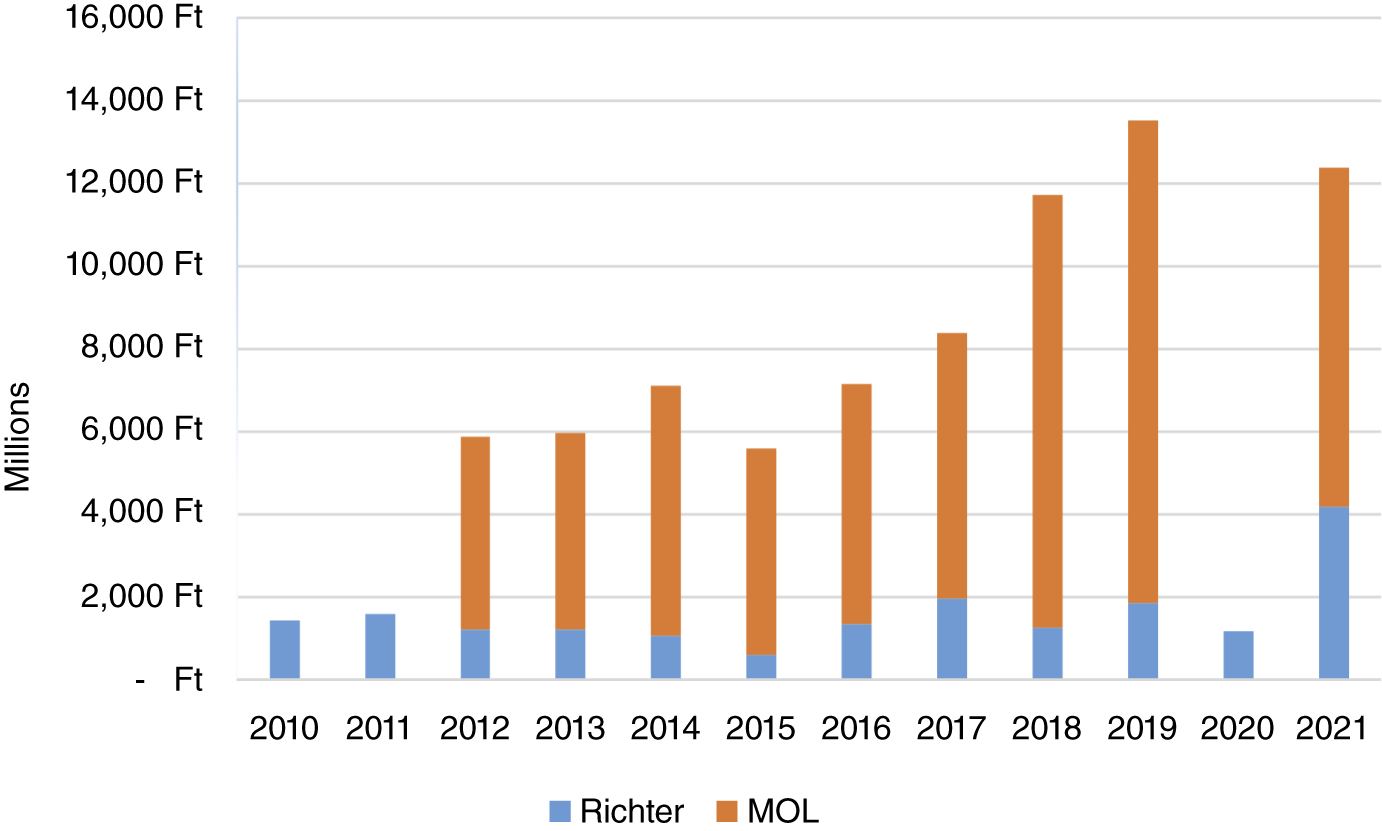
Is this goal realistic, given the new funding structure? Figure 1 shows the hypothetical amount of dividend income that CUB would have received annually since 2010 had it been gifted the shares earlier. On average, between 2010 and 2021, the annual dividend income would have been approximately 6.8 billion HUF (approximately $22.6 million, not accounting for inflation). This generally corresponds to the amount of state funding received by the university during this period, but it certainly does not represent additional funding for improvements. Furthermore, as shown in figure 1, Mol did not pay any dividends for three years, which implies a greater degree of uncertainty than with state funding.
Annual Dividend Income from the 10% of Richter and Mol Shares in Millions of Forints, 2010–2021
Source: Authors’ calculations, based on data from https://bet.hu; 2021 is a projection.

We calculated that the annual dividend yield over 12 years was approximately 2.39% and that the value of shares had increased by 28% since 2010 in absolute numbers, which is a little more than 2% annuallyFootnote 2 (Tétényi and Szent-Iványi Reference Tétényi and Szent-Iványi2022). Comparing this annual growth plus the dividend income from the shares to the returns achieved by American university endowments, the difference is striking. Ennis (Reference Ennis2021) showed that the average US endowment had an annualized return of 8.4% between 2010 and 2019, whereas Sedlacek and Jarvis (Reference Sedlacek and Jarvis2010) found that the spending rate of a nonprofit institution typically falls between 4.0% and 5.5% of its endowment.Footnote 3 They also argued that the endowment’s investments must be diversified and that investment decisions should be made in a portfolio context.
This brief comparison provides lessons for CUB. If the trustees of MUCF decide to diversify the endowment, there is significant potential that in 10 years, the payouts will increase substantially. Consider the following hypothetical scenario as an example. Assume that CUB already owned the Mol and Richter shares in 2010 and sold them to diversify its portfolio to mimic the US endowments analyzed by Ennis (Reference Ennis2021). The value of the shares of Mol and Richter in 2010 was approximately 266 billion HUF ($886.6 million); calculating an 8% annual growth (i.e., Ennis’s estimate of the return of American endowments) and a 4% annual payout, by 2021, the endowment could have resulted in an approximately 16 billion HUF ($53.3 million) payout. However, in reality, Mol and Richter shares performed worse, and the actual payout from dividends was only 6.8 billion HUF ($23.2 million).
The funding-model change, therefore, may represent greater financial autonomy for CUB, provided that the endowment is diversified. However, despite the improved financial freedom of the university, the state still has strong mechanisms for control through informal and more indirect links. MUCF trustees include the CEOs of Mol and Wizz Air (i.e., a low-cost airline), a deputy minister from the Ministry for Innovation and Technology, the Rector of Corvinus University, a Hungarian executive director of the International Monetary Fund, and a former foreign minister in Prime Minister Viktor Orbán’s government (Corvinus University of Budapest 2021). The Senate’s role and responsibilities have become more limited. The government also continues to have influence over the university through the regulatory environment. The Ministry for Innovation and Technology and the Hungarian Accreditation Council make decisions on programs, and the Council also evaluates promotion applications to full professorship, which enables the government to impact the career of individual academics.
The funding-model change, therefore, may represent greater financial autonomy for CUB, provided that the endowment is diversified.
These lines of control bring into question the government’s intentions of providing greater autonomy to CUB or any other Hungarian university. Critics argue that the new funding structure allows Orbán’s party to retain influence over CUB and other universities, even if it were voted out of power (Euronews 2021). This article argues that a diversification of assets is necessary to ensure financial sustainability and greater independence for CUB. However, critics also argue that the actions of the new foundation in managing universities are less transparent and that assets could be “offloaded at reduced prices to politically connected insiders” (Euronews 2021).
In conclusion, CUB’s new funding model replaces state funding with less-certain private funding, but a lower degree of state control still is maintained through both formal and informal channels. Theoretically, the university’s financial autonomy could increase if the endowment were transformed into a more diversified portfolio, similar to those at American universities. Until this happens, government funding will continue to have a role if the university is serious about the reforms needed to boost its competitiveness. Furthermore, CUB’s case illustrates how an institution may become nominally and financially more independent from the state. However, the state may yet find ways to influence the institution and potentially limit its academic freedom.
Data Availability Statement
Research documentation and data that support the findings of this study are openly available at the PS: Political Science & Politics Dataverse at https://doi.org/10.7910/DVN/JDTA6S.