This article draws on a study that investigated the educational value of food gardens and related environmental and sustainability initiatives in primary (elementary) schooling in Australia (Green, Reference Green2011). Building on the study's earlier findings that signify the importance of garden pedagogies for advancing children's garden and food knowledge, this paper adopts a ‘relational materialist approach’ (Hultman & Lenz Taguchi, Reference Hultman and Lenz Taguchi2010; Lenz-Taguchi, Reference Lenz-Taguchi2011) to focus on the agential capacity of non-human forces as a way of producing different knowledge about children's garden experiences. Relatively unexplored in the wider food garden literature, the article analyses the value of children's interactions with animate and inanimate life forces through examining three garden photographs and children's interviews collected as part of the study's wider data collection. Inspired by Karin Hultman and Hillevi Lenz Taguchi's methodological approaches to educational research, which favour the force of the material environment (Hultman & Lenz Taguchi, Reference Hultman and Lenz Taguchi2010; Lenz-Taguchi, Reference Lenz-Taguchi2010), this article concentrates on three gardening images that were taken by one of the gardening teachers and provided to the researcher, and include a sunflower maze, a garden trellis, and cubby building. Each of the photographs reflects specific kinds of practices that occur in food gardens, and potentially brings to light the different garden knowledges afforded to children by such practices. In using ‘a new materialism’ lens, we understand ‘it is not only the humans [children], with their personality traits, but also other material entities that can be seen to play a role’ (Rautio, Reference Rautio2013b, p. 394) in the photographs and in children's gardening learning. We identify this focus as an additional contribution to the vast and proliferating food garden literature that portrays school gardens as important educational sites for learning (Bowker & Tearle, Reference Bowker and Tearle2007).
Although gardens have been a prominent dimension of Western school life for more than a century (Desmond, Grieshop, & Subramaniam, Reference Desmond, Grieshop and Subramaniam2002; Subramaniam, Reference Subramaniam2002), the past two decades symbolise a food garden groundswell that is underpinned by increasing calls for the concept of food to become an integral component of the ecology of education (Waters, Reference Waters, Stone and Barlow2005; Weaver-Hightower, Reference Weaver-Hightower2011). More broadly, these calls have been advanced by global food advocates in response to the escalating and prolonged unease about children's declining connection to food (Alexander, Reference Alexander2013; Oliver, Reference Oliver2013; Waters, Reference Waters2008). Subsequently, the international renewal and redefining of food and agricultural literacy in schools through gardening is now identified as one of the key influences for increasing children's food consciousness and for rejuvenating children's relationship with fresh food (Centre for Ecological Literacy, 2010; Rauzon, Studer, Martin, Crawford, & Wang, Reference Rauzon, Studer, Martin, Crawford and Wang2007). Collectively, these efforts have progressed school gardens as significant learning sites that increase and deepen children's food knowledge, including where food comes from, how to cook it, and how it affects their bodies (Brembeck & Johansson, Reference Brembeck and Johansson2010).
In spite of the renewed and intensified efforts to provide more healthful food and learning opportunities for young people through gardening (Blair, Reference Blair2009; Pivnick, Reference Pivnick, Grant and Littlejohn2001), concerns about children's increasing disconnect to food abound (Ableman, Reference Ableman, Stone and Barlow2005; Pollan, Reference Pollan2006). Central to these concerns are fears for the widening gap between children, food production and food consumption, and the processes that transport food seemingly effortlessly to children's plates (Dillon, Rickinson, Sanders, & Teamey, Reference Dillon, Rickinson, Sanders and Teamey2005). While conceptually it is understood food is produced on farms, consumers tend to have little to no understanding of the specific conditions — including geopolitical, geographical, social and economic conditions that enable food to grow (Berry, Reference Berry1990, Reference Berry2009). Food has always come from the land and food production has been a vital role of gardeners since the domestication of plants began thousands of years ago (Cushing, Reference Cushing2005; Pollan, Reference Pollan2008), yet the deep interconnectedness between food, people and ‘vibrant matter of all kinds’ (Bennett, Reference Bennett2010) has become almost invisible in post-industrial societies. In post-industrial contexts most children have few opportunities to explore the complex relationships between food and the cultivation of plants. Whether or not this is due to the ways adults govern how children are brought, or not, into relationship with food and with the greater food channels (Kerton & Sinclair, Reference Kerton and Sinclair2010; Waters, Reference Waters, Stone and Barlow2005) remains to be seen. Whatever the barriers, school food gardens now play a critical role in bridging the perceived chasm between food production and consumption, and fostering children's relationship with food and the wider food systems (Salsedo, Reference Salsedo2007; Wilkins, Reference Wilkins2005). However, children's perspectives of their own learning in gardens are still largely missing from the literature.
In addition to increasing children's exposure to fresh food and food origins, gardens have been identified as places where children can enter into meaningful relationships with other species to increase awareness of the complexity and interrelatedness of the earth's life support systems (Moore, Reference Moore1995; Moore & Wong, Reference Moore and Wong1997). This dynamic but less examined dimension of gardening discourse brings attention to children's interactions with the life systems that comprise the soil, air, sun and other life forces that sustain humans (Capra, Reference Capra2009; Kirschenmann, Reference Kirschenmann2008). Building on the importance of these non-human entities, Williams and Brown (Reference Williams and Brown2012) advance the ecological materiality of ‘living soil’ as an important metaphor for curriculum that progresses children's understanding of broader ecological and social systems. The idea of ecological materiality has long been held as an essential tenet of ‘ecological literacy’, a term encompassing a developed affinity with the basic principles of ecology, such as life, earth, forests, water and place (Bowers, Reference Bowers1996; Cutter-Mackenzie & Smith, Reference Cutter-Mackenzie and Smith2003; Orr, Reference Orr1992). At the heart of ecoliteracy is the privileging of children's engagement with non-human life forms that are essential for understanding ecological themes and ideas, such as diversity, interdependence, food webs and communities (Capra, Reference Capra, Stone and Barlow2005).
In trying to understand the significance of these life forms and non-human entities for children's ecological literacy, the article sets out to examine the meaning of the embodied exchanges that occur between children and the garden world as part of everyday learning (Holmes, Reference Holmes1999). The focus of the article relates to how the complexity and interrelatedness of all life, including matter itself (Hinchliffe, Kearnes, Degen, & Whatmore, Reference Hinchliffe, Kearnes, Degen and Whatmore2005), are largely unexamined as critical dimensions of garden pedagogy. In keeping with Holmes’ (Reference Holmes1999) contention that ‘gardens are an expression of a relationship between humans and their world’ (p. 152), the paper seeks to foreground the role garden materialities play in supporting and enabling children's meaning making and learning about the interrelatedness of all life. While much of the garden literature speaks to the social, ecological and health benefits of children growing food, there is a need to better understand the significance of the dynamic exchanges that occur between children and the animate and inanimate garden entities.
Using a ‘new materialities’ framework or a ‘relational materialist approach’ (Hultman & Lenz Taguchi, Reference Hultman and Lenz Taguchi2010, p. 525), the article considers the ecological life forces and other non-human materialities (or more than human dimensions) of school food gardens that act as ‘intra-action’ agents (Rautio, Reference Rautio2013b) in children's garden learning. The photographs that were selected for analysis in this article were one aspect of the intra-active encounters that took place in the school garden. Children's moments of joy while exploring the sunflower maze, the intense engagement with bamboo trellis, and the sense of place making through building the cubby generated the push on the camera's button. It was the intensity of the moment and the sense of shared excitement that led to the pictures being taken. The camera was a part of the encounters and contributed to learning, and while this aspect of intra-action is not the focus of this article, it is important to at least note that data and method are intermeshed (Allen & Duhn, Reference Allen and Duhn2013).
In recognising these diverse encounters between humans and other-than-humans as the ‘constitutive factors in children's learnings and becomings’ (Hultman & Lenz Taguchi, Reference Hultman and Lenz Taguchi2010, pp. 526–527) we examine the agency of the less recognised non-human materialities or material artefacts of a garden by asking: What intra-actions are taking place when children learn to garden?
Defining a New Materialities Framework
New materialism hails from a poststructural reading of the world to reconsider the ways humans and more-than-human continually create the conditions for each other's existence (Braidotti, Reference Braidotti2007; Panelli, Reference Panelli2010; Taylor, Pacini-Ketchabaw, & Blaise, Reference Taylor, Pacini-Ketchabaw and Blaise2012). This perspective is strongly advanced in innovative early childhood discourse, where the productive nature of forces and forms are emphasised as vibrant matter in the lives of young children (Duhn, Reference Duhn2014; Lenz-Taguchi, Reference Lenz-Taguchi2010; Rautio, Reference Rautio2013b). Underpinning this thinking is the recognition that humans are constituted through complex entanglements with other animate and non-animate co-existing entities and materialities. Jane Bennett refers to the vitality of materialities as an ‘ecology of things’ (Bennett, Reference Bennett2010) or ‘thing power’ that has agential powers that ‘flow[s] around and through humans’ (Bennett, Reference Bennett2004, p. 349). Drawing on Bennett's (Reference Bennett2004, Reference Bennett2010) and Barad's (Reference Barad2007, Reference Barad, Alaimo and Hekman2008) work, Rautio (Reference Rautio2013b) ponders why children carry stones in their pockets. Rautio maintains it is not only humans with their personality traits, but also other material entities or things that have agential power; for instance, when a stone ‘calls’ a child to pick it up and carry it in her pocket. Feminist philosopher Karen Barad advances ‘intra-activity’ as a perspective that enables new understandings of the co-emergence of difference through encounters. Entities become other than they were before the encounter because they act on each other simultaneously. Instead of inter-action as turn taking by individuals, intra-action considers the forces that are generated by all kinds of encounters between ‘vibrant matter’ of all sorts (Bennett, Reference Bennett2010). This view shifts the focus from a pedagogy that seeks to support individual learners to become more stable and coherent individuals to an opening towards selves and others that are in flux and open to continuous change in encounters with the world. Rautio (Reference Rautio2013b) explains:
that such intra-activity relates to a relationship between any organism and matter (human or non-human), which are understood not to have clear and inherent boundaries, but are always in a state of intra-activity of higher or lesser intensity or speed. It is intra-action — that yields us to consider ourselves, and any other thing in the world, as a consequence of the world. (p. 394)
In observing ‘the intersection of human and more-than-human’ in the respective photos, our investigation moves beyond thinking that humans are exclusively active and agentic in a garden (Hultman & Lenz Taguchi, Reference Hultman and Lenz Taguchi2010, p. 527) to consider how non-human and matter can be granted ‘agency’.
Background to the Study
The 4-year study on which this article draws set out to investigate the pedagogical role of food gardens in three Australian primary schools. The schools were chosen based on their commitment to environmental and sustainability education, and food gardening. At the time of the study the gardening programs were well developed and integral to a wider school culture. Across each of the schools, garden learning was structured around creating, maintaining, planting, harvesting and cooking food, tree planting, seed propagation and other scientific and environmental investigations within the grounds of the respective schools. Gardening and environmental activities such as designing and building new gardens and garden beds, digging, pruning, making and spreading compost, creating permanent art installations, collecting and planting seeds, weeding, watering and mulching were commonly embedded in each school, and formed the basis of integrated curriculum where multiple subject areas were taught through gardening. Conservation activities such as creating frog ponds, tree planting and other land management practices in wetlands and creeks were also key features of the programs. Learning tended to occur in small groups across various school ground sites and was supported by gardening and classroom teachers, as well as community volunteers. Interactions with weather patterns, seasons, the cycles of day and night, animals and mini-beasts, the living soil, the air and other earthly phenomena were customary and effective themes for organising pedagogy and curriculum in each of the schools (Bird Rose, Reference Bird Rose1996; Somerville & Green, Reference Somerville and Green2011).
Two schools were located in the Dandenong Ranges, approximately 35 km east of the city of Melbourne. This area serves as an important water catchment for the capital city; it has a well-established horticultural industry and supports a middle class ‘alternative’ demographic. The two schools have generous land allocations of over 10 acres that afford extensive garden, environmental and sporting activities. The third school was situated in southern Tasmania on the D’Entrecasteaux channel, approximately 38 km south of the state capital Hobart, in a low socio-economic rural community. Originally a 20-acre farm, the school resides within a small fishing community with a population of approximately 300, and the majority of students commute from outside the township. One school had a highly structured weekly kitchen-garden program (Grades 3–6) that included 45 minutes of cooking with a kitchen specialist and 45 minutes of gardening with a designated gardening teacher. The other schools offered weekly 1-hour food gardening and environmental education lessons conducted by a specialist gardening or environmental education teacher in outside and inside classrooms.
Methods
Data Collection and Analysis
As part of the broader study, qualitative data were primarily derived from semi-structured, face-to-face digitally recorded interviews across three primary schools with three school principals and three gardening/environmental teachers. Interviews were conducted with 53 children (aged from 6–13) whose parents had given informed consent to their participation. These interviews occurred individually except on some occasions when small groups of students (no more than four) were interviewed together. ‘Walking interviews’ (Clark & Emmel, Reference Clark and Emmel2010) with students were also used as a method for collecting data about children's gardening and conservation learning. As part of the walking interviews (conducted with either one student or in pairs) children were asked to take the researcher to a favourite location where gardening and/or sustainability activities occurred. Here, children were encouraged to tell a story about the site, including why it was special to them and the type of activities and interactions that had taken place. At the site students were also invited to take a photo. Other sources of data included children's hand-drawn maps that illustrated their garden design ideas for new garden projects, personal research journal, field notes, and over 100 photographs taken by gardening teachers, children and the researcher across the three research sites.
As part of the data collection process the researcher observed five different gardening and environmental lessons at each of the participating schools (a total of 15 lessons of up to one hour each) across all grade levels. The observations took place in food gardens and other school ground sites such as wetlands and native gardens where children participated in a range of garden and conservation activities, including vegetable planting, watering, plant propagation, seed collection, tree planting, nature trail design, composting, weed eradication from gardens and wetlands, food harvesting and cooking. During this time the researcher moved around the learning sites to conduct non-recorded conversations with children. All conversations with children during the observations were written up as field notes.
From this broad data set, we chose three images: bamboo garden trellis, sunflower garden and cubby building (taken by one of the gardening teachers during environmental and gardening lessons) as the focus for this article. The photos were purposefully selected for their capacity to highlight and re-think the intra-active exchanges that take place when children and non-human materiality come together in garden and school ground settings. Through our examination of the human–more than human interplay in each of the photos, we set out to explore new ways of understanding the different and less examined elements of garden pedagogy that supports and enables children's garden learning.
In the study on which this article draws, the concept of ‘storyline’ was used as an analytical approach for each data set. Framed by a poststructuralist approach, Søndergaard (Reference Søndergaard2002) describes the term storyline as ‘a set of sequences of actions and positions saturated with cultural meaning. . . a condensed version of a naturalised and conventional cultural narrative, one that is often used as the explanatory framework of one's own and others’ practices and sequences of action’ (p. 191). Data analysis therefore focused on ‘the line[s] in a story, one in which the positions of specific actors are revealed and made available to the subject as potential identifications’ (Søndergaard, p. 191). At the completion of the initial analysis process, a separate transcript summary was developed to highlight distinguishable overarching categories or storylines, which included, for example, ‘ecological competence’, ‘children as designers’, ‘democratic processes’, ‘food knowledge’ and ‘community partnerships’. These categories served as a way of allocating unique storylines within the data to their appropriate categories.
Findings and Discussion
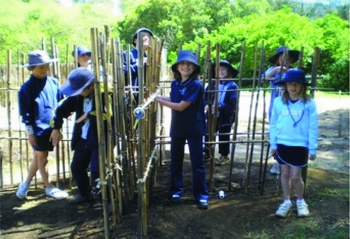
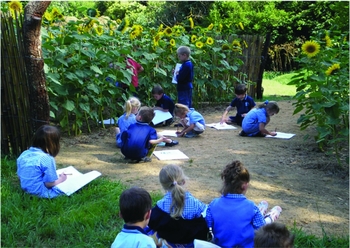
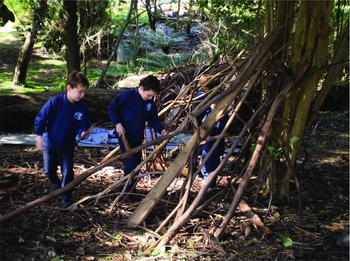
As discussed, the following analysis employs the lens of a new materialities framework (Hultman & Lenz Taguchi, Reference Hultman and Lenz Taguchi2010) to examine the human–non-human interactions that constitute learning in three gardening contexts. We do this by using three photos — referred to here as bamboo garden trellis (Figure 1), sunflower maze (Figure 2) and cubby building (Figure 3).
Children and the bamboo garden trellis.

Intra-actions with a sunflower maze.

Cubby building.

In Figure 1 a group of eight 10- to 11-year-old boys and girls stand beside a bamboo trellis that has been constructed as part of a gardening lesson. The box-like construction has a combination of horizontal and vertical poles (laterals) that have been lashed together with twine to form a three dimensional freestanding structure. In the early part of the lesson, the teacher showed students how to join the pieces of bamboo together with a technique known as ‘frapping’, where twine is lashed across, around and under two pieces of bamboo to join them together. Throughout the lesson this process was repeated multiple times, allowing new pieces of bamboo to be gradually added to the greater structure.
I remember making the trellis to grow the beans . . . there was three of us [in one section of the trellis], me and two other friends, and we all got our bamboo sticks and we put them on the ground, on top of each other, and then tied them together and turned it into the right shape . . . well, we needed a bit of help because it was a bit hard, and then we put it up . . . we needed to get another three people to put it up. (Grade 4 student)
An ‘anthropocentric gaze’ (Hultman & Lenz Taguchi, Reference Hultman and Lenz Taguchi2010) of the photo would focus on what the children have built. In shifting the focus to an intra-active encounter, bamboo and children together create the new structure: through mutual engagement learning is afforded by the pieces of bamboo. In working with the individual pieces of bamboo, students are able to construct a robust trellis that will eventually support crops of summer vegetables such as climbing beans, snow peas and cucumbers, which rely on physical structures to support their upward growth and downward hanging fruit. The bamboo canes were less pliant than anticipated. More children had to be called in to help with the trellis making. Bamboo seen as vibrant matter is more than just a dead material. Children and bamboo come together for an intense moment in time where individual learning is superseded by the coming together of forces and forms. Many hands are needed to hold the canes together, twine enables the frapping, canes bend here and there, resist and support. Children and bamboo are immersed in a lively encounter that does not end when the structure is completed. Over time, bean and tomato shoots appear out of the soil, and begin sending tendrils up the bamboo structure. What was a bare and stark structure becomes a lively, green tent-like dome that invites children, insects and adults to engage with it. If considered as intra-active encounters, the beans and tomatoes that inhabit the structure, the insects that pollinate the plants and the soil that nourishes the plants are all intra-active partners in children's learning.
In the next image a group of young children sit on the ground; some sit together on the grass and others sit away from the group on the sawdust pathway looking towards the lush and colorful sunflower forest. The students are drawing, measuring and graphing the bright yellow and green plants. Some are looking up to the forest and returning to their books. In the middle of the photo, a boy holds his workbook and looks on as his friend disappears into the sunflower maze.
Well it's really fun to just like, to run around. Heaps of kids like mazes. There are not many mazes around and to have one in your school is like pretty cool. I think kids like being covered [by the sunflowers] and seeing those beautiful sunflowers. (Grade 5 student)
When they [seeds] were all starting to fall out, we got to get a flower and we took all the seeds out of it, and we also got to take one sunflower head home, so we could have seeds at home as well. We mixed them up with a whole lot of other seeds and we used them for like, birdseed. (Grade 4 student)
Children in this image were enchanted by the maze: they were open to it, welcoming of it, they observed and drew it, and they created their own ways of playing with it — or is the maze playing with them (Rautio, Reference Rautio2013b)? The students embody the maze through their immersion in its materiality — they run through it, hide and get lost in its foliage. They collect, eat and swap the seeds. There is mutual engagement between the children and the maze: each affects the other, the children assist in the distribution of seeds and thus enable a proliferation of sunflower life, and the maze generates a heightened sense of beauty and appreciation for the children. These intra-actions reflect children's ‘aesthetic-affective openness towards material surroundings’ that includes ‘an attentiveness to and sensuous enchantment by non-human forces, an openness to be surprised and to grant agency to non-human entities’ (Rautio, Reference Rautio2013b, p. 395).
In the third and final photo, a group of boys move around a forested area adjacent to a nearby food garden. In this image, the boys are collecting long wooden branches and broken shrubbery to build a cubby around the base of a large tree. The photo highlights the gradual construction of the cubby that has taken place as the boys add individual pieces of wood on top of one another to create a tipi-like canopy. One of the boys is hiding underneath the almost completed cover.
This [cubby] is a special place. Sometimes we have hide and seek. We run around in the bushes and we do a lot of dodging things. (Grade 3 student)
Previous to the children's interaction with the pieces of wood, the branches lay motionless on the ground as elements of a natural forest floor ecosystem. In this lifeless form, the branches might be home to unnoticed life forms such as frogs, spiders or birds, and left undisturbed may eventually decompose to become part of the forest's organic litter. Once gathered and taken to the cubby-building site by the children, however, the branches take on another life form and vibrancy that assists in the creation of the new construction. When architecturally manoeuvred and joined together by the children, the branches and pieces of wood create a hidden cubby that affords a sense of privacy and retreat for the children who built it. In working with the materiality of the forest, the wood and children work together to generate a new structure where children can exist and look out towards the world. Viewed through the lens of a new materialism, the photo reveals ‘a wealth of [human and non-human] agential entities’ (Rautio, Reference Rautio2013b, p. 397) that merge together in a new exchange. The intra-actions provide meaningful connections that are constituted by the cubby, the surrounding trees, the insects and bacteria, leaves and twigs lie hidden within the forest and the leafy carpet of forest mulch that children move through in search of materials.
Despite the potential of the photo to be perceived as irrelevant to a food garden, we understand the cubby-building activity as closely associated with children's garden learning, as it was captured during unstructured play at the end of a gardening lesson. What becomes important here is that an earlier analysis of the photo would have emphasised the children's creative and resourceful capacity to build the cubby. While these are critical dimensions of children's social and ecological competence, a retrospective post-humanist frame of reference emphasises how children and non-human entities create the conditions for each other's existence (Rautio, Reference Rautio2013a). In this sense, we shift our gaze to the emergence of the co-existence and interactions between children and their non-human world.
Forces and Forms in a Food Garden
Collectively, the photos highlight the forces at play in a gardening environment. We understand these gardening forces as a critical but often overlooked element of garden pedagogy that enliven children's capacity to make and inhabit gardens. We are beginning to sense how these forces and forms speak to the agential capacity of non-material entities, their vibrant matter (Bennett, Reference Bennett2010), and their capacity to inform and shape children's garden learning. This is a first attempt at bringing intra-activity in food garden pedagogy into focus, and we suggest that there is enormous scope for conceptual and empirical research to explore and theorise children's intra-active learning in food gardens. The ‘intra-activity’ of the three gardening contexts begins to illustrate the effect of non-human entities on children in food garden settings, depicting what Jane Bennett describes as ‘the nonhumanity that flows around but also through humans’ (Bennett, Reference Bennett2004, p. 349). In response to Barad's (Reference Barad2007) contention that ‘agency is not something a body (human or non-human) or an entity has, but that it is a relationship brought about by “intra-action”’ (as cited in Rautio, Reference Rautio2013b, p. 397), the analysis of the images bring to light the relational and intimate coming together of children and non-human forces in everyday local worlds.
School gardens are often perceived exclusively as places where children grow food. While this is true to a large extent, each of the garden-related images signifies the autonomy that is afforded to children who are able to make decisions about where and how to intra-act in the garden (beyond just growing food). In the selected images, the children initiate the cubby building idea; students determine their own interpretation of how to design and build a trellis, and through their own initiative, invent new and unexpected interactions with the sunflower maze. Left to their own devices, children are experts in engaging with the non-human entities of everyday places in unpredictable and improvised ways. However, the images also reveal the capacity of non-human entities to reciprocate and intra-act with children through their own sense of agency, availing themselves of whatever exchange may happen. Seen through the lens of a new materialism, children and their material surroundings are equal — each informing, shaping and changing the other. These garden exchanges exemplify some of the ways children make sense of the world and how they become interwoven into and through that world.
Conclusion
In this article we have attempted to begin to examine the intra-actions that occur as part of children's learning in a school garden. By applying a new materialism framework to examine the garden practices from a set of three images, we identified the dynamic intra-activities that are in play in the reciprocal engagement between children and the non-human world. In shifting the focus from human individuals, or in this instance children, as the exclusive constituents of a food garden, we have interrogated the agentic capacity of the non-human forces and material surrounding that constitute a garden, which play an important part in the kind of beings children will become as a consequence of these gardening encounters. In this sense, it is the material world of plants, rocks and stone, soil, animals, and weather that are emphasised in children's everyday embodied encounters in a garden (Rautio, Reference Rautio2013b).
Children's complex meetings with the life forces of a food garden, whether adult-directed or student initiated, are an overlooked dimension of garden pedagogy and broader garden discourse. Unlike traditional learning settings that are often controlled by adult agendas, children's garden interactions with the human and non-human world are largely uncontrolled, unexpected and unknown because they tend to happen outside of the pedagogical gaze. This insight raises important questions for intra-active garden pedagogies, if such pedagogies are based on mindful respect for children's autonomy. Children and gardens are part of a process of mutual intra-active becoming that potentially opens spaces for ‘agency’ as transformation, for children and gardens.
In privileging the agency of non-human materiality rather than merely focusing on children's agency, we contend that garden learning is enabled through planned and spontaneous interactions and partnerships with non-human materialities. Children's intra-action with the non-human entities of a garden is a vital dimension of gardening practice. The agential powers of garden surroundings have great capacity to mobilise and inform children's inhabitation of food gardens, and have a direct bearing on how they care for, understand and inhabit a food garden. There is scope for exploration of the diverse relationships between humans and the world, with emphasis on complex entanglements between human and other-than-human.
Given that these dimensions of garden discourse remain relatively unexamined, this article serves as a contribution to how we might interpret gardening processes that value the part non-human materiality plays within garden settings. The findings in this article are significant in that they expand current garden pedagogy. We suggest that the post-humanist frame of reference opens up new understandings of the taken-for-granted and often overlooked dimensions of children's gardening. The interest in school food gardens, which are increasingly considered as an important site for fostering children's relationship with food (Green, Reference Green2011; Salsedo, Reference Salsedo2007), is, as pointed out earlier, often driven by adult agendas. Refocusing attention on children's relationship with all that lives, and makes, the garden, has the potential to create spaces for intra-active encounters where children and more-than-human others define what is important. This enables new learning to emerge, which fosters much more than ‘just’ learning about food production. There is potential for extensive learning how to live together in more sustainable ways, including living together with more-than-human others. Growing food, sharing food, protecting food and enjoying food all become aspects of such learning which is essentially learning the ethics of sustainable living in shared spaces.
While we advocate for multiple outcomes associated with children's garden learning, in applying a new materialism framework to the photographic data, new insights into the part non-human materialities play in expanding children's garden learning emerge. It is these overlooked intra-actions which inform, shape and deepen children's connection to food and to food production. What we do not know is if children view their own learning as an intra-active partnership. What kinds of new pedagogies become possible for garden learning if the focus is shifted from individual learners to intra-active learning? We look forward to continuing this line of research in our attempt to create new spaces for children's learning in food gardens and food garden surroundings.
Acknowledgments
All photos supplied by one of the (anonymous) gardening teachers who granted the authors permission for publication.
Author Biographies
Dr Monica Green lectures in the School of Education at Federation University, Australia. Her teaching and research interests are focused in the area of place-based education for sustainability in primary schools. She has conducted extensive research in Victorian schools investigating sustainability curriculum frameworks and pedagogies with a focus on the contribution of everyday sites such as school ground contexts and school food gardens.
Dr Iris Duhn lectures in the Faculty of Education, at Monash University, Australia. Her teaching and research focuses on critical childhood studies, with a particular focus on education for sustainability. Her publications and research projects contribute a critical childhood studies’ perspective to early childhood education in Australia and internationally.