Introduction
Herbicide efficacy can be influenced by numerous factors. Previous research has identified a time-of-day (TOD) effect on weed control efficacy with many POST applied herbicides. Extensive research has evaluated the TOD effect with glyphosate (Martinson et al. Reference Martinson, Koukkari, Durgan and Gunsolus2002; Miller et al. Reference Miller, Martinson, Sothern, Durgan and Gunsolus2003; Mohr et al. Reference Mohr, Sellers and Smeda2007; Norsworthy et al. Reference Norsworthy, Oliver and Purcell1999; Sellers et al. Reference Sellers, Smeda and Johnson2003; Waltz et al. Reference Waltz, Martin, Roeth and Lindquist2004), acifluorfen (Lee and Oliver Reference Lee and Oliver1982), atrazine (Stewart et al. Reference Stewart, Nurse and Sikkema2009), bentazon (Andersen and Koukkari Reference Andersen and Koukkari1978; Doran and Andersen Reference Doran and Andersen1976), bromoxynil (Stewart et al. Reference Stewart, Nurse and Sikkema2009), chlorimuron ethyl (Miller et al. Reference Miller, Martinson, Sothern, Durgan and Gunsolus2003; Stopps et al. Reference Stopps, Nurse and Sikkema2013), dicamba/diflufenzopyr (Stewart et al. Reference Stewart, Nurse and Sikkema2009), fluazifop-P-butyl (Friesen and Wall Reference Friesen and Wall1991), flumiclorac, fluthiacet-methyl (Fausey and Renner Reference Fausey and Renner2001), fomesafen (Miller et al. Reference Miller, Martinson, Sothern, Durgan and Gunsolus2003), glufosinate (Martinson et al. Reference Martinson, Koukkari, Durgan and Gunsolus2002; Miller et al. Reference Miller, Martinson, Sothern, Durgan and Gunsolus2003; Stewart et al. Reference Stewart, Nurse and Sikkema2009), imazethapyr (Stopps et al. Reference Stopps, Nurse and Sikkema2013), linuron (Kraatz and Andersen Reference Kraatz and Andersen1980), nicosulfuron (Stewart et al. Reference Stewart, Nurse and Sikkema2009), paraquat (Norsworthy et al. Reference Norsworthy, Oliver and Purcell1999), quizalofop-P-ethyl (Stopps et al. Reference Stopps, Nurse and Sikkema2013), and saflufenacil (Budd et al. Reference Budd, Soltani, Robinson, Hooker, Miller and Sikkema2017). Generally, for the weed species and herbicides evaluated, the best weed control is achieved following midday applications, with reduced control following an early-morning or late-night application.
There are currently no known studies that have examined possible TOD effects on weed control efficacy of the Group 27, or HPPD-inhibiting herbicides. Tolpyralate is a relatively new HPPD-inhibiting herbicide that belongs to the benzoylpyrazole family. Tolpyralate decreases carotenoid synthesis in the plant, resulting in subsequent bleaching, necrosis, and eventual plant death. Photosystem II (PSII)–inhibiting herbicides are commonly tank-mixed with HPPD-inhibiting herbicides to improve weed control efficacy. Atrazine applied with tolpyralate increases the spectrum of weeds controlled and increases the speed of activity (Anonymous 2019; Metzger et al. Reference Metzger, Soltani, Raeder, Hooker, Robinson and Sikkema2018a). Although no known studies have evaluated the influence of TOD on tolpyralate + atrazine efficacy, some studies have evaluated the effect of TOD on the efficacy of the PSII-inhibiting herbicides, such as atrazine, bromoxynil (Stewart et al. Reference Stewart, Nurse and Sikkema2009), and bentazon (Andersen and Koukkari Reference Andersen and Koukkari1978; Doran and Andersen Reference Doran and Andersen1976). Similar to the aforementioned studies, applying PSII-inhibiting herbicides in early morning or late night resulted in reduced control compared to a midday application (Doran and Andersen Reference Doran and Andersen1976; Stewart et al. Reference Stewart, Nurse and Sikkema2009).
Across the TOD studies with the various herbicides, no known single factor explains the variability in weed control efficacy due to TOD. Throughout the day, fluctuations in air temperature, relative humidity (RH), and light intensity may cause physiological changes in weed species that contribute to the TOD response (Stewart et al. Reference Stewart, Nurse and Sikkema2009). High temperature and RH have been reported to increase plasma membrane and cuticular wax fluidity and stomatal openings, allowing for greater herbicide absorption and translocation in the plant (Anderson et al. Reference Anderson, Swanton, Hall and Mersey1993; Hess and Falk Reference Hess and Falk1990; Johnson and Young Reference Johnson and Young2002; Pallas Reference Pallas1960; Prasad et al. Reference Prasad, Foy and Crafts1967). The influence of RH was greater than temperature for glufosinate efficacy in research conducted by Andersen et al. (Reference Anderson, Swanton, Hall and Mersey1993) and Coetzer et al. (Reference Coetzer, Al-Khatib and Loughin2001) on Amaranthus spp. and green foxtail. Andersen and Koukkari (Reference Andersen and Koukkari1978) found that light intensity altered sicklepod leaf orientation; under reduced light intensities, sicklepod leaflets took on a vertical position, reducing the leaf area for herbicide interception. The presence of dew may also be a contributing factor. Doran and Andersen (Reference Doran and Andersen1976) suggested that heavy dew early in the morning may reduce herbicide efficacy as a result of increased herbicide runoff and/or dilution; however, Stewart et al. (Reference Stewart, Nurse and Sikkema2009) reported that the presence of dew did not contribute to the TOD response. Aside from environmental factors, herbicide mode of action has been found to play a role in TOD effects (Miller et al. Reference Miller, Martinson, Sothern, Durgan and Gunsolus2003). It is evident from the literature that numerous factors contribute to the TOD response.
Weed control efficacy as influenced by TOD may be specific to weed species. Stewart et al. (Reference Stewart, Nurse and Sikkema2009) evaluated various herbicides and reported that the weed most sensitive to TOD was velvetleaf, followed by common ragweed, lambsquarters, and redroot pigweed. Annual grasses such as green foxtail and barnyardgrass were less sensitive to herbicide application timing during the day, although in some environments weed control was reduced from an application at 06:00 h or after 21:00 h. Diurnal leaf movements may also influence TOD response; for some weed species, such as velvetleaf, hemp sesbania, and sicklepod, leaves were horizontal at noon, allowing for greater spray interception and retention (Doran and Andersen Reference Doran and Andersen1976; Kraatz and Andersen Reference Kraatz and Andersen1980; Norsworthy et al. Reference Norsworthy, Oliver and Purcell1999; Sellers et al. Reference Sellers, Smeda and Johnson2003). Doran and Andersen (Reference Doran and Andersen1976) reported that velvetleaf control decreased when bentazon was applied early in the morning or late at night when leaves were drooping. Applying at times when leaves have the greatest “projected leaf area” (i.e., area seen from directly above), often observed at midday, allow for greater interception and retention of foliar herbicides (Kraatz and Andersen Reference Kraatz and Andersen1980). Thorough spray coverage is important for optimal weed control, as with glufosinate, where greatest control is observed with a midday application (Stewart et al. Reference Stewart, Nurse and Sikkema2009). Depending on weed species, leaf changes in orientation throughout the day can have an impact on level of control achieved.
TOD studies provide information that can be used to optimize herbicides efficacy; however, there is a lack of research for HPPD-inhibiting or Group 27 herbicides. Defining the TOD that optimizes weed control efficacy with tolpyralate + atrazine application may reduce potential yield loss due to weed interference. Therefore, the objective of this research was to determine if there is a TOD effect on the weed control efficacy of annual grass and broadleaf weeds with tolpyralate + atrazine.
Materials and Methods
Experimental Methods
This study consisted of six TOD trials conducted over a 2-yr period (2018, 2019) at the University of Guelph, Ridgetown Campus (42.445oN, 81.879oW), Ridgetown, ON, Canada. Trials in the same year of study (T1 to T3 in 2018 and T4 to T6 in 2019) were located in different areas of the research station and sprayed on different dates. Sites were conventionally tilled and managed under a corn–soybean [Glycine max (L.) Merr.]–winter wheat (Triticum aestivum L.) rotation. All sites were moldboard plowed in the fall followed by two passes with an S-tine cultivator with rolling-basket harrows in the spring to prepare the seed bed. Fertilizer was applied according to crop nutrient requirements and soil test results.
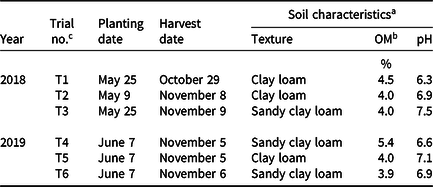
The corn hybrid used in 2018 was DKC53-56 (Bayer Crop Science, St. Louis, MO), and in 2019 the hybrids were DKC45-65 and DKC53-56 (Bayer Crop Science, St. Louis, MO). Corn was seeded at approximately 83,500 seeds ha–1 to a depth of 4 cm in rows spaced 75 cm apart. Trials were established as a randomized complete block design with four replications, except for one site-year in 2018 that had three replicates. Each plot was 3 m wide (four corn rows) and 8 m long. Tolpyralate + atrazine (30 + 560 g ai ha–1) tank-mixed with methylated seed oil concentrate (MSO Concentrate ®; Loveland Products Inc., Loveland CO) (0.5% v/v) and urea ammonia nitrate (2.5% v/v) were applied at 3-h intervals starting at 06:00 h through 24:00 h of the same day at each site. Weedy and weed-free controls were included in each replicate. The weed-free control received a PRE application of S-metolachlor/atrazine (2,880 g ai ha–1) + mesotrione (140 g ai ha–1) and a POST application of glyphosate (900 g ai ha–1); weed escapes were controlled with hand hoeing. Table 1 lists locations, seeding dates, harvest dates, and soil characteristics.
Planting dates, harvest dates, and soil characteristics for six field trials conducted at Ridgetown, ON, in 2018 and 2019.

a Average within trial site.
b Abbreviation: OM, organic matter.
c T1 to T6 represent trials conducted at Ridgetown.
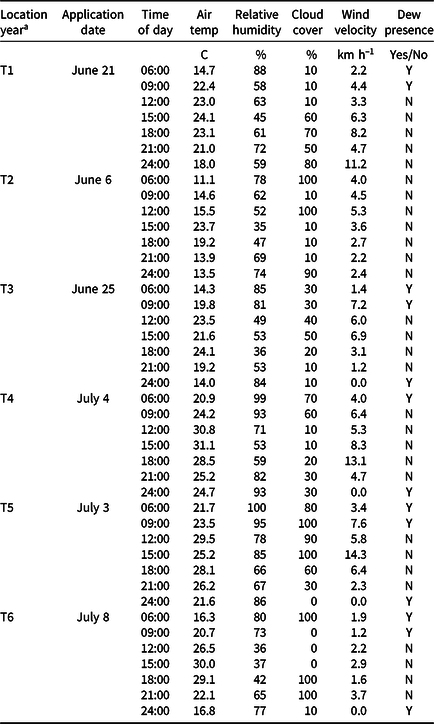
Herbicides were applied with a CO2-pressurized backpack sprayer equipped with a handheld 1.5-m spray boom, with four ULD120-02 (Pentair, New Brighton, MN) nozzles spaced 50 cm apart that produced a spray width of 2.0 m. The sprayer was calibrated to deliver 200 L ha–1 of spray solution at 240 kPa. All applications were made when the average weed height and/or diameter in the study area were 10 cm. Weather data was collected at each application time using an anemometer (Table 2).
Weather data at the time of application of tolpyralate + atrazine applications in corn at Ridgetown, ON, in 2018 and 2019.

a T1 to T3, location year 2018 for time of day of tolpyralate + atrazine applications; T4 to T6, location year 2019 (see Table 1).
Evaluation of visible crop injury and weed control occurred at 1, 2, and 4 WAA and 2, 4, and 8 WAA, respectively. These parameters were evaluated on a percentage scale, and every weed species in each plot received a rating between 0 and 100%, where 0 represents no injury or weed control and 100% represents complete death of the corn or weed species. Grain corn yield was measured at crop maturity by harvesting the center two corn rows in each plot with a small-plot combine. Grain moisture contents and weight were recorded; grain yield was corrected to 15.5% grain moisture prior to analysis and is presented as 1,000 kg ha-1.
Statistical Analysis
Data were analyzed with variance analysis using PROC GLIMMIX in SAS v 9.4 (SAS Institute, Cary, NC). Data were pooled across years and location for a total of six environments. Variances were partitioned into the fixed effect of TOD and random effects of environment (composed of site-years), environment nested within replication, and environment by time. Assumptions of variance analysis (random, homogeneous, normally distributed) were tested using residual plots and the Shapiro-Wilk normality test. Residuals of weed control and yield data were normally distributed; the weed-free and weedy control were excluded from analyses. Regression parameters were generated using ANOVA by partitioning the TOD least square means into linear and quadratic parameters. Using F-tests, linear and quadratic coefficients were compared, and when significant at α = 0.05, they were included in the regression equation.
Results and Discussion
The air temperature, RH, cloud cover, wind velocity, and dew presence varied across site-years (Table 2). According to the tolpyralate label, optimal herbicide efficacy is obtained, with applications made during warm, moist conditions (21 C) with adequate soil moisture prior to and after application (Anonymous 2019). Similar to Stewart et al. (Reference Stewart, Nurse and Sikkema2009), wind speed and air temperature was generally greatest between 12:00- and 18:00-h timings, whereas relative humidity and dew presence were the highest at 06:00- and 24:00-h timings.
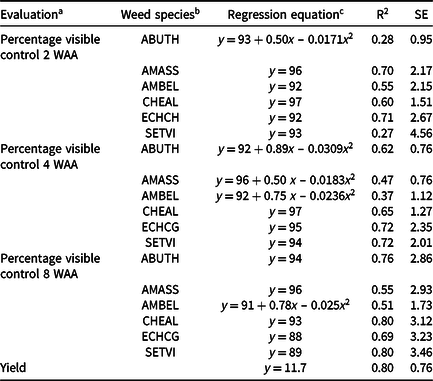
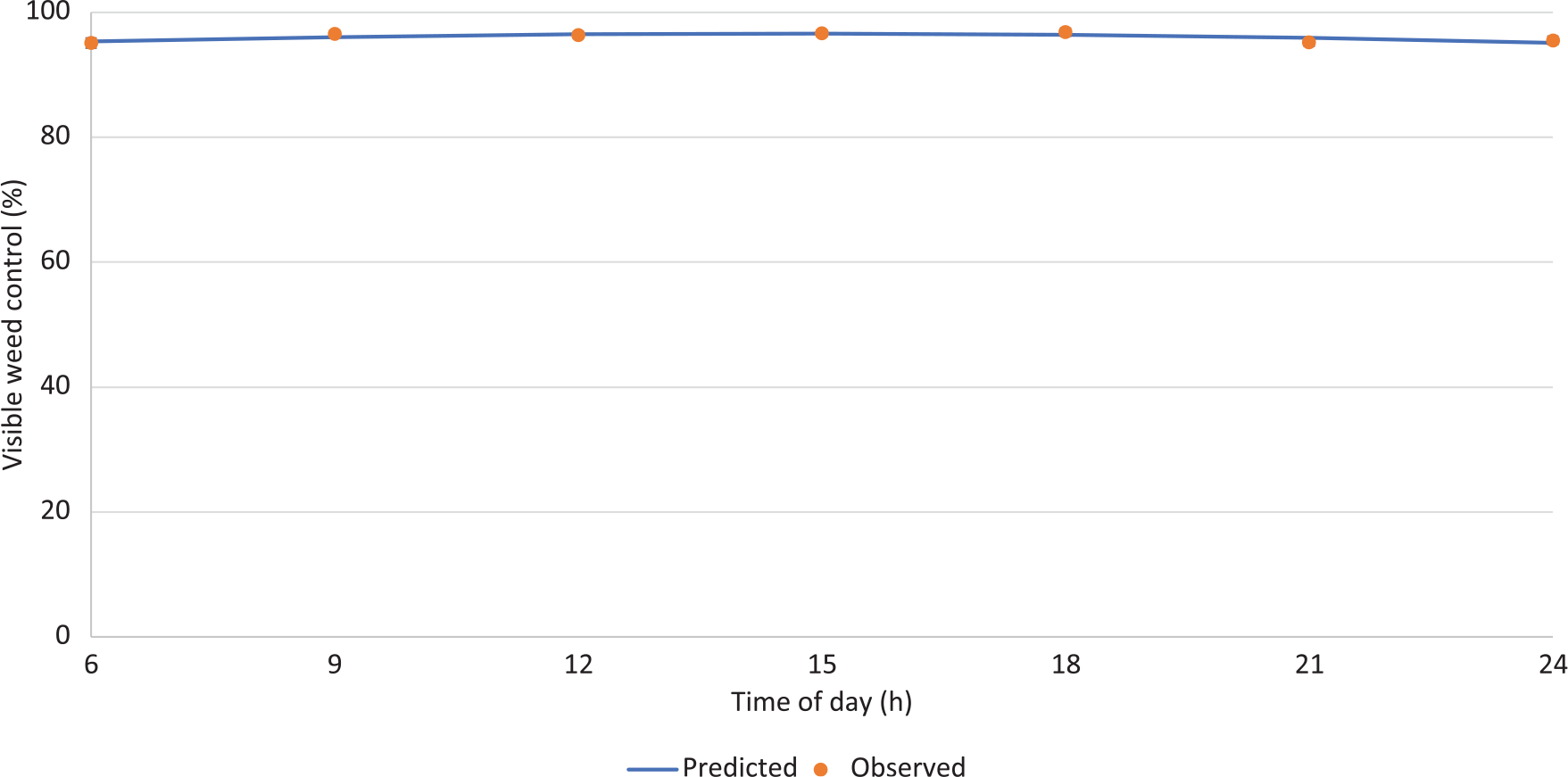
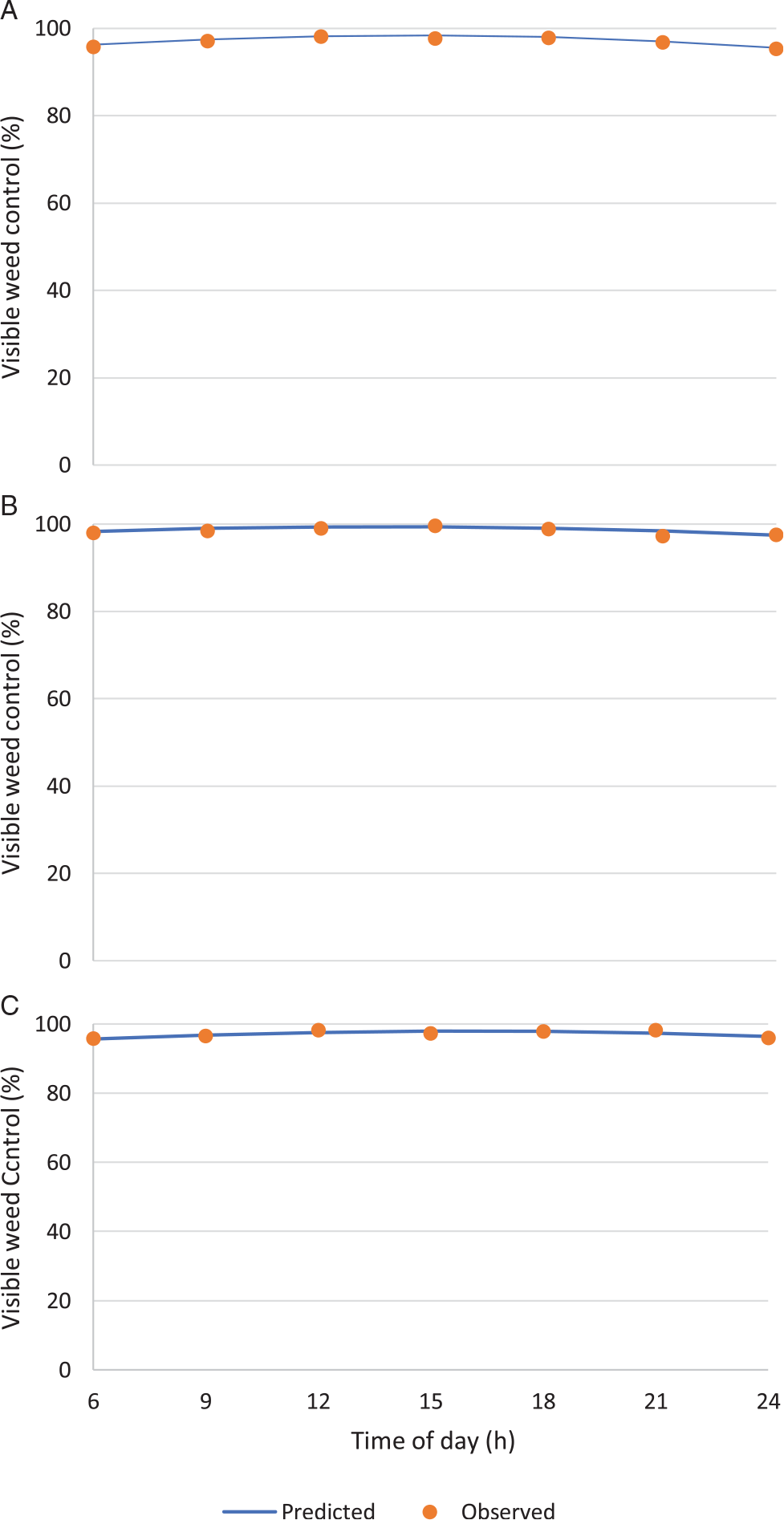
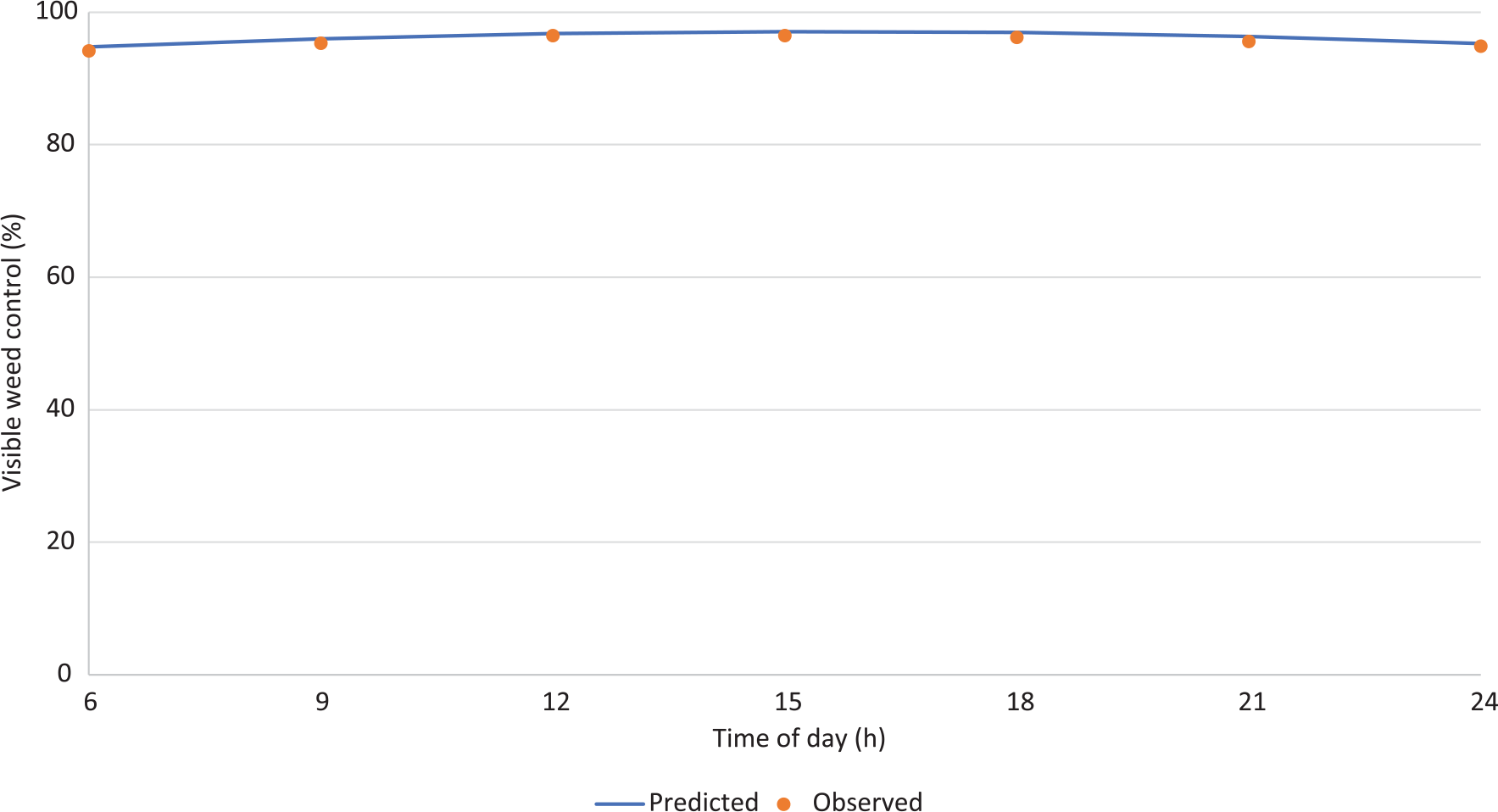
TOD followed a quadratic response for some weed species; however, TOD was highly likely to be not biologically significant (Table 3). The magnitude of change in control across all timings was ≤2%. Regression equation parameters for visible velvetleaf, pigweed species, common ragweed, lambsquarters, barnyardgrass, and green foxtail control provided by tolpyralate + atrazine between 06:00 h and 24:00 h at 2, 4 and 8 WAA are presented in Table 3. All weed species were controlled 92% to 97%, 93% to 99%, and 88% to 96% at 2, 4, and 8 WAA, respectively (Figures 1, 2 and 3).
Percent weed control and grain corn yield response to tolpyralate + atrazine applied at different times throughout the day across six trials at Ridgetown, ON, in 2018 and 2019.

a Abbreviation: WAA, wk after application.
b Weed species abbreviations: ABUTH, velvetleaf; AMASS, pigweed; AMBEL, common ragweed; CHEAL, lambsquarters; ECHCG, barnyardgrass; SETVI, green foxtail.
c Linear and quadratic equations were only included when significant at α = 0.05.
Mean percentage weed control 2 wk after application in response to tolpyralate + atrazine applied at different times throughout the day for velvetleaf at Ridgetown, ON, in 2018 and 2019.

Mean percentage weed control 4 wk after application in response to tolpyralate + atrazine applied at different times throughout the day for (A) velvetleaf, (B) pigweed, (C) common ragweed at Ridgetown, ON, in 2018 and 2019.

Mean percentage weed control 8 wk after application in response to tolpyralate + atrazine applied at different times throughout the day for common ragweed at Ridgetown, ON, in 2018 and 2019.

The control achieved in this study with tolpyralate + atrazine is consistent with research by Metzger et al. (Reference Metzger, Soltani, Raeder, Hooker, Robinson and Sikkema2018b), who reported similar control of these species with tolpyralate + atrazine (30 + 1,000 g ai ha–1). The species that exhibited a TOD response were velvetleaf, pigweed, and common ragweed. Research by Stewart et al. (Reference Stewart, Nurse and Sikkema2009) found that velvetleaf and common ragweed control with atrazine was influenced by TOD. In contrast to tolpyralate + atrazine, there was a much greater TOD response with atrazine; velvetleaf and common ragweed control varied up to 58% and 18%, respectively, as of result of TOD with atrazine. Similar to this study, Stewart et al. (Reference Stewart, Nurse and Sikkema2009) found no TOD effect on lambsquarters control with atrazine, but in contrast to this study they did not find a TOD effect with atrazine for the control of redroot pigweed.
Tolpyralate + atrazine provided excellent control of the weed species evaluated at all application timings. As expected, there was no influence of tolpyralate + atrazine application TOD on corn yield. Research by Stewart et al. (Reference Stewart, Nurse and Sikkema2009) rarely found an effect of TOD of herbicide application on corn yield due to weed interference. Stewart et al. (Reference Stewart, Nurse and Sikkema2009) suggest that applying herbicides at times they are most efficacious could result in increased yield and profit, but only if weed control efficacy was affected by TOD.
This research was conducted to explore if there was a TOD effect on the control of common annual grass and broadleaf weeds with tolpyralate + atrazine. Prior to this research, no studies were found in the literature on the effect of TOD with any Group 27 herbicide. TOD effects are often specific to herbicide and weed species. Extensive research has been completed on the effect of TOD on weed control efficacy with glufosinate; generally, a midday application resulted in greater weed control compared to an early-morning or late-night application (Martinson et al. Reference Martinson, Koukkari, Durgan and Gunsolus2002, Reference Martinson, Durgan, Gunsolus and Sothern2005; Stewart et al. Reference Stewart, Nurse and Sikkema2009). A similar trend to improved weed control efficacy with other herbicides was reported by Stewart et al. (Reference Stewart, Nurse and Sikkema2009); however, in that research glyphosate did not show a TOD response. Tolpyralate is a systemic herbicide, like glyphosate, that can translocate throughout the plant to the site of action. Similar to results with tolpyralate + atrazine, at label rates glyphosate provided excellent control of all weed species regardless of TOD of application. In contrast, results from research by Martinson et al. (Reference Martinson, Koukkari, Durgan and Gunsolus2002, Reference Martinson, Durgan, Gunsolus and Sothern2005) report a similar TOD effect with glufosinate and glyphosate; however, in that study a low rate of glyphosate was used, which may have contributed to the TOD effect.
Knowing that an herbicide has a TOD effect can be just as important as knowing that there is no TOD effect. Tolpyralate provided consistent control of all species regardless of TOD. Stewart et al. (Reference Stewart, Nurse and Sikkema2009) suggested that applying herbicides between 12:00 and 15:00 h could result in improved corn yields and profit, because of reduced weed interference with a TOD effect. Similarly, Martinson et al. (Reference Martinson, Durgan, Gunsolus and Sothern2005) reported that it is most economical to apply glufosinate and glyphosate at midday. The results from this study show that tolpyralate + atrazine applied from 06:00 to 24:00 h provided consistent season-long control of velvetleaf, pigweed species, common ragweed, lambsquarters, barnyardgrass, and green foxtail. The lack of TOD response suggests that air temperature, RH, cloud cover, wind velocity, and presence and/or absence of dew had little impact on weed control efficacy with tolpyralate + atrazine. Previous research has found one or more of the aforementioned environmental factors to influence a TOD response with herbicides like bentazon (Doran and Andersen Reference Doran and Andersen1976), mesotrione (Johnson and Young Reference Johnson and Young2002), atrazine, bromoxynil, glufosinate, and nicosulfuron (Stewart et al. Reference Stewart, Nurse and Sikkema2009).
In conclusion, no TOD response was observed for any species except velvetleaf at 2 WAA, velvetleaf, pigweed, and common ragweed at 4 WAA, and common ragweed at 8 WAA, that were fit to a quadratic curve; however, the response was ≤3%. Results of this study show that regardless of TOD of application, tolpyralate + atrazine consistently provide >88% control of several common annual grass and broadleaf weeds in corn.
Acknowledgments
Funding for this project was provided by ISK Biosciences Inc. No other conflicts of interest have been declared.