INTRODUCTION
The purpose of this article is to describe the development of a scale that will allow us to understand the level of confidence that family members have for participating in health care decisions for terminally ill loved ones. We first identified a need for such a scale when our study of terminally ill patient decision making revealed that a high percentage of patients preferred shared decision making with family. The challenge, however, is that family and other surrogate decision makers are often unprepared for end-of-life decision making and many report high levels of distress from this role (Teno et al., Reference Teno, Lynn and Wenger1997; Tilden et al., Reference Tilden, Tolle and Nelson2001; Sulmasy et al., Reference Sulmasy, Sood and Texeira2006). There is a dearth of measures to assess advance care planning (Mularski et al., Reference Mularski, Dy and Shurarman2007), and, although there are instruments to measure how confident family members are in their caregiving roles (Steffen et al., Reference Steffen, McKibbin and Zeiss2002), we found no instruments that measured family members' confidence in their ability to take part in health care decision making with or for a terminally ill loved one. In this article we describe the development and validation of the Family Decision-Making Self-Efficacy Scale. The scale has two scenarios that reflect how family participation actually occurs. The first covers decisions when the patient retains the capacity to participate, and the second covers decisions made on the supposition that the patient lacks decisional capacity. For simplicity, we refer to these as the conscious and unconscious scenarios within the scale.
Background
Our study of the natural history of end-of-life decision making in 130 patients with end-stage cancer, heart failure, or amyotrophic lateral sclerosis (ALS) examined how patients preferred to involve their family and physician in health care decision making. When considering family involvement, 44% preferred to share decision making equally with a family member. When considering both family and physician involvement given a hypothetical situation in which they would not have decisional capacity, 33% of patients preferred that their family's input be given greater weight than their physician's input (Nolan et al., Reference Nolan, Hughes and Narendra2005). When we followed patients for 6 months, these preferences did not change significantly (Sulmasy et al., Reference Sulmasy, Hughes and Thompson2007). This stability of patients' preferences for family involvement is good news for the timing of advance care planning. Health professionals can begin these discussions soon after the patient has been identified as having a terminal illness. Having a method to measure the family members' confidence in their ability to participate in decision making at the level desired by the patient could greatly enhance advance care planning.
Defining the Construct of Family Decision-Making Self-Efficacy
As part of the natural history of end-of-life decision making study described above, we interviewed a subgroup of 16 family members after the death of their loved one. We found that only 50% of patients who preferred shared family decision making actually experienced this at the end of life (Nolan et al., Reference Nolan, Kub and Hughes2008). Using in-depth qualitative interviews with the family members, we used a directed content analysis approach in which open-ended questions regarding the phenomena of interest are used to start the interview followed by more structured questions using existing theory (Hsieh & Shannon, Reference Hsieh and Shannon2005). In this case, we started with broad questions about the types of health care decisions made near the death of the patient and how they were made. Following this, we asked more structured questions based on Bandura's (Reference Bandura1997) Self-Efficacy Theory. This theory states that self-efficacy or confidence that one can perform a behavior is influenced by three main factors: previous performance of the desired behavior, vicarious experience of observing others perform the behavior, and positive feedback that one can successfully perform the behavior. In the structured phase of the interview, we asked family members whether they had any previous experience in health care decision making with or for a loved one near the time of death, whether they had observed another person make these types of decisions, or whether they had received positive feedback from anyone regarding their ability to participate in these types of decisions. We also asked whether there were other things that made their participation in these decisions easier or more difficult. We analyzed family member responses and identified six main themes: being a surrogate, choosing treatments, accepting palliative care, meeting spiritual needs, maintaining family harmony, and communicating with health professionals (Nolan et al., Reference Nolan, Kub and Hughes2008).
METHODS
Content Validity
From the six themes of family decision making self-efficacy, we developed 23 items with a 5-point Likert Scale ranging from 1 (“completely disagree”) to 5 (“completely agree”) for the first version of the Family Decision-Making Self-Efficacy Scale. We then provided a copy of these items to a multidisciplinary panel of end-of-life decision-making researchers including a doctorally prepared nurse, a psychiatrist, and an internal medicine specialist. We asked panel members whether or not each item reflected the theme of decision-making self-efficacy it was meant to represent. We also asked them to recommend wording for any item that would improve clarity, brevity, grammar, or other aspects of the tool. Finally, we asked panel members whether, collectively, all of the items provided a representative sample of the domain of items that measure family member perceived self-efficacy in decision making for a terminally ill family member. Based on panel member input, we revised several items to make them more specific.
One reviewer recommended that the scale accommodate both a single family member who would be the decision maker with or for a terminally ill loved one and the situation in which several family members would serve in this role. We addressed this concern by giving the following directions at the start of the scale, “In some families, one person makes health care decisions with a sick loved one. In other families, several family members or friends make decisions with the sick loved one. When answering the questions below, please keep in mind your particular situation.” We wanted to allow for one person to complete the scale with input from others without requiring each family member to complete his or her own scale. We also changed the anchors to “cannot do at all” to “certain I can do” to more clearly reflect the construct of self-efficacy on which the scale was grounded. The conscious scenario in the tool has the stem, “If my loved one prefers to have help in making health care decisions, I am confident that I will be able to help: …”. The unconscious scenario begins with, “If my loved one becomes too ill to make health care decisions, I am confident that I will be able to: …”.
Pilot Testing the Scale
Sample
We obtained approval from the Johns Hopkins Medicine Institutional Review Board for a pilot study of this instrument as part of a larger pilot study of a family decision-making self-efficacy intervention. This intervention study, which took place in the outpatient setting, involved a brief guided patient–family discussion of the patient's desire for involving family in health care decisions and the family member's confidence that he or she could take on this role. The discussion was tailored to address any low levels of family decision-making self-efficacy followed by recommendations for further discussion at home. Inclusion criteria for patients were having a preoperative appointment in the surgical clinic for pancreatic cancer or in the ALS Comprehensive Care Clinic, 18 or older, and able to read and write in English. These two disease groups were selected because of two different trajectories to the end of life; one is characterized by a rapid decline (pancreatic cancer) and the other by a gradual decline in health status. Inclusion criteria for family members were having a patient who met the study inclusion criteria who consented to inviting the family member to participate, 18 or older, and able to read and write in English.
Procedures
A caregiver in the clinic asked patients if they would like to hear about this study, and if the patient was interested, one of the research team members described the study and obtained written consent from interested patients and family members. In most cases, the family member accompanied the patient to the clinic. Twenty-six patients (46%) approached to participate declined, so their family member was not invited to participate. Thirty patients and family members consented to participate and were enrolled. We gave family members both the conscious and unconscious scenarios within the Family Decision-Making Self-Efficacy Scale in the clinic at baseline along with a demographic form that we developed.
We tested the interitem correlations and item to total scale correlations using the Pearson's Correlation to determine the internal reliability of the scale. We dropped items from the scale that had at least one interitem correlation less than r = .40. Then we tested item to total score correlations. Once a final version of the scale was obtained, we used the Cronbach alpha test to measure the internal reliability of each version of the family decision-making scale. We also performed a test–retest reliability on a subsample of six family members at baseline and at 4 weeks. During the pilot, we dropped one additional item that asked the extent to which the family member felt prepared to discuss the patient's funeral if the patient wanted to discuss this. This was deleted as a family member thought that this was an upsetting question. The final conscious and unconscious scale versions are in Appendixes I and II, respectively.
Known Groups Validity
According to Self-Efficacy Theory, family members with experience making decisions for an ill loved one should have greater self-efficacy for this behavior than those without this experience. In our qualitative work and the qualitative work of others, surrogate decision makers have described this type of experience as helpful in preparing them for the decision making role (Vig et al., Reference Vig, Starks and Taylor2007; Nolan et al., Reference Nolan, Kub and Hughes2008). Also, previous studies of caregiver self-efficacy have revealed that spouses have lower levels of self-efficacy compared to nonspouses (Depp et al., Reference Depp, Sorocco and Kasl-Godley2005). To test these relationships in this study, we used Student's t test for independent groups to see if there was a difference in the family decision-making self-efficacy between those with and without experience with this type of decision making and whether there were differences between spouse and nonspouse family members.
RESULTS
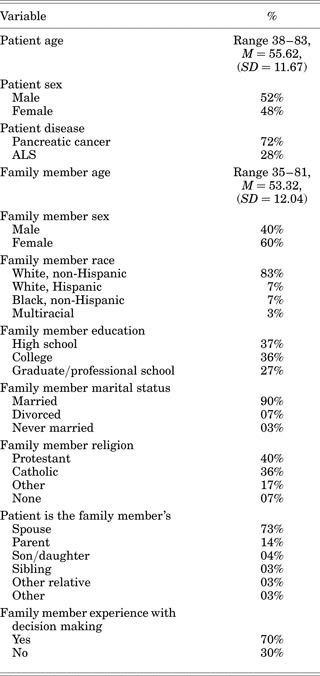
We recruited a convenience sample of 30 surrogates of patients with pancreatic cancer or ALS. Table 1 provides a summary of the patient and family characteristics.
Family and patient characteristics (N = 30)

Psychometric Properties
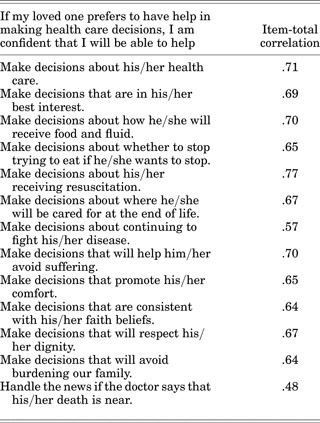
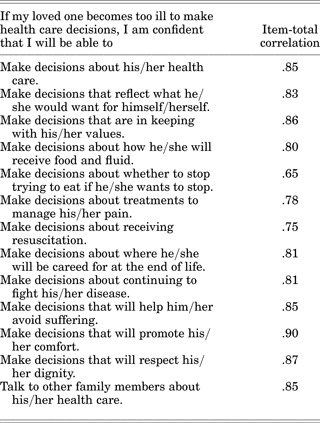
After we dropped items that had interitem correlations of less than .40, 13 items remained in the conscious version of the scale and 13 items remained in the unconscious version of the scale. They were not the same items, however. So, we identified a subscale with an overlap of 9 items common to both versions of the scale for use by investigators or clinicians who desired to compare the scores on the conscious and unconscious versions of the scale (see Appendix III). For each version of the scale, we determined an item to total scale score correlation. See Table 2 for item to total score correlations in the conscious version of the scale and Table 3 for item to total score correlations for the unconscious version of the scale.
Item to total scale score correlation: Conscious scenarioa

a All items were ranked on a 5-point scale with 1 meaning “Cannot do at all” and 5 meaning “Certain I can do.”
Item to total scale score correlation: Unconscious scenarioa

a All items were ranked on a 5-point scale with 1 meaning “Cannot do at all” and 5 meaning “Certain I can do.”
The 13 items within the conscious scenario of the scale had strong internal consistency (Cronbach's α = .91) as did the 13 items within the unconscious scenario of the scale (Cronbach's α = .95). The test–retest reliability using Pearson's Correlation was r = .96, p = .002, in the 13-point conscious scenario and r = .92, p = .009, in the 13-point unconscious scenario. For the 9-item overlap subscale, Cronbach's α was .91 for the conscious scenario and .93 in the unconscious scenario. Test–retest reliability was r = .97, p = .001, in the conscious scenario and r = .90, p = .01, in the unconscious scenario.
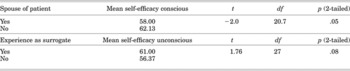
Table 4 summarizes the differences in self-efficacy by status as spouse or nonspouse or by the family member's experience or lack of experience with making decision for a terminally ill family member. Family members who had experience making decisions for an ill family member had higher levels of decision making self-efficacy (M = 61.00, SD = 5.68) compared to those without this experience (M = 56.37, SD = 7.81). This difference approached significance in the unconscious scenario (p = .08). Spouses scored lower than nonspouses (M = 58.00, SD = 6.68, vs. 62.12, SD = 4.08, respectively, p = .05).
Differences in family decision making self-efficacy by status as spouse or experience as a surrogate decision maker

DISCUSSION
The Family Decision-Making Self-Efficacy Scale is based on our previous work in patient preferences for involving family in end-of-life decision making enriched by in-depth interviews with family members after the patient's death. Based on these analyses, the Family Decision-Making Self-Efficacy tool incorporating the six themes of being a surrogate, choosing treatments, accepting palliative care, meeting spiritual needs, maintaining family harmony, and communicating with health professionals shows promise based on acceptable psychometric properties.
Both the conscious and unconscious versions of this scale have been easy for family members to complete and revealed high levels of internal consistency reliability and test–retest reliability. The scales' ability to distinguish between family members who had experience making decisions for an ill family member and those who did not warrants further testing with larger sample sizes. Also, similar to studies of caregiver self-efficacy (Depp et al., Reference Depp, Sorocco and Kasl-Godley2005), spouses had lower levels of decision-making self-efficacy than nonspouses, but again this difference only approached significance and warrants further study. Regarding caregiving self-efficacy, Depp et al. (Reference Depp, Sorocco and Kasl-Godley2005) suggested that spouses, who are often also the main caregivers of the dying patients, may be exhausted or may be more self-critical when examining their self-efficacy. The inverse correlation between family decision-making self-efficacy and caregiver burden suggests that this may be the case.
We invite other investigators to test the Family Decision Making Self-Efficacy Scale in larger and more diverse samples of family members with a loved one with a terminal illness. We believe that having a method to measure family confidence in taking on the decision-making role will be a great asset to both investigators who wish to test new interventions to promote advance care planning and to clinicians who would like a simple and efficient way to determine how confident a family member is in being able to take part in health care decision making for a terminally ill loved one.
ACKNOWLEDGMENTS
We thank Drs. Virginia Tilden, Joseph Carrese, and William Breitbart for their expert review of the Family Decision-Making Self-Efficacy Scale. We also gratefully acknowledge the financial support of the National Institute for Nursing Research at the National Institutes of Health (1 R01 NR005224-01A1), the ALS Research Center of Johns Hopkins University, and the Fan Fox and Leslie R. Samuels Foundation through a grant administrated by Partnership for Caring. Finally, we thank Ms. Christine St. Ours and Ms. Marian Grant for enrolling and interviewing patients and family members and for their expert support of this study.
APPENDIX I: FAMILY DECISION-MAKING SELF-EFFICACY SCALE: CONSCIOUS PATIENT SCENARIO
In some families, one person makes health care decisions with a sick loved one. In other families, several family members or friends make decisions with the sick loved one. When answering the questions below, please keep in mind your particular situation.
If my loved one prefers to have help in making health care decisions, I am confident that I will be able to help:
1) make decisions about his/her health care.
Cannot do at all 1 2 3 4 5 Certain I can do
2) make decisions that are in his/her best interest.
Cannot do at all 1 2 3 4 5 Certain I can do
3) make decisions about how he/she will receive food and fluid.
Cannot do at all 1 2 3 4 5 Certain I can do
4) make decisions about whether to stop trying to eat if he/she wants to stop.
Cannot do at all 1 2 3 4 5 Certain I can do
5) make decisions about his/her receiving resuscitation.
Cannot do at all 1 2 3 4 5 Certain I can do
6) make decisions about where he/she will be cared for at the end of life.
Cannot do at all 1 2 3 4 5 Certain I can do
7) make decisions about continuing to fight his/her disease.
Cannot do at all 1 2 3 4 5 Certain I can do
8) make decisions that will help him/her avoid suffering.
Cannot do at all 1 2 3 4 5 Certain I can do
9) make decisions that promote his/her comfort.
Cannot do at all 1 2 3 4 5 Certain I can do
10) make decisions that are consistent with his/her faith beliefs or ultimate concerns.
Cannot do at all 1 2 3 4 5 Certain I can do
11) make decisions that will respect his/her dignity.
Cannot do at all 1 2 3 4 5 Certain I can do
12) make decisions that will avoid burdening our family.
Cannot do at all 1 2 3 4 5 Certain I can do
13) handle the news if the doctor says that his/her death is near.
Cannot do at all 1 2 3 4 5 Certain I can do
APPENDIX II: FAMILY DECISION MAKING SELF-EFFICACY SCALE: UNCONSCIOUS PATIENT SCENARIO
In some families, one person makes health care decisions for a loved one who is too sick to make these decisions. In other families, several family members or friends make these decisions together. When answering the questions below, please keep in mind your particular situation.
If my loved one becomes too ill to make health care decisions, I am confident that I will be able to:
1) make decisions about his/her health care.
Cannot do at all 1 2 3 4 5 Certain I can do
2) make decisions that he/she would make for himself/herself.
Cannot do at all 1 2 3 4 5 Certain I can do
3) make decisions that are in keeping with his/her values.
Cannot do at all 1 2 3 4 5 Certain I can do
4) make decisions about how he/she will receive food and fluid.
Cannot do at all 1 2 3 4 5 Certain I can do
5) make decisions about whether to stop urging him/her to eat.
Cannot do at all 1 2 3 4 5 Certain I can do
6) make decisions about treatments to manage his/her pain.
Cannot do at all 1 2 3 4 5 Certain I can do
7) make decisions about his/her receiving resuscitation.
Cannot do at all 1 2 3 4 5 Certain I can do
8) make decisions about where he/she will be cared for at the end of life.
Cannot do at all 1 2 3 4 5 Certain I can do
9) make decisions about continuing to fight his/her disease.
Cannot do at all 1 2 3 4 5 Certain I can do
10) make decisions that will help him/her avoid suffering.
Cannot do at all 1 2 3 4 5 Certain I can do
11) make decisions that promote his/her comfort.
Cannot do at all 1 2 3 4 5 Certain I can do
12) make decisions that will respect his/her dignity.
Cannot do at all 1 2 3 4 5 Certain I can do
13) talk to other family members about his/her health care.
Cannot do at all 1 2 3 4 5 Certain I can do
APPENDIX III:SUBSCALE OF OVERLAP ITEMS BETWEEN THE CONSCIOUS AND UNCONSCIOUS SCALE SCENARIOS
May be used to compare scores in the conscious and unconscious scenarios.
1) make decisions about his/her health care.
2) make decisions about how he/she will receive food and fluid.
3) make decisions about whether to stop trying to eat if he/she wants to stop.
4) make decisions about his/her receiving resuscitation.
5) make decisions about where he/she will be cared for at the end of life.
6) make decisions about continuing to fight his/her disease.
7) make decisions that will help him/her avoid suffering.
8) make decisions that promote his/her comfort.
9) make decisions that will respect his/her dignity.