Introduction
The Stroop task (Stroop, Reference Stroop1935) has become a widely-used paradigm in many studies (see McLeod, Reference MacLeod1991). In the original task, participants were shown words written in different coloured inks, and asked to name the colour of the ink. This was easy in the control condition (naming colour patches), and even easier in the congruent condition, where the written word and ink colour matched (i.e., the word red written in red ink). However, the task was considerably more challenging in the incongruent condition, which consisted of a mismatch (i.e., the word red written in green ink). This slower naming latency for incongruent trials is termed the “Stroop effect”, and has been attributed to the competition created by the automatic process of reading interfering with the process of colour naming (McLeod & MacDonald, Reference MacLeod and MacDonald2000). This task has often been used in discussions of automaticity in language processing (e.g., Cohen, Dunbar & McClelland, Reference Cohen, Dunbar and McClelland1990; Tzelgov, Henik & Leiser, Reference Tzelgov, Henik and Leiser1990), and has also been used to demonstrate the advantages of bilingualism on cognitive control − a set of processes that include, but are not limited to, inhibition, attention, monitoring, conflict resolution, and selection.
There is evidence that in the bilingual lexicon, both languages are active during both comprehension (Marian & Spivey, Reference Marian and Spivey2003) and production (Kroll, Bobb & Wodniecka, Reference Kroll, Bobb and Wodniecka2006). With two simultaneously active language systems, bilinguals must use cognitive control skills to pay attention to the linguistic environment, select the appropriate language, inhibit the inappropriate one, and manage the conflict between the two. This experience in managing two languages may give them an advantage in general cognitive control skills. The bilingual advantage was shown by Bialystok, Craik and Luk (Reference Bialystok, Craik and Luk2008), who used the Stroop task to demonstrate that bilinguals show better interference suppression compared to their monolingual counterparts. Similarly, Zied, Philippe, Pinon, Havet-Thomassin, Ghislaine, Roy and Le Gall (Reference Zied, Philippe, Pinon, Havet-Thomassin, Ghislaine, Roy and Le Gall2004) found that more proficient bilinguals were better at inhibiting interference than less proficient bilinguals. Furthermore, the bilinguals tested by Bialystok et al. (Reference Bialystok, Craik and Luk2008) showed not only less interference in incongruent trials, but also showed an advantage in congruent trials, suggesting that inhibitory control is not the only skill to benefit from bilingualism. Attentional skills have also been implicated (Costa, Hernández & Sebastián-Gallés, Reference Costa, Hernández and Sebastián-Gallés2008; Marzecová, Asanowicz, Krivá & Wodniecka, Reference Marzecová, Asanowicz, Krivá and Wodniecka2013; also see Bialystok, Craik & Luk, Reference Bialystok, Craik and Luk2012), although the specific mechanism behind the advantage remains unclear (see Hilchey & Klein, Reference Hilchey and Klein2011).
Recently, however, the entire notion of a bilingual advantage has been questioned. Using several linguistic and non-linguistic tasks, Paap and Greenberg (Reference Paap and Greenberg2013) fail to find an advantage for young adult bilinguals. Using the Stroop task, Kousaie and Phillips (Reference Kousaie and Phillips2012) also find no bilingual advantages in a sample of younger and older bilinguals, and Coderre, Van Heuven and Conklin (Reference Coderre, Van Heuven and Conklin2013) only find an advantage under very specific testing conditions. Despite these studies to the contrary, discounting the existence of a bilingual advantage may be premature, especially in light of studies that continue to find advantages. It is worthwhile to instead examine some of the factors, such as Age of Acquisition (AoA) and task difficulty, that could influence the bilingual advantage.
A variation of AoA, the Age of Immersion (AoI) provides an interesting avenue for investigation. Heidlmayr, Moutier, Hemforth, Courin, Tanzmeister and Isel (Reference Heidlmayr, Moutier, Hemforth, Courin, Tanzmeister and Isel2014) and Coderre et al. (Reference Coderre, Van Heuven and Conklin2013) both identify AoI in the second language (L2) as a possible factor in Stroop task performance; while the former study finds no effects of L2 AoI, the latter does find such effects. However, this factor has received little attention in the literature. The current study focuses specifically on AoI, and also makes an argument for identifying simultaneous bilinguals as a specific separate group in studies of bilingualism.
Looking at AoA, Tao, Marzecová, Taft, Asanowicz and Wodniecka (Reference Tao, Marzecová, Taft, Asanowicz and Wodniecka2011) provide an excellent summary of various studies and the ages used to classify bilinguals as “early” and “late”. Many studies follow the traditional classification of “early” as being an AoA of 6 years and under. This, however, fails to capture any differences from the potentially distinct group of simultaneous bilinguals, whose experience of “second” language acquisition differs from early sequential bilinguals. Simultaneous bilinguals acquire two languages from birth, with no language preceding the other; thus, rather than having an L1 and an L2, they essentially have two L1s. One possible view, that we test here, is whether differences may be found between early sequential bilinguals and simultaneous bilinguals.
We hypothesize that simultaneous bilinguals, having only one system that includes both languages from the beginning, may show no conflict due to no need to mediate between two different language systems. However, early sequential bilinguals, have developed (at least partially) one language system before the next system is developed. Although the result may be that representations are shared in the bilingual mental lexicon for both simultaneous and early bilinguals (Sabourin, Brien & Burkholder, Reference Sabourin, Brien and Burkholder2014), there are still differences in how the language systems develop. Because there are two systems in conflict, the early sequential bilinguals may need to use cognitive control to mediate the conflict, strengthening these skills as a consequence. These differences in experience may bring about differences in cognitive control skill; however, grouping simultaneous and early sequential bilinguals together fails to capture these differences.
Finally, task difficulty may also contribute to the mixed results for cognitive control. A number of studies use young adult participants, but as has been often noted (e.g., Costa et al., Reference Costa, Hernández and Sebastián-Gallés2008), this group is at the peak of cognitive control already, unlike children and older adults, who have shown a considerable boost from bilingualism (see Bialystok et al., Reference Bialystok, Craik and Luk2012). Thus, the task challenge may be insufficient to elicit any advantages in young adults, although advantages may become apparent in a bilingual environment. This was shown by Wu and Thierry (Reference Wu and Thierry2013), who used single-language and mixed-language contexts, and found better non-linguistic cognitive control abilities in the mixed-language context.
The current study aims to examine the effects of a little-explored variable, AoI, on bilingual cognitive control using the Stroop task. This paradigm enables us to investigate cognitive control in a bilingual setting, as well as vary the task difficulty by presenting both languages individually or together. Furthermore, we aim to distinguish the differences between simultaneous and early sequential bilinguals. While having similar language skills, these two groups differ in their manner of acquisition of both languages, which we hypothesize leads to differences in cognitive control ability. We predict that the integrated single system of simultaneous bilinguals will result in smaller cognitive control advantages due to a decreased need to exercise control mechanisms as a result of less conflict, while early sequential bilinguals will show the typically-reported greater advantages due to practice in managing two conflicting language systems. Furthermore, we predict that advantages will be more pronounced in the mixed-language task due to its increased difficulty.
Methods
Participants
Thirty-one English–French bilinguals (5 male) between the ages of 18 and 24 (M = 19.0, SD = 1.7) participated in the current experiment. Participants were recruited through the university's Integrated System of Participation in Research (ISPR) and received 1 point credit for their psychology class. All were native speakers of English who have been immersed in French from an early age, and some reported speaking or having studied other languages (Spanish, n = 4; Arabic, n = 1). By self-rating, no language other than English or French was at a level of intermediate or higher, nor had been learned before puberty.
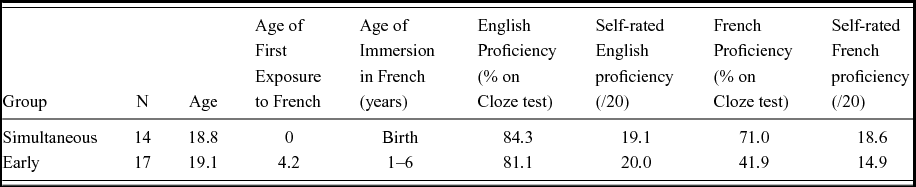
Based on answers to a Language Background Questionnaire (Sabourin & Members of the University of Ottawa ERPLing Lab, Reference Sabourin2009), participants were divided into 2 groups reflecting their Age of Immersion (AoI) in French: simultaneous, defined as an AoI of 0 years of age (n = 14), reflecting immersion in both English and French from birth; and early, defined as AoI between one and six years (n = 17), reflecting immersion in a French environment at a young age. All participants reported using English and French on a daily basis, and rated their proficiency in both languages using a self-rating 5-point scale for oral comprehension and production, written proficiency and writing proficiency for a maximum score of 20. Objective measures of proficiency (Brown, Reference Brown1980; Tremblay, Reference Tremblay2011) reflected these self-ratings. Please refer to Table 1 for detailed participant group information.
Participant Groups.

Stimuli
A bilingual Stroop task was programmed using Presentation (Neurobehavioral Systems). Stimuli were presented using a desktop computer and a 19-inch screen. Participants used a button box to respond.
The stimuli words used were red, yellow, green, black, silver, and white for English, and rouge, jaune, vert, noir, argent, and blanc, for French. Six colours were chosen to increase the difficulty of the task. Additionally, table, chair, fork, spoon, house, and book were included as control items in the English task, and arbre, chaise, stylo, livre, maison, and souris were included as control items in the French task to obtain baseline reading RTs. Words were presented in capital letters in size 60 Times New Roman font in the centre of the screen, and could appear in either the Control (a control item in any colour font), Congruent (i.e., the word “red” presented in red font), or Incongruent (i.e.,, the word “red” presented in green font) condition.
Three separate experiments were created. First, an English Stroop task, which consisted of English Control, English Congruent, and English Incongruent items intermixed. Second, a French Stroop task, which consisted of French Control, French Congruent, and French Incongruent items intermixed. Finally, a Mixed Language Stroop task, in which all of the aforementioned conditions appeared intermixed. Pseudo-randomization was employed to ensure that identical colours and words were not repeated twice in succession. The English and French tasks contained 25 trials each of Control, Congruent, and Stroop trials, for a total of 75 trials for each task. The Mixed Language task consisted of 25 trials each of the English and French Control, English and French Congruent, and English and French Incongruent trials, for a total of 150 trials for the task. Each task was preceded by 15 practice trials. Furthermore, the three tasks were counterbalanced for order of presentation and separated by an interspersed task lasting approximately 5 minutes.
Procedure
Participants filled out a consent form and the language background questionnaire, and were then invited into a sound-attenuated room to begin the experiment. The task was explained in English by the researcher, such that participants were told that they would see words in different colours appear in the middle of the screen. They were asked to press the button that corresponded to the colour of the font of the word they saw on the screen (e.g.,, if the word “red” appears in green font, participants have to press the green button). These instructions also appeared on the screen in front of the participant. The researcher remained in the room during practice trials to give the participant an opportunity to ask questions. Once the practice trials were over and there were no further questions, the researcher left the room and the experiment began.
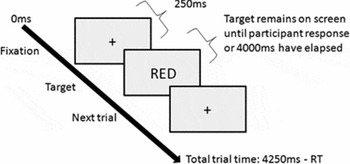
Each trial began with a fixation cross in the middle of the screen for 250ms. This was followed by the onset of the target. Once the target appeared on screen, it remained there until the participant responded or 4000ms had elapsed (see Figure 1). RTs and Accuracy were recorded and analysed. At the end of each task was a self-timed break. Once participants were ready to resume, they pressed a button on the button-box.
Sample trial.

Participants completed the tasks in random order. An initial practice block of 15 trials was completed before the first task. Practice blocks of 5 trials each were completed before each subsequent task. Altogether, the experimental tasks took approximately 15 minutes to complete.
Results
Experiment 1. English Stroop Task
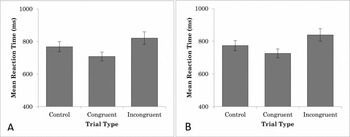
Results of the English Stroop task reveal that while there was an effect of Congruency (Control, Congruent, and Incongruent; F(2, 58) = 17.28, p<.001), there was no significant interactions between Congruency and AoI (p = .878). This demonstrates that the expected inhibition (calculated as the difference between mean RTs in the incongruent and control conditions) and facilitation (difference between mean RTs in congruent and control conditions) effects to English stimuli were found regardless of the language experience of the participants. See Figure 2A below.
Main effect of congruency by language. Error bars represent Standard Error. A represents Experiment 1, the English task, and B represents Experiment 2, the French task.

Experiment 2. French Stroop Task
Results of the French Stroop task reveal that while there was an effect of Congruency (F(2, 58) = 17.28, p<.001), there were no significant interactions between Congruency and AoI (p = .559). This demonstrates that, as expected and just as in the English Stroop task, inhibition and facilitation effects were present and that this, again, does not differ by language experience. See Figure 2B.
Experiment 3. Mixed-Language Stroop Task
An examination of the Mixed-Language Stroop task reveals a different overall pattern from the two single-language tasks. Similar to the single-language tasks, results showed an effect of Congruency (p<.001) indicating the expected inhibition (mean difference = 52.8ms, p = .001) and facilitation effects (mean difference = 40.6ms, p = .002).
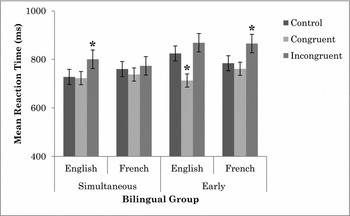
However, in the mixed-language task (Figure 3), this congruency effect interacted with Language (F(2, 58) = 3.45); p = .039), and showed a trend of interacting with AoI (F(2, 58) = 3.01; p = .073). And, importantly, a significant 3-way interaction between Congruency, Language, and AoI (F(2, 58) = 4.89; p = .011) was found. In order to interpret the 3-way interaction, separate Congruency by Language ANOVAs were run for each AoI group.
Average Reaction Times for Experiment 3 in each language by AoI. Simultaneous bilinguals are shown on the left and Early bilinguals are shown on the right. Error bars represent Standard Error. Asterisks represent a significant difference from the control condition.

For the Early bilinguals, a main effect of Congruency was found (F(2, 32) = 16.49, p<.001) indicating again the expected inhibition (mean difference = 62.8ms, p = .006) and facilitation (mean difference = 67.3ms, p = .001) effects. This congruency effect interacted with the language of the stimuli (F(2, 32) = 5.12, p = .014) such that only a facilitation effect was found for the English stimuli (mean difference = 111.8ms, p = .001), while for the French stimuli, only an inhibition effect was found (mean difference = 81.2ms, p = .001).
For the Simultaneous bilinguals, a main effect of congruency was also found (F(2, 26) = 4.53, p = .032), but for this group this effect was only due to significant inhibition effects (mean difference = 42.8ms, p = .043). This congruency effect only marginally interacted with the language of the stimuli (F(2, 26) = 3.38, p = .054). This marginal interaction reflected only inhibition effects for the English stimuli (mean difference = 72.5ms, p = .003) and neither inhibition nor facilitation effects (ps>.3) for the French stimuli.
Discussion
Looking at Figure 2, it can be seen that while the expected congruency effect is present, there are no differences between simultaneous and early bilinguals when only one language is required for the task. This is consistent with the lack of effects found by Kousaie and Phillips (Reference Kousaie and Phillips2012) in their Stroop task, which used English only. This may in part be due to an insufficiently challenging task for the young adults (despite 6 colours being used to increase the difficulty level), as the pattern of effects differs from that of the mixed language task, which combines both languages and is arguably more challenging in nature. Different patterns in the single-language and mixed-language condition were also reported by Wu and Thierry (Reference Wu and Thierry2013), who note that the mixed-language condition “shifted the executive control system to an enhanced functional level” in a study of non-linguistic control with young adults (p. 13535).
Looking at Figure 3, the expected congruency effect is still present, but we also find a three-way interaction between the AoI, Language, and Congruency. For the early sequential bilinguals, we find a strong facilitation effect in their L1, although there are no significant effects of interference in this dominant language. The opposite is found in their L2, French, where there is little facilitation, but a much larger interference effect. For simultaneous bilinguals, the pattern is different: there is neither interference nor facilitation in French, but a small effect of inhibition in English is seen. We hypothesize that the simultaneous bilinguals are better able to focus on the task of determining the colours and ignoring the language differences presented in the mixed language task while the early sequential bilinguals have a more difficult time blocking out the written stimuli. While this may arguably be due to proficiency effects, we hypothesize that it is more likely due to AoI and bilingual context effects.
These different patterns of facilitation and inhibition suggest to us that even though both simultaneous and early bilinguals have acquired two languages from an early age, there are differences in underlying processing. Thus, the common practice of grouping these two distinct groups together may in part contribute to the inconsistencies observed in cognitive control studies. In particular, the facilitation effect seen in early bilinguals and the inhibition seen in simultaneous bilinguals in English may cancel each other out if the two groups are combined. To fully understand the differences between these two groups, correlational analyses would be beneficial; however, due to the small sample size, we restrict ourselves to treating the data as categorical.
In addition to observing an effect of AoI, the current study also notes a distinct effect of the task. While no effect was seen in single-language tasks, it appears in the mixed-language task. This may be due to the increased difficulty, but it may also add evidence regarding the importance of language context. Among the few studies that examine context, Wu and Thierry (Reference Wu and Thierry2013) also varied the language context by placing a flanker task between single-language and mixed-language blocks, and results showed better interference suppression in mixed-language blocks. Expanding on the idea of context, Green (Reference Green2011) discusses what he terms the “behavioural ecology of bilingual speakers”, which refers to the differences in how a community of bilinguals use their two languages. This is expanded into three distinct contexts in the Adaptive Control Hypothesis (Green & Abutalebi, Reference Green and Abutalebi2013), with single-language context, dual-language context, and dense code-switching contexts identified. Each context places different demands on processing and control.
In our task, the differences in results between single- and mixed-language tasks may reflect not only the demand of the immediate language context, but also the AoI differences may reflect the language context that our bilinguals find themselves in: simultaneous and early bilinguals in the Ottawa area often find themselves in mixed-language environments, and as a result of this language experience, it is particularly in mixed-language contexts where their specific skills can be observed. Thus, context and environment appear to play an important role in processing.