The aims of this article were to review the published literature on fungal endocarditis in children and to discuss the aetiology and diagnosis, with emphasis on non-invasive methods and various treatment regimes. Invasive fungal infections have evolved into important causes of morbidity and mortality in children with severe underlying illnesses. Irrespective of age and the underlying condition, fungal endocarditis remains difficult to diagnose, and responses to treatment depend on early diagnosis and restoration of host defences. For more than three decades, options for antifungal chemotherapy have been limited to amphotericin B with or without flucytosine. Recent years, however, have witnessed an expanded clinical experience with antifungal triazoles and the development of less-toxic lipid amphotericin B formulations and echinocandins; moreover, new diagnostic modalities have been developed to aid earlier diagnosis.
Children, particularly neonates and young infants, represent a unique patient population with regard to both patterns of fungal infections and disposition to antifungal agents.
Biological characteristics that may be unique to paediatric age groups include specific anatomical, physiological, and immunological aspects. The comparably small diameter of blood vessels provides a nidus for catheter-associated Candida thrombophlebitis, thrombosis, and endocarditis. In neonates, physiological differences such as the larger fractional water content, the smaller plasma protein fraction, relatively larger organ volumes, and the functional immaturity of hepatic metabolism and renal excretion may all lead to profound differences in drug distribution, metabolism, and elimination. Specific immunological characteristics in neonates include a functional immaturity of mononuclear and polymorphonuclear phagocytes and T lymphocytes as well as a possibly increased susceptibility to the immunosuppressive effects of corticosteroids. These deficiencies may render neonates susceptible to nosocomially acquired opportunistic fungal infections.Reference Andreas, Emmanuel and Thomas 1
Methods
We systematically reviewed published cases and case series of fungal endocarditis in children. We searched the literature, including PubMed and individual references for publications of original articles, single cases, or case series of paediatric fungal endocarditis, with the following keywords: “fungal endocarditis”, “neonates”, “infants”, “child”, and “cardiac vegetation”. In addition, the reference list of each article was searched manually to verify that all published cases were collected for this review. Care was taken to exclude cases likely to reflect duplicate reporting. Criteria for a case or a case series to be included were the following: detection of fungal pathogens in blood plus echocardiographic findings and/or detection of fungal pathogens in cardiac sites after surgery or postmortem. Statistical evaluation of differences in proportions and calculation of odds ratios and 95% confidence intervals were performed using Fisher’s exact test for categorical variables. A two-sided p value of <0.05 indicated statistical significance.
Results
Aetiology
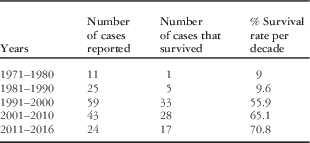
A total of 98 articles were analysed with 192 documented cases of fungal endocarditis in children. Most of the case data were retrieved from previous review articles, case reports, or multi-institutional case series; 144 cases were documented from 63 articles in a single meta-analysis study in 2005.Reference Millar, Jugo and Moore 2 The time distribution of cases with outcome is presented in Table 1. Overall, 120 yeast infections and 43 mould infections were reported. Identity of the fungus was not known in other cases. The majority of infections were due to yeast with Candida albicans (72 cases) being the most common, followed by Candida tropicalis (13 cases) and Candida parapsilosis (13 cases). Other yeasts were reported in a minority of cases, including Candida dublinensis,Reference Grizelj, Vuković and Sarić 3 Candida krusei,Reference Patted, Halkati and Yavagal 4 Saccharomyces cerevisiae,Reference Ruiz-Esquide, Diaz, Wu and Silva 5 Hansenula anomala,Reference Tissieres, Gervaix, Beghetti and Jaeggi 6 and Kodamaea ohmeri.Reference Sundaram, Bijulal and Tharakan 7 Moulds were reported in only seven infants with Aspergillus fumigatus being the most common.
Time distribution of cases with outcome.

Out of 93 infant cases, 60 were in neonates (⩽28 days of birth), of which 57 were born prematurely – that is, <37 weeks of gestation – with a median gestational age of 27 weeks and median birth weight of 860 g. Among the 33 infants aged 28 days, 16 were born prematurely with a median gestational age of 31 weeks and median birth weight of 1050 g.
Among the 46 cases aged 1–10 years, 27 infections were due to yeast. The most common species included C. albicans (14 cases), followed by C. tropicalis (7 cases), Histoplasma capsulatum,Reference Seriki, Aderele, Johnson and Smith 8 Rhodotorula,Reference Naveh, Friedman, Merzbach and Hashman 9 and C. haemulonii Reference Muro, Motta Fde, Burger, Melo and Dalla-Costa 10 in a minority of cases. Of the 19 mould infections, Aspergillus was the most common pathogen. Zygomycetes such as Lichtheimia corymbifera Reference Mitchell, McManus, Dietz, Camitta, Szabo and Havens 11 and dematacious fungi such as Neoscytalidium dimidiatum Reference Mishra, Barik, Arif and Malempati 12 were also documented.
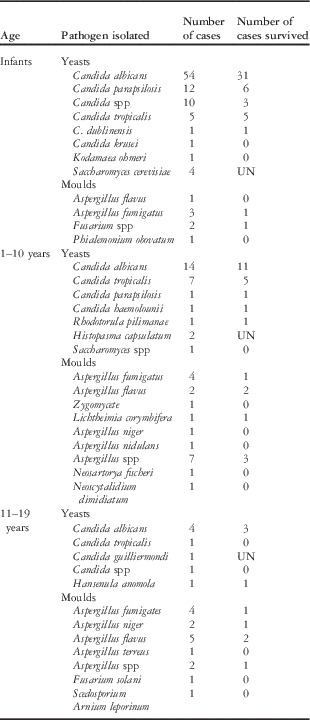
In 25 children aged 11–19 years, mould infections were reported at a higher rate. Of 25 infections, eight were due to yeast and 17 due to moulds. In 28 documented cases, age was not specified. The summary of the incidence of fungal aetiology with reference to age group and survival rate is presented in Table 2.
Summary of the incidence of fungal agents and survival rates.

UN=unknown.
Mode of diagnosis
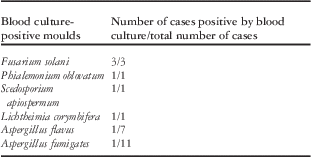
In all the yeast infection cases, blood culture was positive, except in one case where the aetiology was established via postmortem diagnosis.Reference Sutton 13 Of 43 cases of mould infections, blood culture was positive in eight cases (Table 3). Fungal cultures were obtained from eight cases, and tissue histology studies were carried out. In 13 cases, diagnoses were made postmortem. Polymerase chain reaction (PCR) was carried out in only a few cases. Of the four cases of mould infection with negative blood culture, PCR blood was positive for mould, which was then supported by positive histology (one Aspergillus niger, two Aspergillus flavus, one A. fumigatus).Reference Miranda, de Sousa and Monterroso 14 , Reference Badiee, Amirghofran, Ghazi Nour, Shafa and Nemati 15 In a few cases of mould infection, there were other accessible sites that were concurrently fungal culture positive along with blood culture. In one case, a lesion over the head and a sternotomy wound yielded Aspergillus nidulans.Reference Casson, Riordan and Ladusens 16 In another case, sputum cultures were positive for A. fumigatus.Reference Nikolousis and Velangi 17 In the above-mentioned cases, blood cultures were negative, and fungal vegetations were confirmed after histological findings.
Incidence of blood culture-positive moulds.

Risk factors
Of 93 infants, 73 (78.4%) were born premature; furthermore, the majority of fungal endocarditis cases had an association with central venous catheters (65 of 93, 69.8%). Regardless of confirmed bacteraemia, antimicrobial agents were administered in 76 of 93 (81.7%) infants. Previous or concurrent confirmed bacteraemia was recorded in 19 of 93 (20.4%) infants. Other predisposing factors included open-heart surgeries for heart disease in 43 of 192 (22.3%) cases and chemotherapy for malignancies in 16 of 192 (8.3%) cases. Aspergillus species was found in 24 of 43 (55.8%) cases who had previously undergone open-heart surgery.
Site of vegetation
From pathological aspects, infective endocarditis IE was classified on the basis of site of vegetation. The most common site was the right side of the heart (86 cases), followed by the left side (21 cases), and combined (13 cases). Both valvular (57 cases) and mural vegetations (50cases) were documented.
Treatment
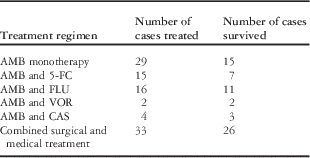
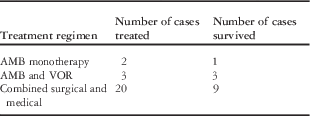
The heterogeneity of the antifungal regimens recorded in this systematic review reflects partially the lack of treatment recommendations for this age group. There was a trend for using certain regimens as they were being developed over time. Between 1983 and 1995, the majority of cases were treated with a combination of amphotericin B and lluorocytosine. From 1999 to 2005, the combination of amphoteracin B and fluconazole was most commonly used. Caspofungin and voriconazole combination treatment was reported only after 2005 and in 2011. The outcome of different treatment regimens in yeast and mould infections is depicted in Tables 4 and 5.
Summary of different treatment regimens for yeast infections with outcome.

AMP=amphoteicin B; FLU=fluconazole; VOR=voriconazole; CAS=caspofungin; 5-FC=5-fluorocytosine
Summary of different treatment regimens for mould infections with outcome.

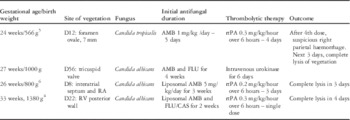
Recombinant tissue plasminogen activator (rtPA) was tried in patients who had persistent candidaemia and thrombocytopaenia after 3 weeks of conventional antifungal therapy.Reference Babayigit, Cebeci and Buyukkale 18 – Reference Aydemir, Erdeve, Oguz, Altug and Dilmen 20 In all cases, the vegetations resolved with one to three doses of rtPA without major complications or need for surgery (Table 6).
Details of neonatal Candida endocarditis treated by thrombolytic therapy.

rtPA=recombinant tissue plasminogen activator; RA=right atrium; RV=right ventricle
Outcome
The overall fatality rate was 56.25%. Significant differences in outcome were reported before and after 2000 (56 cases with 59% case fatality before 2000 versus 22 cases with 33% case fatality after 2000, p=0.0013). Infection with yeast was associated with significantly better outcomes when compared with moulds (35 cases of yeasts with 42% case fatality versus 28 cases of moulds with 65% case fatality, p⩽0.05). Among the various antifungal regimens used, none was associated with a significantly better outcome. Furthermore, when the combination treatment of antifungals with surgery was compared with therapy without surgery, we observed that 35 of 53 (66%) reported cases treated with both antifungal drugs and surgery were alive when compared with 42 of 70 (60%) who received only antifungal drugs (p=0.57). Initial antifungal combination therapy was not significantly associated with better outcome when compared with monotherapy. Among the 40 cases who received initial combination therapy, 14 (35%) succumbed to the disease, compared with 15 (48.3%) out of 31 cases who received monotherapy (p=0.33). The most important cause of death was cardiac complication in the form of failure. Extracardiac complications such as embolisation, septic shock, multiorgan failure, disseminated fungal infection, acute renal failure also significantly contributed to mortality in many cases.
Discussion
Fungal endocarditis remains a rare, yet serious entity. There has been an increase in fungal endocarditis due to various medical interventions to improve survival of life, especially those related to premature infants and repair for children with CHD. Candida spp are the most frequently encountered pathogens. Filamentous fungi including Aspergillus spp also contribute to a significant number of cases. The diagnosis is extremely difficult, primarily because of the fact that the indications for fungal endocarditis are not clearly evident. In microbiological terms, reliable laboratory diagnosis is of particular concern. Obtaining sufficient volumes of blood and mistaken identity of contaminants as pathogen are some of the limitations. The use of special medium formulations for the recovery of yeasts is generally not necessary, because most of them grow well in conventional aerobic, blood culture broths within 2–3 days. Exceptions to this rule include Candida glabrata and Cryptococcus neoformans, which typically require 3–5 days of incubation. In this review, all but one species of yeast grew in blood culture medium. Reliable growth of filamentous fungi in automated blood culture systems is difficult to obtain. Of the moulds, Fusarium can be recovered in blood culture broth, but most other filamentous fungi could not be detected.Reference Murray and Masur 21 All the three cases of Fusarium solani Reference Guzman-Cottrill, Zheng and Chadwick 22 – Reference Guzman-Cottrill, Xiaotian Zheng and Chadwick 24 in paediatric endocarditis were positive in blood culture. A few other moulds such as Aspergillus, Scedosporium,Reference Sobottka, Deneke, Pothmann, Heinemann and Mack 25 Lichtheimia,Reference Mitchell, McManus, Dietz, Camitta, Szabo and Havens 11 and Phialemonium Reference Gavin, Sutton and Katz 26 were also recovered.
Traditionally, laboratory diagnosis is based on two techniques, culturing the causative organism from blood and serological tests for the detection of organisms that are difficult to isolate. Although serological diagnostic methods such as the detection of mannan and galactomannan can be useful for detecting fungal infections, they are not reliable. In the above-documented cases, only a few cases have used this diagnostic modality. In a case of endocarditis due to A. fumigatus where the blood culture was negative, mannan and galactomannan assay also provided negative results, and fungal endocarditis was confirmed only by positive histology and blood PCR.Reference Miranda, de Sousa and Monterroso 14 The gold standard for the diagnosis of fungal endocarditis is culturing and isolation of aetiological agents from emboli, infected valves, or other materials collected by invasive methods such as surgery. In cases with documented mould endocarditis, diagnosis was established only after tissue histology and tissue culture in 16 cases. When one examines surgical materials such as vegetations, valves, and grafts for potential fungal pathogens, it is important to note that conventional culture techniques yield very high rates of false-positive results (13–55%) compared with previous blood cultures or nucleic acid amplification test NAAT-based testing of surgical materials.Reference Badiee, Amirghofran and Ghazi Nour 27 It is best that culture-based methods be supplemented with molecular methods or histological examination of tissues for greater specificity. In this review, four cases of blood PCR-positive moulds were supported by positive histology.
Specimens that are easily accessible, such as peripheral emboli, sternotomy wounds after open cardiac surgery, and distal necrotic lesions, should also be screened for aetiology. Pulmonary involvement is very common with fungal endocarditis. Less-invasive specimens such as bronchoalveolar lavage and protected tracheal specimens can also be used.
Delay in diagnosis was a major determining factor of mortality in many of the mould infection cases – 17 cases were diagnosed postmortem. In two cases, Aspergillus mural endocarditis was documented.Reference Walsh and Hutchins 28 The classic manifestations of endocarditis and abrupt embolic occlusion of large peripheral arteries characteristic of fungal valvular endocarditis were not seen in patients with mural endocarditis. In another case, where Zygomycetes infection was reported, transoesophageal echocardiogram was carried out only at a later stage, which detected a large intra-atrial mass. The patient died on the same day, and the postmortem examination revealed the aetiology.Reference van de Glind, Gidding and Verlaat 29 A total of 13 cases were reported before 1980s. Some of them underwent CHD repair, which predisposed them to fungal endocarditis; two-dimensional echocardiogram was performed, which could not detect the vegetations as they were in the patch area.Reference Barst, Prince and Neu 30
Although early diagnosis and therapy can lead to good clinical outcomes, the use of blood culture to diagnose fungal endocarditis is not reliable, and use of cultures of materials from the infected site remains the “gold standard”; however, this method is invasive, requires major surgery for sample collection, and is not possible in patients with poor condition. The time between sampling and obtaining results of cultures may be as long as 7–10 days, which may be too long for the introduction of effective treatment. Although there is only limited evidence, molecular methods using blood may be more accurate and reliable for the diagnosis of these infections.
As there are no consensus guidelines for the treatment of fungal endocarditis, different combinations of antifungal drugs were used as they were being developed over time. Amphotericin B has been the first-line antifungal agent for medical therapy, although it does not penetrate vegetations well. Although imidazoles such as fluconazole do not have proven efficacy in human fungal IE, long-term suppressive therapy with these agents has been recommended by experts for patients with infections caused by susceptible organisms who cannot undergo curative surgery. In this review, some cases were on prophylactic antifungals for 6 months to 1 year. Oral fluconazole was used for Candida endocarditis, and oral voriconazole/itraconazole was used for Aspergillus endocarditis.
The addition of 5-fluorocytosine (100–150 mg/kg per day, divided every 6 hours) to amphotericin B administered orally for Candida endocarditis may provide additional benefit. The rationale is that the two drugs may act synergistically and potentiate fungal killing. The use of liposomal forms of amphotericin B is an alternative for patients with moderate-to-severe renal impairment or those with unacceptable infusion-related toxicities.
Combination therapies with new triazoles such as voriconazole show promise in the treatment of candidiasis refractory to conventional therapy. In this review, three cases – C. parapsilosis in a preterm infant,Reference Emel, Hulya, Ahmet and Eren 31 A. fumigatus,Reference Nikolousis and Velangi 17 and Fusarium Reference Guzman-Cottrill, Zheng and Chadwick 22 – were successfully treated with initial combination therapy of Amphotericin B and voriconazole. Although it cannot be recommended as a standard treatment for neonatal patients on the basis of the results of case reports with limited samples sizes, these drugs appear to be safe antifungal agents for use in critically ill, preterm infants with persistent fungaemia despite AMB treatment.
Echinocandins are in comparison relatively new agents, having been approved for candidaemia only within the past decade. Similar to amphotericin B, echinocandins are fungicidal, and similar to the lipid formulations of amphotericin B they have good activity against candidal biofilms. In five neonates with C. albicans endocarditis, caspofungin was used in combination with other antifungals. In one case, there was no resolution of vegetation with combined amphotericin B and caspofungin treatment, and the baby died of renal failure.Reference Sharma, Nagraj, Allapathi, Rajegowda and Leggiadro 32 In two other neonates, fluconazole resulted in successful treatment after failure of the initial combination treatment with amphotericin B and caspofungin.Reference Karatza, Dimitiou and Marangos 33 In a preterm neonate, rtPA caused complete resolution after failure with 6 weeks of AMB and CAS.Reference Babayigit, Cebeci and Buyukkale 18 A neonate with Eustachian valve endocarditis was successfully managed with VOR and CAS.Reference Goksu Cetinkaya, Yavuz and Karatekin 34 Although the combination therapy of echinocandins with other antifungals has been compared with the treatment of invasive candidiasis, no studies were available regarding treatment of paediatric fungal endocarditis.
Interestingly, there have been a few cases of neonatal fungal endocarditis treated successfully with recombinant tissue plasminogen activator in combination with antifungal therapy. Tissue plasminogen activators are thrombolytic agents that act directly on plasminogen and convert it to plasmin. Plasmin, in turn, digests fibrin. tPA can indiscriminately dissolve not only pathological thrombi but also haemostatic clots, and thereby lead to serious haemorrhagic complications. Therefore, close monitoring of the coagulation profile is extremely important. Even with older vegetations the therapy can be helpful. Neonates need a higher dose and increased number of doses for infective endocarditis resolution.Reference Levitas, Krymko, Richardson, Zalzstein and Ioffe 35 This could possibly be explained by differences in the clotting factor cascade that is seen in neonates compared with older children. Recombinant tissue plasminogen activator will help breakdown the vegetation, allowing better penetration of the antimicrobials, and therefore resulting in faster resolution of vegetations.
Conclusion
Fungal endocarditis remains a rare infection. The rarity of the disease prevents defining specific guidelines regarding the therapeutic management; however, with the extensive use of intravenous antibiotics and many interventional procedures, the incidence of fungal infections is on the rise. To complicate it further, least common and less-pathogenic organisms are also involved in serious infections. Non-invasive methods such as PCR tests can be used to improve the chances of detecting and identifying the aetiological agent in a timely manner. Delays in diagnosis of these infections may result in high mortality and morbidity.
Acknowledgement
None.