Introduction
An acetyl coenzyme A carboxylase (ACCase) herbicide–resistant rice (ACCase-R) technology became available for use in 2017 (Provisia® Rice System, BASF Research Triangle Park, NC). This technology provides an additional tool for grass control, especially red rice in cultivated rice production. The herbicide targeted for use in Provisia rice is quizalofop-p-ethyl, a Group 1 herbicide that inhibits the ACCase enzyme (Anonymous 2018). Quizalofop is a selective POST herbicide that provides control of annual and perennial grasses (Shaner Reference Shaner2014). Furthermore, ACCase-R rice can be used during cultivated rice production to manage grasses that are resistant to other sites of action or susceptible to currently available herbicides (Osterholt et al. Reference Osterholt, Webster, Blouin and McKnight2019a, Reference Osterholt, Webster, Blouin and McKnight2019b; Rustom et al. Reference Rustom, Webster, Blouin and McKnight2018, Reference Rustom, Webster, Blouin and McKnight2019).
Research has indicated that herbicide application timings can define a weed control program in rice production (Carlson et al. Reference Carlson, Webster, Salassi, Bond, Hensley and Blouin2012; Masson et al. Reference Masson, Webster and Williams2001). Two quizalofop applications per rice growing season will be necessary, with a maximum rate of 240 g ai ha–1 for a single season (Anonymous 2018). In general, early-growth-stage herbicide applications followed by (fb) sequential applications are necessary for optimum weed control in rice production (Carlson et al. Reference Carlson, Webster, Salassi, Bond, Hensley and Blouin2012; Leon et al. Reference Leon, Webster, Bottoms and Blouin2008; Pellerin and Webster Reference Pellerin and Webster2004).
Previous research evaluating quizalofop for red rice and barnyardgrass control in soybean production indicates proper application timing and rate are necessary for effective red rice control (Askew et al. Reference Askew, Shaw and Street2000; Noldin et al. Reference Noldin, Chandler, McCauley and Sij1998). Therefore, similar research evaluating application timings and rates of quizalofop in ACCase-R rice is necessary to maximize weed control with this new system.
ACCase-R rice can be planted in a dry- or water-seeded rice production system. Water-seeded rice production is a system beginning with the establishment of a seeding flood prior to rice planting, followed by broadcasting pre-germinated rice seed into the established flood (Harrell and Saichuk Reference Harrell, Saichuk and Saichuk2014). In water-seeded rice production, three different flood systems are commonly utilized: (1) continuous flood, (2) pinpoint flood, and (3) delayed flood. In the continuous flood system, flood water remains on the field from the time of seeding until draining 2 to 3 wk prior to harvest. This is not a common practice in Louisiana or other rice producing states in the mid-South. The pinpoint flood system is characterized by draining the seeding flood approximately 24 h after planting pre-germinated rice seed and allowing the radicle of the sprouted seed to penetrate the soil, often referred to as pegging (PEG). The permanent flood is established 3 to 5 d after planting and remains on the field up to 2 to 3 wk prior to harvest. In the delayed flood system, the field is drained following seeding for a period of 3 to 4 wk before the permanent flood is established, and the flood remains on the field until 2 to 3 wk prior to harvest. The latter two flood management systems are common in Louisiana and other southern rice producing states.
Flood establishment in water-seeded rice can reduce weed competition with cultivated rice, as flooding creates an environment that reduces weed seed germination (Dunand et al. Reference Dunand, Baker, Sonnier and Dilly1985; Harrell and Saichuk Reference Harrell, Saichuk and Saichuk2014; Leon 2008; Levy et al. Reference Levy, Bond, Webster, Griffin and Linscombe2006; Smith Reference Smith1981; Sonnier and Baker Reference Sonnier and Baker1980). Sequential herbicide application timings in combination with a water-seeded system can be a strategy for weed management in rice production (Masson et al. Reference Masson, Webster and Williams2001; Pellerin and Webster Reference Pellerin and Webster2004; Smith Reference Smith1981). Increased barnyardgrass and red rice control is often observed in a water-seeded rice production system with a pinpoint flood program in combination with an herbicide application (Ntanos et al. Reference Ntanos, Koutroubas and Mavrotas2000; Smith Reference Smith1981).
The objective of this research was to evaluate control of barnyardgrass and red rice, rough rice yield, and gross economic returns when the initial application of quizalofop was applied at different timings and rates under a pinpoint or delayed permanent flood system.
Materials and Methods
A field study was conducted in the 2016 and 2017 crop seasons at the LSU AgCenter H. Rouse Caffey Rice Research Station, near Crowley, LA (30.177147° N, 92.3477430° W). Soil type at the study location was a Crowley silt loam with a pH of 6.4 and 1.4% organic matter. Prior to planting, a 5-cm flood was introduced to the research area, and pre-germinated ACCase-R ‘PVL01’ rice seed was hand-broadcast onto a 1.5-m by 5.1-m plot at a rate of 100 kg ha–1. The study was initiated May 10, 2016 and May 6, 2017. Awnless straw-hull red rice was broadcast in the research area at a rate of 50 kg ha–1. Additionally, the research area is naturally infested with barnyardgrass with a density of 120 plants m–2. Fertility and other pest management practices were based on recommendations from the LSU AgCenter Rice Production Guidelines (Harrell and Saichuk Reference Harrell, Saichuk and Saichuk2014).
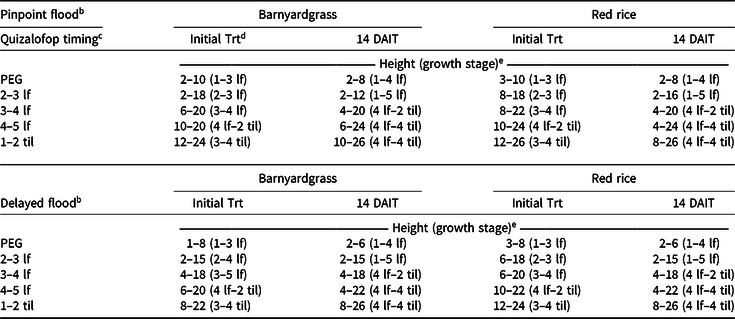
The experimental design was a split plot with three factors. The whole plot consisted of Factor A: (1) a pinpoint-flood water-seeded system and (2) a delayed flood water-seeded system. The subplots consisted of factors B and C. Factor B consisted of initial quizalofop application timings at five different rice growth stages: (1) PEG, ‘PVL01’ rice with an anchored radicle with coleoptile length of 2.5 cm; (2) two- to three-leaf stage; (3) three- to four-leaf stage; (4) four- to five-leaf stage; and (5) one- to two-tiller stage. Factor C consisted of quizalofop rates: 97 g ha–1 fb 143 g ai ha–1 and 120 g ha–1 fb 120 g ai ha–1 for a total of 240 g ha–1. Therefore, all possible combinations of timing and rate were randomized within each whole plot with four replications. The initial application was applied at each growth stage described in Factor B, and the second application was applied 2 wk after the initial application. A nontreated was added to each flood system for comparison. Barnyardgrass and red rice size and growth stage are listed in Table 1. An application of halosulfuron at 52 g ai ha–1 was applied to control broadleaf and sedge weeds present in the research area when rice was in the three- to four-leaf stage.
Average height (cm) and leaf or tiller number of barnyardgrass and red rice at quizalofop application timing, averaged over 2016 and 2017.a

a Water-seeded systems: Pinpoint, established flood when rice radicle penetrated soil and had a coleoptile length of 2.5 cm; delayed flood, established flood at four-leaf to one-tiller growth stage.
b Means followed by the same letter do not significantly differ at P = 0.05 using Tukey’s test.
c Quizalofop timing determined by rice stage of growth.
d Abbreviations: DAIT, days after the initial treatment; lf, leaf; PEG, rice seedlings with a coleoptile 2.5 cm in length; til, tiller; Trt, treatment.
e Growth stage (leaf or tiller number) is given in parentheses.
The pinpoint system consisted of field drainage 24 h after planting, and when the rice seedling radicle had anchored into the soil with a 2.5 cm coleoptile, the permanent flood was established. The flood was established approximately 5 d after the initial drain. The pinpoint flood depth was increased incrementally to the research area at a depth to not completely submerge the tip of the coleoptile, and this flood was maintained and raised as rice plants elongated until a final flood depth of 10 cm was achieved. The delayed flood system consisted of field drainage 24 h after planting, and when rice seedlings were at the four-leaf to one-tiller growth stage a flood was introduced onto the research area and raised to a final flood depth of 10 cm.
Quizalofop was applied with a CO2-pressurized backpack sprayer calibrated at 145 kPa to deliver 140 L ha–1 of spray solution. The spray boom consisted of five flat-fan 110015 nozzles (Flat Fan Airmix Venturi Nozzle; Green-leaf Technologies, Covington, LA). A crop oil concentrate was added to each herbicide application at a rate of 1% v v-1 (Agri-Dex label; Helena Chemical Co., Collierville, TN).
Visual evaluations included crop injury and barnyardgrass and red rice control. Visible injury and control were evaluated on a scale of 0 to 100%, with 0% = no injury or no control and 100% = complete plant death, at 14, 28, and 42 d after the initial quizalofop treatment (DAIT). ACCase-R rice plant height was recorded from four plants in each plot measured from the ground to the tip of the extended rice panicle immediately prior to harvest. The center four rows planted in ACCase-R rice were harvested with a Mitsubishi VM3 (Mitsubishi Corp., 3-1, Marunouchi 2-chome, Chiyoda-ky, Tokyo, Japan) plot combine, and grain yield was adjusted to 12% moisture.
Economic analyses were based on the average long-grain rice price for 2017 and 2018 (personal communication, Michael Deliberto, Assistant Professor, Agriculture Economics, Louisiana State University). Base rice price was set at US$0.242 kg–1. Profitability of the herbicide programs was determined by evaluating total value product, which was calculated by multiplying the rough rice yield by the price. Herbicide costs were not included, because the total amount of quizalofop, 240 g ai ha–1, was applied in two split applications during the growing season across all treatments. Total gross returns account for rice crop value.
Barnyardgrass and red rice control data were arranged as repeated measures and subjected to the MIXED procedure of SAS (SAS Institute 2013). Years and replications were considered random effects. Considering year or combination of year as random effects permits inferences about treatments over a range of environments (Carmer et al. Reference Carmer, Nyuist and Walker1989; Hager et al. Reference Hager, Wax, Bollero and Stroller2003). Flood systems, application timings, and quizalofop rates were considered fixed effects. Type III statistics were used to test all possible interactions of these fixed effects. Tukey’s honest significant difference test was used to separate all means at the 5% probability level (P < 0.05). Normality effects over all DAIT were checked using the UNIVARIATE procedure of SAS, and assumptions for normality were met.
Results and Discussion
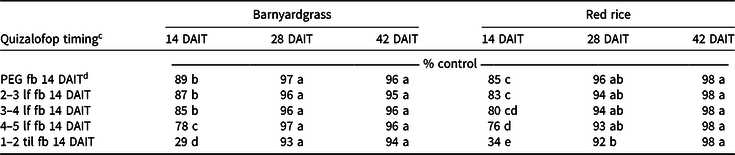
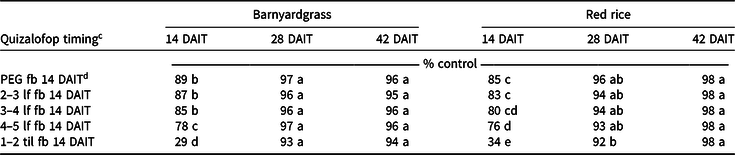
An application timing by evaluation date interaction occurred for barnyardgrass control; therefore, data were pooled over flood system and quizalofop rate (Table 2). Barnyardgrass control, at 14 DAIT of quizalofop, was 85% to 89% when treated at the PEG, two- to three-leaf, and three- to four-leaf rice stages. Quizalofop application at the four- to five-leaf stage of rice resulted in barnyardgrass control of 78%, and delaying the initial quizalofop application to the one- to two-tiller rice stage resulted in 29% control. Regardless of quizalofop application timing, barnyardgrass control at 14 DAIT was less compared with control observed 28 and 42 DAIT due to the second quizalofop application at 14 DAIT. These decreases observed with a single application of quizalofop for barnyardgrass control indicate the importance of applying quizalofop on small, actively growing barnyardgrass to maximize control early in the growing season.
Barnyardgrass and red rice control when treated with quizalofop-p-ethyl applied at different rates and timings in a pinpoint- or delayed-flood water-seeded rice production system.a
a Quizalofop applied at 97 g ai ha–1 followed by (fb) 143 g ha–1 or 120 g ha–1 fb 120 g ha–1. Water-seeded systems: pinpoint, established flood when rice radicle penetrated soil and had a coleoptile length of 2.5 cm; delayed, established flood at four-leaf to one-tiller growth stage.
b Data pooled over pinpoint and delayed flood and quizalofop rate, 2015 and 2016. Means followed by the same letter do not significantly differ at P = 0.05 using Tukey’s test.
c Quizalofop timing determined by rice stage of growth.
d Abbreviations: DAIT, days after the initial treatment; lf, leaf; PEG, rice seedlings with a coleoptile length of 2.5 cm; til, tiller number.
At 28 and 42 DAIT, including a second application of quizalofop at 14 DAIT, increased barnyardgrass control was observed, 93% to 97%, and these data did not differ across or within application timings. Reports of imazethapyr-treated barnyardgrass in imidazolinone-resistant rice production indicate that early applications of imazethapyr increased control compared with later timings (Carlson et al. Reference Carlson, Webster, Salassi, Bond, Hensley and Blouin2012; Leon et al. Reference Leon, Webster, Bottoms and Blouin2008; Masson et al. Reference Masson, Webster and Williams2001).
Data analysis for red rice control indicated an interaction for application timing by evaluation date; therefore, data were pooled over flood system and quizalofop rate (Table 2). At 14 DAIT, the initial quizalofop application to ‘PVL01’ rice at the PEG, two- to three-leaf, and three- to four-leaf growth stage controlled red rice 85%, 83%, and 80%, respectively. Similar to the three- to four-leaf application timing, red rice control with quizalofop applied at the four- to five-leaf stage was 76%. Delaying the initial quizalofop application to the one- to two-tiller rice stage controlled red rice 34%. These decreases observed with a single application of quizalofop for red rice control indicate the importance of applying quizalofop on small, actively growing weeds to maximize control.
At 28 and 42 DAIT, quizalofop applied at any application timing controlled red rice 92% to 98% (Table 2). If the initial application of quizalofop was delayed to the one- to two-tiller stage, red rice was reduced at 28 DAIT to 92% control, compared with 98% control at 42 DAIT.
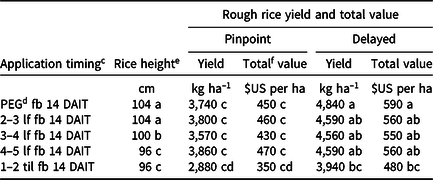
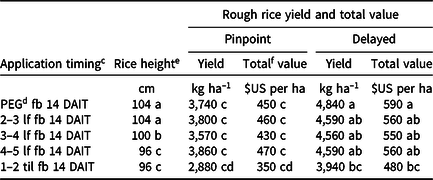
A quizalofop application timing main effect occurred for ACCase-R rice plant height; therefore, data were pooled over flood system and quizalofop rate (Table 3). Rice treated with quizalofop at the PEG and two- to three-leaf stages resulted in a rice height of 104 cm at harvest. In comparison, delaying the initial application of quizalofop to the three- to four-leaf, four- to five-leaf, and one- to two-tiller stages resulted in a decrease in rice height to 96 cm to 100 cm. These data indicate that reductions observed for barnyardgrass and red rice control at 14 DAT with quizalofop applications at three- to four-leaf, four- to five-leaf, and one- to two-tiller stages (Table 2), can have a direct relationship with reduced rice plant height observed for the corresponding growth stage (Table 3). Reduced control may translate into a weed that is more competitive than a rice plant later in the season (Bergeron Reference Bergeron2017; Diarra et al. Reference Diarra, Smith and Talbert1985). Rice crop injury due to quizalofop treatment was less than 5% for all evaluations (data not shown).
Rough rice yield, total value above herbicide cost, and height at harvest of ACCase-resistant rice treated with quizalofop-p-ethyl applied at different rates and timings in a pinpoint-or delayed-flood water-seeded rice production system.a, b
a Quizalofop applied at 97 g ai ha–1 followed by (fb) 143 g ha–1 or 120 g ha–1 fb 120 g ha–1. Water-seeded systems: pinpoint, established flood when rice radicle penetrated soil and had a coleoptile length of 2.5 cm; delayed, established flood at four-leaf to one-tiller growth stage.
b Means followed by the same letter do not significantly differ at P = 0.05 using Tukey’s test.
c Quizalofop timing determined by rice stage of growth.
d Abbreviations: DAIT, days after the initial treatment; lf, leaf; PEG, rice seedlings with a coleoptile length of 2.5 cm; til, tiller number.
e Rice height data pooled over pinpoint and delayed flood and quizalofop rate, 2015 and 2016.
f Total value above input costs based on rice price of US$0.242 kg–1.
An application timing by flood system interaction occurred for rough rice yield; therefore, data were pooled over quizalofop rate (Table 3). When the initial application of quizalofop occurred to rice at the PEG stage, rough rice yield was 4,840 kg ha–1 in the delayed flood system compared with the pinpoint-flood system with a yield of 3,740 kg ha–1. In the delayed flood system, a yield reduction of 19% was observed when quizalofop was applied at the one- to two-tiller stage, compared with rice treated at the PEG application timing. A yield reduction of 40% was observed when rice was treated with quizalofop applied at the one- to two-tiller stage in the pinpoint-flood system, compared with the PEG application timing in the delayed flood system.
Total gross value for the rice treated at the PEG timing in the pinpoint and the delayed flood system was $450 and $590 ha–1, respectively (Table 3). Delaying the initial application to the four- to five-leaf stage resulted in little change in total value within each flood system. However, delaying the initial application to the one- to two-tiller stage resulted in a reduction of $100 ha–1 in the pinpoint system and $110 ha–1 with the delayed flood system compared with an initial application at the PEG timing. These data indicate the delayed flood system has increased gross value compared with the pinpoint system within each application timing, except the one- to two-tiller timing.
Overall, quizalofop application timing can have an impact on barnyardgrass and red rice control and rough rice yield. These data indicate barnyardgrass and red rice should be treated at early growth stages to minimize competition with ACCase-R rice. Thus, early quizalofop applications, with either rate of quizalofop, within each flood system are important tools for rice producers to manage weeds in an ACCase-R rice production system.
Acknowledgments
Published with the approval of the Director of the Louisiana Agricultural Experiment Station and the Louisiana State University Agricultural Center, Baton Rouge, LA 70803, under manuscript number 2019-306-34100. The authors would like to thank the staff of the Louisiana State University Agricultural Center’s H. Rouse Caffey Rice Research Station. Louisiana Rice Research Board provided partial funding for this project. No conflicts of interest have been declared.