Introduction
Antarctic shags Phalacrocorax (atriceps) bransfieldensis Murphy inhabit the Antarctic Peninsula and surrounding island groups, making them the southernmost nesting members of the cormorant family (Phalacrocoracidae). While a considerable body of work has focused on Antarctic shag biology, particularly on diet and reproductive success (reviewed by Casaux & Barrera-Oro Reference Casaux and Barrera-Oro2006), attempts to comprehensively assess their geographical distribution and total abundance have been relatively few. To address this information gap, all publicly available information on Antarctic shag populations is compiled here to identify what is known and, importantly, what remains unknown about their distribution, abundance and any trends in abundance.
A comprehensive understanding of shag population distribution and abundance is required to quantify their role in the Antarctic foodweb and to identify breeding locations of particular importance to their conservation. Importantly, Antarctic shags differ from other diving seabirds of the region (e.g. most penguins) by predominantly consuming a variety of demersal fish rather than subsisting primarily upon krill (Casaux & Barrera-Oro Reference Casaux and Barrera-Oro2006), making them potential indicators of fish populations that are themselves difficult to survey. The first step in developing shags as an indicator species would be an analysis of their population trends (Casaux & Barrera-Oro Reference Casaux and Barrera-Oro2016). Several authors have found evidence of population declines at certain colonies or regions, suggesting that shags may be declining more generally (Naveen et al. Reference Naveen, Forrest, Dagit, Blight, Trivelpiece and Trivelpiece2000, Woehler et al. Reference Woehler, Blight and Bullock2010, Coria et al. Reference Coria, Montalti, Rombola, Santos, Garcia Betoño and Juares2011, Casaux & Barrera-Oro Reference Casaux and Barrera-Oro2016), but since the extent of interannual dispersal of Antarctic shags between colonies is unknown, it is difficult to draw conclusions about changes in population size without examining the entire population.
Despite being understudied relative to the region’s penguins, the Antarctic shag plays a particularly important role in the designation of Important Bird Areas (IBAs) in the Antarctic Peninsula and surrounding island groups (Harris et al. Reference Harris, Carr, Lorenz and Jones2011). Of the 43 IBAs identified by treating colony sites as points (as opposed to aggregating over larger areas), more than half (n=23) were triggered solely by shag congregations that exceeded 1% of the global population of the species. At the time of that report, many of those colony sites identified as IBAs had last been surveyed in the 1980s; population updates for these colonies, or for the global population, would probably refine our identification of bird ‘hotspots’ in the region. A comprehensive assessment of the global population size of Antarctic shags has been complicated by the uncertainty and debate surrounding the taxonomy of the blue-eyed shag complex, as past population estimates, including those available to Harris et al. (Reference Harris, Carr, Lorenz and Jones2011), have included colonies that may be appropriately treated as South Georgia shags (P. georgianus Lönnberg). For this reason, a complete analysis of shag populations in the Antarctic requires careful consideration of shag taxonomy.
Taxonomy
Throughout much of the twentieth century, shags in the Antarctic Peninsula were considered conspecific with other shags throughout much of the Southern Ocean (e.g. Watson Reference Watson1975, Harrison Reference Harrison1985), and usually named P. atriceps, with several English names that were primarily variants of blue-eyed shag or imperial cormorant. In Siegel-Causey’s (Reference Siegel-Causey1988) phylogeny of the Phalacrocoracidae, constructed using osteological characters, the blue-eyed shags were given their own genus (Notocarbo) within a subfamily (Leucocarboninae). The author described the Antarctic shag (N. bransfieldensis) as inhabiting ‘the Palmer Peninsula of Antarctica and islands along the Scotia Arc’, and considered it distinct from the South Georgia shag (N. georgianus), which was described as ‘restricted to the Scotia Arc’. In their widely used taxonomy, Sibley & Monroe (Reference Sibley and Monroe1990) cited Siegel-Causey (Reference Siegel-Causey1988) in their decision to keep these as separate species in the genus Phalacrocorax, though other authors continued to lump the blue-eyed shag complex together into P. atriceps (e.g. Johnsgard Reference Johnsgard1993). Most current taxonomies treat georgianus and bransfieldensis as separate taxa within a super-species that includes several other ‘blue-eyed’ shags around the Southern Hemisphere (Clements et al. Reference Clements, Schulenberg, Iliff, Roberson, Fredericks, Sullivan and Wood2016, Gill & Donsker Reference Gill and Donsker2017), though there remains disagreement about the genus name (Phalacrocorax, Notocarbo or Leucocarbo). Other current taxonomies treat them as conspecific, retaining the names georgianus and bransfieldensis as subspecies, arguing that the differences between these taxa have never been rigorously documented (Orta et al. Reference Orta, Garcia, Christie, Jutglar and Kirwan2017). The current IUCN Red List still treats georgianus and bransfieldensis as subspecies of the imperial shag (P. atriceps).
All field-observable characteristics distinguishing georgianus and bransfieldensis from other blue-eyed shag forms, and especially from each other, are subtle and subject to much individual variation (Shirihai et al. Reference Shirihai, Jarrett and Cox2007). The Antarctic shag (bransfieldensis) has more extensive white on the sides of the head, back and perhaps outer scapulars than the South Georgia shag (georgianus), with small differences in average length (georgianus: 72–75 cm, bransfieldensis: 77 cm) and wingspan (georgianus: 27.0–30.4 cm, bransfieldensis: 32–33 cm). However, these differences are so slight that any field identification of live birds is based solely on range (Shirihai et al. Reference Shirihai, Jarrett and Cox2007).
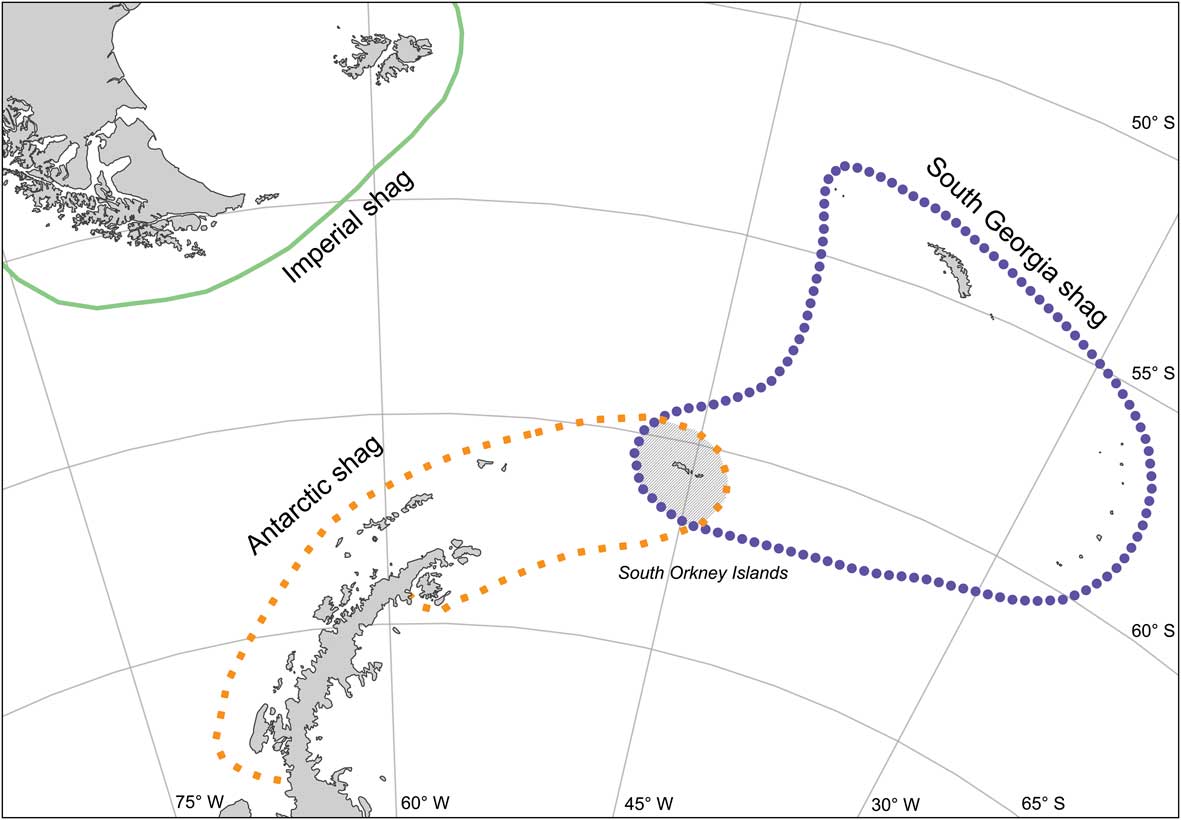
Regardless of whether the Antarctic and South Georgia shags are treated as distinct species or subspecies, all recent major taxonomies list the Antarctic shag as inhabiting the Antarctic Peninsula, South Shetland Islands and Elephant Island, and the South Georgia shag as inhabiting South Georgia, Shag Rocks, South Sandwich Islands and South Orkney Islands (Fig. 1). Little information exists as to why the South Orkney Islands should be considered the southernmost extent of South Georgia shag rather than the northernmost extent of Antarctic shag, and to our knowledge no evidence to support this boundary has been published. The species/subspecies assignment of shags in the South Orkney Islands is important because that island group is traditionally managed together with the Antarctic Peninsula and South Shetland Islands. Previous summaries of shag populations, including those used in the designation of IBAs, have used the total population of shags from the South Orkney Islands together with those from the Antarctic Peninsula and South Shetland Islands (Harris et al. Reference Harris, Carr, Lorenz and Jones2011). While management decisions could use either species or subspecies as taxonomic units, any thresholds based on a proportion of total population depend on the assignment of the island group to either one or the other taxon.
Ranges of the three generally recognized taxa of blue-eyed shags in the Scotia Sea region. Shags in the South Orkney Islands are most often described as South Georgia shags, but some sources have considered them Antarctic shags.

For the purposes of this assessment of shag populations, the Antarctic shag is considered to be a distinct taxon from the South Georgia shag, and the respective names P. (atriceps) bransfieldensis and P. (atriceps) georgianus are adopted to reflect the continued ambiguity of their species status. Here summaries of known populations are presented and the impact on IBA designations when the South Orkney Islands are and are not included in population totals are discussed.
Methods
Shag population data were collected from as much of the published and ‘grey’ literature as could be obtained (Table I, and Table S1 and associated metadata found at http://dx.doi.org/10.1017/S0954102017000530). This effort began with online searches of published literature using all forms of the common and scientific names of the species. For colonies at or near research stations, attempts were made to fill data gaps by contacting individuals who may have knowledge about unpublished data. Any relevant studies or publications were searched for mentions of abundances, and any such data were associated with a location using either geographical co-ordinates or names of localities. The overarching strategy was to collect any abundance data on breeding aggregations from any location, and then standardize those data to a single metric by making reasonable assumptions about how different types of data could be compared.
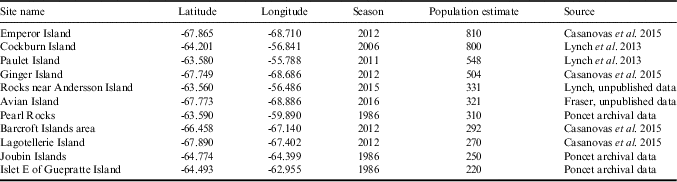
List of major Antarctic shag breeding locations (>200 breeding pairs). Abundance data are from the last available census.

One of the most challenging aspects of this process was determining whether data from different sources referred to the same or different breeding locations, as location names often vary among research groups. We were fortunate that a few research programmes had maintained relatively comprehensive records of data collected at many different locations, reducing the time spent cross-validating sources. One such source contained archival data collected by S. and J. Poncet, which are referenced in Harris (Reference Harris2006) and Harris et al. (Reference Harris, Carr, Lorenz and Jones2011), and were provided directly by S. Poncet for this manuscript (personal communication 2017; hereafter, Poncet archival data). Many data came from visits by the Antarctic Site Inventory (ASI; Naveen et al. Reference Naveen, Forrest, Dagit, Blight, Trivelpiece and Trivelpiece2000, Lynch et al. Reference Lynch, Naveen and Fagan2008, Reference Lynch, Naveen and Casanovas2013, Casanovas et al. Reference Casanovas, Naveen, Forrest, Poncet and Lynch2015). Counts from any site with breeding shags visited by the ASI were taken from the most recent season available from surveys published by Lynch et al. (Reference Lynch, Naveen and Casanovas2013) and Casanovas et al. (Reference Casanovas, Naveen, Forrest, Poncet and Lynch2015), and then updated with any more recent ASI data (Lynch, unpublished data). There are likely to be additional unpublished datasets that we were unable to find and we hope that our review highlights areas where additional existing data, were it published or otherwise made available, might be used to fill in gaps.
Methods for measuring population size differed among data sources, mostly relying on counts of physical nest sites (raised mounds of mud, excreta and often plant material) that were judged active by the presence of eggs, incubating adults or chicks. Occasionally counts were reported as the number of adults or chicks present. Antarctic shag nests situated on relatively flat rock outcrops are generally accessed on foot and can be observed either with the naked eye or from higher vantage points using binoculars. Nest sites on rock ledges or steep rocky slopes are generally counted from offshore vessels using binoculars.
The number of breeding pairs was used as the unit of choice for our population assessment, and the most recent count of breeding pairs available was used. This metric was chosen both because the majority of abundance records were measured in breeding pairs and because it is the measurement least likely to be influenced by intra-annual changes in phenology and attendance. When census numbers were reported as total number of adults (Shuford & Spear Reference Shuford and Spear1988), the total number of breeding pairs was estimated by dividing the count by 1.5, which is the median ratio of adults:nests visible in eight photographs of Antarctic Peninsula shag colonies (from various places and times available to the authors). Because nests are established within a phenological window and failed nests are abandoned, there can be significant intraseasonal variation in the number of active nests at a site; repeated nest counts of the same population will fluctuate accordingly. In years with greater than two counts of the same type, the maximum was used in the interest of obtaining a population estimate as close to the true number of active breeding pairs during the peak of the nesting season. If counts of more than one type (e.g. nests and chicks) were available from a single season, priority was given to nest counts as the most direct measure of the number of breeding pairs. This is because some breeding pairs may have failed to hatch chicks, and because the number of surviving chicks at the colony at any one time requires additional assumptions regarding the number of chicks per nest (see below). Because the number of chicks decreases near the end of the breeding season due to fledging and chick mortality, the assumption was made that late-season chick counts were less reflective of the breeding population than nest counts from recent past breeding seasons. Four such late-season chick counts were discarded in favour of slightly older nest counts (Petermann Island: chick count on 25 January 2016 replaced by nest count on 20 January 2015; Andresen Island: chick count on 22 January 2016 replaced by nest count on 16 January 2013; Uruguay Islands: chick count on 24 January 2016 replaced by nest count on 21 January 2015; and Port Charcot: chick count on 17 February 2016 replaced by nest count on 21 December 2014). The remaining counts of chicks were converted to an approximate number of breeding pairs using a conversion factor of 1.7 chicks per pair. This value is the median ratio from all records (n=66) in the ASI database which counted both nests and chicks in the same visit.
Shag presence is confirmed at several colonies, but without an estimate of abundance, by Harris et al. (Reference Harris, Carr, Lorenz and Jones2011). In three such cases an alternative source for a population estimate was not found. To estimate the number of shags that might therefore be unaccounted for in our global total, these missing abundances were imputed by sampling with replacement from the distribution of colony sizes and summing these three samples to represent the missing population; repeating this bootstrapping procedure 10 000 times yielded a probability distribution for the missing abundance.
Estimates of uncertainty were provided for some but not all of the counts reported in the literature, and were summarized by five categories: i)<5%, ii) 5–10%, iii) 10–25%, iv) 25–50% and v) order of magnitude. Following the treatment of observation error by Che-Castaldo et al. (Reference Che-Castaldo, Jenouvrier, Youngflesh, Shoemaker, Humphries, McDowall, Landrum, Holland, Li, Ji and Lynch2017), observation error was treated as a log-normal process. Confidence intervals (CIs; 95%) for our estimate of shag population size were calculated using 10 000 random draws from a log-normal distribution for each colony, using the following scale parameters (see Che-Castaldo et al. Reference Che-Castaldo, Jenouvrier, Youngflesh, Shoemaker, Humphries, McDowall, Landrum, Holland, Li, Ji and Lynch2017 supplementary data 2): i) 0.025, ii) 0.050, iii) 0.120, iv) 0.230 and v) 0.510. Those counts with no uncertainty provided were assigned to category iv). While this method of measuring uncertainty is well suited to modelling observation error of counts, it does not include any error associated with other factors such as intra-annual changes in numbers of active nests or possible changes in population since the most recent count at many colonies.
Although long-term data on Antarctic shag populations are scarce, documentation of changes over time was attempted using two methods. First, for 46 colonies both a recent population estimate (≥2005–06) and a ‘historic’ population estimate (<1995–96) were available, and the difference in estimated abundance was used as a metric for long-term change in the population at that location. Second, time series of abundance at sites with at least 10 years of available population estimates were examined directly to assess temporal change. These time series are largely limited to the last 20 years, but provide a more nuanced picture of dynamics and interannual fluctuations than the simple decadal comparison.
Results
In total, 185 active colonies of shags were identified, representing a population of 13 230 breeding pairs, including 12 colonies of shags (1984 pairs) in the South Orkney Islands (Table S1) that might be considered South Georgia shags. The bootstrap procedure for the three populations with no abundance data (Cape Lindsey, Stinker Point and Upper Island) suggested roughly 120 pairs (Fig. S1 found at http://dx.doi.org/10.1017/S0954102017000530) might be missing from these known but unsurveyed colonies, which when added to our census total results in a total estimated population of 13 350 breeding pairs. Excluding the South Orkney Islands, the total population of Antarctic shags is estimated to be 11366 breeding pairs distributed across 173 active colonies. Approximately 88% of the shag colonies (accounting for ~80% of the population) had some level of uncertainty reported with the most recent count. Using our log-normal model for observation error 95% CIs were calculated for the entire population (12788, 15018) and for the population excluding the South Orkney Islands (10846, 12926). Colony size is well described by a log-normal distribution (Fig. S2 found at http://dx.doi.org/10.1017/S0954102017000530) and, accordingly, a relatively small number of large colonies represent the bulk of the total population. For example, there are only 11 colonies with more than 200 breeding pairs and collectively these colonies account for 41% of the total Antarctic shag population.
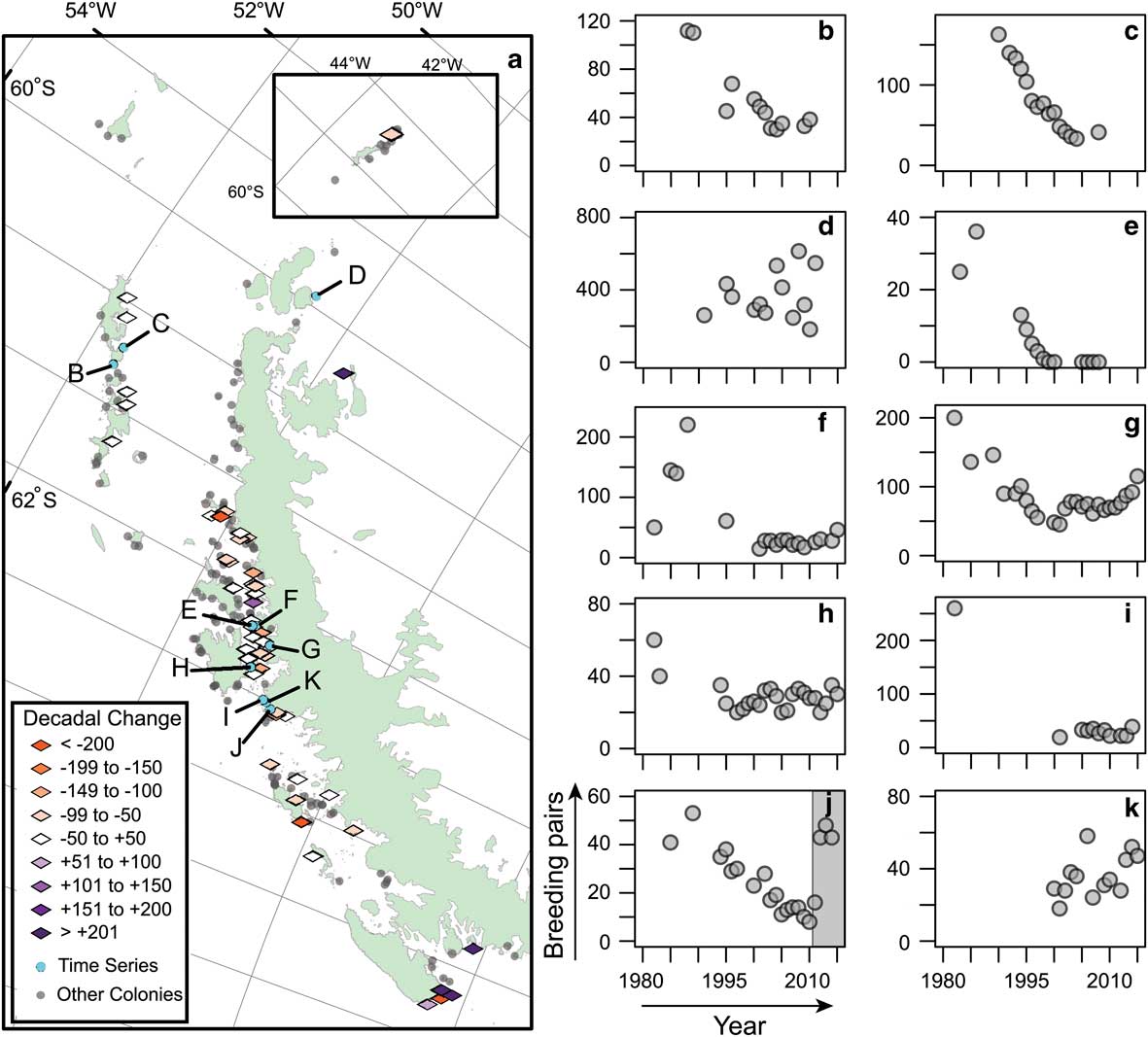
Recent and ‘historic’ population data were available for 46 identified colonies (Fig. 2a coloured diamonds), and an unambiguous latitudinal boundary was discovered (in northern Marguerite Bay), north of which shag populations appear to have mostly declined or remained stable and south of which shag populations appear to have generally increased. Shags have also increased at a single large colony near the Weddell Sea (Cockburn Island), at the north-eastern range edge. Data from Delaite Island, in the central Gerlache Strait, are difficult to interpret; while no nests were recorded in 1989–90, the population estimate of 115 from 2016 is broadly consistent with a count of 60 nests in 1983–84 (Poncet archival data), suggesting a small overall positive trend in a region otherwise characterized by declining populations.
Map of known Antarctic shag breeding colonies, including colonies of shags (presumed South Georgia shag) in the South Orkney Islands (inset). Colonies with population estimates across decades are displayed as diamonds, colour coded to indicate the apparent change from pre-1995 to post-2005. Side panels display available population (number of breeding pairs) time series for b. Harmony Point, c. Duthoit Point, d. Paulet Island, e. Orne Islands, f. Cuverville Island, g. Brown Station, h. Jougla Point, i. Port Charcot, j. Petermann Island (shaded region indicates the establishment of a new subcolony elsewhere at the site), and k. Pleneau Island. b. & c. data from Casaux & Barrera-Oro Reference Casaux and Barrera-Oro2016, d.–j. data from pre-1994 come from Poncet archival data, including personal communication from J.J. Argoud (f. 1983) and C. Verheyden (i. 1991).

Using data originally published by Casaux & Barrera-Oro (Reference Casaux and Barrera-Oro2016) and additional data from the ASI (Lynch et al. Reference Lynch, Naveen and Casanovas2013, Lynch, unpublished data) and Poncet archival data, reasonably comprehensive time series were assembled for ten colonies (Fig. 2b–k). The two colonies described by Casaux & Barrera-Oro (Reference Casaux and Barrera-Oro2016), Harmony Point and Duthoit Point, exhibited declines (Fig. 2b & c, respectively), as did the Orne Islands (Fig. 2e). Seven other colonies showed no apparent trends (Fig. 2d & f–k). Orne Islands, being the smallest of the ten colonies with extensive time series, had 13 breeding pairs in the 1994–95 season but declined to extinction five years later. It is notable that while there was no overall trend at the large Paulet Island colony (Fig. 2d), there were large (two to threefold) fluctuations in abundance during the mid- to late-2000s. At Petermann Island (Fig. 2j) an abrupt increase in 2012–13 was the result of a new subcolony that was established on the southern end of the island,~0.5 km away from the original breeding colony. The birds around Petermann Island are not marked, making it impossible to say how many of the birds in the ‘new’ colony may have relocated from the old colony; however, the roughly threefold increase in population in a single season at a new location is unlikely to have occurred without substantial immigration.
Discussion
Excluding the shags inhabiting the South Orkney Islands (arguably South Georgia shags), the global population of Antarctic shags is estimated to be 11 366 breeding pairs, distributed across 173 active colonies. This is very close to the ~11 000 pairs usually cited (Shirihai et al. Reference Shirihai, Jarrett and Cox2007, Orta et al. Reference Orta, Garcia, Christie, Jutglar and Kirwan2017). Including the 12 known colonies in the South Orkney Islands increases the total population size to 13 350 breeding pairs. To our knowledge, this is the most comprehensive review of the Antarctic shag population ever undertaken and by describing in detail what is known and unknown about the distribution and abundance of Antarctic shags we hope to establish a baseline of information that can be updated and corrected over time by the community.
It should be noted that 94 (54%) of the 173 active Antarctic shag colonies (accounting for ~45% of the total population) were last surveyed in or before the 1980s. The large span of time over which the most recent surveys were conducted, when combined with the apparent presence of both increasing and decreasing trends throughout the region, forces us to consider our estimate of the current population to be only approximate. In addition, our method of calculating CIs does not incorporate uncertainty from outdated counts. The shag population at Astrolabe Island, along the north-western Antarctic Peninsula, is one example of a site that needs to be resurveyed. A visit there in November 2015 noted the presence of many shags but was unable to obtain a population estimate (Foley, personal communication 2016). The observers noted that the number of nests may have been as high as 500, much higher than the January 1987 count of 154 cited by Harris et al. (Reference Harris, Carr, Lorenz and Jones2011). If true, this would make it the seventh largest colony known and increase the total population size by ~3% to 11 661. It is not clear whether the apparent (but unverified) increase in shags at that location is due to a genuine increase in abundance (a notable exception to the north–south divide in shag trends) or a failure of the original survey to adequately count shags nesting out of sight along the uppermost plateau. We suggest that seabird researchers prioritize the collection of shag census information from those larger colonies that have not been surveyed in several decades.
Although there are only a limited number of colonies that have been surveyed with high frequency, there is compelling evidence of a spatially explicit pattern of increases at the edges of the range (Marguerite Bay in the south and the Weddell Sea in the east) and a mix of both stable and declining colonies throughout the rest of the range. The best information on trends comes from the ten sites where it was possible to construct a detailed time series. The two colonies exhibiting clear population declines over the entire time series were those studied by Casaux & Barrera-Oro (Reference Casaux and Barrera-Oro2016) on Nelson Island in the South Shetland Island group (Fig. 2b & c). Most of the other colonies did not show clear trends over similar timescales, either because data for the 1980–90s were lacking or because of large variability in counts. This variability is observable on decadal scales such as the large growth followed by large decline at Cuverville Island through the 1980–90s, followed by a stable, smaller population in the 2000s. A similar pattern could have occurred at Port Charcot (Fig. 2i), but with only one count from the early 1980s it is difficult to draw many conclusions.
The large number of relatively small shag colonies (i.e.<50 nesting pairs) is in striking contrast to the distributions of the region’s other diving seabirds (i.e. penguins) that are rarely found breeding in such small groups. The persistence of small colony sizes may reflect weaker Allee effects in shags than in penguins. Connectivity and dispersal among colonies may also be relatively high in this species, compared to other seabirds in the region. It has been observed that the region’s shag colonies form and disappear more readily than penguin colonies (S. Poncet, personal communication 2017), and ten locations were found that once had but no longer have breeding shags. Two of those locations (Christine Island and Elephant Rocks) are in the Palmer Station area and were impacted by the Bahia Paraiso oil spill in 1989. This event probably accounts for the disappearance of shags in these locations, as well as the severe decline at nearby Cormorant Island (Fraser, personal communication 2017). With these exceptions, there are no obvious drivers for the other colony extirpations. Instead, this pattern of intermittent occupancy is consistent with a shag metapopulation defined by quasi-static populations connected by dispersal. Several of the smaller colonies not surveyed in recent decades may have subsequently gone extinct, and it is impossible to know how many of the colonies documented in recent years were not present in the past. Given the potential for adult dispersal among colonies, establishing a list of breeding locations for Antarctic shags may involve a catalogue of suitable locations that fluctuate in occupancy status.
Where there is an opportunity to observe intraseasonal dynamics, dramatic fluctuations were found in the number of active nests even within the span of a few weeks, particularly when nest abandonment causes a sharp drop in the number of occupied nests (Lynch, unpublished data). Very little is known about patterns of breeding phenology in Antarctic shags, making it very difficult to estimate how close any particular count is to the true number of pairs attempting breeding in any given year. As such, any given count represents a minimum number of actively breeding pairs in each year. This is one of several reasons why our estimates of uncertainty (based solely on observation error), should be considered a lower bound. Intra- and interannual variability in breeding phenology, reproductive success and incidence of skipped breeding are poorly described in this species, making it difficult to extrapolate precisely how the total population is related to the number available for counting at the time of a survey. More data on these factors will probably be required for us to calculate a robust measure of uncertainty for our global population estimate.
In addition to intra-annual fluctuations in abundance, colonies appear to undergo substantial interannual fluctuations in abundance. Such interannual variability could reflect high rates of skipped breeding or movement among sites, and may explain the temporary disappearance of the Delaite Island population in 1989. Other species of cormorants also experience dramatic fluctuations in annual numbers of breeding pairs at colonies (Potts et al. Reference Potts, Coulson and Deans1980, Nur & Sydeman Reference Nur and Sydeman1999, Bustnes et al. Reference Bustnes, Anker-Nilssen, Erikstad, Lorentsen and Systad2013), suggesting that such a pattern is not uncommon. A dedicated programme of tagging individual shags so that they could be visually identified at other colonies (e.g. Barlow et al. Reference Barlow, Daunt, Wanless and Reid2013), while logistically challenging in the Antarctic, would be very helpful in interpreting these time series so that conservation-relevant declines may be separated from other dynamics.
Casaux & Barrerra-Oro (Reference Casaux and Barrera-Oro2016) suggested that overexploitation of some of the preferred prey (Notothenia rossii Richardson and Gobionotothen gibberifrons (Lönnberg)) could be the cause for declines in two long-term time series for populations of Antarctic shags at Harmony Point and Duthoit Point, South Shetland Islands (Fig. 2b & c). Their evidence for this alternative explanation came from diet data collected at those two colonies, compared with other diet information collected along the Danco Coast, outside of the region where these fish species had been exploited. The decreases in population exhibited by these two colonies (~120 pairs at Duthoit Point and ~70 pairs at Harmony Point between the late 1980s and late 2010s; Casaux & Barrera-Oro Reference Casaux and Barrera-Oro2016) are similar to many of the patterns throughout much of the rest of the range described here (Fig. 2). While it is certainly possible that interactions with fisheries are responsible for shag declines in some parts of the range, such as the South Shetland Islands, the absence of an inshore demersal fishery along most of the Antarctic Peninsula suggests that fisheries cannot be the only driver. More long-term time series data from different parts of the range will probably be required to fully understand the causes for the apparent shift in Antarctic shag distribution suggested by our analysis.
Given the unavoidable limitations in the available data, some notes of caution are appropriate. While our analysis of decadal shifts does identify several colonies that have undergone dramatic changes in numbers (Fig. 2a), many of these decadal shifts are based on only two recorded counts, and in these cases long-term trends are unavoidably confounded with interannual variability. The decadal comparisons among colonies are also not standardized in time, meaning that population shifts at one colony may have been offset by increases or decreases at other nearby colonies. Despite these caveats, the overall geographical pattern in the decadal analysis is quite striking: all but one of the colonies suggesting dramatic increases in population since the 1980s are at the southern and eastern range edges, while colonies with apparent decreases are scattered throughout the range. This pattern lends further support to the suggestion by Casanovas et al. (Reference Casanovas, Naveen, Forrest, Poncet and Lynch2015) of a gradient in shag population growth rates similar to that observed in Adélie penguins. Such a latitudinal gradient in shag distribution and abundance would be consistent with the impacts of climate change on other seabirds of the region (e.g. Cimino et al. Reference Cimino, Lynch, Saba and Oliver2016).
Our review is most directly useful to ongoing conservation efforts in the Antarctic, in particular the establishment of IBAs. Because a single colony that contains greater than 1% of a species’ global population is a threshold for identifying an IBA, refining the global population of shags by even several hundred birds can alter which colonies are or are not included. The most important update to consider in regard to the efforts by Harris et al. (Reference Harris, Carr, Lorenz and Jones2011) would be to make a decision about whether the shags in the South Orkney Islands should be considered part of the global Antarctic shag population. Based on our results the threshold population value of 133 used by Harris et al. (Reference Harris, Carr, Lorenz and Jones2011) is appropriate if the South Orkney Islands shags are to be included with those from the Antarctic Peninsula; however, restricting the population to those usually described as P. (atriceps) bransfieldensis would reduce this threshold to 114. Alternatively, treating the entire blue-eyed shag complex as a single species, as is still favoured by some taxonomies, would raise the threshold much higher (an exact number is beyond the scope of this review, but would probably be in the thousands above the size of any Antarctic colony). Many of the colonies identified as IBAs on account of large shag populations have undergone apparent declines in recent years, and seven of them would no longer trigger IBA status. Our results also identify several new candidate locations for IBA status, based on previously unreported colonies or recent population increases (e.g. Earle Island and Lagotellerie Island; Table S1). Continued population declines in most of the range combined with increases at the extreme southern end of the range have the potential to further change the status of additional IBAs in the same way. Finally, both intra- and interannual variability in abundance may make it difficult to identify IBAs based on a single year’s census estimate. We believe that the designation of IBAs in the Antarctic is a valuable management objective; however, its practical application to Antarctic shag colonies may require innovative methods that account for this species’ apparent metapopulation structure.
Suggestions for future work
This review of Antarctic shags has identified where more information on the shags of this region is needed. There are four priorities for future work. i) Updated surveys for colonies that have not been counted in the last two decades, particularly those with large populations, would improve the confidence of the global population size. ii) More time series from individual colonies throughout the range would allow researchers to monitor whether a regional shift in distribution (from north to south) is actually occurring. iii) A mark–recapture study designed to estimate the rates of intercolony dispersal rates and skipped breeding would allow us to better assess whether interannual variation in colony size is reflective of population growth rates, dispersal or demographic patterns. iv) A geographically comprehensive genetic analysis of shags from the Antarctic Peninsula and all major island groups in the region (including around Patagonia, the Falkland Islands (Malvinas), South Georgia, the South Sandwich Islands, the South Shetland Islands and especially the South Orkney Islands) would allow the taxonomy of the P. atriceps complex to be resolved sufficiently to draw boundaries for conservation purposes.
Much of this information, particularly time series, may already exist in unpublished records or grey literature. Modelled probabilities of breeding are currently included in the online Mapping Application for Penguin Populations and Projected Dynamics (MAPPPD; Humphries et al. Reference Humphries, Naveen, Schwaller, Che-Castaldo, McDowall, Schrimpf and Lynch2017), and it is possible that future efforts to model population of shags could be incorporated into that or similar database efforts. To facilitate data exchange for Antarctic shags, a public GitHub repository has been created to which the population data reviewed in this manuscript has been added (https://github.com/mbschrimpf/Antarctic_shags). Other researchers are encouraged to add additional data and citations to that list. Efforts such as this to collect and share survey data may be helpful for other species with discrete breeding locations, especially in places like the Antarctic where logistics make regular surveys difficult for any single research team.
Acknowledgements
We acknowledge financial support from the US National Science Foundation’s Office of Polar Programs (award no. 1255058) and the National Aeronautical and Space Administration (Award NNX14AC32G). Collection of data by the ASI was made possible by Oceanites and the many associated volunteers who surveyed birds in the field. Many of those surveys were supported by members of the International Association of Antarctica Tour Operators. The authors would like to thank S. Poncet and C. Harris for direct access to archival data, and to W. Fraser for both access to unpublished data and personal communications regarding regional trends. D. Futuyma, C. Graham and R. Veit provided constructive feedback on the manuscript, and the authors thank the anonymous reviewers for their input.
Author contributions
MS and HL conceived the project and wrote the manuscript; MS performed the literature review and analysis; RN and HL facilitated access to data sources and contacts; all authors provided comments on the manuscript.
Supplemental material
A supplemental table and associated metadata, and two figures will be found at http://dx.doi.org/10.1017/S0954102017000530.