Post-traumatic stress reactions are common, both in working populations directly exposed to accidents or disasters and in professional first responders who deal with traumatic events as part of their occupation.Reference Skogstad, Skorstad and Lie 1 A sound organizational and psychosocial work environment is crucial to prevent psychological distress after traumatic events. However, more research is needed to target precise interventions that can accomplish that goal.Reference Skogstad, Skorstad and Lie 1 , Reference van der Velden, Bosmans and Bogaerts 2
After a workplace terror attack, it is reasonable to assume that the workload and type of work may change and that employees will need to contribute extra effort. In general, psychosocial factors at work can significantly contribute to employee mental health.Reference Stansfeld and Candy 3 , Reference Niedhammer, Tek and Starke 4 Previous studies have found that high demand at work may increase the risk of health adversities among employees, particularly when combined with psychosocial factors, like lack of perceived reward,Reference van Vegchel, de Jonge and Bosma 5 lack of control,Reference Karasek 6 or injustice.Reference Ferrie, Head and Dhipley 7 , Reference Elovainio, Kivimäki and Vahtera 8
The Effort-Reward Imbalance (ERI) Model is frequently used in studies on work strain. This model assumes that health consequences following adverse work conditions can be explained by an interaction between the degree of effort made and the reward received at work.Reference van Vegchel, de Jonge and Bosma 5 , Reference Siegrist, Siegrist and Dittmann 9 Specifically, the model hypothesizes that the imbalance between effort and reward might lead to sustained strain reactions and poor health. According to this model, the most stressful condition is when the reward received does not match the effort made. Previous studies have shown that the combination of high effort and low reward is associated with health adversities, such as cardiovascular disease,Reference Siegrist 10 , Reference Söderberg, Rosengren and Hillström 11 hypertension, dyslipidemia,Reference Peter, Alfredsson and Hammar 12 , Reference Xu, Hang and Gao 13 adverse effects on the immune system,Reference Bathman, Almond and Hazi 14 sleep disturbances, fatigue,Reference Fahlén, Knutsson and Peter 15 and some psychiatric disorders, like depression and anxiety.Reference Ferrie, Head and Dhipley 7 , Reference Godin, Kittel and Coppieters 16 Fewer studies have investigated the relationship between high effort and the risk of post-traumatic stress disorder (PTSD). Also, there is little evidence on whether reward from a leader or colleagues affects the risk of PTSD among individuals who put in extra effort during the aftermath of a terror attack.
In the present study, we analyzed survey data collected on employees in the Norwegian Ministries after the 2011 Oslo Bombing. The bomb explosion resulted in immense destruction of the buildings, work equipment, and infrastructure of the Norwegian Ministries. Many employees were physically and emotionally affected and struggled with post-traumatic stress symptoms in the aftermath of the terror attack.Reference Hansen, Nissen and Heir 17 Despite substantial damage, the need for relocation, and suboptimal working conditions, there was a need for “business as usual” in the Ministries. This, in turn, required extra effort from the employees after the terror attack.
This study aimed to examine whether performing extra effort in the aftermath of a workplace terror attack affected the risk of PTSD and whether reward for extra effort from a leader or colleagues reduced the risk of PTSD. According to the ERI Model, we hypothesized that extra effort in the aftermath of a workplace terror attack would increase the risk of PTSD, whereas reward from a leader or colleagues would mitigate this effect.
Methods
Participants
This study was part of the research project “Mental health and work environment factors in the aftermath of the 2011 Oslo Bombing attack.”Reference Hansen, Nissen and Heir 17 Data were collected 10 months after the bomb explosion among individuals who were employed in the Norwegian Ministries at the time of the attack. Our sample included 1971 employees who consented to participation, which represented a response rate of 56% of the 3520 individuals who were invited to participate. From this sample, 44 were excluded owing to missing data. The mean age of the respondents was 45.4 years, with a range of 19 to 70 years, and 42.3% were male. Both age and the proportion of females were higher in our final sample than in the excluded group. Among the included respondents, 89% had more than 12 years of education, 73% were married or cohabitating, and 18% held a leadership position. The study was approved by the Regional Committees for Medical and Health Research Ethics.
Measures
A questionnaire was made available online via a web portal established for this purpose. All employees received an invitation letter with a personal code to log on to the web portal and access the questionnaire.
To assess PTSD symptoms, we used the Norwegian version of the PTSD Checklist (PCL-S).Reference Hem, Hussain and Wentzel-Larsen 18 The participants responded to 17 items on a 5-point Likert scale ranging from 1 (not at all) to 5 (extremely). These items indicated the presence and intensity of post-disaster symptoms on the basis of the respondent’s experiences over the preceding month. To distinguish between individuals with and without PTSD, the Diagnostic and Statistical Manual of Mental Disorders, 4th edition (DSM-IV), criteria were applied to the PCL responses. 19 , Reference Weathers, Litz and Herman 20 According to the DSM-IV system, a PTSD diagnosis required one positive score in cluster B (re-experiencing symptoms), three in cluster C (avoidance symptoms), and two in cluster D (hyperarousal symptoms). 21 A positive score was defined as a response ≥3 on the Likert scale. The same procedure was shown to perform well for detecting PTSD in a Norwegian disaster population.Reference Hem, Hussain and Wentzel-Larsen 18
Extra effort was defined as longer working hours, higher work intensity, and tasks that were not typically performed by the responders in their daily work. Those that had performed extra effort due to the bomb explosion were asked to what degree they had received reward for this effort from the leader and colleagues. Perceived reward was categorized as (1) very little or none at all, (2) little, (3) some, (4) quite a bit, or (5) very much. When dichotomized in the regression analysis, very much and quite a bit (4 and 5) were considered “much” and the other categories (1, 2, and 3) were considered “not much.”
Statistical Analyses
The association between performing extra effort due to the bomb explosion and the risk of PTSD was examined with logistic regression. For those who had performed extra effort, the association between perceived reward for this effort given by the leader or colleagues and the risk of PTSD was also examined with logistic regression. Multiple logistic regression analysis was used to adjust for confounders, including sex, age, educational level, leadership responsibility, and whether the employee was present at work during the bomb explosion. All tests were two-tailed, and differences were considered significant when P<0.05. The statistical analysis was performed with SPSS version 20.0 for Windows (IBM Corp, Armonk, NY).
Results
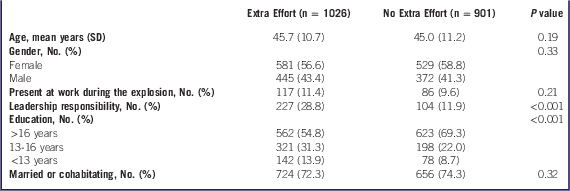
The characteristics of the respondents who had performed extra effort or no extra effort in the aftermath of the bomb explosion are shown in Table 1. Approximately half of the employees had performed extra effort. The group that had performed extra effort following the bomb explosion comprised more leaders and employees with low education levels than in the group that did not perform extra effort. There were no significant differences between the groups according to age, sex, marital status, or exposure to the bomb explosion.
Characteristics of Government Employees Who Performed Extra Effort or No Extra Effort at Work, 10 Months After the Oslo Bombing (N=1927)Footnote a

a Abbreviation: PTSD, post-traumatic stress disorder.
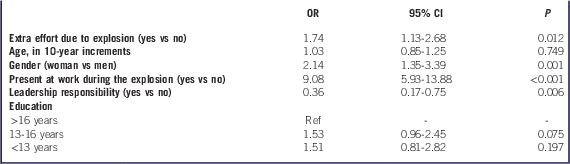
Of the 1927 employees in this study, 113 fulfilled the criteria for PTSD (5.9%). This number included 74 of 1026 (7.2%) who had performed extra effort, and 39 of 901 (4.3%) who had not performed extra effort. Thus, employees who had performed extra effort displayed increased risk for PTSD (odds ratio [OR]=1.71, 95% confidence interval [CI]: 1.15-2.55, P=0.008). This result was similar after adjustment for sex, age, educational level, leadership responsibility, and whether the employee was present at work during the bomb explosion (Table 2). There were no significant interactions between extra effort and the other variables in the regression.
Association Between Performing Extra Effort due to the Bomb Explosion and Risk of PTSD for Government Employees (N=1927) after the Oslo BombingFootnote a

a Abbreviations: CI, confidence interval; OR, odds ratio; PTSD, post-traumatic stress disorder. Results were adjusted for confounders. There were no significant interactions between performing extra effort at work and the other variables in the regression analysis.
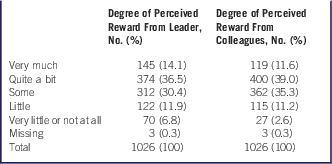
For those in the extra effort group (n=1026), perceived reward for their effort from a leader or colleagues is shown in Table 3. Half of the employees experienced very much or quite a bit of reward from the leader. Also, half of the employees experienced very much or quite a bit of reward from their colleagues.
Degree of Perceived Reward From a Leader or Colleagues for Government Employees Who Performed Extra Effort due to the Bomb Explosion (N=1026)

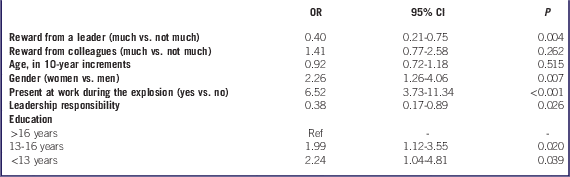
Perceived reward from the leader was associated with lower risk for PTSD (OR=0.39, 95% CI: 0.23-0.64, P<0.001); perceived reward from colleagues was not significantly associated with lower risk of PTSD (OR=0.72, 95% CI: 0.45-1.17, P=0.18). These results were similar after adjustment for sex, age, educational level, leadership responsibility, and whether the employee was present at work during the bomb explosion (Table 4). There were no significant interactions between reward from the leader or colleagues and the other variables in the regression.
Associations Between Reward for Extra Effort due to the Bomb Explosion and Risk of PTSD in Government Employees (N=1026) After the Oslo BombingFootnote a

a Abbreviations: CI, confidence interval; OR, odds ratio; PTSD, post-traumatic stress disorder. Results were adjusted for confounders. There were no significant interactions between reward from a leader or colleagues and the other variables in the regression analysis.
Discussion
This study demonstrated that extra effort at work was associated with increased risk for PTSD among ministerial employees in the aftermath of the 2011 Oslo Bombing. Among employees who had performed extra effort in the aftermath of the incident, perceived reward from a leader reduced the risk of PTSD.
To our knowledge, this is the first study to demonstrate that the risk of PTSD increases among individuals who perform extra effort at work in the aftermath of a workplace terror attack. Our findings may be consistent with earlier studies that demonstrated an increased risk of PTSD among employees in the New York City metropolitan area with high perceived work stress after the September 11 attacks.Reference Nandi, Galea and Tracy 22 It is likely that the extra effort represents an additional burden that makes the individuals more susceptible to stress reactions; moreover, this association resembles the well-established association between high workloads or long hours and adverse mental health effects, like anxiety and depression.Reference Bannai and Tamakoshi 23
We found that rewards for the extra effort from a leader reduced the risk of PTSD. This finding is consistent with reports that high effort combined with low reward is a risk factor for mental health disorders.Reference Stansfeld and Candy 3 Thus, our findings highlight the importance of the ERI Model.Reference Weathers, Litz and Herman 20 In the aftermath of a workplace terror attack, the employees may be highly vulnerable as a result of high workloads, and the importance of reward from a leader appears to be crucial for avoiding post-traumatic stress. Anecdotal reports from the aftermath of the Oslo Bombing have described employees who quit work or struggled to thrive at work owing to the high effort required combined with insufficient perceived reward from a leader.
The importance of reward from a leader may also be consistent with findings among military personnel and rescue workers, where it has been shown that support from a supervisor reduces the risk of PTSD.Reference Jones, Seddon and Fear 24 - Reference van der Ploeg and Kleber 27 Good leadership may influence group cohesion and reduce post-traumatic stress.Reference Booth-Kewley, Schmied and Highfill-McRoy 28 - Reference Du Preez, Sundin and Wessely 30 Our findings also reflect the well-documented effects of good leadership, which reduces sickness, absences, and disability pensions and promotes job satisfaction and job well-being.Reference Kuoppale, Lamminpää and Liira 31
Lack of reward from a leader after performing extra effort might influence the sense of meaning a person feels in the work. According to Janoff-Bulman, a traumatic experience may affect a person’s previous, deeply held, global beliefs related to the meaningfulness of the world and the worthiness of the self; a change in these worldview domains may lead to trauma-related distress and psychopathology.Reference Janoff-Bulman 32 During recovery from a traumatic event, employees who perceive reward for their extra effort might feel that their work is meaningful, that they are valuable, and that other people are reliable and fair. On the other hand, employees who do not perceive reward for their extra effort might feel that the world and others are unfair and that they are not valuable; these concepts may sustain and even reinforce a breakdown in their basic assumptions.
The risk of PTSD in women was twofold the risk in men. This finding is consistent with several post-disaster studies.Reference Brewin, Andrews and Valentine 33 We found no interactions between sex and extra effort in the prediction of PTSD. Similarly, we found no interactions between sex and reward from a leader or colleagues. The associations between extra effort, reward, and PTSD were similar for men and women, which suggests that sex differences in PTSD prevalence must arise from mechanisms other than those investigated in this article. The main reasons women are at increased risk are unknown, and it is not established whether environmental or biological factors are dominant.Reference Olff, Langeland and Draijer 34 Various hypotheses have been suggested to explain women’s vulnerability to PTSD. This includes women’s and men’s mental health before the traumatic event, differences in how traumatic events are interpreted and experienced, differences in social support after trauma, and how psychological distress is reported.Reference Olff, Langeland and Draijer 34 , Reference Breslau 35
The present study had some limitations. Data were collected 10 months after the event, and both effort and reward were assessed only by self-reported measures. The diagnosis of PTSD was determined by a self-reported instrument (PCL) and not by clinical diagnosis. However, the Norwegian version of the PCL has been shown to perform well as a diagnostic instrument for detecting PTSD in epidemiological research.Reference Hem, Hussain and Wentzel-Larsen 18 We did not consider fulfilment of the DSM A criteria, but only took into account the burden of symptoms. All staff members employed in the Ministries at the time of the explosion were asked to participate in the study. This approach reduced the sample selection bias. However, with a 56% response rate, we could not exclude the possibility of a response bias. Our study sample comprised a working population with above-average socioeconomic status, which are factors known to protect from psychopathology.Reference Brewin, Andrews and Valentine 33 Thus, our study sample was probably not confounded by high rates of preexisting psychopathology or other risk factors for PTSD. Owing to the cross-sectional design, it is difficult to draw any conclusions related to causality.
This study demonstrated that working populations exposed to traumatic events face potential health adversities due to high workloads, but that reward from a leader can reduce the risk of PTSD. Future research should aim to assess more specifically what underlies the concept of perceived reward from a leader. That type of information can point to factors that protect against mental health problems after a traumatic event and potentially contribute to extending the ERI Model.
Conclusions
-
1. Extra effort in the aftermath of a terror attack may increase the risk of PTSD.
-
2. Perceived reward from a leader might reduce the risk of PTSD among those performing extra effort.
-
3. The ERI Model may add a theoretical contribution for understanding the etiology of work-related PTSD.