Nonsuicidal self-injury (NSSI) is the intentional self-inflicted destruction of body tissue, performed without suicidal intent, using methods that are not socially sanctioned (e.g., cutting, burning, hitting, or trying to break one's own bones; Nixon & Heath, Reference Nixon, Heath, Nixon and Heath2009; Nock & Favazza, Reference Nock, Favazza and Nock2009). NSSI occurs in the absence of other psychiatric diagnosis (Selby, Bender, Gordon, Nock, & Joiner, Reference Selby, Bender, Gordon, Nock and Joiner2012) and independently of suicide attempts (Butler & Malone, Reference Butler and Malone2013), with recent reviews highlighting lifetime prevalence rates between 4% and 38% in high school and university student samples (Brunner et al., Reference Brunner, Kaess, Parzer, Fischer, Carli, Hoven and Wasserman2014; Heath, Schaub, Holly, & Nixon, Reference Heath, Schaub, Holly, Nixon, Nixon and Heath2009; Muehlenkamp, Claes, Havertape, & Plener, Reference Muehlenkamp, Claes, Havertape and Plener2012). NSSI serves primarily as a means of regulating negative affect, though other functions including to exert social/interpersonal influence and to generate feeling are also consistently reported (see Klonsky, Reference Klonsky2007, for a review). Self-injurers are believed to have a limited understanding of emotional experience, and access to fewer appropriate coping strategies by which to reduce subjective negative emotional experience (Nock, Reference Nock2008). From a social/interpersonal function perspective, NSSI may serve as a communicative behavior in order to obtain caregiving from a social other (i.e., caregiver or romantic partner) who is otherwise inattentive or inconsistent in his or her provision of care (Nock, Reference Nock2008).
NSSI behavior is believed to reflect one possible manifestation of dysregulated emotion resulting from inadequate early care from primary caregivers (Linehan, Reference Linehan1993; Yates, Reference Yates and Nock2009). As such, researchers have highlighted the salience of disruptions in early attachment relationships (i.e., through parental loss via prolonged separation, death, or abandonment; van der Kolk, Perry, & Herman, Reference van der Kolk, Perry and Herman1991; Walsh, Reference Walsh2006) as key risk factors for NSSI. Additional theory (see Yates, Reference Yates and Nock2009) using developmental psychopathology as a framework to study NSSI behavior further emphasizes the proposed association between NSSI and attachment, particularly given the role of secure attachment in the development of optimal regulation of emotional distress throughout the life span and, conversely, the risk that insecure attachment generates for subsequent emotional dysregulation (see Carlson & Sroufe, Reference Carlson, Sroufe, Cicchetti and Cohen1995). Although the only two investigations addressing prospective links between insecure (e.g., disorganized) attachment in infancy and NSSI in early adulthood have yielded nonsignificant associations (Lyons-Ruth, Bureau, Holmes, Easterbrooks, & Brooks, Reference Lyons-Ruth, Bureau, Holmes, Easterbrooks and Brooks2013; Yates, Reference Yates2005), scholars emphasize that adults’ insecure representations of early attachment relationships may be especially influential in the development of self-harming behavior (see Adam, Reference Adam, Sperling and Berman1994; Farber, Reference Farber2000, Reference Farber2008; van der Kolk et al., Reference van der Kolk, Perry and Herman1991). As such, the current investigation represents the first aimed at estimating associations between young adults’ attachment states of mind regarding primary caregivers and NSSI behavior.
Attachment States of Mind and the Adult Attachment Interview (AAI)
The AAI (George, Kaplan, & Main, Reference George, Kaplan and Main1996/1985) is a well-established, valid, and reliable assessment of adult attachment states of mind regarding childhood primary caregivers. The AAI requires individuals to discuss their early relationships with primary caregivers, their experiences of loss and abuse, and their current perspectives regarding these relationships and experiences. The main goal of this process is for individuals to access and reflect upon early memories, some of which may be painful or traumatic, and to create a narrative history of these memories that is free of contradictions and demonstrates a coherent depiction of perceived events and their impact upon the self (Hesse, Reference Hesse, Cassidy and Shaver2008). The AAI has traditionally been coded to yield one of four classifications (Main, Goldwyn, & Hesse, Reference Main, Goldwyn and Hesse2002; see also Main, Hesse, & Goldwyn, Reference Main, Hesse, Goldwyn, Steele and Steele2008). Autonomous (i.e., secure) interviews are rated as such based on the speaker's concise, coherent discussion of either negative or positive caregiving experiences. Interviews in which the speaker minimizes or denies the impact of negative experiences are classified as dismissing. Individuals who overemphasize negative experiences with parents, or who discuss such memories in anger or with passive, convoluted speech patterns are rated as having a preoccupied state of mind. Finally, unresolved states of mind are assigned when speakers fail to maintain an organized discourse strategy when discussing experiences of either loss (e.g., death of a loved one) or trauma (e.g., abuse). Variation in the discourse style of these narratives is believed to demonstrate in part one's current strategy for coping with emotionally laden experiences (Allen, Reference Allen, Cassidy and Shaver2008; Kobak, Cole, Ferenz-Gillies, & Fleming, Reference Kobak, Cole, Ferenz-Gillies and Fleming1993).
In addition to this traditional approach, researchers have recently explored the latent structure of the AAI coding systems in several normative risk samples. These researchers have consistently identified a two-factor structure that is supported by both exploratory (Bernier, Larose, Boivin, & Soucy, Reference Bernier, Larose, Boivin and Soucy2004; Larose & Bernier, Reference Larose and Bernier2001; Roisman, Fraley, & Belsky, Reference Roisman, Fraley and Belsky2007; Tarabulsy et al., Reference Tarabulsy, Larose, Bernier, Trottier-Sylvain, Girard, Vargas and Noël2012; Whipple, Bernier, & Mageau, Reference Whipple, Bernier and Mageau2011) and confirmatory factor analysis (Haltigan, Leerkes, et al., Reference Haltigan, Leerkes, Wong, Fortuna, Roisman, Supple and Plamondon2014; Haltigan, Roisman, & Haydon, Reference Haltigan, Roisman and Haydon2014), as well as taxometric analyses (Haltigan, Roisman, et al., Reference Haltigan, Roisman and Haydon2014; Roisman et al., Reference Roisman, Fraley and Belsky2007), with one scale reflecting dismissing state of mind and a second scale reflecting preoccupied/unresolved state of mind (referred to as preoccupied for simplicity).
Despite the consistency of the factor structure of the AAI coding systems across prior research, the generalizability of this two-factor structure to populations of greater clinical risk has been called into question (van IJzendoorn & Bakermans-Kranenburg, Reference van IJzendoorn and Bakermans-Kranenburg2014; see also Roisman, Fraley, & Booth-LaForce, Reference Roisman, Fraley and Booth-LaForce2014). In the only examination of the factor structure of the AAI within a clinical sample, the same two relatively orthogonal dimensions (dismissing and preoccupied) were observed using a sample of 87 mothers, approximately half of whom had a borderline personality disorder diagnosis (BPD; Macfie, Swan, Fitzpatrick, Watkins, & Rivas, Reference Macfie, Swan, Fitzpatrick, Watkins and Rivas2014). Although Macfie et al.’s investigation provides an important first analysis of the factor structure of the AAI in a clinically at-risk population (but see Raby, Labella, Martin, Carlson, & Roisman, Reference Raby, Labella, Martin, Carlson and Roisman2017 [this issue]), these findings nonetheless require replication in additional higher risk samples.
A potential benefit of adopting a scaled measurement approach to the AAI in either normative or high-risk populations is that it facilitates analysis of the distinct correlates of dismissing and preoccupied attachment states of mind, the study of which is otherwise challenging due to small group sizes for some state of mind categories, particularly preoccupied. Existing research using this approach has demonstrated theoretically consistent divergent correlates of dismissing and preoccupied states of mind. Specifically, dismissing states of mind have been associated with the suppression of emotional distress, including low self-reported distress (Bernier et al., Reference Bernier, Larose, Boivin and Soucy2004; Fortuna, Roisman, Haydon, Groh, & Holland, Reference Fortuna, Roisman, Haydon, Groh and Holland2011; Larose & Bernier, Reference Larose and Bernier2001; Larose, Bernier, & Soucy, Reference Larose, Bernier and Soucy2005; Roisman, Tsai, & Chiang, Reference Roisman, Tsai and Chiang2004), changes in autonomic nervous system physiology suggesting behavioral inhibition during attachment-relevant tasks (i.e., electrodermal activity; Dozier & Kobak, Reference Dozier and Kobak1992; Roisman, Reference Roisman2007; Roisman et al., Reference Roisman, Tsai and Chiang2004), attentional biases away from attachment-related stimuli (Haydon, Roisman, Marks, & Fraley, Reference Haydon, Roisman, Marks and Fraley2011; Maier, Bernier, Pekrun, Zimmermann, & Grossmann, Reference Maier, Bernier, Pekrun, Zimmerman and Grossmann2004; Maier et al., Reference Maier, Bernier, Pekrun, Zimmerman, Strasser and Grossmann2005), and fewer expressions of both positive and negative affect during conflict discussions with siblings (Fortuna et al., Reference Fortuna, Roisman, Haydon, Groh and Holland2011). In contrast, preoccupied states of mind are typically related to emotional activation, such as high self-reported distress (Bernier et al., Reference Bernier, Larose, Boivin and Soucy2004; Larose & Bernier, Reference Larose and Bernier2001; Larose et al., Reference Larose, Bernier and Soucy2005; Roisman et al., Reference Roisman, Tsai and Chiang2004; Tarabulsy et al., Reference Tarabulsy, Larose, Bernier, Trottier-Sylvain, Girard, Vargas and Noël2012), greater expressivity of negative affect during conflict discussions with relational others (Fortuna et al., Reference Fortuna, Roisman, Haydon, Groh and Holland2011; Haydon, Roisman, & Burt, Reference Haydon, Roisman and Burt2012), identifying with more negative self-views (Haydon et al., Reference Haydon, Roisman, Marks and Fraley2011), and greater discrepancies in the valence of early experiences and the valence of emotion expressed during the AAI, signifying dysregulated emotional experience during the AAI (Roisman et al., Reference Roisman, Tsai and Chiang2004).
Attachment States of Mind and NSSI
The evidence reviewed above suggests the salience of preoccupied states of mind specifically to high emotionality and the dysregulation of emotional experience. These characteristics are also implicated in NSSI behavior. Higher preoccupied states of mind imply not only a failure to adequately regulate emotional distress, a key deficit reported by self-injurers (Adrian, Zeman, Erdley, Lisa, & Sim, Reference Adrian, Zeman, Erdley, Lisa and Sim2011; Martin, Bureau, Yurkowski, Lafontaine, & Cloutier, Reference Martin, Bureau, Yurkowski, Lafontaine and Cloutier2016), but also a predisposition to ruminate upon prior distressing experience (see Cole-Detke & Kobak, Reference Cole-Detke and Kobak1996). Rumination is similarly a common correlate of NSSI behavior (Selby, Franklin, Carson-Wong, & Rizvi, Reference Selby, Franklin, Carson-Wong and Rizvi2013; Voon, Hasking, & Martin, Reference Voon, Hasking and Martin2014; Zaki, Coifman, Rafaeli, Berenson, & Downey, Reference Zaki, Coifman, Rafaeli, Berenson and Downey2013). Research further suggests that self-injuring youth and young adults portray additional characteristics believed to (or shown to) underlie preoccupied (and to a lesser extent, unresolved) attachment representations. These include excessive self-reported negative emotionality and dysregulated emotional processing (Glenn, Blumenthal, Klonsky, & Hajcak, Reference Glenn, Blumenthal, Klonsky and Hajcak2011; Najmi, Wegner, & Nock, Reference Najmi, Wegner and Nock2007; Nock & Mendes, Reference Nock and Mendes2008; Plener, Bubalo, Fladung, Ludolph, & Lulé, Reference Plener, Bubalo, Fladung, Ludolph and Lulé2012), and high self- or other-focused blame and aggression (e.g., Swannell et al., Reference Swannell, Martin, Page, Hasking, Hazell, Taylor and Protani2012; Wolff et al., Reference Wolff, Frazier, Esposito-Smythers, Becker, Burke, Cataldo and Spirito2014). Additional research examining the role of maladaptive schemas regarding early caregiving experiences in NSSI has shown relations between NSSI and “angry child” (i.e., individual feels angry regarding early emotional or physical abandonment) or “punitive parent” (i.e., individual feels she or he deserves punishment) schemas regarding one's (retrospectively reported) childhood caregiving experiences (Saldias, Power, Gillander, Campbell, & Blake, Reference Saldias, Power, Gillanders, Campbell and Blake2013). Similar relations have been found between NSSI and holding intrapersonal schemas of alienation and defectiveness, and interpersonal schemas of abandonment and abuse (Quirk, Wier, Martin, & Christian, Reference Quirk, Wier, Martin and Christian2015). Although schemas regarding early experience are not synonymous with attachment states of mind, they nonetheless reflect cognitive processes by which information regarding early caregiving experiences is organized. Moreover, the specific maladaptive schemas mentioned here resemble beliefs one would conceptually expect to be held by individuals with preoccupied states of mind.
Additional empirical justification for the proposed associations between preoccupied states of mind and NSSI comes from research linking this state of mind with BPD diagnosis and suicidal behavior, with which NSSI frequently co-occurs (Cloutier, Martin, Kennedy, Nixon, & Muehlenkamp, Reference Cloutier, Martin, Kennedy, Nixon and Muehlenkamp2010; Hamza & Willoughby, Reference Hamza and Willoughby2013; Lofthouse, Muehlenkamp, & Adler, Reference Lofthouse, Muehlenkamp, Adler, Nixon and Heath2009). Meta-analytic findings pertaining to traditional (i.e., categorical) coding of the first 10,000 AAIs (Bakermans-Kranenburg & van IJzendoorn, Reference Bakermans-Kranenburg and van IJzendoorn2009) demonstrate an overrepresentation of preoccupied and unresolved (but not dismissing) states of mind in investigations regarding BPD and suicidal behavior. Moreover, when considering the individual studies included in the meta-analysis, preoccupied states of mind are consistently the most common secondary classification of individuals demonstrating unresolved states of mind (Adam, Sheldon-Keller, & West, Reference Adam, Sheldon-Keller and West1996; Barone, Reference Barone2003; Patrick, Hobson, Castle, Howard, & Maughan, Reference Patrick, Hobson, Castle, Howard and Maughan1994), further suggesting the salience of preoccupied states of mind to self-harming disorders and behavior.
The Current Study
The current research was guided by two objectives. First, given the need to replicate prior research regarding the factor structure of the AAI in a sample with psychiatric characteristics (e.g., NSSI behavior), we examined the latent structure of the AAI within a sample of young adults, half of whom reported NSSI behavior. We expected to find a factor structure comparable to what has been previously identified (e.g., Bernier et al., Reference Bernier, Larose, Boivin and Soucy2004; Haltigan, Leerkes, et al., Reference Haltigan, Leerkes, Wong, Fortuna, Roisman, Supple and Plamondon2014; Haltigan, Roisman, et al., Reference Haltigan, Roisman and Haydon2014; Larose & Bernier, Reference Larose and Bernier2001; Macfie et al., Reference Macfie, Swan, Fitzpatrick, Watkins and Rivas2014; Roisman et al., Reference Roisman, Fraley and Belsky2007; Tarabulsy et al., Reference Tarabulsy, Larose, Bernier, Trottier-Sylvain, Girard, Vargas and Noël2012; Whipple et al., Reference Whipple, Bernier and Mageau2011), featuring relatively orthogonal factors representing dismissing and preoccupied states of mind. Second, we investigated which attachment states of mind regarding caregivers were more strongly associated with NSSI. We hypothesized that preoccupied, but not dismissing, states of mind would be associated with NSSI.
Method
Participants
The sample comprised 120 young adults between the ages of 17 and 25 years (106 females; M = 20.38 years, SD = 1.98). Participants were recruited between 2010 and 2013 from a university student participant pool within the psychology department, and through external advertisements posted online (Craigslist, Kijiji) and across a university campus in eastern Canada. Exactly half (n = 60) of the participants were recruited based on reported NSSI behavior; the remaining 60 individuals had not engaged in NSSI, and were matched to members of the NSSI group based on age and sex. A majority (86.3%) of participants in the overall sample were students, with others identifying primary occupations as white-collar workers (6.0%) or unemployed (3.4%); the remaining 4.4% were blue-collar workers, self-employed, or homemakers. The majority (75%) of the sample was Caucasian, with other ethnicities such as Asian (5.9%), Black (5.9%), Latino (4.2%), and Middle Eastern (4.2%) represented at lesser frequencies; this ethnic split closely resembles the concurrent ethnic demographics of the city within which data were collected (Statistics Canada, 2011). Demographics did not differ between NSSI and control groups, except that self-injurers were less likely than expected to be students (45.5%); χ2 (1, n = 117) = 4.79, p < .05, Cramer V = 0.20.
Within the NSSI group, the average age of onset for NSSI was 13.9 years (SD = 3.39 years). Although 52.5% of the NSSI group had not self-injured in the past 6 months (endorsing only previous NSSI), 28.8% had engaged in NSSI one to five times in the past 6 months, 8.5% endorsed monthly and weekly self-injury, and 1.7% had self-injured daily. The most commonly reported methods for NSSI included cutting (70.2%), scratching (41.2%), burning (40.0%), and trying to break bones (40.0%).
Participant pool recruitment
Fifty participants (20 self-injurers) were recruited through the institution's undergraduate participant pool following participation in a larger study regarding interpersonal influences on emotional adjustment and psychological well-being. Individuals from the original study who had consented to additional contact regarding subsequent related studies were invited by e-mail or by phone to complete the current study. All participants who indicated having engaged in NSSI behavior in online questionnaires were contacted first, followed by non-self-injurers who were possible matches based on age and sex for each NSSI participant.
External advertising recruitment
The remaining 70 participants (40 self-injurers) were recruited through external advertisements. Volunteers contacted researchers by phone or e-mail for more information and were screened for age (between 17 and 25 years) and lifetime NSSI behavior. All participants who had engaged in NSSI were immediately invited to participate; those who had not engaged in NSSI were invited to participate provided they matched a participant in the NSSI group. Contact information for possible controls with no match at the time of initial contact were retained, and individuals were contacted subsequently if a suitable NSSI group match was later identified. Recruitment methods were conducted in parallel, as was recruitment of both NSSI and control groups. Featured demographics did not vary based on recruitment method, except that individuals recruited from external advertising tended to be older (M = 21.2 years, SD = 2.1 years) than those recruited through the undergraduate participant pool (M = 19.3, SD = 1.1), t (107. 46) = 6.20, p < .001, d = 1.13, and were less likely to identify being a student as their primary occupation (79.1% students) compared to those from the undergraduate participant pool (96.0% students), χ2 (1, n = 117) = 6.92, p < .01, Cramer V = 0.24.
Procedure
Participants attended a laboratory session to complete a series of questionnaires and the AAI. Given the psychological risk nature of the sample, researchers reviewed participants’ responses to the following questions prior to conducting the AAI to determine if additional risk assessment was required: have you ever thought about taking your life; have you made an attempt to take your life in the past 6 months; have you ever been treated by a medical doctor after injuring yourself on purpose; and have you ever been kept in hospital because of hurting yourself on purpose. A full risk assessment was conducted to determine if the participant was in imminent danger of extreme self-injury, or purposeful or accidental suicide if a yes response was provided for any of the questions listed above. None of the participants were deemed to be at imminent risk based on the assessments administered. Following questionnaires and risk assessment (if applicable), the AAI was completed. Participants received $20 compensation, reviewed a mental health resource sheet with the researcher following the study procedures, and were provided the contact information for the third author, who is a licensed clinical psychologist; all participants who completed the risk assessment were contacted by the first author by e-mail or phone 1 week following completion of study procedures to ensure there were no resulting ill effects of participation.
Measures
Attachment states of mind
Current attachment states of mind regarding childhood caregivers were assessed using the AAI (George et al., Reference George, Kaplan and Main1996/1985). Verbatim transcripts of the interviews were coded using the system outlined by Main et al. (Reference Main, Goldwyn and Hesse2002) by trained and reliable coders who were blind to NSSI status. Main et al.’s coding system consists of several rating scales regarding both inferred caregiver behavior and state of mind regarding early experiences. Each scale is rated on a 9-point scale such that scores of 1 indicate no evidence of the particular characteristic, and scores of 9 indicate a high degree of a given characteristic. Although both inferred caregiver behavior and state of mind scales were coded, only the state of mind ratings (i.e., idealization, involving anger, derogation, lack of recall, metacognitive monitoring, passivity, fear of loss, and coherence) were relevant to the current analyses. Three of these scales (idealization, involving anger, and derogation) are rated separately for mother and father.
Interrater reliability of the state of mind scales was assessed using 30 (25%) randomly selected transcripts. Acceptable reliability was evident for all rating scales with intraclass correlation coefficients ranging between 0.63 (metacognitive monitoring) and 0.98 (father involving anger). Cases for which rating scores did not match were conferenced; none of the corresponding changes in scores resulted in a modification of more than 1 point on the 9-point scale, and none resulted in a change in classification using the traditional scoring system.
NSSI
Both lifetime occurrence of NSSI and frequency of recent NSSI (within the past 6 months) were assessed using the Ottawa Self-Injury Inventory (Martin et al., Reference Martin, Cloutier, Levesque, Bureau, Lafonatine and Nixon2013; Nixon, Levesque, Preyde, Vanderkooy, & Cloutier, Reference Nixon, Levesque, Preyde, Vanderkooy and Cloutier2015). Lifetime engagement of NSSI was measured by responses to “have you ever in your lifetime purposefully hurt yourself without the intention of killing yourself,” to which participants responded yes or no; this represented the outcome variable for primary analyses. The frequency of recent NSSI (during previous 6 months) was determined by answers to “how often in the past 6 months have you actually injured yourself without the intention to kill yourself?” Responses were rated on a 5-point scale (not at all, 1–5 times, monthly, weekly, or daily); frequency of recent NSSI was used solely for descriptive purposes due to low incidence of recent NSSI within the previous 6 months within this sample.
Covariates and demographic variables
All participants completed a sociodemographic questionnaire, including items regarding primary occupation, living arrangements (i.e., with parents or not with parents), and ethnicity (1 = Caucasian, 0 = other ethnicity), which were used either as potential covariates or for descriptive purposes.
Results
The factor structure of the AAI
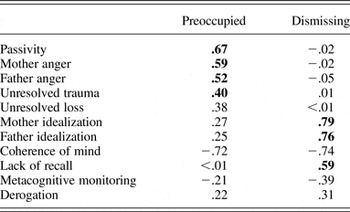
An exploratory factor analysis with direct oblimin rotation was used to examine the factor structure of the AAI within this partly at-risk sample. The following 11 state of mind subscales were initially included in this analysis: mother idealization, father idealization, mother anger, father anger, derogation, lack of recall, metacognitive monitoring, passivity, unresolved loss, unresolved trauma, and coherence of mind; fear of loss was excluded due to 0 variance. Examination of the scree plot (Nunnally & Bernstein, Reference Nunnally and Bernstein1994) and parallel analysis (Fabrigar, Wegener, MacCallum, & Strahan, Reference Fabrigar, Wegener, MacCallum and Strahan1999) were used to determine the number of factors to extract. Both methods suggested a two-factor solution best fit the data (Table 1). The first factor was composed of scales representing preoccupied states of mind, including mother involving anger, father involving anger, and passivity; ratings for unresolved trauma also loaded primarily on this factor. The second factor represented dismissing states of mind and included mother idealization, father idealization, and lack of recall rating scales. Metacognitive monitoring, derogation, and unresolved loss were each eliminated as their factor loadings failed to reach a threshold of 0.40 on either factor. Coherence of mind loaded at near equal magnitude on both factors, as expected given results of prior factor analyses and the fact that low scores on coherence of mind are indicative of both insecure states of mind. Thus, coherence of mind was excluded from the preoccupied and dismissing scales, similar to the practice adopted in prior research (see Haltigan, Roisman, et al., Reference Haltigan, Roisman and Haydon2014).
Exploratory factor analysis factor loadings for preoccupied and dismissing scales

Note: Bold values indicate which rating scales comprise each dimension's composite. The remaining values (unresolved loss, metacognitive monitoring, and derogation) were each excluded when creating preoccupied and dismissing composites because of factor loadings of <0.40. Coherence of mind was similarly excluded because of near equal loading across both factors. An exploratory factor analysis was also conducted separately for NSSI and control groups, yielding highly similar results. For the nonsuicidal self-injury group, the exploratory factor analysis results were identical to those presented for the overall group. For the control group, unresolved trauma was removed because of near zero variance, and derogation loaded >0.40 on the dismissing factor.
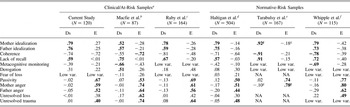
Preoccupied and dismissing scales were next calculated by averaging relevant rating scales. Scores on the preoccupied factor ranged from 1.00 to 6.83 (M = 1.92, SD = 1.12), and scores on the dismissing factor ranged from 1.00 to 6.50 (M = 2.09, SD = 1.30). Each factor demonstrated acceptable internal consistency (α = 0.6 and α = 0.8, respectively), and the two scales were weakly correlated, r = –.17, p = .06. Comparisons of AAI factor structure between the current analysis and prior exploratory analysis of normative and clinical/at-risk samples are listed in Table 2; overall, the results showed loading of AAI scales comparable to prior research across both preoccupied and dismissing scales.
Comparison of Adult Attachment Interview factor structure based on exploratory factor and principal components analyses across clinical/at-risk and normative-risk samples

Note: Ds, Dismissing scale; E, preoccupied scale; Low var., variable was excluded from exploratory factor analysis/principal component analysis (EFA/PCA) a priori because of low variability; NA, variable excluded from EFA/PCA without explicit reason provided by the authors. Bold values indicate rating scales that were used in creation of Ds and E composites within each investigation. When included in composites, coherence and metacognitive monitoring were each first reverse scored. Additional details regarding the composition of Ds and E scales within each study are listed below. The results of confirmatory factor analyses (Haltigan, Leerkes, et al., Reference Haltigan, Leerkes, Wong, Fortuna, Roisman, Supple and Plamondon2014; Haltigan, Roisman, & Haydon, Reference Haltigan, Roisman and Haydon2014) are not included here because the factor structure was defined a priori for those investigations.
a At least a portion of the analytic samples for these studies was characterized by clinical characteristics (i.e., nonsuicidal self-injury, borderline personality disorder) or higher risk (i.e., low socioeconomic status).
b Macfie, Swan, Fitzpatrick, Watkins, and Rivas (Reference Macfie, Swan, Fitzpatrick, Watkins and Rivas2014; PCA, varimax rotation).
c Raby, Labella, Martin, Carlson, and Roisman (Reference Raby, Labella, Martin, Carlson and Roisman2017 [this issue]; EFA, oblique rotation).
d Haltigan, Roisman, and Haydon (Reference Haltigan, Roisman and Haydon2014; EFA, oblique rotation). Factor loadings are reported from an EFA reanalysis of the sample in Roisman, Fraley, and Belsky (Reference Roisman, Fraley and Belsky2007); thus, the redundant PCA from Roisman et al. is excluded from the table, although similar results are reported therein.
e Tarabulsy, Larose, Bernier, Trottier-Sylvain, Girard, Vargas, and Noel (Reference Tarabulsy, Larose, Bernier, Trottier-Sylvain, Girard, Vargas and Noël2012; EFA, varimax rotation). Factor loadings are reported from an EFA reanalysis of aggregated samples from Larose and Bernier (Reference Larose and Bernier2001; PCA; N = 62); Bernier, Larose, Boivin, and Soucy (Reference Bernier, Larose, Boivin and Soucy2004); and Larose, Bernier, and Soucy (Reference Larose, Bernier and Soucy2005; PCA; N = 102); thus, the redundant PCAs from Larose and Bernier (Reference Larose and Bernier2001), Bernier et al. (Reference Bernier, Larose, Boivin and Soucy2004), and Larose et al. (Reference Larose, Bernier and Soucy2005) are excluded here, although similar results are reported therein.
f Whipple, Bernier, and Mageau (Reference Whipple, Bernier and Mageau2011; EFA, oblique rotation). Specific factor loadings are not reported in the original article; to obtain factor loading information, we contacted the authors and they provided the additional detail presented here.
g Factor loading reflects that for idealization/anger scores averaged across mother and father prior to conducting EFA.
Associations between attachment states of mind and NSSI
Prior to conducting analyses related to the study's second aim, the influences of possible covariates were explored. The potential confounding influences of age and sex were already accounted for by matching procedures during sample recruitment; thus, current living arrangements (e.g., Do you currently live with your parents?) and ethnicity were explored as potential covariates based on previously established relation with NSSI (e.g., Melendez & Melendez, Reference Melendez and Melendez2010; Tulloch, Blizzard, & Pinkus, Reference Tulloch, Blizzard and Pinkus1997). No significant associations with NSSI were found for either living arrangements, χ2 (1) = 11, p = .75, or ethnicity (Caucasian vs. non-Caucasian), χ2 (1) = 0.35, p = .56. Associations between potential covariates and AAI dimensions were also explored; age and sex were considered in these analyses as well given that their potential confounding influences on dismissing and preoccupied states of mind were not accounted for by matching procedures between NSSI and control groups. Neither dismissing (r = .15, p = .08) nor preoccupied (r = –.10, p = .29) state of mind scores were associated with whether or not participants currently lived with their parents. Ethnicity was similarly unrelated to dismissing (r = .11, p = .24) and preoccupied (r = .07, p = .44) states of mind, as were both sex (dismissing: r = –.01, p = .92; preoccupied: r = .11, p = .25) and age (dismissing: r = –.02, p = .83; preoccupied: r = –.03, p = .76). No covariates were included in analyses given the lack of associations between potential confounds and either NSSI or attachment states of mind.
Correlations were calculated to test bivariate associations between preoccupied and dismissing states of mind and NSSI. Results showed significant positive correlation between NSSI and preoccupied states of mind (r = .26, p < .01). In contrast, NSSI was trivially associated with dismissing states of mind (r = .06, p = .55). The results of a Steiger z test to further test the hypothesis that preoccupied states of mind would be more correlated with NSSI than would dismissing states of mind demonstrated that the difference in the magnitude of these correlations was marginally significant (z = 1.53, p = .06).
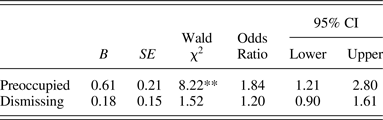
Next, a binary logistic regression was conducted to test the hypothesis that preoccupied, but not dismissing, states of mind would be uniquely associated with increased odds of having engaged in NSSI behavior. Results showed the model was a good fit to the data, omnibus χ2 (2) = 10.16, p < .01, and accounted for an estimated 11% of variance in the odds of engaging in NSSI (Nagelkerke R 2 = .108). Odds ratios (see Table 3) indicated that preoccupied states of mind were associated with significantly greater odds of having engaged in NSSI, while dismissing states of mind were not related to risk for NSSI behavior.
Nonsuicidal self-injury behavior regressed on preoccupied and dismissing states of mind

**p < .01.
Discussion
The current study had two aims. First, we sought to examine the factor structure of the AAI in a (partially) at-risk sample, as there is a scarcity of research in this regard in the current literature (see van IJzendoorn & Bakermans-Kranenburg, Reference van IJzendoorn and Bakermans-Kranenburg2014; see also Roisman et al., Reference Roisman, Fraley and Booth-LaForce2014). Second, we explored the conceptually anticipated unique association between preoccupied, but not dismissing, attachment states of mind and NSSI behavior. Results supported hypotheses, such that a factor structure similar to that reported in prior research in both normative (e.g., Bernier et al., Reference Bernier, Larose, Boivin and Soucy2004; Haltigan, Roisman, et al., Reference Haltigan, Roisman and Haydon2014; Larose & Bernier, Reference Larose and Bernier2001; Roisman et al., Reference Roisman, Fraley and Belsky2007; Whipple et al., Reference Whipple, Bernier and Mageau2011) and at-risk (Macfie et al., Reference Macfie, Swan, Fitzpatrick, Watkins and Rivas2014) samples was identified, and preoccupied states of mind were associated with increased odds of having engaged in NSSI behavior, while dismissing states of mind were not.
Existing investigations adopting a dimensional approach to AAI states of mind have featured normative-risk samples, with few exceptions (e.g., Macfie et al., Reference Macfie, Swan, Fitzpatrick, Watkins and Rivas2014; see also Raby et al., Reference Raby, Labella, Martin, Carlson and Roisman2017 [this issue]). We thus included comparisons of the current analysis with results from existing research across both normative and clinical/at-risk samples (see Table 2). These comparisons confirm that the factor structure of the AAI is nearly identical across both types of samples, which counters the argument, implicit in van IJzendoorn and Bakermans-Kranenburg's (Reference van IJzendoorn and Bakermans-Kranenburg2014) critique of dimensional approaches to the AAI, that preoccupied and unresolved states of mind should form distinct dimensions in clinical/at-risk populations. In the current sample, 12% of self-injurers qualified for preoccupied classification (i.e., were assigned a score on passivity, mother involving anger, or father involving anger of 5 or higher), and 28% qualified for an unresolved classification (i.e., were assigned an overall unresolved score of 5 or higher); the proportion eligible for preoccupied classification rose to 28% when unresolved ratings were collapsed across secondary classifications. Even higher frequencies of preoccupied and unresolved states of mind via categorical classification are reported by Macfie et al. (Reference Macfie, Swan, Fitzpatrick, Watkins and Rivas2014). Thus, although these frequencies of preoccupied and unresolved states of mind are higher than that typically found in normative samples of adolescent and undergraduate student samples (see Bakermans-Kranenburg & van IJzendoorn, Reference Bakermans-Kranenburg and van IJzendoorn2009, for a meta-analysis), analysis of the AAI rating scales within these clinical samples did not identify a factor structure that varied from that identified in normative risk populations. Instead, both the current factor analytic results and those presented by Macfie et al. (Reference Macfie, Swan, Fitzpatrick, Watkins and Rivas2014) suggest that higher base rates of preoccupied and unresolved states of mind in clinical samples do not alter the general factor structure underlying the AAI.
It is noteworthy that the similarities in the factor structure of the AAI far outweigh the differences across a growing number of investigations of both normative and nonnormative risk samples. These similarities point to a need for continued work exploring, and using, the dismissing and preoccupied scales in research of clinical and at-risk populations. In particular, additional work in this regard may further elucidate the overlap between preoccupied and unresolved states of mind identified in current and prior research. As suggested by West, Adam, Spreng, and Rose (Reference West, Adam, Spreng and Rose2001), such overlap may reflect the similarity of cognitive processes underlying preoccupied and unresolved representations. Alternatively, this overlap may demonstrate a methodological limitation of the original AAI classification system, such that preoccupied and unresolved states of mind are intrinsically linked and may not represent distinct attachment states of mind. Regardless, more research is needed using samples within which preoccupied and unresolved states of mind predominate to confirm or refute these possibilities.
The results of this research also support the hypothesis that preoccupied (but not dismissing) attachment states of mind regarding childhood primary caregivers are associated with NSSI behavior. These findings are consistent with meta-analytic distributions of attachment state of mind classifications in relevant clinical populations of individuals diagnosed with BPD and those displaying suicidal behavior (see Bakermans-Kranenburg & van IJzendoorn, Reference Bakermans-Kranenburg and van IJzendoorn2009, for a meta-analysis). The current results thus add to a growing literature suggesting that preoccupied attachment states of mind are salient to disorders in which self-harm, either suicidal or nonsuicidal, occurs. These findings also provide additional empirical support for the distinct theoretically driven correlates of dismissing and preoccupied attachment states of mind, particularly those emphasizing associations between preoccupied states of mind and tendencies toward high negative emotionality (e.g., Fortuna et al., Reference Fortuna, Roisman, Haydon, Groh and Holland2011; Haydon et al., Reference Haydon, Roisman, Marks and Fraley2011, Reference Haydon, Roisman and Burt2012). On the AAI, these tendencies are evident through continued focus upon past experience, with failure to incorporate the effects of experience into a coherent representation of self and other. These discourse strategies imply a predisposition to ruminate upon prior distressing experience (Cole-Detke & Kobak, Reference Cole-Detke and Kobak1996), which is also commonly associated with NSSI behavior (e.g., Selby et al., Reference Selby, Franklin, Carson-Wong and Rizvi2013; Zaki et al., Reference Zaki, Coifman, Rafaeli, Berenson and Downey2013). Rumination upon negative experience may trigger instances of NSSI engagement by heightening distress to overwhelming levels. Individuals with higher preoccupied states of mind may also have limited understanding of, or a less capacity to access, appropriate means with which to cope with distress, and thus engage in NSSI when feeling overwhelmed by the intensity of their emotions. Additional research examining the replicability and robustness of the identified links between NSSI and preoccupied attachment states of mind in additional samples of varying demographics is warranted.
Limitations
Despite the important findings presented herein, this investigation is not without limitations. First, although the direction of effects from preoccupied states of mind to NSSI behavior is implied in our analyses, the cross-sectional data used in this study cannot unambiguously demonstrate these effects. Second, the sample under study was predominantly composed of university students, and may not be generalizable to all populations in which NSSI occurs, some of which may be at higher risk for lower functioning (i.e., poverty or maltreatment samples recruited from the community, or samples of clinical inpatients). Third, the lack of assessment of psychological disorder in this study may further limit the generalizability of results specifically to nonclinical populations of self-injurers, as full assurance that NSSI occurred entirely absent psychiatric diagnosis was not possible. Fourth, the combined high-risk (NSSI group) and low-risk (control group) sample used in this study for the analysis of the factor structure of the AAI may limit the generalizability of these results to clinical, at-risk populations.
Conclusions and directions for future research
First, our findings, combined with those reported by Macfie et al. (Reference Macfie, Swan, Fitzpatrick, Watkins and Rivas2014), provide important support for the generalizability of the two-dimensional factor structure of the AAI to samples that are clinically at risk. Thus, additional evidence for this factor structure in clinical populations is needed, particularly through confirmatory techniques and using samples that are comprised entirely of clinically at-risk participants (as opposed to partially at risk as in the current investigation and in Macfie et al., Reference Macfie, Swan, Fitzpatrick, Watkins and Rivas2014; but see Raby et al., Reference Raby, Labella, Martin, Carlson and Roisman2017 [this issue]). Second, our findings showed that preoccupied attachment states of mind regarding primary caregivers have distinct associations with NSSI behavior, aligning with prior research that has identified a growing list of behavioral, cognitive, and affective correlates specific to preoccupied states of mind. Together, the current and prior research suggests that the differential correlates of dismissing and preoccupied states of mind can be meaningfully interpreted as conceptually relevant strategies underlying each state of mind. Given that the current investigation is the first to directly link preoccupied attachment states of mind to NSSI, as noted earlier replication of this finding is needed. Future studies of this type should draw on non-college student samples to estimate these associations in order to enhance the generalizability of current results across populations of self-injurers.
The current findings also provide an important starting point for future research to examine preoccupied attachment states of mind as one potential mechanism by which atypical early experiences may be related to NSSI behavior. Theory and research (Yates, Reference Yates2004; see Yates, Reference Yates and Nock2009, for a review) each suggest that childhood maltreatment experiences are a key developmental antecedent of NSSI behavior. Although the importance of adopting a developmental psychopathology framework to study regulatory, representational, or reactive pathways from maltreatment to NSSI behavior has been discussed (see Yates, Reference Yates and Nock2009), theoretically supported prospective empirical testing of these paths remain absent from the literature. Results of research linking childhood maltreatment with preoccupied states of mind (see Raby et al., Reference Raby, Labella, Martin, Carlson and Roisman2017 [this issue]) and of the current investigation linking preoccupied attachment states of mind with NSSI, indicate that preoccupied states of mind in particular may be a plausible mediator of the association between maltreatment and NSSI. Thus, future research should aim to test Yates's (Reference Yates and Nock2009) proposed representational path to NSSI via the hypothesis that preoccupied attachment states of mind serve as one mechanism by which childhood maltreatment experiences are associated with NSSI behavior. Research along these guidelines would provide empirical testing of an existing theory that is largely accepted throughout the field, would contribute to the existing literature regarding the developmental psychopathology of NSSI in youth and young adults, and would shed additional light upon the mechanisms by which early experience and representations of early experience are related to NSSI behavior.