Introduction
Disruptive mood dysregulation disorder (DMDD) was added to the Diagnostic and Statistical Manual of Mental Disorders, fifth edition (DSM-5) as a new diagnosis for children and adolescents (American Psychiatric Association, 2013). DMDD is characterized by severe temper tantrums and persistently angry/irritable mood that are present for at least 12 months and across contexts. DMDD cannot be diagnosed in children before the age of 6 years and must be observed by the age of 10 years. The disorder was added to DSM-5 given accumulating evidence supporting the clinical distinction between non-episodic and episodic irritability (Leibenluft, Reference Leibenluft2011). Yet, much of this research was based on severe mood dysregulation (SMD), a condition characterized by severe and chronic irritability but which also required the presence of hyperarousal symptoms, which overlap with symptoms of mania and attention-deficit/hyperactivity disorder (ADHD) (Leibenluft et al. Reference Leibenluft, Charney, Towbin, Bhangoo and Pine2003). SMD was originally conceptualized as a possible phenotype for bipolar disorder, but this has not been supported (Leibenluft, Reference Leibenluft2011). Not surprisingly, the inclusion of DMDD in DSM-5 has been controversial given that little empirical data exist on the disorder. Moreover, there has been debate as to whether the disorder affords clinical utility over and above co-morbid disorders, particularly co-occurring depression and oppositional defiant disorder (ODD) (Copeland et al. Reference Copeland, Angold, Costello and Egger2013).
Emerging research shows that although DMDD appears to be relatively common in clinical settings (26.0–30.5%) (Axelson et al. Reference Axelson, Findling, Fristad, Kowatch, Youngstrom, Horwitz, Arnold, Frazier, Ryan, Demeter, Gill, Hauser-Harrington, Depew, Kennedy, Gron, Rowles and Birmaher2012; Margulies et al. Reference Margulies, Weintraub, Basile, Grover and Carlson2012), it is fairly uncommon in community samples with 3-month prevalence rates ranging from 0.8 to 3.3% in 2- to 17-year-old children from the Great Smoky Mountain Study (Copeland et al. Reference Copeland, Angold, Costello and Egger2013) and 8.2% in 6-year-old children from the Stony Brook Temperament Study (Dougherty et al. Reference Dougherty, Smith, Bufferd, Carlson, Stringaris, Leibenluft and Klein2014). Both community-based studies demonstrate that DMDD frequently co-occurs with another disorder; rates of co-occurrence ranged from 60.5 to 92.0%, and the highest rates of co-occurrence were with depression and ODD (Copeland et al. Reference Copeland, Angold, Costello and Egger2013; Dougherty et al. Reference Dougherty, Smith, Bufferd, Carlson, Stringaris, Leibenluft and Klein2014). DMDD was also concurrently associated with elevated rates of psychosocial impairment, difficult child temperament, family and peer problems, school suspension, service use and poverty (Copeland et al. Reference Copeland, Angold, Costello and Egger2013; Dougherty et al. Reference Dougherty, Smith, Bufferd, Carlson, Stringaris, Leibenluft and Klein2014). Dougherty et al. (Reference Dougherty, Smith, Bufferd, Carlson, Stringaris, Leibenluft and Klein2014) also provided the first data on early childhood predictors of DMDD, which included age 3 years diagnoses of ADHD and ODD, difficult child temperament, and environments characterized by problematic parenting and parental psychopathology.
Community-based longitudinal studies of DMDD are sparse. A few studies have examined the long-term adult psychiatric outcomes of SMD and chronic irritability (Brotman et al. Reference Brotman, Schmajuk, Rich, Dickstein, Guyer, Costello, Egger, Angold, Pine and Leibenluft2006; Leibenluft et al. Reference Leibenluft, Cohen, Gorrindo, Brook and Pine2006; Stringaris et al. Reference Stringaris, Cohen, Pine and Leibenluft2009). These findings generally support that SMD and/or chronic irritability in youth aged 10–13 years increase risk for depression, anxiety and functional impairment in adulthood. Using the same sample reported in Brotman et al. (Reference Brotman, Schmajuk, Rich, Dickstein, Guyer, Costello, Egger, Angold, Pine and Leibenluft2006), Copeland et al. (Reference Copeland, Shanahan, Egger, Angold and Costello2014) applied the DSM-5 DMDD criteria to children aged 10–16 years and examined adult outcomes. Relative to non-case and psychiatric comparison subjects, youth with DMDD were at higher risk for meeting criteria for adult depressive and anxiety disorders, and having poorer health, legal, financial, educational and social functioning than non-case comparison subjects. Rather strikingly, the high rate of co-morbidity in youth with DMDD persisted into adulthood, with rates of co-morbidity five and seven times higher than non-case and psychiatric comparison subjects, respectively. These initial findings provide compelling evidence that youth with DMDD have a poor long-term course. However, a number of issues require further exploration.
First, no study to date has examined DMDD, or even SMD, from early childhood to pre-adolescence. This is particularly important as DMDD can be diagnosed in children as young as the age of 6 years, and the persistent irritability and angry affect that characterize DMDD probably contribute to significant impairment in children's expanding social and academic success, two fundamental domains of childhood. Moreover, DMDD may play a role in the development and course of other forms of child and adolescent psychopathology. Hence, longitudinal studies beginning in early childhood are needed to illuminate these processes.
Second, given the high rates of co-morbidity observed for DMDD, a major critique of the new diagnosis is that DMDD may merely be a category for diagnostically complex children with multiple co-morbid conditions. Thus, it is unknown whether a diagnosis of DMDD affords any clinical utility in predicting the longitudinal course of psychopathology over and above co-morbid disorders. Nevertheless, previous findings demonstrate that DMDD is associated with significant concurrent functional impairment even after accounting for co-morbid conditions, suggesting that DMDD may contribute additional prognostic information over and above other diagnoses (Dougherty et al. Reference Dougherty, Smith, Bufferd, Carlson, Stringaris, Leibenluft and Klein2014).
The present study investigated DMDD in 6-year old children using data from the Stony Brook Temperament Study (Olino et al. Reference Olino, Klein, Dyson, Rose and Durbin2010), a large community-based study of young children followed from the age of 3 to 9 years. Previously, we reported on the concurrent correlates and early childhood predictors of DMDD at the age of 6 years (see Dougherty et al. Reference Dougherty, Smith, Bufferd, Carlson, Stringaris, Leibenluft and Klein2014). In this report, we extended these findings and tested the longitudinal associations between DMDD at the age of 6 years and clinical and functional outcomes at the age of 9 years. We examined whether DMDD assessed at the age of 6 years predicts psychiatric disorders and symptoms, functional impairment, peer relations, and psychiatric and educational service use at the age of 9 years, both in models adjusting for demographic covariates only and in models adjusting for demographic covariates and all psychiatric disorders at the age of 6 years. Based on the limited longitudinal research on DMDD and the broader literature on SMD and chronic irritability, we hypothesized that DMDD at the age of 6 years would predict DMDD, depressive and anxiety disorders, greater functional impairment, peer problems, and psychiatric and educational service use at the age of 9 years, even after accounting for demographic covariates and psychiatric disorders at the age of 6 years. In addition, we hypothesized that DMDD would predict childhood externalizing disorders, given the frequent co-occurrence between DMDD and externalizing psychopathology (Copeland et al. Reference Copeland, Angold, Costello and Egger2013; Dougherty et al. Reference Dougherty, Smith, Bufferd, Carlson, Stringaris, Leibenluft and Klein2014). Lastly, to provide a highly stringent test of the specificity and clinical utility of DMDD, we examined whether associations between age 6 years DMDD and age 9 years outcomes persisted after controlling for demographic covariates, all psychiatric disorders at the age of 6 years, and concurrent diagnoses at the age of 9 years.
Method
Participants
The Stony Brook Temperament Study is a longitudinal study investigating the role of early temperament on the development of psychiatric disorders (Olino et al. Reference Olino, Klein, Dyson, Rose and Durbin2010). We recruited families with a 3-year-old child living within 20 contiguous miles (32 km) of Stony Brook University. Potential participants were identified via a commercial mailing list; eligible families had a child between 3 and 4 years of age with no significant medical conditions or developmental disabilities, and at least one English-speaking biological parent. Of the 815 families who were identified as potentially eligible, 559 entered the study and 541 (96.8%) provided child diagnostic information (see Bufferd et al. Reference Bufferd, Dougherty, Carlson and Klein2011). There were no significant differences between families who did and did not participate on demographic variables. The study was approved by the human subjects review committee. Informed consent was obtained from parents, and child assent was obtained at the age of 9 years.
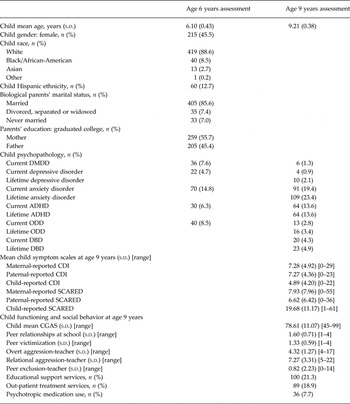
Participants were assessed at the ages of 3, 6 and 9 years. At the age 6 years assessment, an additional 50 minority/non-white participants were recruited to increase the diversity of the sample. Findings on the age 3 years predictors of DMDD assessed at the age of 6 years have been reported previously (Dougherty et al. Reference Dougherty, Smith, Bufferd, Carlson, Stringaris, Leibenluft and Klein2014). The current report focuses on the age 9 years outcomes of DMDD assessed at the age of 6 years. At the age of 6 years, 516 parents were interviewed regarding their 6-year-old child (mean = 6.1, s.d. = 0.4 years). Of the 516 families, 473 (91.7%) participated in the age 9 years wave (mean = 9.2 years, s.d. = 0.4): 470 parents and children completed a diagnostic clinical interview; 467 families completed questionnaires about the child's depressive and anxiety symptoms; and 300 teachers completed peer functioning measures. Families who participated at the ages of 6 and 9 years did not differ from those who participated at the age of 6 years but not at the age of 9 years on any of the variables in this paper. See Table 1 for sample characteristics and online Supplementary material for attrition analyses.
Characteristics of the study sample (n = 473)

s.d., Standard deviation; DMDD, disruptive mood dysregulation disorder; ADHD, attention-deficit/hyperactivity disorder; ODD, oppositional defiant disorder; DBD, disruptive behavior disorder; CDI, Child Depression Inventory; SCARED, Screen for Child Anxiety Related Disorders; CGAS, Children's Global Assessment Scale.
Age 6 years assessment
DMDD
Primary caregivers were interviewed regarding their child's psychopathology using the Preschool Age Psychiatric Assessment (PAPA; Egger et al. Reference Egger, Ascher and Angold1999). A 3-month primary period was used to enhance recall, but symptom onset dates were obtained for all criteria. Although the PAPA was not designed to assess DMDD, consistent with Copeland et al. (Reference Copeland, Angold, Costello and Egger2013) it contained information needed to rate DSM-5 DMDD criteria. As described elsewhere (Dougherty et al. Reference Dougherty, Smith, Bufferd, Carlson, Stringaris, Leibenluft and Klein2014), criteria A and B (recurrent/severe temper outbursts) were defined using items from the ODD section assessing temper tantrums/outbursts occurring at least three times per week (criterion C). Chronically irritable/angry mood between temper outbursts (criterion D) was coded using items from the depression section on whether the child was prone to feelings of anger, irritability, annoyance or low frustration tolerance more days than not (⩾45 times in the past 3 months). Based on age-of-onset questions, we determined whether frequent temper outbursts and chronically irritable/angry mood had been present for 12 months or more (criterion E). Based on setting information, temper outbursts and chronically irritable/angry mood had to occur in at least two settings (criterion F). Children were assessed at the age of 6 years; thus age-of-onset criteria were met (criteria G and H). Criteria I and J involve exclusions for a history of mania, bipolar disorder and intermittent explosive disorder. Based on the Kiddie-Schedule of Affective Disorders and Schizophrenia (K-SADS) (described below), no child met criteria for lifetime bipolar spectrum disorders or for lifetime mania or hypomania. Using these criteria, 36 (7.6%) 6-year-old children met criteria for DMDD.
Child psychiatric disorders
As described elsewhere (Bufferd et al. Reference Bufferd, Dougherty, Carlson, Rose and Klein2012), Diagnostic and Statistical Manual of Mental Disorders, 4th edition, text revision (DSM-IV-TR) disorders in the previous 3 months were assessed with the PAPA at age 6 years and included: any depressive disorder [major depressive disorder (MDD) using modified criteria for preschoolers (Luby et al. Reference Luby, Mrakotsky, Heffelfinger, Brown, Hessler and Spitznagel2003), dysthymic disorder, or depression not otherwise specified (NOS)]; any anxiety disorder [specific phobia, separation anxiety disorder, social phobia, generalized anxiety disorder (GAD), agoraphobia, selective mutism]; ADHD; and ODD. Inter-rater reliability for all diagnoses was good (κ's = 0.64–0.89).
Age 9 years assessment
Child psychiatric disorders
In all, 470 parents and their children were interviewed using the Present and Lifetime version of the K-SADS (K-SADS-PL; Axelson et al. Reference Axelson, Birmaher, Zelazny, Kaufman and Gill2009). Doctoral students in clinical psychology and a master's-level clinician administered the K-SADS first to the parent and then to the child. Summary ratings for each symptom were derived based on the combination of parent and child reports. Interviewers were unaware of the age 6 years data. All cases with a K-SADS diagnosis were reviewed in a case conference co-led by a child psychiatrist and a clinical psychologist. Current and lifetime diagnoses were derived for the following DSM-IV-TR psychiatric disorders: any depressive disorder (MDD, dysthymic disorder, depressive disorder-NOS); any anxiety disorder (specific phobia, social phobia, separation anxiety, GAD, panic, agoraphobia, obsessive–compulsive, post-traumatic stress, acute stress, anxiety disorder-NOS); any ADHD (ADHD-inattentive, hyperactivity or combined type, ADHD-NOS); and any disruptive behavior disorder (DBD) (ODD, conduct disorder, DBD-NOS). Current symptoms of any depression (α = 0.84), anxiety (α = 0.85), ADHD (α = 0.86) and DBD (α = 0.73) were rated on a three-point scale (0 = not present; 1 = subthreshold; 2 = threshold) and were summed to create dimensional scores. A second rater derived ratings from 74 videotaped interviews to assess inter-rater reliability. Inter-rater reliability for lifetime diagnoses (κ = 0.58–0.85) and dimensional scores [intraclass correlation (ICC) = 0.77–0.97] were acceptable.
The DMDD diagnosis was not proposed at the time of the K-SADS interviews; however, Axelson et al. (Reference Axelson, Findling, Fristad, Kowatch, Youngstrom, Horwitz, Arnold, Frazier, Ryan, Demeter, Gill, Hauser-Harrington, Depew, Kennedy, Gron, Rowles and Birmaher2012) previously operationalized a current DMDD diagnosis using items from the K-SADS (see online Supplementary material).
Child depressive and anxiety symptoms
At the age of 9 years, 467 mothers (α = 0.79, 17 items), 405 fathers (α = 0.76, 17 items) and 463 children (α = 0.74, 27 items) completed the Child Depression Inventory (CDI; Kovacs, Reference Kovacs1992), and 467 mothers (α = 0.90), 404 fathers (α = 0.88) and 463 children (α = 0.73) completed the 41-item Screen for Child Anxiety Related Disorders (SCARED; Birmaher et al. Reference Birmaher, Brent, Chiappetta, Bridge, Monga and Baugher1999) to assess children's current depressive and anxiety symptoms, respectively. Correlations between maternal- and paternal-reported CDI and SCARED scores were 0.44 and 0.58, respectively. Correlations ranged from 0.09 to 0.22 between either maternal or paternal and youth reports.
Functional impairment
The K-SADS interviewer completed the Children's Global Assessment Scale (CGAS) following the administration of the K-SADS. The CGAS is a global measure of children's level of functioning (Shaffer et al. Reference Shaffer, Gould, Brasic, Ambrosini, Fisher, Bird and Aluwahlia1983). Scores range from 0 to 100, where 0 indicates the worst functioning and 100 indicates superior functioning. The inter-rater reliability (ICC) for the CGAS was 0.56.
Service use
The K-SADS interviewer assessed whether the child ever received psychotherapy or was prescribed psychotropic medication for a mental health problem. In addition, the interviewer assessed whether the child currently receives educational support services, which included emotional or learning support in the classroom, a full- or part-time classroom aid, special education accommodations, reading room resources and/or tutoring.
Peer functioning
The K-SADS interviewer rated the child's peer relationships at school on a four-point scale from 1 (excellent) to 4 (poor) and how often the child is victimized or bullied by peers on a four-point scale from 1 (never) to 4 (very often). In addition, 300 teachers reported on children's peer aggression using two subscales from the Children's Social Behavior Scale-Teacher Version (CSBS-T; Crick, Reference Crick1996). The CSBS-relational aggression scale (five items, α = 0.89) assesses whether the child excludes or socially manipulates peers by using his/her relationship with the victim as the vehicle for harm (e.g. ‘when mad at a peer, this child ignores the peer’). The CSBS-overt aggression scale (four items, α = 0.86) assesses whether the child attempts or threatens to harm another child's physical well-being (e.g. ‘this child initiates physical fights with peers’). Each item was rated on a five-point scale ranging from 1 (never true) to 5 (almost always true). Also, 299 teachers completed the Excluded by Peers scale (seven items, α = 94) from the Child Behavior Scale (Ladd & Profilet, Reference Ladd and Profilet1996), which assesses whether the child is ignored, avoided or excluded by peers. Each item was rated on a three-point scale from 1 (does not apply) to 3 (certainly applies).
Data analyses
Binary logistic regression analyses were conducted to examine longitudinal associations between DMDD at the age of 6 years and psychiatric diagnoses at the age of 9 years (DMDD, any depressive disorder, any anxiety disorder, DBD and ADHD). Odds ratios (ORs) provide the effect size estimate. Separate models were run for each of the current and lifetime diagnoses. DMDD diagnosis was entered as the independent variable. Models included child's current age, gender and parental education as covariates if they were significantly associated with the outcome variableFootnote 1 Footnote †. Linear regression analyses were used to examine longitudinal associations between DMDD at the age of 6 years and symptoms scales at the age of 9 years. We report models adjusted for significant demographic covariates only and models adjusted for significant demographic covariates and all psychiatric disorders at the age of 6 years (any depressive disorder, any anxiety disorder, ODD and ADHD). Finally, as the most stringent and conservative test of the predictive validity of a DMDD diagnosis at the age of 6 years on outcomes at the age of 9 years, all models were rerun adjusting for significant demographic covariates, all age 6 years psychiatric disorders, and age 9 years co-morbid psychiatric disorders to account for prior diagnoses and co-morbid diagnoses on age 9 years outcomesFootnote 2 . When the outcome was a current age 9 years diagnosis or symptom scale, we controlled for current age 9 years co-morbid diagnoses, and when the outcome was a lifetime diagnosis assessed at the age of 9 years, we controlled for co-morbid lifetime diagnoses.
Linear regression analyses were used to examine longitudinal associations between DMDD at the age of 6 years and functional impairment and peer functioning at the age of 9 years. Logistic regression analyses were used to examine longitudinal associations between DMDD and educational support services, out-patient treatment and medication use. We report models adjusted for significant demographic covariates only and models adjusted for significant demographic covariates and all age 6 years psychiatric disorders. Lastly, all models were rerun adjusting for significant demographic covariates, all age 6 years psychiatric disorders, and all age 9 years current psychiatric disorders on children's functional impairment, peer functioning, and service use at the age of 9 years.
Results
Child gender and age and parental education were examined as covariates. Boys were more likely to meet criteria for current and lifetime ADHD and DBD, receive educational services, and have greater maternal, paternal and youth-reported CDI scores, higher teacher-rated overt aggression, and lower CGAS scores at the age of 9 years than girls; girls had greater maternal-rated SCARED scores than boys. If neither parent had a 4-year college degree, children were more likely to meet criteria for current and lifetime DBD and receive educational services, and have greater maternal-rated CDI and SCARED scores, youth-reported SCARED scores, poorer peer relations at school, and lower CGAS scores at the age of 9 years than children with at least one parent with a 4-year college degree. No significant associations were observed for child current age.
DMDD stability
At the age of 6 years, 36 (7.6%) met criteria for DMDD using the PAPA. At the age of 9 years, six (1.3%) met criteria for DMDD using the K-SADS. Five children (13.9%) who had a DMDD diagnosis at the age of 6 years continued to meet criteria for DMDD at the age of 9 years; thus, 83.3% of children who met criteria for DMDD at the age of 9 years also met criteria for DMDD at the age of 6 years. DMDD at the age of 6 years significantly predicted DMDD at the age of 9 years [OR = 69.84, 95% confidence interval (CI) 7.91–616.42, p < 0.001]; controlling for significant demographic covariates and all psychiatric disorders at the age of 6 years, there was a marginally significant association between DMDD at the age of 6 years and DMDD at the age of 9 years (OR = 14.97, 95% CI 1.00–218.22, p = 0.05).
DMDD at the age of 6 years as predictor of psychiatric disorders at the age of 9 years
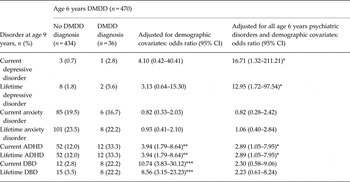
Table 2 shows associations between DMDD at the age of 6 years and current and lifetime disorders at the age of 9 years. In models adjusted for demographic covariates, DMDD at the age of 6 years significantly predicted current and lifetime ADHD and DBD at the age of 9 years. After controlling for demographic covariates and all age 6 years psychiatric disorders, DMDD at the age of 6 years significantly predicted current and lifetime depressive disorder and current and lifetime ADHD at the age of 9 years. After controlling for demographic covariates, all age 6 years psychiatric disorders, and all age 9 years co-morbid psychiatric disorders, DMDD at the age of 6 years continued to predict current (OR = 21.81, 95% CI 1.36–349.30, p = 0.03) and lifetime (OR = 20.40, 95% CI 2.08–200.49, p = 0.01) depressive disorder, and there were trends for current (OR = 2.87, 95% CI 0.95–8.65, p = 0.06) and lifetime (OR = 2.78, 95% CI 0.95–8.10, p = 0.06) ADHD.
DMDD at the age of 6 years as predictor of DSM-IV disorders at the age of 9 years a

DMDD, Disruptive mood dysregulation disorder; DSM-IV, Diagnostic and Statistical Manual of Mental Disorders, 4th edition; CI, confidence interval; ADHD, attention-deficit/hyperactivity disorder; DBD, disruptive behavior disorder.
a Demographic variables (age, gender, parental education) were included as covariates only if they were significantly associated with the outcome variable.
* p < 0.05, ** p < 0.01, *** p < 0.001.
DMDD at the age of 6 years as predictor of psychiatric symptoms at the age of 9 years
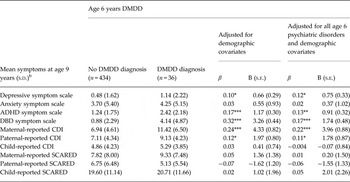
Table 3 shows associations between DMDD at the age of 6 years and children's current psychiatric symptoms at the age of 9 years. In models adjusted for demographic covariates only and for models adjusted for demographic covariates and all age 6 years psychiatric disorders, DMDD at the age of 6 years predicted K-SADS depressive, ADHD and DBD symptom scales and maternal- and paternal-reported CDI scores at the age of 9 years. In models adjusted for demographic covariates, all age 6 years psychiatric disorders, and all age 9 years current co-morbid disorders, DMDD at the age of 6 years continued to predict K-SADS depressive (B = 0.73, s.e. = 0.33, β = 0.12, p = 0.03), ADHD (B = 0.78, s.e. = 0.32, β = 0.11, p = 0.02) and DBD symptoms (B = 1.56, s.e. = 0.48, β = 0.16, p = 0.001), and maternal-reported CDI scores (B = 3.43, s.e. = 0.85, β = 0.19, p < 0.001) at the age of 9 years.
DMDD at the age of 6 years as predictor of symptom scores at the age of 9 years a

DMDD, Disruptive mood dysregulation disorder; s.d., standard deviation; s.e., standard error; ADHD, attention-deficit/hyperactivity disorder; DBD, disruptive behavior disorders; CDI, Child Depression Inventory; SCARED, Screen for Child Anxiety Related Disorders; K-SADS, Kiddie-Schedule of Affective Disorders and Schizophrenia.
a Demographic variables (age, gender, parental education) were included as covariates only if they were significantly associated with the outcome variable.
b K-SADS scales n = 470 (434 no DMDD, 36 DMDD); maternal-reported CDI and SCARED n = 467 (431 no DMDD, 36 DMDD); paternal-reported CDI n = 405 (374 no DMDD, 31 DMDD); paternal-reported SCARED n = 404 (373 no DMDD, 31 DMDD); child-reported CDI and SCARED n = 463 (428 no DMDD, 35 DMDD).
* p < 0.05, ** p < 0.01, *** p < 0.001.
DMDD at the age of 6 years as predictor of functional impairment, service use and peer functioning at the age of 9 years
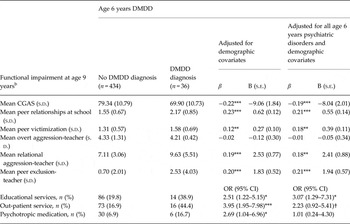
DMDD at the age of 6 years significantly predicted lower CGAS scores at the age of 9 years both in models adjusted for demographic covariates only and models adjusted for demographic covariates and all psychiatric disorders at the age of 6 years (Table 4). In addition, in models controlling for demographic covariates, children with DMDD at the age of 6 years were more likely to receive educational support services, out-patient treatment and psychotropic medication at the age of 9 years. After controlling for demographic covariates and all age 6 years psychiatric disorders, DMDD at the age of 6 years remained a significant predictor of educational services at the age of 9 years. DMDD at the age of 6 years also predicted interviewer-rated poorer peer relations at school and more frequent peer victimization, and greater teacher-reported greater relational aggression and peer exclusion both in models adjusted for demographic covariates only and in models adjusted for demographic covariates and all psychiatric disorders at the age of 6 years. Lastly, when we reran models adjusting for demographic covariates, all age 6 years psychiatric disorders, and all age 9 years current psychiatric disorders, DMDD at the age of 6 years continued to predict lower CGAS scores (B = −6.56, s.e. = 1.81, β = −0.16, p < 0.001), poorer interviewer-rated peer relations at school (B = 0.40, s.e. = 12, β = 0.15, p = 0.002) and greater peer victimization (B = 0.30, s.e. = 0.11, β = 0.14, p = 0.007), and greater teacher-reported relational aggression (B = 2.21, s.e. = 0.87, β = 0.16, p = 0.01) and peer exclusion (B = 1.66, s.e. = 0.52, β = 0.18, p < 0.01); there was also a trend level association between DMDD and use of educational services (OR = 2.40, 95% CI 0.96–5.97, p = 0.06).
DMDD at the age of 6 years as predictor of functional impairment and service use at the age of 9 years a

DMDD, Disruptive mood dysregulation disorder; s.e., standard error; CGAS, children's global assessment scale; s.d., standard deviation; OR, odds ratio; CI, confidence interval.
a Demographic variables (age, gender, parental education) were included as covariates only if they were significantly associated with the outcome variable.
b CGAS, peer relationships at school, peer victimization, educational services, out-patient service and psychotropic medication n = 470 (434 no DMDD, 36 DMDD); teacher-reported relational and overt aggression n = 300 (281 no DMDD, 19 DMDD); teacher-reported peer exclusion n = 299 (280 no DMDD, 19 DMDD).
* p < 0.05, ** p < 0.01, *** p < 0.001.
† p < 0.10.
Discussion
Using data from a large, community-based sample, we examined the longitudinal associations between the DSM-5 diagnosis of DMDD assessed at the age of 6 years and clinical and functional outcomes at the age of 9 years. We found that DMDD at the age of 6 years predicted current DMDD at the age of 9 years and predicted any current and lifetime depressive disorder and ADHD, after controlling for demographic covariates and all age 6 years psychiatric disorders. In addition, DMDD at the age of 6 years predicted depressive, ADHD and DBD symptoms on the K-SADS, and maternal and paternal reports of depressive symptoms on the CDI, after controlling for demographic covariates and all age 6 years psychiatric disorders. DMDD at the age of 6 years also predicted greater functional impairment, poorer peer relations, and educational support service use, even after accounting for demographic covariates and psychiatric disorders at the age of 6 years. Lastly, as a particularly stringent test of the predictive validity of DMDD, we examined the specificity of the longitudinal associations by controlling for age 9 years psychiatric disorders, in addition to demographic covariates and all age 6 years psychiatric disorders. In these models, DMDD at the age of 6 years continued to predict any depressive disorder; depressive, ADHD and DBD symptoms on the K-SADS; maternal reports of depressive symptoms on the CDI; greater functional impairment; and poorer peer functioning.
The course and stability of DMDD across childhood are largely unknown. We found that DMDD at the age of 6 years significantly predicted DMDD at the age of 9 years; however, the rates decreased from 7.6% at the age of 6 years to 1.3% at the age of 9 years. Five children (13.9%) who had a DMDD diagnosis at the age of 6 years continued to meet criteria for DMDD at the age of 9 years; thus, 83.3% of children who met criteria for DMDD at the age of 9 years also met criteria for DMDD at the age of 6 years. It is unclear whether this decline in DMDD at the age of 9 years was due to methodological differences in the clinical assessments (PAPA v. K-SADS) or to a substantive decrease in DMDD across this developmental period. Nevertheless, having the diagnosis at the age of 6 years increased a child's risk for persistent DMDD. Similarly, cross-sectional data on the rates of DMDD across childhood (Copeland et al. Reference Copeland, Angold, Costello and Egger2013) and longitudinal data on normative irritability across childhood (Wiggins et al. Reference Wiggins, Mitchell, Stringaris and Leibenluft2014) demonstrate similar decreases in irritability after early childhood. In the only other study examining the stability of SMD and DMDD, Deveney et al. (Reference Deveney, Hommer, Reeves, Stringaris, Hinton, Haring, Vidal-Ribas, Towbin, Brotman and Leibenluft2015) reported that in a clinical sample, 48.7% and 39.5% of youth (aged 7–17 years) with SMD continued to meet criteria for SMD at 2- and 4-year follow-ups, respectively. Of those children with DMDD at baseline, 51.3% and 36.4% continued to meet criteria for DMDD at 2 and 4 years, respectively. Consistent with our findings, Deveney et al. (Reference Deveney, Hommer, Reeves, Stringaris, Hinton, Haring, Vidal-Ribas, Towbin, Brotman and Leibenluft2015) demonstrated that the majority of children with SMD or DMDD no longer meet criteria for the diagnosis 4 years later, and that children with DMDD or SMD are at high risk for continued impairment and other forms of psychopathology over time as discussed below.
Our findings that DMDD at the age of 6 years uniquely predicted any depressive disorder and interviewer-rated and maternal-rated depressive symptoms at the age of 9 years are consistent with Copeland et al.'s (2014) longitudinal study that found that children with DMDD were at increased risk for developing depression in adulthood compared with non-case and psychiatric comparison subjects, and the broader literature linking SMD and chronic irritability to depression in adults (Brotman et al. Reference Brotman, Schmajuk, Rich, Dickstein, Guyer, Costello, Egger, Angold, Pine and Leibenluft2006; Leibenluft et al. Reference Leibenluft, Cohen, Gorrindo, Brook and Pine2006; Stringaris et al. Reference Stringaris, Cohen, Pine and Leibenluft2009). These results are also consistent with evidence for shared genetic influences between irritability and depression in adolescents (Stringaris et al. Reference Stringaris, Zavos, Leibenluft, Maughan and Eley2012). Nevertheless, it is important to acknowledge that even though the ORs are significant, the estimates are based on a small number of children with depressive disorders. Likewise, the findings for depressive disorders were only significant in models adjusting for earlier and/or concurrent psychopathology. Thus, these findings require replication. Interestingly, in contrast to findings reported by Copeland et al. (Reference Copeland, Shanahan, Egger, Angold and Costello2014), we did not find evidence for longitudinal associations between DMDD and any anxiety disorder or symptoms at the age of 9 years, suggesting that these associations may not emerge until later in development.
DMDD at the age of 6 years also predicted current and lifetime ADHD, and ADHD and DBD symptoms in models controlling for all psychiatric disorders at the age of 6 years. These associations persisted even after further controlling for concurrent co-morbid disorders at the age of 9 years, but with trend-level associations for current and lifetime ADHD diagnoses. Consistent with our results, Leibenluft et al. (Reference Leibenluft, Cohen, Gorrindo, Brook and Pine2006) found that chronic irritability in early adolescence predicted ADHD in mid-adolescence after accounting for earlier ADHD. Taken together, the association between DMDD and later ADHD is consistent with current conceptualizations of ADHD as a disorder characterized by attentional, behavioral and emotional dysregulation (Martel, Reference Martel2009). Furthermore, given that DMDD predicted later ADHD after accounting for earlier ADHD, these findings suggest that the emotional dysregulation/irritability in children with DMDD may influence the developmental trajectory of ADHD. Thus, investigating how DMDD influences the development, phenomenology, course and treatment of ADHD warrants further attention. Also consistent with previous findings that irritability is concurrently (Stringaris et al. Reference Stringaris, Cohen, Pine and Leibenluft2009) and longitudinally (Leibenluft et al. Reference Leibenluft, Cohen, Gorrindo, Brook and Pine2006) associated with both emotional and behavioral disorders in adolescence, we found that DMDD predicted both externalizing (ADHD and DBD) and depressive symptoms in all adjusted models. These findings suggest that DMDD is a shared risk factor for both internalizing and externalizing symptoms in childhood, perhaps increasing risk for each as well as their co-occurrence.
DMDD at the age of 6 years predicted greater functional impairment at the age of 9 years, even after controlling for all psychiatric disorders at the age of 6 years and concurrent psychiatric disorders at the age of 9 years, demonstrating that the link between DMDD and subsequent psychosocial impairment cannot be entirely explained by earlier or concurrent co-morbid psychopathology. These findings strongly argue for the clinical utility and predictive validity of DMDD in childhood, and do not support the contention that DMDD is merely a new category for co-morbid diagnoses. DMDD at the age of 6 years also predicted a greater likelihood of using psychological (out-patient psychosocial and pharmacological) and educational services, and the association with later educational services persisted after accounting for all age 6 years psychiatric disorders. The link between DMDD and academic problems is consistent with longitudinal findings demonstrating that DMDD and chronic irritability in older youth predicted lower educational attainment in adults (Stringaris et al. Reference Stringaris, Cohen, Pine and Leibenluft2009; Copeland et al. Reference Copeland, Shanahan, Egger, Angold and Costello2014). Studies have found that children with SMD perform poorly on tasks of cognitive flexibility (Adleman et al. Reference Adleman, Kayser, Dickstein, Blair, Pine and Leibenluft2011; Leibenluft & Stoddard, Reference Leibenluft and Stoddard2013); this may contribute to the educational problems observed in children with DMDD. Future research is needed to further characterize the cognitive deficits in DMDD that play a role in emotional dysregulation and academic difficulties.
Both interviewer- and teacher-rated measures identified significant peer problems in children with DMDD. Controlling for all psychiatric disorders at the ages of 6 and 9 years, DMDD at the age of 6 years uniquely predicted interviewer-rated poorer peer relations at school and more frequent peer victimization, and teacher-reported greater relational aggression toward peers and peer exclusion at the age of 9 years. Interestingly, children with DMDD were rated as being more likely to be both victimized by peers and engage in peer victimization via relational aggression. Likewise, evidence suggests that irritable youth have atypical attentional biases toward hostile social and/or affective stimuli, perhaps making them more prone to anger and aggression toward peers (Leibenluft & Stoddard, Reference Leibenluft and Stoddard2013). Youth with SMD also show aberrations in labeling facial emotions both in their behavioral (Guyer et al. Reference Guyer, McClure, Adler, Brotman, Rich, Kimes, Pine, Ernst and Leibenluft2007; Rich et al. Reference Rich, Grimley, Schmajuk, Blair, Blair and Leibenluft2008) and neural responses (Brotman et al. Reference Brotman, Rich, Guyer, Lunsford, Horsey, Reising, Thomas, Fromm, Towbin, Pine and Leibenluft2010; Tseng et al. Reference Tseng, Thomas, Harkins, Pine, Leibenluft and Brotman2016). These findings suggest that children with DMDD may show neurocognitive deficits in emotional and social-information processing that contribute to their poor peer functioning, but more research is sorely needed in this area.
This study had several strengths, including being the first investigation of pre-adolescent outcomes of early childhood DMDD, the use of structured clinical interviews to assess child psychopathology, and the inclusion of reports from multiple informants. However, the study also had a number of limitations. First, the relatively small number of cases (n = 36) of DMDD at the age of 6 years may have limited the values that could be observed in our dependent variables (i.e. range restriction), which may affect the power to detect significant longitudinal effects. Second, we did not correct for multiple testing. We view our analyses as exploratory, providing hypotheses for future testing given the limited research on DMDD. Third, we assessed child psychopathology at the ages of 6 years and 9 years using different measures (PAPA and K-SADS), and the concordance between these measures is unknown. Fourth, DMDD diagnosis relied on psychiatric interviews that were not designed to assess DSM-5 DMDD. Fifth, assessments of psychiatric diagnoses were largely based on parent-report; however, our findings do not seem to be due to shared method variance because psychopathology at the age of 9 years was assessed by interviewing both the parent and child and because we found meaningful associations between DMDD and maternal, paternal and teacher-reported measures. Nevertheless, there were discrepancies in results between parent and child informants, suggesting that child and parent report capture different aspects of the youth's emotions and behavior. Lastly, the sample was largely white and middle class. Future research should extend this research to more diverse samples.
In summary, our findings underscore the clinical significance of DMDD in childhood. Our results suggest that a diagnosis of DMDD identifies a group of children who are at high risk for continued psychopathology and impairment, including DMDD, depression, externalizing problems, and academic and peer problems. Importantly, associations between DMDD and later psychopathology and impairment cannot be explained by co-morbidity with other disorders. Further scientific investigation is critically needed to advance our understanding of DMDD, including its epidemiology, clinical features, development, long-term course, genetics and pathophysiology. This information is necessary to inform the development of targeted therapeutic interventions that can be applied with young children, with the hope of improving the long-term prognosis of children with DMDD.
Supplementary material
For supplementary material accompanying this paper visit http://dx.doi.org/10.1017/S0033291715002809
Acknowledgements
This research was supported by the National Institute of Mental Health (D.N.K., grant number R01 MH069942) and the General Clinical Research Center (Stony Brook University, National Center for Research Resources, grant number M01 RR10710).
Declaration of Interest
G.A.C. has received funding from Glaxo Smith Kline, Bristol Myers Squibb, Pfizer and Merck. The other authors report no financial relationships with commercial interests.