In “Five Laws of Politics” (Cuzán Reference Cuzán and Cuzán2015), an analysis of 426 elections in 23 presidential and parliamentary democracies drawn from Organisation for Economic Co-operation and Development members and Latin America revealed the following invariant or nearly invariant patterns:
(1) Law of Minority Rule. On average, 75% of the electorate turned out to vote, of whom 42% marked their ballots for the incumbents—the president’s or prime minister’s party—which yields a support rate of less than one third of the electorate.
(2) Law of Incumbent Advantage. Incumbents win reelection 60% of the time.
(3) Law of Shrinking Support, also known as “the cost of ruling” (Budge et al. Reference Budge2012; Nannestad and Paldam Reference Nannestad and Paldam1999; Wlezien Reference Wlezien2017). The incumbents incur a loss of support between elections averaging 4 percentage points.
(4) Law of the 60% Maximum. The incumbent party candidate succeeded at crashing that ceiling in fewer than 3% of cases.
(5) Law of Partials. No single party or coalition of parties can harmonize the diversity of interests and opinions of the electorate. The democratic synthesis is produced by competing parties taking turns at governing (Budge et al. Reference Budge2012). On average, any one party serves two terms for a total of eight years in office.
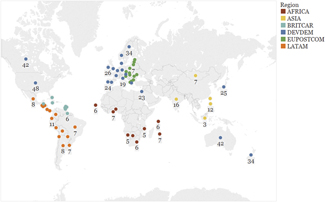
The purpose of this follow-up article is twofold: (1) to present additional confirmatory evidence in support of the contention that there are, indeed, “laws” of politicsFootnote 1; and (2) to extract theoretical insights from the empirical findings. I argue that democracies appear to exhibit a general tendency toward equilibrium values in electoral outcomes. The findings derive from a dataset composed of twice as many elections (i.e., 971 versus 426)Footnote 2 and three times as many countries (i.e., 74 versus 23) as in the original article.Footnote 3 To be added to the original dataset, elections generally must have been held in countries in which for at least two decades ending in the most recent year their Freedom House (2018) ratings on political rights and civil liberties were no higher than 4 (i.e., Partly Free). However, in some instances—usually in Africa, where democracies are scarce—this rule was relaxed if no more than in one or two nonelection years one of the ratings reached no higher than five. Figure 1 displays the distribution of most countries across space and region.Footnote 4 Also, to avoid losing data on current administrations or governments, if an incumbent party was currently in its third or later term at the time of the analysis, its values on Terms, Outcome, Reign, and Maximum Vote were “right censored.” That is, its values on Terms and Reign are counted as of the time they were observed for the analysis because they will not be any lower.
The purpose of this follow-up article is twofold: (1) to present additional confirmatory evidence in support of the contention that there are, indeed, “laws” of politics; and (2) to extract theoretical insights from the empirical findings.
Map of Elections

FINDINGS
I now proceed to analyze the data, first as averages over the entire period and then longitudinally, across time.
Statics
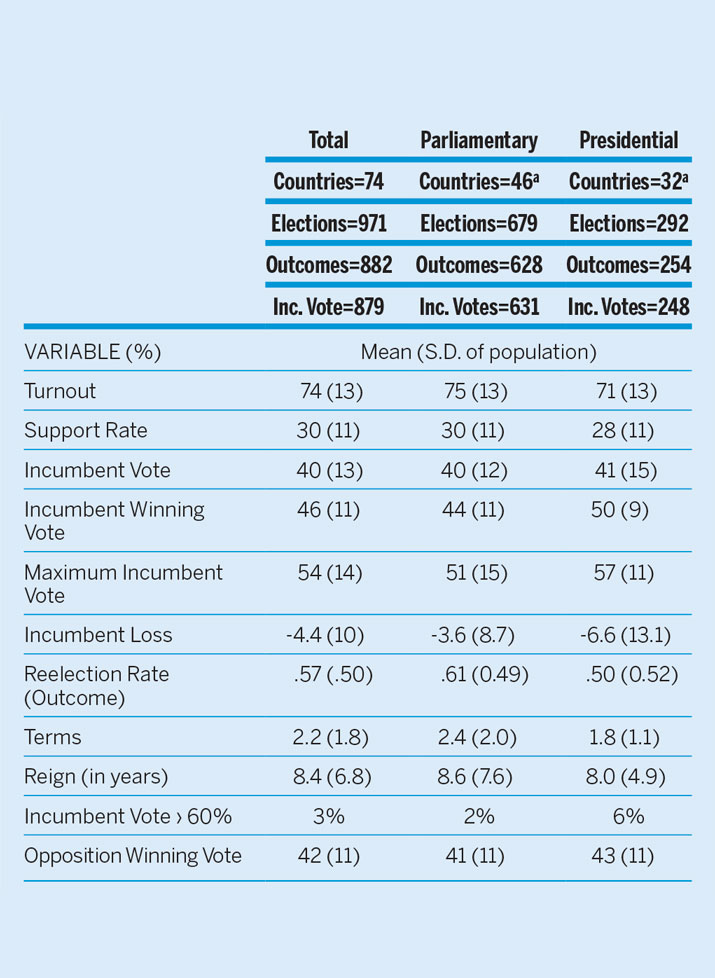
The descriptive statistics of the electoral variables are shown in table 1. The first column of data presents values for the entire dataset. These should be compared to those displayed in table 1 in Cuzán (2015, 417). The averages have budged only slightly, although the variation around the mean values has widened—an understandable difference given the range of democratic development in the countries covered in the more inclusive series. The mean values showing so little difference demonstrates that the original findings are robust with respect to the number and diversity of cases. This suggests that adding more countries or elections is unlikely to alter the parameter estimates. One benefit is that it may bring into relief regional patterns and variations with greater confidence than can be justified at present. Only the few that appear unlikely to be diluted with additional data are mentioned in this article.
Descriptive Statistics, All and by Type

Notes: aBoth parliamentary and presidential elections are included for France, Poland, and Portugal. Also, three times the Israeli prime minister was elected on a nation-wide vote, and those elections are classified as “presidential.”
On average, 75% of eligible voters turn out to vote, casting 40% of their ballots for the incumbents, which amounts to a “support rate” of not quite one third of the electorate (i.e., Law of Minority Rule). When victorious, the in-party typically (1) wins approximately 45% of the vote, which is around 4 percentage points higher than the opposition’s share when it prevails; (2) is reelected nearly 60% of the time; and (3) serves two terms lasting about eight years (i.e., Law of Incumbent Advantage). This advantage notwithstanding, incumbents lose about 4 percentage points per term (i.e., Law of Shrinking Support),Footnote 5 and in only about 3% of cases does the in-party top the Law of the 60% Maximum.Footnote 6
Compared to their counterparts in presidential systems, incumbents in parliamentary democracies face a larger electorate (i.e., turnout is higher); are reelected more often but with a smaller share of the vote; are constrained by a lower ceiling on that vote (i.e., presidential systems break the 60% ceiling twice as often as parliamentary systems); but incur a smaller loss between elections. Moreover, when the opposition wins, it also takes in a lower fraction of the vote than those in presidential systems.Footnote 7 However, there is no difference in the incumbents’ share of the vote (win or lose), the number of consecutive terms they serve, or the length of their reigns.
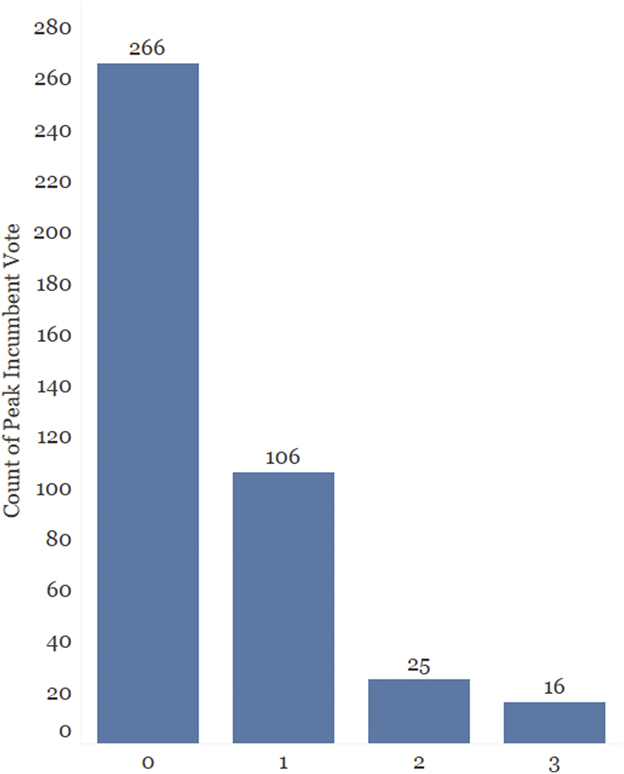
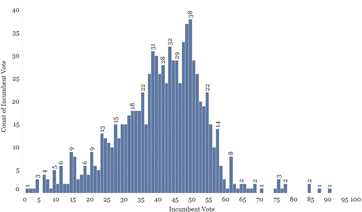
As shown in figure 2, in almost two thirds of the cases, the vote share of incumbents is highest when they first are elected to office; another 25% peak in their first reelection; and only 10% crest in their second or later reelection. Figure 3 paints an even more dramatic picture, depicting a leftward-skewed distribution in which 80% of incumbents manage to obtain no more than 50% of the vote. Beyond that, their numbers fall precipitously. In fact, fewer than 10% take in more than 55% and, as mentioned previously, no more than 3% top 60% of the vote—with almost all of those outliers falling outside the developed democracies, in Africa, Asia, or Latin America. Actually, some in the top 3% reflect opposition boycotts; at the very next contested election, the incumbents’ share shrank drastically. Furthermore, in only nine countries does the Incumbent Vote average exceed 50%; all but one (i.e., Australia, 50.2%) are found outside of the developed democracies.Footnote 8
Incumbents’ Highest Vote Share within Reign, by Election
Note: 0=first elected; 1=first reelection; 2=second; 3=later.

Incumbent Vote Frequency Distribution

Dynamics
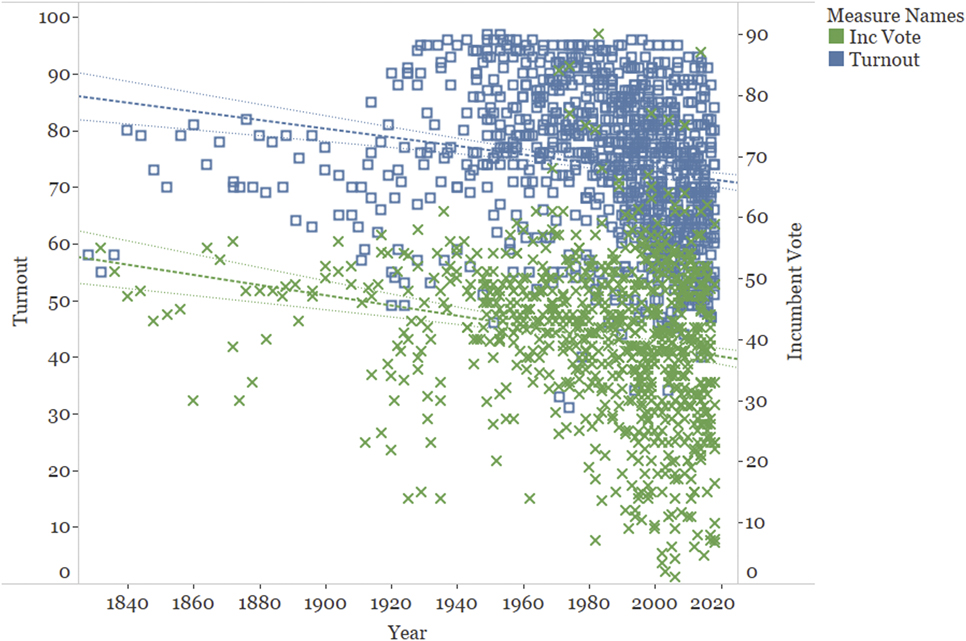
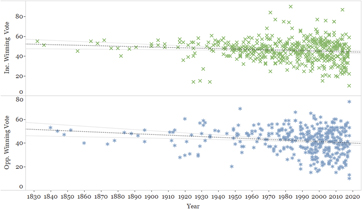
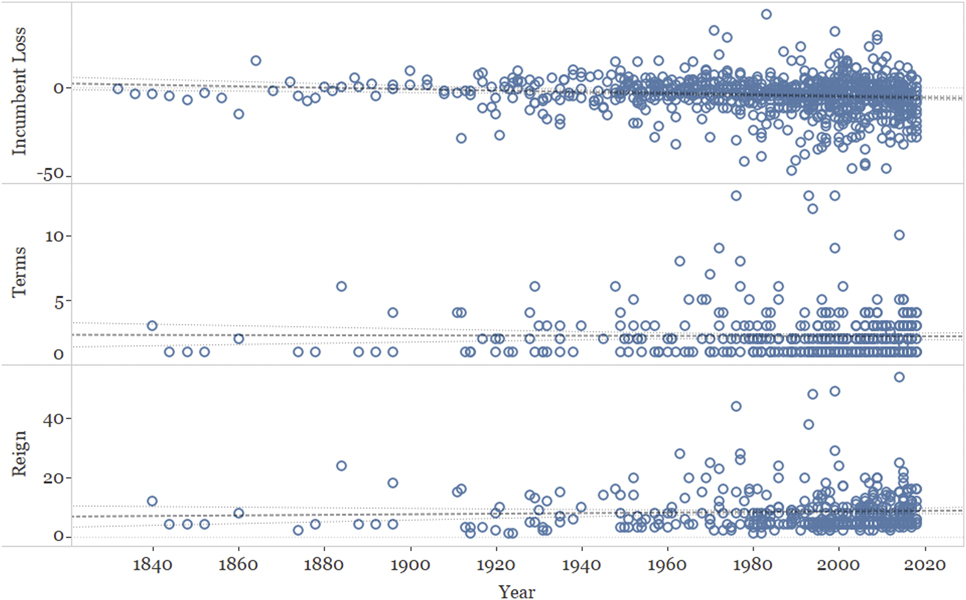
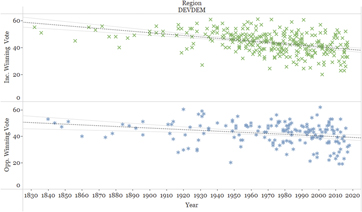
The longitudinal behavior of these variables, shown in figure 4 (Turnout and Incumbent Vote) and figure 5 (Incumbent Winning Vote and Opposition Winning Vote), all slightly drift downward across time, although the R-sq. in all is small (≤0.05). Conversely, Incumbent Loss, Terms, and Reign are flat, as shown in figure 6. Turning to the developed democracies only, as a group they show no relationship between time and Turnout, Incumbent Loss, Terms, or Reign. However, figure 7 shows a secular decline among them in the Winning Vote for both the Incumbents and the Opposition, with the more pronounced decrease occurring in the former (R-sq.=0.19 and 0.07, respectively).Footnote 9
Turnout and Incumbent Vote

Winning Vote: Incumbent and Opposition

Incumbent Loss, Terms, and Reign

Winning Vote in the Developed Democracies: Incumbent and Opposition

Although modest, the secular decline in Incumbent Vote in the developed democracies, where elections have been held continuously for three-quarters of a century or longer, may reflect a combination of a breakdown of old-party cohesion, erosion of an old-party brand, and an increasingly divided electorate, which makes it more difficult for erstwhile catchall parties to aggregate interests—probably not a good thing. Or, it may signal a more positive development because in most of these democracies one party was dominant for many years. Taken together, these changes may mean that the political arena in the developed democracies has become more competitive. This may be regarded as a good thing because vigorous competition for votes among parties is a hallmark of modern mass democracy (Budge et al. Reference Budge2012). Which of the two interpretations is closer to or encompasses a larger share of the truth of the matter remains to be seen.
DISCUSSION
The previous analysis suggests that in countries where there is sufficient freedom to contest them, election outcomes gravitate toward a set of parameters describing electoral equilibrium.Footnote 10 At equilibrium, the variables measuring incumbent support generally tend toward the following values: Support Rate (33%); Incumbent Vote (40%); Incumbent Winning Vote (45% in parliamentary, 50% in presidential); the ceiling they are highly unlikely to break (60%); Incumbent Loss in percentage points per term (-3 in parliamentary, -6 in presidential); their reelection rate (60% in parliamentary, 50% in presidential); Terms (2); and Reign (8 years). These parameters could be interpreted as the “natural” values toward which democracies incline, fluctuating up and down in the long run.Footnote 11
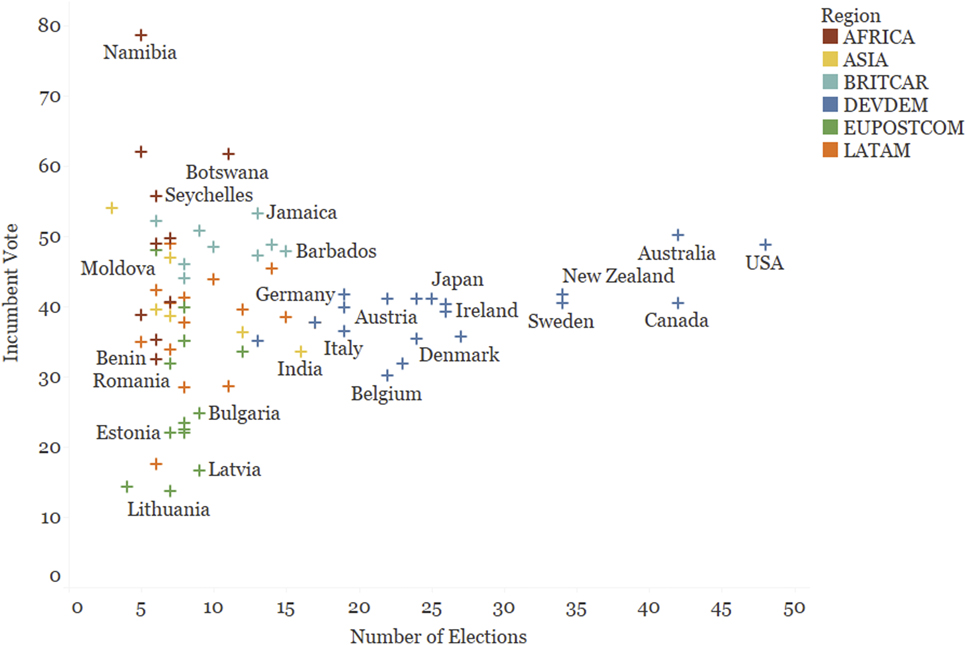
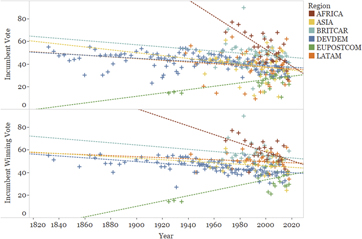
If indeed there are natural or equilibrium values in electoral outcomes, then we would expect democracies that have been around a long time to be closer to them than those that have not. As shown in figure 8, this appears to be the case. The range of values around the overall average among the newer democracies (i.e., those with fewer elections) is 1.5 to 2.0 times as large as that of the older democracies. (Outliers above the mean are mostly African and those below it are a mix of Latin American and post-Communist European.) Furthermore, as shown in figure 9, all regional trend lines in Incumbent Vote and Incumbent Winning Vote converge. It is as if time acts as a funnel, drawing toward the equilibrium level what initially had been widely dispersed country outcomes. From figure 8, we can surmise that the threshold for reaching the equilibrium values appears to be somewhere between 10 and 15 consecutive elections. Held on average every four years, it may take about 40 years for the average values of at least some of the new democracies to approach equilibrium. Nevertheless, the process may proceed faster in some and slower in other democracies. It depends on the strength of friction encountered from electoral rules (Carey Reference Carey, Herron, Pekkanen and Shugart2018; Shugart and Taagepera Reference Shugart and Taagepera2017) and from country-specific contexts including political culture, recent history, and exceptional leaders (Colomer Reference Colomer2010).
This analysis appears to uphold the claim that elections in democracies are governed by a number of “laws” of politics constraining the share of support and, therefore, the time that an incumbent party can expect to exercise power in a single stretch.
Incumbent Vote by Number of Elections

Convergence among Regions

Be that as it may, the evolution might proceed more or less as follows. The initial elections may favor one party above all others due to, say, the prestige of its founding leader or its history in the fight for independence or founding of democracy. Following the death or retirement of the leader or particular failures in policy, infighting among rival claims to the presidency or the premiership rooted in ideas, interests, and personal ambition would ensue, causing a split.Footnote 12 Starting at the other end, political entrepreneurs would seek to merge ideologically close parties that divide the vote of a large minority or plurality of the electorate into a larger, more competitive organization or alliance. We do occasionally observe party splits, mergers, and short-term as well as enduring alliances in various countries from time to time.Footnote 13
CONCLUSION
This analysis appears to uphold the claim that elections in democracies are governed by a number of “laws” of politics constraining the share of support and, therefore, the time that an incumbent party can expect to exercise power in a single stretch. Although these “laws” may be largely a function of mechanical or statistical features of democratic institutions (Lebo and Norpoth Reference Lebo and Norpoth2007; Norpoth Reference Norpoth2014; Shugart and Taagepera Reference Shugart and Taagepera2017; Stokes and Iverson Reference Stokes and Iverson1962), their operation in specific cases is mediated by particular electoral rules and country-specific contexts, which are the product of history, culture, and political leadership. From the analysis, we may draw a specific recommendation for institutional reform: more frequent elections should aid the equilibrium-seeking processes of democracies.Footnote 14 Parliamentary democracies should consider holding elections no less often than every three years and presidential democracies no more than every four years, including off-year elections for the legislature halfway through the presidential term, as in the United States.
SUPPLEMENTARY MATERIAL
To view supplementary material for this article, please visit https://doi.org/10.1017/S1049096519000519
ACKNOWLEDGMENTS
This article is much improved from earlier drafts thanks to comments and suggestions from anonymous reviewers and from Ian Budge, John Carey, Cal Clark, Jay Cost, Andrew Gelman, Adreas Graefe, Richard J. Heggen, Randall J. Jones, Jr., Charles Kroncke, Arend Lijphart, Vello Pettai, Stephen and Elaine Snyder, William B. Tankersley, Michelle H. Williams, and especially Josep M. Colomer and Rein Taagepera. Thanks also to Yamisle Roca for her assistance in gathering much of the data collected during 2018. I also am grateful to The University of West Florida for its generous support and benign academic environment. The usual caveat applies: any errors of fact or interpretation or deficiencies in presentation are entirely my own.