Hurricanes and typhoons are cyclonic storms. They both belong to the tropical cyclones in the northern hemisphere. Typhoons and hurricanes originate from different waters and are experienced by different countries. In general, tropical cyclonic storms generated in the Atlantic ocean are called hurricanes, and those generated in the Pacific ocean are called typhoons.Reference Wang1 Hence, in this study, hurricanes and typhoons were considered as virtually the same kind of disaster.
Natural disasters such as flood, hurricanes, and typhoonsReference Cerda, Bordelois and Galea2 have caused a lot of deaths and loss of resources every time. For example, Hurricane Katrina, which was the most deadly hurricane in the past 70 years, killed more than 1000 people and caused more than US $100 billion in damage.Reference Galea, Brewin and Gruber3 Typhoon Haiyan hit the Philippines in Samar and caused approximately 7000 deaths.Reference Hugelius, Gifford and Ortenwall4 In addition, the foregoing disasters can cause serious psychological disorders such as posttraumatic stress disorder (PTSD),Reference Tang, Yen and Cheng5 anxiety,Reference Amstadter, Acierno and Richardson6 depression,Reference Amstadter, Acierno and Richardson6, Reference Pietrzak, Tracy and Galea7 just to name a few.
PTSD is a mental illness which, among other factors, can be caused by traumatic events, such as war, natural disaster, and traffic accidents.Reference Careaga, Girardi and Suchecki8 There is 1 in every 25 people who meets lifetime PTSD criteria according to data from the World Mental Health Surveys.Reference Liu, Petukhova and Sampson9 Studies reporting the prevalence of PTSD among survivors of a hurricane or typhoon found varied results. For example, the prevalence of PTSD among survivors after a hurricane or typhoon varied from 1.1%Reference Rubens, Vernberg and Felix10 to 61.92%.Reference Guo, Tian and Wang11 This huge variation might have been associated with factors such as variation in the intensity of and assessment time after the storms in question. Any of these varied estimates may not represent an accurate estimate of the prevalence of PTSD in this population and, hence, may not be reliable for planning psychological interventions for this high-risk population. Therefore, it is necessary to determine a more accurate estimation of the prevalence of PTSD among survivors after a hurricane or typhoon by combining results from the published studies. This estimate would then be more reliable for the invention of effective interventions. Thus, a systematic review and meta-analysis were carried out in this study to provide a more accurate theoretical estimation of the prevalence of PTSD among survivors after a hurricane or typhoon.
The Diagnostic and Statistical Manual of Mental Disorders, 5th edition (DSM-V), was published on May 18, 2013. The DSM-V criteria for PTSD differ significantly from the DSM-IV criteria. The DSM-IV Criterion A2 (The person’s response involved intense fear, helplessness, or horror. Note: In children, this may be expressed instead by disorganized or agitated behavior) was eliminated. Whereas there were 3 major symptom clusters in DSM-IV – re-experiencing, avoidance/numbing, and arousal – there are now 4 symptom clusters in DSM-V, because the avoidance/numbing cluster is divided into 2 distinct clusters: avoidance and persistent negative alterations in cognitions and mood. The exclusive Criterion H (The disturbance is not attributable to the physiological effects of a substance, for example, medication, alcohol, or another medical condition) was added. Furthermore, separate criteria were added for children age 6 years or younger with this disorder.12 This should be noticed because the differences between DSM-V and DSM-IV might lead to different prevalences of PTSD among survivors after a hurricane or typhoon diagnosis.
METHODS
Search Strategy
A literature search was performed in 3 electronic English databases and 2 Chinese databases. Specifically, PubMed (National Library of Medicine, Bethesda, MD), ISI Web of Science (Thomson Reuters, New York, NY), and Embase (Elsevier, Amsterdam, Netherlands) were the 3 English databases, whereas CNKI and WanFang were the 2 Chinese databases.
The search terms for PubMed were (“Cyclonic Storms” [Mesh]) AND “Stress Disorders, Posttraumatic” [Mesh]. The search terms for Embase were ‘hurricane’/mj AND ‘posttraumatic stress disorder’/mj. The search terms for ISI Web of Science were #1: TS = (Stress Disorders, Posttraumatic); #2: TS = (Cyclonic Storms); #3: #1AND #2 Time span: All years. Search language = Auto. The search terms for CNKI were #1: Subject = posttraumatic stress disorder (Mesh); #2: Subject = typhoon or hurricane (Mesh) #3: #1 AND #2. The search terms for WanFang were Subject: (posttraumatic stress disorder) * Subject: (typhoon or hurricane) * Date: -2017. The search strategy was restricted to articles published within the period from the initial state of the databases to August 27, 2017.
Eligibility Criteria
The inclusion criteria were (1) the study must be observational; (2) the study must assess PTSD among survivors of a hurricane or typhoon; (3) the prevalence of PTSD among survivors of a hurricane or typhoon should be given or could be calculated from the article; (4) PTSD must be diagnosed by those questionnaires based on DSM-III, DSM-IV or DSM-V; and (5) studies must assess PTSD at not less than 1 month after the storm. The exclusion criteria were (1) articles were not written in English or Chinese; (2) review or systemic review; (3) duplicate sample or a smaller sample in the same cohort; (4) having a sample size of less than 300; and (5) articles reported PTSD in individuals with psychiatric disorders.
Data Extraction
Assessment of the eligibility of articles was independently done by 2 individuals (Zhipeng Wang and Xin Wu) who also extracted data. Any differences between them were resolved with a third person involved. Extracted data included the name of the first author of an article, publication year, study design, region, name of the hurricane or typhoon, category of disaster, mean age, time of assessment of PTSD in survivors of the hurricane or typhoon, number of survivors with PTSD, sample size, and score of the quality of study. Specifically, the categories of disaster were identified based on the Saffir–Simpson Hurricane Wind Scale.13 Accordingly, Category-1 has an average speed of 119–153 kilometers per hour (km/h); Category-2 has an average speed of 154–177 km/h; Category-3 has an average speed of 178–208 km/h; Category-4 has an average speed of 209–251 km/h; and Category-5 has an average speed of at least 252 km/h. All extracted data were recorded in Microsoft Excel.
Quality Evaluation
Loney et al.’s study quality evaluation instrument was used to examine the quality of the eligible studies for this systematic review and meta-analysis.Reference Loney, Chambers and Bennett14 This instrument was used because it is suitable for evaluating observational studies. In this instrument, quality evaluation is based on the following 8 principles: (1) random sample or whole population; (2) unbiased sampling frame; (3) adequate sample size (more than 300); (4) standard measures; (5) outcomes measured by unbiased assessors; (6) adequate response prevalence (70%); (7) confidence intervals, subgroup analysis; and (8) study subjects described. Each item was assigned a score of 1 point when a criterion was met. Otherwise, the score of zero was assigned. Thus, the maximum score for this instrument was 8.Reference Loney, Chambers and Bennett14 Similar to other studies that used this instrument,Reference Chen and Liu15 this study used a cutoff score of 5 to classify the quality of studies. For example, a study was high quality if it scored at least 5 points; otherwise, it was considered low quality.
Statistical Analyses
The programming language R, version 3.4.1, was used to estimate the combined prevalence of PTSD among survivors of a hurricane or typhoon. This estimation used the procedure of Freeman–Tukey transformation of inverse hyperbolic sine function in a fixed effects model when heterogeneity between the studies was low (I2 < 50%). Otherwise, the random effects model was used to estimate the combined prevalence of PTSD. When high heterogeneity was observed, subgroup analyses and meta-regression analyses were carried out to explore the origin of heterogeneity between the studies. Meta-regression analyses were performed on the mean age and publication year, whereas subgroup analyses were performed on the subgroups according to the category of storm, and category of time of assessment of PTSD after the storm. The association of subgroups with the prevalence of PTSD was examined using the chi-square test in SPSS version 22.0 (IBM Corp, Armonk, NY). A sensitivity analysis was conducted to examine the influence of the studies with low quality on the combined prevalence. This involved a re-estimation of the combined prevalence after removing studies with low-quality scores. Publication bias was assessed using the funnel plot and tested using Egger’s test.
RESULTS
Literature Search and Basic Information
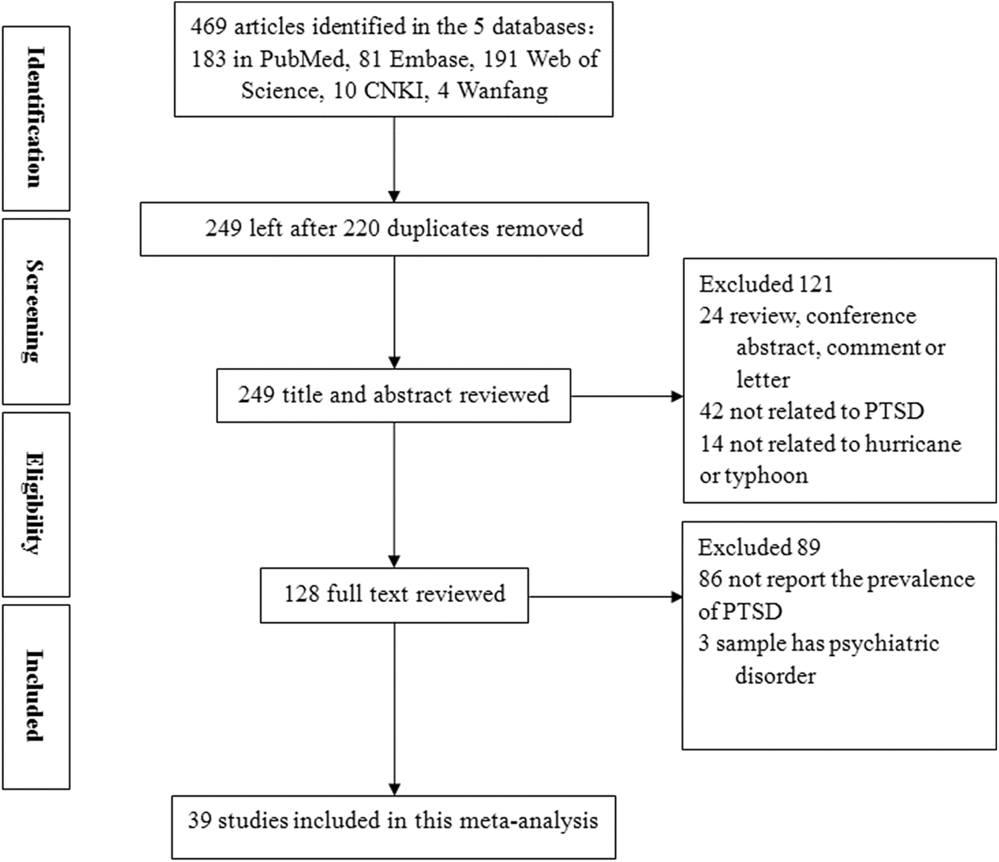
A total of 469 relevant articles were identified according to the strategy described in the “search strategy” in the previous section. Among the 469 articles, 183 were from PubMed, 191 from ISI Web of Science, 81 from Embase, 10 from CNKI, and 4 from WanFang. Initially, 220 articles were removed for duplicating data. Then 121 were excluded from the 249 left because they belonged to any of the following categories: reviews, conference abstract, comment or letter, not related to PTSD, not related to a hurricane or typhoon, and sample size was less than 300. Thus, 128 studies were considered for eligibility assessment. After this assessment, 89 were excluded for neither reporting the prevalence of PTSD nor providing adequate information for determining the prevalence of PTSD, and for studying PTSD in a sample of individuals with psychiatric disorders. After excluding 89 articles, 39 articles were finally included in the systematic review and meta-analysis (Figure 1).
PRISMA Flow Chart of Article Selection: Illustration of How Eligible Articles Were Selected.

Description of Included Articles
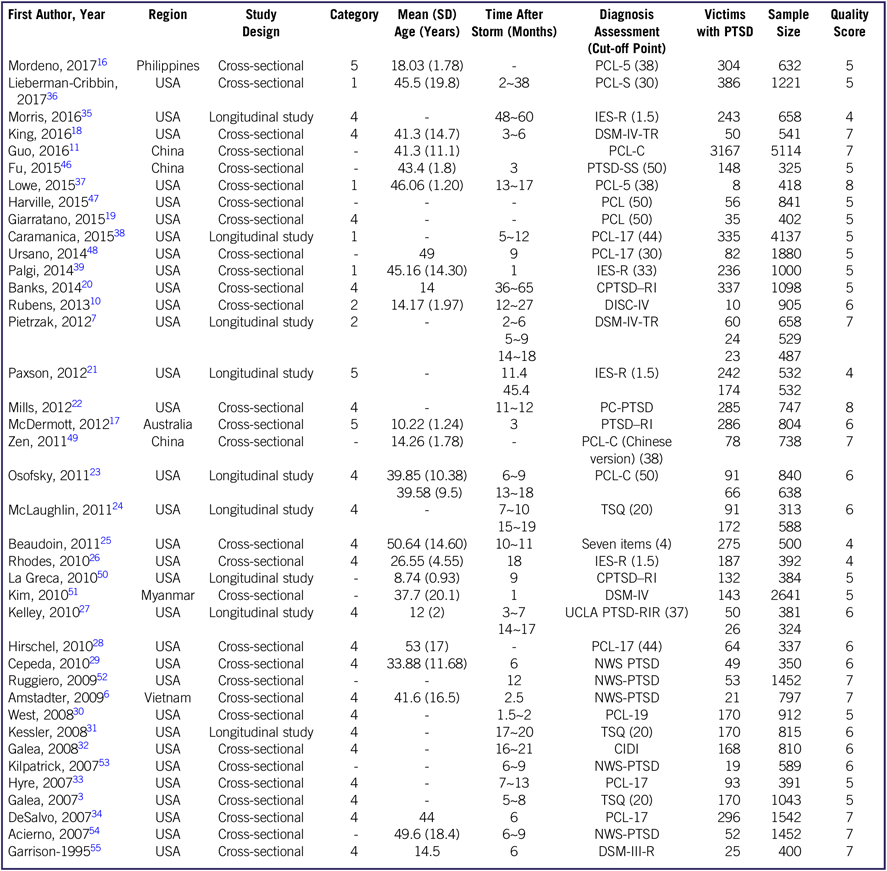
Among the 39 literatures, the evaluation time of PTSD after a hurricane or typhoon ranged from 1 month to 65 months. In addition, 9 studies used longitudinal design, whereas 30 were cross-sectional designs. Only 4 articles scored less than 5 points, in terms of the quality assessment, whereas 14 articles scored 5 points, 10 articles 6 points, 9 articles 7 points, and 2 articles 8 points. Thus, there were 35 high-quality studies. Hurricane Katrina was reported in about half of the articles, and 32 (82%) of the articles reported the prevalence of PTSD among survivors of a hurricane or typhoon in the United States. See Table 1 for a summary of these results.
Characteristics of Included Studies on the Prevalence of PTSD in Survivors After a Typhoon/Hurricane

Abbreviations: PCL-5 = Posttraumatic Stress Disorder Checklist for Diagnostic and Statistical Manual of Mental Disorders, Fifth Edition; PCL-S = Posttraumatic Stress Disorder Checklist-Specific; IES-R = Impact of Event Scale-Revised; DSM-IV-TR = Diagnostic and Statistical Manual of Mental Disorders, Fourth Edition, Text Revision; PCL-C = Posttraumatic Stress Disorder Checklist – Civilian Version; PTSD-SS = Post-traumatic Stress Disorder Self-rating Scale; PCL = Posttraumatic Stress Disorder Checklist; PCL-17 = 17-item PTSD Checklist; PTSD–RI = Posttraumatic Stress Disorder Reaction Index for Children; DISC-IV = Diagnostic Interview Schedule for Children; PC-PTSD = The Primary Care PTSD Screen; TSQ = Trauma Screening Questionnaire; UCLA PTSD-RIR = The UCLA PTSD Reaction Index Revised; NWS-PTSD = National Women’s Study PTSD module; PCL-19 = 19-item Veterans Administration PTSD Checklist; CIDI = The Composite International Diagnostic Interview-DSM-IVPTSD Module; DSM-III-R = Diagnostic and Statistical Manual of Mental Disorders, Third Edition Revision.
Combined Prevalence of PTSD
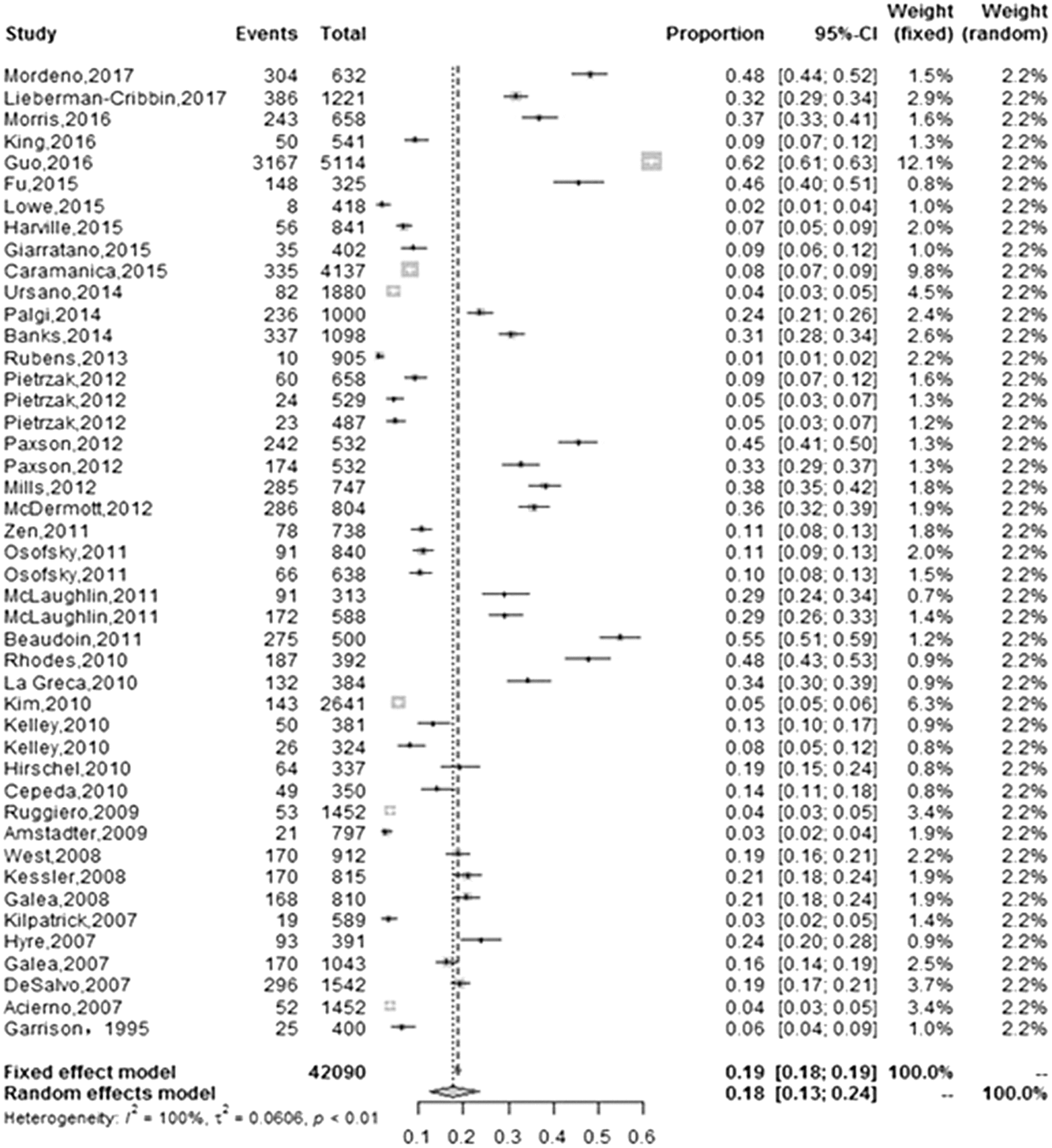
A total of 43 123 survivors of a hurricane and typhoon were identified in the 39 articles, of which 9373 were diagnosed with PTSD. The random effects model was used to determine the combined prevalence (I2 = 99.6%, P < 0.001). Therefore, the combined prevalence of PTSD among survivors after a hurricane and typhoon was 17.81%, with a 95% CI of 12.63% to 23.67% (Figure 2).
Forest Plot Showing the Pooled Prevalence of PTSD Among Survivors After a Typhoon or Hurricane.

Subgroup Analysis
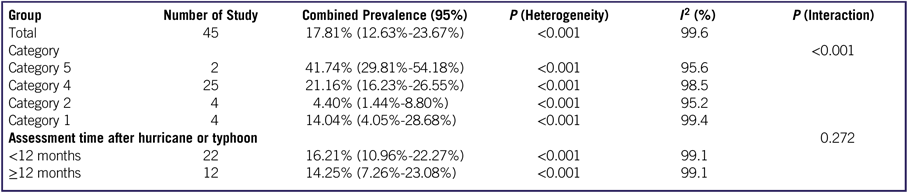
According to the subgroup analyses, the combined prevalence of PTSD among survivors of a hurricane and typhoon was 41.74% (95% CI: 29.81%, 54.18%), 21.16% (95% CI: 16.23%, 26.55%), 4.4% (95% CI: 1.44%, 8.8%), and 14.04% (95% CI: 4.05%, 28.68%) for Category-5,Reference Mordeno, Carpio and Nalipay16, Reference McDermott, Berry and Cobham17 Category-4,Reference Galea, Brewin and Gruber3, Reference King, Polatin and Hogan18–Reference Morris and Deterding35 Category-2,Reference Pietrzak, Tracy and Galea7, Reference Rubens, Vernberg and Felix10 and Category-1Reference Lieberman-Cribbin, Liu and Schneider36–Reference Palgi, Shrira and Hamama-Raz39 storms, respectively. There was no study that focused on the Category-3 storm. The combined prevalence of PTSD differed significantly with different storm categories. For example, the combined prevalence of PTSD for a Category-5 hurricane and typhoon was higher than that for a Category-4, Category-2, and Category-1 (P < 0.001). Also, the combined prevalence for a Category-4 hurricane and typhoon was higher than that for a Category-2 and Category-1, and a combined prevalence for a Category-2 was lower than that for a Category-1. Heterogeneity was significantly high across these categories and ranged from I2 = 95.2% to I2 = 99.4%. Also, the subgroup analysis according to the time of assessment of PTSD showed that the prevalence of PTSD among survivors of a hurricane and typhoon was 16.21% (95% CI: 10.96%–22.27%) and 14.25% (95%CI: 7.26%–23.08%), among the subgroup assessed at less than 12 months after the storm and among those assessed at not less than 12 months after the storm, respectively. However, there was no significant difference of prevalence of PTSD between these 2 subgroups. Moreover, for each subgroup, heterogeneity was the same and significantly high (I2 = 99.1). See Table 2 for a summary of these results.
Subgroup Analyses of the Prevalence of PTSD After a Hurricane or Typhoona

a P (heterogeneity) values for heterogeneity across studies were computed using Cochrane’s Q test; P (interaction) values for comparisons between subgroups were computed using the χ2 test with 1 degree of freedom.
Meta-Regression Analysis
A meta-regression was carried out to explore the origin of heterogeneity accounted for by the variables such as the mean age and publication year. Each variable was singly entered into the meta regression. Results showed that the mean age did not make a significant contribution to heterogeneity (P = 0.7246, R 2 = 0.00%), whereas the publication year made a significant contribution to heterogeneity, which was significantly reduced with subsequent published studies (P = 0.0828, R 2 = 4.43%).
Sensitivity Analysis and Publication Bias
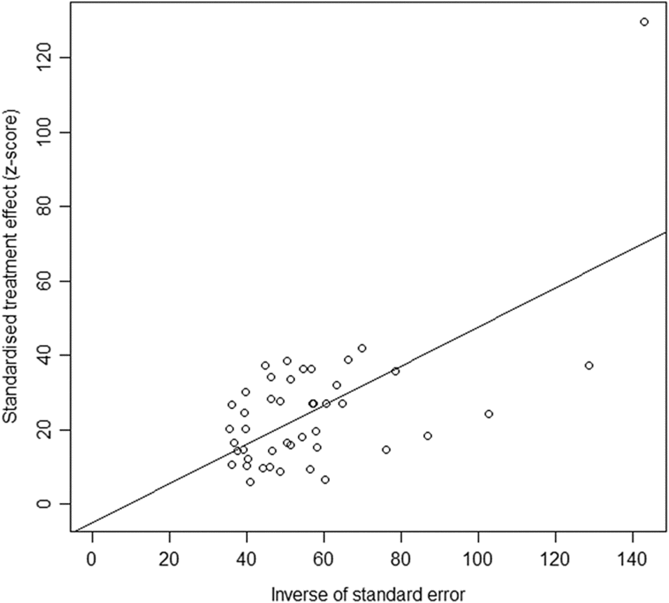
The combined prevalence of PTSD among survivors after a hurricane and typhoon reduced from 17.81% to 15.97% after excluding articles with low quality. The small change in the combined prevalence after excluding the low-quality articles indicated low sensitivity. Also, there was a low possibility of publication bias because the Egger funnel plot in Figure 3 appeared to show a symmetrical distribution of publication quality scores along the straight line, and the Egger test confirmed these results (P = 0.406).
Egger Plot of Literature on the Prevalence of Posttraumatic Stress Disorder Among Survivors After a Typhoon or Hurricane.

DISCUSSION
Studies investigating the prevalence of PTSD among survivors of a hurricane and typhoon found varied results. Particularly, the prevalence varied between 1.1%Reference Rubens, Vernberg and Felix10 and 61.92%.Reference Guo, Tian and Wang11 However, these results have not been combined to obtain a more reliable estimation of the prevalence of PTSD among this population. Therefore, this is the first systematic review and meta-analysis to assess the combined prevalence of PTSD induced by a hurricane or typhoon.
The combined prevalence of PTSD in this study was 17.81%, which was close to that among flood survivors, 15.74% (95% CI: 11.25%–20.82%),Reference Liu, Petukhova and Sampson40 but less than that of earthquake survivors, 23.66% (95% CI: 19.34%–28.27%).Reference Dai, Chen and Lai41 This was probably because an earthquake always happens suddenly and without a warning. On the other hand, the direction and intensity of a hurricane and typhoon can be predicted. Therefore, earthquakes may bring more damage to one’s properties and health. That may lead to more PTSD patients induced by an earthquake than those induced by a hurricane and typhoon.
Furthermore, subgroup analyses by category of storm showed that the combined prevalence of PTSD for a Category-5 storm was higher than that for a Category-4, which was higher than that for a Category-1, which was higher than that for a Category-2. It appears there is a positive linear relationship between the prevalence of PTSD and category of storm for Categories 2, 4, and 5. That is, the prevalence of PTSD increased with the increasing order of categories from Category-2 to Category-5. This trend was in line with a previous study.Reference Liu, Petukhova and Sampson40 However, the combined prevalence of PTSD for Category-1 was higher than that for Category-2 probably because studies that investigated the Category-1 storm had relatively smaller sample sizes, which may be biased. Hence, generally, a more severe hurricane or typhoon may lead to more PTSD cases than a less severe storm. Therefore, more psychological intervention resources must be allocated to survivors of a more severe storm. Contrary to results of some previous study,Reference Dai, Chen and Lai41 this study observed no difference between the prevalence of PTSD assessed at less than 12 months and that assessed at not less than 12 months. This may be attributed to the fact that, compared with less than 12 months, 12 months or more after a traumatic event is a longer time to assess PTSD induced by the trauma because, at that time, individuals might have experienced other traumatic events that had put them at a high risk for PTSD.Reference Hartl, Rosen and Drescher42 In this study, heterogeneity was high between the eligible studies, because such meta-regression and subgroup analyses were conducted to identify the source of heterogeneity. Results of meta-regression analyses showed that mean age did not make a significant contribution to heterogeneity (P = 0.7246, R 2 = 0.00%), whereas the publication year made a significant contribution to heterogeneity, which significantly reduced with subsequent published studies (P = 0.0828, R 2 = 4.43%). The impact of publication year on heterogeneity was probably because of the frequency the hurricane or typhoon may hit this population. The higher the frequency it hits them, the more the storm turns into an exposure therapy,Reference Myers and Zandberg43 which would make people know that the next storm may hit them and they would prepare themselves psychologically for it; hence, they may become less vulnerable to developing PTSD. Also, although mean age did not make a significant contribution to heterogeneity in this study, Wu XinReference Wu, Wang and Cofie44 found that being of younger age was related to the appearance of severity of PTSD among breast cancer patients. This study proposed that PTSD symptoms had a great impact on their lifestyle, careers, and fertility issues. The young could be more unwilling to accept the fact of breast cancer diagnosis than older. On the other hand, the reason for mean age to not explain source of heterogeneity in this study may be based on how individuals of all ages reacted to the storm, which is a subject for further investigation. Additionally, heterogeneity was high across all of the subgroups for subgroup analyses, suggesting that the subgroups could not explain other sources of heterogeneity. Thus, there is need for further research to identify sources of heterogeneity in this population, perhaps by examining, among other variables, how gene-environment interaction and genetic factors were related to the onset of PTSD after a hurricane or typhoon.Reference Koenen, Amstadter and Nugent45
Some limitations should be noticed. First, heterogeneity was significantly high among the studies involved in this systematic review and meta-analysis when calculating the combined prevalence of PTSD both with all studies and with studies within subgroups. Besides, only 2 subgroups, category of storm and time of assessment of PTSD after the storm, were included in subgroup analyses, which limited the search for the sources of heterogeneity. It was not possible to include subgroups according to social support, gender, income, type of instrument used to assess PTSD, education level, and trauma type because these factors could not be extracted from the original articles. Therefore, it is suggested that future research should explore more factors influencing the development of PTSD among this population in order to explore the sources of heterogeneity. Although in the recent revision of the DSM, drastic changes were made in the diagnostic criteria of the PTSD in comparison with DSM-III and DSM-IV versions, it was still not possible to explore heterogeneity according to the type of PTSD assessment instrument used because the accuracy of the instruments varied in their sensitivity and specificity when matching the DSM diagnostic criteria. Also, when they were the same, they were used differently in terms of cutoff scores. Despite these limitations, the results of this study have been derived from eligible articles with low possibility of publication bias, and also low sensitivity when determining the combined prevalence of PTSD among the survivors of a hurricane or typhoon. Hence, these results may currently be deemed credible.
CONCLUSIONS
The prevalence of PTSD after a hurricane or typhoon was considerably high: 17.81%. Therefore, it is important for governments to adopt measures to guide psychological interventions for PTSD among survivors of a hurricane or typhoon. Further research is needed to not only identify more factors associated with the prevalence of PTSD in this population, but also identify sources of heterogeneity when estimating the prevalence.
Conflict of Interest Statement
The authors have no conflicts of interest to declare.