Introduction
Research shows that functional impairment is negatively related to mental well-being (Loke et al., Reference Loke, Abdullah, Chai, Hamid and Yahaya2011) and that supportive social relationships, also referred to as social networks, promote mental health (Netuveli et al., Reference Netuveli, Wiggins, Montgomery, Hildon and Blane2008), while less accessible social networks correlate with mental distress (Sicotte et al., Reference Sicotte, Alvarado, Leon and Zunzunegui2008). Social networks are also related to functional impairment (Avlund et al., Reference Avlund, Lund, Holstein and Due2004) although the latter may itself be a precursor of social network structure or function (Fyrand et al., Reference Fyrand, Moum, Finset and Glennas2002). Despite this broad base of knowledge, there is little reported research on the role of social networks in relation to the effect of functional impairment on psychological state (Chan et al., Reference Chan, Anstey, Windsor and Luszcz2011). The current inquiry considers, therefore, whether social networks modify the effect of functional impairment on depressive symptoms.
The association between depression and functional impairment or disability in late life is well documented. A meta-analysis concluded that functional impairment is a risk factor for the onset of depressive symptoms (Lenze et al., Reference Lenze2001). Specifically, the more extensive the functional impairment or disability, the more pronounced the severity of depression (Cole et al., Reference Cole, Juncos, Kogos, Youngstrom and Watts1996; Cuijpers et al., Reference Cuijpers, de Graaf and van Dorsselaer2004). The experience of functional impairment generally disrupts routine life patterns and requires subsequent behavioral adjustment, such as restriction of interpersonal relationships (Bruce, Reference Bruce2001). This may, in turn, trigger onset or exacerbation of depressive symptoms. Whether these social concomitants of functional impairment can be modified so as to change the association between functional impairment and depression remains, however, remains an unresolved question.
Older adults with access to supportive social relationships have fewer depressive symptoms (Netuveli et al., Reference Netuveli, Wiggins, Montgomery, Hildon and Blane2008). Social network types are compound measures that reflect the nature and the extent of one's social ties (Wenger, Reference Wenger1991). Research on network types generally employs indirect indicators, such as number of children or the frequency of contact with them. Social network types constructed through such measures have been found to be related to health (Litwin, Reference Litwin1998); mental health outcomes, such as anxiety, loneliness, and happiness (Litwin and Shiovitz-Ezra, Reference Litwin and Shiovitz-Ezra2011) and depressive symptoms (Fiori et al., Reference Fiori, Antonucci and Cortina2006); and also to functional dependency (Doubova et al., Reference Doubova, Perez-Cuevas, Espinosa-Alarcon and Flores-Hernandez2010). An alternative approach for the construction of network types is to ask respondents to actually name the persons who are meaningful to them (Cornwell et al., Reference Cornwall, Schumm, Laumann and Graber2009). This method yields more accurate social network information. A recent example of such an approach was the implementation of a new social network module in the fourth wave of SHARE (Litwin and Stoeckel, Reference Litwin and Stoeckel2014).
Older adults with greater and more diverse social ties have been found to report fewer depressive symptoms (Litwin, Reference Litwin2011). However, research also shows that supportive relationships are differentially protective against depression. A study utilizing data from the English Longitudinal Study of Aging (ELSA) found, for example, that interactions with people of different relationship types (spouse, children, other family, friends) related differentially to depression, and that relationships with a spouse or children were the most robust in reducing depressive symptoms (Stafford et al., Reference Stafford, McMunn, Zaninotto and Nazroo2011). Other studies underscore the importance of friends, suggesting that elective relationships promote positive mental health in late life (Fiori et al., Reference Fiori, Antonucci and Cortina2006; Golden et al., Reference Golden, Conroy and Lawlor2009).
A review of the literature on the origins of depression in late life shows that having meaningful relationships with others can intervene between risk factors and depression (Blazer and Hybels, Reference Blazer and Hybels2005). Studies show, for example, that the positive association between disability and depressive symptom trajectories is mediated by perceived support (Taylor and Lynch, Reference Taylor and Lynch2004). Network size and confidence in the social network member reliability to provide support when needed are also related to less depressed mood among disabled older persons (Allen et al., Reference Allen, Ciambrone and Welch2000). Olstad et al. (Reference Olstad, Sexton and Søgaard2001) discovered that both family contact and receipt of instrumental support buffered the deteriorating effect of disability-related stressors on mental health. However, not all social relationships and support exchanges are equally beneficial (Mendes de Leon et al., Reference Mendes de Leon, Gold, Glass, Kaplan and George2001). To our knowledge, there is no recent publication on the specific role of network type in the inter-relationship between network, functional impairment, and depression.
Based upon this review, the main aim of the present inquiry is to examine the inter-relationship between social network type, functional impairment, and depressive symptoms. We wish to clarify whether network type impacts the relationship between functional impairment and depressive symptoms in late life. We hypothesize that the number of depressive symptoms in late life varies by network type when seen in relation to the number of functional limitations. In addition, we hypothesize that persons without the support of a personal social network have more depressive symptoms when experiencing functional impairment.
Methods
The data source for this analysis is SHARE, a cross-national panel study of people aged 50 years and older based upon probability samples of community dwelling older adults in each of the participating countries. The survey also follows respondents who moved to residential facilities and allows response by proxy for those with difficulty to respond. (But proxies are not asked questions of a subjective nature, such as depressive symptoms). The fourth wave of SHARE was administered, in 2010, in Austria, Belgium, Czech Republic, Denmark, Estonia, France, Germany, Hungary, Italy, Netherlands, Poland, Portugal, Slovenia, Spain, Sweden, and Switzerland. A social network module was introduced in this wave in which respondents were asked to list up to seven people with whom they discussed important matters (Litwin et al., Reference Litwin, Stoeckel, Roll, Shiovitz-Ezra, Kotte, Malter and Börsch-Supan2013). Subsequent information obtained about each named person included the nature of the relationship (e.g. child, friend, neighbor, etc.), gender, geographic proximity, frequency of contact, and emotional closeness. The current analysis was limited to respondents aged 65 years and older. The final analytic sample was thus comprised of 26,401 respondents.
The dependent variable was a count of depressive symptoms measured on the EURO-D depression scale which measures such symptoms as pessimism, suicidal thoughts, and irritability. The EURO-D was developed from the Geriatric Mental State (GMS) to allow for comparison of depressive symptoms across European countries and has demonstrated strong validity and internal consistency. Each item was given a dichotomous response. The sum of EURO-D symptoms (range 0–12) was entered as a standardized z-score because of the positively skewed distribution of the variable, as generally occurs in samples of community-dwelling older people (Prince et. al., 1999).
The functional impairment variable reflects the number of mobility-related activities that respondents had difficulty doing because of health or physical limitations. The score on this scale ranged from 0 to 10 and showed good internal reliability in this sample(α =0.86). The probes included such items as walking 100 meters, rising from a chair, climbing stairs, and stooping/kneeling/crouching. Higher scores on the scale represented greater functional impairment. The mean score and its distribution in this sample were on par with recently published research comparing disability in the USA, England, and continental Europe using data collected in 2006 (Wahrendorf et al., Reference Wahrendorf, Reinhardt and Siegrist2013).
Network type was derived by means of eight criterion variables using a K-means cluster analysis (Litwin and Stoeckel, Reference Litwin and Stoeckel2014). The criterion variables were the proportion of the network composed of each of five relationship categories (spouse or partner, children, other family, friends, and others) and the proportion of the network reflecting three interactional dynamics (proximity of 5 km or less, daily contact, and very or extremely close emotional ties). Six network types were derived in this procedure and they are currently termed: “distal children,” “proximal family,” “spouse,” “other family,” “friend,” and “other” networks. A seventh category, “no network,” was added to include the respondents who had named no one in their social networks. We describe each network type next.
The “distal children” network type numbered 3 members (in addition to the survey respondent), on average. Its members were mainly children who did not live close by but with whom the respondent maintained close emotional ties (despite less frequent contact). This network type was the most common in the sample (22.7%). The “proximal family” network type, in comparison, numbered 2.6 members on average and included both spouse and children among its named members. Moreover, the members in this relatively common network type (20.4% of the sample) lived within close proximity, maintained frequent contact, and provided a high degree of emotional closeness. In contrast, the “spouse” network was comprised primarily of a spouse or partner, and numbered only 1.1 members. The spouse network type was the smallest of the groupings in terms of named members, but reflected the greatest degree of proximity, contact, and emotional closeness. It accounted for 17.8%of the sample.
The “other family” network type was comprised of mainly extended family relations, such as siblings, grandchildren, and parents. Its members, who numbered 3 on average, were less proximate to the respondent and less in contact with him or her, relative to those in the network types described thus far. They were, nevertheless, fairly close emotionally. The other family network was the interpersonal milieu of 15.4% of the sample. In comparison, the “friend” network also numbered 3 members, on average, and it accounted for 13.6% of the sample. This particular grouping was composed mostly of friends who were in moderate to high geographic proximity to and moderate emotional closeness with the respondent but in less frequent contact. Finally, the “other” network type included neighbors, colleagues, or formal helpers. Its members were geographically proximate but reflected less contact and the least degree of emotional closeness among the respective network types. The other network type numbered 2.7 persons, on average, and was prevalent in only 6.3% of the sample.
In sum, more than three quarters of the respondents were placed within family-based network types. About one-fifth of the sample was embedded in non-family networks. We note, in addition, that a small proportion of the sample (3.8%) emerged as having no network at all.
Dummy variables were created for each of the respective network types. Interaction terms for each network type and the extent of functional impairment were calculated as the product of the network dummy and the functional impairment score (e.g. distal children network (0–1)* functional impairment (0–10)). The interaction score thus reflects the extent of functional impairment among respondents within each network type (0–10).
Sociodemographic characteristics were considered as control variables, including age, gender, marital status (married or registered partnership, widowed, and otherwise (divorced, separated, or never married)) and education, classified on the International Standard Classification of Education Scale (ISCED-97) as primary (0–2), secondary (3), and post-secondary (4–6). We also controlled for country of residence in order to take cultural and societal differences in depression into account. Health and cognitive status were taken into account as well. Limitations with activities of daily living ranged from 0 to 6. The number of chronic health conditions, such as diabetes or heart disease, was also entered (0–11). Cognition was measured in terms of verbal learning and recall ability. Respondents were given ten words and requested to immediately recall them. Five minutes later, they were asked to list the ten words that were previously given. The cognitive score combined the total number of words learned and recalled (0–20), with higher scores reflecting better cognition.
Statistical analysis
First, univariate analyses of all the study variables were executed to provide a description of the sample. Next, bivariate analyses of the associations between each of the variables and the EURO-D outcome measure were performed. The differences in the EURO-D scores were analyzed using t-tests for dichotomous variables, Pearson correlation for continuous variables, and ANOVA with Tukey HSD post hoc tests for categorical variables. Probability values were adjusted for multiple comparisons using the Bonferroni correction, as specified in Table 1. Variables with significant associations with the EURO-D outcome measure at the bivariate level were employed in the multivariate analysis. In the third and final phase, a two-stage ordinary least squares regression (OLS) was performed in which the EURO-D symptom count was regressed on the study variables. The count was first regressed on the functional impairment scores, the network type dummy variables, and the control variables (sociodemographic background, country, and health). The “no network” type served as the network type reference category in the analysis. The second model added the interaction terms between social network type and extent of functional impairment. A Bonferroni correction was made for the two-stage OLS regression resulting in a 0.025 threshold for significance. All statistical analyses were performed in SPSS 18.
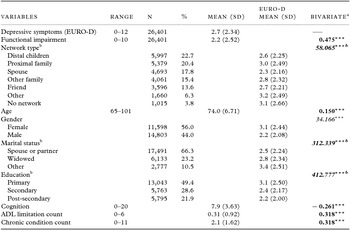
Univariate description of study variables and their bivariate associations with the EURO-D score

Notes: n = 26,401; country findings available upon request. *** p <0.001. aBivariate Test: t-test; Pearson R2 ; F-Statistic .bBonferroni correction significant threshold =0.05 / # comparisons.
Results
Univariate findings are presented in Table 1. Means and standard deviations are reported for continuous variables and percentages are reported for dichotomous and categorical variables. Depressive symptoms numbered 2.7, on average, and ranged from 0 to 12 (Table 1). Functional impairment among respondents was at a low to moderate rate, (mean = 2.2). The average age was 74 years and more than half were female (56%). The majority of the respondents were living with a spouse or partner (66.3%) and about one-quarter (23.2%) were widowed. Nearly half the sample had attained a primary level of education (49.4%); the others were almost equally divided between secondary and post-secondary education. The mean verbal recall score was 7.9 words. The mean number of ADL limitations was less than 1, and the mean number of chronic conditions was 2. Bivariate findings show that all the variables in the table maintained a significant association with the EURO-D outcome measure (Table 1). Tukey HSD post hoc tests for the ANOVA analyses indicated that all groups of the education and marital status categorical variables varied significantly from each other on depressive symptoms. Significant differences in the number of EURO-D symptoms were also found between about 90% of the social network types, and every type differed from one or more other types (F = 58.965; p < 0.001).
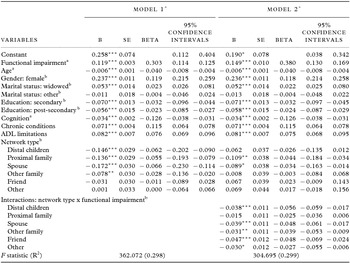
The results of the two-stage OLS regression are presented in Table 2. Model 1 shows that the extent of functional impairment had the strongest association with the EURO-D count; the greater the number of functional limitations, the greater the count of depressive symptoms. Moreover, cognition, higher education, and age were all related to fewer depressive symptoms. Female gender, widowed marital status (compared to those married or partnered), chronic conditions, and ADL limitations were all associated with a greater number of symptoms. The model also controlled for country (findings available upon request), and fewer depressive symptoms than average emerged in several countries (Sweden, Denmark, Germany, the Netherlands, Switzerland, Austria, Czech Republic, and Slovenia). A greater number of symptoms were found in France, Portugal, Poland, Hungary, and Estonia.
Network type associations with EURO-D; Interactions with functional impairment: OLS Regression

Notes: *p < 0.025; ** p < 0.01; *** p < 0.001, n = 26,401; ^ Model adjusted for country – results available upon request.
ascale ranges: age (65–101); cognition (0–20); functional impairment count (0–10), b Reference categories: gender (male), marital status (married/partnered), education (primary educ.) network type (no network), network type interaction (no network x functional impairment).
Among the network types, the “spouse” network cluster had the strongest negative association with EURO-D symptoms. Additional negative associations were evident among “distal children,” “proximal family,” and “other family” networks. The non-familial network types, “friend” and “other,” did not significantly differ in the number of depressive symptoms in comparison to the “no network” type reference category. The study variables in Model 1 accounted for 30% of the explained variance in the EURO-D outcome.
Model 2 added the interactions between network type and the extent of functional impairment. The strength and direction of the associations of functional impairment and the control variables with depressive symptoms remained largely unchanged. However, several distinctions emerged in the associations between network type and the EURO-D score, depending on functional impairment. For those with no functional impairment, the associations between network type and depressive symptoms differed from the results obtained in Model 1. Only “proximal family” and “spouse networks” retained the negative associations with depressive symptoms, albeit at a slightly lower strength, in comparison to the “no network” reference group.
Among the functionally impaired, all of the network type categories, except for the “proximal family” type, had fewer depressive symptoms in comparison to the no network grouping. Moreover, in contrast to the depressive symptom reducing effect of the “proximal family” network among respondents without functional limitations, those with one or more limitations who were embedded in the “proximal family” network had the same extent of depressive symptoms as the impaired respondents who had no network. Although the two non-familial network types, “friend” and “other,” were significantly associated with fewer depressive symptoms among respondents with functional impairment, this was not the case among the non-impaired as was noted earlier. Lastly, the interaction terms did not appreciably change the amount of explained variance, but pointed to the variation in the associations between the study's key variables
Discussion
This study examined the inter-relationship between social network type, functional impairment, and depressive symptoms among older adults. The analysis was based upon data from a social network module that was employed for the first time in the fourth wave of SHARE, in 16 European countries. In his module, survey respondents were asked to list up to seven individuals with whom they discuss important matters. Their responses thus provided a self-reported listing of their most meaningful relationships. The results showed that functional impairment was indeed the prime correlate of the depression outcome. In addition, network type was differentially associated with depressive symptoms – those in family-oriented networks had fewer symptoms than respondents who were embedded in non-family networks and those who had no network at all. The analysis also confirmed the hypotheses addressed in this study. First, the number of depressive symptoms in late life varied with the network type when viewed in relation to functional impairment. Second, older persons without a personal social network did, in fact, have more depressive symptoms when experiencing functional impairment.
The study considered seven groupings of personal social networks that were derived in previous analytic work (Litwin and Stoeckel, Reference Litwin and Stoeckel2014). The network types that resulted were mostly family based (currently termed: “distal children,” “proximal family,” “spouse,” and “other family”) representing three-quarters of the study's sample. Two non-family-based groupings were also present – the “friend” and “other” networks. A seventh grouping reflected those with no-named social ties.
The first model of the regression analysis showed that the network types were related differentially to the depression outcome after controlling for functional impairment, sociodemographic background, health, cognition, and country of residence. Specifically, respondents embedded in “distal children,” “proximal family,” “spouse,” and “other family” networks all had fewer depressive symptoms than those in the “friend” and “other” networks and from those in the “no network” reference category. These findings underscore the importance of family-based networks for the mental health of older European adults and suggest that inherent mental health risks are associated with having less accessible non-family social networks, including friend networks, or none at all.
These results align with those from the previously cited ELSA study (Stafford et al., Reference Stafford, McMunn, Zaninotto and Nazroo2011), but contrast with earlier research which has found that social connections with friends are depression reducing (Fiori et al., Reference Fiori, Antonucci and Cortina2006; Golden et. al., Reference Golden, Conroy and Lawlor2009; Litwin, Reference Litwin2011). One explanation for this discrepancy is that the present analysis employed a more specific inventory in which respondents were asked to name the people who were most meaningful to them. This approach, which allowed for the examination of the relationship characteristics between older adults and their most trusted social ties, differs from the indirect measurement approaches applied in much earlier research. As a result, the network types that were constructed in the present study may more accurately reflect the relational dynamics of both kin and non-kin ties, as well as the nuances as to how older adults psychologically relate to their social ties.
The second model of the regression analysis, in which the interaction between network type and functional impairment was taken into account, underscores that functional impairment comes into play in the association between social network type and mental health. Among the respondents with no functional limitations, those embedded in the two closest family-based network types (“proximal family” and “spouse” network types) had fewer depressive symptoms in relation to the “no network” reference category. Respondents in all the other network types, on the other hand, were indistinguishable from those in the “no network” category in relation to the mental health outcome. This suggests that net of functional impairment, social ties are not necessarily a correlate of mental health. Moreover, the fact that respondents free of functional impairment who maintained mainly friend networks did not have fewer depressive symptoms than those with no network at all implies that networks of choice, that is non-familial social ties, may not always be linked to better mental health. Friends may be helpful as social companions, but their contribution may wane if they are one's main or only confidants.
In contrast, the same model in the regression showed that among respondents with at least some degree of functional limitation, each increase in the number of limitations was related to having fewer depressive symptoms in all the network types but the “proximal family” type (compared to the “no network” reference category). That is, mobility-impaired older adults with no network had more depressive symptoms in almost all cases. It seems that when in need, those without a network have no one else to whom to turn when they can no longer rely upon themselves. This may lead to poorer mental health.
The finding that impaired respondents who were embedded in the “proximal family” network type were not less depressed than those with no network at all is more difficult to interpret. It might be that having a very accessible close family network (second only to the “spouse” network), encouraged these respondents to use their networks beyond the degree minimally required, inadvertently reinforcing their sense of helplessness and lack of autonomy which, in turn, exacerbated their poor mental state. Alternatively, respondents embedded in the “proximal family” networks live within relatively close proximity to their adult children. Some of them may have relocated to be near family because of failing health and a corresponding need for assistance. Therefore, these respondents may be experiencing other losses associated with moving that may contribute to poor mental health, such as loss of a meaningful home or proximity to long-time friendships. These dynamics are beyond the scope of this study and require additional analysis in future research.
The negative association with depressive symptoms that was observed among the mobility-impaired respondents with a “friend” network type, (and to a lesser degree, those in the “other” network type) also requires additional comment. The finding suggests that when limitations set in, friends and acquaintances do matter after all. This implies that the maintenance of meaningful relationships with friends and others, when experiencing functional impairment, may help sustain feelings of social engagement and may encourage corresponding positive mental well-being outcomes.
The main limitation of the current investigation was the cross-sectional nature of the data. This restricts the findings to discussion of associations and does not allow determination of directionality. This limitation was a given, insofar as the network module on which the network types were based was implemented only in the fourth wave of the SHARE survey. In addition, the effect of a very large sample on the associations must be acknowledged.
The results from this study underscore that different interpersonal milieus maintain diverse associations with mental health in late life when taking into account functional limitations. The practical implication of this finding is that mental health practitioners need to be aware of the various types of personal social networks in which their clients are embedded. These differing interpersonal environments seem to work differently in terms of depression prevention, especially among older people who are experiencing functional decline. The findings also suggest that practitioners should be aware of the importance of having friends when functional impairment sets in and family ties are not available. Indeed, those who lack social ties of any kind in late life are the most vulnerable to mental distress, and should be given highest priority by those who are entrusted with their care.
Conflict of interest
None.
Description of authors’ roles
H. Litwin designed the study, supervised the project, wrote sections of the manuscript, and gave critical comment. K. Stoeckel constructed the analytic sample, performed the statistical analyses, and wrote and edited the final manuscript.