INTRODUCTION
Discfishes (or remoras) of the family Echeneidae are fishes equipped with a sucking disc, which is used to attach themselves to large marine animals. This association assures several benefits to remoras, including transportation, protection from predators, increased courtship/reproduction potential and greater feeding opportunities (Fertl & Landry, Reference Fertl and Landry1999, Reference Fertl, Landry, Perrin, Würsig and Thewissen2002; Silva & Sazima, Reference Silva and Sazima2003). On the other hand, hosts also obtain advantages since remoras feed on parasites (i.e. copepods) and clean hosts from sloughing epidermal tissue and, in addition, ingest scraps of food, faeces, small nekton and zooplankton (Cressey & Lachner, Reference Cressey and Lachner1970; Vaske, Reference Vaske1995; Sazima et al., Reference Sazima, Moura and Rodrigues1999; Fertl & Landry, Reference Fertl, Landry, Perrin, Würsig and Thewissen2002; Williams et al., Reference Williams, Mignucci-Giannoni, Bunkley-Williams, Bonde, Self-Sullivan, Preen and Cockcroft2003).
Discfishes are found on a large variety of hosts, such as teleosts, sharks, marine mammals and turtles: indeed, some remora species (e.g. Echeneis naucrates) attach to a diverse array of hosts, whereas others show a preference for specific hosts (Strasburg, Reference Strasburg1964; Sazima & Grossman, Reference Sazima and Grossman2006). According to Strasburg (Reference Strasburg1959, Reference Strasburg1964), in most cases attachment tends to be specific both to host and attachment site.
Overall, five species of discfishes occur in Mediterranean waters, belonging to two genera: Echeneis (E. naucrates) and Remora (R. australis, R. brachyptera, R. osteochir and R. remora).
In the last decade, the study of some biological and ecological aspects of the Mediterranean spearfish Tetrapturus belone in several research projects (Potoschi, Reference Potoschi2000; Castriota et al., Reference Castriota, Finoia, Campagnuolo, Romeo, Potoschi and Andaloro2008; Romeo et al., Reference Romeo, Consoli, Castriota and Andaloro2009, Reference Romeo, Battaglia, Pedà, Perzia, Consoli, Esposito and Andaloro2012) has given us the opportunity to collect several specimens of R. osteochir (marlin sucker), which is usually hosted by this billfish. Indeed, marlin sucker is an oceanic species with a strong preference for marlins and sailfish as hosts, where it can be found attached to the body or gill chamber (Lachner & Post, Reference Lachner, Post, Quéro, Hureau, Karrer, Post and Saldanha1990). In addition, marlin sucker has also been reported in association with swordfish, Xiphias gladius (Castro Pampillón, Reference Castro Pampillón1996; Psomadakis et al., Reference Psomadakis, Scacco and Vacchi2006; Tuncer et al., Reference Tuncer, Orlov and Ozen2012), shortfin mako shark, Isurus oxyrinchus (Mucientes et al., Reference Mucientes, Queiroz, Pierce, Sazima and Brunnschweiler2008) and occasionally with other pelagic fishes (Tuncer et al., Reference Tuncer, Orlov and Ozen2012). The relationship between marlin sucker and its hosts (in particular billfishes) is considered mutualistic, based on the relative importance of parasitic copepods in the diet of R. osteochir (Cressey & Lachner, Reference Cressey and Lachner1970; Vaske, Reference Vaske1995; O'Toole, Reference O'Toole2002). Recently Gray et al. (Reference Gray, McDowell, Collette and Graves2009) investigated the population structure of the marlin sucker in the Atlantic and Pacific Oceans, inferred from mitochondrial control region DNA sequence analysis, supporting the theory that Atlantic marlin sucker were isolated from their Pacific conspecifics, and subsequently brought back into contact in the relatively recent geological past. Moreover, the Atlantic population was likely secondarily colonized by Indo-Pacific individuals. According to Gray et al. (Reference Gray, McDowell, Collette and Graves2009) the genetic differentiation observed in marlin sucker are likely determined by host-dependent effects (e.g. habitat preference, migration patterns) and parallel evolutionary forces (e.g. vicariant isolation, selection, genetic drift) affecting both the host and symbiont.
The marlin sucker lives in warm and temperate seas of all oceans (Froese & Pauly, Reference Froese and Pauly2013); its distribution in the Mediterranean was long thought to be limited to the western basin (Lachner & Post, Reference Lachner, Post, Quéro, Hureau, Karrer, Post and Saldanha1990), but a catch of a specimen of marlin sucker in Aegean waters was recently reported (Tuncer et al., Reference Tuncer, Orlov and Ozen2012). If data on remora-host relationships are excluded, very poor information on the biology and ecology of this species is available in the literature, mainly focused on reproductive aspects (Morota & Fujita, Reference Morota and Fujita1995; Garibaldi & Orsi Relini, Reference Garibaldi and Orsi Relini2003), feeding habits (Cressey & Lachner, Reference Cressey and Lachner1970; Vaske, Reference Vaske1995; O'Toole, Reference O'Toole2002) and genetic structure (Gray et al., Reference Gray, McDowell, Collette and Graves2009). Moreover, some observations on marlin sucker pairs cohabitating on the same istiophorid host (Cressey & Lachner, Reference Cressey and Lachner1970; Gray et al., Reference Gray, McDowell, Collette and Graves2009) suggests the possibility of repeated spawning events between cohabitating fishes, thus covering a wide distribution area for their progeny given the highly migratory nature of their hosts (Gray et al., Reference Gray, McDowell, Collette and Graves2009).
The aim of this paper is to describe for the first time the age and growth of marlin sucker, together with other biological and ecological aspects. Moreover, we provide the first description of the sagittal otolith of marlin sucker.
MATERIALS AND METHODS
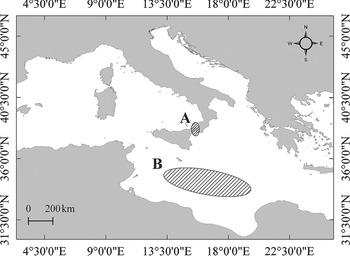
Overall, 236 individuals of marlin sucker were collected in the southern-central Mediterranean Sea (Figure 1), from May to August in 2008 and 2009. The large amount of samples (N = 183) were hosted by 87 specimens of the Mediterranean spearfish caught by albacore surface longlines. Moreover, additional samples (N = 53) were collected during the activities of the harpoon fishery targeting swordfish in the Strait of Messina. They were found attached to the same host, Mediterranean spearfish (N = 34), which is usually another harpoon fishery target species (Potoschi, Reference Potoschi2000; Di Natale et al., Reference Di Natale, Mangano, Celona, Navarra and Valastro2003, Reference Di Natale, Mangano, Celona and Valastro2005). The majority of marlin sucker collected during this research study were found hidden within the gill chamber of their host, in a cavity that seems to be well-adapted to the marlin sucker's body shape. All individuals were identified as marlin sucker according to taxonomic features reported by Fischer et al. (Reference Fischer, Bauchot and Schneider1987) and Lachner & Post (Reference Lachner, Post, Whitehead, Bauchot, Huraeu, Nielsen and Tortonese1986, Reference Lachner, Post, Quéro, Hureau, Karrer, Post and Saldanha1990). Specimens were measured (total length, TL; disc length, DL) to the nearest 0.1 mm and weighed (total weight, TW, and eviscerate weight, EW) to the nearest 0.01 g. Macroscopic observation of the gonads was used to determine sex in specimens and to assign a gonadal maturity stage according to the five-degree scale proposed by Holden & Raitt (Reference Holden and Raitt1974): I = immature; II = first developing or spent in a recovery phase; III = developing to spawning; IV = mature/spawning; V = post-spawning or spent.
Sample collection areas in the Mediterranean Sea (A = Strait of Messina; B = southern-central Mediterranean).

Additional information on the size (LJFL = lower jaw fork length) of the host (Mediterranean spearfish) was also recorded.
On each host, we collected between one and three marlin suckers. In order to analyse the length composition of potential pairs and to understand if they were made up of individuals of similar length, we used linear regression plotting the relationship between male and female sizes and including only specimens in pairs. Differences in pair size were checked by paired-sample Wilcoxon signed rank test using the Statistica v.10 software package (Statsoft, 2011). Finally, the non-parametric Mann–Whitney U test (Mann & Whitney, Reference Mann and Whitney1947) was employed to examine the possible relationships between Mediterranean spearfish LJFL and marlin sucker size and number.
Age readings
Sagittal otoliths were removed from the vestibular apparatus, cleaned and stored dry. The description of sagittae was provided, according to Tuset et al. (Reference Tuset, Lombarte and Assis2008).
Age readings were performed on the concave side of the right otolith. To better identify annual growth zones, made up of alternating opaque and hyaline rings, otoliths were clarified by full immersion in methyl benzoate for 6 h and then observed using a stereo microscope under reflected light against a dark background. Annuli were observed on the rostrum and their continuity was checked around the otolith edges wherever possible.
Each sagitta was read by two observers and when readings differed by one or more years, a third reading was performed. As a rule, if there was still a difference between readings, the otolith was discarded. The ageing precision of readings was estimated by calculating the index of average per cent error, APE (Beamish & Fournier, Reference Beamish and Fournier1981; Campana, Reference Campana2001), and the mean coefficient of variation, CV (Chang, Reference Chang1982; Campana, Reference Campana2001).
The validation of periodic deposition of hyaline and opaque zones was carried out by otolith edge analysis (van der Walt & Beckley, Reference van der Walt and Beckley1997; Labropoulou & Papaconstantinou, Reference Labropoulou and Papaconstantinou2000; Campana, Reference Campana2001) on 228 specimens (individuals in age class 0 were excluded). The relative frequency of opaque or hyaline rings in the otolith edge was plotted across sampling months.
Growth
Age data and corresponding specimen lengths were fitted into the von Bertalanffy (Reference von Bertalanffy1938) theoretical growth model:
 $${L_t}\, = \,{L_\infty} ({\rm 1}-{{\rm e}^{ - k(t - {t_0})}})$$
where L t is the length (in cm) at age class t, L ∞ is the length (asymptotic length) that the fish of a population would reach if they were to grow indefinitely, k the instantaneous growth coefficient, t the age (years) and t 0 the theoretical age at which length is 0. Growth parameters (L ∞, k, t 0) of this equation were estimated and then the growth performance index (Φ’ = 2 log10 L ∞ + log10 k) (Munro & Pauly, Reference Munro and Pauly1983) was calculated.
Length-weight relationship was calculated using both total weight (TW) and eviscerate weight (EW). Parameters of length-weight relationship were obtained by transforming the potential function TW = a * TLb and EW = a * TLb into logarithmic form. TW is total weight, EW is eviscerate weight, TL total length, a the intercept of the regression line and b the regression coefficient, representing the slope of the log-transformed relation (Le Cren, Reference Le Cren1951; Froese, Reference Froese2006; Froese et al., Reference Froese, Tsikliras and Stergiou2011). When b = 3 the growth of a fish species is isometric (all fish dimensions increase at the same rate), whereas a negative allometric (or hypoallometric) growth is observed when b < 3 (a fish increases less in weight than predicted by its increase in length) and a positive allometric (or hyperallometric) growth when b > 3 (a fish increases more in weight than predicted by its increase in length) (Froese et al., Reference Froese, Tsikliras and Stergiou2011). In order to verify whether the calculated b was significantly different from the theoretical value of isometric growth (=3), the Student's t-test was employed (P = 0.05).
The relationship between the increase in length of sucker disc (DL) and body (TL) was examined by linear regression and possible differences between sexes were checked by the Student's t-test (comparison between regression coefficients).
RESULTS
The marlin suckers examined in the present study ranged between 4.4 and 22.6 cm TL (mean TL = 14.7 ± 3.27) in size and 0.41 and 75.90 g (mean weight = 21.30 ± 15.37 g) in weight. Macroscopic observation of the gonads identified 96 males measuring 10.1–22.6 cm in TL, ranging from 4.73 to 75.90 g, and 132 females measuring 10.5–22.2 cm in TL, ranging from 5.47 to 74.50 g; the sex of the remaining eight individuals (4.4–8.9 cm TL) was considered undetermined because they were too young.
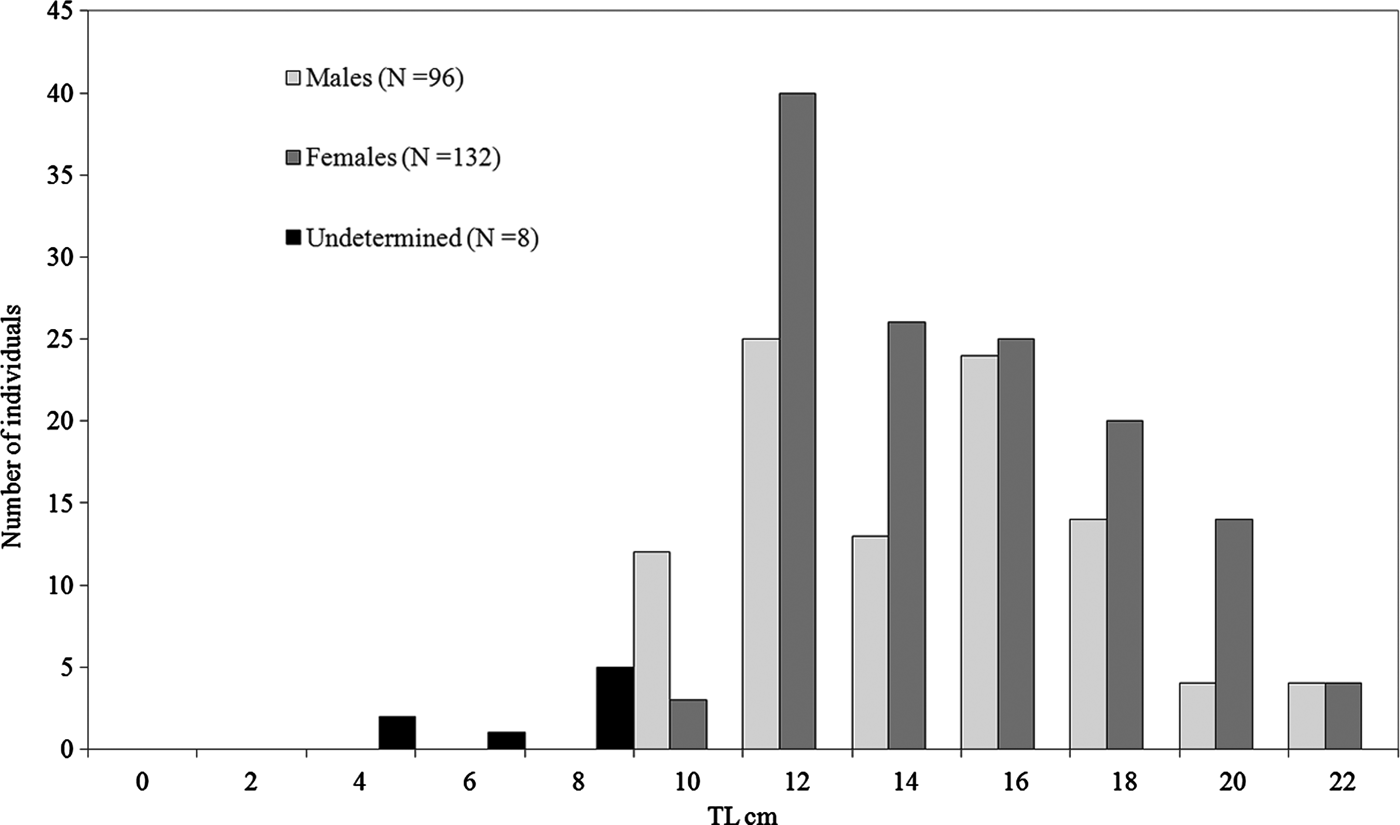
Figure 2 reports the length (2 cm classes) frequency distribution of the marlin sucker specimens; 73.3% of samples belong to the classes 10 cm (TL range: 9.1–11.0) to 14 cm (TL range: 13.1–15.0).
Length frequency distributions by sex of marlin sucker caught in the two study areas of the Mediterranean Sea.

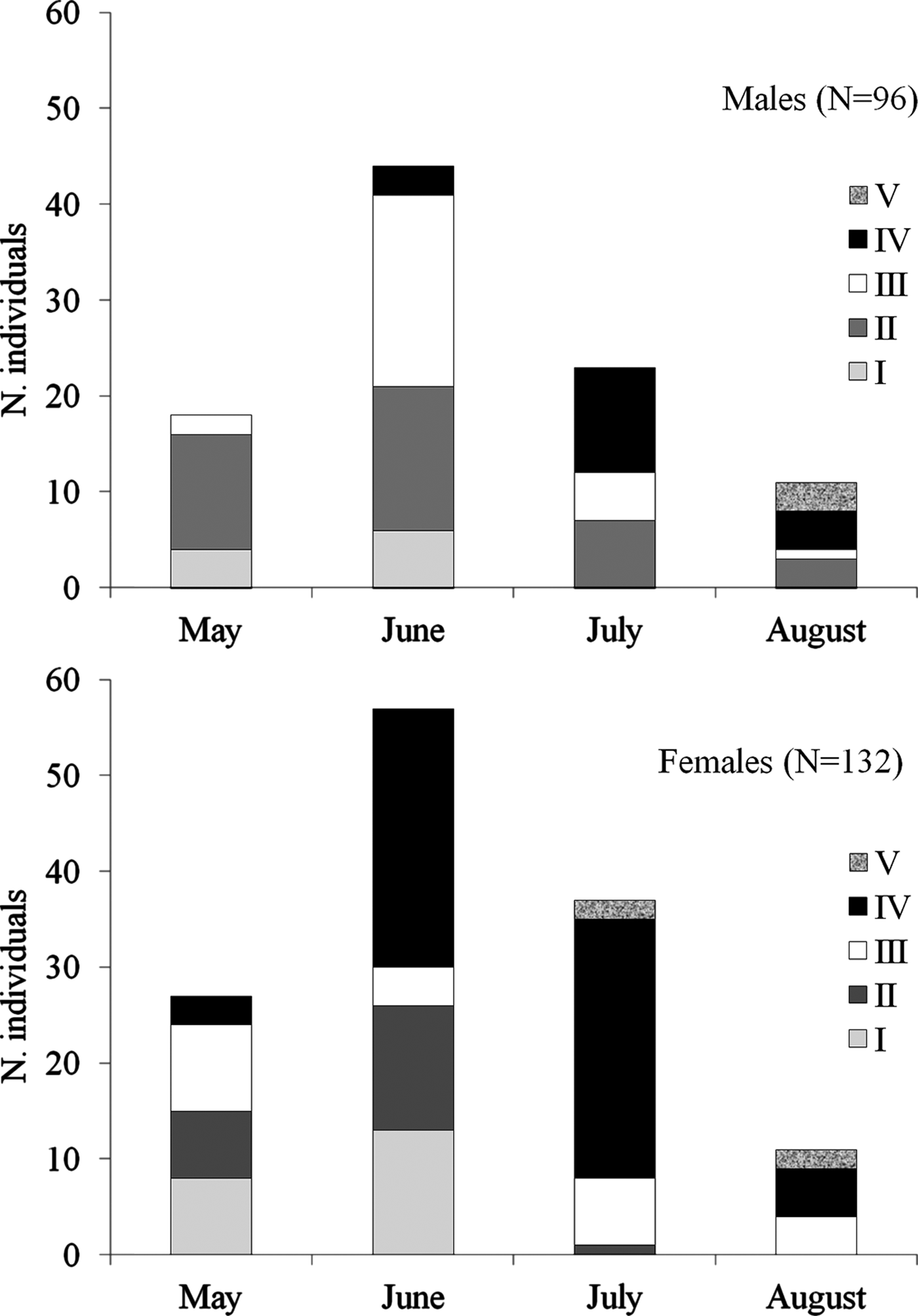
Monthly maturity stages of marlin sucker, determined by macroscopic observation of the gonads, are shown in Figure 3. Even though the sampling period was restricted to a short fishing season (May to August), the analysis of gonads allowed identification of a peak of reproduction during June and July; however, mature individuals were found across all sampling months. Some specimens in a post-maturity stage were observed during July and August.
Monthly maturity stages of gonads per sex observed in the marlin sucker specimens caught in the southern-central Mediterranean Sea.

The analysis of length composition of potential pairs by linear regression showed that there was not a high level of correlation between male and female sizes. However, no significant differences in pair size were highlighted by the paired-sample Wilcoxon signed rank test (Z = 1.1970; P = 0.2313; n.s.).
Analysis of the relationship between Mediterranean spearfish LJFL and marlin sucker size and number by non-arametric Mann–Whitney U test did not show any significant differences, resulting in no size-related association between marlin suckers and their host (TL remora/ Mediterranean spearfish LJFL: P = 1.0012; n.s.; number of remoras/Mediterranean spearfish LJFL: P = 0.2453; n.s.).
Otolith description
Shape: elliptic to irregular, ventral margin sinuate or entire. Sulcus acusticus: Pseudo-archaesulcoid, ostial, median. Ostium: tubular, longer than the cauda. Cauda: round-oval, straight, ending near to the posterior margin. Anterior region: double-peaked; rostrum very broad, short, round; antirostrum very short, poorly defined or very short, slightly pointed; excisura moderately wide with a shallow notch. Posterior region: round.
Age readings and growth
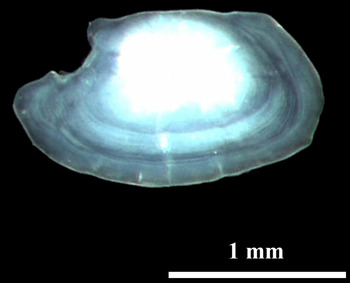
In general, the otoliths of marlin sucker were easy to read, with clearly identifiable growth increments (Figure 4). The average per cent error value (APE = 2.44) and the mean coefficient of variation (CV = 3.16) indicated a good level of ageing precision in readings. Although the samples were collected over the course of just a few months (May to August), edge analysis highlighted the formation of an opaque increment during these warm months (with a percentage ranging between 74.5 and 96.7, in May and July respectively), thus confirming an annual pattern of deposition of one opaque increment and one hyaline increment.
Sagittal otolith of marlin sucker showing two annuli.

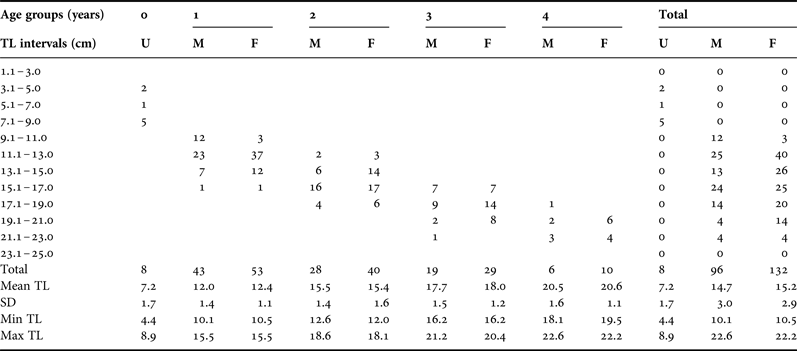
Overall, five age groups were found, ranging from age class 0 to 4; results of age readings are summarized in Table 1, reporting the age-length key per sex for the marlin sucker specimens examined in this paper. The eight undetermined specimens belonged to the 0 age group, whereas the most represented age group was age 1 with 96 individuals, 43 of which were males and 53 females; the older group (age 4) included only six males and 10 females. Mean TL (cm) and standard deviation values of each age group per sex are also reported in Table 1, together with TL range.
Number of individuals per sex for each age and length class (age-length key) for R. osteochir. (F, females; M, males; U, undetermined).

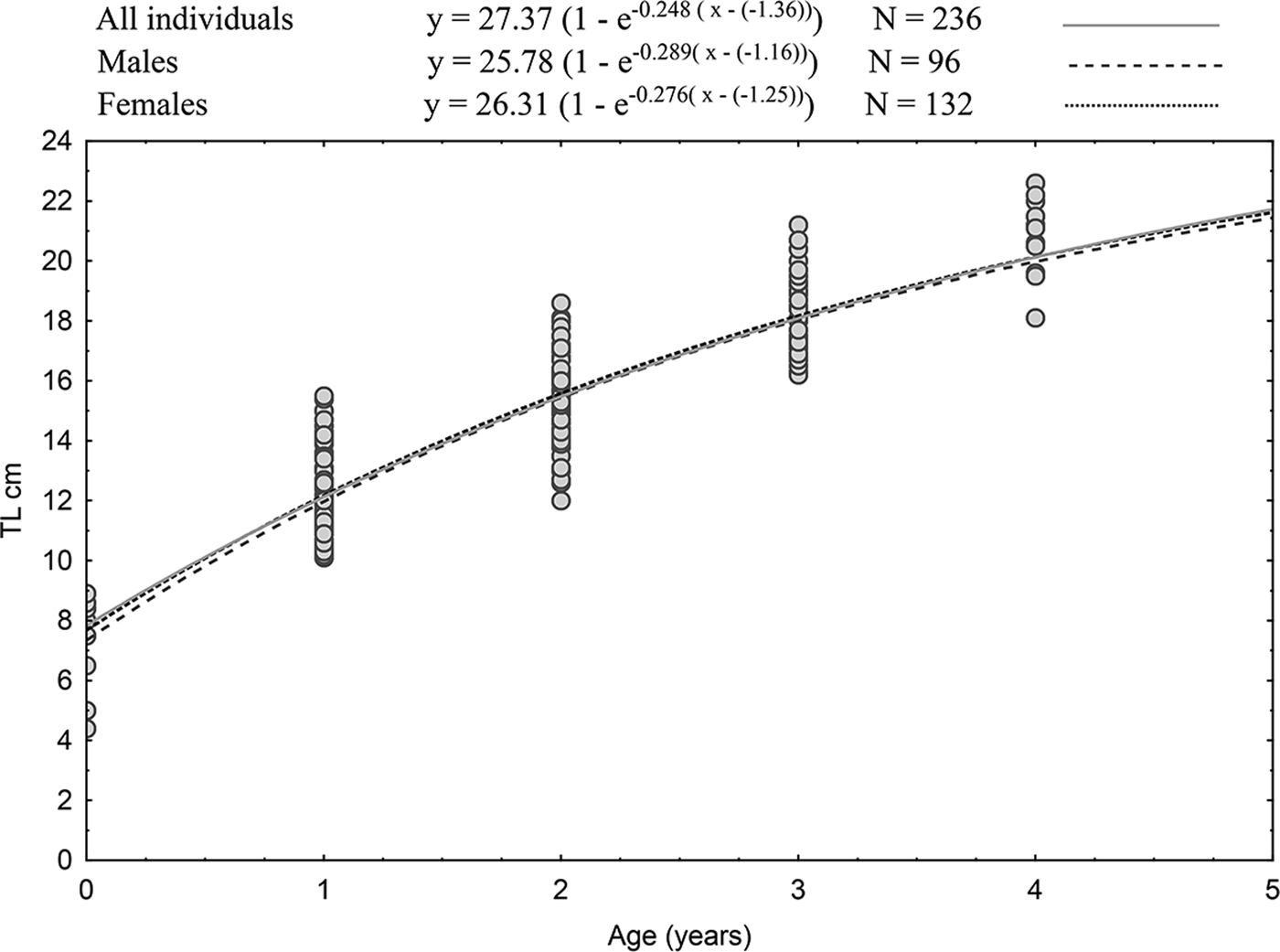
The relationship between age and length was calculated and described by the von Bertalanffy equation (Figure 5), resulting in the following growth parameters: L ∞ = 27.37 cm TL, k = 0.248 year−1, t 0 = −1.36 year. Male growth parameters (L ∞ = 25.78 cm TL, k = 0.289 year−1, t 0 = −1.16 year) were quite similar to female ones (L ∞ = 26.31 cm TL, k = 0.276 year−1, t 0 = −1.25 year) as well as resulting growth curves (Figure 4). The corresponding values of the growth performance index (Φ’) were respectively 2.269 for all individuals, 2.283 for males and 2.281 for females.
Von Bertalanffy growth curve for all individuals and by sex of marlin sucker.

Parameters of length-weight relationships are shown in Table 2. Concerning the TW-TL equation, unlike the regression coefficient (b) of males, the b calculated for females was significantly different from the theoretical value of isometric growth (=3), as shown by the Student's t-test outcomes. In contrast, this difference was not detected for EW-TL equation, where all sexes showed an isometric growth (Table 2).
Length-weight (TL-W and TL-EW) relationships per sex for R. osteochir in the central Mediterranean Sea. Results of Student's t-test (to test whether the calculated b differs significantly from the theoretical value of isometric growth b = 3).

Table 3 reports the equations (linear regression) of the relationship between the growth in length of sucker disc (DL) and body (TL) for all individuals and by sex; no significant differences were detected between males and females by the Student's t-test (t (N−4) = 0.068; not significant).
Equations of relationship between sucker disc length (DL) and total length (TL) per sex.

DISCUSSION
The present study considers several aspects of the biology and ecology of marlin sucker for the first time. Monitoring of albacore longline fishing and swordfish harpoon fishing allowed us to collect a relatively large number of specimens of marlin sucker, exclusively associated with Mediterranean spearfish. Although an association with swordfish has been reported in the literature both in Atlantic (Castro Pampillón, Reference Castro Pampillón1996) and in Mediterranean waters (Psomadakis et al., Reference Psomadakis, Scacco and Vacchi2006; Tuncer et al., Reference Tuncer, Orlov and Ozen2012), in the present study no marlin sucker was observed on swordfish, even though greater numbers of swordfish were examined (e.g. Romeo et al., Reference Romeo, Battaglia, Raicevich, Perzia and Andaloro2015), this fish being the target species of the Sicilian harpoon fishery and therefore usually dominating harpoon catches (Di Natale et al., Reference Di Natale, Mangano, Celona and Valastro2005; Romeo et al., Reference Romeo, Battaglia, Raicevich, Perzia and Andaloro2015).
This high preference for host association with Mediterranean spearfish could be supported by an observation occurring during the sampling operations: several marlin suckers were found hidden inside the gill chamber of their host, in a cavity that seems to be well-adapted to the marlin sucker's body shape. This observation should be examined in future investigations to understand whether the preference for this billfish association is due to an evolutionary adaptation for both marlin sucker and its host, strengthened by the mutual advantages of this relationship (i.e. availability of food and protection for marlin sucker; control of ectoparasites for Mediterranean spearfish, according to Mucientes et al., Reference Mucientes, Queiroz, Pierce, Sazima and Brunnschweiler2008).
Otoliths of marlin sucker showed clear growth patterns in their macrostructure and they were not difficult to interpret; this was confirmed by the good level of ageing precision in readings, as indicated by the values for APE (2.44) and mean coefficient of variation (CV = 3.16). Ring formation seems to follow the typical annual pattern of fishes living in temperate waters, with opaque and hyaline increments being laid down during warm and cold months, respectively, as confirmed by otolith edge analysis. Therefore, it is confirmed for this species that one opaque zone plus one subsequent translucent zone are to be regarded together as one year of growth (Beckman & Wilson, Reference Beckman, Wilson, Secor, Dean and Campana1995).
Age readings by the observation of annuli in sagittal otoliths suggest that the marlin sucker has a life expectancy of about 4 years, within the studied length range (4.4 and 22.6 cm TL), even though a longer duration cannot be excluded given the maximum length of 40 cm TL reported for the species (Edwards, Reference Edwards1990) from the Atlantic Ocean. However, the fact that such sizes have never been recorded from the Mediterranean Sea and the available literature (Tortonese, Reference Tortonese1970; Garibaldi & Orsi Relini, Reference Garibaldi and Orsi Relini2003; Psomadakis et al., Reference Psomadakis, Scacco and Vacchi2006; Tuncer et al., Reference Tuncer, Orlov and Ozen2012; present paper) may indicate that the species reaches shorter lengths in Mediterranean waters, as no specimens larger than 28.6 cm (Tortonese, Reference Tortonese1970) have ever been caught there. This hypothesis, proposed for the first time by Garibaldi & Orsi Relini (Reference Garibaldi and Orsi Relini2003), cannot be currently ‘confirmed’, but future research is needed to compare the Atlantic and Mediterranean populations as well as to investigate any genetic exchanges.
The parameters of the von Bertalanffy and EW-TL equations did not show any differences in growth between sexes, whereas the TW-TL relationship highlighted an apparent distinct growth for males (isometric) and females (allometric). This result can be easily explained: we should take into account that a large amount of samples were collected during their reproductive period and female gonads are usually more voluminous and heavier than male ones. Thus, the differences may be only due to gonad size, as supported by the other results: similar sizes, growth curves, DL-TL and EW-TL relationships.
Our length-weight relationship differs from the equation calculated by Tuncer et al. (Reference Tuncer, Orlov and Ozen2012), considering both the individual collected from the north-eastern Aegean Sea and the 16 specimens captured by Garibaldi & Orsi Relini (Reference Garibaldi and Orsi Relini2003) in the Ligurian Sea. Indeed, Tuncer et al. (Reference Tuncer, Orlov and Ozen2012) found a negative allometry (b = 2.8715), but this difference is likely more imputable to the small sample size (only 17 individuals analysed, as against 236 in the present paper) than to a real difference in growth pattern.
Analysis of the marlin sucker's gonads identified a reproductive peak during June and July, although mature individuals occurred throughout all sampling months. Garibaldi & Orsi Relini (Reference Garibaldi and Orsi Relini2003) also observed mature gonads of marlin sucker from the Ligurian Sea between July and September, thus supporting our findings about the occurrence of reproduction in summer months. The sampling period, linked to seasonal fishing operations (longline and harpoon) and to the capture of a bycatch host species (Mediterranean spearfish), makes it impossible to fully investigate the gonadal development of the marlin sucker throughout the year, so other reproduction events in other months cannot be excluded.
The analysis of length composition of potential pairs showed no significant differences between male and female sizes, as already observed by Garibaldi & Orsi Relini (Reference Garibaldi and Orsi Relini2003) in four marlin sucker pairs from the Ligurian Sea. Ripe male and female marlin sucker pairs have been observed cohabitating on the same istiophorid host by some authors (Cressey & Lachner, Reference Cressey and Lachner1970; Gray et al., Reference Gray, McDowell, Collette and Graves2009) and according to Gray et al. (Reference Gray, McDowell, Collette and Graves2009) these data suggest the chance for repeated spawning events between cohabitating fishes. Moreover, marlin sucker gametes and larvae are presumably disseminated in a wide distribution area, given the highly migratory nature of their hosts (Gray et al., Reference Gray, McDowell, Collette and Graves2009). All these factors together with the occurrence of mature gonads in relatively small fishes, belonging to one age group, contributes to the reproductive success of this species.
The objective difficulty in collecting specimens of marlin sucker, fish without any commercial interest and living in a pelagic environment associated with specific hosts, has until now determined a lack of knowledge on its behavior, biology and ecology, which the present study partially rectifies.
ACKNOWLEDGEMENTS
The authors are grateful to the fishermen who helped their efforts during this study. The authors would also like to thank Anthony Green for kindly revising the English of the manuscript.