Introduction
Autism spectrum disorder (ASD)1 is a condition characterized by impairment in social communication and interactions, restricted interests, and stereotyped behaviors, eventually associated with intellectual disability and language development alterations. Many authors stressed the presence of shared phenotypical presentations and risk factors between ASD and the schizophrenia spectrum disorders (SSD), a group of disorders that, according to The Diagnostic and Statistical Manual of Mental Disorders, Fifth Edition (DSM-5), includes schizophrenia (SCZ), other psychotic disorders of the same spectrum (such as schizophreniform disorder, schizoaffective disorder, delusional disorder, etc.) and schizotypal personality disorder.1–Reference Chisholm, Lin and Abu-Akel5 BleuerReference Bleuler6 considered autism a core element of SCZ, and the term “autism” was often used as a synonym of SCZ until Rutter and Kolvin,Reference Kolvin7, Reference Rutter8 during the 1970s, proposed to consider ASD and SCZ as different disorders. However, these conditions show high comorbidity ratesReference Stahlberg, Soderstrom and Rastam9–Reference Solomon, Olsen and Niendam12 and increasing evidence stressed that SCZ should be considered, as ASD, a neurodevelopmental disorder.Reference Goldstein, Minshew and Allen13, Reference Ursini, Punzi and Chen14 Moreover, several authorsReference Burbach and van der Zwaag15, Reference Kushima, Aleksic and Nakatochi16 suggested the presence of shared pathogenetic, neurobiological, and genetics underpinnings between ASD and SSD. For example, MECP2 gene mutations have been linked to a wide range of neurodevelopmental disorders, ranging from ASD, SCZ, and also bipolar disorder.Reference Chao, Chen and Samaco17 However, it should be noted how ASD and SCZ also differ in several features, such as the earlier onset of ASD, which usually appears in childhood, while SCZ usually appears in adolescence or adulthood.1, Reference Goldstein, Minshew and Allen13Moreover, while negative symptoms of SCZ may resemble some ASD-like features, psychotic features are more typically present in SCZ, possibly implying differences in the impact on global functioning and quality of life between the two conditions.1, Reference Goldstein, Minshew and Allen13
The link between ASD and SCZ has been further confirmed from an epidemiological point of view by a recent meta-analysis conducted by Zheng et alReference Zheng, Zheng and Zou18 in terms of a higher prevalence of SCZ in patients with ASD as well as of ASD in patients with SCZ. Particularly interesting is the hypothesis of a phenotypical continuum between SSD and ASDReference Folstein and Rutter19, Reference van Os, Hanssen and Bijl20: according to this conceptualization, ASD and SSD would be different conditions, although part of the same psychopathological spectrum.Reference Spek and Wouters3, Reference Solomon, Olsen and Niendam12, Reference Gadow21–Reference Owen and O’Donovan24 It should be noted how recently researchers focused their interest in the subthreshold autism dimension, stressing the relevance of autistic-like traits in psychopathology also without the presence of a full-fledged ASD diagnosis.Reference Dell’Osso, Lorenzi and Carpita25Autistic traits were firstly investigated in first-degree relatives of ASD children, leading to the concept of a “broad autism phenotype” (BAP).Reference Baron-Cohen, Wheelwright and Skinner26–Reference Carpita, Carmassi and Calderoni29 However, further studies stressed how autistic traits seems to be continuously distributed across general population, being particularly frequent in clinical samples of patients with other kinds of mental disorders.Reference Baron-Cohen, Wheelwright and Skinner26–Reference Dell’osso, Lorenzi and Carpita40The high rates of autistic traits in comorbidity with other psychiatric disorders suggested that multifactorial neurodevelopmental alterations may represent a common vulnerability factor for many psychiatric conditions, including SSD.Reference Dell’Osso, Lorenzi and Carpita41 In this framework, a meta-analysis from De Crescenzo et alReference De Crescenzo, Postorino and Siracusano42 confirmed that autistic symptoms are more frequent among SSD patients, highlighting shared cognitive traits between autism and schizophrenic spectra. More limited literature has focused on how autistic traits may influence SSD presentations and global functioning. A lower premorbid adjustment during childhood and adolescence was frequently recorded in SSD patients and it was associated with an earlier onset of disease, more severe negative symptoms, worse prognosis, and functional outcome.Reference Cannon, Caspi and Moffitt43–Reference Galderisi, Rucci and Mucci51 Rapoport et alReference Rapoport, Chavez and Greenstein11, Reference Bechi, Agostoni and Buonocore52 observed that the presence of autistic traits might be involved in the heterogeneity of premorbid adjustment, clinical expression, and pathological trajectories in SCZ patients. On the other hand, SCZ patients with a preponderance of negative symptoms were reported to show an “autistic-like phenotype.”Reference Bastiaansen, Meffert and Hein53 Chisholm et alReference Chisholm, Pelton and Duncan54 evidenced, among patients experiencing a first episode of psychosis, that a higher expression of autistic traits was associated with a worse functioning and quality of life, as well as with higher severity of psychotic symptoms. More recently, Vita et alReference Vita, Barlati and Deste55 reported that among patients with SCZ the presence of autistic traits was linked to poorer cognitive performance and lower real-life functioning. Conversely, Vaskinn and Abu-AkelReference Vaskinn and Abu-Akel56 reported how, among SSD patients, the presence of autistic traits was associated with a better functioning, hypothesizing that the two conditions may compensate each other. In this framework, increasing research in the field of global functioning and quality of life highlighted the importance of investigating possible protective factors, such as positive coping styles, resilience, and self-esteem. Despite that, resilience factors in autism have been poorly investigated.Reference Lai and Szatmari57 Previous literature reported how autistic traits, also when sub-threshold, seem to be linked with a lower global functioning and adjustment,Reference Skylark and Baron-Cohen28, Reference Carpita, Carmassi and Calderoni29, Reference Suzuki, Miyaki and Eguchi58 as well as with lower self-esteem, poorer adjustment to stress, and a higher tendency to maladaptive coping styles, leading to a reduced quality of life.Reference Owen and O’Donovan24, Reference Hirvikoski and Blomqvist59 However, studies in this field were mainly conducted in the general population or in clinical samples of ASD patients, while the influence of ASD or autistic traits on specific patterns of functioning, as well as on resilience and coping styles, in other clinical populations has been scantly investigated, leading to controversial results.Reference Dell’Osso, Lorenzi and Carpita41, Reference Abu-Akel, Clark and Perry60, Reference Kronenberg, Goossens and van Busschbach61
Similar results have been reported also among SSD patients, which showed higher levels of perceived stigma and lower self-esteem and resilience to stress.Reference Karakaş, Okanli and Yilmaz62, Reference Torgalsbøen63 Among SSD patients, a lower self-esteem has been associated with worse social functioning and quality of life.Reference Eklund, Backstrom and Hansson64, Reference Roe65 Moreover, lower levels of resilience were linked to a greater functional impairment and higher levels of psychosis.Reference Torgalsbøen63, Reference Kim, Song and Park66 Intriguingly, executive functions, which are a feature typically impaired among subjects with autistic traits, were reported to moderate the relationship between subjective experience and social functioning among SSD patients,Reference Brekke, Kohrt and Green67 while both resilience and self-esteem seem to moderate the relationship between perceived stigma and quality of life.Reference Kim and Jang68 Regarding coping styles, a higher prevalence of maladaptive coping strategies was reported among patients with SSD.Reference Cotton, McCann and Gleeson69, Reference Marquez-Arrico, Benaiges and Adan70 Other authors stressed the relationship between lower self-esteem and maladaptive coping strategies in this population,Reference Zappia, Montemagni and Macrì71 as well between lower perceived stigma and positive coping.Reference Holubova, Prasko and Hruby72, Reference Holubova, Prasko and Hruby73 According to a recent study by Chen et al,Reference Chen, Xu and Mao74 positive coping strategies and resilience may influence the variability in functional impairment among patients with SCZ. Previously some authors, as reported above, focused on the role of autistic traits in influencing clinical presentation and real life functioning and outcome in SSD patients. The aim of the present study was to further deepen the investigation in this field, evaluating how autism spectrum may be linked, among SSD patients, to specific patterns of functioning, focusing on personal resources, and adjustment strategies. In particular, we aimed to evaluate how patients with SSD with or without significant autistic traits may differ with respect to levels of functioning, self-esteem, resilience, and coping profiles.
Methods
Subjects
One hundred and sixty-four outpatients with SCZ were recruited at the University psychiatric clinics of Pisa, Brescia, Cagliari, Catania, L’Aquila, Roma “Tor Vergata,” Siena, and Napoli as part of the add-on autism spectrum study of the Italian Network for Research on Psychoses.Reference Galderisi, Rucci and Mucci51
Inclusion criteria were a diagnosis of SCZ according to DSM-IV-TR, confirmed with the Structured Clinical Interview for DSM-IV-patient version (SCID-IV-P), an age between 18 and 66 years. Exclusion criteria were as follows: (1) history of head trauma with loss of consciousness; (2) history of moderate to severe mental retardation or of neurological diseases; (3) history of alcohol and/or substance abuse in the last 6 months; (4) current pregnancy or lactation; (5) inability to provide an informed consent; and (6) treatment modifications and/or hospitalization due to symptom exacerbation in the last 3 months. All subjects signed a written informed consent after receiving a comprehensive explanation of the study procedures and goals. The study has been conducted in accordance with the principles of the Declaration of Helsinki (59th World Medical Association General Assembly; October 2008). Approval of the study protocol was obtained from the Ethics Committees of the participating centers.
Study design
Subjects were grouped depending on the presence of significant autistic traits according to the Adult Autism Subthreshold Spectrum (AdAS Spectrum) instrument. We investigated the relationships between autistic traits and levels of functioning, self-esteem, resilience, and coping styles. Correlations between specific dimensions of the autism spectrum and functioning profiles were also investigated. Further information about the study design is reported elsewhere.Reference Galderisi, Rucci and Mucci51
Assessments
Socio-demographic variables were collected in a clinical form, using all available sources of information. In addition, all subjects were asked to fill out questionnaires or answering questions assessing the autism spectrum, real-life functioning, self-esteem, resilience, and coping styles.
Autism spectrum
The autism spectrum was investigated by means of the Autism Spectrum Quotient (AQ)Reference Baron-Cohen, Wheelwright and Skinner26and the AdAS Spectrum.Reference Dell’Osso, Gesi and Massimetti75–Reference Dell’Osso, Carmassi and Cremone77
The AQ is a widely used questionnaire providing a self-report measure of autistic traits among adults without intellectual impairment.Reference Baron-Cohen, Wheelwright and Skinner26 It features 50 questions, assessing 5 different areas: social skill; attention switching; attention to detail; communication; and imagination. A score over 32 has been shown to be a useful cut-off for identifying subjects with clinically significant levels of ASD symptoms in the validation study,Reference Baron-Cohen, Wheelwright and Skinner26 while subjects scoring 23 or greater have been considered with a possible BAP, that is a variety of subthreshold manifestations of ASD, such as peculiar communication and cognitive processes, strong persistent interests, and rigid and aloof personality.Reference Wheelwright, Auyeung and Allison78 The AdAS Spectrum is a 160-item self-report questionnaire developed with the aim of assessing a broad variety of symptoms and associated manifestations of ASD. It was developed to assess not only full-threshold symptoms, but also subthreshold and partial forms of ASD, as well as isolated autistic traits across the lifetime. Items are grouped into seven domains: childhood/adolescence, verbal communication, nonverbal communication, empathy, inflexibility and adherence to routine, restricted interests and rumination, and hyper-/hyporeactivity to sensory input. In the validation study, the AdAS Spectrum showed high internal consistency, sound test–retest reliability (Kunder–Richiardson coefficient = 0.964, Intraclass correlation coefficient= 0.976) and strong convergent validity with alternative dimensional measures of autism. In proceeding with Dell’Osso et al, subjects scoring 44 or above may be considered as having clinically significant levels of autistic traits.Reference Dell’Osso, Gesi and Massimetti75–Reference Dell’Osso, Carmassi and Cremone77
Level of functioning and self-esteem
Patients’ real-life functioning was evaluated using the Specific Levels of Functioning (SLOF) scale,Reference Mucci, Rucci and Rocca79 a 43-item survey assessing the patient’s current functioning and observable behavior, with a specific focus on the presence of skills, assets, and abilities rather than deficits. The SLOF was based on the caregivers’ judgment about patients’ functioning, and therefore it was administered to the caregivers.Reference Galderisi, Rucci and Mucci51 It is composed of six subscales: (1) physical functioning, (2) personal care skills, (3) interpersonal relationships, (4) social acceptability, (5) activities of community living, and (6) work skills. Each of the 43 questions is rated on a 5-point Likert scale, resulting in a total score ranging from 43 to 215. A higher total score is associated with a better overall functioning of the patients. Self-esteem levels were evaluated with the Self-Esteem Rating scale (SERS), an instrument composed of 40 items organized in a 7-point Likert scale.Reference Nugent and Thomas80Score ranges from −120 to +120, positive scores are associated with higher levels of self-esteem.
Resilience and coping abilities
Resilience was evaluated using the Resilience Scale for Adults (RSA),Reference Friborg, Hjemdal and Rosenvinge81 a 33-item scale organized in six dimensions: perception of self, perception of the future, structured style, social competence, family cohesion, and social resources. Responses are rated on a 7-point Likert scale, higher scores are associated with higher levels of resilience. The brief-COPE scale was employed for evaluating coping styles. The scale is composed of 28 items organized in 14 domains, which investigates 14 different coping styles: self-distraction, denial, self-blame, substance use, behavioral disengagement, venting (which are different dimensions of “avoidant coping”), active coping, use of emotional support, use of instrumental support, positive reframing, planning, acceptance (which are different dimensions of “approach coping”), religion, and humor. Responses are organized in a 4-point Likert scale; higher scores indicate a higher use of a specific coping style.Reference Carver82
Statistical analyses
Student’s t-test or chi-squared tests were used for comparing demographic characteristics and scores reported on psychometric instruments between SCZ patients with and without autistic traits. Pearson’s correlation coefficient was used for investigating significant correlations between AdAS Spectrum domains and SLOF, SERS, RSA, and COPE scores. Finally, a logistic regression was performed for identifying the variables best predicting the presence of a comorbid autism spectrum. Statistical analyses were conducted using SPSS, version 20.
Results
Socio-demographic characteristics and autistic symptoms
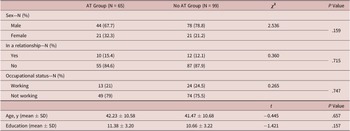
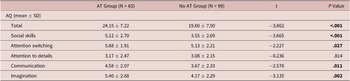
The sample included 164 patients with SCZ (mean age = 41.8 ± 10.6 years) and it was composed of 122 male (74.4%) and 42 female (25.6%). According to the AdAS spectrum, 65 subjects (39.6%) scored above the threshold for autistic traits (>43), while 99 subjects (60.4%) reported a score ≤ 43: these group were named “AT group” and “No AT group,” respectively. Socio-demographic characteristics of subjects with or without autistic traits are displayed in Table 1. No significant differences were found for age, gender, years of education, occupational status (working/not working), and marital status (in a relationship yes/no). AT group reported higher scores than No AT group on all AQ domains but attention to details (see Table 2).
Comparisons of Socio-Demographic Characteristics Between Groups.

Abbreviation: SD, standard deviation.
Comparisons Between SCZ Patients with and without AT on AQ Scores.

Abbreviations: AQ, Autism Spectrum Quotient; SCZ, schizophrenia; SD, standard deviation.
p values <.05 are marked in bold.
Comparison of levels of functioning and self-esteem between groups
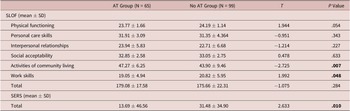
When considering the SLOF, patients in the AT group reported significantly higher scores on activities of community living subscale but significantly lower scores on work skills subscale. AT group scored significantly lower also on SERS total score (see Table 3).
Comparisons Between SCZ Patients with and without AT on SLOF and SERS Scores.

Abbreviations: SCZ, schizophrenia; SERS, Self-Esteem Rating scale; SLOF, Specific Levels of Functioning; SD, standard deviation.
p values <.05 are marked in bold.
Correlations of autism spectrum symptoms with levels of functioning and self-esteem
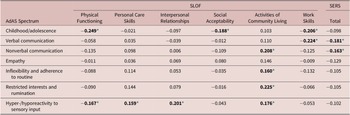
Correlations of AdAS Spectrum with SLOF and SERS scores were reported in Table 4. Significant positive correlations were found between SLOF activities of community living subscale and AdAS Spectrum nonverbal communication, inflexibility and adherence to routine, restricted interests and rumination, hyper-/hyporeactivity to sensory input domain scores. Positive correlations were found also between AdAS Spectrum hyper-/hyporeactivity to sensory input domain and both SLOF personal care skill and Interpersonal relationships scores. Significant negative correlations were reported between SLOF physical functioning subscale and AdAS Spectrum childhood/adolescence, hyper-/hyporeactivity to sensory input domains, as well as between SLOF work skills subscale and AdAS Spectrum childhood/adolescence, verbal communication domains. AdAS Spectrum childhood/adolescence domain score was also negatively correlated with SLOF social acceptability subscale score. Finally, significant negative correlations were found between SERS total score and AdAS Spectrum verbal communication and nonverbal communication domains.
Correlations of the AdAS Spectrum with SLOF and SERS.

Abbreviations: AdAS, Adult Autism Subthreshold Spectrum; SERS, Self-Esteem Rating scale; SLOF, Specific Levels of Functioning.
* P < .05.
Statistically significant correlation coefficients are marked in bold.
Comparison of resilience ability and coping styles between groups
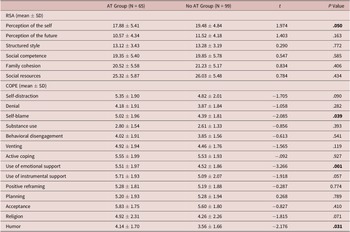
When comparing RSA and COPE scores, we found significantly lower scores on RSA perception of the self dimension among patients in the AT group. This group scored significantly higher also on COPE self-blame, use of emotional support, and humor domains (see Table 5).
Comparisons Between SCZ Patients with and without AT on RSA and COPE Scores.

Abbreviations: RSA, Resilience Scale for Adults; SCZ, schizophrenia; SD, standard deviation.
p values <.05 are marked in bold.
Correlations of autism spectrum symptoms with resilience ability and coping styles
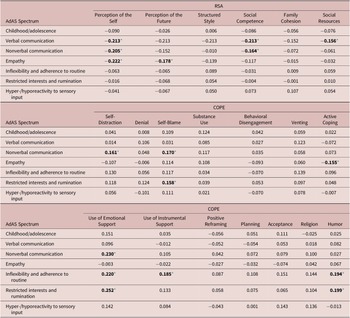
Correlations between AdAS Spectrum and scales measuring resilience and coping styles are shown in Table 6. AdAS Spectrum verbal communication domain showed significant negative correlations with RSA perception of the self, social competence, and social resources subscales, while AdAS Spectrum nonverbal communication domain was negatively correlated only with RSA perception of the self and social competence domains. Significant negative correlations were found also between AdAS Spectrum empathy domain and RSA perception of the self and perception of the future subscales. When considering the COPE, significant positive correlations were found between AdAS Spectrum nonverbal communication and COPE self-distraction, self-blame, and use of emotional support dimension, while AdAS Spectrum empathy domain was negatively correlated with COPE active coping dimension. AdAS Spectrum inflexibility and adherence to routine and restricted interests and rumination domains were both significantly and positively correlated with COPE use of emotional support and humor dimension; AdAS Spectrum inflexibility and adherence to routine domain was also significantly correlated with COPE use of instrumental support, while AdAS Specrum restricted interest and rumination domain was positively correlated also with COPE self-blame dimension.
Correlations of the AdAS Spectrum with RSA and COPE.

Abbreviations: AdAS, Adult Autism Subthreshold Spectrum; RSA, Resilience Scale for Adults.
* P < .05.
Statistically significant correlation coefficients are marked in bold.
Logistic regression
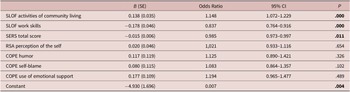
We performed a multiple logistic regression analysis with the presence of autism spectrum (according to AdAS Spectrum cut-off) as the dependent variable. We chose to use as independent variables the factors for which a significant difference between groups was observed on t-test analyses, and in particular SLOF activities of community living and work skills scores, SERS total score, RSA perception of the self, COPE self-blame, use of emotional support, and humor scores. Results showed that the variables significantly predictive for the presence of an autism spectrum were SLOF work skills and SERS total scores (higher scores indicating higher levels of functioning and self-esteem) as negative predictors (odds ratio [OR] = 0.837, 95% confidence intervals [CI] = 0.764-0.916 and OR = 0.985, 95% CI = 0.973-0.997, respectively) and SLOF activities of community living score as positive predictor (OR = 1.148, 95% CI = 1.072-1.229) (see Table 7).
Logistic Regression Analysis with the Presence of Autistic Traits (According to AdAS Spectrum Cut-Off) as Dependent Variable and SLOF Activities of Community Living and Work Skills Scores, SERS Total Score, RSA Perception of the Self, COPE Humor, Self-Blame, Use of Emotional Support and Humor Scores as Independent Variables.

Abbreviations: AdAS, Adult Autism Subthreshold Spectrum; CI, confidence intervals; RSA, Resilience Scale for Adults; SE, standard error; SERS, Self-Esteem Rating scale; SLOF, Specific Levels of Functioning.
p values <.05 are marked in bold.
Discussion
According to previous literature,Reference Zheng, Zheng and Zou18, Reference De Crescenzo, Postorino and Siracusano42, Reference Bechi, Agostoni and Buonocore52, Reference Chisholm, Pelton and Duncan54, Reference Matsuo, Kamio and Takahashi83 this study showed that a significant proportion of patients with SCZ has significant levels of autistic traits, as evaluated with both the AdAS Spectrum and the AQ.
Levels of functioning and self-esteem
Our results highlighted specific profiles of functioning in SCZ patients with autistic traits, allowing us to hypothesize that these features could play a significant role in determining the global adjustment. Despite overall functioning, as evaluated by the total SLOF score, did not differ significantly between AT/No AT patients, the autistic dimension was shown to affect more subtle dimensions of functioning assessed by SLOF subscales, such as activities of community living and work skills domains. In particular, subjects with high autistic traits were shown to have better performances in the activities of community living subscale, whose scores were also positively correlated with those reported on four AdAS Spectrum domains (nonverbal communication, inflexibility and adherence to routine, restricted interests and rumination, and hyper-/hyporeactivity to sensory input). To some extent, these data are in line with Vaskinn and Abu-Akel study,Reference Vaskinn and Abu-Akel56 which evidenced a better functioning and social cognition among patients with SCZ and autistic traits, hypothesizing that these conditions may compensate each other and lead to a better adjustment at least in some tasks. On the other hand, AT group reported poorer performance in the work skills subscale, in line with other studies which highlighted a lower functional outcome among SCZ patients with autistic traits.Reference Galderisi, Rucci and Mucci51, Reference Bastiaansen, Meffert and Hein53 A possible explanation of our results is that some discrete autistic dimensions, such as the adherence to routines or the focus on restricted interests, may actually help individual’s functioning in simple tasks, whereas a detrimental effect of autistic traits may prevail in more complex activities, such as those explored in the work skills dimension of SLOF, ultimately resulting in an impaired ability to work that is in line with previous literature.Reference Suzuki, Miyaki and Eguchi58, Reference Trevisan and Birmingham84, Reference Wallace, Budgett and Charlton85 However, it should be noted that, while working skills can be more easily ascertained, the assessment of community living skills of the patients might be more exposed to biases depending from the subjective judgment of the caregivers. The score reported on SLOF work skills subscale was negatively correlated with those reported on AdAS Spectrum verbal communication and childhood/adolescence domains, highlighting that reduced work skills were related to a higher impairment in verbal communication, as well as with higher autistic traits during childhood/adolescence. This result add to previous studies, which reported poorer academic performances among patients in the autism spectrum with greater verbal communication difficulties,Reference Trevisan and Birmingham84, Reference Wallace, Budgett and Charlton85 while Bechi et alReference Bechi, Agostoni and Buonocore52 reported how autistic traits may influence since childhood the social functioning of the subjects. Interestingly, a negative correlation was found also between AdAS spectrum childhood/Adolescence domain and social acceptability and physical functioning subscales of SLOF. This result is strikingly in line with Bejerot et alReference Bejerot, Edgar and Humble86 who reported an association between autistic traits and both a worse physical performance and the risk of being bullied since childhood in a sample of university students. The poorer physical performance associated with autistic traits is not surprising in light of the clumsiness commonly described among the core characteristics of high functioning autistic subjects.Reference Gillberg and Kadesjö87 The lower social acceptability among SCZ patients with high autistic traits during childhood is instead worth of special attention given the potential impact of autistic traits in the outcome of SCZ patients since childhood as observed by Bechi et al.Reference Bechi, Agostoni and Buonocore52 Another result emerging from our data is the lower level of self-esteem in the group with high autistic traits, as assessed by the SERS questionnaire. Besides corroborating previous literature,Reference Eklund, Backstrom and Hansson64, Reference Roe65, Reference McChesney and Toseeb88–Reference Arwert and Sizoo90 our data further clarify the relationship between AT and self-esteem, showing that lower levels of this latter were related to a greater impairment on verbal and nonverbal communication skills, as demonstrated by the negative correlations reported between SERS scores and AdAS Spectrum verbal communication and nonverbal communication scores. In line with Hillier et al,Reference Hillier, Goldstein and Murphy91 this result might suggest that impaired communication skills are likely to undermine self-perception and self-esteem among SCZ patients, also suggesting a possible target of intervention in similar clinical samples.
Resilience
Somehow consistently with the results reported on SERS, patients in the AT group showed worse scores in the perception of the self subscale of RSA, which explores a group of dimensions that are known to act as resources of resilience. In agreement with other studies,Reference Torgalsbøen63–Reference Kim and Jang68, Reference Capps, Sigman and Yirmiya92, Reference Williamson, Craig and Slinger93 correlation analyses between AdAS Spectrum and RSA domains scores confirm the critical role of communicative impairment with respect to low self-perception, low self-esteem, and low social competence in SCZ patients, as indicated by the negative correlations between both domains exploring communication (verbal and nonverbal) of AdAS Spectrum and perception of the self and social competence subscales of RSA. This also add to previous data by our group indicating a relationship between impaired communication and both lower functional adjustment and suicide,Reference Carpita, Carmassi and Calderoni29, Reference Dell’Osso, Carpita and Muti36 which was in turn related to worse self-perception in other studies,Reference Pelton and Cassidy94 highlighting the multifaceted impact of communication skills on global functioning and mental health.
Coping styles
Our study also showed that the presence of significant levels of autistic traits among SCZ patients was associated with a unique pattern of coping strategies, as evaluated by the COPE scale. In particular, subjects in the AT group were significantly more likely to use self-blame, humor, and emotional support as coping strategies. Coping strategies based on humor have been reported to be alternatively linked to positive or negative outcomesReference Eisenberg, Shen and Schwarz95, Reference Meyer, Helle and Tucker96 in the scientific literature, and further studies should be focused on clarify the implications of this specific coping styles. The greater likelihood to use emotional support in order to cope with life events is somehow consistent with previous studies indicating that autistic traits are positively associated with maladaptive emotionally based coping styles and negatively related to adaptive strategies that use social diversion.Reference Groden, Cautela, Prince, Berryman, Schopler and Mesibov97, Reference Pisula, Danielewicz, Kawa and Pisula98 Intriguingly, both COPE self-blame and use of emotional support dimensions were positively correlated with the nonverbal communication and restricted interests and rumination domains of AdAS Spectrum, confirming the detrimental role of communication deficit and rumination above other autistic dimensions in the ability to positively adjust to events, as already shown in other patients groups.Reference Dell’Osso, Cremone and Carpita99
Predictive factors for the presence of autistic traits
According to the results of the regression analysis, among the dimensions of functioning and personal resources that showed significant differences between groups, those with a higher association with the presence of an autism spectrum seemed to be the levels of self-esteem, as measured by the SERS, and the levels of work skills and functioning in activities of community living, as measured by the SLOF. In particular, while SLOF work skills and SERS total score were negative predictive factors, SLOF activities of community living score was a positive predictive factor of the presence of autistic traits.
Globally, these results suggest that among SCZ patients a pattern of lower work skills but higher functioning in activities of community living, together with lower levels of self-esteem, should be considered suggestive of a possible unrecognized autism spectrum in comorbidity.
A better understanding of specific patterns of functioning, resilience, and coping styles among patients with SCZ and autism spectrum may allow clinicians to identify in an early stage this specific population, eventually developing more targeted therapeutic and management strategies for improving patients’ adjustment, clinical, and functional outcome.Reference Bechi, Agostoni and Buonocore52–Reference Vita, Barlati and Deste55
Limitations
Our study suggests a possible role of autistic traits in shaping the functioning and the adjustment of patients with SCZ, even when a clear autistic symptomatology is not evident or is concealed by the severity of the psychotic disorder. Still, the results presented here need to be considered in light of some necessary limitations. First of all, the cross-sectional design prevents any conclusion about cause-effect relationships. Second, the inclusion in the study also of self-report questionnaires might have led to an underestimation or an overvaluation of symptoms by the patients. In particular, although self-report instruments may allow avoiding operator-dependent selection biases, they prevent a formal validation of the clinical condition according to standardized diagnostic criteria.Reference Fusar-Poli, Rutigliano and Stahl100 Moreover, in this study, we did not specifically evaluate the presence of negative symptoms in patients with SCZ, and the use of self-report instruments may have prevented us to identify potential overlapping features between ASD and negative symptoms. These limitations concerning the use of self-report instruments are of specific relevance among subjects with autistic traits, due to their difficulties in self-assessment of abilities and lack of introspective accuracy.Reference Harvey, Deckler and Jones101 Further limitations are represented by the relatively limited sample size and by the specific patient population, which is affected by a chronic, severe psychopathology. Moreover, the sample was composed mostly by males (122 M vs 42 F), eventually leading to gender biases in our results. In the context of the above limitations, results from our study may deepen the knowledge on the relationship between SCZ and autism spectrum, raising the awareness of clinicians on the widespread occurrence and functional impact of autistic traits also in this kind of patients.
Disclosures
The authors have nothing to disclose.
Appendix
The following members of the Italian Network for Research on Psychoses contributed to this study: Stefano Barlati, Cassandra Ariu, Pier Paolo Faresin (University of Brescia), Federica Pinna, Michele Muscas, Luca Marras (University of Cagliari), Laura Fusar Poli, Teresa Surace, Carmen Concerto (University of Catania), Laura Giusti, Anna Salza, Valeria Bianchini (University of L’Aquila), Luigi Giuliani, Francesco Brando, Chiara Coccia (University of Campania, Naples), Giorgio Di Lorenzo, Cinzia Niolu, Michele Ribolsi (Tor Vergata University of Rome), Arianna Goracci, Alessandro Cuomo, and Simone Bolognesi (University of Siena).