INTRODUCTION
Acquiring syntax involves assigning words to grammatical categories and understanding the relationship between the categories at the abstract level. The child must go beyond specific instances heard in the input and reach abstract patterns and rules. Such abstract representations are essential for syntactic productivity in children's speech and comprehension. Here we report an empirical study that addressed the question of abstract grammatical representation in young children, using the case of grammatical gender feature agreement.
Grammatical agreement such as number and gender is common in natural languages. For example, in English the subject and the present tense main verb agree in number. In gender-marked languages, the gender features of certain syntactic categories (such as nouns, determiners, generalized quantifiers) agree when conjoined to form phrases or sentences. In French, for instance, gender-marked determiners have separate masculine and feminine forms (e.g., le MASC/la FEM ‘the’; un MASC/une FEM ‘a’). Most nouns, however, have one form and belong to one of two genders (e.g., chapeau MASC ‘hat’; rue FEM ‘street’). The gender of most nouns is semantically arbitrary. Their gender agreement with other categories is strictly a syntactic property (e.g., un MASCchapeau MASC ‘a hat’; une FEMrue FEM ‘a street’).
There is a growing interest in young children's representation and processing of grammatical agreement. Recent online comprehension studies examined grammatical gender agreement (e.g., Johnson, Reference Johnson, Brugis, Clark-cotton and Ha2005; Lew-Williams & Fernald, Reference Lew-Williams and Fernald2007; Van Heugten & Shi, Reference Van Heugten and Shi2009). Gender knowledge was tested implicitly, as the child's task focused on identifying a named object while two objects were displayed on a monitor. The target nouns were produced in the context of determiners, and gender of determiners and nouns was manipulated across trials. The idea behind the design was that if children did not process gender, their noun recognition should not differ across gender manipulations. In gender-matched trials, children watched two objects of different genders while hearing speech containing a determiner preceding a noun naming the target object. The determiner and noun shared the same gender, e.g., Dutch: de COMbal COM ‘the ball’ (Johnson); French: la FEMbanane FEM ‘the banana’ (Van Heugten & Shi); Spanish: la FEMpelota FEM ‘the ball’ (Lew-Williams & Fernald). Children's responses suggested that they used the determiner gender to efficiently process the noun while hearing the speech. In gender-uninformative trials, the nouns for each object pair shared the same gender so that a determiner with that gender was compatible with both objects, e.g., Spanish: seeing a ball (pelota FEM) and a cookie (galetta FEM) while hearing la FEMpelota FEM (Lew-Williams & Fernald). Accordingly, performance was less efficient in uninformative trials than in gender-matched trials. Target recognition was most impeded in gender-mismatched trials, in which gender agreement was violated, e.g., French: *le MASCbanane FEM (Van Heugten & Shi); Dutch: *het NEUTbal COM (Johnson). These studies suggest that two- to three-year-olds process grammatical gender online.
It is now important to determine whether the gender effect in the above studies reflected knowledge that was truly syntactic. Since the nouns were familiar to young children, an alternative account is equally plausible. This account is linked to the specific phrases that children likely encountered in their prior input. Children may have simply represented specific exemplars, with no abstract knowledge. For example, when a gender-matched trial in Van Heugten and Shi (Reference Van Heugten and Shi2009) presented two objects depicting bateau MASC ‘boat’ and banane FEM ‘banana’, the word la FEM in the auditory instruction had 100% probability to predict the target object (banane) and 0% probability to predict the distractor. This is because the specific phrase la banane was likely encountered in children's prior input and should therefore be previously stored, whereas the ungrammatical phrase *la bateau should not. In an uninformative trial the nouns for the two objects (e.g., bateau MASC ‘boat’, ballon MASC ‘ball’) both likely co-occurred with the same determiner (le MASC) in children's prior input (e.g., le bateau; le ballon). That determiner thus had 50% probability to predict the target or the distractor. Finally, the gender-mismatched phrases (e.g., *le MASCbanane FEM) presumably never occurred in the prior input, i.e., 0% probability of co-occurrence, which should yield the poorest noun recognition. This probability account therefore would be based on memorized phrases and their co-occurrence probabilities, rather than assuming any abstract representation.
The key evidence for abstract representation is the ability to generalize from previously encountered words to grammatically coherent new combinations (that have never been heard). Abstract representation is most convincingly demonstrated by the ability to apply generalized structures to novel words and novel combinations, a kind of productivity that is characteristic of syntactic knowledge.
The present study aimed at determining whether young children represent grammatical gender abstractly. We tested this question using novel nouns. In particular, we examined whether children represent gender as an abstract feature of grammatical categories and process gender agreement non-adjacently. The previous studies reviewed above all used adjacent gender-marked words, i.e., a determiner immediately followed by a familiar noun. It is unknown if children process non-adjacent dependency of gender-marked words. Preferential listening studies showed that 1·5–2-year-olds track certain non-adjacent dependencies of their native language (Dutch: Van Heugten & Johnson, Reference Van Heugten and Johnson2011; English: Santelmann & Jusczyk, Reference Santelmann and Jusczyk1998; French: Van Heugten & Shi, Reference Van Heugten and Shi2010; German: Höhle, Schmitz, Santelmann & Weissenborn, Reference Höhle, Schmitz, Santelmann and Weissenborn2006) and of briefly trained artificial speech (Gómez, Reference Gómez2002). For example, infants accept is_ing, but not *can_ing dependencies (Santelmann & Jusczyk). French-learning infants accept determiner–auxiliary dependencies such as le_va (DetSING_AuxSING) and disfavor violations such as *les_va (DetPLUR_AuxSING) (Van Heugten & Shi). However, the acceptable non-adjacent dependencies in existing studies always involved specific items that co-occur frequently in the input, whereas the disfavored non-adjacent elements do not or rarely co-occur in the input. Infants' sensitivity may be driven by their memory of the specific non-adjacent dependent elements stored from the input (e.g., hearing is_ing and le_va frequently but never *can_ing and *les_va). No study has directly examined children's ability to track non-adjacent dependencies at an abstract level, e.g., between grammatical categories.
To clearly assess abstract representation, we used a word-teaching phase, which introduced two new word–object pairs. Each novel word followed a gender-marked determiner. That is, children were simultaneously presented with the new word forms and their genders. The novel words themselves contained no phonological markings of gender. Their genders were strictly assigned by the determiners during the teaching phase. The test phase presented the two objects while one was named with a new determiner. For example, a child was taught a novel noun as masculine (e.g., un MASCravole ‘a ravole’). Subsequently, ravole would occur with another masculine determiner (le MASC ‘the’) in a gender-matched test trial, but with a feminine determiner (la FEM ‘the’) in a gender-mismatched trial. In neutral trials the target noun followed a gender-unmarked determiner les ‘the’. Crucially, because the combinations of each novel noun and a new determiner in the test phase had never occurred during training, nor in the child's prior environment, the probability between the specific determiner and the target novel word in each test trial was 0%. This design thus enabled us to test if children could rely on the abstract representation of grammatical gender (i.e., beyond any memorized specific phrases and the co-occurring probabilities between words) to distinguish different kinds of test trials. Specifically, we asked if children could assign the abstract gender feature in determiners to adjacent novel nouns during the teaching phase and perceive the feature upon hearing new instances involving new determiners and the novel nouns in the test trials.
In addition, our experiment tested whether young children represented non-adjacent dependencies at the abstract grammatical level, beyond the tracking of specific familiar elements shown in previous studies (Höhle et al., Reference Höhle, Schmitz, Santelmann and Weissenborn2006; Santelmann & Jusczyk, Reference Santelmann and Jusczyk1998; Van Heugten & Johnson, Reference Van Heugten and Johnson2011; Van Heugten & Shi, Reference Van Heugten and Shi2010). We inserted a gender-unmarked adjective between the new determiner and the novel noun in all our test trials (Det + Adj + N). To process gender agreement, children had to activate the genders of new determiners as abstract feature classes, and activate the genders of the newly taught novel nouns. Gender agreement was thus assessed across non-adjacent abstract categories (Det, N).
We hypothesized that two-year-olds represent abstract grammatical gender and the gender feature agreement between different categories. We expected them to assign the determiner gender to the co-occurring novel noun during training, and to process the feature agreement between the new determiners and the novel nouns during the test phase. Moreover, gender processing should be incrementally affected while gender-marked elements were being heard.
METHOD
Participants
Thirty-three Quebec-French-learning 30-month-olds completed the experiment (M age: 2;6·05; range: 2;6·00–2;7·18; 18 males, 15 females). Nineteen other children were removed from analyses due to fussiness (15), parental interference (2), and technical errors (2).
Auditory and visual stimuli
Speech stimuli included two pseudo-nouns, cagère, ravole, which respected the phonological structure of French. The words served as a control of children's prior experience, allowing us to examine reliably whether children have abstract gender knowledge and whether they encode gender features during word learning. The novel words do not contain any phonological markings of grammatical gender (Cyr & Shi, Reference Cyr and Shi2013), so that we could exclusively test the role of determiners preceding nouns for the encoding and activation of gender.
Besides the pseudo-nouns, we used eleven familiar nouns (six for the teaching phase and five for the test phase), including masculine (i.e., singe ‘monkey’, lapin ‘bunny’, ballon ‘ball’, mouton ‘sheep’, souliers ‘shoes’) and feminine (i.e., poule ‘hen’, fleur ‘flower’, pomme ‘apple’, maison ‘house’, grenouille ‘frog’, banane ‘banana’). The reason to use different sets of familiar nouns for the teaching phase and the test phase was to make the task interesting for the children.
We then created noun phrases (NPs) using the pseudo-nouns and familiar nouns. The NPs included five determiners: two indefinite (un MASC-SINGULAR, une FEM-SINGULAR ‘a’), and three definite (le MASC-SINGULAR, la FEM-SINGULAR, les PLURAL ‘the’). Note that the gender-unmarked les can co-occur with words of both genders. In the NPs for test trials only, we added an adjective joli ‘pretty’ between the determiner and noun. The adjective is phonologically gender-unmarked (i.e., /ʒɔli/) despite the spelling differences (joli MASC/jolie FEM).
A native Quebec-French female speaker produced the speech stimuli in an acoustic booth. They were digitally recorded using a Sound Device 702 T at 48 kHz sampling frequency and 24 bits bit rate. We designed two carrier phrases to introduce the NPs in teaching trials (Oh NP; NP, tu l'aimes? ‘NP, do you like it?’), and one in test trials (Oh regarde! NP ‘Oh look! NP’).
Visual stimuli were objects unknown to children under age three, a red wrench and a silver shaker, which depicted the two pseudo-nouns (ravole, cagère). Familiar nouns were depicted by colorful pictures of the objects. A rising rainbow together with a bird song served as the attention getter between test trials. Colorful moving balls along with a cheerful interjection (Wow!) acquainted the child with the procedure at the beginning of the experiment.
Procedure
Children were individually tested in an intermodal preferential looking procedure. The child sat on the parent's lap in an acoustical chamber, facing a 42-inch LCD screen. Loudspeakers delivering auditory stimuli were adjacent to both sides of the screen. The parent listened to masking music from headphones. A Panasonic video camera hidden below the screen recorded the child, sending simultaneous video signals of the child to a monitor in the neighboring room, where an experimenter, blind to all stimuli, observed the child. When the child looked at the screen, the researcher started the experiment. Audio-visual stimuli were presented by a computer program. Every test trial was child-initiated (i.e., started when the child looked at the screen).
Design
A brief teaching phase presented each pseudo-noun, along with a novel object on the left or right side of the screen. For a specific child, one pseudo-noun was paired with one object and with one gender, and the other pseudo-noun with the other object and the other gender. The gender of the pseudo-noun was indicated by the gender-marked determiner (e.g., un MASCravole MASC, or une FEMravole FEM for another group of children).
Familiar nouns were also presented in the teaching phase, each with an indefinite determiner agreeing with the intrinsic gender of that noun (e.g., un MASClapin MASC ‘a rabbit’; une FEMfleur FEM ‘a flower’) and depicted by a representative image. These presentations served to inform the child that each object was named. In total, the two pseudo-nouns were each presented seven times and the six familiar nouns each one time, all in a random order. The picture presentations had a mean duration of 2700 ms and were separated by 300 ms of a blank screen. The teaching phase lasted approximately one minute.
The test phase immediately followed. Each test trial presented pictures of two objects of different genders side by side, and one of the two objects was named. The named object was therefore the target, and the other one the distractor. The two novel objects were always paired together. The speech, in the Det + Adj + N structure (e.g., le MASC /ʒɔli/ ravole MASC), included a definite determiner le MASC, la FEM, or les, which were not used during training. In trials containing the gender-unmarked plural determiner les, one side of the screen displayed two copies of one object while the other side displayed two copies of another object.
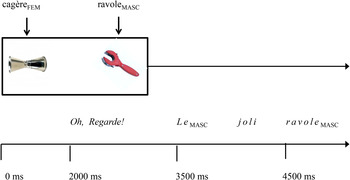
Test trials were all constructed in the same way: first, two objects appeared on the screen in silence. After 2000 ms, the carrier Oh regarde started, followed by the NP. The pictures stayed until the end of the trial. The carrier was the same token across trials. The determiner onset occurred exactly 3500 ms following the trial onset. The average duration was 363 ms for the determiners (SD = ·03), 628 ms for the adjective (SD = ·09), 1370 ms for the pseudo-nouns (SD = ·12), and 1093 ms for the familiar nouns (SD = .06). Figure 1 shows the timeline for a test trial.
Timeline of stimuli presentation during a test trial.

Three test trial types were created for Novel-Noun trials: Gender-Matched, Gender-Mismatched, and Neutral, corresponding to the gender agreement between the determiner and the noun in the auditory instruction. In Gender-Matched trials, the target was introduced by a determiner with the same gender as in the teaching phase. Thus, if ravole was presented as a masculine noun during the teaching phase (i.e., following a masculine determiner, un MASCravole MASC), Gender-Matched test trials then presented ravole with another masculine determiner (i.e., le MASC /ʒɔli/ ravole MASC ‘the pretty ravole’). In Gender-Mismatched trials, the determiner and the pseudo-noun disagreed in gender relative to the gender assignment during training. For example, if ravole was trained as masculine, a Gender-Mismatched test trial presented it with a feminine determiner (*la FEM /ʒɔli/ ravole MASC), thus ungrammatical. In Neutral trials the determiner les was gender-unmarked (e.g., les /ʒɔli/ ravoles MASC). Since gender-unmarked determiners can co-occur with both masculine and feminine words, les was compatible with both the target and distractor. This was unlike the gender-marked determiner in Gender-Matched and Gender-Mismatched trials, which agreed with the gender of one of the objects (the target or the unnamed distractor, respectively).
We also included Familiar-Noun test trials to compare with Novel-Noun trials. Familiar nouns were in two trial types: Gender-Matched and Neutral. In Gender-Matched trials, the noun was preceded by a definite determiner, which matched with the intrinsic gender of the target noun (e.g., le MASC /ʒɔli/ mouton MASC ‘the pretty sheep’). In Neutral trials (e.g., les /ʒɔli/ souliers MASC ‘the pretty shoes’) the gender-unmarked les was compatible with both the target and the distractor.
Each pseudo-noun was used for all three Novel-Noun trial types, forming a total of six test trials (two per trial type) for each child (see ‘Appendix’). For Familiar-Noun trials, two nouns were used for Gender-Matched trials, and another three for Neutral trials. The order of trials was quasi-randomized to ensure variability of determiner use, noun use, and the side for the target object across test trials. The assignment of objects and genders to pseudo-nouns was fully counterbalanced across children.
Offline coding
All test sessions were recorded and offline coded by a blind researcher at a rate of 30 frames/sec. Using the Super Coder Software (Hollich, Reference Hollich2005), the researcher coded each frame as left look, right look, or looking elsewhere.
Analysis
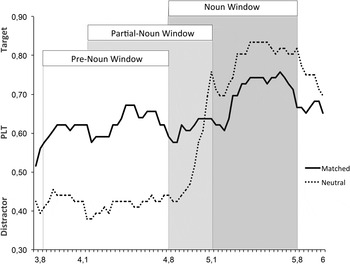
To reveal incremental processing of gender agreement, we analyzed the looks in three time windows of 1000 ms starting from specific time-points. For each window, we calculated the proportion of looking to target (PLT) by dividing the total looking time to the target by the sum of the looking time to the target and that to the distractor. The first window, Pre-Noun Window, started 300 ms from the determiner onset to the point before the noun. The 300 ms was the approximate time needed to initiate an eye movement (e.g., Lew-Williams & Fernald, Reference Lew-Williams and Fernald2007). The second time window, Partial-Noun Window, started 600 ms from determiner onset, covering also the adjective and initial part of the noun. The last window, Noun Window, started 300 ms after the noun onset and ended shortly after the noun.
We predicted that if children represented gender as an abstract feature and if gender agreement was processed online, target recognition should be more efficient in Gender-Matched than Neutral trials, and least efficient in Gender-Mismatched trials. More efficient recognition should be shown by greater PLT in Matched than in the other trial types, particularly during the early windows.
RESULTS
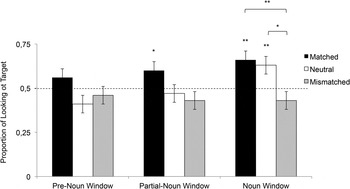
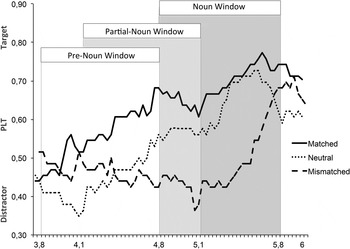
For Novel-Noun trials, the three trial types did not differ in the proportion of looking to target (PLT) during the Pre-Noun Window (F(2,64) = 1·81, p = ·171). We also compared these PLTs to chance level 0·50. Above chance would indicate target recognition. Results showed that in none of the trial types was the PLT significantly different from chance during this first time window; in other words, the participants did not look at the target object more than we would expect by chance (Gender-Matched: M = ·56, SE = ·05, t(32) = 1·22, p = ·230; Neutral: M = ·41, SE = ·05, t(32) = –1·62, p = ·115; Gender-Mismatched: M = ·46, SE = ·05, t(32) = –0·86, p = ·395). During the Partial-Noun Window PLTs in the three trial types had a trend towards a significant difference (F(2,64) = 2·76, p = ·071). Importantly, looking to target was above chance in Gender-Matched trials (M = ·60, SE = ·05, t(32) = 2·18, p = ·036), but not in Neutral trials (M = ·47, SE = ·05, t(32) = –0·60, p = ·553), nor in Gender-Mismatched trials (M = ·43, SE = ·05, t(32) = –1·43, p = ·162). During the Noun Window, trial types differed significantly (F(2,64) = 5·32, p = ·007). Children continued to looked at the target above chance in Gender-Matched trials (M = ·66, SE = ·05, t(32) = 2·88, p = ·007). PLT was now above chance in Neutral trials (M = ·63, SE = ·05, t(32) = 2·79, p = ·009), but still not in Gender-Mismatched trials (M = ·44, SE = ·05, t(32) = –1·36, p = ·184). Pairwise comparison using Bonferonni correction showed that Gender-Matched and Neutral trials did not differ from each other (p = 1·000), but both were different from Gender-Mismatched trials (p = ·008; p = ·042). Figure 2 shows the PLT for the different trial types. The proportion of looking in Gender-Mismatched trials moved towards the target only towards the end of the trial (see the dashed line in Figure 3). These results show that grammatical gender was encoded during the training and activated online during testing. All statistics were two-tailed.
Proportion of looking to the target (mean and SE) in Novel-Noun trial types during the three time windows. The dotted line indicates the chance level. Notes: *p < .05. **p < .01.

Timecourse of looking during Novel-Noun trials.

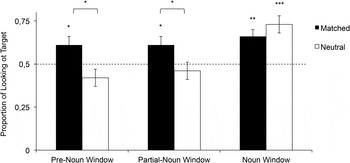
For Familiar-Noun trials, PLT was greater in Gender-Matched trials than in Neutral trials during the Pre-Noun Window (paired t(32) = 2·59, p = ·014). Looking to target was above chance in Gender-Matched trials (M = ·61, SE = ·05, t(32) = 2·29, p = ·029), but not in Neutral trials (M = ·42, SE = ·05, t(32) = –1·74, p = ·092). PLT did not differ from chance for Neutral trials during the Partial-Noun Window either (M = ·46, SE = ·05, t(32) = –0·73, p = ·472), while it did for Gender-Matched trials (M = ·61, SE = ·05, t(32) = 2·34, p = ·026). Children looked more at the target in Gender-Matched trials than in Neutral trials (paired t(32) = 2·05, p = ·048) during this window. Looking to target reached above chance for Neutral trials during the Noun Window (M = ·73, SE = ·04, t(32) = 6·49, p < ·001). Children continued to look at the target above chance level in Gender-Matched trials (M = ·66, SE = ·04, t(32) = 3·67, p = ·001), and the PLTs in Gender-Matched and Neutral trials were no longer different in the Noun Window (t(32) = –1·40, p = ·171). Figure 4 shows the PLT for the different trial types. These results suggest that there was an advantage for target recognition in Gender-Matched trials; the determiner gender facilitated recognition in Gender-Matched trials, even before the familiar noun was heard. Figure 5 shows the timecourse during Familiar-Noun trials. All statistics were two-tailed.
Proportion of looking to the target (mean and SE) in Familiar-Noun trial types during the three time windows. The dotted line indicates the chance level. Notes: *p < .05. **p < .01. ***p < .001.

Timecourse of looking during Familiar-Noun trials.

DISCUSSION
The experiment revealed several novel findings. During the brief teaching phase, children not only quickly mapped novel words to novel objects, but also assigned a grammatical gender feature to each pseudo-noun based on the gender of the adjacent determiner (e.g., un MASCravole MASC ‘a ravole’). The feature they encoded was abstract, as shown by the results of the test trials. In particular, the test utterances included determiners and an adjective that did not appear during training. The phrases were never encountered in children's prior input. Thus, the probability between the pseudo-noun and the preceding real words was equally low across test trial types. Recognition patterns, however, were not equal for different trial types. Performance was better in trials in which the determiner and noun categories agreed in gender than in trials in which the determiner was gender-unmarked, and recognition was most impeded when the two categories were mismatched in gender. Since the probability between each specific determiner and the upcoming pseudo-noun was 0% across all test trials (in terms of children's prior input), their differential responses for the different trial types cannot be related to the probability. Rather, children showed clear evidence of abstract representation of grammatical gender. They automatically activated the gender feature of the gender-marked determiner and that of the pseudo-noun, and processed the feature agreement while the NP was unfolding.
Children in our study processed non-adjacent feature dependencies between abstract grammatical categories. In previous studies (Höhle et al., Reference Höhle, Schmitz, Santelmann and Weissenborn2006; Santelmann & Jusczyk, Reference Santelmann and Jusczyk1998; Van Heugten & Johnson, Reference Van Heugten and Shi2011; Van Heugten & Shi, Reference Van Heugten and Shi2010), the non-adjacent dependencies were elements that co-occur frequently in the input (e.g., is_ing), and infants may have tracked those specific elements rather than dependencies of an abstract level. The test utterances in our study, in contrast, had never been heard before, so the observed effect could not be due to the tracking of any previously stored specific dependent elements. Moreover, the pseudo-nouns contained no phonological cue to gender. The only distinction between the Gender-Matched and Gender-Mismatched trials was at the abstract feature level, that is, the gender relations between the new determiners and the pseudo-nouns. The better recognition in the Gender-Matched trials demonstrates that children checked the gender feature agreement between two non-adjacent grammatical categories: the determiner and noun categories.
The test trials containing familiar nouns yielded similar results to those presenting novel nouns. Performance was overall better in the former case, a result that was expected since the representations of familiar nouns should be easier for access. The key finding, however, was that children showed the same processing advantage for gender-matched trials for both familiar and newly learned nouns. This means that grammatical gender is not tied to specific familiar words. Rather, the feature is represented abstractly across all relevant words in the lexicon and is used productively for novel words and novel combinations.
Taken together, the results of our experiment are consistent with the prediction of the acquisition models within the framework of generative grammar that abstract representations are present in early child language (e.g., Valian, Reference Valian, Lewis, Karimi, Harley and Farrar2009; Valian, Solt & Stewart, Reference Valian, Solt and Stewart2009; Yang, Reference Yang2013). The results are also consistent with some of the latest lexical constructivist proposals (which now allow generalization at an early age) (e.g., Dabrowska & Tomasello, Reference Dabrowska and Tomasello2008), but not with item-specific constructivist approaches (e.g., Pine & Lieven, Reference Pine and Lieven1997; Tomasello, Reference Tomasello2000).
The processing required for the novel words in our task was challenging. During the teaching phase, children were faced with many aspects of word learning (word–object associations and grammatical information). Test utterances were all new, and gender was on non-adjacent categories (i.e., at an abstract level) without any phonological cue. Despite the difficult task, they showed a strong ability to encode and process gender features and their agreement in addition to learning the association between each novel object and the novel noun. We predict that younger children should yield similar results if the task is less demanding. Indeed, younger children (between one and two years of age) can categorize nonwords to abstract equivalent classes in easier tasks that require no learning of word meaning, for example, in preferential listening studies (Gerken, Wilson & Lewis, Reference Gerken, Wilson and Lewis2005; Gómez & Lakusta, Reference Gómez and Lakusta2004; Höhle, Weissenborn, Kiefer, Schulz & Schmitz, Reference Höhle, Weissenborn, Kiefer, Schulz and Schmitz2004; Mintz, Reference Mintz, Hirsh-Pasek and Golinkoff2006; Shi & Melançon, Reference Shi and Melançon2010). Grammatical gender categorization has been recently shown in a simpler listening task in French-learning infants as young as 20 months of age (Cyr & Shi, Reference Cyr and Shi2013). Those previous studies and the present study conjointly provide evidence in support of early abstract representations. Children at a very young age represent grammatical properties and structural relations (adjacent and non-adjacent), and they consistently exhibit grammatical productivity in their performance.
APPENDIX
Example Stimuli for One Group of Infants