Introduction
Commonly regarded as a core feature of serious mental illness (Green & Nuechterlein, Reference Green and Nuechterlein1999), neurocognitive impairment precedes the onset of psychosis (Carrión et al. Reference Carrión, Goldberg, McLaughlin, Auther, Correll and Cornblatt2011), and likely remains stable over time (Bonner-Jackson et al. Reference Bonner-Jackson, Grossman, Harrow and Rosen2010). Convergent research demonstrates a relationship between neurocognition and functional outcome in important areas of community living (e.g. independent living, social, and occupational functioning; Lepage et al. Reference Lepage, Bodnar and Bowie2014). Nevertheless, enhancing neurocognitive performance is not a panacea for the challenges associated with serious mental illness. Efforts to improve functional outcome are most effective when interventions (e.g. cognitive remediation) are embedded within multi-modal psychiatric rehabilitation (i.e. treatment packages that build upon individuals’ strengths while addressing the array of obstacles to recovery, like distressing symptoms and lack of meaningful activity; Wykes et al. Reference Wykes, Huddy, Cellard, McGurk and Czobor2011). Further, the relationship between neurocognition and functional outcome can be explained by multiple intervening variables. We review key intermediary variables here, using the Beck et al. (Reference Beck, Rector, Stolar and Grant2009) cognitive model of community participation to describe how dysfunctional attitudes might stem from and influence other constructs in the pathway between neurocognition and community participation.
The cognitive model of community participation and the role of attitudes
Beck et al. (Reference Beck, Rector, Stolar and Grant2009) hypothesized that neurocognitive difficulties and related challenges in the execution of daily tasks contribute to negative subjective experiences (e.g. rejection from peers), lowering self-esteem and leading to the development of dysfunctional attitudes concerning personal capabilities or acceptance from others. These attitudes cause social withdrawal and inactivity, protecting against failure and rejection. Indeed, Grant & Beck (Reference Grant and Beck2009) demonstrated that defeatist performance beliefs (e.g. ‘If you cannot do something well, there is little point in doing it at all’) mediated the relationship between neurocognition and both negative symptoms and functional outcome. A recent meta-analysis supported these intermediary relationships across studies (10 studies for negative symptoms, eight studies for functional outcomes), while calling for longitudinal research to further clarify the causal relationships (Campellone et al. Reference Campellone, Sanchez and Kringin press).
Additionally, Grant & Beck (Reference Grant and Beck2010) demonstrated that asocial beliefs (e.g. ‘People are usually better off if they stay aloof from emotional involvements with most others’) predicted asocial behavior; these beliefs also negatively related to engagement in independent living activities (Granholm et al. Reference Granholm, Ben-Zeev and Link2009). Grant & Beck (Reference Grant and Beck2010) proposed that, like defeatist performance beliefs, asocial beliefs develop from negative social experiences, leading to a reduction in social engagement and activity. Yet, asocial beliefs have never been tested in a study that also includes defeatist performance beliefs.
Other intervening variables and opportunities for further research
Motivation is another potential link between neurocognition and functional outcome. Research addressing this issue has operationalized motivation (or amotivation) numerous ways, leading to a variety of findings. First, although uncommon, low effort (indicated by assessments of effort on neurocognitive tests) predicted neurocognition (Strauss et al. Reference Strauss, Morra, Sullivan and Gold2015). Second, intrinsic motivation was associated with performance on neurocognitive tests (Fervaha et al. Reference Fervaha, Zakzanis, Foussias, Graff-Guerrero, Agid and Remington2014) and mediated the relationship between neurocognition and work, independent living, and social functioning (Nakagami et al. Reference Nakagami, Xie, Hoe and Brekke2008). Third, negative symptoms mediated the relationship between neurocognition and both functional outcome and quality of life (Lin et al. Reference Lin, Huang, Chang, Chen, Lin, Tsai and Lane2013). Negative symptoms were also intermediary between defeatist performance beliefs and functional outcome (Green et al. Reference Green, Hellemann, Horan, Lee and Wynn2012). Anhedonia and asociality particularly demonstrated a relationship with community tenure after hospital discharge (Ahmed et al. Reference Ahmed, Murphy, Latoussakis, McGovern, English, Bloch, Anthony and Savitz2016). However, some negative symptom measures share similar content with indicators of functional outcome (Keefe, Reference Keefe2014), and have been criticized for being clinician-rated, with relatively low inter-rater reliability. Some researchers have proposed that because motivation is an internal state, it should only be assessed via self-report measures (Choi et al. Reference Choi, Choi, Reddy and Fiszdon2014). Finally, evaluation of motivation via more objective effort-based assessments (e.g. button-pressing, hand-grip tasks) produced inconsistencies regarding the relationship between performance on these tasks and functional outcome (Green et al. Reference Green, Horan, Barch and Gold2015).
Several studies have also identified emotion perception and functional skills (often referred to ‘functional capacity’, or skills needed to perform daily tasks as assessed by laboratory-based measures) as mediators of the relationship between neurocognition and functional outcome, and as predictors of defeatist performance beliefs (Horan et al. Reference Horan, Rassovsky, Kern, Lee, Wynn and Green2010; Green et al. Reference Green, Hellemann, Horan, Lee and Wynn2012). The effect of neurocognition on social functioning (Addington et al. Reference Addington, Girard, Christensen and Addington2010), social skill (Meyer & Kurtz, Reference Meyer and Kurtz2009) and independent living and work functioning (Brekke et al. Reference Brekke, Kay, Lee and Green2005) was explained by emotion perception. Functional skills mediated the relationship between neurocognition and personal care and interpersonal skills (Bowie et al. Reference Bowie, Reichenberg, Patterson, Heaton and Harvey2006; Galderisi et al. Reference Galderisi, Rossi, Rocca, Bertolino, Mucci, Bucci, Rucci, Gibertoni, Aguglia, Amore, Bellomo, Biondi, Brugnoli, Dell'Osso, De Ronchi, Di Emidio, Di Giannantonio, Fagiolini, Marchesi, Monteleone, Oldani, Pinna, Roncone, Sacchetti, Santonastaso, Siracusano, Vita, Zeppegno and Maj2014; Strassnig et al. Reference Strassnig, Raykov, O'Gorman, Bowie, Sabbag, Durand, Patterson, Pinkham, Penn and Harvey2015) and independent living skills (Quinlan et al. Reference Quinlan, Roesch and Granholm2014). However, the idea that functional skills directly relate to actual participation in everyday activities is a matter of debate, as a variety of personal and contextual factors, such as self-confidence and disability benefits policies, are likely to affect the relationship (Harvey et al. Reference Harvey, Velligan and Bellack2007; Horan et al. Reference Horan, Rassovsky, Kern, Lee, Wynn and Green2010).
Community participation as a unique and important outcome
Promoting community integration and enhancing recovery are emergent priorities for mental health services and systems transformation. To achieve these goals, policymakers and program staff seek to create additional opportunities for community participation, the ‘self-determined choice and action that individuals make to be active in valued roles in the communities of their choice, across a variety of domains in their life’ (Burns-Lynch et al. Reference Burns-Lynch, Brusilovskiy and Salzerin press). The World Health Organization's International Classification of Functioning, Disability, and Health framework (WHO, 2001) defines several of these domains [e.g. self-care (bathing); domestic life (cooking, shopping); community, civic, and social life (leisure, religion, politics); and major life activities (education, employment)]. Community participation has been shown to positively relate to recovery, quality of life, and meaning of life (Kaplan et al. Reference Kaplan, Salzer and Brusilovskiy2012; Burns-Lynch et al. in press). A requisite step in optimizing opportunities for community participation is to expand understanding of factors that facilitate or hinder it and how these variables interrelate.
The present study
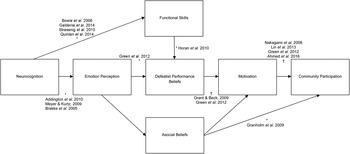
The purpose of this study was to conduct the first longitudinal test of a theory-driven pathway between neurocognition through emotion perception, functional skills, defeatist performance beliefs, asocial beliefs, and motivation to community participation (i.e. time in community-based activity). This pathway is depicted in Fig. 1. We aimed to address the gaps in the current literature while expanding knowledge about factors that contribute to or limit community participation. We regard time in community-based activity as a particularly informative outcome variable; it is often considered when assessing individuals’ functioning in areas of community living and also offers a way to evaluate community participation and the degree to which people are actively engaged in their recoveryFootnote 1 Footnote †. Both defeatist performance beliefs and asocial beliefs were included to better understand the functional implications of these dysfunctional attitudes. Given interest in examining the role of motivation in this pathway, and to avoid the methodological problems mentioned previously, we assessed motivation with a self-report measure that has been shown to relate to functional outcome rather than by proxy through a negative symptom measure. We included emotion perception and functional skills because of their demonstrated intermediary role between neurocognition and functional outcome, particularly attending to whether there were direct relationships with outcome. According to the cognitive theory of community participation and extant research, we anticipated a single pathway linking neurocognition to community participation. We hypothesized that:
-
(1) Neurocognition would predict emotion perception and functional skills.
-
(2) Both emotion perception and functional skills would predict defeatist performance beliefs. As asocial beliefs may be more strongly linked to difficulties with social cognition than more general functional skills, we expected that only emotion perception would predict asocial beliefs.
-
(3) Defeatist performance beliefs and asocial beliefs would predict motivation.
-
(4) Both motivation and asocial beliefs would have direct effects on community participation.
Proposed model. *At least one previous study that included comparable measures demonstrated a relationship between these variables. † At least one previous study found a relationship between conceptually related constructs.

Method
Participants
One hundred seventy-five adults (aged ≥18 years) were recruited from the Brain Behavior Laboratory at the University of Pennsylvania and local community mental health centers; 135 had follow-up data and thus were included in the longitudinal analyses. All participants had DSM-IV-TR diagnoses of a serious mental illness with psychotic features (e.g. schizophrenia spectrum disorders, mood disorders with psychotic features, psychosis not otherwise specified) determined by a best-estimate lifetime diagnosis consensus made by Ph.D.-level or M.D.-level clinicians. A structured clinical interview (Nurnberger et al. Reference Nurnberger, Blehar, Kaufmann, York-Cooler, Simpson, Harkavy-Friedman, Severe, Malaspina and Reich1994) administered by an assessor trained to acceptable reliability (intraclass correlation >0.80) assisted in diagnostic determination. Although not a formal inclusion criterion, efforts were made to recruit individuals with negative symptoms, and a negative symptom measure (Andreasen, Reference Andreasen1982) was administered to participants. Antipsychotic medication treatment was not a requirement for the study, but 94% of the sample was being prescribed antipsychotic medication at baseline. Exclusion criteria consisted of head injury with loss of consciousness that was documented in medical records and evidence of a condition that would compromise neurocognition (e.g. insulin-dependent diabetes, heart disease).
Procedure
Participants were recruited through clinician referrals. Permission to speak with potential participants was sought before research staff made initial contact. All participants provided written informed consent after receiving a complete description of the study procedures.
At baseline and approximately 6 months later, participants completed computerized neurocognitive performance tasks and self-report and interviewer-rated instruments, receiving financial compensation each time. Interviewers were masters-level or Ph.D.-level research personnel trained and supervised in the administration of all study measures. Collateral information obtained from family members, treatment providers, and chart review assisted in the determination of interviewer ratings. Throughout the study period, all participants received outpatient treatment as usual (e.g. psychiatric medication, case management, day program activities, supportive therapy). Study procedures were approved by the Institutional Review Boards of the University of Pennsylvania and the City of Philadelphia.
Measures
Neurocognition and emotion perception
Neurocognition and emotion perception were assessed via a computerized battery validated for use with individuals with schizophrenia (Gur et al. Reference Gur, Ragland, Moberg, Bilker, Kohler, Siegel and Gur2001). Standardized scores from three neurocognitive domains (i.e. abstraction/mental flexibility, verbal memory, and attention/vigilance) that have shown to be particularly related to functional outcome (Green et al. Reference Green, Kern, Braff and Mintz2000) were averaged to provide an index of neurocognition. Abstraction/mental flexibility was measured using the Penn Conditional Exclusion Test (PCET; Kurtz et al. Reference Kurtz, Ragland, Moberg and Gur2004) and the Abstraction and Working Memory Test (AIM; Glahn et al. Reference Glahn, Cannon, Gur, Ragland and Gur2000). The PCET consists of a series of trials during which the examinee must choose the shape that does not belong to a group. The objective of the AIM is for participants to match a target object with similar stimuli when these stimuli are presented simultaneously or after a delay. Verbal memory was assessed with the Penn Word Memory Test (Gur et al. Reference Gur, Jaggi, Ragland, Resnick, Shtasel, Muenz and Gur1993), which presents examinees with a list of 20 words that they are asked to remember during delayed recall trials. Attention/vigilance was examined using the Penn Continuous Performance Test (Kurtz et al. Reference Kurtz, Ragland, Bilker, Gur and Gur2001), a task that requires examinees to respond after stimuli are presented based on whether digits or letters are presented subsequently. Standardized scores from the Penn Emotion Recognition Task (Kohler et al. Reference Kohler, Turner, Bilker, Brensinger, Siegel, Kanes, Gur and Gur2003) and the Penn Emotion Discrimination Task (Erwin et al. Reference Erwin, Gur, Gur, Skolnick, Mawhinney-Hee and Smailis1992) were also averaged to form an index of emotion perception. The Penn Emotion Recognition Test presents photographs of happy, sad, angry, fearful, disgusted, or non-emotional/neutral facial expressions; examinees are asked to identify the emotional expression. The Penn Emotion Discrimination Task asks examinees to judge whether the intensity of emotional expression pairs is the same or different. Scoring procedures are described elsewhere (Gur et al. Reference Gur, Nimgaonkar, Almasy, Calkins, Ragland, Pogue-Geile, Kanes, Blangero and Gur2007).
Functional skills
Functional skills were assessed using the total score from the Brief UCSD Performance-Based Skills Assessment (UPSA-B; Mausbach et al. Reference Mausbach, Harvey, Goldman, Jeste and Patterson2007), a measure of communication and financial skills. Individuals were asked to perform or role-play a variety of tasks (e.g. make change, call directory assistance to request a telephone number), and performance was scored based on demonstrated level of skill (total scores range from 0 to 100).
Dysfunctional attitudes
Defeatist performance beliefs
The Defeatist Performance Belief scale, derived from the Dysfunctional Attitude Scale (Weissman, Reference Weissman1978), consists of 15 statements about capability and task performance (e.g. ‘Failing partly is the same as being a complete failure’). Individuals rated each statement on a 7-point scale (1 = agree totally, 7 = disagree totally). The Defeatist Performance Belief scale showed good internal consistency (α = 0.86) in the present sample.
Asocial beliefs
The Asocial Beliefs scale from the Revised Social Anhedonia Scale (Eckblad et al. Reference Eckblad, Chapman, Chapman and Mishlove1982) contains 15 true/false statements about preference for involvement with others (e.g. ‘Making new friends isn't worth the energy it takes’). The Asocial Beliefs scale demonstrated fair internal consistency (α = 0.69) in the current sample.
Motivation
The Penn Motivation Inventory contains 16 items rated on a 5-point Likert scale [never (0), occasionally (1), much of the time (2), most of the time (3), or always (4)]. Inspired by the Self-Reinforcement Questionnaire (Heiby, Reference Heiby1982) and adapted for individuals with schizophrenia, the Penn Motivation Inventory contains two subscales: Self-Directed items assess ability to self-initiate and sustain task-related behavior (e.g. ‘When I succeed at small things, I become encouraged to go on’); Other-Directed items examine the need for others to engage in task-related behavior (e.g. ‘I need coaxing from other people to start something’). The Penn Motivation Inventory demonstrates acceptable reliability (α = 0.74 to 0.81), construct validity (moderate significant correlations with measures assessing beliefs about autonomy and dependence, negative significant correlation with negative symptoms), and predictive validity [positive significant correlation with social functioning (Luther, McCole, Beck & Grant, unpublished observations, 2016)]. The internal consistencies of the Self-Directed and Other-Directed subscales were acceptable in the study sample (α = 0.82 and 0.67). Motivation was quantified with the index score (Other-Directed minus Self-Directed).
Community participation
Community participation was assessed using four of the seven subscales of the Social Functioning Scale (Birchwood et al. Reference Birchwood, Smith, Cochrane, Wetton and Copestake1990), an interviewer-rated measure examining participation in activity during the 3 months prior to assessment (0 = never, 3 = often). These four subscales were selected because they pertain to four community participation areas as identified by the WHO (2001) and specifically assess actual participation rather than activity performance or perceived need for help with activities. The Independence (Performance) subscale, corresponding to Self-Care and Domestic Life, assesses autonomous participation in activities of daily living (e.g. bathing, shopping); the Recreational and Prosocial subscales, corresponding to the subdomains of ‘Recreation and Leisure’ and ‘Community life’ within the community, civic, and social life area, measure engagement in leisure activity that does not necessarily involve others (e.g. reading), and leisure activity with others (e.g. going to parties), respectively; and the Occupational subscale, corresponding to Major Life Activities, measures employment, educational, and homemaker activities. The average of the four standardized subscales was calculated to index overall community participation. The index score was the primary outcome variable in our analyses; we utilized the four standardized subscale scores in secondary analyses.
Statistical analysis
We performed path analyses to test theory-driven (Beck et al. Reference Beck, Rector, Stolar and Grant2009) relationships among the variables. The ratio of the number of cases to free parameters in each model was more than 10:1 (Kline, Reference Kline2005). First, as a replication test of previous findings (see Fig. 1), path analyses were conducted to examine cross-sectional relationships among the variables at baseline. Next, to test assumptions about the temporal ordering of the variables, longitudinal models were constructed using baseline variables to predict community participation at follow-up. In these models, we did not control for baseline community participation since our aim was to establish the temporal ordering of the variables rather than examine change over time. For both cross-sectional and longitudinal models, we first predicted the index of overall community participation, followed by individual participation areas in separate analyses.
Due to non-normal and missing data, the fitting function was maximum likelihood with robust standard errors and χ2 (Brown, Reference Brown2006). Data were missing at random (due to individuals declining to complete certain assessments or assessment items, assessors forgetting to administer a measure, or technical problems with the computerized neurocognitive battery); this assumption was supported by a missing value analysis. Evaluation criteria to test the single pathway hypothesis included model fit indices, the magnitude and significance of direct effects, model R 2, and comparison to other models with additional paths. Model fit was considered good if χ2 value was close to 0 (probability level >0.05), the Comparative Fit Index (CFI) was close to 0.95, and the Root Mean Square Error of Approximation (RMSEA) was close to 0.06 (Hu & Bentler, Reference Hu and Bentler1999). We followed Cohen (Reference Cohen1988) in categorizing the magnitude of R 2 effect sizes (small = 0.1, medium = 0.3, and large = 0.5). To provide further support for our theory-driven model, we added direct paths from each predictor that did not have an expected direct relationship with outcome; model fit was compared using the Satorra-Bentler scaled χ² difference test (Satorra & Bentler, Reference Satorra and Bentler2001). Given the hypothesized expectation of a single pathway, we anticipated that the addition of these direct effects would not significantly improve model fit.
All analyses were performed using MPlus v. 5.1 (Muthén & Muthén, Reference Muthén and Muthén1998–2007).
Ethical standards
The authors assert that all procedures contributing to this work comply with the ethical standards of the relevant national and institutional committees on human experimentation and with the Helsinki Declaration of 1975, as revised in 2008.
Results
Participant characteristics
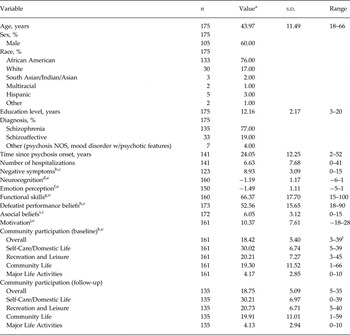
Participant demographic and clinical characteristics are presented in Table 1. As shown, most participants had a long history of serious mental illness and had experienced multiple hospitalizations. Most individuals demonstrated at least mild negative symptoms. Mean neurocognition, emotion perception, dysfunctional attitudes, and outcome scores are comparable to those reported in previous studies with similar samples (Birchwood et al. Reference Birchwood, Smith, Cochrane, Wetton and Copestake1990; Gur et al. Reference Gur, Ragland, Moberg, Bilker, Kohler, Siegel and Gur2001; Grant & Beck, Reference Grant and Beck2009, Reference Grant and Beck2010).
Participant demographic and clinical characteristics

NOS, Not otherwise specified.
a Unless otherwise specified, values are means.
b Scale for the Assessment of Negative Symptoms.
c Lower scores are better.
d Computerized battery consisting of Penn Conditional Exclusion Test; Abstraction and Working Memory Test; Penn Word Memory Test; Penn Continuous Performance Test.
e Higher scores are better.
f Computerized battery consisting of Penn Emotion Recognition Task and Penn Emotion Discrimination Task.
g Brief UCSD Performance-Based Skills Assessment (UPSA-B).
h Dysfunctional Attitude Scale.
i Revised Social Anhedonia Scale.
j Penn Motivation Inventory.
k Social Functioning Scale.
l Raw scores are reported here, while standardized scores were used in the analyses.
Path models
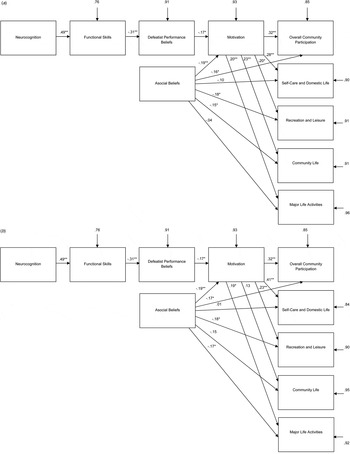
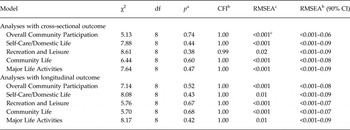
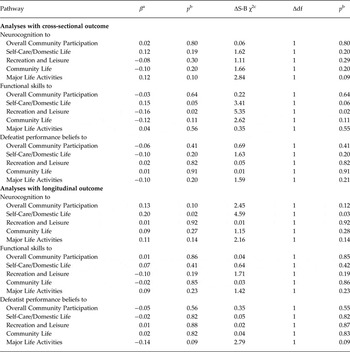
Model fit was excellent for an initial model (depicted in Fig. 1) predicting overall community participation at baseline (χ2 = 12.31, df = 12, p = 0.42; CFI = 1.00, RMSEA = 0.01, 90% confidence interval <0.001–0.08). However, the direct effects between emotion perception and both defeatist performance beliefs and asocial beliefs were non-significant (β = −0.13 and −0.09, p = 0.08 and 0.28, respectively). To establish the most parsimonious model, we compared models with and without paths through emotion perception, finding the reduced model fit the data as well as the full model (Satorra−Bentler scaled χ2 difference = 3.86, df difference = 2, p < 0.15). Removing emotion perception produced two separate pathways to community participation: one from neurocognition through functional skills, defeatist performance beliefs, and motivation to community participation; the other from asocial beliefs to community participation, directly and through motivation. Final models are described below and presented in Table 2 and Fig 2.
Final path models. (a) Final path models with cross-sectional outcomes. (b). Final path models with longitudinal outcomes. Both panels represent five-path models, each with a different outcome. All parameter estimates are standardized regression coefficients. *Significant at p < 0.05, **significant at p < 0.01.

Model fit statistics for final path models

CI, Confidence interval; CFI, Comparative Fit Index; RMSEA, Root Mean Square Error of Approximation.
a Two-tailed.
b RMSEA values and CI lower limits are approximated given values very close to 0.
Cross-sectional models
Overall community participation
Model fit was excellent for the final model predicting overall community participation at baseline. All direct effects were statistically significant. The model explained 15% of the variance in community participation, a moderate effect size. Model fit was not improved by adding direct paths between neurocognition and community participation, functional skills and community participation, or defeatist performance beliefs and community participation (Table 3).
Additional direct effects and model fit comparisons

a Standardized direct effect.
b Two-tailed.
c Satorra–Bentler χ2 difference. Models compared to models without specified pathway.
Individual participation areas
Excellent fit was observed for each model predicting individual participation areas; however, the direct effects of asocial beliefs on Self-Care/Domestic Life and Major Life Activities were not statistically significant. The models explained 4–10% of the variance in various areas of participation (small to moderate effect sizes). For almost every participation domain, model fit was not improved by adding direct paths between neurocognition, functional skills, or defeatist performance beliefs and community participation (Table 3). The exception was Recreation and Leisure; a model with a direct path from functional skills fit the data better than a model without this path.
Longitudinal models
Overall community participation
The model predicting overall community participation at follow-up also fit the data very well. Again, all direct effects were statistically significant, and the model explained 15% of the variance in community participation at follow-up. Model fit was not improved by adding direct paths between neurocognition and community participation, functional skills and community participation, or defeatist performance beliefs and community participation (Table 3).
Individual participation areas
Excellent fit was demonstrated for each of the models predicting individual participation areas at follow-up. Similar to the baseline models, some direct effects were not statistically significant (i.e. motivation predicting Community Life, asocial beliefs predicting Self-Care/Domestic Life). The direct effect of asocial beliefs showed a non-significant trend when predicting Community Life. The models explained 5–16% of the variance in various participation areas (small to moderate effect sizes). In almost all cases, model fit was not improved by adding direct paths between neurocognition, functional skills, or defeatist performance beliefs and community participation (Table 3). However, model fit was improved with the addition of a direct path between neurocognition and Self-Care/Domestic Life.
Discussion
This study tested a theory-driven pathway from neurocognition to community participation through emotion perception, functional skills, dysfunctional attitudes, and motivation. Findings provide empirical support for the intermediary role of dysfunctional attitudes and motivation and are consistent with Beck et al. (Reference Beck, Rector, Stolar and Grant2009) cognitive theory of community participation, both when outcome was assessed cross-sectionally and longitudinally. Greater dysfunctional attitudes and lower motivation are indeed prognostic of poorer community participation and engagement in recovery-related activity. Importantly, the longitudinal findings bolster the directionality of these relationships, filling a significant gap in the literature (Campellone et al. Reference Campellone, Sanchez and Kringin press).
The present study extends the findings of Green et al. (Reference Green, Hellemann, Horan, Lee and Wynn2012), who demonstrated a single pathway from visual perception through social cognition, defeatist performance beliefs, and negative symptoms to outcome. In addition to this pathway, we found support for a separate pathway from asocial beliefs to outcome. Asocial beliefs were predictive of less engagement in several areas of community participation, emphasizing the salience of the social aspects of these activities and the effect of social considerations upon participation. The pathway from asocial beliefs emerged because asocial beliefs were not related to emotion perception. In follow-up analyses, we also determined neither neurocognition nor functional skills predicted asocial beliefs. There are at least two explanations for the null findings. First, emotion perception is a single domain of social cognition that was selected because similar studies (Brekke et al. Reference Brekke, Kay, Lee and Green2005; Meyer & Kurtz, Reference Meyer and Kurtz2009; Addington et al. Reference Addington, Girard, Christensen and Addington2010) have consistently found it to be a mediator of the relationship between neurocognition and functional outcome. As we did not assess other domains of social cognition (e.g. theory of mind, social reasoning biases), the possibility remains that social cognition, defined more broadly, is related to asocial beliefs. In fact, Green et al. (Reference Green, Hellemann, Horan, Lee and Wynn2012) found that a social cognition factor that included emotion perception, theory of mind, and emotional intelligence was moderately related to defeatist performance beliefs; future research might evaluate whether the same is true for asocial beliefs. Second, the non-significant predictors of asocial beliefs may signify that the effect of asocial beliefs on community participation operates independently of these putative precursors. Although the cognitive model of community participation suggests that aversive social experiences that lead to the development of dysfunctional attitudes stem from personal skill-related challenges, other factors may also contribute. For example, research suggests that because of public stigma, receiving a mental illness label is associated with a loss of self-esteem, contributing to withdrawal from social interactions and activities (Link et al. Reference Link, Struening, Neese-Todd, Asmussen and Phelan2001). As such, perceived stigma may lead to the development of asocial beliefs. The present study represents a key step in the development of a more sophisticated understanding of the divergent origins and impact of various dysfunctional attitudes, setting the stage for future research in this area.
These results also extend understanding of the effects of neurocognition, functional skills, and motivation on community participation. The magnitude of the effect of neurocognition was comparable to that of visual perception in Green et al. (Reference Green, Hellemann, Horan, Lee and Wynn2012), suggesting that both are useful cognitive performance indicators. Consistent with Horan et al. (Reference Horan, Rassovsky, Kern, Lee, Wynn and Green2010), functional skills generally did not have a direct relationship with outcome but did significantly predict defeatist performance beliefs. This finding suggests an indirect relationship between demonstrated skills and participation in activity that is dependent upon on beliefs about personal capability. Finally, the effect of motivation was notably smaller than that of negative symptoms in Green et al. (Reference Green, Hellemann, Horan, Lee and Wynn2012). It is possible that measurement overlap artificially inflated the relationship between negative symptoms and functional outcome in previous research or that the effect of motivational processes on community participation is weaker than on functional outcome. In other words, participation in activity may require less reliance upon motivational reserves than performing an activity with a high degree of proficiency. This is a fruitful area for further research.
Several limitations to the present study point to additional directions for future research. First, the longitudinal models supported our prediction about the temporal ordering of the variables, but future research should more definitively assess their relationships through experimental methods. Second, in order to evaluate the cognitive model of community participation, path analyses favored specificity over comprehensiveness. The large residual variances in all path models imply that additional predictors of community participation should be explored. These might include social competence and support (Brekke et al. Reference Brekke, Kay, Lee and Green2005) or contextual variables [i.e. socioeconomic status (Green et al. Reference Green, Hellemann, Horan, Lee and Wynn2012), access to supportive resources (Galderisi et al. Reference Galderisi, Rossi, Rocca, Bertolino, Mucci, Bucci, Rucci, Gibertoni, Aguglia, Amore, Bellomo, Biondi, Brugnoli, Dell'Osso, De Ronchi, Di Emidio, Di Giannantonio, Fagiolini, Marchesi, Monteleone, Oldani, Pinna, Roncone, Sacchetti, Santonastaso, Siracusano, Vita, Zeppegno and Maj2014)]. Further, other predictors of motivation might be assessed, such as anticipatory pleasure or reward processing (Gard et al. Reference Gard, Kring, Gard, Horan and Green2007; Gold et al. Reference Gold, Waltz, Prentice, Morris and Heerey2008). Another potential contributor to limited variance explained is the relatively low internal consistency of the asocial beliefs measure. Third, for substantive (i.e. seeking to assess temporal ordering) and methodological reasons (i.e. the relatively brief follow-up period, existence of only two time points), we did not assess change in community participation; longitudinal change studies exploring longer-term outcome (at least 1 year) over at least three time points would be useful. Finally, given that some research has demonstrated that motivation also influences performance on neurocognitive tests (e.g. Strauss et al. Reference Strauss, Morra, Sullivan and Gold2015), an alternative hypothesis is that dysfunctional attitudes lower motivation needed for neurocognitive tasks as well as community participation. As suggested by the inconsistencies among studies that have evaluated motivational processes, it is important to consider the manner in which motivation is operationalized and it may need to be assessed multiple ways (i.e. effort on neurocognitive tasks and self-reported motivation for task engagement). Such questions were beyond the scope of the present study, but may be evaluated in future research.
Conclusions
The present study has important implications for facilitating community integration and recovery in people with serious mental illness. The existence of multiple pathways to community participation, with one being independent of neurocognition, further supports the utility of multi-modal interventions that expand beyond cognitive remediation. Given that dysfunctional attitudes and motivation are proximal predictors of outcome that are not explicitly targeted by cognitive remediation packages, interventions that modify them are indicated. One such intervention is recovery-oriented cognitive therapy (CT-R; Grant et al. Reference Grant, Huh, Perivoliotis, Stolar and Beck2012). CT-R begins with engagement in energizing activity and development of personally meaningful goals to break through isolation and enhance motivation. Simultaneously, this active approach facilitates experiential learning, especially centered on personal mastery and connection with others, thereby ameliorating both defeatist performance beliefs and asocial beliefs. Another intervention, cognitive-behavioral social skills training (CBSST), includes an emphasis on goal setting and correcting dysfunctional attitudes that impede functioning (Granholm et al. Reference Granholm, Holden, Link and McQuaid2014). Interventions that target the multiple pathways to outcome, including CT-R and CBSST, can catalyze recovery-promoting activity, and, therefore, should be widely implemented in the treatment of serious mental illness.
Acknowledgements
We express our gratitude to the individuals who participated in this research. We also acknowledge Raquel Gur, M.D., Ph.D.; Ruben Gur, Ph.D.; Christian Kohler, M.D.; Steve Siegel, M.D., Ph.D.; Jennifer Greene, M.S.; LaRiena Ralph, B.S.N.; Jan Richard, M.S.; Julie Thysen, Ph.D.; Paul Hughett, P.E., Ph.D.; and Sean Gallager, M.S. of the University of Pennsylvania Brain Behavior Laboratory, who assisted with recruitment and testing. We thank Mary Tabit, Psy.D.; Nadine Chang, Ph.D.; Dimitri Perivoliotis, Ph.D.; Neal Stolar, M.D.-Ph.D.; Kara Devers, Psy.D.; Heath Hodges, M.A., M.L.S.; Kerry McCole, M.Phil.Ed.; Marguerite Cruz, B.A.; and Gloria Huh, M.A., of the University of Pennsylvania Aaron T. Beck Psychopathology Research Center, who assisted with data collection. We thank Nina Bertolami, B.A., of the Aaron T. Beck Psychopathology Research Center, who assisted with manuscript editing and data analysis. Finally, we acknowledge Keith Bredemeier, Ph.D., of the Aaron T. Beck Psychopathology Research Center for his feedback on previous versions of the manuscript.
This work was supported by the Barbara and Henry Jordan Foundation and the Foundation for Cognitive Therapy to A.T.B.
Declaration of Interest
None.