Patients admitted to healthcare facilities are at risk to acquire colonization or infection with healthcare-associated pathogens such as Clostridioides difficile, methicillin-resistant Staphylococcus aureus (MRSA), and vancomycin-resistant enterococci (VRE). The hands of healthcare personnel are generally considered the most important source of pathogen transmission. Reference Donskey1 Contaminated surfaces and equipment have also been implicated in transmission, either through direct contact with patients or indirectly when hands of personnel transfer pathogens from surfaces or equipment to patients. Reference Donskey1–Reference Suwantarat, Supple, Cadnum, Sankar and Donskey4 Admission to a room previously occupied by a colonized or infected patient increases the risk for subsequent room occupants to acquire the same organism, suggesting acquisition from inadequately cleaned surfaces. Reference Donskey1,Reference Donskey2 Contaminated shared electronic thermometers and temperature probes have been linked to transmission of C. difficile, VRE, and the emerging fungal pathogen Candida auris. Reference Jernigan, Siegman-Igra, Guerrant and Farr6–Reference Eyre, Sheppard and Madder8 Finally, some recent studies have suggested that floors might be an underappreciated source of pathogen transmission. Reference Koganti, Alhmidi, Tomas, Cadnum, Jencson and Donskey9–Reference Mahida and Boswell13 For example, a nonpathogenic virus inoculated onto floors in patient rooms disseminated rapidly to the hands of patients and to surfaces in the room. Reference Koganti, Alhmidi, Tomas, Cadnum, Jencson and Donskey9
To develop effective control measures, a better understanding of sources of pathogen exposure in healthcare facilities is needed. In the current study, we investigated the timing and routes of contamination of the rooms of patients newly admitted to the hospital, focusing on individuals with negative nares screen for MRSA and no known carriage of healthcare-associated pathogens. We hypothesized that direct interactions with healthcare personnel or medical equipment would be associated with recovery of pathogens from surfaces and patients.
Methods
Study setting
The Cleveland Veterans’ Affairs (VA) Medical Center is a 215-bed acute-care hospital. All admitted patients are screened for nasal carriage of MRSA. At the time of the study, hand hygiene compliance in the facility was measured at >85% based on observations by dedicated hand hygiene monitors.
Observational cohort study
We conducted an observational cohort study of patients newly admitted to single-patient rooms on medical-surgical wards. Patients with prior colonization or infection with MRSA, VRE, or C. difficile within the past year were excluded. The study was approved by the facility’s institutional review board. Prior to enrollment, patient rooms received routine postdischarge cleaning by environmental services personnel followed by additional cleaning and disinfection by research personnel. Research personnel applied a sporicidal cleaner–disinfectant product containing 2,500 parts per million sodium hypochlorite on all high-touch surfaces and on the floor and allowed the surfaces to air dry. A low-pressure mercury ultraviolet-C (UV-C) light room decontamination device (UVDI-360 Room Sanitizer, Ultraviolet Devices, Santa Clarita, CA) was then run for two 5-minute cycles in the patient room (one on each side of the bed) and for one 5-minute cycle in the bathroom. Reference Cadnum, Tomas and Sankar14 Cultures of high-touch surfaces (bed rail, bedside table, call button, patients’ bedside chart) and floors (5×10-cm areas adjacent to the patients’ bed) were collected to assess effectiveness of cleaning and disinfection. If any of these preadmission cultures returned positive, the patient’s data were excluded from the assessment of routes of room contamination.
After admission, interactions between the participating patients and personnel and portable equipment were observed for ~6 hours per day by research personnel. Any entry of personnel or equipment into the room with or without contact with the patient and/or environment was considered an interaction. The research personnel were primarily stationed outside the rooms but entered the room if needed to observe care interactions; if interactions could not be directly observed (eg, curtains pulled), research personnel would ask providers to describe the procedures being performed and the types of contact. Hospital personnel were aware that a study related to environmental contamination was being conducted but were not informed of the study goals. Cultures of high-touch surfaces (bed rails, bedside tables, call buttons, patients’ bedside charts) and floors (5×10-cm areas adjacent to the patients’ beds) as well as the hands, chest, groin, and sock bottoms of patients and bedding (ie, sheets and blankets at the base of the bed where feet are placed) were collected as previously described at the time of admission, 4 and 12 hours after admission, and at least once daily on subsequent days for up to 4 days if the patient remained hospitalized. Additional sets of cultures were collected if observed interactions involved direct or indirect contact between personnel or equipment and patients or environmental surfaces; the sites of contact were sampled (eg, patient’s skin or surfaces or equipment would be sampled if contacted by personnel or patients during care activities).
Microbiology and molecular typing
BBL CultureSwabs (Becton Dickinson) premoistened with Dey Engley neutralizer were used for sample collection. Cultures were processed for C. difficile, MRSA, and VRE as previously described. Reference Kanwar, Thakur and Wazzan15 For selected patients with MRSA isolates recovered from multiple sites, spa typing was performed. Reference Alhmidi, Cadnum and Koganti16
Use of simulations to test the effectiveness of wearing slippers in reducing transfer from floors to high-touch surfaces
Based on results of the hospital-based study implicating floors as a route of pathogen transmission, we hypothesized that having patients wear slippers would be effective in reducing transfer of pathogens from floors to high-touch surfaces. To test this hypothesis, we used simulations with the nonpathogenic virus bacteriophage MS2 comparing transfer when socks were worn versus when slippers were worn over the socks. The simulations were conducted in a simulated patient room.
Bacteriophage MS2 was prepared as previously described. Reference Tomas, Kundrapu and Thota17 A 1-mL suspension containing 108 plaque-forming units (PFU) of MS2 was applied to a 10-cm × 10-cm area of the floor adjacent to the bed and allowed to air dry. Two types of simulations were conducted to assess whether wearing slippers would reduce transfer of MS2 from the floor to high-touch surfaces in a simulated patient room containing a patient bed and bedside table. In the first simulation, research personnel walked through the area of contamination while wearing hospital patient socks or socks plus slippers. They removed the slippers (if worn) and lay down on the bed, touched the bedding in contact with their socks, and then touched the bedside table. The second simulation was identical to the first except the participants removed their socks after sitting on the bed and then touched the bedside table. BBL CultureSwabs were used to sample the floor, sock bottoms, hands, bedding, and tray table. Bacteriophage MS2 was quantified as previously described. Reference Tomas, Kundrapu and Thota17 The simulations were repeated 3 times.
Data analysis
Analysis of variance was used to compare the log10 PFU of bacteriophage MS2 to socks, bedding, hands, and bedside tables. Data were analyzed using R version 3.5.0 software (R Foundation for Statistical Computing, Vienna, Austria).
Results
In total, 25 patient rooms were cleaned and disinfected in anticipation of recruitment of new admissions for enrollment. Of the 25 patients considered for enrollment, 8 (32%) declined participation. Of the 17 study participants, 16 (94%) were ambulatory. The mean age of the participants was 66.9 (range, 24–82) and 15 (88.2%) were male. Based on observations, the participants interacted with an average of 2.4 personnel and 0.4 portable devices per hour. The average number of personnel and portable equipment interactions observed per patient were 15 (range, 3–32) and 3.5 (range, 0–11). Figure 1 shows the number and types of personnel and portable devices that entered the rooms. The average length of patient participation was 2.2 days (range, 1–4).
Frequency of interactions between 17 study participants and personnel (A) and shared portable equipment and fomites (B). The equipment and fomites were taken inside the room and either directly contacted patients or were contacted by personnel who subsequently touched the patients. Other personnel included social work, nutrition, pharmacy, dialysis, patient transport, and phlebotomy. Workstations were computerized workstations on wheels. Other equipment and fomites included portable vital signs equipment, electrocardiogram machine, echocardiogram machine, and transfer devices.

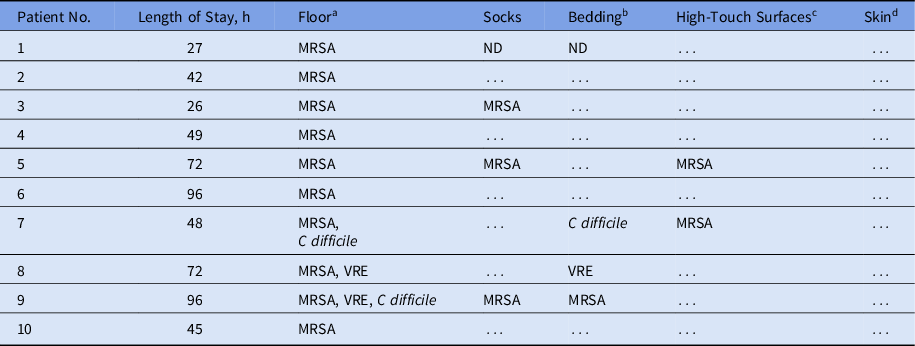
All room cultures collected after cleaning and disinfection and before admission were negative (174 total). In total, 1,208 environmental and skin swab samples were obtained for culture after patient admission, including 418 that were collected based on observations of interactions between patients and personnel and/or portable equipment and 790 that were sampled at scheduled intervals. One or more environmental cultures became positive for at least 1 of the pathogens in 10 of the 17 (59%) rooms. MRSA, C. difficile, and/or VRE were recovered in rooms of 10 (59%), 2 (12%), and 2 (12%) participants, respectively. Table 1 shows the pathogens recovered from the different sampling sites for the 10 participants who had 1 or more positive room cultures. For all 14 instances where pathogens were recovered, the initial site of recovery was the floor.
Culture Results for the 10 Newly Admitted Patients with 1 or More Positive Cultures for Methicillin-Resistant Staphylococcus aureus (MRSA), Clostridioides difficile, and Vancomycin-Resistant Enterococci (VRE)

Note. ND, not done.
a Floor cultures included 5×10-cm areas adjacent to the patients’ beds.
b Bedding included sheets and blankets at the base of the bed where feet are placed.
c High-touch surfaces included bed rail, bedside table, call button, and patients’ bedside chart.
d Skin sites included hands, chest, and groin.
Figure 2 shows the cumulative percentage of MRSA contamination in rooms and the percentage of patients remaining the hospital. For all 10 patients with positive MRSA cultures, contamination was initially detected on the floor after personnel entered the room; for 6 of the 10 (60%) patients, MRSA was detected on the floor within 8 hours of admission. No cultures of surfaces or patients’ skin became positive for MRSA when samples were collected immediately after personnel and/or equipment were observed interacting with the subjects (N = 418 sets of cultures). MRSA was recovered from high-touch surfaces in 3 (17.6%) of the 17 rooms. In 2 (66.7%) of 3 instances when MRSA was recovered from high-touch surfaces, an isolate with the same spa type was recovered from a previous floor sample. In 1 instance when MRSA was recovered from high-touch surfaces, an MRSA isolate with a different ribotype was recovered from a previous floor sample. For 3 patients, MRSA isolates recovered from the floor had the same spa type as isolates subsequently recovered from other sites (socks, bedding, and/or high touch surfaces).
Cumulative percentage of methicillin-resistant Staphylococcus aureus (MRSA) contamination in rooms of 17 study participants and percentage of patients remaining the hospital.

Figure 3 shows the average concentration of bacteriophage MS2 recovered from different sites with the 2 simulation protocols. For both protocols, MS2 was transferred from the floor to all the subsequent sampling sites when socks were worn. When slippers were worn over the socks, contamination was significantly reduced on socks, bedding, hands, and bedside tables (P < .01). No MS2 was detected on the hands or bedside table when slippers were worn.
Concentration of bacteriophage MS2 recovered from different sites during 2 simulation protocols with or without slippers worn over socks and removed on sitting. Bacteriophage MS2 was inoculated onto the floor and allowed to air dry. A, participants stepped onto the contaminated area, sat on the bed, removed slippers (if present), lay down on the bed, touched the bedding adjacent to their feet, and touched the bedside table. B, participants stepped onto the contaminated area, sat on the bed, removed slippers (if present), removed socks, and touched the bedside table. PFU, plaque-forming unit.

Discussion
The hands of personnel and contaminated surfaces and equipment are generally recognized as important vectors for transmission of healthcare-associated pathogens. Reference Donskey1–Reference Kanamori, Rutala and Weber3 Infection control measures therefore emphasize efforts to improve hand hygiene and cleaning of surfaces and equipment. In the current study, we did not find evidence that interactions with personnel or equipment resulted in contamination of patient’s skin or high-touch surfaces in rooms of hospitalized patients as all cultures collected immediately after observed interactions were negative. Rather, healthcare-associated pathogens, particularly MRSA, were initially recovered from the floor in rooms of newly admitted patients followed in a subset of patients by detection on sock bottoms, bedding, and high-touch surfaces. In 2 (66.7%) of 3 instances when MRSA was recovered from high-touch surfaces, an isolate with the same spa type had been recovered from the floor previously. These findings build upon a growing body of evidence suggesting that floors might be an underappreciated source of pathogen dissemination not addressed by current control measures. Reference Donskey2,Reference Koganti, Alhmidi, Tomas, Cadnum, Jencson and Donskey9–Reference Mahida and Boswell13
The fact that pathogens were recovered from the socks of patients suggests that one route of transfer may involve movement from socks to bedding or hands with subsequent transfer to high-touch surfaces by hands. The simulations with bacteriophage MS2 demonstrate the feasibility of this mechanism of transfer, either from socks directly to hands during sock removal or from socks to bedding and then to hands. Alternatively, we have previously demonstrated that fomites often contact hospital room floors and can serve as a vector for transfer to hands. Reference Deshpande, Cadnum and Fertelli10
Our results suggest that 2 simple interventions could be helpful in reducing the risk for acquisition of pathogens from hospital room floors. First, cleaning and disinfection of floors with a relatively dilute sodium hypochlorite disinfectant followed by operation of a UV-C room decontamination device after routine postdischarge cleaning resulted in consistent negative cultures of floors. In a previous study, cleaning and disinfection of floors with a quaternary ammonium disinfectant and/or operation of a UV-C room decontamination device were effective in reducing floor contamination. Reference Mustapha, Alhmidi, Cadnum, Jencson and Donskey18 Second, in the simulation study, wearing slippers over hospital socks dramatically reduced transfer of bacteriophage MS2 from the floor to hands and to high-touch surfaces. Because extensive efforts to clean floors are not likely to be feasible in healthcare facilities, having patients wear slippers might be an easy measure to reduce the frequency of transfer of pathogens from the floor to hands and high-touch surfaces.
Our study has several limitations. We studied a relatively small number of patients from a single facility with excellent hand hygiene compliance rates. Additional studies are needed in other settings. Our results suggest but do not prove that shoes transferred healthcare-associated pathogens into rooms of patients. Previously, we demonstrated that shoes of personnel are frequently contaminated with pathogens, particularly MRSA. Reference Kanwar, Thakur and Wazzan15 The demonstration of the effectiveness of slippers in reducing transfer from floors involved a simulation with healthy volunteers. Additional studies are needed with hospitalized patients who could have difficulty wearing slippers due to issues such as frailty or loss of visual acuity. We studied only 3 common bacterial pathogens and therefore our findings may underestimate the potential for importation of pathogens such as Candida spp and viruses, including severe acute respiratory syndrome coronavirus 2, that have been detected on floors. Reference Kumar, Eilertson and Cadnum19–Reference Redmond, Dousa and Jones21 We did not closely observe interactions between patients and visitors who could also potentially serve as a source of importation of pathogens. Reference Knighton, Zabarsky and Donskey22 Rectal cultures were not collected on admission to assess for VRE or C. difficile colonization. However, groin and skin swabs were collected. Previous studies have demonstrated that groin and skin cultures detect approximately half of patients colonized with VRE or C. difficile, including those most likely to shed organisms to the environment. Reference Sethi, Al-Nassir, Nerandzic and Donskey23,Reference Donskey, Sunkesula and Jencson24 Finally, we did not evaluate strategies that might reduce transfer of pathogens into patient rooms on shoes or on wheeled equipment. For example, it has been suggested that the use of a UV-C device for shoe decontamination might reduce transfer of pathogens into rooms on shoes. Reference Rashid, Poblete and Amadio25 Improved cleaning and disinfection protocols for devices such as wheelchairs have also been suggested as a means to limit the transfer of pathogens by contaminated wheels. Reference Jencson, Cadnum, Wilson and Donskey26
In conclusion, our findings suggest that healthcare facility floors may be an underappreciated source of dissemination of healthcare-associated pathogens. Future studies are needed to obtain additional evidence regarding the role of floors in pathogen transmission and to evaluate potential control measures. Simple interventions such as improved floor cleaning and disinfection, having patients wear slippers, and cleaning of high-touch items that contact the floor deserve additional study.
Acknowledgments
We thank the nurses, environmental management services personnel, and patients at the Cleveland VA Medical Center who participated in the study.
Financial support
This work was supported by from the Department of Veterans Affairs (merit review grant no. CX001848) to C.J.D.
Conflicts of interest
C.J.D. has received research grants from Clorox, Pfizer, and PDI. All other authors report no conflicts of interest relevant to this article.