Introduction
More than 12% of the US population will develop thyroid dysfunction during their lifetime (American Thyroid Association, 2017). Thyroid dysfunction, especially hypothyroidism, is more prevalent in women (British Thyroid Association, 2017). Thyroid dysfunction can lead to severe conditions such as cardiovascular disease (Gomberg-Maitland and Frishman, Reference Gomberg-Maitland and Frishman1998), infertility (Poppe et al., Reference Poppe, Velkeniers and Glinoer2008), and osteoporosis (Dhanwal, Reference Dhanwal2011). The causes of thyroid dysfunction are largely unknown, but recent research has implicated stress as a possible contributor. Stress is related to changes in the immune, endocrine, and central nervous systems (Plaza et al., Reference Plaza, Garcia-Esteve, Ascaso, Navarro, Gelabert, Halperin, Valdes and Martin-Santos2010), and stressful life events have been associated with the onset of Graves’ hyperthyroidism (Winsa et al., Reference Winsa, Adami, Bergstrom, Gamstedt, Dahlberg, Adamson, Jansson and Karlsson1991). In addition, childhood trauma is known to affect the hypothalamic-pituitary-thyroid (HPT) axis (Friedman et al., Reference Friedman, Wang, Jalowiec, McHugo and McDonagh-Coyle2005; Plaza et al., Reference Plaza, Garcia-Esteve, Ascaso, Navarro, Gelabert, Halperin, Valdes and Martin-Santos2010) and adult immune function (Fagundes et al., Reference Fagundes, Glaser and Kiecolt-Glaser2013; Baumeister et al., Reference Baumeister, Akhtar, Ciufolini, Pariante and Mondelli2016). In chronically stressed people, the immune system may be affected through the nervous and endocrine system along with increased cortisol (Kudielka and Wust, Reference Kudielka and Wust2010), leading to autoimmunity as well as increased susceptibility to autoimmune disease such as Graves’ disease (Winsa et al., Reference Winsa, Adami, Bergstrom, Gamstedt, Dahlberg, Adamson, Jansson and Karlsson1991; Mizokami et al., Reference Mizokami, Wu Li, El-Kaissi and Wall2004).
Posttraumatic stress disorder (PTSD) is a common mental disorder that develops in some persons exposed to extremely stressful traumatic events such as combat, violence, or childhood abuse. All studies of trauma/PTSD and thyroid function to date have been cross-sectional. At least 11 studies have investigated the relation between PTSD and thyroid dysfunction, and these studies can be mainly divided into two groups: (1) studies of male soldiers and refugees (Kosten et al., Reference Kosten, Wahby, Giller and Mason1990; Bauer et al., Reference Bauer, Priebe, Graf, Kurten and Baumgartner1994; Wang et al., Reference Wang, Mason, Southwick, Johnson, Lubin and Charney1995; Mason et al., Reference Mason, Weizman, Laor, Wang, Schujovitsky, Abramovitz-Schneider, Feiler and Charney1996; Wang and Mason, Reference Wang and Mason1999; Kozaric-Kovacic et al., Reference Kozaric-Kovacic, Karlovic and Kocijan-Hercigonja2002; Karlovic et al., Reference Karlovic, Marusic and Martinac2004) and (2) studies of women exposed to childhood physical or sexual abuse (Friedman et al., Reference Friedman, Wang, Jalowiec, McHugo and McDonagh-Coyle2005; Haviland et al., Reference Haviland, Sonne, Anderson, Nelson, Sheridan-Matney, Nichols, Carlton and Murdoch2006; Sinai et al., Reference Sinai, Hirvikoski, Nordström, Nordström, Nilsonne, Wilczek, Åsberg and Jokinen2014). Only one other study included people with other civilian traumas (Olff et al., Reference Olff, Guzelcan, de Vries, Assies and Gersons2006). Many of these studies found indicators of both hyper- and hypo-thyroidism in association with PTSD, however, results are conflicting. A total of six studies reported significantly increased level of triiodothyronine (T3) in PTSD cases compared with non-cases (Wang et al., Reference Wang, Mason, Southwick, Johnson, Lubin and Charney1995; Mason et al., Reference Mason, Weizman, Laor, Wang, Schujovitsky, Abramovitz-Schneider, Feiler and Charney1996; Wang and Mason, Reference Wang and Mason1999; Kozaric-Kovacic et al., Reference Kozaric-Kovacic, Karlovic and Kocijan-Hercigonja2002; Girdler et al., Reference Girdler, Thompson, Light, Leserman, Pedersen and Prange2004; Friedman et al., Reference Friedman, Wang, Jalowiec, McHugo and McDonagh-Coyle2005). For example, Wang and Mason in Reference Wang and Mason1999 found significantly higher total T3 and free T3 level among veterans with combat-related PTSD, and Friedman et al. in Reference Friedman, Wang, Jalowiec, McHugo and McDonagh-Coyle2005 found a higher level of total T3 in PTSD women with experiences of sexual abuse compared with women without PTSD. However, three other studies reported opposite results: decreased level of T3 and thyroxine (T4) in PTSD people (Bauer et al., Reference Bauer, Priebe, Graf, Kurten and Baumgartner1994; Haviland et al., Reference Haviland, Sonne, Anderson, Nelson, Sheridan-Matney, Nichols, Carlton and Murdoch2006; Sinai et al., Reference Sinai, Hirvikoski, Nordström, Nordström, Nilsonne, Wilczek, Åsberg and Jokinen2014). For example, Bauer et al. reported that refugees from East Germany showed the significantly lower level of total T4, free T4, and total T3 compared with controls from the general population. There was also one study (Olff et al., Reference Olff, Guzelcan, de Vries, Assies and Gersons2006) reporting no significant change in T4 levels in PTSD, while another study (Kosten et al., Reference Kosten, Wahby, Giller and Mason1990) suggested that change in thyroid hormone, which is the conversion from thyrotropin-releasing hormone to thyroid-stimulating hormone, is more prominent in people with PTSD with comorbid depression. The opposite direction of associations was found from two studies (Plaza et al., Reference Plaza, Garcia-Esteve, Ascaso, Navarro, Gelabert, Halperin, Valdes and Martin-Santos2010; Plaza et al., Reference Plaza, Garcia-Esteve, Torres, Ascaso, Gelabert, Luisa Imaz, Navarro, Valdes and Martin-Santos2012) conducted by the same group regarding childhood abuse and risks of thyroid dysfunction. The first study, conducted in 2010, reported a significantly increased likelihood for thyroid dysfunction among women with childhood abuse experiences (OR 5.02, 95% CI 1.13–22.33); however, the following study, published in 2012, reported no significant association between childhood sexual abuse and thyroid dysfunction (OR 0.90, 95% CI 0.19–4.20).
To date, all studies have examined PTSD as present or absent; no studies have examined the association with the number of PTSD symptoms on thyroid function. Furthermore, most studies to date have assessed PTSD concerning the status of specific thyroid hormones at a single time point without long-term follow-up and have not evaluated disease outcomes such as hypothyroidism or hyperthyroidism.
Thus, in this study, we evaluated the associations between trauma exposure, PTSD symptoms and risk of incident thyroid dysfunction over 24 years in the Nurses’ Health Study II (NHS II). We hypothesized that compared with no trauma, greater PTSD symptoms would be associated with an increased risk of thyroid dysfunction. Because early stress in life can contribute to the development of thyroid disorder, childhood factors including parental education were considered as potential confounders. In addition, health behaviors (i.e. cigarette smoking, alcohol consumption, and physical activity) and medication use [i.e. post-menopausal hormone (PMH), ibuprofen, and antidepressant use] were evaluated as potential pathway variables between trauma/PTSD and development of thyroid disorder based on the literature and prior work in this cohort (Kimerling et al., Reference Kimerling, Ouimette and Wolfe2002; Young et al., Reference Young, Kornstein, Harvey, Wisniewski, Barkin, Fava, Trivedi and Rush2007; Lee et al., Reference Lee, Sur, Yeom, Shim, Lee and Hahm2016).
Methods
Study population and design
NHS II is an ongoing prospective cohort study, started in 1989 with 116 429 female registered nurses aged 25–42 years. Participants completed baseline questionnaires and were followed biennially for information on lifestyle factors and disease diagnosis (Bao et al., Reference Bao, Bertoia, Lenart, Stampfer, Willett, Speizer and Chavarro2016). In 2001, 91 297 women were mailed a supplemental questionnaire regarding violence exposure, and 68 376 participants responded (75% response rate). In 2008, a supplemental questionnaire evaluating trauma exposure and PTSD was mailed to 60 804 women who completed both the 2001 violence questionnaire and the 2007 biennial questionnaire (Morgan et al., Reference Morgan, Hazlett, Wang, Richardson, Schnurr and Southwick2001). Of the 60 804 women, 54 224 returned the supplemental questionnaire (89% response rate). We excluded women, who had a history of cancer diagnosis before 1989 (n = 435), and who had reported thyroid dysfunction at baseline (n = 3268). We additionally excluded women with insufficient information on the date of diagnosis of thyroid dysfunction (n = 186) or with inconsistent self-reported data on thyroid disease (n = 449), leaving 45 992 women in the final analysis. There was no substantial difference for the baseline characteristics between included and excluded participants from NHS II (online Supplementary Table S1).
The Partners Healthcare Human Research Committee approved this investigation. The return of questionnaires constituted implied consent. All procedures contributing to this work comply with the ethical standards of the relevant national and institutional committees on human experimentation and with the Helsinki Declaration of 1975, as revised in 2008.
Ascertainment of trauma and PTSD symptoms
Trauma exposure and PTSD symptoms were ascertained retrospectively. In 2008, past exposure to trauma was assessed with a modified version of the 16-item Brief Trauma Questionnaire (Schnurr et al., Reference Schnurr, Vielhauer, Weathers and Findler1999; Morgan et al., Reference Morgan, Hazlett, Wang, Richardson, Schnurr and Southwick2001), a reliable and valid assessment of trauma exposure (Schnurr et al., Reference Schnurr, Vielhauer, Weathers and Findler1999). Participants were queried about lifetime exposure to 16 traumatic events (e.g. stillbirth, unwanted sexual contact, serious accident). Participants were asked to report the event that was the worst and the first of their lifetime, separately. If there was only one traumatic event, it was considered as the worst and first trauma. Information about the age at first and worst trauma was obtained. Using the seven-item Brief Screening Scale for Diagnostic and Statistical Manual of Mental Disorders (DSM)-IV-PTSD (Breslau et al., Reference Breslau, Peterson, Kessler and Schultz1999), PTSD symptoms were assessed in response to women's worst trauma.
Trauma and PTSD were coded as time-varying, with the year of participants’ worst trauma considered as the date of onset of PTSD symptoms. In either case of having no trauma or before the first trauma, the women were considered as having no trauma exposure. After their first trauma, women were classified as being trauma-exposed with no symptoms. Therefore, following their first trauma, women were categorized as being trauma-exposed with no PTSD symptoms. From the date of the worst trauma and thereafter, women were placed into five exposure groups based on the severity of PTSD symptoms: (1) no exposure to trauma, (2) exposure to trauma and no symptoms of PTSD, (3) exposure to trauma with one–three PTSD symptoms, (4) exposure to trauma with four–five PTSD symptoms, and (5) exposure to trauma with six–seven PTSD symptoms.
Ascertainment of thyroid disorders
On the 1989 baseline questionnaire, participants were asked whether they had a history of thyroid disease, without specifying hypothyroidism or hyperthyroidism, and the date of diagnosis. They were also asked about thyroid hormone replacement therapy at baseline. During the follow-up, the use of thyroid hormone replacement therapy, physician diagnoses of hypothyroidism and hyperthyroidism, thyroid nodules, and other hyperthyroidism were queried biennially. From 1993 to 2013, participants were asked about newly diagnosed hypothyroidism or Graves’ disease and the dates of diagnosis for each condition. In this study, we defined hypothyroidism as either: (1) physician diagnosis of hypothyroidism, or (2) currently using thyroid hormone replacement therapy [which, in this cohort, was used by ten times as many women with hypothyroidism as those with hyperthyroidism (Kang et al., Reference Kang, Kueck, Stevens, Curhan, De Vivo, Rosner, Alexander and Tworoger2013)]. Graves’ hyperthyroidism was separately categorized from people who responded to have the diagnosis of Graves’ disease.
In NHS II, validation studies using supplemental questionnaires and medical records have been conducted for hypothyroidism (Kang et al., Reference Kang, Kueck, Stevens, Curhan, De Vivo, Rosner, Alexander and Tworoger2013) and Graves’ hyperthyroidism (Holm et al., Reference Holm, Manson, Michels, Alexander, Willett and Utiger2005) in two subsamples; these studies (Holm et al., Reference Holm, Manson, Michels, Alexander, Willett and Utiger2005; Kang et al., Reference Kang, Kueck, Stevens, Curhan, De Vivo, Rosner, Alexander and Tworoger2013) included 68 women with self-reported hypothyroidism and 72 women with self-reported Graves’ hyperthyroidism. All women who reported a history of hypothyroidism had a clinical diagnosis of hypothyroidism or a prescription for levothyroxine/desiccated thyroid extract. In the validation study (Holm et al., Reference Holm, Manson, Michels, Alexander, Willett and Utiger2005), Graves’ hyperthyroidism was confirmed in 85% of the women with self-reported hyperthyroidism.
Covariates
Based on a priori knowledge of risk factors for thyroid dysfunction, age at baseline, race/ethnicity (Caucasian, African, Latina, Asian, other), parental education at birth (⩽high school, some college, ⩾4 years of college), and somatotype at age 5 were selected as potential confounders (Radetti et al., Reference Radetti, Kleon, Buzi, Crivellaro, Pappalardo, di Iorgi and Maghnie2008; Li et al., Reference Li, Du, Reitzel, Xu and Sturgis2013; Olmos et al., Reference Olmos, Figueiredo, Aquino, Lotufo and Bensenor2015). Body mass index (BMI, kg/m2: <18.5, 18.5 to <21, 21 to <23, 23 to <25, 25 to <27, 27 to <30, and 30+), cigarette smoking (never, former, or current smoker of: 1 to 14, 15 to 24, or 25+ cigarettes per day), alcohol consumption (none, 1 to <5, 5 to <10, 10 to <20, and ⩾20 g per day), physical activity (categorized as <3, 3 to <9, 9 to <18, 18 to <27, and ⩾27 metabolic equivalent hours per week), menopausal and PMH status (pre-menopausal, post-menopausal with no PMH, post-menopausal with past PMH use, post-menopausal with current PMH use, post-menopausal with PMH missing, and uncertain menopausal status), and ever use of ibuprofen and antidepressant use were selected as potential pathway variables (Kolakowska and Swigar, Reference Kolakowska and Swigar1977; Fisher et al., Reference Fisher, Mannino, Herman and Frumkin1997; Samuels et al., Reference Samuels, Pillote, Asher and Nelson2003; Schindler, Reference Schindler2003; Wiegratz et al., Reference Wiegratz, Kutschera, Lee, Moore, Mellinger, Winkler and Kuhl2003; Ciloglu et al., Reference Ciloglu, Peker, Pehlivan, Karacabey, Ilhan, Saygin and Ozmerdivenli2005; Iacobellis et al., Reference Iacobellis, Ribaudo, Zappaterreno, Iannucci and Leonetti2005; Eker et al., Reference Eker, Akkaya, Sarandol, Cangur, Sarandol and Kirli2008). Among them, BMI, cigarette smoking, alcohol consumption, physical activity, menopausal status, and ibuprofen use were coded as time-varying; these variables were self-reported at baseline and updated biennially unless otherwise stated. BMI was calculated from self-reported height and weight, which were validated in NHS (Rimm et al., Reference Rimm, Stampfer, Colditz, Chute, Litin and Willett1990), and self-reported weight was highly correlated with measured weight (crude Pearson correlations was 0.89). Alcohol consumption was assessed in 1989 and every 4 years thereafter to 2011. Physical activity was assessed in 1991, 1997, 2001, 2005 and 2009. In 1993, lifetime antidepressant use was first queried and then updated every 2 years from 1997 to 2013. In 2001, questions on childhood abuse were asked. For physical and emotional abuse before age 12, five questions from the Physical and Emotional Abuse Subscale of the Childhood Trauma Questionnaire (Bernstein et al., Reference Bernstein, Fink, Handelsman, Foote, Lovejoy, Wenzel, Sapareto and Ruggiero1994) were used, and an index comprising the sum of the responses was used as a continuous variable. For childhood sexual abuse before age 18, four questions from the Sexual Maltreatment Scale of the Parent–Child Conflict Tactics Scales (Straus et al., Reference Straus, Hamby, Finkelhor, Moore and Runyan1998) were asked to query unwanted, forced, or coerced sexual contact by an older child or adult and coded into four categories from none to severe (Perera et al., Reference Perera, Gavian, Frazier, Johnson, Spring, Westermeyer, Butcher, Halcon, Robertson, Savik and Jaranson2013). Each covariate had an additional ‘missing value’ category.
Statistical analysis
To evaluate whether women with PTSD symptoms were at increased risk of incident thyroid disease, we used Cox proportional hazards models to compute hazard ratios (HRs) and 95% confidence intervals (CIs). We used graphical and numerical methods of Lin et al. (Reference Lin, Wei and Ying1993) to check the proportional hazards assumption for each covariate in the Cox model (Lin et al., Reference Lin, Wei and Ying1993). Person-time was measured from baseline in 1989 until the return of the last questionnaire, diagnosis of thyroid disease (hypothyroidism or Graves’ hyperthyroidism), loss to follow-up, or the end of follow-up in 2013.
A series of models were fit. The base model was adjusted only for age. Model 2 additionally adjusted for race and childhood factors (parental education and somatotype at age 5), which were key potential confounders. We examined potential mediation in two additional models. Model 3 further adjusted for health behaviors (cigarette smoking, alcohol consumption, and physical activity), and model 4 further adjusted for medication use. Trauma/PTSD symptoms were lagged 1 year prior to the period. For example, PTSD status as of 1988 and covariates (e.g. cigarette smoking, physical activity, and alcohol consumption) as of 1989 predicted the onset of thyroid dysfunction in 1989–1991.
As a thyroid disorder is relatively unrecognized in the general population, and there is also a chance of higher detection of the disease in women with mental health problems who may use frequent medical services. We re-ran the analysis osteoporosis, which is also a common unrecognized condition as a control outcome.
We conducted six sensitivity analyses. First, we conducted entirely prospective analyses; i.e. we examined whether PTSD status in 2008 predicted incident thyroid disease in 2009–2013 (N = 1604 cases hypothyroidism, N = 138 cases Graves’ hyperthyroidism). Second, to reduce the likelihood of reverse causation, we lagged PTSD exposure an additional 2 years/4 years over the 1 year lag in the primary analyses. Third, we tested whether thyroid disorders as exposure increased the risk of PTSD onset as the outcome among those with trauma exposure in order to evaluate the extent of possible reverse causation. Fourth, to address the possibility that any associations may be due to higher health care utilization/screening in those with either PTSD or thyroid dysfunction, we restricted the analyses to women who reported recent physician exams. Fifth, we excluded the participants who reported ‘life-threatening illness’ as their cause of lifetime worst trauma. Finally, to examine any potential confounding by childhood abuse, we further adjusted model 4 for childhood physical, emotional, and sexual abuse.
Results
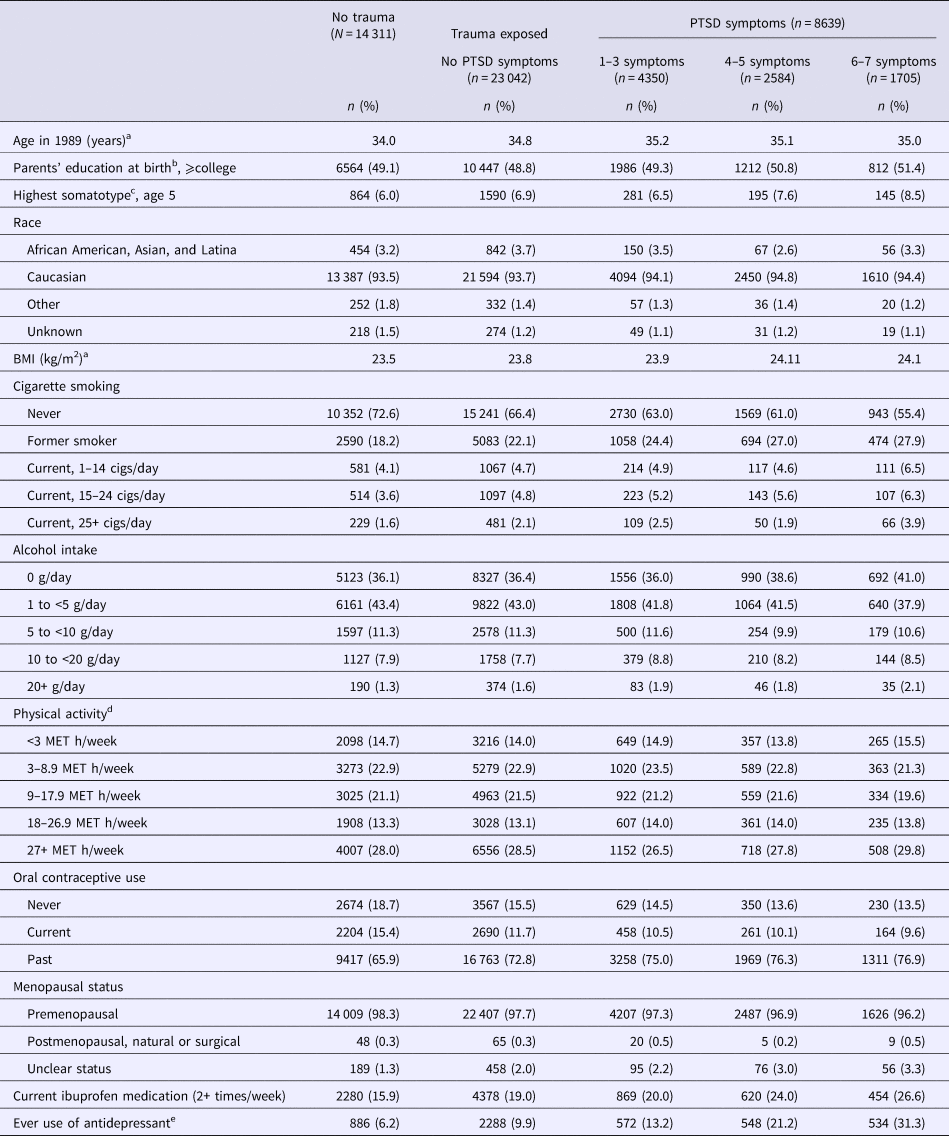
Thirty percent of women reported that they had no history of traumatic events at baseline in 1989. Fifty percent reported that they had exposed to trauma with no PTSD symptoms. Four percent of women reported the highest number (6–7) of PTSD symptoms. Compared with women who did not experience any trauma, women with the highest number of PTSD symptoms were more likely to have the highest somatotype at age 5, be white, have higher BMI, smoke frequently, use oral contraceptives, be menopausal, use ibuprofen medication, and use antidepressants (Table 1).
Baseline characteristics of NHS II participants by trauma exposure and PTSD symptoms (1989) (N = 45 992)

a Mean value.
b Highest education attainment among father and mother.
c Somatotype was in 10 different categories from least to greatest adiposity.
d MET h/week = metabolic equivalent hours/week.
e First assessed in 1993.
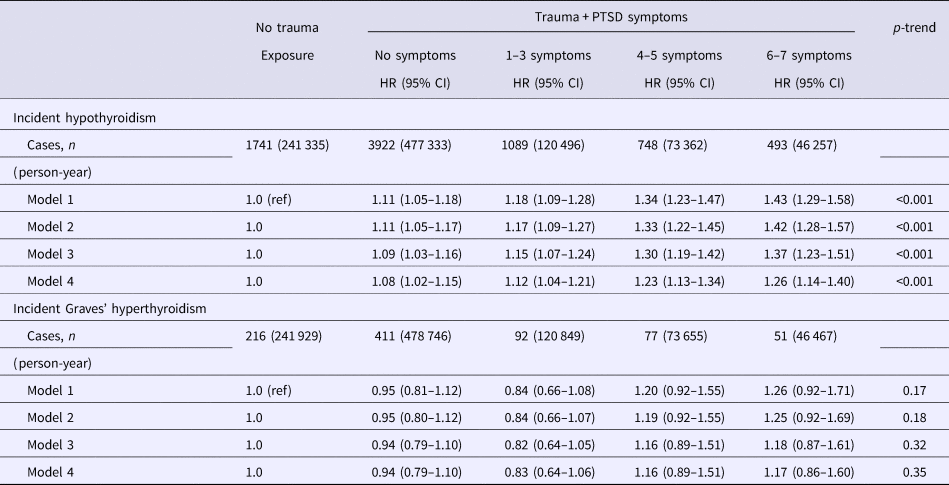
Over 24 years of follow-up, 7993 women developed hypothyroidism, and 847 women developed Graves’ hyperthyroidism. Overall, women with PTSD symptoms had a higher incidence of hypothyroidism in a dose–response pattern. No significant association was observed with Graves’ hyperthyroidism. In the model adjusted for age, we observed a highly statistically significant association between greater PTSD symptoms and incidence of hypothyroidism alone (model 1 in Table 2). With additional adjustment for race, highest somatotype at age 5, and parental education (model 2 in Table 2), associations between PTSD symptoms and hypothyroidism were attenuated, but the associations and the tests of trend remained statistically significant. There was little change in the adverse associations between PTSD and hypothyroidism, after adjustment for possible mediating factors related to health behaviors (i.e. smoking, alcohol consumption and physical activity). Associations between PTSD and hypothyroidism were somewhat attenuated after further adjustment for additional possible pathway variables including PMH use, ibuprofen use, and antidepressant use (Table 2, model 4). For the outcome, the associations and dose–response trends remained statistically significant. In the final model, women with the highest number of PTSD symptoms had an HR of 1.26 (95% CI 1.14–1.40, p-trend <0.001) for hypothyroidism, compared with women without any trauma exposure (Table 2).
Adjusted HRs (95% CIs) for the association between trauma exposure and PTSD symptoms with risk of incident thyroid diseases with 1 year lag, 1989–2013

Model 1, adjusted for age; model 2, model 1 + race and childhood factors; model 3, model 2 + health behavior; model 4, model 3 + menopausal and PMH status, ibuprofen use and antidepressant use.
Race/ethnicity (Caucasian, African, Latina, Asian, other).
Childhood factors: parental education at birth (⩽high school, some college, ⩾4 years of college) and somatotype at age 5.
Health behavior: BMI (kg/m2: <18.5, 18.5 to <21, 21 to <23, 23 to <25, 25 to <27, 27 to <30, and 30+), cigarette smoking (never, former, or current smoker of: 1–14, 15–24, or 25+ cigarettes per day), alcohol consumption (categorized as none, 1 to <5, 5 to <10, 10 to <20, and ⩾20 g per day), and physical activity (categorized as <3, 3 to <9, 9 to <18, 18 to <27, and ⩾27 metabolic equivalent hours per week).
Menopausal and PMH status: (pre-menopausal, post-menopausal with no PMH, post-menopausal with past PMH use, post-menopausal with current PMH use, post-menopausal with PMH missing, and uncertain menopausal status).
BMI, cigarette smoking, alcohol consumption, physical activity, menopausal status, and ibuprofen use were coded as time-varying.
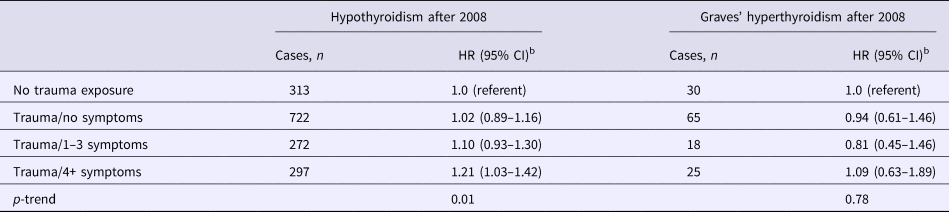
In prospective analyses from 2008, results were similar (Table 3). For women with the highest number of PTSD symptoms (4+ symptoms), the HR for hypothyroidism was 1.21 (95% CI 1.03–1.42, p-trend = 0.012). When we evaluated exposures lagged by an additional 2 or 4 years, there was little difference from the main model for the relationship between PTSD symptoms and thyroid dysfunction (online Supplementary Table S2). In models evaluating whether thyroid conditions as an exposure were associated with subsequent PTSD symptoms as the outcome, we found that hypothyroidism was associated with modestly higher risk of clinical PTSD symptoms [for more than four PTSD symptoms: HR 1.17 (95% CI 0.99–1.38)]. We found no significant results for hyperthyroidism (online Supplementary Table S2). Results for women with a depression diagnosis were similar to results for the entire study population. However, the results for women without a depression diagnosis were slightly attenuated compared with the results from the entire population (results not shown). In analyses restricted to women who reported physician examinations, results were similar to the main analyses. Compared with women without trauma exposure, women with the highest number of PTSD symptoms had an HR of 1.24 (95% CI 1.11–1.38) for hypothyroidism, with significant dose–response trends (p-trend <0.001) (online Supplementary Table S4). After excluding the women who reported ‘life-threatening illness’ as their cause of lifetime worst trauma, overall results did not change (results not shown). Also, we did not find a significant association between trauma/PTSD and osteoporosis which we examined as a controls outcome (results not shown).
In additional analyses adjusting for childhood abuse, the association between PTSD symptoms and hypothyroidism was slightly attenuated but remained statistically significant [for hypothyroidism, PTSD six–seven symptoms: HR = 1.18 (95% CI 1.06–1.32), p-trend <0.001]. No significant result was found for PTSD symptoms and Graves’ hyperthyroidism (online Supplementary Table S5).
Prospective analysis (excluding women with thyroid disease cases before 2009) of the association between PTSD symptomsa and incident thyroid disease 2008–2013.

Race/ethnicity (Caucasian, African, Latina, Asian, other), Parental education at birth (⩽high school, some college, ⩾4 years of college), BMI (kg/m2: <18.5, 18.5 to <21, 21 to <23, 23 to <25, 25 to <27, 27 to <30, and 30+), cigarette smoking (never, former, or current smoker of: 1–14, 15–24, or 25+ cigarettes per day), alcohol consumption (categorized as none, 1 to <5, 5 to <10, 10 to <20, and ⩾20 g per day), physical activity (<3, 3 to <9, 9 to <18, 18 to <27, and ⩾27 metabolic equivalent hours per week), menopausal and PMH status (pre-menopausal, post-menopausal with no PMH, post-menopausal with past PMH use, post-menopausal with current PMH use, post-menopausal with PMH missing, and uncertain menopausal status).
a PTSD symptoms were first assessed in 2008.
b Fully adjusted for age, race, parental education, somatotype at age 5, physical activity, BMI, alcohol consumption, cigarette smoking, menopause status, ibuprofen use and antidepressant use.
Discussion
To our knowledge, this is the first study of PTSD symptoms in relation to incident thyroid disease in civilian women, using data from a longitudinal population-based cohort that evaluated potential pathway variables. Over 24 years of follow-up, we found that more PTSD symptoms were associated with incident hypothyroidism, in a dose–response pattern. The results remained significant in prospective analyses and various sensitivity analyses addressing multiple aspects such as an extended lag period, depression, physician examination, and childhood abuse. According to Olivier et al.’s definition (Olivier et al., Reference Olivier, May and Bell2017), women with four or more PTSD symptoms seemed to demonstrate medium relative effect size, whereas women with three or fewer symptoms showed small effect size for hypothyroidism. We did not find a statistically significant association between PTSD symptoms and Graves’ hyperthyroidism. However, since the number of participants with Graves’ disease was relatively small in the current study, this result needs to be interpreted with caution. Elevated PTSD symptoms have been linked to cognitive decline (Hayes et al., Reference Hayes, Vanelzakker and Shin2012; Sumner et al., Reference Sumner, Hagan, Grodstein, Roberts, Harel and Koenen2017) as well as cardiovascular disease (Gomberg-Maitland and Frishman, Reference Gomberg-Maitland and Frishman1998), infertility (Poppe et al., Reference Poppe, Velkeniers and Glinoer2008), and depression (North et al., Reference North, Nixon, Shariat, Mallonee, McMillen, Spitznagel and Smith1999); increasing hypothyroidism risk may be one mechanism through which PTSD contributes to these diseases.
Our results are consistent with two previous population studies that focused on autoimmune thyroiditis (including Hashimoto's thyroiditis), the most common cause of hypothyroidism (National Institute of Diabetes and Digestive and Kidney Diseases, 2017). In a study of 666 269 American veterans who served in Iraq and Afghanistan, O'Donovan et al. (Reference O'Donovan, Cohen, Seal, Bertenthal, Margaretten, Nishimi and Neylan2015) reported that people who had PTSD showed an increased risk of autoimmune thyroiditis compared with those with no psychiatric disorders. While psychiatric disorders other than PTSD were associated with a 40% increased risk of thyroiditis, PTSD was associated with a 92% increased risk of thyroiditis. However, the authors did not specify whether the thyroiditis was hyperthyroidism or hypothyroidism. This distinction may have been important, as in our study, we observed no associations with Graves’ hyperthyroidism when we evaluated these two outcomes separately. In a national survey of a sample of 2490 male Vietnam veterans (Boscarino, Reference Boscarino2004), Boscarino et al., reported that chronic PTSD was associated with autoimmune diseases, including hypothyroidism (adjusted OR 8.5, 95% CI 1.9–37.9), but they did not assess hyperthyroidism.
Trauma/PTSD has been associated with short-term changes in thyroid hormone levels (Bauer et al., Reference Bauer, Priebe, Graf, Kurten and Baumgartner1994; Wang et al., Reference Wang, Mason, Southwick, Johnson, Lubin and Charney1995; Mason et al., Reference Mason, Weizman, Laor, Wang, Schujovitsky, Abramovitz-Schneider, Feiler and Charney1996; Wang and Mason, Reference Wang and Mason1999; Kozaric-Kovacic et al., Reference Kozaric-Kovacic, Karlovic and Kocijan-Hercigonja2002; Girdler et al., Reference Girdler, Thompson, Light, Leserman, Pedersen and Prange2004; Karlovic et al., Reference Karlovic, Marusic and Martinac2004; Friedman et al., Reference Friedman, Wang, Jalowiec, McHugo and McDonagh-Coyle2005; Haviland et al., Reference Haviland, Sonne, Anderson, Nelson, Sheridan-Matney, Nichols, Carlton and Murdoch2006; Bunevicius et al., Reference Bunevicius, Leserman and Girdler2012; Sinai et al., Reference Sinai, Hirvikoski, Nordström, Nordström, Nilsonne, Wilczek, Åsberg and Jokinen2014). Most of these studies measured thyroid hormone profiles shortly after trauma, without long-term follow-up. Besides, interpreting these results is especially difficult considering possible comorbidity with depression, and thyroid hormones levels are known to increase in the early stages of depression, with hormone levels decreasing over time (Wei et al., Reference Wei, Sun, Zhao, Liu, Lin, Li and Ma2014).
The mechanisms underlying the association between PTSD and hypothyroidism are not clear. First, it is possible that trauma itself may lead to the reduction in thyroid hormone levels over a long period (Vitek and Shatney, Reference Vitek and Shatney1987; Desborough, Reference Desborough2000). Helmreich and Tylee (Reference Helmreich and Tylee2011) reported that physical trauma in rats led to decreased activity of the thyroid gland. For the chronic effect of trauma, several studies proposed related factors such as elevated inflammation, change in the immune cell gene expression pathway, dysregulation in the HPT axis, and accelerated immune cell aging (Yehuda et al., Reference Yehuda, Teicher, Levengood, Trestman and Siever1994; Neylan et al., Reference Neylan, Brunet, Pole, Best, Metzler, Yehuda and Marmar2005; Yehuda et al., Reference Yehuda, Golier and Kaufman2005; von Kanel et al., Reference von Kanel, Hepp, Kraemer, Traber, Keel, Mica and Schnyder2007; Hoge et al., Reference Hoge, Brandstetter, Moshier, Pollack, Wong and Simon2009; Uddin et al., Reference Uddin, Aiello, Wildman, Koenen, Pawelec, de Los Santos, Goldmann and Galea2010; Neylan et al., Reference Neylan, Sun, Rempel, Ross, Lenoci, O'Donovan and Pulliam2011; O'Donovan et al., Reference O'Donovan, Sun, Cole, Rempel, Lenoci, Pulliam and Neylan2011; Pace et al., Reference Pace, Wingenfeld, Schmidt, Meinlschmidt, Hellhammer and Heim2012). Changes in the immune and endocrine systems, and the central and autonomic nervous systems that are brought on by trauma are known to be associated with chronic sensitization of these systems, thus affecting subsequent responsiveness to stress exposure (Plaza et al., Reference Plaza, Garcia-Esteve, Ascaso, Navarro, Gelabert, Halperin, Valdes and Martin-Santos2010). Second, it is possible that behavioral changes associated with PTSD, such as cigarette smoking and alcohol consumption, may increase the risk of hypothyroidism (Cook, Reference Cook1998; Padyukov et al., Reference Padyukov, Silva, Stolt, Alfredsson and Klareskog2004; Palma et al., Reference Palma, Gabriel, Colugnati and Tufik2006; Ascherio and Munger, Reference Ascherio and Munger2007); however, we found that greater PTSD severity was independently associated with hypothyroidism even after adjustment for cigarette smoking, alcohol consumption, and physical activity. Third, autoimmune disorders and mental health problems may have overlapping etiologies (O'Donovan et al., Reference O'Donovan, Cohen, Seal, Bertenthal, Margaretten, Nishimi and Neylan2015). Childhood trauma is known to be related to dysregulated glucocorticoid signaling and immune cell aging, which may trigger the onset of both autoimmune disorders and PTSD (Dantzer et al., Reference Dantzer, O'Connor, Freund, Johnson and Kelley2008; Dube et al., Reference Dube, Fairweather, Pearson, Felitti, Anda and Croft2009; Pace and Heim, Reference Pace and Heim2011). Non-human studies also provide evidence that trauma and PTSD may increase the risk of autoimmune diseases (Johnson et al., Reference Johnson, Prentice, Bridegam, Young, Steelman, Welsh, Welsh and Meagher2006; Welsh et al., Reference Welsh, Steelman, Mi, Young, Storts, Welsh and Meagher2009). In the current study, we found the persistent association with PTSD symptoms and hypothyroidism even after adjusting for childhood trauma, indicating that there may be multiple mechanisms underlying how PTSD may lead to suppressed thyroid function.
This study has unique strengths. To our knowledge, it is the first large long-term cohort study of civilian women evaluating the relationship between PTSD symptoms and thyroid dysfunction, with information available on a large number of potential confounders and pathway variables, including behavioral factors and medication use. We assessed the prospective relationship between trauma/PTSD and thyroid function and also considered possible reverse causation. Although there was some evidence for reverse causation that HR increased for clinical PTSD among women with prevalent hypothyroidism compared with women with no hypothyroidism (online Supplementary Table S3) there was a significant linear association between PTSD symptoms and hypothyroidism after restricting to outcomes developed after PTSD assessment, and results were similar with extended lagging of exposure. We were also able to evaluate the association between trauma/PTSD and thyroid dysfunction by depression status.
There were several limitations to our study. First, the definition of thyroid dysfunction was based on self-reports of hypothyroidism and hyperthyroidism, which may have led to under-ascertainment of thyroid dysfunction. However, self-reports of hypothyroidism and hyperthyroidism were previously validated in this cohort of health professionals (Holm et al., Reference Holm, Manson, Michels, Alexander, Willett and Utiger2005; Kang et al., Reference Kang, Kueck, Stevens, Curhan, De Vivo, Rosner, Alexander and Tworoger2013), and a high percentage of self-reports are accurate in this sample; in addition, sensitivity analyses restricting the analyses to women reporting physician exams found similar results. Second, we assessed trauma and lifetime PTSD retrospectively in 2008; indeed, the percentage of women with PTSD was moderately lower than in other reports (Kessler et al., Reference Kessler, Sonnega, Bromet, Hughes and Nelson1995; Kessler et al., Reference Kessler, Berglund, Demler, Jin, Merikangas and Walters2005); yet, associations were similar in analyses where the study began in 2008. Third, we used a screening instrument to evaluate PTSD due to a large number of participants and did not seek clinical confirmation, which may have biased associations to the null. Fourth, we identified the onset of PTSD as the year of the worst traumatic event. For women with multiple traumatic events, PTSD symptoms may have occurred before the worst event. This would have led to some measurement error, which could have biased our results toward the null (Hutcheon et al., Reference Hutcheon, Chiolero and Hanley2010). Fifth, there is the possibility of ascertainment bias influencing the association between PTSD and thyroid diagnosis. That is, women with PTSD may be more likely to seek medical care and, thus, be diagnosed with a thyroid condition that often goes undiagnosed in the general population. To test this possibility, we additionally examined whether osteoporosis, which is also a common unrecognized condition in the general population, was associated with trauma and PTSD symptoms and no relation was found. Sixth, the age of every traumatic event was not collected due to the burden on participants, and we did not address the effect of duration and remission of PTSD symptoms on thyroid disease. Prior to their worst event, participants may have had PTSD symptoms, since many women experienced multiple traumas, and this may have caused measurement error, biasing results to the null. Also, if the risk of hypothyroidism decreases after the remission of PTSD symptoms, we might have underestimated the strength of PTSD symptom-thyroid disease association. To evaluate questions about how duration and remission impact the relation between PTSD and thyroid disease, further research is warranted. Finally, women in our study sample were predominantly white and highly educated, so the generalizability of our findings could be limited. There is considerable variation by race/ethnicity (McLeod et al., Reference McLeod, Caturegli, Cooper, Matos and Hutfless2014) in rates of autoimmune thyroid diseases, including Graves’ disease and Hashimoto thyroiditis, and thus further research is needed in populations of different race/ethnic backgrounds.
Conclusions
It is known that PTSD not only affects women's mental health, but also affects physical health by increasing risk of cardiovascular disease (Sumner et al., Reference Sumner, Kubzansky, Elkind, Roberts, Agnew-Blais, Chen, Cerda, Rexrode, Rich-Edwards, Spiegelman, Suglia, Rimm and Koenen2015), type-2 diabetes (Roberts et al., Reference Roberts, Agnew-Blais, Spiegelman, Kubzansky, Mason, Galea, Hu, Rich-Edwards and Koenen2015), and hypertension (Sumner et al., Reference Sumner, Kubzansky, Roberts, Gilsanz, Chen, Winning, Forman, Rimm and Koenen2016). Our study suggests that PTSD symptoms may also be associated with thyroid disorders, which can cause additional health problems such as depression (Gold et al., Reference Gold, Pottash and Extein1981) and memory loss (Mennemeier et al., Reference Mennemeier, Garner and Heilman1993). Also, symptoms of thyroid disease, such as weight gain, excess fatigue or muscle weakness, may be a threat to health and quality of life (Screening, Reference Screening2003). If these results are confirmed, our findings suggest that thyroid health warrants clinical attention in women with PTSD symptoms. Since thyroid disorders are treatable with proper medications, timely screening and early intervention for thyroid disorder in populations at high-risk of PTSD may lessen the morbidity associated with the disorder.
Supplementary material
The supplementary material for this article can be found at https://doi.org/10.1017/S0033291718003495.
Author ORCIDs
Sun Jae Jung https://orcid.org/0000-0002-5194-7339.
Acknowledgements
None.
Author contribution
Dr Jung had full access to all of the data in the study and takes responsibility for the integrity of the data and the accuracy of the data analysis. Study design and concept: Jung, Koenen. Acquisition, analysis, or interpretation of data: Jung, Kang, Koenen, Roberts. Drafting of the manuscript: Jung. Critical revision of the manuscript for important intellectual content: Jung, Kang, Roberts, Sumner, Nishimi, Chen, Kubzansky, Koenen. Statistical analysis: Jung, Chen. Obtained funding: Koenen, Kubzansky. Administrative, technical, or material support: Nishimi. Study supervision: Koenen.
Financial support
Drs Koenen, Kubzansky, and Roberts are supported by NIH grant R01MH10126 and Dr Sumner is additionally supported by K01 HL130650-01.NIH grant UM1CA176726 supported for NHS II cohort infrastructure. Dr Jung is supported by the Yerby Postdoctoral Fellowship. Also, this study was supported by a new faculty research seed money grant of Yonsei University College of Medicine for 2018 (2018-32-0034) awarded to Jung. The funders had no role in the design and conduct of the study; collection, management, analysis, or interpretation of the data; preparation, review, or approval of the manuscript; or decision to submit the manuscript for publication.
Conflict of interest
None.
Ethical standards
The authors assert that all procedures contributing to this work comply with the ethical standards of the relevant national and institutional committees on human experimentation and with the Helsinki Declaration of 1975, as revised in 2008.