

A young man leaves his humble rural home and journeys to the big city where he hopes to make his fortune. Once in the metropolis he encounters a series of tricksters who quickly relieve him of what little money he has. The story is an ancient one, but it acquired a renewed cultural salience in the booming economy of the 1830s when the United States was earning most of its income from the export of cotton, and the exchange of a slave-produced commodity for British-manufactured dry goods opened new avenues for upward mobility.Footnote 1 In Asa Greene's novel The Perils of Pearl Street (1834), William Hazard's parents present him on their leave-taking with “fifty dollars of money” so that he can find employment “selling goods, figuring accounts, or fingering cash” in one of New York's wholesale dry-goods stores.Footnote 2 The eponymous hero of Charles F. Briggs's The Adventures of Harry Franco (1839) also forsakes the workbench and the plough, setting out for the metropolis in order to seek his fortune with a “small roll of bank bills” in his hand.Footnote 3 To embrace the market, in Jean-Christophe Agnew's summary, is to move away from “ritual, kin, and prescriptive bonds” and towards “contractual, commutable, and convertible forms of compensation” – in other words, money.Footnote 4 “Franco” sounds like a coin, while “Hazard” suggests a narrative hero who puts himself at risk. As their stories unfold, both men increasingly resemble money as they circulate randomly from place to place, borne helplessly on the swirling currents of exchange.
Although they sit squarely in the tradition of the English comic novel these texts have not found a secure place in the canon. On its first publication, the Knickerbocker judged Harry Franco to be an “exceedingly amusing, racy, and original production,” if “somewhat desultory and unconnected.”Footnote 5 Edgar Allan Poe compared its scenes of “picturesque low-life” to the work of Tobias Smollett but regretted their tendency to “degenerate” into “sheer vulgarity.”Footnote 6 Since then, the novel has been cited occasionally as an example of American humour, an “elaborate burlesque” of popular stories about “adventurous boys” who leave home “with nothing but a wallet and a mother's blessing” and achieve success through their “industry, frugality, honesty and perseverance.”Footnote 7The Perils of Pearl Street has suffered a similar fate, earning a brief mention in Hans Bergmann's survey of antebellum New York writing as a “satiric parable” that also serves as a “guidebook to the styles and languages of deceitful merchants.”Footnote 8 With the advent of the “history of capitalism” both novels have experienced something of a revival, albeit as illustrations in a larger historical narrative. In Brian Luskey's reconstruction of the lifeworld of antebellum clerks, Hazard exemplifies both low pay and duplicitous sales techniques, while, in swapping a fifth-storey hotel room for “the intimate topographies of the farmhouse,” Franco rehearses what Michael Zakim calls the “primal scene of capitalism,” the replacement of agrarian self-sufficiency and community with the market's “relentless logic of universal equivalence and mutual estrangement.”Footnote 9 The conjuncture of two neglected literary texts with a revived interest in the history of antebellum finance nevertheless presents an opportunity for interdisciplinary analysis. What distinguishes Harry Franco and The Perils of Pearl Street is that they are situated on what Mary Poovey has termed the “fact/fiction continuum,” in a period when questions of economic value were yet to become divorced from moral or cultural concerns. These are novels that explore the affective states and ethical dilemmas generated by the credit system at the heart of the antebellum economy.Footnote 10
Literary studies scholars have focussed on paper money as the economy's most disruptive innovation.Footnote 11 In this scholarship, banknotes – worthless slips of paper only theoretically redeemable for coins or specie – function within a range of popular genres as emblems of uncertain knowledge, faulty representation, and frustrated desire. David Anthony describes a new class of “paper money men,” represented in sensationalist fiction as being torn between the desire to immerse themselves in the promiscuous circulation of banknotes and the need to hoard more tangible tokens of value in the form of specie.Footnote 12 For Joseph Fichtelberg, the language of feeling deployed in popular sentimental novels by T. S. Arthur and Susan Warner parallels the market's “boundless capacity to circulate, negotiate, and sympathize,” enabling Americans to relinquish outdated ideas of republican virtue and become “as supple and fluid as the market itself.”Footnote 13 More recently, Jeffrey Sklansky has suggested that the denunciation of the “stream of paper circulation” by radical Jacksonian Democrats like William Leggett follows the logic of melodrama by depicting bankers as deceitful monopolists, cornering the money supply at the expense of all “plaindealing” people.Footnote 14 But while this scholarship has coalesced productively around the “problematic of representation” involved in paper money it has neglected two other “genres of the credit economy” widely used in the antebellum period – the bill of exchange and the promissory note.Footnote 15
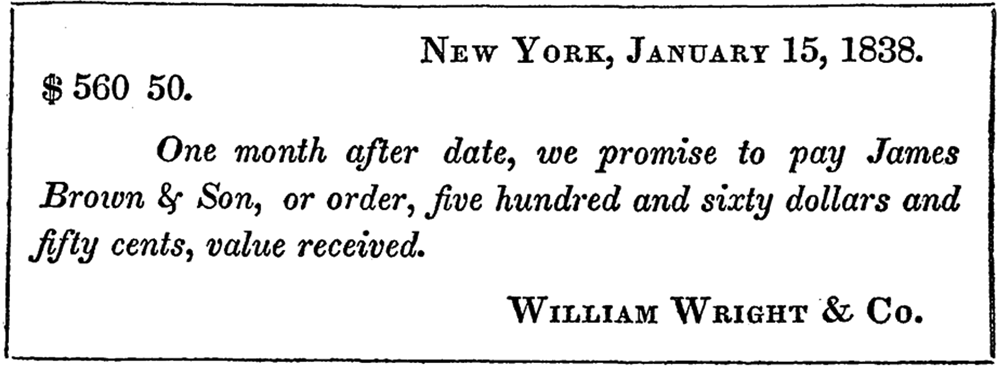
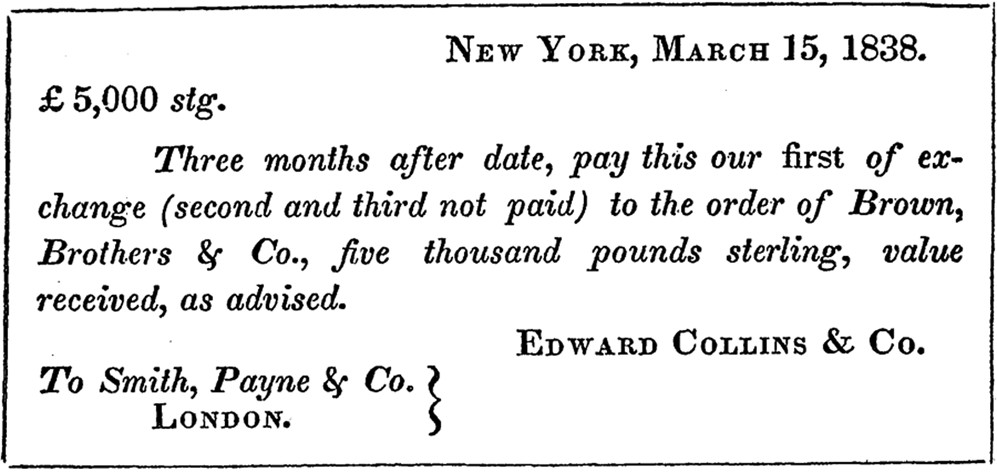
A promissory note was essentially an IOU in which A promised to pay B “a specified sum” at “some future period.”Footnote 16 In Figure 1, William Wright & Company promise to pay James Brown & Son the sum of $560.50, one month after the date of the note. Promissory notes were commonly used in local, informal networks of credit by small traders – farmers, retailers, manufacturers, and artisans. Interest on a note was chargeable at 6 percent per annum, but only became payable in the event of non-payment. In the event of default a note was said to be “dishonoured,” with the creditor entitled to seek redress from a magistrate or public notary.Footnote 17 In a bill of exchange, A instructed B to pay a specified sum to C. In the example given in Figure 2, Edward Collins & Co. (the drawer of the bill) instruct Smith, Payne & Co. (the drawee) to pay £5,000, after an interval of three months, to Brown, Brothers & Co. (the payee), in return for “value received” (a consignment of dry goods). A bill of exchange combined two transactions: a remittance or transfer of funds from one location to another, and an extension of credit. It worked because, by conducting business with him on a regular basis, trader A had built up a credit balance with middleman B, establishing a relationship of trust – and a pool of funds – on which he could “draw.”Footnote 18
Promissory note. B. F. Foster, The Merchant's Manual, Comprising the Principles of Trade, Commerce, and Banking (Boston: Perkins & Marvin, 1838), 93.

Bill of exchange. Foster, The Merchant's Manual, 96.

Bills and notes were also fully negotiable financial instruments. If a payee didn't want to hold a bill until its maturity date he could transfer it to someone else, by writing the name of the new person entitled to the payment on the back (in dorso), and “endorsing” the transfer with his own signature. In return the original payee received the specified sum in cash, minus a fee or “discount.” The most common way of “discounting” a bill in this way was by selling it to a bank, which created a money market by reselling the bills to other merchants and traders. Transferability allowed a single credit transaction to create additional liquidity by drawing in an expanding cast of creditors willing to pay the discounted sum in cash in expectation of a larger payment. A still ordered B to pay C, but C’s role as the bona fide holder of the bill had now been taken by D (who was in turn replaced by E, then F, and so on, indefinitely). The bill's new holder had a legal right to recover the amount from the bill's original drawer, or from anyone who had accepted or endorsed it. An endorsee through whose hands a protested bill or a dishonoured note had passed could therefore find himself called upon to pay it on behalf of someone “perhaps wholly unknown.”Footnote 19 It was also difficult for the drawer of a bill or a note to know when the promises they had made would return for payment, and from whom the demand would be made. The only certainty was that, if a man failed to pay a note or a bill and became insolvent, “all of his promises” were likely to return “at once.”Footnote 20
While a banknote constituted a promise to pay its bearer a sum in specie immediately, bills and notes were based on what Poovey calls the “principle of deferral,” a principle with both economic and narrative implications.Footnote 21 Poovey's innovation was to focus on the stylistic or generic features of bills, drawing attention to the interpretive labour required in order to determine whether their signatures and names referred to actual persons who could be trusted to pay. In this article I am concerned, rather, with the instrumentality of bills and notes, their function within a set of social practices and credit institutions as revealed in two popular fictions. Marx's privileging of production and his relegation of the sphere of circulation has resulted in what Margot Finn calls an “impoverished theoretical framework” for understanding credit as a vital component of capitalism.Footnote 22 Although I find Marx's categories useful at key points later in the discussion, I draw, in the first section, on a range of antebellum business histories in order to reconstruct the workings of what I call the cotton-for-credit system, focussing on the way the system coordinated complex transatlantic exchanges and intervals of time. The second section develops the concept of temporal discontinuity, the signature experience of a trader with a note to pay, which is brought out by Hazard's narration of The Perils of Pearl Street. The final section explores the multiple temporalities of The Adventures of Harry Franco and goes on to examine the problems of agency experienced by a protagonist instructed to write bills in the middle of a financial panic. Although they require the labour of contextualization, these novels can provide us with insights into the experience of everyday life in a system of deferred payments, an economy based on new forms of social interdependence.
BUYING TIME: THE COTTON-FOR-CREDIT SYSTEM
Bills of exchange were relatively simple instruments allowing traders to “transfer value from place to place,” but in the antebellum period they formed the basis of an increasingly complex “commercial system.”Footnote 23 The greater part of the antebellum cotton trade was conducted and financed by seven Anglo-American merchant banking houses led by Baring Brothers and Company. These business firms were known as “acceptance” or “commission” houses because they extended credit to favoured merchants on both sides of the Atlantic by accepting their bills and charging 1 percent or 1.5 percent in commission. Brown, Shipley and Company had the most extensive network, with branches in New York, Baltimore, and Philadelphia.Footnote 24 A Lancashire textile manufacturer would place an order for cotton with one of the commission houses, whose American agents were watching “with keen eyes the annual growth of the cotton crop.”Footnote 25 The commission house would lend the money the manufacturer needed for the order by buying from him a bill of exchange that promised to repay the money after an agreed period, usually sixty days.Footnote 26 The commission house then instructed its American branch house to make an advance payment to a southern planter at one of the seaboard cities of Baltimore, Charleston, Savannah, Mobile, or New Orleans. The price of the cotton was “pledged in advance of its actual sale – sometimes even in advance of its actual planting.”Footnote 27 The writing of the original bill of exchange, its discounting by the bank, and its acceptance by the commission house rested on a single assumption: that the sum advanced would not exceed the value of the crop when it was sold.Footnote 28 The branch house would then arrange for a sterling bill to be drawn on the credit balance of the house in London or Liverpool, at up to two-thirds of the value of the cotton. The cotton bales, “wrapped in burlap and tightly bound,” could now be shipped from the southern port to New York, or directly to Liverpool, with the freight charges and insurance costs managed by the commission house.Footnote 29
The southern planter could have simply sent the bill to the English house and waited to be paid at the contracted time, when the manufacturer paid off his bill in London. But the planter could not afford to wait this long because he was likely to be in debt and in immediate need of funds to buy slaves, land, and provisions. Once the branch agent had endorsed the bill on behalf of the house, guaranteeing its payment even if the British manufacturer should default, the planter could exchange the bill for cash by discounting it with a southern bank or broker.Footnote 30 Since it represented a credit note on a reputable British firm, the bill held by the planter was valuable to anyone who needed to spend money in New York, Liverpool, or London. American banks and bill brokers bought up foreign bills of exchange, making a discount or deduction according to the period of credit still remaining. Banks and bill brokers then sold the bills to American merchants, who used the sterling debt they represented to pay for imports of manufactured goods.Footnote 31 In this way, the bill – “paper phanto[m] of a cotton crop [as] yet unsold” – made its way back to the English commission house via the interregional and international money markets.Footnote 32 Once they arrived, the bills were sold by the commission houses to their own source of credit, the English country banks based on Lombard Street in London. The country banks had no qualms about holding the debt, since they could be confident that the manufacturer would pay off the bill once the cotton had arrived at Liverpool and been sold.Footnote 33
The commission houses were also involved in America's import trade. British manufacturers consigned goods to the houses for shipment to America, in return for advances of two-thirds or three-quarters of their value in bills of exchange, advances the houses paid for by discounting the bills on Lombard Street. An American merchant wishing to purchase British manufactured goods drew a bill of exchange on the commission house in London. The goods were shipped to the partner or agent of the house in New York, and made their way into the interior via one last chain of credit.Footnote 34 Wholesale jobbing merchants bought the goods from New York's auction houses by offering their promissory notes, dated at six to eight months and drawn on the city's banks.Footnote 35 A wholesaler would endorse the notes offered him as payment by a retailer and discount them at a bank, with the wholesaler receiving cash for his goods and the retailer an indirect extension of credit. The jobbers sold the goods to retailers in the backcountry by accepting their bills and notes and discounting them at a bank.Footnote 36 By 1832, a stream of $10 million in domestic or “inland” bills of exchange was coursing through the Mississippi valley, $4 million of it payable at New York.Footnote 37
Why was this a system and not a network? “Network” has its descriptive uses in clarifying relationships between persons and places.Footnote 38 But the metaphor becomes misleading when it suggests a purely spatial image of pattern and arrangement that is “always and necessarily opposed to wholes and enclosures.”Footnote 39 Taken this literally, the metaphor supports a kind of epistemological scepticism, a conviction that, because of their “unmappable complexity,” we can never “apprehend” the “totality of the networks that organize us.”Footnote 40 The economy tends to feature in this sceptical, humanist tradition as an opaque and abstract world, made up of “lifeless and life-denying” categories – a world of “senseless causal connections” that are “too complex for understanding.”Footnote 41 But the antebellum financial system was an organized totality that was precisely mapped, and its agents were fully aware of how its discrete operations combined and intersected. Individually contracted exchanges could only become sources of “high profits and rapid accumulations” once they had been scaled up, and the higher-volume flows of goods and credit channelled and controlled by financial institutions.Footnote 42 This was a system characterized not only by “connection and interconnection,” but by an organizational structure, its constituent elements governed by “specific ‘logics’ of determination and relationality.”Footnote 43 The cotton-for-credit system was, in Michel Aglietta's terms, a “regime of accumulation,” a stable and regulated structure of social relationships creating the conditions for the production and exchange of commodities and the extraction of value.Footnote 44
The system developed as a coordinated sequence of flows: cotton moving down the Mississippi river to New Orleans and on to Liverpool, manufactured goods shipped from Liverpool to New York for distribution to the interior, a steady stream of foreign or sterling-denominated bills working its way from New York to London, a growing tidal wave of domestic or dollar-denominated bills surging from New Orleans and other points in the interior to New York.Footnote 45 But the system was also designed to solve the problem of time by smoothing complex transitions between its nodal points and managing potential blockages. In the rural interior, crops took time to plant, raise, and harvest, while dry goods in urban stores flew off the shelves. Agrarian and urban spaces – “land” and “market” – generated coexisting and incompatible forms of time that were harmonized by the commission houses.Footnote 46 When northern importers needed credit in the summer months the houses sold foreign bills of exchange and invested the cash in short-term commercial paper. When the cotton crop came onto the market in the late autumn the houses liquidated these holdings and placed them in the hands of their southern branch agents for the writing of “cotton bills.”Footnote 47 In this way, the cotton-for-credit system allowed planters, manufacturers, and merchants on both sides of the Atlantic the time they needed to turn one commodity seamlessly into another. Under the aegis of this new form of business administration time acquired an “unprecedented flexibility, malleability, and multidimensionality,” becoming “a powerful means of organizing, and reorganizing, human relations.”Footnote 48
An extensive scholarship has described the standardization or “homogenization” of linear time in the nineteenth century by the forces of capitalist “modernity,” a process that creates discontinuities and conflicts with older, cyclical forms of time derived from religion and nature.Footnote 49 Less attention has been paid to the ways in which the liberal capitalism of the nineteenth century contained its own forms of temporal heterogeneity. As William Goetzmann points out, the power of financial instruments like bills of exchange and promissory notes derives from their ability to displace value “forward and backward through time,” enhancing the ability to “imagine and calculate the future.” Finance makes human beings “creatures of time,” creating and shaping “the possibilities of the temporal dimension.”Footnote 50 But, as we have seen, the situation is more complex than this because the antebellum financial system exhibited a novelistic tendency to “jumble and superimpose multiple and incommensurable rhythms,” overlaying different tempos within a single extended sequence.Footnote 51 Traders within the system were playing a high-stakes game with time, purchasing and providing temporary liquidity in the expectation of future payment, forever running ahead of themselves in a continuous process of “temporal displacement and recuperation.”Footnote 52 In The Perils of Pearl Street these governing forms of temporality – financially mediated experiences of time – occupy a central place.
THE TIME OF A NOTE
In order to grasp the instrumentality of the credit system and its narrative representation we need to recover a nineteenth-century grasp of duration, or what Caroline Levine calls “the specificity of temporally unfolding forms.”Footnote 53 It is here that literary narratives can extend the historical understanding of time-bound obligations. Promissory notes, or “drafts on futurity,” establish a proleptic framework for Hazard's narrative, which concerns the extent to which prospects and projects can be based on “rational expectations” (5, 15). A mercantile career may proceed towards the future at fast or slow speeds, either “rushing headlong towards a precipice,” or exhibiting a “patient and steady perseverance” (90). Hazard, of course, choses the former. After two years as a clerk he feels “an itching desire” to set up in business on his own account, a need to “grow rich apace” (97). He accordingly pools the $1,000 dollars he has saved with an equal sum advanced by another clerk, Alfred Launch, in order to establish a firm of wholesale jobbing merchants, buying dry goods from the auction houses “by the bale,” and selling to the retail trade “by the piece” (102). In order to establish their firm on Pearl Street, Launch & Hazard make cash purchases to the value of $2,000, and give their notes, payable in six months’ time, for “thirty thousand more” (101). Hazard knows that to rely so heavily on “fictitious capital” – to venture on “the perilous ocean of trade” in “so frail a bark” – is to nominate oneself as “a candidate for shipwreck” (99).Footnote 54 But he also knows that capitalism is an adventure story, one in which reward is proportioned to risk.
The drama that unfolds depends for its suspense on a grasp of some concrete particulars of the credit system. Hazard explains that the jobbers have resolved “not to give endorsed paper”; in other words, “not to trouble themselves to find security for the payment of their notes” (103). This reflects the status of Launch & Hazard as new entrants to the jobbing market, unable to draw on social connections with established merchants willing to endorse their paper and stand ready to pay in the event of default. Instead, the firm enters into an agreement with another house, Gumption & Plunket, to endorse each other's notes. It was already a truism that merchants needed to keep accurate accounts in order to be able to present a “true picture” of their “pecuniary circumstances” and preserve their honour as “merchants and gentlemen.”Footnote 55 Hazard admits that mutual endorsement lacks this kind of credibility: it is, transparently, a stratagem by which “A, with empty pockets, boulsters up the credit of B; while B, with the like empty pockets, supports the credit of A” (122). It is “an expedient of to-day,” leaving tomorrow to “shift for itself” (83). But postponing their obligations only intensifies the exposure of both parties to risk.
The partners have received the cash they need to buy goods by discounting their own notes at a bank, meaning that they are in debt to the bank to the tune of $30,000. Six months pass in what seems to Hazard like an “exceedingly short duration,” scarcely more “than a winter's day” (115). Time for a merchant with “notes to pay, by a specified time,” appears “to gallop” towards a moment of “peril,” a “dangerous crisis” (115, 116). The specified hour for payment at the bank is three o'clock, with only a minute's grace. If they are not paid promptly the notes will be “protested” – placed in the hands of the public notary and subject to legal proceedings against the debtor. Even more seriously, the partners’ delinquency will result in a loss of future creditworthiness. The “pile of unlucky paper” sits under the eye of the notary, “a sort of caco-demon” performing the role of a malign fate (118, 117). Hazard is forced into the practice of “shinning,” which involved “running about to one's acquaintance,” asking them if they have any spare cash in order to “meet the emergency of a note in bank,” the term deriving from the tendency of borrowers hurrying through the streets to bark their shins on “wheelbarrows, boxes, barrels, piles of brick, and other obstacles” (123–24). Hazard runs “furiously” along Pearl Street importuning everyone he recognizes, “always increasing the rapidity of my steps in proportion to the remaining time, or the greatness of the sum of money still to be obtained” (127). When this “shinning frenzy” fails, Launch and Hazard try selling the notes given to them by their own customers to private bill brokers. New York City brokers commonly “shaved” the sellers of bills and notes by charging steep discounts of between 12 percent and 30 percent for their services, the range reflecting the fact that the value of a bill or a note was directly indexed to its maker's reputation, the consensus judgement of the community on his ability to pay.Footnote 56 The paper offered by Launch & Hazard is shaved ruthlessly until “the blood follow[s] the razor” (127, 132). The notary, meanwhile, is waiting at the bank, next to the “fated pile of notes” (118). “At length the clock strikes: one! The hand of the notary descends a little; two! It falls nearly to the pile; three! It grasps the entire heap.” Hazard and Launch are forced into bankruptcy, stopping payments to their creditors and selling off their stock of goods for sixty cents on the dollar (140).
In The Perils of Pearl Street the promissory note establishes its own chronotope, Bakhtin's term for those organizing narrative forms in which time “thickens, takes on flesh, becomes artistically visible.”Footnote 57 The contradictory time of the note means that six months is compressed into one minute. Ruled by both an elongated period of credit and the strictly arithmetical necessity of a due date, a note causes time to become uneven, a confusing melange of “the slow and the sudden.”Footnote 58 Greene's narrative presents a newly internalized sense of the money market's determining rhythms, demonstrating that a full immersion in the temporal cycles of the credit system is the price paid by capitalists without real capital. Living on time borrowed from the future intensifies the parvenu borrower's dependence on banks, brokers, and informal credit circles – “interconnected threads of debt” that escape and exceed autonomous marketplace agency.Footnote 59 When he first sets out for New York City, the young William Hazard is convinced that he possesses the “integrity of character” that can be smoothly converted into economic capital (12). The merchant is described in a series of aggressively masculine pronouns and active verbs: “he sells a world of goods – he employs a store full of clerks – he piles the boxes mountain high before his door – he takes a prodigious heap of [commercial] paper – he has oceans of business in the bank – he is continually handling the cash” (6). But the older and wiser Hazard, narrating his story in the aftermath of his own failure, points out that the goods are not all paid for, the clerks are not profitably employed, the boxes are not always filled, and the paper is “not always signed by responsible men” (7). Drafts on futurity are always likely to be dishonoured.
FAST PROPERTY
Like William Hazard, Harry Franco grows up in a rural backwater, “a quiet little out-of-the-way place, about a day's ride from one of the steamboat landings on the Hudson” (Volume I, 3). Franco's village is quiet because it has been ravaged by the trade depression that followed the Jefferson Embargo of 1808, and his father is a ruined merchant. A moment of capitalist crisis has resulted in an “organic fastening-down” to an intensely localized place, “limited and sufficient unto itself,” governed by the cyclical rhythms of nature.Footnote 60 But this rural idyll is penetrated by the market, as the countryside begins to fill with imported consumer goods.Footnote 61 The sight of his insolent cousin clothed in a “handsome surtout with a fur collar” stirs Franco's “desires and aspirations,” provoking him to leave home “in quest of a fortune” (Volume I, 8, 10, 12). The opening chapters of The Adventures of Harry Franco depict a still “transitional” or “incomplete” capitalism, a world organized around the “distinct temporalities” of the metropolis and the countryside.Footnote 62 But this straightforward dichotomy forms the basis for more complex forms of “multi-temporality” in which the two foundational modalities of time are not only “discontinuous from each other” but “heterogeneous within themselves.”Footnote 63
“I was in reality afloat upon the wide world,” Franco tells us, “ignorant of its ways, with no definite object of pursuit” (Volume I, 32–33). The narrative proceeds in a disconnected series of episodes, a narrative form loosely modelled on Smollet's picaresque novel The Adventures of Roderick Random (1748).Footnote 64 Starting with a small roll of bank notes, his adventures linked only by the “adventitious connection” of his “movement through space and time,” Franco is – like Random – a figure of “exchangeability,” his identity as fluid, mobile, and generic as money.Footnote 65 He visits a Broadway auction house, drinks mint juleps with a pompous southern lawyer, observes peanut-eating butcher-boys, visits phrenologists and oyster cellars, and goes to the theatre. When he fails to find employment as a clerk in a countinghouse Franco works his passage on a ship bound for Buenos Aires and survives starvation, flogging, and mutiny. The first volume of the novel ends with Franco pocketing a $1,000 share of the ship's cargo. Time in this sequence of events is subjected to a logic of “random contingency,” “chopped up into separate segments,” each episode “rounded-off and complete” but “isolated and self-sufficient.”Footnote 66 Everything is, as the novel's Knickerbocker reviewer said it was, “desultory and unconnected” – as though the aftershocks of the 1808 crash have generated just enough turbid ripples to keep the parvenu adventurer randomly circulating. In the second volume, this abstract and empty “adventure time” meshes with real historical time in another moment of capitalist crisis, a temporal rupture that appears autochthonous but is revealed to have precise social and economic origins.Footnote 67
After two years’ absence, Franco returns to New York, stepping ashore on the East River at Catharine Market, a well-known “space of flows,” where “the goods of Long Island slipped in and out of the isle of Manhattan.”Footnote 68 But a normally vibrant market culture – with its “willingness to merge and make combinatory” – appears curiously deadened and inert.Footnote 69 Franco enumerates the people and things he sees in the manner of a stocktaker's inventory, a bill of goods, or a ship's manifest. There is an “old red faced apple woman” brushing flies from “pyramids of dusty fruit”; a “negro” opening “hard shelled clams”; a “young girl in a black silk dress and a tattered leghorn hat” selling ice cream; a “negro wench” selling hot corn; some “spruce looking gentlemen” with “glass show cases” displaying “jewelry, and soaps, and penknives”; and an “old man, very poorly dressed, with an assortment of second hand books and tattered maps” (Volume II, 2). “[T]hree or four cartmen, in dirty frocks,” are reading the penny newspapers, while a group of wood sawyers wait “listlessly” for employment (Volume II, 22). The separate parts of this scene stand in for a complex whole, a slow market where no one is buying. In this chronotopic “visualizing of locality,” dynamic and expansive energies have come to an abrupt standstill, the trade depression as urban-capitalist idyll.Footnote 70
But if time is slowing down in Catherine Market it is accelerating on Wall Street. At first this scene is one of a conventional “stir and bustle,” with crowds of “keen and anxious” men hurrying “to and fro” (Volume II, 15, 14, 15). But Franco notices something unusual: “the walls of the houses, the trunks of the trees, the fences, and the lamp posts” are covered with “plans of lithographed towns and cities” (Volume II, 14). The city is in the middle of a real-estate boom, fueled by the expanding credit system.Footnote 71 Franco hears from the talk on the street that “getting rich fast” means “speculating in fast property” (Volume II, 16). With no time to lose, he lends his $1,000 to a genteel real-estate speculator, Dooitt, at one-quarter percent interest per day. Assured that his money will not “remain idle an hour,” Franco accepts Dooitt's promissory note, declining his offer of some endorsed paper as “collateral security” (Volume II, 28). Credit, Marx says, “accelerates the velocity of the metamorphoses of commodities,” and so increases the velocity of “monetary circulation.”Footnote 72 Mediated by Dooitt's note, Franco's bank-issued money speeds towards stock issues in companies building the cities of the future. But he has been the victim of a con trick. Dooitt's note turns out to be worthless because the interest rate violates state usury laws, leaving Franco with no means of recovering his money. His $1,000 has metamorphosed into ottomans, marble tables, and champagne, the stage props of Dooitt's larcenous trade.
Dooitt belongs to an antebellum class of “predatory swindlers and fast-talking cheats,” out-and-out rogues who seemed “mysteriously immune to the terrible sword of financial correction”Footnote 73 But the line separating the “popular phrensy” of speculation from “regular and pains-taking business” was far from clear.Footnote 74 The Whig journalist and free-market theorist Richard Hildreth pointed out that when a “wild” speculation came to nothing it was “stigmatized as a bubble or a humbug,” but if it succeeded it was “commended as enterprise.” Hildreth concluded that, for “an improving country,” a “certain spirit of speculation must at all times exist,” otherwise “there could be no improvement.”Footnote 75 Hildreth's insight was later elaborated on by the Austrian economist Joseph Schumpeter, who pointed out that if all present and future production were financed only by the sale of what had been produced in the past there would be no economic growth. It requires the creation of credit to disrupt this “circular flow,” the issuing of “certificates of future services or of goods yet to be produced.”Footnote 76 The different speeds of Wall Street and Catherine Market – fast and slow, accelerating and decelerating – underline the fundamentally nonsynchronous nature of a credit-based economy, an economy whose rhythms are necessarily complex and syncopated because it must always be keeping at least one step ahead of itself. As this process intensifies, Franco's ambitions become increasingly future-oriented and immaterial. “I was always hoping for something,” he tells us, “I hardly knew what; a dim form, like the shadow of a desire, was ever before me” (Volume II, 45).
BILLS, PRINCIPALS, AND AGENTS
After borrowing money from his landlady and a former shipmate, Franco finds employment in the counting room of Marisett & Co., one of the commission houses or firms of “merchant middlemen” located on South Street.Footnote 77 While Herman Melville's Bartleby famously rebels against office hierarchy and the cramped, sedentary life of the clerk, Franco does all that is expected of him. Although he finds “[c]opying mercantile letters” a “dull business,” he sits up half the night perfecting his handwriting and learning the language of “dollars,” “operations,” “loans,” “exchanges,” and “bills” (Volume II, 99, 171, 176). When his father writes enclosing “a small draft” – a bill on which he is “at liberty” to draw at his own “discretion” – Franco is shocked to find that the amount is five hundred dollars (Volume II, 148). In a separate letter, his sister explains that their father has been offered “a great price” for the family's garden, which has been “laid out into building lots,” giving him access to plentiful credit at the town's newly opened bank (Volume II, 151). Another company has agreed to buy the house and convert it into a hotel, paying fifty dollars in order to “make the agreement binding” (Volume II, 151). Despite his reputation for probity and caution, Franco's employer succumbs to the speculative mania and attempts to corner the cotton market. Kept in the dark about the “entire plan of operations,” Franco is sent with sealed instructions to New Orleans (Volume II, 195). Before leaving New York he becomes aware that “many prudent merchants” have begun throwing out “dark and ominous hints of an approaching catastrophe in the mercantile world” (Volume II, 210–11). The cotton-for-credit system is on the verge of breaking down, about to be convulsed by the financial panic of 1837.
The whole of society has persuaded itself that money possesses the magical ability to produce more money out of itself. But promissory notes and bills of exchange actually represent “nothing but accumulated claims, legal titles, to future production.”Footnote 78 Fictitious capital is contingent on the “creation of real value” through “the embodiment of social labour in material commodities,” in this case the chattel labour of slaves and the waged labour of textile workers and urban clerks.Footnote 79 If the expected profits of future production do not materialize in time and capitalists cannot deliver contracted prices, the credit system is thrown into crisis. This is precisely what happened in the middle of 1836, when poor wheat harvests in Britain caused an economic downturn and British demand for American cotton slumped. Alarmed by the large flows of British capital into American cotton, canals, and railroads, the Bank of England signalled a move to tighter credit conditions by raising its key interest rate. With demand depressed and credit more expensive, cotton prices at both Liverpool and New Orleans were pushed lower. Falling cotton prices meant that New Orleans cotton factors could not fulfil their contractual obligations, which in turn put intolerable pressure on their creditors, the New York commission houses. By April of 1837, bad cotton debts had brought down New York houses with combined capital of $60 million. The panic spread when banknotes – themselves promissory instruments that could be redeemed for specie – became as suspect as the bills of distressed merchants. On 10 May, with depositors demanding the redemption of their notes, New York's banks were forced to close their doors. Newspaper reports helped the panic to become contagious. On 12 May, a wave of bank suspensions rippled across the Deep South in Mobile, Montgomery, and Natchez, reaching New Orleans the following day. By the end of the month the nation's banking system had effectively shut down.Footnote 80 In the 1837 panic a new order of temporality appears and the “repetitive rhythms” of the business cycle, “fluctuations purely internal to the capitalist economy,” begin to be heard.Footnote 81
The business cycle establishes its own chronotope in Franco's narrative, a temporal sequence composed of alternating periods of speculative mania, financial panic, and economic depression. In this series of events an accelerating tempo is associated with spatial and cultural confusion, a dizzying loss of coordinates. At a déclassé New Orleans boarding house Franco dances with Madame Grandemaison, “whirled around with the velocity of a top” (Volume II, 207) while an African American cook sings the waltz from Der Freyschutz in “double quick time” (Volume II, 208). Franco's vertigo is premonitory of the “fearful winding up in the affairs of the trading and speculating world” that is approaching, as the “anticipated crisis” only makes men rush faster into “the wildest speculations” (Volume II, 210, 211). Franco detects signs of the approaching calamity in the demeanour of the city's merchants, “a strange, daring recklessness” which is “mixed up” with “despondency and apprehension” (Volume II, 211). As the final reckoning approaches, the contrapuntal rhythms of the economy become confused and the rhythms of the business cycle reproduce themselves in contradictory affective states, a loss of both economic and emotional equilibrium.
In what is an implicitly contractual relation, Marisett, acting as employer and principal, has delegated responsibility to Franco as his employee and agent, promising him a partnership position in the firm if he succeeds. When he opens the letter containing his instructions Franco finds he has been given “positive directions for the purchase and disposition of cotton,” and left “almost nothing” for the exercise of his own judgement (Volume II, 210). His funds consist of “blank acceptances of Marisett & Co.” (Volume II, 212). Because bills of exchange were “certain and precise” contracts, “formed in the fewest possible words to effect the objects of commerce,” it was convenient to print multiple copies as blank forms that resembled bank notes.Footnote 82 It was a well-established legal doctrine that a principal bestowed on an agent an “unlimited authority” to dispose of negotiable instruments “as he may please.”Footnote 83 Clerks were entrusted to draw bills by procuration, with the principal signing the blank bill and the agent adding his signature to it once he had filled in the date, the credit term (usually sixty days), the sum, and the name of the payee. Since he was performing “a mere ministerial office” an agent was not normally liable for losses occasioned by the fraud or failure of third persons to whom he had given credit.Footnote 84 Franco accordingly negotiates his blank acceptances “without difficulty” (Volume II, 212). Although the principal–agent contract works smoothly at first, it becomes ensnared by the problems of asymmetric information and misaligned interests which occur when the agent follows his own course of action, based on his own information and reading of the situation.Footnote 85
On the morning of the bank suspension Franco calls on a merchant friend of Marisett's and finds a scene of “wailing and wo” (Volume II, 213). The friend has, “but a few minutes before, nearly severed his head from his body with a razor,” and his “gory corpse” lies “stretched upon the floor, with his distracted children weeping over him” (Volume II, 213). The news arrives from New York of “overturnings, failures, and distresses immeasurable” (Volume II, 213). Marisett writes telling Franco to stop buying cotton, destroy the remaining blank acceptances, and “make no farther contracts of any description” (Volume II, 213). A separate letter from Marisett's clerk, Bargin, informs him that “we have come to the determination of stopping payment” (Volume II, 214). Another clerk, Garvey, has speculated with the firm's money on “private land operations,” meaning that its liabilities now “greatly exceed” its assets (Volume II, 215). With the fall of the firm, Franco tells us, “my own towering hopes were all brought to the ground. Love, ambition, and revenge, were all laid low” (Volume II, 214). He is now involved in a textbook case of decision making under conditions of uncertainty.
The “fixed purpose” of Franco's soul is initially “unsettled” by the crisis (Volume II, 216). He has in his possession “a considerable sum of money,” the proceeds of a bill discounted before Marisett & Co. stopped payment (Volume II, 216). Franco decides to reverse the terms of the principal–agent relation in which he has been placed by Marisett and take the money “to the gambling house” (Volume II, 216). If he wins at the pharo table he will return in triumph to New York and save the firm. If he loses, he will follow the example of Marisett's friend and commit suicide (Volume II, 216). Franco's actions no longer originate in his own will, but obey a law of mimetic contagion by which the market's moods of “recklessness,” “daring,” and “dissipation” become “infectious” (Volume II, 216). Furnishing himself with a pistol, Franco goes in search of the gambling house in the Rue St. Louis, but the streets are filled with a thick fog and he loses his way. Coming across a “half-opened door” with “light streaming out of it,” he enters “a large room dimly lighted with tallow candles” and realizes that has stumbled upon a church (Volume II, 218). An “old negro woman” suggests that listening to the sermon will “do your soul good” (Volume II, 219). Throwing the pistol away, Franco returns to his room, burdened by a “load” of “conscious guilt” (Volume II, 221). After “wrestlin[g]” with his “spirit” he eventually finds the “peace which they alone find who hang their sins upon the cross” (Volume II, 222). Franco's last-ditch conversion to Christianity saves him from destruction. “The scales had fallen from my eyes,” he declares, merging the words of the Apostle and the prophet, “my tongue was loosened, and my ears were unsealed” (Volume II, 228).
If the organizing motif of the adventure story is a test of the hero's moral integrity, then Franco might appear to have emerged from a difficult situation with selfhood intact, soul redeemed, and mercantile honour preserved.Footnote 86 But it is actually Franco's role as the agent of a middleman that saves him. His involvement in the panic is limited by the fact that he has been making contracts under another man's signature. It turns out that his operations for the account of Marisett & Co. were “not very extensive,” and that, since he is not “personally liable” for any of the contracts, he is able to return immediately to New York (Volume II, 223). The fallout from the 1837 panic pointed to an enduring truth about the credit system and the wider market economy: that “individuals are always less pertinent than the relations linking them.”Footnote 87 A blank bill of exchange is an emblem of increasingly abstract and routinized transactions, which are now mediated through institutions, contracts, and financial instruments rather than connections of kinship, friendship, or neighbourly familiarity. Franco fills in the blank bills as a pure functionary, naming buyers and sellers who are also functionaries. In the densely intermediated networks of the cotton-for-credit-and-dry-goods system both principals and agents are “cast” into predetermined positions, the “situation of being assigned.”Footnote 88 The putatively autonomous subject finds himself reduced to “a purely positional cipher, the marker of an empty center.”Footnote 89
Franco finds the desks of the countinghouse on South Street covered with dust, and Marisett's desk closed up. “I never saw a man so completely broke down,” a clerk tells him; “he couldn't survive the loss of his credit” (Volume II, 227). From this point on, real historical time gives way to the adventure time of the picaresque, in one last turn of fortune's wheel – “riches gained, a lost father recovered, true love won and wed, family estate repurchased.”Footnote 90 A romance plot has developed in parallel with the narrative of Franco's economic adventures from the moment he sees Georgiana De Lancey, “a being of light and loveliness,” at the Broadway theatre, and learns that she is rich (Volume I, 55). It turns out that Marisett is Georgiana's uncle and legal guardian, but events conspire to keep the lovers apart. When Franco's father sends him “a considerable remittance in bank bills” he finds the ruined merchant and is reunited with his lost sweetheart (Volume II, 236). Franco marries Georgiana and the happy couple return with the invalid Marisett to the parental home on the Hudson, where they live “in the enjoyment of blessings innumerable” (Volume II, 252). The novel seems to return to “real organic time of idyllic life” as opposed to the “frivolous, fragmented time of city life,” the shift of chronotope providing an emotionally satisfying “resolving chord.”Footnote 91
But this is no longer a sleepy, “out-of-the-way place” governed by “seasons rather than years, harvests rather than profits, and reproduction rather than accumulation,” the ancestral home as “the immovable part (the real estate) of capitalist property.”Footnote 92 A railroad company has constructed its track across Harry's father's land, enhancing the value of his property “almost a hundred fold” (Volume II, 236). The Franco family home is now a hotel, with the addition of “a row of wooden pillars and a pediment,” together with “a coat of white paint” (Volume II, 236). The future has at last materialized in its pure Schumpeterian form. Franco confesses that he is pleased by the outcome of his father's “fortunate speculation,” and by the sudden “accession of wealth in the family” (Volume II, 237). But the influx of money prevents any organic fastening down. Time in Franco Ville, renamed and absorbed into the cotton-for-credit system, has accelerated to match that of Wall Street. The system does not recover from its crisis: it uses crisis to recover, displacing its internally generated contradictions to new zones of accumulation, coordinating different times, persons, and places. Nowhere can be “limited and sufficient unto itself.”Footnote 93
Narratives have their own ways of seeking equilibrium by managing time. As first-person narrators, William Hazard and Harry Franco exercise the privilege of reviewing their past histories from the perspective of an as-yet-undisclosed future. The bankrupt Hazard relates his story while poised on the threshold of a new career as a lecturer in bookkeeping; while the newly capitalized Franco has safely returned to a transformed home. As Anna Kornbluh has suggested, the device of analepsis reflects the temporal order of an economy oriented towards the future. Exploiting the distance between youthful folly and the mature wisdom afforded by retrospect, the narrator “knows now what he did not know then, and what we do not know yet.”Footnote 94 These narratives are themselves drafts on futurity, their “analeptic temporality” making their readers speculators, eagerly following the events of the story in anticipation of the point at which “the action will finally catch up with the narration.”Footnote 95 Since The Perils of Pearl Street and The Adventures of Harry Franco have a carefully defined present, differentiating the time of the narration from the time of the story, these anticipations are fulfilled. The temporal disjunctures of the credit system are smoothed by the closed circle of narrative form, the redemption of fiction's own promissory note.
VALUE RECEIVED
In order to create the “value received” in a bill of exchange the concrete and particular work of individual hands needed to be combined in the abstract and general process that Moishe Postone calls “labor-mediated interaction.”Footnote 96 Slave hands coerced into ever higher levels of productivity by the “slave-driver's lash” picked bolls of Petit Gulf cotton, separated the fibres from the seeds, and pressed them into four-hundred-pound bales to be shipped from Louisiana's seaports to Liverpool.Footnote 97 Largely female hands tended the spindles and looms of Lancashire's textile mills, their names, if they flagged, entering the “overseer's book of penalties.”Footnote 98 To get the raw cotton to the Lancashire factory and exchanged for dry goods, largely male hands filled out day books, ledgers, journals, cash books, invoice books, sales books, letter books, bill books, receipt books, books of expenses, bills of lading, and bills of exchange, performing the alchemy of credit that turned “lashes into labor into bales into dollars into pounds sterling.”Footnote 99 The cotton-for-credit system facilitated “the connection of spheres of production” that, in Marx's words, “belong together and mesh into one another.”Footnote 100 If we are not to become lost in the winding paths of endlessly proliferating networks and academic specialisms we need to recover a sense of the antebellum economy as a “concrete totality,” a social whole that involves “a synthesis of many particular determinants,” a “unity of diverse elements.”Footnote 101
From one perspective, the credit system appears as a “colossal system of gambling and swindling,” a malign power capable of seizing control of the economy and inflicting a recurrent pattern of crisis, with the promissory note and the bill of exchange revealing the “social powers of intangible forms,” of “real abstractions.”Footnote 102 From another perspective, bills and notes – with their structured interactions between drawers, drawees, payees, principals, and agents – point towards the principle of social interrelatedness that Postone identifies as the defining characteristic of a capitalist economy. In his discussion of the credit system, Marx tells a version of this story, one in which “B deposits the money received in payment from A with his banker, who passes it to C in discounting a bill of exchange, C buying from D, D depositing it with his banker and the latter lending it to E, who buys from F.”Footnote 103 Although the rewards are distributed towards holders of capital, value can only be created under capitalism because everyone is, in effect, working for everyone else.
As picaresque adventure narratives, The Perils of Pearl Street and The Adventures of Harry Franco foreground complex relationships between characters, times, and places rather than individual attributes or interior states.Footnote 104 A narrative principle of connection allows these antebellum novels to grasp the social relations underpinning the credit system, linked dependencies commonly misrecognized as malign fate. Driving the plots of both novels are two forms of social interdependence, a dishonoured note and a blank bill of exchange. In its concrete manifestations, this principle of interdependence might allow us to escape the rigid antinomies of individual autonomy and structural determination that are regularly called upon to explain economic life, making persons appear “less as powerful or symbolic agents in their own right than as moments in which complex and invisible social forces cross.”Footnote 105 The creation of value is, undeniably, difficult to grasp because it is the work of many hands, mediated by different kinds of labour, and subject to the principle of deferral. But as Leigh Claire La Berge points out, nothing sustains the hegemony of finance more effectively than the belief that its convoluted operations are “beyond our collective cognitive, linguistic, and epistemological reach.”Footnote 106 We need to follow the interwoven paths of more than one kind of money in order to discover what, historically, we have owed to each other.