Introduction
Neuropsychiatric problems are common in elderly people living in residential facilities (RFs) (Reichman et al., Reference Reichman1998). Indeed, several studies have shown that depression, anxiety, sleep disturbances, and agitation occur frequently in institutionalized persons and predict poorer quality of life and increased disability of patients (Hinton et al., Reference Hinton, Tomaszewski Farias and Wegelin2008). Moreover, they are largely responsible for the widespread use of psychoactive medications (Avorn and Gurwitz, Reference Avorn and Gurwitz1995). Studies investigating neuropsychiatric symptoms have focused mainly on people with cognitive impairment and dementia. In particular, several authors examined whether individual symptoms in subjects with dementia can be merged into syndromes, in order to simplify the understanding of underlying etiologies and obtain more effective pharmacological and non-pharmacological interventions (Frisoni et al., Reference Frisoni1999). These studies (Frisoni et al., Reference Frisoni1999; Mirakhur et al., Reference Mirakhur, Craig, Hart, McLlroy and Passmore2004; Spalletta et al., Reference Spalletta2004; Aalten et al., Reference Aalten2008; Hollingworth et al., Reference Hollingworth2006) report generally concordant results, identifying an affective syndrome, including depression and anxiety, a psychotic syndrome, characterized by delusions and hallucinations, and an apathetic syndrome. The remaining syndromes are characterized by heterogeneous symptom distribution and poorer reproducibility from sample to sample (Frisoni et al., Reference Frisoni1999; Mirakhur et al., Reference Mirakhur, Craig, Hart, McLlroy and Passmore2004; Spalletta et al., Reference Spalletta2004; Colombo et al., Reference Colombo, Vitali, Cairati, Vaccaro, Andreoni and Guaita2007; Aalten et al., Reference Aalten2008).
Unfortunately, as far as we know, no studies have explored the frequency and pattern of distribution of neuropsychiatric symptoms and syndromes in institutionalized older people who are not suffering from cognitive impairment or dementia. Research has shown, for example, that nursing home residents are often taking inappropriate medication (Furniss et al., Reference Furniss, Craig and Burns1998) or they are inadequately treated (Brown et al., Reference Brown, Lapane and Luisi2002). From a clinical point of view, it is of great interest to investigate whether these aspects may be generalized to institutionalized older subjects who do not suffer from cognitive deficits but may express behavioral symptoms and syndromes. In addition, a syndrome approach for investigating neuropsychiatric disturbances might be strategic also for older people living in RFs. It could lead to more suitable treatment strategies, best directed towards syndromes rather than individual symptoms, also in this group of people.
For these reasons, the aims of the present work were to investigate neuropsychiatric symptoms in non-demented elderly people living in RFs by using the 12-item Neuropsychiatric Inventory (NPI) (Cummings, Reference Cummings1997). Specifically, we aimed to: (1) report the occurrence of NPI symptoms, (2) identify symptom clusters by means of both factor analysis and cluster analysis, (3) investigate predictors of the different syndrome occurrence, and (4) examine the proportion of people with symptoms who are being treated for the disturbances.
Methods
We collected data from the PROGetto RESidenze (PROGRES-Older people) project (De Girolamo et al., Reference De Girolamo2007). This project includes a survey of RFs for older people in Italy, with the aim of collecting information on nursing home provision, demographic and clinical characteristics of residents, staffing arrangements, and discharge rates. Details of the study design have been described previously (De Girolamo et al., Reference De Girolamo2007). Briefly, the study includes five regional health authorities: Veneto (north-east), Umbria (central), Calabria (south), Sardinia (south) and Sicily (south). From the nursing-home register of each of the five participating regions 754 RFs were eligible, accounting for 40,314 residents older than 65 years. Subsequently, 95 RFs were selected by randomization of all the eligible RFs. Data were collected for 1215 subjects living in the selected RFs for at least one year.
Trained psychologists and neuropsychologists collected the demographic and clinical characteristics of each resident from the clinical records and by interviewing nurses and physicians on the staff of the RFs. Neuropsychological evaluation was carried out by trained specialists and accepted inter-rater reliability was defined as κ>0.80.
Study population
Of 1215 people living in the RFs for at least one year, 314 (25.8%) were excluded because of a previously documented formal clinical diagnosis of dementia. We also excluded 265 (21.8%) subjects who could not perform the clinical neuropsychological assessment due to severe cognitive disturbances (defined as Mini-mental State Examination (MMSE) score < 14) or who were unable to perform the MMSE. A further 125 (10.3%) patients were excluded because of sensory impairment (vision or hearing) which made the clinical assessment impossible. A further 75 (6.2%) subjects refused to participate. Finally, we excluded 170 (14%) subjects because they scored less than 24 on the MMSE (the cut-off score for cognitive impairment or dementia in the Italian population; (Measso et al., Reference Measso1993) and 14 (1.2%) subjects for whom no clinical data were available. Thus, the present study population consisted of 252 (20.7%) non-demented people who had been resident in a RF for more than one year. Each subject signed an informed consent before enrolment.
Demographic characteristics and cognitive-behavioral assessment
Demographic data were collected, with education assessed as the number of years of formal schooling/university, and global cognitive level assessed with the MMSE (Folstein et al., Reference Folstein, Folstein and McHugh1975). The Mental Deterioration Battery (MDB) (Carlesimo et al., Reference Carlesimo, Caltagirone and Gainotti1996) was used to assess the neuropsychological domain performances. The MDB is a standardized and validated neuropsychological battery, which consists of seven neuropsychological tests from which eight performance scores can be derived. Of the eight total scores, four pertain to the elaboration of verbal stimuli and four to visuo-spatial materials. The tests were selected to obtain information on the functionality of different cognitive domains such as: verbal memory (MDB Rey's 15-word Immediate Recall and Delayed Recall); short term visual memory (MDB Immediate Visual Memory); logical reasoning (MDB Raven's Progressive Matrices’ 47); simple constructional praxis (MDB Copying Drawings and Copying Drawings with Landmarks); and language (MDB Phonological Verbal Fluency and MDB Sentence Construction test).
The NPI was used to assess the frequency and severity of neuropsychiatric symptoms in 12 domains: delusions, hallucinations, agitation, depression, anxiety, euphoria, apathy, disinhibition, irritability, aberrant motor behavior, night-time behavior disturbances, appetite and eating abnormalities (Cummings, Reference Cummings1997). The severity and frequency of each symptom were scored on the basis of structured questions administered to the nurse or another staff member who knew the resident. Frequency was rated from 1 (occasionally) to 4 (very frequently) and severity from 1 (mild) to 3 (severe). If the symptom was absent, a score equal to zero was given. The multiplication of frequency and severity was used as symptom composite score, with a range from 0 to 12. In the current study, a symptom composite score ≥ 4 indicates the presence of clinically relevant symptoms (Lyketsos et al., Reference Lyketsos, Lopez, Jones, Fitzpatrick, Breitner and DeKosky2002; Steinberg et al., Reference Steinberg2004).
The residents’ records at each RF were checked for current pharmacological treatments, in particular antipsychotic, antidepressant, anxiolytic or hypnotic, and psychotropic agents.
Statistical analysis
First, baseline characteristics of the study population were calculated in men and women. Gender differences in the frequency of categorical variables were assessed using χ2, and two-tailed unpaired Student t-tests were used to analyze differences in continuous variables. Second, we examined the proportion of patients without the 12 individual NPI symptoms (NPI score 0), as well as the number of people with clinically mild symptoms (NPI score 1–3) and clinically significant symptoms (NPI score ≥ 4) (Spalletta et al., Reference Spalletta2010).
In order to reduce NPI symptoms to a limited number of behavioral syndromes (factors), we performed a principal component factor analysis on the NPI items. An orthogonal rotational procedure (varimax) was used to more easily interpret the factors. Eigenvalues greater than 1 were used to select the factors. Symptoms with factors loading greater than 0.50 were included.
Further, we used cluster analysis to investigate the relationship among variables. The cluster analysis can add complementary information to factor analysis due to its ability to assign symptoms or individuals into groups without the use of a priori categorizations (Everitt et al., Reference Everitt, Landau and Leese2001). The cluster analysis can attribute the total variance to a single source, while factor analysis is a method that divides the total variance among the several underlying abstract factors that are extracted (McKay et al., Reference McKay2004). The hierarchical cluster analysis was performed on the items of NPI using the Ward method for partitioning the data; a similarity matrix was calculated using an Euclidean distance measure and all the variables were standardized using a z-score, which represents the number of standard deviations from the mean of each value. A dendrogram (diagrammatic representation of the closeness of the associations) was constructed.
Differences in the frequency variables between subjects with and without syndromes were assessed. Educational level was dichotomized into low (<8 years) and high (≥8 years). We split age into two groups: younger-old (<85 years) and older-old (≥85 years) (Binstock, Reference Binstock1985). People were divided according to their cognitive performance as follows: lower MMSE (score 24–27) and higher MMSE (score ≥27) (Pham et al., Reference Pham, Kifley, Mitchell and Wang2006). A series of four logistic regression models were used to determine the increased risk of having behavioral syndromes in female, younger-old, and people with higher education or lower MMSE scores. Odds ratios with 95% confidence intervals were calculated with multiple adjustments for all variables in the model.
All statistical analyses were performed using the Statistical Package for Social Science (SPSS) version 15.
Results
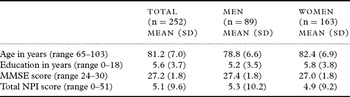
We studied 252 people living in RFs, 64.7% of whom were female (Table 1). The mean age of the sample was about 81 years. There were no differences in age, education, MMSE or total NPI score between men and women. More than two thirds (n = 173, 68.7%) of the people were classified as young-old (<85 years), and 148 (58.7%) had low MMSE performance (score 24–27). Educational level was quite low, but this is not unusual for this age cohort of people living in Italy. This is because obligatory school attendance at that time was between 3 and 5 years. Twenty-two persons (8.7%) were using an antipsychotic agent only, 32 (12.7%) an antidepressant agent only, 52 (20.6%) an anxiolytic or hypnotic agent only, while 29 (11.5%) patients were taking more than one type of psychotropic agent.
Demographic and clinical characteristics of study population

SD = Standard Deviation.
MMSE = Mini-mental State Examination.
NPI = Neuropsychiatric Inventory.
NPI results
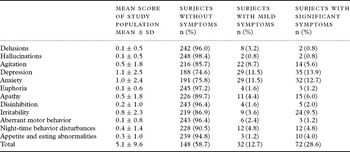
Table 2 shows the NPI composite score (severity × frequency) and the rate of residents with and without clinically relevant symptoms for each NPI item. Depression and anxiety were the more severe (highest mean score) and most common psychiatric problems; indeed, these symptoms were clinically significant in more than 1 in 10 of the institutionalized elderly people. Delusions and hallucinations were the symptoms with the lowest occurrence (less than 1%). Other symptoms had a frequency rate between 1% and 10%. The majority of participants (148 subjects; 58.7%) did not present any symptoms, whereas 41.3% had at least one NPI symptom. Among people who presented at least one NPI symptom, 69.2% had at least one clinically relevant symptom (NPI composite score ≥ 4).
NPI composite score (severity × frequency, range 0–12) and proportion of people with or without symptoms

SD = Standard Deviation.
NPI = Neuropsychiatric Inventory.
Mild symptoms: NPI composite score = 1 to 3.
Significant symptoms: NPI composite score ≥ 4.
NPI factor analysis and cluster analysis
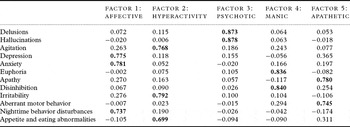
The principal component factor analysis reduced the twelve NPI symptoms to five factors, accounting for 71.7% of the total variance (Table 3). Factor 1 (Affective syndrome) included depression, anxiety, and night-time behavior disturbances, and accounted for 26.2% of the total variance. Factor 2 (Hyperactivity syndrome) reflected agitation, irritability, and appetite and eating abnormalities, explaining 13.9% of the total variance. The third factor (Psychotic syndrome) had high loads of delusions and hallucinations (12% of the total variance). Euphoria and disinhibition loaded highly on the fourth factor (Manic syndrome), accounting for 10.3% of the total variance. Factor 5 (Apathetic syndrome) included apathy and aberrant motor behavior, explaining 9.3% of the total variance.
Factor analysis of Neuropsychiatric Inventory symptoms

Each of the 12 NPI symptoms contributed positively to only one syndrome, suggesting a good five-factor solution based on eigenvalue criteria.
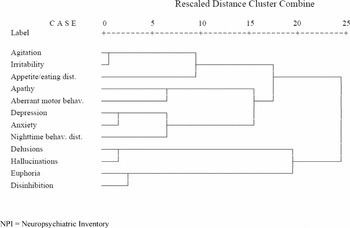
Figure 1 displays the dendrogram obtained from the cluster analysis of NPI variables. Five clusters have been identified: (a) one cluster included agitation, irritability, and appetite and eating disturbances; (b) a second cluster consisted of apathy and aberrant motor behavior; (c) depression, anxiety, and night-time behavior disturbances constituted a third cluster; (d) delusions and hallucinations were in the fourth cluster; and (e) the fifth cluster included euphoria and disinhibition. The five clusters identified using cluster analysis were similar to the five factors found using factor analysis.
Dendrogram representing cluster analysis of NPI symptom categories.

To better understand the distribution of syndromes in our sample of subjects we assumed that each factor or cluster identified by factor analysis and cluster analysis constitutes a behavioral syndrome and we categorized each patient on the basis of the presence or the absence of one or more syndromes. According to previous research (Spalletta et al., Reference Spalletta2010) a syndrome was considered to be present when the patient showed all the NPI symptoms that were constituents of that specific syndrome. In other words, a patient who received a score equal or greater to 1 in every symptom constituting a specific syndrome was classified as having that syndrome, while patients who did not show all the symptoms of at least one syndrome were considered without syndromes. On the basis of this categorization, five behavioral syndromes were found. The most common was the Affective syndrome, occurring in 11 (4.4%) patients. Six patients (2.4%) had the Apathetic syndrome; four patients (1.6%) had Hyperactivity, and four (1.6%) had Manic syndrome. The least prevalent syndrome was Psychotic, which was present in only two (0.8%) patients.
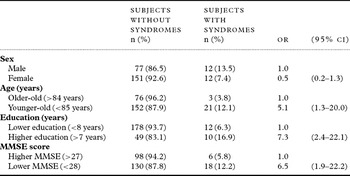
Table 4 shows the results of logistic regression analysis: the risk of having a neuropsychiatric syndrome was five times higher in people with younger age, seven times higher in people with higher education, and more than six times higher in people with lower MMSE score. Sex was not significantly associated to the presence of syndromes.
Logistic regression analysis of factors associated with the presence of neuropsychiatric syndromes

OR = odds ratio calculated with logistic regression.
CI = confidence interval;
MMSE = Mini-mental State Examination.
Psychotropic treatment
Almost half (n = 46, 48.9%) of patients without behavioral symptoms were taking psychotropic medication, and more than half of those with mild behavioral symptoms (n = 18, 56.3%) or with clinically significant symptoms (n = 38, 52.8%) were untreated. More problematically, when we considered people with syndromes, identified by the presence of symptoms belonging to the same factor or cluster, 11 (45.8%) people exhibiting at least one of the behavioral syndromes were not undergoing psychotropic treatment. On the other hand, of the people with no behavioral syndromes 81 (35.5%) were taking psychotropic agents.
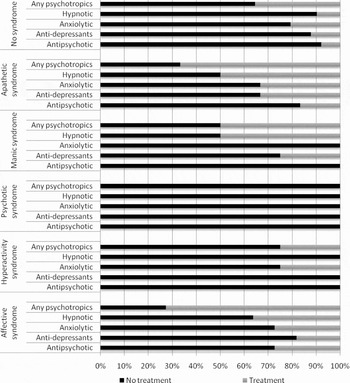
Figure 2 shows the psychotropic drug use in people with specific behavioral syndromes. No-one with the Psychotic syndrome was undergoing psychotropic treatment, but this may be due to the low frequency of this syndrome. For most of the other syndromes, the psychotropic agents more frequently used were hypnotics (Manic n = 2, 50%; Apathetic n = 3, 50%; Affective n = 4, 36.4%), and anxiolytic (Apathetic n = 2, 33.3%; Affective n = 3, 27.3%; Hyperactivity n = 1, 25%).
Proportion of people with different NPI syndromes undergoing specific psychotropic treatment.

Antidepressants were prescribed in 33.3% of people with Apathetic syndrome, 25% with Manic syndrome and 18.2% with Affective syndrome. Only some people with the Apathetic syndrome (16.7%) and Affective syndrome (27.3%) were taking an antipsychotic.
Discussion
Main findings
In this study we investigated the frequency and severity of psychiatric symptoms and related syndromes in elderly persons without dementia living in RFs. We found that depression and anxiety were the most prevalent symptoms in this cohort of people, and discovered that single symptoms cluster differently than in dementia patients. Younger age, higher education, and lower MMSE scores were the strongest determinants of the presence of neuropsychiatric syndromes. Finally, we found that a large proportion of non-demented older people with neuropsychiatric syndromes are not undergoing adequate treatment for the psychiatric disturbances.
Occurrence of neuropsychiatric symptoms in RF residents
In our sample, almost one-third of non-demented RFs residents exhibited at least one significant neuropsychiatric symptom. This frequency is slightly higher than the reported frequency of neuropsychiatric symptoms in elderly with normal cognition living in the general population, which is estimated at between 16% and 25% (Lyketsos et al., Reference Lyketsos, Steinberg, Tschanz, Norton, Steffens and Breitner2000; Geda et al., Reference Geda2008). However, the proportion is much lower than that of dementia patients living in care environments, which is reported to be as high as 70% (Zuidema et al., Reference Zuidema, Koopmans and Verhey2007).
Difference between neuropsychiatric disturbances in people with and without dementia
We identified five different neuropsychiatric syndromes, generally similar to the four or five syndrome types previously reported in patients with AD (Frisoni et al., Reference Frisoni1999; Mirakhur et al., Reference Mirakhur, Craig, Hart, McLlroy and Passmore2004; Spalletta et al., Reference Spalletta2004; Hollingworth et al., Reference Hollingworth2006; Aalten et al., Reference Aalten2008). However, although the general patterns are similar, our study highlights that non-demented people in RFs have a different specific pattern of behavioral disturbances than dementia patients. In patients with AD, apathy is often the most severe neuropsychiatric symptom (Frisoni et al., Reference Frisoni1999; Landes et al., Reference Landes, Sperry and Strauss2005), followed by anxiety and depression (Lyketsos et al., Reference Lyketsos, Lopez, Jones, Fitzpatrick, Breitner and DeKosky2002; Spalletta et al., Reference Spalletta2004); hallucination and delusions occur in about one-quarter of people with dementia in clinical settings (Ballard, Reference Ballard2007) and agitation, irritability and aberrant motor behavior are frequent symptoms in demented elderly living in nursing homes (Margallo-Lana et al., Reference Margallo-Lana2001). In our sample, depression and anxiety were the symptoms with the highest NPI composite score and occurrence. These findings support previous data from Lyketsos et al. (Reference Lyketsos, Steinberg, Tschanz, Norton, Steffens and Breitner2000) which showed depression and anxiety to be the most prevalent symptoms (7% and 5.6%, respectively) in elderly people without dementia participating in the Cache County Study.
Three notable differences in our identified syndromes should be discussed in relation to non-demented RF residents and AD patients. First, we found depression, anxiety and night-time behavior disturbances in the same cluster, while in people with AD, depression was found associated with apathy (Frisoni et al., Reference Frisoni1999; Spalletta et al., Reference Spalletta2004), with anxiety (Zuidema et al., Reference Zuidema, Koopmans and Verhey2007; Aalten et al., Reference Aalten2008) or with appetite and eating abnormalities (Aalten et al., Reference Aalten2003). Second, in our study, agitation, irritability and appetite and eating abnormalities fitted into the hyperactivity clusters, while several other studies in AD found disinhibition and aberrant motor behavior in the hyperactivity cluster (Frisoni et al., Reference Frisoni1999; Aalten et al., Reference Aalten2003; Spalletta et al., Reference Spalletta2004; Colombo et al., Reference Colombo, Vitali, Cairati, Vaccaro, Andreoni and Guaita2007). Third, only a few studies in AD concurred with our finding of apathy being in the same cluster as aberrant motor behavior (Frisoni et al., Reference Frisoni1999; Mirakhur et al., Reference Mirakhur, Craig, Hart, McLlroy and Passmore2004; Zuidema et al., Reference Zuidema, Koopmans and Verhey2007). These results highlight that depression and apathy are two distinct syndromes in elderly people without dementia. Indeed, depression is associated with symptoms that are often associated with depressive mood, such as anxiety and sleeping disturbances, while apathy is more related to aberrant motor behavior, probably because apathetic elderly are more prone to develop aimless wandering instead of remaining motionless.
Factors associated with neuropsychiatric symptoms
In our study, elderly subjects both with younger age or higher education had a higher risk of having neuropsychiatric syndromes. One explanation may be that institutionalization could provoke neuropsychiatric disturbances, especially those that are depression and anxiety related, in younger and highly educated people who might have more consciousness of their disability and reduced quality of life. Another hypothesis is that neuropsychiatric disturbances could be associated with somatic illnesses in younger old; indeed comorbidity is an important risk factor both for having NPI disturbances and institutionalization (Miller and Weissert, Reference Miller and Weissert2000). Elderly people move more frequently from their own house to RFs when a clinical illness arises or if they lose their independence. Alternatively, psychiatric factors may be a contributing reason for entering RFs.
We also found a six-fold increased risk of syndromes in subjects whose MMSE scores were less than 28, possibly due to the effect of Affective and Apathetic syndromes, the most prevalent syndromes, on the cognitive status. Previous studies have shown a high risk of neuropsychiatric disturbances in non-demented people with cognitive impairment (Palmer et al., Reference Palmer, Berger, Monastero, Winblad, Backman and Fratiglioni2007; Geda et al., Reference Geda2008; Di Iulio et al., Reference Di Iulio2010; Palmer et al., Reference Palmer2010) which may be associated with a preclinical phase of dementia.
Psychotropic drug use in RF residents
Our data highlight that many institutionalized people in RFs with significant neuropsychiatric disturbances are not undergoing treatment with psychotropic drugs. Almost half the people exhibiting at least one syndrome were not taking any psychotropic medication. However, since recent guidelines suggest psychosocial interventions as the first choice treatment for neuropsychiatric disturbances (California Workgroup on Guidelines for Alzheimer's Disease Management, 2008), it is possible that those not taking psychotropic drugs may be receiving non-pharmacological treatment for their disturbances. However, our study highlights that those who are taking drugs, are often inadequately treated. Most notably, benzodiazepines (hypnotics and anxiolytics) were the most used drugs, especially in people with Apathetic and Affective syndromes. This may suggest that, rather than treating the underlying etiology of depression, for example, physicians are instead focusing on treating specific symptoms such as insomnia and agitation, which may be an inappropriate prescription. Within RFs, people may be less likely to get a thorough psychiatric diagnosis and appropriate treatment.
Strengths and limitations
This work has some limitations. We collected data from five Italian regions which could result in bias due to variations in socio-economic and health indicators in the different regions of Italy (ISTAT, 2004). However, the five regions were well balanced and represented all three main geographic-economic areas recognized in Italy as internally coherent, that is north, central and south Italy. Also, we did not measure the predictors of individual behavioral syndromes due to reduced number of subjects showing these symptoms and the consequent reduced power in the final size of the sample. However, we were able to describe the predictors of behavioral syndromes considered as a whole that may help clinicians to predict neuropsychiatric phenomena. Further studies with very large samples (perhaps more than 1000 subjects) are needed to measure predictors of individual behavioral syndromes in elderly people without dementia.
Conversely, the present study has several important characteristics and strengths. First, to our knowledge this is the first work that analyzes neuropsychiatric syndromes in elderly people without dementia living in RFs. Secondly, we utilized both factor analysis and cluster analysis, two different and complementary tools, to study the resulting syndromes. Finally, the evidence of an identical five-factor solution in both statistical methods is of extreme importance and heiightens the consistency of the factor structure.
Clinical implications
This work has also some relevant clinical implications: indeed, it shows that depression and anxiety are still undertreated relevant neuropsychiatric disturbances in our sample of institutionalized elderly people. Moreover, they are associated with night-time behavior disturbances in the depression factor or cluster, so we might postulate that these symptoms have common underlying etiologies. These findings are of great importance because two relevant and frequent disorders in the elderly, such as anxiety and sleep disturbances, could be better treated by means of antidepressant agents instead of benzodiazepines. In fact, the use of benzodiazepines in elderly people can lead to dangerous side effects, such as confusion, impaired psychomotor performance, sedation, dependence and increased risk of falls and hip fractures (Kamel and Gammack, Reference Kamel and Gammack2006).
Conclusions
In conclusion, our results highlight the importance of a syndromic approach to neuropsychiatric symptoms in patients without dementia and living in RFs, in order to better understand the etiology of different neuropsychiatric disorders, identify the most appropriate pharmacological intervention and improve the well-being and the quality of life of elderly people living in institutions.
Conflict of interest
None.
Description of authors' roles
Luca Cravello and Gianfranco Spalletta contributed to concept and design of the study, to data analysis and data interpretation. Katie Palmer contributed to data analysis and data interpretation. Giovanni de Girolamo and Carlo Caltagirone contributed to the concept and design of the study. All authors contributed to preparing and writing the paper.
Acknowledgments
The study was supported by grant from the Italian Ministry of Health. Dr Palmer was supported by a Marie Curie Intra-European Fellowship from the European Union. The PROGRES-Older People group comprises the following: Principal Investigator: G. de Girolamo; Statistical Consultant: G. Cavrini. Participating institutions and personnel: University of Calabria: M. Zappia, R. Colao, G. Torchia; University of Sardinia: P. Putzu, Y. Arauyo, M. Malgarise; University of Sicily: P. Argentino, S. Bonomo, S. Costanzo, S. Messina; University of Perugia: S. Federici, C. Bonanni, S. Camilli, I. Cuccarini; University of Veneto: P. Scocco, F. De Biasi, M. Rapattoni, G. Fantoni, M. Galuppo; National Institute of Health: P. Morosini, I. Cascavilla; Catholic University of the Sacred Heart: A. Sgadari; Foundazione Santa Lucia: G. Spalletta, C. Caltagirone; University of Rome at Tor Vergata: A. Pasini. University of Reggio Calabria: C. Azzarito, G. Brancati.