Introduction
This paper describes the processes and results of a preliminary study of fashion-related invoices from the Edward Livingston papers at the New York Public Library. Archival invoices are a rich, yet often overlooked source of cultural data. This study demonstrates that in addition to pecuniary information, invoices for clothing and accessories from the Gilded Age reveal complex relationships between modernity, fashion, and group identity. To analyze these relationships, text within the invoices was interpreted through the lens of Georg Simmel's theories on fashion, while the metadata was transformed and visualized through digital humanities applications.
The Livingstons
Family History
‘Before the Kennedys, before the Roosevelts, before the Vanderbilts, there were the Livingstons,’ wrote David Chen in a 1998 New York Times article about the history of the Livingston family.Footnote 1 The family's roots on the American continent date to 1673 with the arrival of Robert Livingston (1654–1728) in Boston. By 1686, the Scottish businessman had accrued 160,000 acres of land in New York's Hudson River Valley.Footnote 2 During the nineteenth century, the Livingston family's land holdings swelled to a million acres, and in conjunction with the family's growing wealth, the Livingston sons had become mainstays of American politics.Footnote 3 Robert R. Livingston (1746–1813), for example, was appointed minister to France and negotiated the Louisiana Purchase.Footnote 4 Robert's brother, Edward (1764–1836), served as a secretary of state and his cousin, William Livingston (1723–1790), was governor of New Jersey during the Revolutionary War.Footnote 5 The women of the Livingston family travelled in similarly elite circles; they married members of blue-blooded New York families, including the Van Rensselaers, Beekmans, Delanos and Schuylers.Footnote 6
The Edward Livingston Papers
The collection of Livingston materials at the New York Public Library (NYPL) documents the lives of Edward Livingston (1834–1906) and his children, Clarisse Hazeltine (1869–1955) and Edward Jr. (1871-?).Footnote 7 Edward, a businessman, was not a political dignitary like his forbearers, but rather a fixture of high society during New York's Gilded Age.Footnote 8 Edward and his children were frequent guests at society balls, including the Astor's, and charitable patrons of the arts.Footnote 9 The society pages of The New York Times described Clarisse's 1887 cotillion at Delmonico's, a haunt for dignitaries and members of high society, as ‘an unusually brilliant affair,’ with some 600 guests.Footnote 10 Clarisse's dress was hailed as ‘the simplest pure white, tier gown being of white silk and draped with tulle.’ Elliott and Anna Roosevelt, the parents of Eleanor Roosevelt and relatives of the Livingstons, were honoured guests at the affair.Footnote 11
Although a relatively small archival collection (5.66 linear feet), the Edward Livingston papers contain hundreds of invoices for household expenses, e.g. books, silverware, club memberships, and articles of clothing.Footnote 12 I selected twenty-five invoices related to clothing or accessories to study in depth. The selections were made to incorporate a variety of clothing items from both small and large proprietors, including bespoke dress shops and renowned department stores. I also favoured easily legible invoices with detailed descriptions of purchases. Edward and his children made most of the purchases, though some invoices were issued to other Livingston family members.
Georg Simmel and the ‘Joint Spirit’
This paper utilizes the theories of Georg Simmel (1858–1918), a German philosopher and cultural theorist, to assess the text and design within the Livingston invoices.Footnote 13 Simmel, who examined modernity as it evolved, wrote extensively about group dynamics, urban culture, and the role of fashion and adornment in society at the turn of the century.Footnote 14 According to Simmel, the cycles of fashion begin with imitation, a means of forming group cohesion and a unified social status.Footnote 15 Fashion serves as a vehicle for this imitation and thereby ‘elevates even the unimportant individual by making them the representative of a totality, the embodiment of a joint spirit.’Footnote 16 This ‘joint spirit,’ however, is divided along class lines. ‘Fashions are always class fashions,’ writes Simmel; moneyed classes use fashion to separate themselves from the remainder of society. In an effort to maintain their separateness, the wealthy institute a perpetual cycle of stylistic evolutions. Simmel describes the pattern:
Just as soon as the lower strata begin to appropriate their style - and thereby overstep the demarcation line which the upper strata have drawn and destroy the uniformity of their coherence symbolized in this fashion - so the upper strata turn away from this fashion and adopt a new one, which in its turn differentiates them from the broad masses.Footnote 17
The cycles of fashion therefore serve to both affirm the group's identity, and at the same time, prevent entry to those of a differing social status.Footnote 18 In addition to the ‘joint spirit,’ individuals within the group use fashion to distinguish themselves from their peers. Simmel writes that individuals follow fashion trends to ‘stand out’ from the group, but also avoid a ‘clash’ with commonly accepted styles. Simmel connects the individual's desire to ‘stand out’ with the growth of the money economy and modernity.Footnote 19 He contrasts the pre-modern economy, in which transactions were local and personal, to modern money exchange, characterized by impersonality and division of labour.Footnote 20 Simmel posits that money and the ‘unrelenting character of modern life’ accelerate imitation and appropriations of style.Footnote 21 As a result, the cycles of fashion and the affirmations of group identity revolve at a rapid, continual pace.
Metadata and Mapping Processes
As part of my examination of the Livingston papers, I employed digital humanities applications to visualize the cultural data embedded within the invoices. The following section details my processes for selecting and implementing the applications.
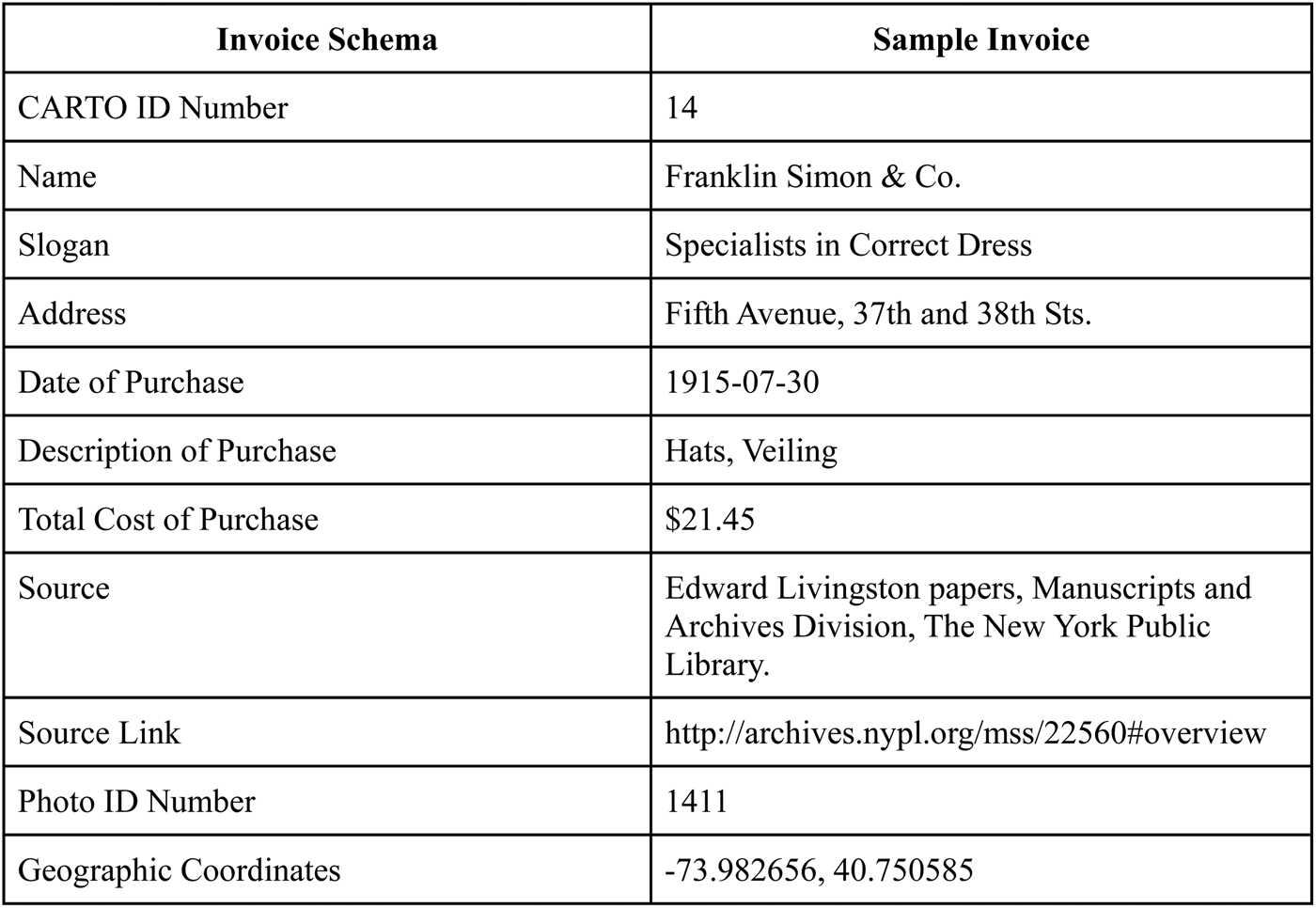
The foundation of my work, as is common with digital projects, was built upon metadata. I created a simple metadata schema to express and organize the descriptive information within the invoices (Fig. 1).
Livingston invoice metadata schema.

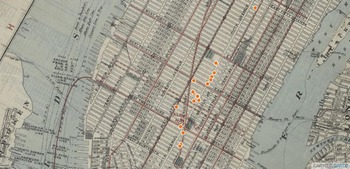
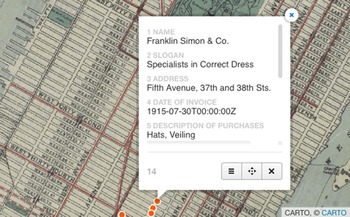
The transcription of metadata was relatively straightforward, with the exception of geographic metadata, which was highly variable. For example, some addresses included building numbers (François Modes, 296 Fifth Avenue), while others were characterized by a block or general vicinity (Arnold, Constable & Co., Broadway cor. of Nineteenth Street). I used Google Maps to determine approximate geographic coordinates for all of the establishments. I selected CARTO, a GIS application with a simple GUI interface, to transform the metadata into a searchable map. Additionally, I used NYPL's Map Warper to export a 1901 street map of New York City produced by the Albemarle Hotel, which was located on Madison Square (Broadway and Fifth Avenue at 24th Street).Footnote 22 The map provides a glimpse of New York City, its landmarks and street grid, as it appeared to tourists and shoppers at the turn of the century. I imported the Albermarle map into CARTO to serve as the base-map for the visualization (Fig. 2 and Fig. 3).
CARTO map of Livingston invoices.Footnote 23

CARTO map of Livingston invoices with metadata.Footnote 24

Examining Modernity
This preliminary study of invoice metadata illuminates complex relationships between fashion and modernity. These relationships include the role of retailers in defining aesthetic standards of group identity; the function of female entrepreneurs as conduits of European style; and the emergence of zoning laws as a response to the expansion of New York's readymade garment industry. The analysis below, which is limited to the discreet sample, could serve as the foundation of a more comprehensive study of fashion-related invoices from multiple archival collections.
Fashion Merchandising
Fashion and fashion merchandising, according to William Leach in Land of Desire, was situated at the heart of America's emergent consumer culture at the turn of the century.Footnote 25 Leach wrote:
Unique to Western Business practices, fashion merchandising was a theatrical strategy par excellence that embodied the quest for the new. Like window display and the toy store, it democratized desire; it carried exciting meanings and introduced the mass of consumers to everything from the aristocratic glamour of Paris to the exotic allure of orientalism…It's effect was often to stir up restlessness and anxiety, especially in a society where class lines were blurred or denied, where men and women fought for the same status and wealth and where people feared being left out or scorned because they could not keep up with others and could not afford the same things other people had.Footnote 26
This ‘theatrical strategy’ of modernity is evident in the both the design and text found throughout the Livingston invoices. Many of the invoices, from both men's and women's retailers, display intricate coats of arms.Footnote 27 A 1904 invoice from Knox Hatter includes a heraldic design with four bald eagles, two of which wear circlet style crowns around their necks. Below the Knox coat of arms, reads the phrase, ‘Moveo et Proficio’ or ‘I move and progress.’ The slogan epitomizes the desire to ‘stand out,’ but refrain from ‘clashing’ with one's peers.Footnote 28 In a similar nod to the regality, a 1905 invoice from Eugene Ferris & Son, ‘Manufacturers of Gentlemen's Fine Shoes,’ describes a purchase of shoes as ‘Footed Napoleon Boots.’ The description implies that the boots, and thus the wearer, embody current Parisian trends, while maintaining a connection to aristocratic European roots.Footnote 29 Additionally, the slogan for Franklin Simon & Co., ‘Specialists in Correct Dress,’ presupposes that individuals not only need to abide by the dictates of ‘correct dress,’ but they also require an expert to help navigate the process of imitation. Fashion merchandising may have ‘democratized desire’ for the masses, but it also expressed the demands of class fashions. Wealthy consumers, like the Livingstons, frequented retailers who affirmed their connections to an elite group identity.Footnote 30
Women as Proprietors
A tally of the Livingston invoices demonstrates that the most expensive purchases were made at small, specialty boutiques, rather than large department stores. Some of these boutiques were owned and operated by women proprietors, such as Mrs. A.M. Dunstan, a designer and dressmaker, who sold the Livingstons a green velvet coat with matching bodice for $370.00. Another shop frequented by the Livingstons was owned by Margaret Mulhall, who travelled to Paris and London in search of design trends to imitate for customers New York.Footnote 31 Dunstan and Mulhall were not anomalies; American female buyers who spotted trends in Europe were known as the ‘queens of retailing’ in fashion industry press.Footnote 32 By 1915, almost one-third of all retail buyers in the United States were women.Footnote 33 These women served as conduits of trends; they propelled the cycles of fashion and thus abetted the demarcations of group identity. A larger study with additional samples of retail invoices is necessary to provide a more comprehensive survey of women buyers and proprietors during the Gilded Age.
Fifth Avenue Aesthetics
In his 1905 study, The Clothing Industry in New York, Jesse Pope described the growing significance of New York as a style capital:
New York City is becoming more and more the centre of fashion, and what is there considered to be proper is becoming more and more the standard for the rest of the country. What London is to England, New York City is to the United States. It is not only the port of entry for a large part of our immigrants, but it is also the port of entry for returning tourists, who bring with them the new ideas and latest styles of Europe. The manufacturer of ready-made clothing is ever alive to his opportunity and adopts these new styles quite as quickly as does the Fifth Avenue custom tailor.Footnote 34
At the turn of the century, New York, and specifically Fifth Avenue, produced fashions and stylistic ‘standards’ that were imitated on a national level. More locally, Fifth Avenue was the frontline in a battle over how New York was to adapt to the social and spatial demands of modernity.Footnote 35
The sum of the geographic data on the Livingston invoices provides an illustration of the fashion industry's physical expansion in New York from 1891–1917. The initial growth began in the 1850s, when development of residential and commercial buildings crept northward from their original encampments at the southern cap of the island.Footnote 36 The Sixth Avenue Elevated Railway (the El) opened in 1878 and dispersed consumers, labourers and tourists throughout the city.Footnote 37 Concurrently, large department stores accumulated in a popular shopping area known as the Ladies’ Mile, which stretched from approximately 15th Street to 24rd Street and across Broadway to Sixth Avenue. Producers of readymade garments followed this northward trend and in the 1890s, loft buildings were erected along Fifth Avenue to shelter manufacturers leaving the Lower East Side. The lofts were intermingled with new department stores and older rowhouses, many of which had been retrofitted to accommodate the evolving garment industry.Footnote 38 In 1910, Pennsylvania Station, a massive transit hub, opened on 34th Street, prompting both high-end retailers and manufacturers to continue the cycle of relocations farther north.Footnote 39
Throughout this expansion, Fifth Avenue was considered prime residential and commercial real estate.Footnote 40 The retailers of Fifth Avenue, as is evident on the Livingston map (Fig. 2 and Fig. 3), included both famed department stores (B. Altman, Bonwit Teller) and smaller specialty boutiques (Louise & Co., Mme. Tierce). The common denominator among the retailers was the elite customer, such as the Livingstons. Many residents and retailers on Fifth Avenue deemed the encroachment of manufacturers and their labourers as a threat to group identity. In response to this threat, property and business owners formed the Fifth Avenue Association (FAA) in an attempt to halt the continual growth of the garment industry.Footnote 41 The FAA described their mission as follows:
The commercial expansion which opened this century started briskly, with something of a tumult. There was not sufficient awareness for the future. After the first uncertainty as to whether Fifth Avenue could be a business street at all, it became an almost fervid intention of shopkeepers, wholesalers, and manufacturers to move into it. Fifth Avenue was a sudden industrial fetish. New buildings were hastily thrown up. There was a great increase in traffic. There was confusion. To direct this trade expansion and to prevent permanent injury to the section, the Fifth Avenue Association was organized in 1907. Then, its main purpose was to oppose the wrong kind of commercialism and to safeguard the standards which are the heritage of Fifth Avenue.Footnote 42
Modernity had brought the sudden and ‘wrong kind of commercialism’ to Fifth Avenue, which threatened the ‘joint spirit’ of the area's property and business owners. The members of the FAA sought to preserve their group identity by preventing the ‘wrong’ aesthetics (manufacturing lofts) and persons (immigrant workforce) from appropriating the space and stylistic connotations of Fifth Avenue.
The FAA, in concert with the Save New York Committee and other advocacy organizations, lobbied government officials to create discrete zones for manufacturing.Footnote 43 In 1916, the City passed zoning ordinances, which mandated constraints on the height and locations of new buildings.Footnote 44 As a result of the law, new constructions of manufacturing lofts were forbidden on Fifth Avenue north of 23rd Street. By securing aesthetic mandates, the FAA had temporarily succeeded in demarcating and conserving their group identity.
Conclusion
As is evident in this preliminary study, invoices for clothing and accessories can be interpreted and visualized to reveal complex relationships between fashion, modernity, and group identity. The metadata within the invoices extends far beyond the implicit financial data to include information about geography and gender. Although the Livingston papers were a satisfactory test case, the next phase of study would benefit from a significantly larger sample of fashion-related invoices from multiple archival collections. Other additions to the study could include supplementary information about the individual family members who purchased each item; a timeline to demonstrate the evolution of fashion cycles; and further examination of the roles of women proprietors at the turn of the century.
Special thanks to Thomas Lannon and Eugenia Paulicelli.