1 Introduction
Plane Couette flow under spanwise system rotation, referred to as RPCF (rotating plane Couette flow) in the following, is somewhat challenging to realise in experiment, yet is a good test case to study the effect of spanwise system rotation on shear flows because of its geometrical simplicity: plane Couette flow is conceptually the simplest wall shear flow, and the mean flow vorticity is parallel to the spanwise direction and does not change sign across the flow field, unlike pressure-driven channel flow. Depending on the direction of the system rotation, two cases are possible; the case where the system rotation is in the same direction as the mean flow vorticity is called the ‘cyclonic’ rotation case, while the other case is called the ‘anticyclonic’ rotation case, and it is well known that the Coriolis force effect is remarkably different between these two cases; it stabilises/destabilises the flow in the cyclonic/anticyclonic case. Bradshaw (Reference Bradshaw1969) pointed out that there is a similarity between flows undergoing spanwise rotation and stratified flows, and the stability can be expressed in the form of a local Richardson number, whereas Kloosterziel, Orlandi & Carnevale (Reference Kloosterziel, Orlandi and Carnevale2007) discussed the stability of several different rotating shear flows using numerical simulations.
Theoretically, Lezius & Johnston (Reference Lezius and Johnston1976) showed that the stability equation for RPCF is identical to that for Bernard convection (which has a critical Rayleigh number of 1708). Similarly to Bernard convection RPCF can in the anticyclonic rotation case (
 ${\it\Omega}>0$
) be unstable to spanwise-periodic disturbance, and the neutral stability curve is given as
 $$\begin{eqnarray}Re_{crit}={\it\Omega}+\frac{107}{{\it\Omega}},\end{eqnarray}$$
where
 $Re=U_{w}h/{\it\nu}$
is the Reynolds number (
 $U_{w}$
,
 $h$
and
 ${\it\nu}$
are the wall speed, channel half-width and kinematic viscosity respectively, see figure 1) and
 ${\it\Omega}$
is the rotation number, defined as
 ${\it\Omega}=2{\it\Omega}_{z}h^{2}/{\it\nu}$
, with
 ${\it\Omega}_{z}$
being the system rotation rate. The number 107 derives from the Bernard stability problem and is
 $1708/16=106.75\approx 107$
. The lowest critical Reynolds number is
 $2\sqrt{107}=20.7$
for
 ${\it\Omega}=10.3$
, and (1.1) shows that at a given
 $Re$
(
 ${>}20.7$
) the RPCF is unstable when the system rotation rate is in a certain range; for instance, at
 $Re=100$
the flow is unstable in the rotation number range
 $1.08<{\it\Omega}<98.9$
. Hence for a given Reynolds number the flow becomes stable at high rotation rates.
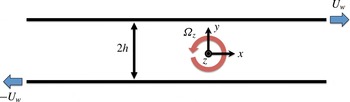
Plane Couette flow under spanwise system rotation.

The theoretical results of Lezius & Johnston (Reference Lezius and Johnston1976) predict that a roll-cell structure, regularly spaced in the spanwise direction and straight in the streamwise direction, arises. These two-dimensional and streamwise-independent roll cells were observed through flow visualisation by Tillmark & Alfredsson (Reference Tillmark, Alfredsson, Gavrilakis, Machiels and Monkewitz1996), Alfredsson & Tillmark (Reference Alfredsson, Tillmark, Mullin and Kerswell2005), Hiwatashi et al. (Reference Hiwatashi, Alfredsson, Tillmark and Nagata2007) and Tsukahara, Tillmark & Alfredsson (Reference Tsukahara, Tillmark and Alfredsson2010), and planar particle image velocimetry (PIV) by Suryadi, Tillmark & Alfredsson (Reference Suryadi, Tillmark and Alfredsson2013) and Suryadi, Segalini & Alfredsson (Reference Suryadi, Segalini and Alfredsson2014). Among them, Tsukahara et al. (Reference Tsukahara, Tillmark and Alfredsson2010) identified 17 different flow states in a wide range of parameters, including both cyclonic and anticyclonic rotations (
 $-30\leqslant {\it\Omega}\leqslant 30$
), and mapped them in the
 $Re$
–
 ${\it\Omega}$
parameter space following Andereck, Liu & Swinney (Reference Andereck, Liu and Swinney1986). Suryadi et al. (Reference Suryadi, Segalini and Alfredsson2014) conducted flow visualisations and quantitative velocity measurement by planar PIV at
 $Re=100$
up to
 ${\it\Omega}=100$
. These experiments showed that as the rotation number increases the two-dimensional and streamwise-independent roll cells bifurcate to three-dimensional roll cells, such as ‘wavy’ roll cells and ‘twisted’ roll cells. Some tertiary states corresponding to these experimentally observed structures have also been found numerically (Nagata Reference Nagata1998; Daly et al.
Reference Daly, Schneider, Schlatter and Peake2014).
Another interesting characteristic of shear flows for anticyclonic system rotation is the behaviour of the mean absolute vorticity, defined as the sum of the vorticity of the mean flow and twice the system rotation. The coherent roll-cell structure induces additional momentum transport by its secondary motion and remarkably changes the mean flow profile, which may result in a state where the absolute vorticity is zero in the central parts of the channel when the system rotation rate is sufficiently high. This ‘zero-absolute-vorticity’ state has been observed in numerical simulations of turbulent plane Poiseuille flow (e.g. Kristoffersen & Andersson Reference Kristoffersen and Andersson1993; Tanaka et al.
Reference Tanaka, Kida, Yanase and Kawahara2000; Xia, Shi & Chen Reference Xia, Shi and Chen2016) as well as in RPCF with anticyclonic system rotation (Bech & Andersson Reference Bech and Andersson1997). The recent PIV measurements by Suryadi et al. (Reference Suryadi, Segalini and Alfredsson2014) on laminar RPCF at
 $Re=100$
showed that the zero-absolute-vorticity state also can appear in this regime, which suggests that the zero absolute vorticity is not caused by the turbulence per se, but may also be due to the secondary flow induced by the roll-cell structures that arise from the Coriolis-force-induced instability.
In the present study we focus on the momentum transport across the channel driven by the roll-cell structure of the laminar RPCF at
 $Re=100$
and investigate the mechanism of how the state of zero absolute vorticity is maintained. We expand the experimental set-up employed by Suryadi et al. (Reference Suryadi, Segalini and Alfredsson2014) to stereoscopic PIV measurements in order to obtain all three velocity components, including the wall-normal component. The Reynolds shear stress and the wall shear stress are evaluated based on the PIV measurements as a measure of the additional momentum transport by the roll cells, and their variation with the system rotation rate is investigated. The mechanism of the zero absolute vorticity is discussed, with a focus on the Reynolds stress production as well as the displaced-particle argument.
2 Governing equations
2.1 Momentum transport equations
We consider flow between two infinite parallel flat plates moving at constant speeds
 $\pm U_{w}$
in the opposite directions under system rotation, as schematically shown in figure 1. The origin of the coordinate system is defined at the centre between the plates, and the
 $x$
-,
 $y$
- and
 $z$
-axes are taken in the streamwise, wall-normal and spanwise directions. We also define
 $\boldsymbol{e}_{1}$
,
 $\boldsymbol{e}_{2}$
and
 $\boldsymbol{e}_{3}$
as the unit vectors pointing in the
 $x$
-,
 $y$
- and
 $z$
-directions. The system rotation vector
 ${\it\bf\Omega}$
considered in this study is constant in time and parallel to the
 $z$
-axis, and is written as
 ${\it\bf\Omega}={\it\Omega}_{z}\boldsymbol{e}_{3}$
, with
 ${\it\Omega}_{z}$
being the constant system rotation rate. Letting
 $\tilde{\boldsymbol{u}}=\tilde{u} \boldsymbol{e}_{1}+\tilde{v}\boldsymbol{e}_{2}+\tilde{w}\boldsymbol{e}_{3}$
be the velocity vector, one can write the continuity and the momentum conservation equations observed in the rotating frame as
 $$\begin{eqnarray}\displaystyle & \displaystyle \boldsymbol{{\rm\nabla}}\boldsymbol{\cdot }\tilde{\boldsymbol{u}}=0, & \displaystyle\end{eqnarray}$$
 $$\begin{eqnarray}\displaystyle & \displaystyle {\it\rho}\left[\frac{\partial \tilde{\boldsymbol{u}}}{\partial t}+\left(\tilde{\boldsymbol{u}}\boldsymbol{\cdot }\boldsymbol{{\rm\nabla}}\right)\tilde{\boldsymbol{u}}\right]=-\boldsymbol{{\rm\nabla}}\tilde{p}+{\it\mu}{\rm\nabla}^{2}\tilde{\boldsymbol{u}}-2{\it\rho}{\it\Omega}_{z}\boldsymbol{e}_{3}\times \tilde{\boldsymbol{u}}, & \displaystyle\end{eqnarray}$$
where
 $\tilde{p}$
is the pressure including both the static pressure and the centrifugal acceleration, and
 ${\it\rho}$
and
 ${\it\mu}$
are the density and the dynamic viscosity of the fluid respectively, both of which are here assumed to be constant. In the undisturbed laminar flow case, as the flow can be assumed unidirectional (
 $\tilde{v}=\tilde{w}=0$
and
 $\tilde{u}$
depends only on
 $y$
), one obtains a linear velocity profile:
 $$\begin{eqnarray}\tilde{u} (y)=\frac{y}{h}U_{w}.\end{eqnarray}$$
The non-dimensional parameters that characterise the flow under consideration are the Reynolds number and the rotation number, here defined as
 $Re=U_{w}h/{\it\nu}$
and
 ${\it\Omega}=2{\it\Omega}_{z}h^{2}/{\it\nu}$
respectively. In some earlier studies a rotation number defined as
 $Ro=2{\it\Omega}_{z}h/U_{w}$
has been used. The relation between these differently defined rotation numbers is
 ${\it\Omega}=Ro\,Re$
, and their physical meaning can be interpreted as
 $$\begin{eqnarray}\displaystyle & \displaystyle {\it\Omega}=\frac{\text{Coriolis force}}{\text{Viscous force}}, & \displaystyle\end{eqnarray}$$
 $$\begin{eqnarray}\displaystyle & \displaystyle Ro=\frac{\text{Coriolis force}}{\text{Inertia force}} & \displaystyle\end{eqnarray}$$
respectively. In the present study we use
 ${\it\Omega}$
following the earlier experimental studies by Tsukahara et al. (Reference Tsukahara, Tillmark and Alfredsson2010) and Suryadi et al. (Reference Suryadi, Segalini and Alfredsson2014).
We consider the moving walls to be infinite in the streamwise and spanwise directions, therefore the mean flow field can be considered to be statistically homogeneous in the
 $x$
- and
 $z$
-directions. We define the averaging operation, denoted by
 $\langle \cdot \rangle$
, as taking the average in these directions and in time. We consider a decomposition by which each instantaneous quantity is separated into the averaged value and the deviation:
 $$\begin{eqnarray}\displaystyle & \displaystyle \tilde{\boldsymbol{u}}=\boldsymbol{U}+\boldsymbol{u}, & \displaystyle\end{eqnarray}$$
 $$\begin{eqnarray}\displaystyle & \displaystyle \tilde{p}=P+p, & \displaystyle\end{eqnarray}$$
where
 $\boldsymbol{U}=U\boldsymbol{e}_{1}+V\boldsymbol{e}_{2}+W\boldsymbol{e}_{3}$
and
 $P$
are the averaged velocity vector and pressure respectively, and
 $\boldsymbol{u}=u\boldsymbol{e}_{1}+v\boldsymbol{e}_{2}+w\boldsymbol{e}_{3}$
and
 $p$
are the deviations of
 $\tilde{\boldsymbol{u}}$
and
 $\tilde{p}$
from their averaged values.
Applying the averaging operation to the
 $x$
-component of (2.2) one can obtain the mean streamwise momentum equation:
 $$\begin{eqnarray}0=\frac{\text{d}}{\text{d}y}\left({\it\mu}\frac{\text{d}U}{\text{d}y}-{\it\rho}\langle uv\rangle \right),\end{eqnarray}$$
where
 $-{\it\rho}\langle uv\rangle$
is the Reynolds shear stress, which represents the effect of the momentum transport by the velocity variation to the mean flow. Equation (2.8) is in the exactly same form as in the case of plane Couette flow without system rotation, as the streamwise Coriolis force
 $2{\it\Omega}_{z}\tilde{v}$
disappears by the averaging operation since
 $V=0$
. Equation (2.8) shows that the total shear stress, i.e. the sum of the viscous and the Reynolds shear stresses, is constant across the channel. By integrating (2.8) from either wall to an arbitrary
 $y$
-position, one obtains
 $$\begin{eqnarray}{\it\mu}\frac{\text{d}U}{\text{d}y}-{\it\rho}\langle uv\rangle ={\it\tau}_{w},\end{eqnarray}$$
where
 ${\it\tau}_{w}$
is the wall shear stress. Using the wall velocity
 $U_{w}$
and the channel half-width
 $h$
as the reference scales, one obtains a non-dimensional form of (2.9):
 $$\begin{eqnarray}\frac{1}{Re}\frac{\text{d}(U/U_{w})}{\text{d}(y/h)}-\frac{\langle uv\rangle }{U_{w}^{2}}=\frac{{\it\tau}_{w}}{{\it\rho}U_{w}^{2}}=\left(\frac{u_{{\it\tau}}}{U_{w}}\right)^{2},\end{eqnarray}$$
where
 $u_{{\it\tau}}$
is the friction velocity, defined as
 $u_{{\it\tau}}=\sqrt{{\it\tau}_{w}/{\it\rho}}$
. Equations (2.9) and (2.10) show that
 ${\it\tau}_{w}$
can be determined from the profiles of
 $U$
and
 $\langle uv\rangle$
near the channel centre, the measurement of which is obviously easier in practice than a direct measurement of the wall shear stress. It should be noted that one can easily obtain the theoretical value of the wall shear stress in the case of the laminar linear velocity profile:
 $$\begin{eqnarray}\frac{{\it\tau}_{w}}{{\it\rho}U_{w}^{2}}=\frac{1}{Re},\end{eqnarray}$$
by substituting (2.3) into (2.10) and assuming
 $-\langle uv\rangle =0$
.
2.2 Absolute vorticity and inviscid instability of the RPCF
In the RPCF the mean flow vorticity has a non-zero component only in the
 $z$
-direction, and one can define the absolute vorticity as
 $$\begin{eqnarray}{\it\Omega}_{a}=-\frac{\text{d}U}{\text{d}y}+2{\it\Omega}_{z}.\end{eqnarray}$$
The RPCF has an inviscid instability when the absolute vorticity is in the opposite sign of the background vorticity, i.e.
 $2{\it\Omega}_{z}{\it\Omega}_{a}<0$
. For the basic linear velocity profile of the RPCF this inviscid instability criterion is written in non-dimensional form as
 $$\begin{eqnarray}\frac{2{\it\Omega}_{z}{\it\Omega}_{a}}{(U_{w}/h)^{2}}=\frac{{\it\Omega}}{Re}\left(-1+\frac{{\it\Omega}}{Re}\right)<0,\end{eqnarray}$$
which results in
 $0<{\it\Omega}/Re<1$
. Therefore, by increasing
 ${\it\Omega}$
at a fixed
 $Re$
one transitions from unstable conditions (
 ${\it\Omega}<Re$
) to the state of zero absolute vorticity (
 ${\it\Omega}=Re$
) and then to stable conditions (
 ${\it\Omega}>Re$
). At low rotation rates there are, of course, also viscous effects that stabilise the flow, which is apparent from (1.1).
2.3 Reynolds stress transport
Based on (2.2) one can obtain the transport equation of the Reynolds stresses (per unit mass)
 $\langle u_{i}u_{j}\rangle$
(the procedure to be applied to (2.2) for the derivation is outlined in detail in, for example, Wilcox (Reference Wilcox1993, pp. 17–18)):
 $$\begin{eqnarray}\left(\frac{\partial }{\partial t}+U_{k}\frac{\partial }{\partial x_{k}}\right)\langle u_{i}u_{j}\rangle =\unicode[STIX]{x1D617}_{ij}+{\it\Pi}_{ij}-{\it\varepsilon}_{ij}+\unicode[STIX]{x1D60B}_{ij},\end{eqnarray}$$
where the four terms on the right-hand side are the production (
 $\unicode[STIX]{x1D617}_{ij}$
), pressure-strain redistribution (
 ${\it\Pi}_{ij}$
), viscous dissipation (
 ${\it\varepsilon}_{ij}$
) and diffusion (
 $\unicode[STIX]{x1D60B}_{ij}$
) of
 $\langle u_{i}u_{j}\rangle$
. The most interesting term in (2.14) is the production term
 $\unicode[STIX]{x1D617}_{ij}$
, which represents the production of velocity deviations from the averaged flow and is written as
 $$\begin{eqnarray}\unicode[STIX]{x1D617}_{ij}=-\langle u_{i}u_{k}\rangle \frac{\partial U_{j}}{\partial x_{k}}-\langle u_{j}u_{k}\rangle \frac{\partial U_{i}}{\partial x_{k}}-2{\it\Omega}_{k}\left({\it\epsilon}_{ikm}\langle u_{j}u_{m}\rangle +{\it\epsilon}_{jkm}\langle u_{i}u_{m}\rangle \right),\end{eqnarray}$$
where
 ${\it\epsilon}_{lmn}$
is the permutation tensor. The first two terms of (2.15) represent the Reynolds stress production by the mean velocity gradient, and the other system-rotation-related terms represent the Coriolis-force effect. As the Coriolis force does not perform work, the physical interpretation of this term is energy transfer between different Reynolds stress components (Tsukahara et al.
Reference Tsukahara, Tillmark and Alfredsson2010).
In the flow field under consideration in the present study, the Reynolds shear stress components
 $\langle uw\rangle$
and
 $\langle vw\rangle$
are considered to be zero due to symmetry, and the transport equations of the other non-zero components can be considerably simplified to become
 $$\begin{eqnarray}\displaystyle \langle u^{2}\rangle :\quad 0\hspace{-2.5pt} & = & \displaystyle \hspace{-2.5pt}-2\langle uv\rangle \left(\frac{\text{d}U}{\text{d}y}-2{\it\Omega}_{z}\right)+{\it\Pi}_{11}-{\it\varepsilon}_{11}+\unicode[STIX]{x1D60B}_{11},\end{eqnarray}$$
 $$\begin{eqnarray}\displaystyle \langle v^{2}\rangle :\quad 0\hspace{-2.5pt} & = & \displaystyle \hspace{-2.5pt}-4\langle uv\rangle {\it\Omega}_{z}+{\it\Pi}_{22}-{\it\varepsilon}_{22}+\unicode[STIX]{x1D60B}_{22},\end{eqnarray}$$
 $$\begin{eqnarray}\displaystyle \langle w^{2}\rangle :\quad 0\hspace{-2.5pt} & = & \displaystyle \hspace{-2.5pt}{\it\Pi}_{33}-{\it\varepsilon}_{33}+\unicode[STIX]{x1D60B}_{33},\end{eqnarray}$$
 $$\begin{eqnarray}\displaystyle -\langle uv\rangle :\quad 0\hspace{-2.5pt} & = & \displaystyle \hspace{-2.5pt}2\langle u^{2}\rangle {\it\Omega}_{z}+\langle v^{2}\rangle \left(\frac{\text{d}U}{\text{d}y}-2{\it\Omega}_{z}\right)+{\it\Pi}_{12}-{\it\varepsilon}_{12}+\unicode[STIX]{x1D60B}_{12}.\end{eqnarray}$$
As shown, the Reynolds stresses
 $\langle u^{2}\rangle$
,
 $\langle v^{2}\rangle$
and
 $-\langle uv\rangle$
have their production terms associated with the mean velocity gradient and/or the system rotation, while there is no production of
 $\langle w^{2}\rangle$
. It should be noted that the
 ${\it\Omega}_{z}$
-related terms in the production of
 $\langle u^{2}\rangle$
and
 $\langle v^{2}\rangle$
are in the exactly same form except the sign, which means that they represent energy transfer between
 $\langle u^{2}\rangle$
and
 $\langle v^{2}\rangle$
. Furthermore, the absolute vorticity
 ${\it\Omega}_{a}=-\text{d}U/\text{d}y+2{\it\Omega}_{z}$
appears in the production terms in (2.16) and (2.19). Hence, under the state of zero absolute vorticity, the production of
 $\langle u^{2}\rangle$
is zero, which means that the energy from the mean flow to
 $\langle u^{2}\rangle$
is completely transferred to
 $\langle v^{2}\rangle$
, and the contribution of
 $\langle v^{2}\rangle$
to the production of
 $-\langle uv\rangle$
also vanishes. In § 5, a detailed discussion on the flow structure and the mechanism of the zero-absolute-vorticity state will be given based on the Reynolds stress production terms.
3 Experimental set-up and procedure
3.1 Flow apparatus and measurement conditions
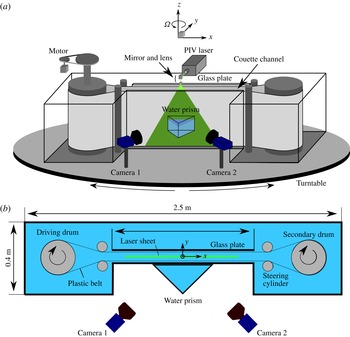
The experimental flow apparatus has been described in detail elsewhere, see for instance Suryadi et al. (Reference Suryadi, Tillmark and Alfredsson2013). In short it is an apparatus in which a plane Couette flow facility designed by Tillmark & Alfredsson (Reference Tillmark, Alfredsson, Johansson and Alfredsson1991, Reference Tillmark and Alfredsson1992) is mounted on a turntable with a PIV system, as schematically shown in figure 2(a), and thus can be rotated around its spanwise axis with an angular velocity of up to
 $0.58~\text{rad}~\text{s}^{-1}$
. The countermoving wall of the Couette channel is a thin and endless plastic belt of 0.05 mm thickness and 30 cm width that is driven by two large cylinders located at both ends of the water tank. Both the wall of the water tank and the plastic belt are made of transparent material (glass and polyester respectively), so that optical access to the test section is possible. (The same design idea for the plane Couette flow apparatus has been used by Daviaud, Hegseth & Bergé (Reference Daviaud, Hegseth and Bergé1992), Malerud, LØY & Goldburg (Reference Malerud, LØY and Goldburg1995), Zettner & Yoda (Reference Zettner and Yoda2001), Hagiwara et al. (Reference Hagiwara, Sakamoto, Tanaka and Yoshimura2002) and most recently Couliou & Monchaux (Reference Couliou and Monchaux2015); however, RPCF has not been studied in any of these.)
Experimental apparatus for rotating plane Couette flow: (a) isometric view of the apparatus; (b) top view of the test section and camera arrangement.

The water tank is filled with water, leaving a few centimetres of the top end of the plastic belt above the free surface, and the motion of the plastic belt in the test section is guided by the vertical glass walls (the glass wall of the water tank and an additional glass plate installed inside the tank, see figure 2
b). In this way, a thin lubricating water layer is established between the plastic belt and the glass wall surface, and its surface tension forces the belt to move stably along the glass walls. The channel width can be varied by moving the glass plate placed inside the water tank, and the distance between the countermoving belts was measured to be
 $2h=19.0\pm 0.2~\text{mm}$
using a microscope (for a detailed description of the procedure to measure the wall distance by a microscope, see, for example, Tsukahara et al. (Reference Tsukahara, Tillmark and Alfredsson2010)). The active size of the test section of the Couette channel is approximately
 $1.5\times 0.28~\text{m}^{2}$
in the streamwise and spanwise directions, which corresponds to
 $156h\times 30h$
. The top of the test section is covered by transparent plastic blocks to achieve symmetric boundary conditions between the top and bottom sides in the test section.
In the present experiment the belt speed
 $U_{w}$
was kept constant during measurement at a value of approximately
 $10.6~\text{mm}~\text{s}^{-1}$
which was chosen according to the temperature of the water (
 $18.8~^{\circ }\text{C}$
on average), so that the Reynolds number was
 $Re=100\pm 1$
throughout the study. Various rotation numbers in the range of
 $0\leqslant {\it\Omega}\leqslant 106$
were used; most of the observed
 ${\it\Omega}$
values were in the range
 $1.08<{\it\Omega}<98.9$
, the aforementioned unstable region.
3.2 Stereoscopic PIV measurement and data acquisition procedure
Stereoscopic PIV measurements were made using a continuous laser with a wavelength of 532 nm (type MgL-F-532, CNI Optoelectronics Technology) and two 8-bit CCD cameras with a resolution of 1024
 $\times$
768 pixel
 $^{2}$
(Genie HM1024, DALSA) connected with 24 mm tilt lenses (T-S 24 mm
 $f/3.5$
ED AS UMC, Samyang). The continuous laser beam was expanded into a laser sheet positioned parallel to the
 $xz$
-plane by a right-angle prism and a cylindrical lens. The right-angle prism and the cylindrical lens were mounted on a motorised linear traversing unit, so that the laser sheet could be traversed in the
 $y$
-direction allowing sequential measurements at different
 $y$
-positions. The viewing angle of the cameras was
 $45^{\circ }$
and the Scheimpflug condition was satisfied by tilting the lenses. There was a laboratory-built water prism attached to the glass wall in front of the test section, in order to reduce image deformation due to refraction in the optical path. The PIV system was mounted on the turntable with the plane Couette flow facility and remotely operated via a wireless network connection from a stationary workstation. Spherical polyamide seeding particles with mean diameter and density of
 $20~{\rm\mu}\text{m}$
and
 $1.03~\text{g}~\text{cm}^{-3}$
respectively (PSP-20, Dantec) were used as tracers.
The particle image pairs taken by each CCD camera were processed by a three-step PIV algorithm based on the fast Fourier transform cross-correlation method, in which the basic PIV, the discrete window shift PIV and the central-difference image-correction method (Wereley & Gui Reference Wereley and Gui2003) were applied in the first, second and third steps with increasing spatial resolution. The size of the interrogation area was
 $48\times 48$
pixel
 $^{2}$
in the first and second steps, and
 $32\times 32$
pixel
 $^{2}$
in the third step, which corresponds to a spatial resolution of
 $4\times 3.2~\text{mm}^{2}$
. The uncertainty in evaluation of the particle displacement by the PIV algorithm was approximately 0.2 pixel, which corresponds to 3 % of
 $U_{w}$
in the present experiment. The size of the measurement domain was
 $8.6h\times 10.6h$
in the
 $x$
- and
 $z$
-directions respectively, and there were
 $42\times 64$
data points with 50 % overlap ratio.
The reconstruction of the three velocity components was conducted using the method proposed by Soloff, Adrian & Liu (Reference Soloff, Adrian and Liu1997). The projection functions were approximated by second-order polynomial functions of
 $x$
,
 $y$
and
 $z$
, and the unknown coefficients were determined by calibration. An aluminium plate which had a square grid with a grid spacing of 15 mm on the surface was used as a calibration target, and the calibration images were acquired with the calibration plate located at
 $y/h=0$
,
 $\pm 0.21$
,
 $\pm 0.42$
and
 $-0.63$
.
Stereoscopic PIV measurements were carried out at nine different wall-normal positions,
 $y/h=0$
,
 $\pm 0.19$
,
 $\pm 0.38$
,
 $\pm 0.57$
and
 $\pm 0.74$
. The measurements at these different
 $y$
-positions were made in a sequence going from
 $y/h=0.74$
to
 $y/h=-0.74$
. After image acquisition at one measurement location the laser sheet was traversed to the next location by the motorised traversing unit, and then the next image pairs were acquired. This routine was repeated until the image acquisition at the last measurement position
 $y/h=-0.74$
was finished, and then the laser sheet was traversed back to the initial position, after which the next sequence began. The image pairs were taken with an exposure time of 15 ms and with a temporal interval of 200 ms. Traversing the laser sheet between each measurement position took 2.0 s, and it took 8 s to return from the last measurement position to the initial position; in total one sequence took 28 s. This sequence was repeated 200 times to obtain a sufficient number of samples, and consequently the measurement duration was approximately 1.5 h for each
 ${\it\Omega}$
.
3.3 Flow visualisation
Visualisations of the coherent roll-cell structure were also made in addition to the stereoscopic PIV measurements. The procedure of the flow visualisation was the same as that described in Suryadi et al. (Reference Suryadi, Segalini and Alfredsson2014). The fluid was seeded by titanium-dioxide-coated mica platelets (Iriodin 120 (5–25
 $~{\rm\mu}\text{m}$
), Merck), and one of the CCD cameras used for the PIV measurement was used, equipped with a 12 mm lens. The size of the field of view was approximately
 $40h\times 30h$
in the streamwise and spanwise directions. The acquired images were digitally processed to improve the quality: the same treatment to remove inhomogeneous background light intensity as used in Suryadi et al. (Reference Suryadi, Segalini and Alfredsson2014) was applied to the acquired images, and the contrast was further enhanced using the function ‘histeq’, which is available in the MATLAB® library.
4 Results
All results presented were obtained at
 $Re=100$
, but at different rotation numbers. In § 4.1, the coherent vortex structures at some representative rotation numbers are presented by showing the three-dimensional instantaneous velocity fields together with the corresponding flow visualisation images. Profiles of statistics such as the mean velocity, the absolute vorticity and the Reynolds stresses are given in § 4.2.
4.1 Coherent roll-cell structures and instantaneous velocity fields
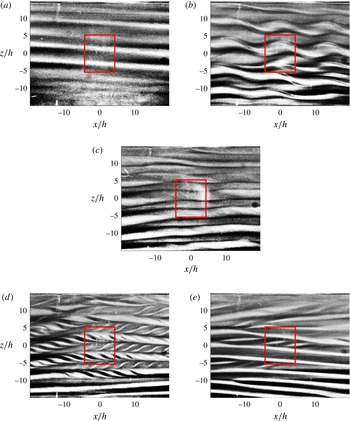
Snapshots of the roll-cell structure captured by flow visualisation for
 ${\it\Omega}=1.5$
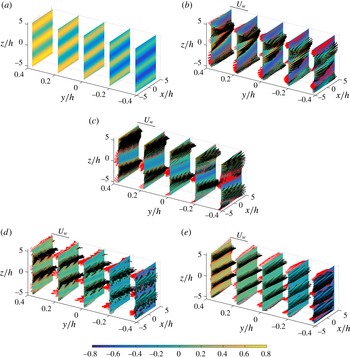
, 8, 20, 55 and 90 are presented in figure 3. Similarly, instantaneous velocity fields measured by stereoscopic PIV are presented in figure 4 (note that figures 3 and 4 were not obtained simultaneously). The red rectangle in each snapshot of figure 3 roughly shows the size and location of the PIV measurement domain, and the colours and the red/black vectors in figure 4 represent the value of the streamwise velocity component
 $\tilde{u} /U_{w}$
and the velocity vector with positive/negative wall-normal velocity respectively. For readability, the number of data points shown for the red/black vectors is reduced to 1/4 of the total data points in figure 4(b–e), and no red/black vectors are shown in figure 4(a) (at
 ${\it\Omega}=1.5$
the velocity vectors are almost parallel to the
 $xz$
-plane due to a very small wall-normal velocity component
 $\tilde{v}$
; if shown they cover the
 $xz$
-plane and the streamwise velocity colour contours cannot be seen).
Visualisation of the coherent roll-cell structure at
 $Re=100$
and some selected rotation numbers: (a)
 ${\it\Omega}=1.5$
, (b)
 ${\it\Omega}=8$
, (c)
 ${\it\Omega}=20$
, (d)
 ${\it\Omega}=55$
, (e)
 ${\it\Omega}=90$
. The red rectangle shown in each figure is roughly presenting the location and size of the PIV measurement domain.

Instantaneous velocity fields measured by stereoscopic PIV at the same Reynolds number (
 $Re=100$
) and rotation numbers as in figure 3: (a)
 ${\it\Omega}=1.5$
, (b)
 ${\it\Omega}=8$
, (c)
 ${\it\Omega}=20$
, (d)
 ${\it\Omega}=55$
, (e)
 ${\it\Omega}=90$
. The colour shows the value of the instantaneous streamwise velocity component
 $\tilde{u} /U_{w}$
, and the red/black arrows present velocity vectors with positive/negative wall-normal velocity. A black arrow showing the length of
 $U_{w}$
is also shown at the left top of each figure.

As shown in figure 3(a), the roll-cell structure takes the form of straight streamwise-oriented roll cells at
 ${\it\Omega}=1.5$
, and these two-dimensional roll cells become wavy and some branchings also appear at
 ${\it\Omega}=8$
, as shown in figure 3(b). The instantaneous velocity fields shown in figure 4(a,b) present the corresponding distribution of
 $\tilde{u}$
, indicating that the roll-cell structures shown in figure 3(a,b) result in a significant variation of the streamwise velocity in the
 $xz$
-plane. In figure 4(b) a branching of the wavy roll cells is also captured. The wavy roll-cell structure observed at
 ${\it\Omega}=8$
appears to correspond to the tertiary flow found by Nagata (Reference Nagata1998) at
 $R=400$
and
 ${\it\Omega}=35$
with their definition of the Reynolds and rotation numbers (these values should be divided by 4 to correspond to the values here). For these parameters Nagata (Reference Nagata1998) noted that ‘…the magnitude of the streamwise velocity on
 $z=0$
(
 $z=y/h$
in the notation of Nagata (Reference Nagata1998)) is almost equal to a half of the wall velocity…’. This corresponds fairly well to the maximum measured values (which are
 $\pm 0.60U_{w}$
) of the streamwise variation seen for
 $y/h=0$
in figure 4(b).
At
 ${\it\Omega}=20$
, as shown in figure 3(c), the roll-cell structure is again fairly straight in the streamwise direction, which was denoted by Tsukahara et al. (Reference Tsukahara, Tillmark and Alfredsson2010) as ‘2Dh’ roll cells (two-dimensional roll cells for high
 ${\it\Omega}$
), and the corresponding instantaneous velocity is presented in figure 4(c). While the roll cells at this rotation number look similar to the two-dimensional roll cells observed at
 ${\it\Omega}=1.5$
, the width of the roll cells is greater, and the important difference is that the 2Dh roll cells at
 ${\it\Omega}=20$
induce a remarkable fluid motion in the wall-normal direction, as shown by the red/black arrows in figure 4(c). In fact, as will be presented in the next section, the 2Dh roll cells cause the largest momentum transport in the wall-normal direction among the various
 ${\it\Omega}$
cases studied.
With further increase of the rotation number the roll-cell structure takes more complex forms. At
 ${\it\Omega}=55$
the roll cells show oblique stripes, as shown in figure 3(d). This structure is named twisted roll cell and has been observed in earlier experiments (Suryadi et al.
Reference Suryadi, Segalini and Alfredsson2014). The stripes of the twisted roll-cell structure can also be seen by the velocity vector pattern in figure 4(d).
At
 ${\it\Omega}=90$
(figure 3
e) the roll-cell structure, which is streamwise-oriented and fairly straight, is much more complex than the straight roll cells observed at
 ${\it\Omega}=1.5$
and
 ${\it\Omega}=20$
. This corresponds to the braided roll cells observed by Suryadi et al. (Reference Suryadi, Segalini and Alfredsson2014), and a recent numerical study (Daly et al.
Reference Daly, Schneider, Schlatter and Peake2014) also found this braided roll-cell structure. While Suryadi et al. (Reference Suryadi, Segalini and Alfredsson2014) reported two different structures at
 $Re=100$
and
 ${\it\Omega}=90$
, i.e. braided and staggered roll cells, only the braided-type structure was observed in both the stereoscopic PIV measurements and the flow visualisations in the present study. The corresponding instantaneous velocity field is shown in figure 4(e). It should be noted that at
 ${\it\Omega}=90$
the colour indicating the streamwise velocity component shows much less variation in the spanwise direction at each
 $y$
-position compared with the other rotation number cases, which indicates that the streamwise velocity profile across the channel at this rotation number is close to that of the undisturbed laminar plane Couette flow without system rotation.
In figure 4 the red/black arrows shown at
 ${\it\Omega}=8$
, 20, 55 and 90 clearly indicate a significant fluid motion in the wall-normal direction induced by the roll-cell structures. In particular,
 ${\it\Omega}=55$
is the case where the largest magnitude of the wall-normal velocity was observed, although the maximum momentum transport was observed at
 ${\it\Omega}=20$
. The magnitude of
 $\tilde{v}$
at
 ${\it\Omega}=55$
is on average as large as 20 % of the wall speed
 $U_{w}$
at the channel centre. It is also noteworthy that at
 ${\it\Omega}=90$
the magnitude of
 $\tilde{v}$
is comparable to that at
 ${\it\Omega}=55$
, although the streamwise velocity
 $\tilde{u}$
is almost constant at each
 $y$
-position. The wall-normal velocity component is generally in the range of
 $-0.3\leqslant \tilde{v}/U_{w}\leqslant 0.3$
, which agrees fairly well with the results of Daly et al. (Reference Daly, Schneider, Schlatter and Peake2014).
4.2 Mean flow profiles and zero-absolute-vorticity state
In the present study the averaging operation is defined as taking the average in the streamwise and spanwise directions and in time as stated in § 2. Hence, the mean velocity
 $U_{i}$
and the Reynolds stresses
 $\langle u_{i}u_{j}\rangle$
were evaluated as
 $$\begin{eqnarray}\displaystyle & \displaystyle U_{i}(y)=\frac{1}{N_{t}N_{x}N_{z}}\mathop{\sum }_{l=1}^{N_{x}}\mathop{\sum }_{m=1}^{N_{z}}\mathop{\sum }_{n=1}^{N_{t}}\tilde{u} (x_{l},z_{m},t_{n};y), & \displaystyle\end{eqnarray}$$
 $$\begin{eqnarray}\displaystyle & \displaystyle \langle u_{i}u_{j}\rangle (y)=\frac{1}{N_{t}N_{x}N_{z}}\mathop{\sum }_{l=1}^{N_{x}}\mathop{\sum }_{m=1}^{N_{z}}\mathop{\sum }_{n=1}^{N_{t}}u_{i}(x_{l},z_{m},t_{n};y)u_{j}(x_{l},z_{m},t_{n};y), & \displaystyle\end{eqnarray}$$
where
 $u_{i}=\tilde{u_{i}}-U_{i}$
and
 $N_{x}$
,
 $N_{z}$
and
 $N_{t}$
are the numbers of data points in the
 $x$
- and
 $z$
-directions and in time.
4.2.1 Mean velocity, absolute vorticity and Reynolds stresses
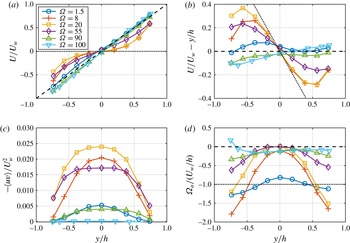
Mean flow profiles across the channel are presented in figure 5 at six representative rotation numbers (in total, measurements were made at 14 rotation numbers in the range
 $0\leqslant {\it\Omega}\leqslant 106$
). Figures 5(a) and 5(b) show the profiles of the mean streamwise velocity
 $U/U_{w}$
and their deviation from the linear velocity profile
 ${\it\Delta}=U/U_{w}-y/h$
respectively. Figure 5(c) shows the corresponding profiles of the Reynolds shear stress
 $-\langle uv\rangle$
, which physically represents the transport of the mean streamwise momentum by the wall-normal velocity. It is shown in these figures that as
 ${\it\Omega}$
increases from 1.5 to 20, the
 $U$
profile increasingly deviates from the linear velocity profile (shown by the dashed line) and that the velocity gradient at the channel centre decreases (the slope of the profile at the channel centre gets closer to that of the dotted line).
Mean flow profiles across the channel at
 $Re=100$
and six different rotation numbers: (a) mean streamwise velocity
 $U$
scaled by the wall speed
 $U_{w}$
, (b) deviation from the linear velocity profile
 $U/U_{w}-y/h$
, (c) Reynolds shear stress
 $-\langle uv\rangle$
scaled by
 $U_{w}^{2}$
, (d) absolute vorticity scaled by
 $U_{w}/h$
. The dashed and dotted lines in (a) and (b) show the linear velocity profile
 $U/U_{w}=y/h$
and
 $U=0$
respectively, and those in (d) show
 ${\it\Omega}_{a}=0$
and
 ${\it\Omega}_{a}=-U_{w}/h$
, corresponding to the zero-absolute-vorticity state and the linear velocity profile with no system rotation.

The Reynolds shear stress
 $-\langle uv\rangle$
is obviously responsible for this change in the profile of
 $U$
:
 $-\langle uv\rangle$
increases as the rotation number increases up to
 ${\it\Omega}=20$
, and has a maximum value at the channel centre at
 ${\it\Omega}$
around 20, which means that the 2Dh roll cells in figures 3(c) and 4(c) result in a significant momentum transport. However, in the higher rotation number range
 $-\langle uv\rangle$
decreases as the rotation number increases, and corresponding to this the profiles of
 $U$
return towards the linear velocity profile. At
 ${\it\Omega}=90$
the
 $U$
profile is quite close to the linear velocity profile, although there still exist clear coherent roll cells, as shown in figure 3(e).
Figure 5(d) presents the profiles of the absolute vorticity
 ${\it\Omega}_{a}=-\text{d}U/\text{d}y+2{\it\Omega}_{z}$
evaluated from the
 $U$
profiles shown in figure 5(a). In the case of no system rotation, the absolute vorticity is
 $-U_{w}/h$
across the channel, which is shown by the dotted line in the figure. It is seen that as the rotation number increases, the profile of
 ${\it\Omega}_{a}$
shifts from
 ${\it\Omega}_{a}=-U_{w}/h$
towards
 ${\it\Omega}_{a}=0$
in the central part of the channel. The state of zero absolute vorticity is achieved at the channel centre at
 ${\it\Omega}=20$
, and the spatial extent of the region of the zero-absolute-vorticity state increases as the rotation number increases. At
 ${\it\Omega}=100$
the absolute vorticity is close to zero across the full width of the channel.
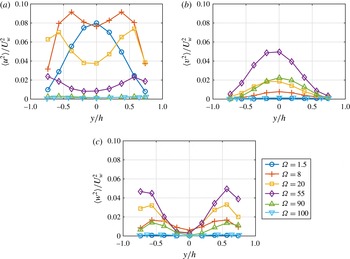
Figure 6 presents the normal Reynolds stresses at the same rotation numbers as in figure 5. At
 ${\it\Omega}=1.5$
the straight roll cells, as shown in figure 4(a), give rise to a significant streamwise velocity variation, and the maximum value at the channel centre is approximately
 $0.08U_{w}^{2}$
, which corresponds to a root mean square variation of 28 % of the wall speed
 $U_{w}$
. On the other hand, the lateral stress components are almost zero at this rotation number. However, as the rotation number increases,
 $\langle u^{2}\rangle$
generally decreases and
 $\langle v^{2}\rangle$
and
 $\langle w^{2}\rangle$
increase. In particular,
 $\langle u^{2}\rangle$
at the channel centre rapidly decreases and the profile of
 $\langle u^{2}\rangle$
changes into an ‘M’-type shape. In contrast,
 $\langle v^{2}\rangle$
always has its maximum value at the channel centre.
Profiles of the Reynolds normal stresses across the channel at
 $Re=100$
and the same values of
 ${\it\Omega}$
as in figure 5: (a)
 $\langle u^{2}\rangle$
, (b)
 $\langle v^{2}\rangle$
, (c)
 $\langle w^{2}\rangle$
. All stresses are scaled by
 $U_{w}^{2}$
.

At
 ${\it\Omega}=55$
, where the twisted roll cells exist, as shown in figures 3(d) and 4(d),
 $\langle v^{2}\rangle$
and
 $\langle w^{2}\rangle$
show the largest magnitudes, and their maximum values are considerably larger than the streamwise component
 $\langle u^{2}\rangle$
. In spite of the largest secondary fluid motion, the momentum transport by the roll cells at this rotation number, i.e. the Reynolds shear stress, is not the largest, which is mainly due to the small streamwise velocity variation
 $\langle u^{2}\rangle$
. It is also noteworthy that at
 ${\it\Omega}=90$
, the values of
 $\langle v^{2}\rangle$
and
 $\langle w^{2}\rangle$
are still significant despite
 $\langle u^{2}\rangle$
being almost zero, which corresponds to the characteristics of the instantaneous velocity field shown in figure 4(e). Such behaviour of the Reynolds shear stress and the anomalous balance between the Reynolds normal stresses will be further discussed based on their production term in § 5.
4.2.2 Wall shear stress variation with system rotation rate
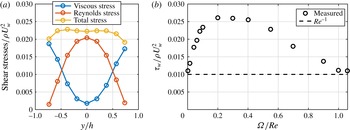
The wall shear stress can be seen as a measure of momentum exchange in the wall-normal direction by viscous diffusion and the Reynolds shear stress, and is therefore also strongly connected with the momentum transport caused by the roll-cell structure. Although a direct evaluation of the wall shear stress is generally not possible based on PIV measurement data, it is possible in the present study because of the constant total-shear-stress profile in the plane Couette flow configuration, as indicated by (2.9). Figure 7(a) presents an example of the viscous, Reynolds and total shear stresses scaled by
 ${\it\rho}U_{w}^{2}$
measured at
 ${\it\Omega}=8$
. It is demonstrated that the evaluated total stress is fairly constant throughout the channel as it theoretically should be (see (2.8)), which supports the validity of the present measurement results. The wall shear stress
 ${\it\tau}_{w}$
was determined by taking the average of the total stress for the measurement points in the interval
 $-0.57\leqslant y/h\leqslant 0.57$
.
Indirect evaluation of wall shear stress: (a) viscous, Reynolds and total shear stresses evaluated based on stereoscopic PIV measurement results at
 ${\it\Omega}=8$
and
 $Re=100$
; (b) variation of the evaluated wall shear stress with
 ${\it\Omega}/Re$
(the dashed line shows the value in the case of no rotation,
 $Re^{-1}$
).

The evaluated wall shear stress
 ${\it\tau}_{w}$
scaled by
 ${\it\rho}U_{w}^{2}$
is shown in figure 7(b). The theoretical value of
 ${\it\tau}/{\it\rho}U_{w}^{2}$
in the case of the linear velocity profile, which is given by (2.11), is also shown by the dashed line for comparison. The wall shear stress
 ${\it\tau}_{w}$
increases from
 $Re^{-1}$
at
 ${\it\Omega}=0$
, and takes a maximum at
 ${\it\Omega}=20$
, corresponding to the behaviour of the Reynolds shear stress
 $-\langle uv\rangle$
. The peak value of
 ${\it\tau}_{w}$
at
 ${\it\Omega}=20$
is 0.026, more than twice the value of the
 ${\it\Omega}=0$
case, which indicates significant momentum transport induced by the roll-cell structure. In the higher rotation number range
 ${\it\tau}_{w}$
decreases towards the theoretical value of the linear velocity profile case, as
 ${\it\Omega}$
approaches 100.
4.2.3 Zero-absolute-vorticity state in scaling by friction velocity
The focus is now set on the connection between the Reynolds shear stress
 $-\langle uv\rangle$
and the absolute vorticity
 ${\it\Omega}_{a}=-\text{d}U/\text{d}y+2{\it\Omega}_{z}$
at the channel centre. As the wall shear stress is evaluated in § 4.2.2, scaling of the experimental results based on the friction velocity
 $u_{{\it\tau}}=\sqrt{{\it\tau}_{w}/{\it\rho}}$
is possible. In this scaling the absolute vorticity is written as
 $$\begin{eqnarray}{\it\Omega}_{a}^{+}=\frac{{\it\Omega}_{a}}{u_{{\it\tau}}^{2}/{\it\nu}}=-\frac{\text{d}U^{+}}{\text{d}y^{+}}+{\it\Omega}_{{\it\tau}},\end{eqnarray}$$
where
 ${\it\Omega}_{{\it\tau}}$
is the system rotation rate scaled by
 $u_{{\it\tau}}$
:
 ${\it\Omega}_{{\it\tau}}=2{\it\Omega}_{z}{\it\nu}/u_{{\it\tau}}^{2}$
. This scaling with
 $u_{{\it\tau}}$
has the clear advantage that the sum of the mean velocity gradient and the Reynolds shear stress is always constant and equal to unity throughout the channel:
 $$\begin{eqnarray}\frac{\text{d}U^{+}}{\text{d}y^{+}}-\langle uv\rangle ^{+}=1,\end{eqnarray}$$
which makes the connection between the Reynolds shear stress and the absolute vorticity clearer. Equations (4.3) and (4.4) immediately give us the variation of
 $\text{d}U^{+}/\text{d}y^{+}$
and
 $-\langle uv\rangle ^{+}$
with the rotation number under the state of zero absolute vorticity,
 ${\it\Omega}_{a}^{+}=0$
:
 $$\begin{eqnarray}\displaystyle & \displaystyle \frac{\text{d}U^{+}}{\text{d}y^{+}}={\it\Omega}_{{\it\tau}}, & \displaystyle\end{eqnarray}$$
 $$\begin{eqnarray}\displaystyle & \displaystyle -\langle uv\rangle ^{+}=1-{\it\Omega}_{{\it\tau}}. & \displaystyle\end{eqnarray}$$
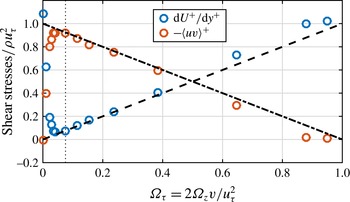
The variation of the measured mean velocity gradient and the Reynolds shear stress at the channel centre is presented in figure 8 scaled by
 ${\it\rho}u_{{\it\tau}}^{2}$
. It is shown that the Reynolds shear stress
 $-\langle uv\rangle ^{+}$
rapidly increases from
 $-\langle uv\rangle ^{+}=0$
to approximately 1 as the rotation number
 ${\it\Omega}_{{\it\tau}}$
increases, and it begins to decrease following the chain line indicating the zero absolute vorticity, (4.6), at approximately
 ${\it\Omega}_{{\it\tau}}=0.076$
, corresponding to
 ${\it\Omega}=20$
. On the other hand, the mean velocity gradient
 $\text{d}U^{+}/\text{d}y^{+}$
rapidly decreases from 1 as the rotation number increases from zero to
 ${\it\Omega}_{{\it\tau}}=0.076$
and then starts to increase for higher rotation numbers according to the zero-absolute-vorticity state range, satisfying (4.4).
Mean streamwise velocity gradient
 $\text{d}U^{+}/\text{d}y^{+}$
and Reynolds shear stress
 $-\langle uv\rangle ^{+}$
at the channel centreline. The vertical dotted line shows the value of
 ${\it\Omega}_{{\it\tau}}=0.076$
corresponding to
 ${\it\Omega}=20$
, and the dashed and chain lines indicate
 $\text{d}U^{+}/\text{d}y^{+}={\it\Omega}_{{\it\tau}}$
and
 $-\langle uv\rangle ^{+}=1-{\it\Omega}_{{\it\tau}}$
respectively, corresponding to the zero-absolute-vorticity state.

In this section, some typical roll-cell structures of RPCF and mean flow profiles at
 $Re=100$
and selected rotation numbers were presented. An anomalous balance between the Reynolds normal stresses was found in the relatively high rotation number range where the mean flow behaves as the state of zero absolute vorticity at the channel centre, and the connection between the zero-absolute-vorticity state and the Reynolds shear stress at the channel centre was shown by the scaling based on the wall shear stress. In the next section, the production of the different Reynolds stress components is discussed in order to further elucidate the anomalous behaviour of the Reynolds stresses and the mechanism that keeps the absolute vorticity at zero near the channel centre.
5 Discussion
5.1 Production of Reynolds stresses and physical interpretation of them based on the displaced-particle argument
The equations for the production for the Reynolds normal stress components
 $\langle u^{2}\rangle$
and
 $\langle v^{2}\rangle$
obtained from (2.16) and (2.17) are
 $$\begin{eqnarray}\displaystyle & \displaystyle P_{11}=-2\langle uv\rangle \left(\frac{\text{d}U}{\text{d}y}-2{\it\Omega}_{z}\right), & \displaystyle\end{eqnarray}$$
 $$\begin{eqnarray}\displaystyle & \displaystyle P_{22}=-4\langle uv\rangle {\it\Omega}_{z}, & \displaystyle\end{eqnarray}$$
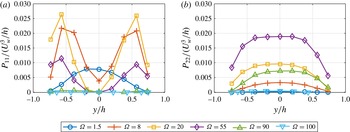
and their profiles at several rotation numbers are presented in figures 9(a) and 9(b) respectively. It is shown that at
 ${\it\Omega}=1.5$
the production of
 $\langle u^{2}\rangle$
is large in the channel centre region, while the production of
 $\langle v^{2}\rangle$
is almost zero across the entire channel. At
 ${\it\Omega}\geqslant 20$
,
 $P_{11}$
is almost zero at the channel centre, which is obviously because the velocity gradient
 $\text{d}U/\text{d}y$
and the system rotation
 $2{\it\Omega}_{z}$
in (5.1) cancel each other there due to the zero-absolute-vorticity state. Instead,
 $P_{22}$
in the channel centre region increases as the rotation number increases. At
 ${\it\Omega}=90$
,
 $P_{11}$
is close to zero across the channel, while
 $P_{22}$
is still large, as can be understood from (5.2). The different behaviour of the production terms results in the anomalous balance between
 $\langle u^{2}\rangle$
and
 $\langle v^{2}\rangle$
shown in figure 6.
Production of the Reynolds normal stresses (a)
 $\langle u^{2}\rangle$
and (b)
 $\langle v^{2}\rangle$
scaled by
 $U_{w}^{3}/h$
at
 $Re=100$
and the same rotation numbers as shown in figure 5.

One can also explain the small streamwise velocity variation in the
 $xz$
-plane at high
 ${\it\Omega}$
with a displaced-particle argument (similar to the Prandtl (Reference Prandtl1925) mixing length theory and used by Tritton & Davies (Reference Tritton, Davies, Swinney and Gollub1985) to discuss stability of spanwise rotating shear flows). Consider a fluid particle moving in the streamwise direction with the local mean velocity
 $U(y)$
and perturbed to also move in the wall-normal direction with the wall-normal velocity
 $v$
, i.e. the instantaneous local velocity
 $\tilde{\boldsymbol{u}}$
is perturbed from
 $\tilde{\boldsymbol{u}}=U(y)\boldsymbol{e}_{1}+0\boldsymbol{e}_{2}$
to
 $\tilde{\boldsymbol{u}}=U(y)\boldsymbol{e}_{1}+v\boldsymbol{e}_{2}$
. After a small duration
 ${\rm\Delta}t$
, the fluid particle has travelled a distance
 $v{\rm\Delta}t$
in the
 $y$
-direction, which gives rise to a streamwise velocity deficit
 $$\begin{eqnarray}{\rm\Delta}u=U(y)-U(y+v{\rm\Delta}t)\approx -v\frac{\text{d}U}{\text{d}y}{\rm\Delta}t.\end{eqnarray}$$
However, at the same time the fluid particle is accelerated in the streamwise direction by the Coriolis force
 $2{\it\Omega}_{z}v$
during
 ${\rm\Delta}t$
. Therefore, the overall velocity deficit due to the fluid displacement in the
 $y$
-direction is
 $$\begin{eqnarray}{\rm\Delta}u=-v\frac{\text{d}U}{\text{d}y}{\rm\Delta}t+2{\it\Omega}_{z}v{\rm\Delta}t=-v\left(\frac{\text{d}U}{\text{d}y}-2{\it\Omega}_{z}\right){\rm\Delta}t,\end{eqnarray}$$
which clearly shows that under the state of zero absolute vorticity, i.e.
 $-\text{d}U/\text{d}y+2{\it\Omega}_{z}=0$
, the motion of the fluid particle in the
 $y$
-direction does not result in any streamwise velocity variation. It should be noted that by multiplying both sides of (5.4) by
 $u$
and applying the averaging operation one obtains
 $$\begin{eqnarray}{\rm\Delta}\langle u^{2}\rangle =-2\langle uv\rangle \left(\frac{\text{d}U}{\text{d}y}-2{\it\Omega}_{z}\right){\rm\Delta}t.\end{eqnarray}$$
Thus, the explanation given above shows the physical process in which the production of the streamwise velocity variation
 $\langle u^{2}\rangle$
occurs.
Equation (5.4) suggests that the wall-normal fluid motion induces two different effects on the streamwise momentum transport which are conflicting each other. One is the fluid mixing effect, which is represented by the term associated with the mean velocity gradient, and the other is the streamwise Coriolis acceleration, and one can see that the Coriolis acceleration enhances the velocity variation across the channel (i.e. in the
 $y$
-direction), in contrast to the fluid mixing effect, which acts to make the velocity distribution uniform; the sign of the Coriolis term
 $2{\it\Omega}_{z}v$
is always the same as that of
 $v$
(for
 ${\it\Omega}_{z}>0$
), which means that the fluid particles moving towards the top wall (‘top’ referring to figure 1) of the channel are accelerated in the positive
 $x$
-direction, while those moving towards the bottom wall are accelerated in the negative
 $x$
-direction. Therefore, the zero absolute vorticity is a state where these two conflicting effects are in balance.
With regard to the shear stress, the production of
 $-\langle uv\rangle$
is
 $$\begin{eqnarray}P_{12}=\underbrace{2\langle u^{2}\rangle {\it\Omega}_{z}}_{\text{I}}+\underbrace{\langle v^{2}\rangle \left(\frac{\text{d}U}{\text{d}y}-2{\it\Omega}_{z}\right)}_{\text{II}},\end{eqnarray}$$
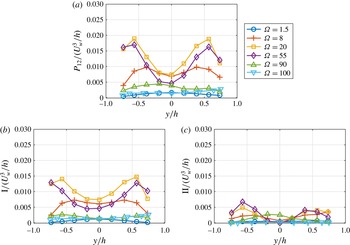
and the terms I and II are the contributions from the streamwise and wall-normal velocity variations respectively. The production
 $P_{12}$
itself is presented in figure 10(a), and the contributions from the terms I and II are separately shown in figures 10(b) and 10(c). The profile of
 $P_{12}$
has a minimum at the channel centre and maxima at approximately
 $y/h=\pm 0.5$
, and shows the largest magnitude at
 ${\it\Omega}=20$
. Thus, the Reynolds shear stress is largest at this rotation number. Comparing the contribution from each term in (5.6) shown in figure 10(b,c), one can clearly see that the second term II is generally small compared with the first term I throughout the channel even at
 ${\it\Omega}=55$
, in spite of the considerable wall-normal velocity fluctuation
 $\langle v^{2}\rangle$
. This is because at the channel centre the velocity gradient and system rotation effect cancel each other due to the zero-absolute-vorticity state, and in the near-wall region
 $\langle v^{2}\rangle$
itself decreases (see the profile of
 $\langle v^{2}\rangle$
in figure 6
b). Thus, the contribution to the production
 $P_{12}$
is mainly from the term I regardless of the rotation number, and the strong wall-normal fluid motion observed at relatively high rotation numbers does not contribute to the production of
 $-\langle uv\rangle$
.


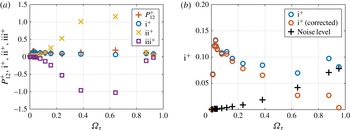
Production terms of
 $-\langle uv\rangle$
scaled by
 $u_{{\it\tau}}^{4}/{\it\nu}$
,
 $P_{12}^{+}$
, at the channel centre: (a) comparison of
 $P_{12}^{+}$
itself and all three terms in (5.7); (b) the term
 $\text{i}^{+}$
.

Furthermore, in order to directly compare such behaviour of
 $P_{12}$
with
 $\langle uv\rangle ^{+}$
at the channel centre shown in figure 8,
 $P_{12}$
is now scaled by
 $u_{{\it\tau}}^{4}/{\it\nu}$
and decomposed into three terms as
 $$\begin{eqnarray}P_{-uv}^{+}=\underbrace{\langle u^{2}\rangle ^{+}{\it\Omega}_{{\it\tau}}}_{\text{i}^{+}}+\underbrace{\langle v^{2}\rangle ^{+}\frac{\text{d}U^{+}}{\text{d}y^{+}}}_{\text{ii}^{+}}+\underbrace{\left(-\langle v^{2}\rangle ^{+}{\it\Omega}_{{\it\tau}}\right)}_{\text{iii}^{+}},\end{eqnarray}$$
in order to look into the balance between them in more detail. The values of each term at the channel centre are compared in figure 11(a), and as before the terms
 $\text{ii}^{+}$
and
 $\text{iii}^{+}$
generally cancel each other, but their magnitude is larger than the first term
 $\text{i}^{+}$
. A zoomed view of the variation of the term
 $\text{i}^{+}$
is shown in figure 11(b), where it can be seen that the term
 $\text{i}^{+}$
rapidly increases as the rotation number increases at low rotation numbers, but in the higher rotation number range it generally decreases. This behaviour of the term
 $\text{i}^{+}$
results in the variation of
 $-\langle uv\rangle ^{+}$
shown in figure 8.
It should also be mentioned that
 $P_{12}$
at
 ${\it\Omega}=100$
shown in figure 9(a) and the term
 $\text{i}^{+}$
at
 ${\it\Omega}_{{\it\tau}}=0.88$
and 0.95 (corresponding to
 ${\it\Omega}=100$
and 106 respectively) in figure 11(b) are not zero, although at these rotation numbers the flow should be stable. This is due to overestimation of the term
 $\text{i}^{+}$
by the noise of the stereoscopic PIV measurement: as stated in § 3.2, the velocity measurement contains the measurement noise of 3 % of
 $U_{w}$
, the influence of which on the evaluation of the term
 $\text{i}^{+}$
is larger at higher rotation numbers as it is multiplied by the rotation number. This noise effect and the term
 $\text{i}^{+}$
corrected by subtracting the noise effect are also shown in figure 11(b). It is shown that the corrected values of the term
 $\text{i}^{+}$
monotonically decrease towards zero as
 ${\it\Omega}_{{\it\tau}}$
reaches 1, which well explains the behaviour of the Reynolds shear stress
 $\langle uv\rangle ^{+}$
shown in figure 8.
The physical interpretation of the terms I and II of (5.6) is further discussed in the following. In a similar manner to that used to derive (5.4), let us consider that a fluid particle moving with an instantaneous velocity
 $\tilde{\boldsymbol{u}}=U(y)\boldsymbol{e}_{1}+0\boldsymbol{e}_{2}$
is perturbed in the streamwise direction, i.e. the local instantaneous velocity is perturbed to be
 $\tilde{\boldsymbol{u}}=(U(y)+u)\boldsymbol{e}_{1}+0\boldsymbol{e}_{2}$
. Due to the velocity fluctuation
 $u$
, an extra wall-normal Coriolis force
 $-2{\it\Omega}_{z}u$
is induced and accelerates the fluid particle in the
 $y$
-direction, which gives a change in the wall-normal velocity component,
 $$\begin{eqnarray}{\rm\Delta}v=-2{\it\Omega}_{z}u{\rm\Delta}t,\end{eqnarray}$$
after a short time
 ${\rm\Delta}t$
. By multiplying (5.8) by
 $u$
and (5.4) by
 $v$
, and applying the averaging operation, we obtain
 $$\begin{eqnarray}\displaystyle & \displaystyle -\langle u{\rm\Delta}v\rangle =2{\it\Omega}_{z}\langle u^{2}\rangle {\rm\Delta}t, & \displaystyle\end{eqnarray}$$
 $$\begin{eqnarray}\displaystyle & \displaystyle -\langle v{\rm\Delta}u\rangle =\langle v^{2}\rangle \left(\frac{\text{d}U}{\text{d}y}-2{\it\Omega}_{z}\right){\rm\Delta}t. & \displaystyle\end{eqnarray}$$
These two expressions obviously correspond to terms I and II of (5.6) respectively, and we can easily reproduce the production of
 $-\langle uv\rangle$
by taking the sum of them:
 $$\begin{eqnarray}-\langle v{\rm\Delta}u\rangle -\langle u{\rm\Delta}v\rangle ={\rm\Delta}(-\langle uv\rangle )=\left[2{\it\Omega}_{z}\langle u^{2}\rangle +\langle v^{2}\rangle \left(\frac{\text{d}U}{\text{d}y}-2{\it\Omega}_{z}\right)\right]{\rm\Delta}t.\end{eqnarray}$$
Now it is clear that the terms I and II in (5.6) represent different physical processes in which the streamwise momentum transport in the wall-normal direction is enhanced. The term I represents the process such that a streamwise velocity variation induces an extra wall-normal Coriolis force that accelerates the fluid particle in the wall-normal direction, by which momentum transport is produced. On the other hand, the term II represents the effects of the wall-normal fluid motion on the momentum transport: the momentum transport in the wall-normal direction driven by the secondary fluid motion of the roll-cell structure and the streamwise Coriolis acceleration that compensates it, as already discussed above.
These two effects induced by the wall-normal fluid motion, which are represented by the term II of (5.6), are quite significant but conflict each other, as shown in figure 11(a) (terms
 $\text{ii}^{+}$
and
 $\text{iii}^{+}$
), and the sum of them is zero under the zero-absolute-vorticity state.
5.2 Mechanism for maintaining the state of zero absolute vorticity
The mechanism by which the absolute vorticity is maintained zero at the channel centre is now addressed based on the Reynolds stress production. Let us assume that the mean velocity gradient at the channel centre is slightly deviated from the zero-absolute-vorticity state by a small disturbance
 ${\it\delta}$
:
 $$\begin{eqnarray}\frac{\text{d}U}{\text{d}y}=2{\it\Omega}_{z}+{\it\delta}.\end{eqnarray}$$
In this case, the equations for the production for the Reynolds stresses are
 $$\begin{eqnarray}\displaystyle & \displaystyle P_{11}=-2\langle uv\rangle {\it\delta}, & \displaystyle\end{eqnarray}$$
 $$\begin{eqnarray}\displaystyle & \displaystyle P_{22}=-4\langle uv\rangle {\it\Omega}_{z}, & \displaystyle\end{eqnarray}$$
 $$\begin{eqnarray}\displaystyle & \displaystyle P_{12}=2{\it\Omega}_{z}\langle u^{2}\rangle +\langle v^{2}\rangle {\it\delta}. & \displaystyle\end{eqnarray}$$
One can clearly see by (5.13)–(5.15) that
 $P_{11}$
and
 $P_{12}$
are directly affected by the value of
 ${\it\delta}$
while
 $P_{22}$
is not.
It can be seen from (5.15) that the second term of
 $P_{12}$
,
 $\langle v^{2}\rangle {\it\delta}$
, always affects the Reynolds shear stress
 $-\langle uv\rangle$
so that the mean flow profile returns to the zero-absolute-vorticity state. In the case of
 ${\it\delta}>0$
, the second term of
 $P_{12}$
is no longer zero but positive, and hence
 $P_{12}$
increases and so does
 $-\langle uv\rangle$
, which eventually decreases the mean velocity gradient. In the same manner, if
 ${\it\delta}<0$
,
 $-\langle uv\rangle$
decreases as the second term of
 $P_{12}$
turns negative, by which the velocity gradient increases. This contribution of the second term in (5.15) can be considered to be significant when the mean flow profile deviates from the zero-absolute-vorticity state, because the magnitude of the
 $\langle v^{2}\rangle$
-related terms in
 $P_{12}$
is remarkably larger than the first term, as already shown in figure 11(a).
In addition,
 $P_{11}$
also supports the state of zero absolute vorticity through the first term of
 $P_{12}$
,
 $2\langle u^{2}\rangle {\it\Omega}_{z}$
. As shown in (5.13), in the case of
 ${\it\delta}>0$
,
 $P_{11}$
becomes positive, and hence the first term of
 $P_{12}$
eventually increases, which is favourable for the aforementioned work of the second term that maintains the zero absolute vorticity. On the other hand, in the case of
 ${\it\delta}<0$
, the second term of
 $P_{12}$
is negative, as mentioned above, while the first term is always positive, and thus their contributions conflict each other. However, the contribution of the first term is weakened as
 $\langle u^{2}\rangle$
decreases, because the production
 $P_{11}$
is negative due to
 ${\it\delta}<0$
. Thus, the first term of
 $P_{12}$
always behaves favourably for the second term that maintains the zero-absolute-vorticity state.
6 Conclusion
The momentum transport caused by the roll-cell structure in laminar rotating plane Couette flow at
 $Re=100$
was experimentally investigated by stereoscopic PIV measurements, and the mechanism of the state of zero absolute vorticity was discussed mainly based on the statistical quantities such as the Reynolds stresses and their production. It was revealed that the momentum transport is mainly caused by the wall-normal Coriolis acceleration induced by disturbance to the streamwise velocity component, and becomes the largest at the rotation number
 ${\it\Omega}=20$
, where the roll-cell structure takes the form of two-dimensional roll cells. At higher rotation numbers the mean flow adheres to a state of zero absolute vorticity in the channel centre region, and the roll-cell structure shows more complex forms, such as twisted roll cells and braided roll cells, which induce strong secondary fluid motion. Such fluid motion does not, however, directly contribute to the net momentum transport, because the momentum transport across the channel and the streamwise Coriolis acceleration, both of which are induced by the wall-normal fluid motion, cancel each other under the zero-absolute-vorticity state. It was also found that the zero-absolute-vorticity state is maintained by a balance between the Reynolds shear-stress production terms associated with these two different effects by the wall-normal fluid motion. Therefore, it can be reasonably concluded that the strong wall-normal secondary fluid motion of the coherent roll-cell structure of RPCF induces significant momentum transport and at the same time a Coriolis acceleration which conflict each other, and the zero-absolute-vorticity state is a stable state where these two effects are in balance.
Acknowledgements
The present work is supported by the C. Tryggers foundation for scientific research providing support for the postdoctoral position of the first author. We also thank Drs A. Suryadi, N. Tillmark and R. Örlü for various contributions during this study.