1. Introduction
In the debate over trade liberalization and development, part of the discussions about developing countries’ agricultural exports to developed countries markets switched from tariffs issues to the building of effective export capacities.
Since the 1980s, there has been an increasing interest in the promotion for the production of non-traditional agricultural exportsFootnote 1 (NTAEs) in developing countries. On the one hand, governments and international development agencies advocate they would be a profitable alternative in the context of deteriorating international markets for traditional exports. On the other hand, the increasing demand for year-round access to horticultural products in developed countries provided strong grounds for supporting the development of such new market opportunities. Yet in conjunction with the surge of such high-value or differentiated agricultural and food products (hereafter HVAs) imports from developing countries, the last two decades have witnessed an enhanced awareness of food safety issues in developed countries. Non-tariff barriers flourished with the aim, conceptually at least, to satisfy a certain level of quality and safety of agricultural products. This growing set of public and private regulations exerted increased pressure on developing countries' producers to transform their processes in order to be eligible to export.Footnote 2
The impact of SPS measures (WTO Agreement on the Application of Sanitary and Phytosanitary Measures) and private standards or codes of practice is still unclear. Their affect on the capacity for developing countries to access developed countries’ markets for HVAs is a vivid research theme that until now provided mixed results. One of the central concerns is about the capacity for developing countries and in particular for their smallholders to develop and sustain exports in such context of increasingly stringent standards. Yet, while some advocate that food safety standards undeniably hamper exporting abilities (Otsuki et al., Reference Otsuki, Wilson and Sewadeh2001), others present evidence that they can also stimulate and enable competitiveness (Jaffee, Reference Jaffee2005; Maertens and Swinnen, Reference Maertens and Swinnen2009). While standards may be an impediment to trade and development for producers in developing countries, they could also serve as a ‘catalyst for realizing pro-poor export-led growth in developing countries’ (Maertens and Swinnen, 2007) and present an opportunity for exporters to ‘decommodify’.
Empirical evidence is still limited and this paper contributes to this debate. By disentangling the drivers of trade in horticultural products, it presents evidence supporting the two following statements: first, the demand for high-value agricultural products and, in particular, high care and differentiated agricultural products (hereafter HCAs) in developed countries and more recently in some emerging countries created an opportunity for exporters to exit crowded and less profitable commodity markets and to enter alternative systems of product valorization. This argument tends to support the view that standards can act as a catalyst. Second, this paper also provides evidence that low capacity to produce quality as well as shocks to reputation reduce the opportunity and benefits of trade in HCAs.
One crucial aspect of the paper is to provide grounds for the fact that agricultural products are becoming much like industrial products in the way that consumers are looking for quality, safety as well as differentiated products. In other words, agricultural and food markets evolve from productivity-based toward quality-based competition. As such, this paper is a contribution to the recent literature on the relationship between quality and trade. Its novelty lies in emphasizing a reputation effect on the capacity to export HCAs. This notion is discussed in the second section. In the third section I develop a new framework that endogenizes various quality parameters in a Melitz (Reference Melitz2003) setting: it integrates heterogeneity in the capacity of exporting countries to produce quality and in consumers’ preference for quality. Many studies analyze the effect of new SPS measures on predicted trade flows with an ex-ante approach (Otsuki et al., Reference Otsuki, Wilson and Sewadeh2001). Yet, too few studies adopt an ex-post analysis posture. They were at the time impossible because of the lack of comprehensive data on the implementation of SPS measures in world trade.Footnote 3 The last section of the paper fills this void. Using a new database on US import refusals, it provides evidence about the effect of a shock to reputation on average horticultural export f.o.b. price.
2. The notions of quality and reputation in horticultural trade
This section presents evidence on the importance of considering heterogeneity in quality when analyzing trade in horticulture and on the reputation impact of exporting non-compliant horticultural products. The analysis of US case stories supports the relevance of the use of import refusals data as a proxy for a reputation shock in the empirical analysis developed in the last section of this paper.
2.1 The notion of quality
Various foods scares and related events triggered the strengthening of public regulation in developed countries. But, in addressing consumers' concerns with quality and food safety, the private sector also found a way to differentiate their products and to compete in quality-defined markets. Therefore, along with public regulation, the private sector developed codes of practices (US market) and certifications (EU market) that are usually far more burdensome. As a consequence, new institutional arrangements were necessary; food retailers reduced their reliance on brokers or terminal markets and increasingly sourced directly from producers. This gave producers the opportunity to enter different systems of product valorization. If trade in fruits and vegetables is usually referred to as trade in HVAs, yet ‘the implied dichotomy between low- and high-value markets presents an unduly simplistic picture of the market choices’ (Jaffee et al., Reference Jaffee, Henson and Rios2011). There is still much heterogeneity in requirements between and within importing countries along various distribution channels and market segments. In line with this, Jaffee and Masakure (2005) emphasize this heterogeneity between and within EU countries according to consumers’ preferences but also in patterns of fresh product purchases and distribution. For example, high-end supermarket chains in the United Kingdom generally require high standards and food safety compliance – in particular when considering the growing importance of pre-packs and other high care products. But other horticultural segments in the country are governed by very different standards. Ethnic, food services and restaurant supply chains’ predominant consideration remains price and continuity. As for the US, even though supermarket chains tend to follow the same path as EU retailers, the supply of horticulture products in bulk through brokers is still widely used (Hanson and Blandon, 2007).
Therefore, as stated in Jaffee et al. (Reference Jaffee, Henson and Rios2011), this evolution provided exporters with a convenient means to differentiate their product in otherwise crowded commodity markets. The reduction in transport costs due to new transportation technologies (Coyle et al., Reference Coyle, Hall and Ballenger2001) and the subsequent increase in competition even more stimulated the development of new strategies among suppliers. The case of Kenyan horticulture exporters is a very famous example (Jaffee and Masakure, 2005). In the late 1980s, only 10% of the Kenyan French bean production was sold directly to supermarket chains in Europe. The rest was sold in bulk through wholesale markets or distributors. With the increase in competition in the European market, because of the diversification of supply origins and the subsequent downward pressure on wholesale prices, sales of loose products became marginally profitable. This prompts the pursuit of product innovation and quality as an adaptation to new market conditions. During the 1990s, even though export quantities did not increase much, export value grew along with the proportion of products directly exported to supermarkets. According to Jaffee and Masakure (2005), this shift of strategy toward value-added processing and packaging allowed for a three-fold increase of Kenya's export value, from 1,000 US$ per ton in the early 1990s to 3,000 US$ per ton. Even though trade in bulk still represents an important component of Kenyan exports in order to cover their costs, this provides further evidence of the opportunities offered by consumers' increasing demand for HCAs and their willingness to pay a premium. According to Jaffee and Henson (2004), ‘rising private sector and public standards have posed challenges to the Kenyan fresh produce industry, yet at the same time they have also thrown a “life line” to the industry’. Peru is another well-known example, often cited as a ‘Standard Success Story’. Even though the country benefits from favorable conditions for the production of winter vegetables for northern hemisphere high-income countries, prohibitive transport costs prevented any price competition with other suppliers. Thus, they adopted a high-quality strategy and implemented national standards in line with international norms that not only allowed them to become competitive in such markets but also generated increased ‘client loyalty’ (Jaffee and Henson, Reference Jaffee and Henson2004). Indeed, such strategy reduced the risk of trade disruptions due to erratic and irregular quality.
Those arguments support the hypothesis that not only preference for quality but also reputation are determinants of the pattern of horticultural exports. To highlight this, I first assume that horticultural products can be defined according to two levels of quality, roughly relying on this differentiation between bulk/commodity exports – for which a buyer/consumer's prime concern is set on price – and HCAs – for which a buyer's prime concern is set on safety, reliability, and value-added attributes. Second, I introduce a reputation parameter – defined in the following section – that impacts the importers' valuation of the quality of the exporting country's whole sector, whether firms export in bulk or HCAs.
2.2 The notion of reputation
The enhanced awareness of food safety issues changed the relationship between exporters and importers. Studies on food scares and crises clearly highlighted the spillovers of such events on the whole sector. For example, Jaud et al. Reference Jaud, Cadot and Suwa-Eisenmann(2010) link food scares and supplier concentration in the EU market. Using a new database quite similar in structure to the one used in this paper for the US, they show that EU agro-food imports are vulnerable to food safety alerts and that they are more concentrated on a few suppliers for ‘risky products’.
Many case studies stress the impact of non-compliance of few product shipments on the overall export sector. In Peru, cooperation between the public and private sector was propelled by a food safety breach that occurred in Spain in 1997 and traced back to Peruvian canned asparagus. According to Jaffee and Henson (2004), European consumers were left with an unfavorable impression causing Peruvian asparagus sales to slump. An even closer example was the E-coli outbreak that occurred in Germany in spring 2011. The German government claimed that cucumbers produced in a Spanish organic farm were the source of the outbreak. Even though this information was rapidly acknowledged to be erroneous, consumer suspicion spread to the whole Spanish fresh vegetables sector, which suffered tremendous losses in a few weeks.
It would be expected that trade in HCAs would reduce the risks of trade disruption due to quality, food safety, or disease issues. However, case stories support the assumption that the effect of a crisis might not be firm-specific, but rather that there are spillover effects to the whole sector. Therefore, it is assumed that consumers’ perception of product quality relates to the history of food scares between two trading countries. The definition of reputation used in this paper draws from Tirole (Reference Tirole1996) who defines collective reputation as an aggregate of individual reputations. Thereby, consumers use past behavior of group members to predict individual future behavior. As such, reputation is assumed to impact export value in various ways. First, there is path dependency between the potential histories of food safety crises associated with one country's exports. Second, even though one firm produces compliant products, it is the collective reputation of the sector that influences consumers’ rating of the product.
2.3 FDA inspections, import refusals, and reputation
Usually, the US Food and Drug Administration (FDA) inspects 1% of food import shipments at the port of entry (Buzby et al., Reference Buzby, Unnevehr and Roberts2008). But if a product or an exporter (country or firm) repeatedly violates US regulations or poses risks in terms of SPS issues, the FDA raises the level of surveillance, creating an ‘alert’ and implementing an ‘Automatic Detention’ (AD) or a ‘Detention Without Physical Evidence’ (DWPE) system. Thereby, the surveillance of products is increased by compulsory detention and the burden of proof that the shipment is compliant is transferred to the exporter. This system of AD and DWPE was first been implemented in the late 1980s. This period witnessed simultaneously an increase in imports of horticultural products in the US market and rising food safety concerns on the part of US consumers and authorities. Thus, aside from detentions due to different pest outbreaks, the increasing attentiveness to food safety and in particular to pesticide residues led to the implementation of AD and alerts for various countries and products for which many violations had been observed.
The occurrence of an alert creates delays and new risks for the importer distribution chain. Under DWPE, exporters that are able to send products complying with the US legislation five times in a row (re)gain access without automatic detention. Still, they continue to be submitted to a higher level of potential controls. This sequence of controls illustrates the importance of earnestness in order to ensure a continuous capacity to export over time. As Baylis et al. (Reference Baylis, Martens and Nogueira2009) point out, the limited resources of the FDA lead inspections to be path-dependent, by continuously focusing on products and/or producers that had encountered problems in the past. Along this line, Buzby et al. (Reference Buzby, Unnevehr and Roberts2008) confirmed the existence of a strong correlation between refusals and FDA alerts. FDA inspections, and as a consequence refusals, are clearly biased against exporters or countries holding a record of non-compliant food exports.
In order to test the effect of a shock to reputation, this paper makes use of a new dataset built upon information on FDA import refusals. Our hypothesis is that the existence of an import alert due to a history of non-compliance of products from a given country has a bad reputation effect on every exporter of this specific product from that country. Remarkably, customs authorities do not recognize private certifications, thus the probability for one exporter to be detained by customs authorities – all other things equal – is the same whether the firm exports HCAs or not. This higher probability for shipments to be controlled and detained has an impact on the reliability of exporters and thus on their reputation. The following case studies provide further evidence supporting the relevance of the use of import refusals data as a proxy for reputation shock in the empirical analysis.
2.4 Evidence from Guatemalan exports to the US
Different case studies in Central America and the Caribbean have emphasized the effects of such path dependency on trade flows and the risk of market disruption. Guatemalan snow peas exports are a famous example. The introduction of NTAEs in Guatemala brought new production technologies and new demands of aesthetic and grade qualities that necessitated an intensive use of chemical inputs in such tropical climates. At first, these aesthetic requirements, as a ‘search’ attribute of quality, did not present specific information asymmetry issues. Guatemala rapidly became first provider to the US, but, from the end of the 1980s, the massive use of pesticides resulted in frequent shipment detention and refusals. As a result, the FDA issued in 1992 a countrywide alert for pesticide residues on Guatemalan imports. Guatemala did not endure the same market disruption as the Dominican Republic, confronted with the same issue, and through time managed to stay among the top exporters. Nonetheless, recurrent refusals and the inability to properly address this concern have been highly detrimental to the country's relative competitive position. First, exporters suffered immediate losses: as reported by Thrupp (Reference Thrupp1995), in the early 1990s, 27.3% of NTAEs shipments sampled from Guatemala were detained. Between 1990 and 1994, the detentions of 3,081 Guatemalan's shipments due to pesticide residues resulted in a loss of a total of US$17,686,000. But producers also suffered longer-term consequences. Guatemala is still today under countrywide alerts with DWPE. While it managed to recover its leading place as snow peas exporters to the US in quantity, all these issues have decreased Guatemalan reputation and competitiveness in the US market compared to its two rivals, Mexico and more recently Peru. Between 2000 and 2006, average export unit price ranked from 0.50 US$/kg to 0.70 US$/kg for Guatemala, compared an average export unit price of 1.20$/kg to 1.90$/kg for Mexico and Peru.Footnote 4 Producers in both latter countries sell their production directly to the food distribution chain, whereas 80% of Guatemalan snow peas are sold through brokers for half price (Henson and Blandon, 2007). Quite surprisingly, a survey (Julian, Reference Julian2003) among US snow pea market stakeholders emphasized that Guatemalan smallholder production, compared to large estate production in Mexico or in California, was much better matched with US consumers’ demand. But the same survey also highlighted that because of the risks associated with automatic detentions, some US importers were no longer directly importing snow peas from Guatemala but rather buying them from brokers, once snow peas had cleared customs.
In Guatemala, major shippers managed to get off automatic detention. Yet recurrent import refusals from small and/or inexperienced exports, in particular during price spikes, continue to fuel the Guatemalan bad reputation. One last surprising consequence was export diversion by some of the most efficient exporters in Guatemala toward the European Union market. They felt the European market was more secure, transparent (one GlobalGAP certification rather than multiple retailer-specific codes of practices), and that it better valued their production.Footnote 5
In the following, the identification of the determinants of average horticultural export prices highlights the mechanisms behind this reputation effect.
3. Quality and reputation matters: theoretical framework
New trade models of firm heterogeneity confirm the importance of differences in producers’ productivities. Across-firm productivity levels explain a significant proportion of the variance of trade flows. The Melitz (Reference Melitz2003) model and its extension by Helpman et al. (Reference Helpman, Melitz and Rubinstein2008) and Chaney (Reference Chaney2008) is now widely accepted. The model introduces fixed and variable export costs in a framework of asymmetric countries and firm heterogeneity with Pareto-distributed firm productivity. The cut-off condition on the incentive to export defines a productivity threshold above which producers should be able to export to distant markets. In this framework, f.o.b. (free on board) export prices are inversely related to distance and to the difficulty to enter one's market, generally revealed by fixed costs of entry.
However, Schott (Reference Schott2004) highlighted the inconsistency of new trade theory models and their expected inverse relationship between price and producer productivity. His study of US imports presents a strong relationship between GDP per capita and average export unit value within products at the HS 10 level. Hummels and Klenow (2005) confirm this prediction and show that richer countries export more units at higher prices to a given market. These results are consistent with the observation that higher-income countries produce goods of higher quality. Both papers underline the importance of other exporting country characteristics and correlate increase in unit value with the exporter's relative endowment of physical and human capital. Focusing on the demand side, Hallak (Reference Hallak2006) finds that richer countries tend to benefit from higher demand for imports from countries producing high-quality goods. In order to explain these observations, studies following the Melitz (Reference Melitz2003) benchmark model offer specific deviations and include a quality factor of trade. Johnson (Reference Johnson2009), Baldwin and Harrigan (Reference Baldwin and Harrigan2009), and Crozet et al. (Reference Crozet, Head and Mayer2009) test a quality-sorting hypothesis on various sectors and confirm the inconsistency of price behavior with the benchmark models. These papers theoretically and empirically demonstrate the importance of taking quality into consideration when explaining bilateral trade flows in specific sectors, although most of them did not provide clear-cut disentangled impacts between quality-sorting on the one hand and productivity-sorting on the other.
It is usually assumed that agricultural trade, presented as commodity trade, tends to follow productivity-sorting patterns (Johnson, Reference Johnson2009). In other words, we should observe an inverse relationship between mill price and distance between trade partners. My hypothesis in this paper is that it is not necessarily the case when it comes to horticultural products. One of the core contentions of this paper is to demonstrate that the usual productivity-sorting model is not sufficient to explain average unit export prices in horticulture. Thereby, it proposes and tests an in-between model combining productivity- and quality-sorting, better suited to capture the duality in the determinants of horticultural exports.
This next section develops this in-between solution compared to the usual literature and introduces both features of productivity- and quality-sorting in a model based on firm heterogeneity with Pareto-distributed firms’ productivity. This section of the paper follows the Melitz (Reference Melitz2003) framework augmented by Eaton et al. (Reference Eaton, Kortum and Kramarz2011), Baldwin and Harrigan (Reference Baldwin and Harrigan2009), Johnson (Reference Johnson2009), and Crozet et al. (Reference Crozet, Head and Mayer2009). Within a constant elasticity of substitution (CES) framework, I adopt a similar method adding a quality parameter that allows for consumers to maximize their utility according to a quality-adjusted price. As aforementioned, it is considered in this paper that horticultural products can broadly be grouped into two categories: commodity products and HCAs. Thus, innovation of this paper lies in a first step in the introduction of two key features. First, in a productivity-sorting setting, it allows for a quality differentiation by the most productive firms. Second, consumers from different countries have heterogeneous preferences for quality.
3.1 Productivity- vs. quality-sorting models
Most quality-adjusted models switch from a productivity-sorting to a quality-sorting setting by hypothesizing that producing quality is costly. Heterogeneity in productivity is therefore replaced by heterogeneity in quality. Thus, one of the difficulties raised by quality-sorting models is to define a relationship between firm's productivity and quality without losing the possibility of comparison with the original Melitz (Reference Melitz2003) productivity-sorting model. These models relate quality and productivity through a power function of the type:

with q the quality parameter, c firms' factor requirement, and θ≥1. Kugler and Verhoogen (Reference Kugler and Verhoogen2012) studying unit values of inputs of Colombian manufacturing plants provide direct empirical support for such a relationship between quality and cost showing that higher cost inputs are associated with higher-quality outputs. The general setting then usually defines a quality-adjusted price  and a quality-adjusted demand
 . With this, the difficulty lies in the definition of the power parameter θ. The model developed in this section does not depart from these hypotheses. I innovate by endogenizing the power parameter, making this relationship idiosyncratic to the dyadic relationship between the exporting and importing country.
The consequence of defining quality as in equation (1) is that, depending on the value of the power parameter, all exporting firms are assumed to export under either productivity-sorting or quality-sorting. Baldwin and Harrigan (Reference Baldwin and Harrigan2009) define this power parameter as the elasticity connecting quality and factor requirements. Thus, setting θ=0 reduces the model to the standard Melitz (Reference Melitz2003) productivity-sorting model. If 0<θ<1, the quality-adjusted price increases with costs and thus with unit price, rendering it undesirable for producers to resort to a quality strategy. Within this range of θ, productivity-sorting is more relevant in explaining trade flows export prices. It is only when θ>1 that the quality-adjusted price negatively relates to unit price. In other words, more factors are required to produce one unit of product, the higher the quality and the lower the quality-adjusted price. The relationship hence integrates consumers’ quality-adjusted demand: based on a firm's factor requirement, consumers regard some varieties as superior to others in terms of quality if and only if θ>1. Thus, quality-sorting models fully reverse the relationship between variable costs and price: the more difficult the access to one country's market, the higher both quality and average export prices are. Therefore, firms are sorted according to quality with the higher firm's factor requirement representing the higher quality. As in Baldwin and Harrigan (Reference Baldwin and Harrigan2009), in quality-sorting settings, firm heterogeneity is thus Pareto-distributed over factor requirements instead of productivity.
Johnson (Reference Johnson2009) builds a framework allowing for close identification of the sign of the correlation between quality-adjusted price and observed unit price among various sectors. He systematically detects if the dynamic of these exporting sectors either matches with a productivity-sorting or a quality-sorting setting. Borrowing from John Sutton's terminology, he proposes to link firms' factor requirements to their ‘capability’ defined by the ratio of quality to costs. This ‘capability’ can be compared to a quality-adjusted factor requirement and firms’ heterogeneity does not rely on their factor requirement anymore but on their capacity to transform variable costs into quality. Thus, firm's quality is a constant elasticity function of their capability. His methodology makes it possible to identify empirically if the power parameter governing the relationship between quality and capability is θ>1 or θ<1, indicating if exports are following productivity- or quality-sorting. His results are of tremendous interest for various reasons: he builds and tests a theoretical framework that clearly supports the rejection of the homogeneous quality formulation of the standard heterogeneous firms' models but also he clearly states the existence of both productivity- and quality-sorting throughout the various sectors he is studying. Unfortunately, his results are not of any support concerning the agricultural sector, since Johnson (Reference Johnson2009) discarded non-manufacturing trade from his sample ‘on the ground that monopolistic competition models ought to be best suited to understand trade in differentiated manufactures’.
Even though this complete inversion of the relationship fits much better with average observed export prices in many sectors, I argue that it still does not allow for considering the full reality of sectors such as the horticultural export sector. I suggest an in-between solution that would better fit the horticultural sector and would allow highlighting the effect of a bad reputation on export prices. Instead of a continuous relationship between quality and productivity, I consider the existence of one single homogenous level of quality. Horticultural products can be differentiated according to the type of market chain through which they enter the importing country. Thus, in order to make the model description more straightforward, I refer from now on to productivity and quality products. Productivity products relate to commodities, sold for example to intermediaries or more specifically to brokers in the US. Quality products relate to HCAs products, directly imported by retailers. To put it differently, the firm has an opportunity to differentiate its products in HCAs and HCAs are homogenous in quality.
As usual in the literature, I assume quality products to be costlier and that the cost of producing quality is a power function of a firm's factor requirement. The model introduces a quality threshold, idiosyncratic to the dyad, defined over the lower productivity level necessary to profitably export quality products. In other words, it is the level of productivity at which it becomes profitable for one exporter to export quality products to one country according to its consumers' preference for quality. I also endogenize the power parameter relating quality to productivity θ i, defined over [0,+∞], and make it specific to the exporting country. This parameter characterizes the capacity 1/θ i of the exporting country to produce quality. As a consequence, the level of productivity necessary to profitably produce quality depends on this capacity: it is much easier to produce horticultural product fulfilling basic quality requirements in France than in Guatemala. Also, the endogenization of the preference for quality parameter to the importing country enables products from the same sector within the same exporting country to be exported under various regimes according to the country of destination. Accordingly, I expect more quality products to be exported to high-income countries when productivity products better fit exports toward developing countries.
I define c as the physical factor requirement necessary to produce one unit of the productivity product and c q the physical factor requirement necessary to produce one unit of the quality product so that:

Firms are heterogeneous in their level of productivity that defines, according to the targeted market, if it is profitable to export either productivity or quality products. I assume that each firm with a level of productivity higher than the quality threshold automatically switches to quality products.
3.2 The setting: disentangling productivity- and quality-sortingFootnote 6
Heterogeneity among consumers of various countries relies on the intensity of their preference for quality q i. As in Eaton et al. (2011), I introduce the term α ij representing an endogenous shock to the quality parameter. This shock has a downgrading effect on the quality parameter, in other words it represents the effect of a bad reputation on consumers' valuation of quality: the higher the shock on the quality parameter, the lower α ijqi. This allows to define a consumer quality-adjusted price  . For productivity products, the quality term becomes α iqi=1.
Firms from i incur fixed costs f ij of selling to market j. When maximizing their profits, firms charge a mill price with a constant mark-up over marginal costs: p i(v)=[σ/(σ−1)]w ic with σ the elasticity of substitution across products, c=1/φ is the firm's specific factor requirement, or the inverse of its productivity, needed to produce one unit of the variety v, and w i is the country-specific factor cost. If a firm from i seeks to sell its products to consumers in j, those consumers bear an additional transport cost τ ij defined in a Samuelson's iceberg costs fashion. Therefore, consumer price becomes:

According to (2), the quality product mill price is p i(v)=[σ/(σ−1)]w ic (1+θi). Therefore, the model introduces two productivity thresholds. The first is the usual cut-off condition for one firm of country i to export to country j:

with Y j being country j's income and P j its price index. The second is the quality threshold reflected by the upper limit level of factor requirement  for which it is profitable to switch to a quality strategy. This threshold corresponds to the specific productivity level for which
 defining
 .
3.3 Expected average unit export f.o.b. price
Trade data only provide information on the average unit export f.o.b. price of products at the HS 6-digit level. Therefore, I am looking for an expression of the expected unit export f.o.b price  of all varieties exported by i to j.
According to the productivity-sorting setting, depends solely on the expected productivity level conditional on firms exporting to i:Footnote 7

This becomes:

In the Productivity–Quality–Reputation (PQR) setting, also depends on the proportion of firms exporting productivity or quality products to this market. Therefore, the expected price conditional on exporting from i to j is defined as:

As in Helpman et al. (Reference Helpman, Melitz and Rubinstein2008), V ijp and V ijq are two monotonic functions of the proportion of exporters respectively exporting under a productivity or quality strategy to country j, G(c). Because of the second threshold, it is not possible to obtain an empirical procedure that allows estimating parameters’ elasticities. Nevertheless, parameters influencing the average f.o.b price are clearly identified allowing us to derive a reduced form of the average price equation and to identify the signs of these parameters. In order to derive such reduced form, I define V ij, the expected factor requirement of exporting firms as:

4. Empirical procedure
4.1 Average unit export f.o.b prices in the productivity-sorting setting
In order to verify the first hypotheses of this paper on heterogeneity in quality, I test the workhorse model based on Melitz (Reference Melitz2003) and its application to average unit export f.o.b. prices of horticultural exports. According to (4), the empirical setting of the productivity-sorting model is set forth in equation (8) where depends positively on export market size and negatively on fixed and variable costs.
The expected average price of exports from i to j, can now be expressed in log-linear form as:

where lowercase variables p j and y j represent the natural logarithms of respective uppercase variables. As in Helpman et al. (Reference Helpman, Melitz and Rubinstein2008) and Johnson (Reference Johnson2009), I parameterize the bilateral fixed and variable costs as follows. I assume that τ ij (variable trade costs) is stochastic due to i.i.d. un-measured trade friction u 1,ij which is country-pair specific. As an analogy to their definition, I define  where D 1,ij represents bilateral symmetric distance between i and j with u ij≈N(0, σ u2). Thus, I have ln τij=χd 1,ij−u 1,ij. Fixed trade costs, are classically set as ln f ij=ϕi+ϕ j+ρD 2,ij+u 2,ij. These data are defined in dyadic form by interacting indicators for the exporting and importing country. I assume that fixed trade costs rely on ϕ i and ϕ j, respectively the exporter and importer fixed effects. D 2,ij is a set of overlapping data that I assume decrease the fixed cost of exporting from i to j (sharing a language, a frontier, a free trade agreement, etc.), and u 2,ij stands for the unobserved variations in trade costs. In what follows, I simplify the number of variables through the linear combination η ij=u 1,ij+u 2,ij of unobserved variations in fixed and variable costs of trade that I assume to be normally distributed, with
 the variance of the composite error. To be thorough, all variables of the model ought to be divided by the variance of this normal distribution. I do not compute this calculation in this paper; I focus on the signs of the left-hand side. Substituting those parameters back into the log-linear expression (15) yields the following expression:

ξ i=[1/(σ−1)]ϕ i and ξ j=p j+[1/(σ−1)]y j−[1/(σ−1)]ϕ j are respectively exporter and importer fixed effects and ξ 0=ln ε is the constant.
The following panel econometric test introduces a time dimension. Some variables, such as income, become time-dependent. Hence, some variables can be transformed as ξ j=p j−[1/(σ−1)]φ j. The log-linearized expected average price equation becomes:

4.2 Average unit export f.o.b prices in the productivity–quality–reputation (PQR) setting
According to (5), I derive a reduced form of the average price equation. The cut-off condition c ij is defined over the same parameters as in the benchmark model but the expected unit export price now also depends on the quality threshold. I have assumed that this threshold increases with the preference for quality of the importing country and with the capacity of the exporting country and decrease with a shock to the preference for quality, idiosyncratic to the dyad. This allows us to define the following estimation equation:

I define  and
 where Y pc ,i and Y pc ,j represent respectively the exporting and importing country GDP per capita with the unobserved quality parameters represented by
 and
 . Thus, I have
 and ln q=β 2y pc ,j+δ 2,j.
The shock to consumers’ preference is defined as a function of the occurrence of custom refusals. Thus, I define  with
 . Thus, ln α ij=β 3s ij+δ 3,ij. I expect β 1 and β 2 to be positive and β 3 to be negative. Substituting those parameters back into the log-linear expression of the expected export f.o.b. price yields the following expression:

With ψ 0 the constant and ψ i and ψ j respectively the exporter and importer fixed effects.
In what follows, I test reputation on panel data, introducing a time dimension. The average price equation with the introduction of time can be presented as the following:

Our dataset allows us to test for the effect of reputation on horticultural imports only in the US. In such a context, country fixed effects are de facto dyadic given that all our exports are directed to the same country. In order to take care of this symmetry problem, I define a ‘Competitiveness’ parameter C ij in analogy with the ‘Attractiveness’ parameter used by Crozet et al. (Reference Crozet, Head and Mayer2009). This parameter collects all non-time-dependent determinants of exports:

Replacing (21) in (20) yields the following estimation equation:

In the econometric test, lnC ij corresponds to an exporter fixed effect, since the importing country is invariant.
4.3 Accounting for the average export price of horticultural products
I use CEPII BACIFootnote 8 trade data at the HS 6-digit level from 1998 to 2007. It reconciles bilateral trade flows reported by exporter (f.o.b) and importer (c.i.f – cost, insurance, and freight) in the UN-COMTRADE trade database. This dataset not only includes trade in quantity but also the equivalent trade value. With this, I compute the average unit f.o.b. price. This calculation and the comparison are made easier since I only consider horticultural trade, which is systematically reported in kilograms. BACI is the only database providing consistent unit-values at the world and product level, so it is particularly well suited to analyzing international trade prices (Gaulier and Zignago, 2009).Footnote 9 The dataset covers ten years, 221 countries, and 102 products including fresh, frozen, and dried fruits and vegetables from HS Chapters 07 and 08.
The classic variables of distance and GDP were respectively retrieved from the CEPII database and from WDI's (World Development Indicators) World Bank online website. GDP per capita, also gathered from WDI, are computed as a proxy for the exporting country's capacity to produce quality as well as the intensity of consumers’ preference for quality in the importing country.
I use a new dataset compiled from FDA data on import refusals to simulate a shock α ij to the valuation of quality parameter on the US market. The FDA makes refusals information public in their Import Refusal Report (IRR). To gain access to historical refusals data, a Freedom of Information request was submitted in September 2009, which the FDA satisfied by supplying data in May 2010. The FDA uses its own product codification. Thus, a correspondence mapping FDA codes to the Harmonized System at the 6-digit level was built so as to relate import refusals to reported trade flows and unit prices. Since this dataset only covers trade with the US, the effect of this shock is tested on a panel covering 11 years, 102 products, and 141 exporting countries to the US.
4.3.1 Productivity-sorting
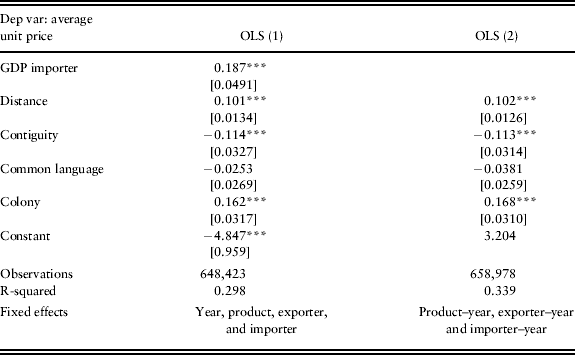
I first test the productivity-sorting model using equation (10). The average unit export f.o.b price doesn't verify the productivity-sorting assumption. While a negative relationship is expected in a productivity-sorting framework, estimation results presented in Table 1 display a positive relationship between average unit f.o.b export prices and distance. Since distance is positively related to average unit price, it is not surprising that sharing a frontier has a negative impact. Sharing a common language is also negatively, although not significantly, related to average unit prices, but having a history of colonial ties has a positive impact on prices. This supports the rejection of the hypothesis of homogenous quality among firms within the horticultural sector. Thus, a comprehensive heterogeneous firm trade model applied to the horticultural sector should also include space for a heterogeneous quality setting. Those results support the assumption that horticultural products are much like industrial products when it comes to sorting out.
Productivity-sorting setting: test on average export unit price (f.o.b)
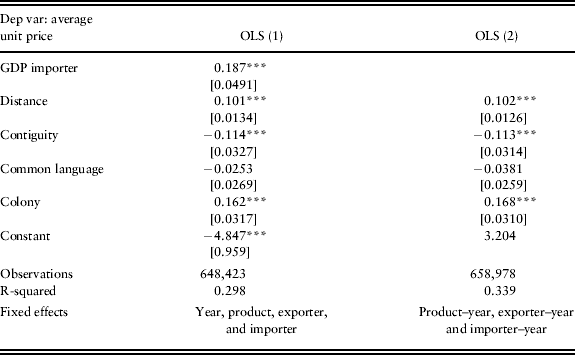
Notes: ***, **, and * respectively indicates significance at the 1%, 5%, and 10% levels. Robust standard errors are clustered at the exporter–importer level.
4.3.2 Evidence on the importance of quality
I first test the empirical setting (13) on the same database used in the previous productivity-sorting test. Comprehensive data on reputation are only available for US imports, but it is still possible to test for the quality and capacity parameters in a multiple importer setting before turning to the more restricted database. As already mentioned, this setting is a reduced form and I thus focus my attention on coefficient variations and signs rather than on their size.
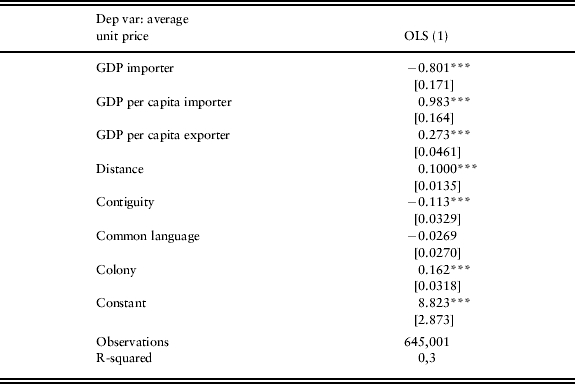
As expected, both GDPs per capita are positively related to average export f.o.b. unit prices as well as distance (Table 2). More surprising is the negative coefficient for importer GDP. Melitz and Ottaviano (2008) as well as Baldwin and Harrigan (Reference Baldwin and Harrigan2009) have already highlighted such results. The former highlight that the size of the market – for which GDP is used as a proxy – affects the toughness of competition to which firms respond through a variation in their mark-ups. This implies that aggregate productivity and average mark-ups respond to the size of the market, and that mark-ups are decreasing in the number of competitors and with the export threshold of the market of destination. Baldwin and Harrigan (Reference Baldwin and Harrigan2009) give one other explanation within their ‘Quality Heterogeneity Firms and Trade’ model. They consider that as export market size increases, more low-quality firms find it profitable to enter. Those low-quality firms (here firms producing productivity products) have a lower mill price. As a consequence, average export f.o.b. price in larger markets are lower. Both assumptions may well explain those results.
PRQ setting without reputation: test on average export unit price (f.o.b)
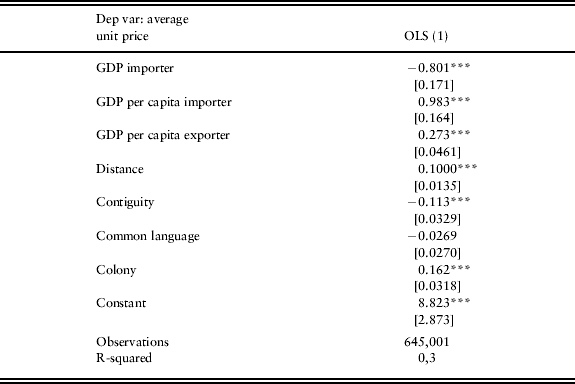
Notes: ***, **, and * respectively indicates significance at the 1%, 5%, and 10% levels. Regression is inclusive of year, product, exporter, and importer fixed effects. Robust standard error is clustered at the exporter–importer level.
These observations and the results obtained are comforting regarding the ability of the model to disentangle the effect of quality and productivity on observed average export prices. On the one hand, I observe the effect of market size that tends to decrease the average export price either through more competition or on the contrary allowing for lower-quality products to enter the market. On the other, high-income markets have a high preference for quality, enabling exporting firms to profitably switch to quality products. Also, results confirm the importance of producer's capacity to produce quality on the mix or proportion of productivity and quality products.
4.3.3 Reputation impact: evidence from the US
In a second step, I test the reputation effect on the US average import price. One might suspect that import refusals are related to GDP per capita. A simple correlation highlights the very limited relation between those two variables. This confirms the relevance of refusals as a good proxy for shocks on the quality valuation parameter.
I first create a dummy variable equal to one if there has been at least one refusal for each exporter/product/year. Refusals counts are endogenous to import levels. If every country has the same probability of having one shipment refused, larger trade flows would result in a higher number of refusals. Thus, a direct use of refusals count is not likely to capture the expected reputation effect. It would inform us on the impact of the addition of one refusal on average export price rather than the impact of the existence of refusals. Moreover, controlling for imports in the regression is problematic since they are highly correlated with other variables used in this specification (e.g. GDP and GDP per capita). Still, using dummy variable risks giving too much weight to marginal refusals. Thus, refusals count is used later on in robustness checks.
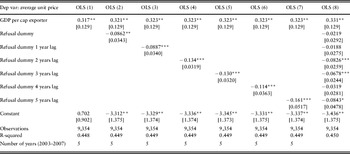
As expected, average f.o.b unit prices are positively related with exporters’ GDP per capita and negatively related to the existence of at least one refusal (Table 3). All other things equal, the occurrence of at least one refusal in the current year reduces average unit export price by 8.26%. This confirms the hypothesis on the effect of a shock to the quality parameter – in other words, to reputation – on the capacity to export quality. Moreover, I observe that the introduction of this parameter slightly increases in magnitude the coefficient on exporter's GDP per capita on unit prices, further highlighting the impact of exporter's capacity to produce quality on average unit export price.
PRQ setting: test on average export unit price (f.o.b)

Notes: ***, **, and * respectively indicates significance at the 1%, 5%, and 10% levels. Each regression is inclusive of year, product, and exporter fixed effects. Robust standard errors are cluster at the product–exporter level.
One could expect refusals to have a lagged influence on prices. I test the same equation using one to five years lagged refusal dummies.Footnote 10 Lagging refusals also suppresses the co-temporality of the data and possible endogeneity issues. Observed coefficients are increasing with the length of the lag. This suggests a long-term effect of refusals that echoes the importance of the earnestness highlighted in this paper. Our database covers ten years. Making further lags implies reducing the panel data to four or less years, resulting in too few observations for results to be reliable. However, tests show that with five year lags, the effect of the occurrence of refusals seems to become less significant. To confirm this, a finite distributed lag model of order five is implemented. The results present a negative sign for all lags of two years and three years that are 1% statistically significant. The estimated long-run propensity is equal to −0.3, corresponding to a reduction by over 25% of the average unit export price, given the occurrence of at least one refusal each and every year for the past five years. Using the simple rearrangement as suggested in Wooldridge (Reference Wooldridge2003), the long-run propensity is found to be 1% statistically significant with a standard error for which the t statistic is about −3.96.
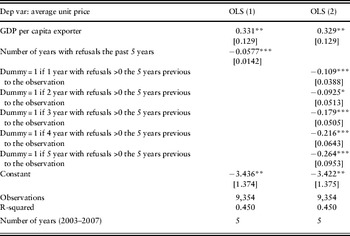
We go further into this intuition with a new set of variables based on the history of occurrence of refusals. The first variable is built as the count of the number of years with an occurrence of at least one refusal over the five years prior to the observation. In a second stage, I build another set of dummies, each representing the five possible values of the latter variable. For example, an observation in 2006, if there was an occurrence of at least one refusal for this specific country/product both in 2003 and 2005, the dummy ‘two year with refusals >0 the past five years’ would be set equal to one. Other variables such as ‘four year with refusals >0 the past five years’ would be equal to zero. Table 4 presents the results of the econometric specification using those variables as proxies for the reputation effect. Results clearly highlight the impact of recurrent refusals: the longer the history of refusals, the more downgrading the impact on average export prices.
PRQ setting with reputation effect in time: test on average export unit price (f.o.b)

Notes: ***, **, and * respectively indicates significance at the 1%, 5%, and 10% levels. Each regression is inclusive of year, product, and exporter fixed-effects. Robust standard errors are cluster at the product–exporter level.
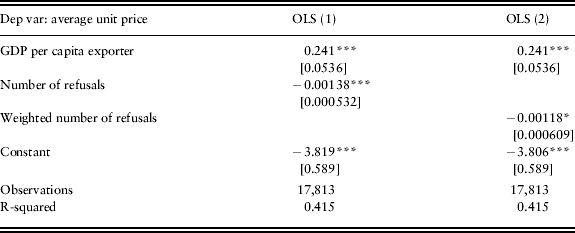
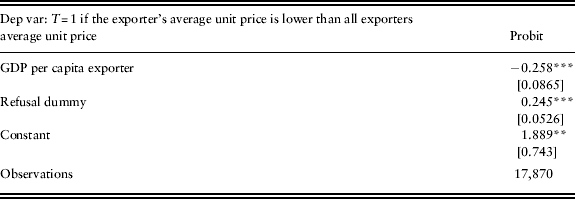
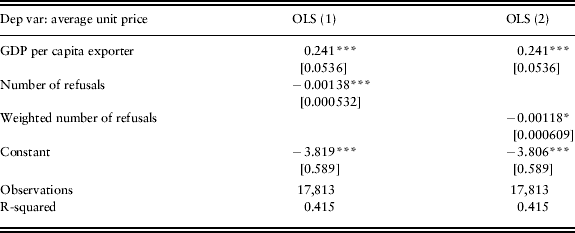
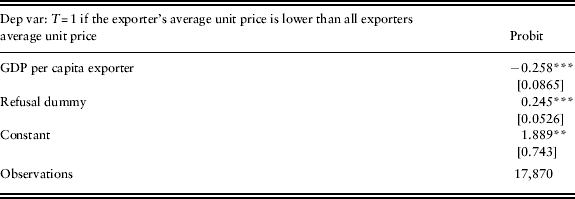
In order to verify the reliability of the use of a refusal dummy, I test the empirical setting using the log of the refusal count, replacing zeros in refusals by 0.001. Second, as aforementioned, one could question the causality between the count of refusals and export quantities. The same empirical setting is tested using an import-weighted number of refusals. This last setting has to be taken with caution because of previously mentioned caveats. Both results, presented in Table 5, confirm the results obtained with the refusal dummy. Finally, the same setting was also tested using a probit. The indicator variable T ijt is defined equal to one if the observed average price of a specific product exported from i to j,  , is lower than the average export price of all exporters of this product to j,
 . Results are consistent with the OLS (Table 6).
PRQ setting: test on average export unit price (f.o.b)
Notes: ***, **, and * respectively indicates significance at the 1%, 5%, and 10% levels. Each regression is inclusive of year, product, and exporter fixed effects. Robust standard errors are cluster at the product–exporter level.
These results confirm the intuition of the importance of quality as well as shocks to reputation in the analysis of horticultural trade flows.
5. Conclusion
Following previous work on the role of productivity in explaining how producers of industrial goods react to exposure to international trade, this paper provides evidence that heterogeneous quality is also a determinant of the capacity to export horticultural products. The paper goes a step further by showing that preference for quality provides a way to create the conditions for increased and more profitable market access. Accordingly, a negative reputation shock conveys a downgrading effect, reducing the ability for countries to export quality products. Exporting a mix of compliant and non-compliant products can reduce the opportunity to and benefits of trade in HCAs. Analyzing the effect over time, this paper highlights the importance of the exporters’ earnestness.
PRQ setting: probit on average export unit price (f.o.b). <all exporters average export unit price (f.o.b)
Notes: ***, **, and * respectively indicates significance at the 1%, 5%, and 10% levels. Each regression is inclusive of year, product, and exporter fixed effects. Robust standard errors are clustered at the product–exporter level.
On a policy-oriented level, those results give further credential and support to the current aid for trade agenda in agriculture. Particularly, the agenda calls for innovative initiatives to better inform and support producers in complying with standards so as to more easily differentiate production toward HCAs. In some areas of Madagascar as well as in countries of Central America, the strong involvement of the private sector in securing a safe and stable supply of horticultural products has been decisive in the development of the sector and allowed for a sensible improvement of producers’ conditions.Footnote 11
This paper also highlights the importance of the implementation of public/private partnerships in particular in the setting and harmonization of domestic and international standards. Such initiatives already proved to be successful in various countries. In Guatemala, the Guatemalan Exporters Association in cooperation with various domestic and international public institutions greatly facilitated both the development and the sustainability of Guatemalan's high-quality exports through capacity building, knowledge transfer, and international visibility of the sector. In Peru, the food safety outbreak on asparagus underlined that one careless exporter could disrupt markets. As a consequence, the public and private sector in Peru understood that all stakeholders in the export chain needed to be involved in joint actions to prevent future problems. Accordingly, they implemented an important program of standards harmonization that is now the mainstay of the country's success in HCAs exports.