Introduction
Understanding factors that influence attraction of tephritid fruit flies (Diptera: Tephritidae) to objects can lead to development of more sensitive traps, which are needed to maximise detection of flies for management and quarantine purposes. Trap systems differ in their attractiveness to tephritid flies due to many factors, including trap shape, colour, fluorescence, and olfactory cues (e.g., Prokopy Reference Prokopy1968; Reissig Reference Reissig1975; Burditt Reference Burditt1988; Jones and Davis Reference Jones and Davis1989; Agnello et al. Reference Agnello, Spangler and Reissig1990; Katsoyannos et al. Reference Katsoyannos, Papadopulos and Stavridis2000; Pelz-Stelinski et al. Reference Pelz-Stelinski, Gut, Stelinski, Liburd and Isaacs2005). In addition, colour contrast of objects with surroundings, due in part to light level differences, affects fly responses. Apple maggot fly, Rhagoletis pomonella (Walsh), was more attracted to light coloured spheres against a dark background but was more attracted to dark red spheres against a lighter background (Owens and Prokopy Reference Owens and Prokopy1984, Reference Owens and Prokopy1986; Prokopy Reference Prokopy1986).
Although contrast is directly related to ambient light conditions, the importance of ambient light levels on the attractiveness of a trap itself to tephritid fly responses has not, to the author’s knowledge, been examined. Positive phototaxis is a well-known phenomenon in insects (e.g., Jander Reference Jander1963; Menzel and Greggers Reference Menzel and Greggers1985; Sivinski Reference Sivinski1998; Cloyd et al. Reference Cloyd, Dickson, Larson and Marley2007). The presence of houseflies, Musca domestica (Linnaeus), on windows inside dim buildings indicates these flies seek light and also respond positively to light contrast (e.g., Goldsmith and Fernandez Reference Goldsmith and Fernandez1968; Zabłocka Reference Zabłocka1972; Howard and Wall Reference Howard and Wall1998). Light passage through a window could be similar to light passage through a translucent sticky yellow trap. Fungus gnats (Diptera: Sciaridae) also gather near lighted windows in greenhouses (Karren and Roe Reference Karren and Roe2000).
Western cherry fruit fly, Rhagoletis indifferens Curran, is a major quarantine pest of cherries (Prunus Linnaeus, Rosaceae) in the western United States of America and in British Columbia in Canada that responds readily to sticky yellow rectangle traps (Yee Reference Yee2012, Reference Yee2013, Reference Yee2014). Such traps deployed in unmanaged cherry trees or orchards are used to detect flies as the basis for timing insecticide sprays (AliNiazee Reference AliNiazee1981). Yellow rectangle traps potentially can also be used for establishing areas of low pest prevalence, as done for tropical fruit flies (Food and Agriculture Organization 2011). However, not all yellow rectangle traps are the same, with some clearly more attractive than others (Yee Reference Yee2012, Reference Yee2013, Reference Yee2014). Differences may be due to shades of yellow but also colour contrast, as yellow spheres are more attractive than red spheres in the dark understorey of cherry trees (Yee Reference Yee2013). Thinner plastic traps viewed from the tree trunk are brighter to human and presumably to fly eyes than thicker cardboard traps due to greater light passage (Yee Reference Yee2014), although light passage through traps has never been quantified. However, by allowing more light passage, plastic traps may be less bright than cardboard traps when viewed from outside of trees and attract fewer flies. These hypotheses have yet to be tested.
The objective of this study was to determine if differences in attractiveness between translucent yellow traps to R. indifferens depend on ambient light intensity and direction. Hypotheses tested in the laboratory were: (1) higher than lower light passage through yellow traps attracts more flies that approach traps from opposite the light source; (2) yellow traps that reflect more light attract more flies that approach traps from the same direction as the light source. Field tests were also conducted to support laboratory findings of light direction effects.
Materials and methods
Flies for laboratory experiments
Flies used in laboratory experiments were collected in June and July 2013 as larvae in field-infested sweet cherries (Prunus avium (Linnaeus) Linnaeus) in central Washington, United States of America. Cherries were placed on hardware cloth screens suspended in tubs for larvae to exit. Larvae dropped into the tubs and pupated. Pupae were held in moist soil at 3–4 °C for approximately six months, and then at 22–24 °C, 16–30% relative humidity, and 16:8 light:dark photoperiod for adult emergence. Flies were kept on water and dry 80% sucrose and 20% yeast extract inside 10.2 cm diameter by 16.2 cm high paper containers at 30 males and 30 females per container and aged until 10–14 days old for testing.
Yellow rectangle traps
The Yellow Sticky Strip (YSS) trap and Alpha Scents (AS) trap were tested (YSS trap: AgriSense-BCS Limited, TreForest Industrial Estate, Pontypridd, South Wales, United Kingdom; AS trap: AlphaScents™, West Linn, Oregon, United States of America). Previous tests had suggested they are the most attractive traps available against R. indifferens (Yee Reference Yee2011, Reference Yee2014). Both traps are covered with a sticky pressure sensitive adhesive. The YSS trap was a high impact polystyrene (plastic) 0.30 mm thick, with colour space values of L*=72.53, a*=−13.81, and b*=56.06 (Chroma Meter CR-400/410, Konica Minolta Sensing, Inc., Tokyo, Japan) and with peak reflectance of 0.6406 at 580 nm (Perkin-Elmer Lambda 9 UV-Vis-NIR Spectrophotometer, Akron, Ohio, United States of America; Avian Technologies LLC, Sunapee, New Hampshire, United States of America). The AS trap was cardboard 0.43 mm thick, with colour space values of L*=92.94, a*=−15.51, and b*=71.90 and with peak reflectance of 0.7934–0.7998 at 680–820 nm. Traps were cut so that they fit over rectangular openings in cardboard on the side of the test box or cage (next two sections).
Choice experiments, light opposite approaching flies
Choice tests simulated a setting where flies approach traps from the dimmer interior of a tree to the brighter periphery of the tree facing the sun’s incoming rays. Two choice experiments were conducted using a 48 cm long by 61 cm wide by 47 cm high closed cardboard box, with white plastic on its ceiling. Traps were placed over two or three 17.8 cm high by 8.3 cm wide openings cut in the box. Light was shone on the traps from outside the box. Each light source was a 5.7 cm diameter bright white, low heat light-emitting diode (LED) bulb (Philips Lighting Co., Somerset, New Jersey, United States of America) with colour temperature of 3000 K. The bulb was installed in a light clamp reflector that directed light forward, preventing scatter behind the bulb. To prevent light scatter to the sides, the bulb and reflector was placed in between two cardboard barriers. Light levels among traps were varied by positioning the bulb different distances away from traps. A 10 cm diameter hole in the middle of the box 48 cm opposite the traps was used for fly release. Temperatures inside the box were 27–29 °C and the relative humidity was 16–30%.
Light intensities (lumens/m2=lm/m2) inside the box (mean from top, bottom, and sides) and light that passed through traps (2 mm away) were measured using a J6511 illuminance probe attached to a portable J16 digital photometer/radiometer (Tektronix®, Beaverton, Oregon, United States of America). Light level treatments were chosen so the light did not increase temperatures at the traps by more than 0.3 °C. The same methods were followed for no-choice experiments (next section).
Choice experiment 1 was a three-choice design, testing YSS and AS traps separately. A trap was taped over each of three openings spaced 8.2 cm apart on the box. Low, medium, and high light levels tested were 54 (bulb turned off), 2367 (bulb 34 cm from trap), and 20 229 lm/m2 (bulb 114 cm from trap). Mean light intensity inside the box was 144 lm/m2. Choice experiment 2 was a two-choice design directly comparing YSS versus ASS traps, set up to test the hypothesis that flies respond more to light passage than trap type. The middle opening of the box was covered, leaving the openings 23 cm apart on either side for traps. Light shone on the AS trap was constant at 20 229 lm/m2 (bulb 32 cm from trap). Light shone on the YSS trap was 20 229, 269, and 2367 lm/m2, so that, relative to the AS trap, more, less, or the same amount of light passed through, respectively. Mean light intensities inside the box were 18–109 lm/m2.
For both choice experiments, 30 female and 30 male flies were released. Lights were turned on one minute after fly release. Numbers of flies caught on traps over 2.5 hours were recorded. Five replicates were conducted, each on a different day. Trap positions were rotated (experiment 1) or switched (experiment 2) each test day to reduce position effects.
No-choice experiments
Two no-choice experiments were conducted using a 61 by 61 cm square aluminium frame cage with grey window screen (1.6 mm openings), one with the light source inside the cage (experiment 1) and the other with the source outside the cage (experiment 2; see next two paragraphs). Cardboard was fitted onto the front and back sides of the cage. A YSS or AS trap was taped over a 16.5 cm high by 10 cm wide opening in the centre of the front cardboard. The light source was a 10 cm diameter soft white, low heat 11.5 Watt LED bulb (65 W equivalent) of 2700 K (Ecosmart™, LSGC Innovation Center, Satellite Beach, Florida, United States of America) installed in a clamp light reflector to direct light forward. Light levels were controlled using a rheostat (Powerstat®, The Superior Electric Co., Bristol, Connecticut, United States of America). The top and sides of the cage were covered with a double sheet of white polyester-cotton fabric (Sheermist White, Walmart, Bentonville, Arkansas, United States of America) to remove visual cues in the room. Temperatures were 26–27 °C and the relative humidity was 16–20% inside the cage. Thirty female and 30 male flies were released opposite the trap. Lights were turned on one minunte after fly release. Numbers of flies caught on traps over seven hours were recorded. For both experiments, six replicates were conducted, each on a different day.
No-choice experiment 1 simulated the same situation as in choice tests. Light intensity shone directly on both YSS and AS traps from outside the cage was 108 (bulb off), 1237, or 5057 lm/m2. To reduce light from scattering to sides, the bulb with reflector was placed in between two Styrofoam™ boards attached to the test cage. Mean light intensities inside the cage were 56–77 lm/m2.
No-choice experiment 2 simulated a situation where flies approach YSS or AS traps from the sunny exterior to darker interior of trees. The light bulb and reflector was attached to a bar on a stand inside the cage and light directed on YSS or AS traps 24 cm away at 43, 667, or 2690 lm/m2. Light intensities 23 cm from the two traps inside the cage were also measured. Mean light intensities inside the cage were 56–2157 lm/m2 for low to high light levels.
Field choice experiment
To support laboratory findings on light direction effects on differential attractiveness of YSS and AS traps, a field experiment comprising three tests was conducted in June to July 2014, one each in a sweet cherry tree in Kennewick (46.2013°N, 119.2715°W), Yakima (46.6062°N, 120.4921ºW), and Cle Elum (47.1938°N, 120.9234°W), Washington. All three trees were ~10–12 m in diameter and ~14–15 m tall. YSS and AS traps were 14 cm wide and 20.3 cm high, each baited with 10 g of ammonium carbonate in a plastic vial with two 1 mm holes to draw flies into the trap area. Each set of YSS and AS traps was paired 0.3–0.8 m apart, 0 to ~2 m away from the tree edge and ~2.5–3 m above ground. One side of each trap faced the direction of the sun during 1000–1300 hours. Each trap was attached to a branch using three wire ties to maintain its direction to the sun. In Kennewick, five pairs of YSS and AS traps were set up in south and in north halves of the tree on 4 June and replaced on four dates until 20 June. Positions of traps within a pair were switched on each date. The mean daily high temperature during the 16-day test was 30.2 °C. In Yakima and Cle Elum, four pairs of traps were set up on the south half of trees on 18 June and replaced on eight dates until 8 July and on 9 July and replaced on six dates until 31 July, respectively. In Yakima and Cle Elum, mean daily high temperatures during the 20-day and 22-day tests were 29.7 °C and 26.5 °C, respectively.
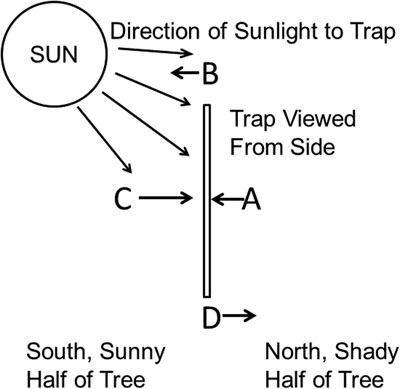
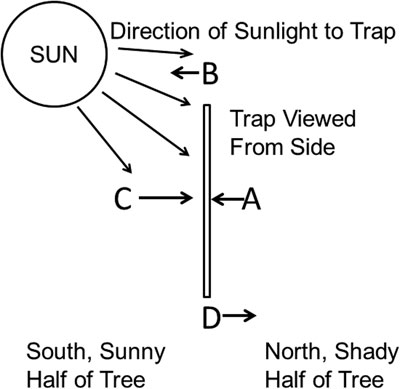
All flies caught on traps were counted and sexed. Light readings were made around each trap (Fig. 1) between 1200 and 1300 hours before traps were replaced. The key measure was light passage through traps (location A in Fig. 1). Light readings 1.5 m above ground as indicators of light levels beneath tree canopies were also made.
Diagram of four locations (A, B, C, and D) of light intensity readings around traps with respect to the sunlight direction between 1200 to 1300 hours in field tests in sweet cherry trees in Kennewick, Yakima, and Cle Elum in Washington, United States of America in June and July 2014. Arrows in front of letters indicate directions the illuminance probe was aimed. Distance of A from the trap was ~2 cm; of C to trap, ~12 cm.
Statistical analysis
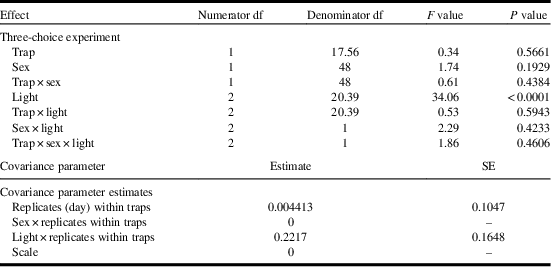
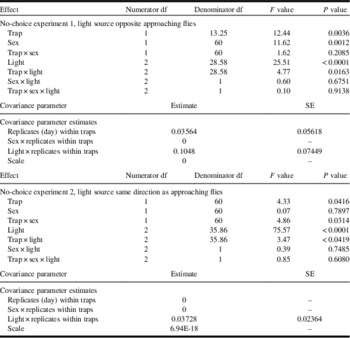
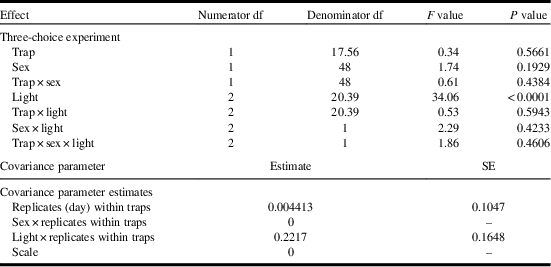
Choice experiment 1 and no-choice experiments were considered a split–split plot design and were analysed using a mixed model analysis of variance. The fixed effects were trap, sex, light, and the interactions. The random effects were replicates (days) within traps, sex×replicates within traps, and light×replicates within traps. The SAS PROC GLIMMIX command (SAS Institute Inc. 2010) was used to fit the model. Light treatment was also fitted as a continuous covariate by removing it from the CLASS statement in SAS code, but it was fitted as a linear effect, resulting in a poor fit to the model and thus had a negative effect on the power of the tests. PROC GLIMMIX allowed use of a discrete distribution to model the counts instead of having to use a normalising transformation, which was problematical in some treatments due to low or zero counts. The “ddfm=kr” option in SAS code was used to specify the recommended method for approximating the error degrees for combinations of the variance component estimates for the random effects that were used to test the fixed effects. When there was a significant light×trap interaction, simple effects analyses using the slicing technique in SAS (SAS Institute Inc. 2010) was conducted, with day as a block followed by Tukey’s honestly significant difference (HSD) test for means separation. Paired sample t-tests were used to analyse fly captures (square-root transformed) in choice experiment 2 and in the field experiment.
Results
Choice experiments 1 and 2, light source opposite approaching flies
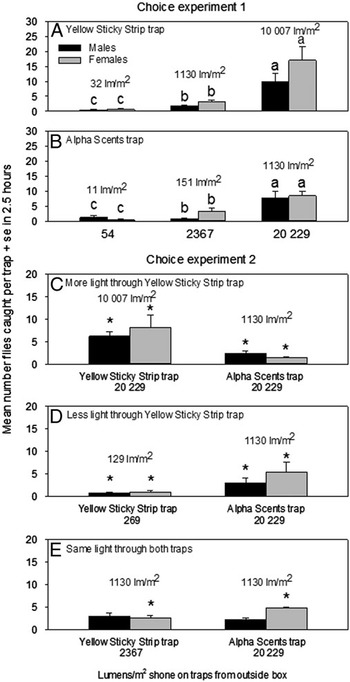
In the three-choice experiment (1) using YSS and AS traps (Table 1, Figs. 2A, 2B), more male and female flies were attracted to traps that received greater light levels. Trap, sex, and interaction effects were not significant. In the two-choice experiment (2), more flies were attracted to the trap with greater light passage, whether it was the YSS (Fig. 2C) or the AS (Fig. 2D). When light passage through YSS and AS traps was the same (Fig. 2E), more females although not males were attracted to the AS trap.
Choice laboratory experiments 1 and 2: mean numbers of male and female Rhagoletis indifferens caught per trap+SE on (A) Yellow Sticky Strip and (B) Alpha Scents traps that received three light levels from outside test box, and on Yellow Sticky Strip versus Alpha Scents traps with (C) more light through Yellow Sticky Strip trap; (D) less light through Yellow Sticky Strip trap; and (E) same light through both traps. Values above bars are mean light intensities that passed traps. For (A) and (B), means within sexes and traps with same letters are not significantly different (honestly significant difference [HSD] test, P>0.05). For (C–E), means within sexes with asterisks indicate significant differences (paired-sample t-tests, P<0.05).

Results of mixed model analysis of variance of choice experiment 1 testing responses of Rhagoletis indifferens to traps and light intensities.
No-choice experiment 1, light source opposite approaching flies
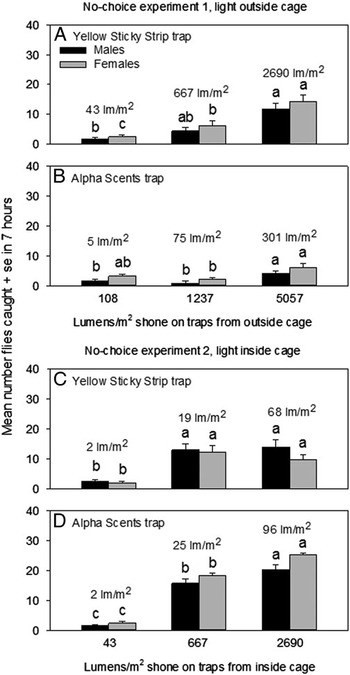
When light was shone on traps opposite approaching flies, there were significant trap, sex, and light effects (Table 2, Figs. 3A, 3B). More females than males were attracted to both traps. There was also a trap×light interaction: at medium and high light levels, the YSS was more attractive than the AS trap; at the low light level, there was no difference between traps. For the YSS trap (Fig. 3A), males did not differ in their attraction to medium and high light levels, but females were more attracted to the high than medium light level. For the AS trap (Fig. 3B), males and females were more attracted to the high than medium light level, but female attraction to low and high light levels did not differ.
No-choice laboratory experiments 1 and 2: mean numbers of male and female Rhagoletis indifferens caught per trap+SE on (A) Yellow Sticky Strip and (B) Alpha Scents traps that received three light levels from outside test cage, and on (C) Yellow Sticky Strip and (D) Alpha Scents traps that received three light levels from inside test cage. Values above bars are mean light intensities that passed through (A and B) or were reflected off (C and D) traps. Means within sexes and traps with same letters are not significantly different (honestly significant difference [HSD] test, P>0.05).

Results of mixed model analysis of variance of no-choice experiments 1 and 2 testing responses of Rhagoletis indifferens to traps and light intensities.

No-choice experiment 2, light source same direction as approaching flies
When light was shone on traps in the same direction as approaching flies, there were significant trap, trap×sex, light, and trap×light effects (Table 2, Figs. 3C, 3D). Unlike in no-choice experiment 1, more flies were attracted to the AS than YSS trap at medium and high light levels. As in that experiment, though, the trap×light interaction arose because there was no difference between traps at the low light level. The trap×sex interaction indicated responses by the sexes depended on trap: for the YSS trap (Fig. 3C), males and females did not differ in their attraction to medium and high light levels; however, for the AS trap (Fig. 3D), both sexes were more attracted to the high than medium light level.
Field choice experiment
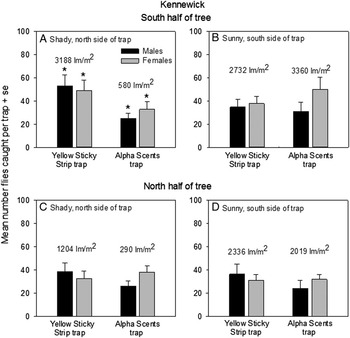
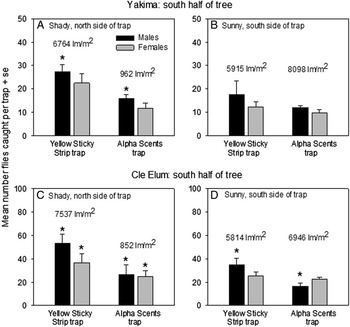
In Kennewick on the south half of the tree (Fig. 4A), more males and females were caught on the shady side of the YSS than AS trap, but there were no differences on the sunny side of the two traps (Fig. 4B). On the darker north half of the tree (Figs. 4C, 4D), numbers of flies caught on the shady or sunny side of YSS and AS traps did not differ. Results in Yakima and Cle Elum (Figs. 5A–5D) on the south half of trees were similar to those in that half of the Kennewick tree, with two exceptions. In Yakima, numbers of females caught on the shady side of YSS and AS traps in Yakima did not differ statistically; in Cle Elum, more males were caught on the sunny side of the YSS than AS trap. More light passed through the shady side (location A in Fig. 1) of YSS than AS traps in all three trees (Fig. 4, 5), but light levels at other locations around traps were similar.
Field choice test in June 2014 in Kennewick, Washington, United States of America: mean numbers of male and female Rhagoletis indifferens caught per trap+SE on Yellow Sticky Strip and Alpha Scents trap on the south half of a sweet cherry tree on the (A) shady, north-facing side of trap; (B) sunny, south-facing side of trap; (C, D) on two sides of traps in the north half of the tree. Values above bars are mean light intensities on shady (A, C) or sunny sides (B, D) of traps between 1200 and 1300 hours. Light readings 1.5 m above ground on south and north halves were 3000–11 000 and 1100–6000 lm/m2, respectively. Within sexes, means of traps with asterisks are significantly different (paired sample t-tests; df=4; P<0.05).

Field choice tests in June to July 2014 in Yakima and Cle Elum, Washington, United States of America: mean numbers of male and female Rhagoletis indifferens caught per trap+SE on Yellow Sticky Strip and Alpha Scents trap on the south half of sweet cherry trees: Yakima, (A) shady, north-facing side of trap; (B) sunny, south-facing side of trap; (C, D) two sides of traps in Cle Elum. Values above bars are mean light intensities on shady (A, C) or sunny sides (B, D) of traps between 1200 and 1300 hours. Light readings 1.5 m above ground on the south half were 2000–5000 and 11 000–20 444 lm/m2 in Yakima and Cle Elum, respectively. Within sexes, means of traps with asterisks are significantly different (paired sample t-tests; df=3; P<0.05).

Discussion
The hypothesis that higher than lower light passage through yellow traps attracts more R. indifferens that approach traps from opposite the light source was supported in laboratory choice experiments 1 and 2 and no-choice experiment 1. The two-choice experiment comparing YSS and AS traps also suggests that light intensity passing traps in a dim setting is more important for attracting flies than the colour or reflectance of traps. In M. domestica and Lucilia Robineau-Desvoidy (Diptera: Calliphoridae), light intensity in the 400–525 nm region plays a greater role in attraction than hue (Zabłocka Reference Zabłocka1972). Drosophila melanogaster Meigen and Drosophila simulans Sturtevant (Diptera: Drosophilidae) preferred higher light intensities within a light gradient of 10 to 590 lm/m2 (Parsons Reference Parsons1975). Fungus gnats, Bradysia Winnertz (Diptera: Sciaridae), also preferred the highest light intensities in choice tests (Cloyd et al. Reference Cloyd, Dickson, Larson and Marley2007).
In the laboratory, light contrast between traps and dim surroundings was increased with greater light intensity shone on traps from outside the cage. Higher contrast created by greater light intensity was probably more responsible for elevated positive responses by R. indifferens to traps than light intensity itself. Contrast cues are used by R. pomonella for attraction to objects (Owens and Prokopy Reference Owens and Prokopy1984) and by other insects. In the field, contrast with the background seems attractive to Caribbean fruit fly, Anastrepha suspensa (Loew) (Diptera: Tephritidae): an orange trap that contrasted strongly with a green foliage background caught the most flies (Greany et al. Reference Greany, Agee, Burditt and Chambers1977). European cherry fruit fly, Rhagoletis cerasi (Linnaeus) (Diptera: Tephritidae), preferred to oviposit in artificial fruit that contrasted with the background (Levinson and Haisch Reference Levinson and Haisch1984).
The hypothesis that yellow traps which reflect more light attract more R. indifferens that approach traps from the same direction as the light source was supported in laboratory no-choice experiment 2. Unlike when the light source was opposite approaching flies, where more flies were attracted to the YSS trap, here more flies were attracted to the AS trap. In both cases, it appears the most illuminated traps were most attractive. However, because high light intensity shone on AS traps inside the cage resulted in low contrast (the cage was more lit than in no-choice experiment 1), it is unclear if contrast in this case played a role in attractiveness of traps.
Field tests generally supported laboratory findings of light passage through traps increasing trap attractiveness to R. indifferens. The greater captures of field flies on the north, shady side of the YSS than AS trap could be due to higher sunlight intensity passing the YSS trap, consistent with laboratory results, during morning to midday hours. Flies are most abundant at this location from 0800–1400 hours (Yee Reference Yee2002), when light passage through traps would be greatest. Field results from the Kennewick tree also suggest fly captures on the YSS and AS traps were affected by light levels surrounding traps. In the south half of the tree where light intensity was higher, the YSS trap was more attractive than the AS trap. However, in the darker north half, greater light passage through the YSS than AS trap appeared to be neutralised, possibly because the greater light passage did not reach a critical level to stimulate greater fly responses. Alternatively, higher temperatures in the south half of trees could have increased fly activity levels.
Similar numbers of or fewer flies were caught on the sunny side of the AS than YSS trap in the field when it was expected to catch more flies based on laboratory light reflectance results. Several possible reasons could explain this discrepancy. Natural sunlight on the sunny side of the two traps made the traps similarly bright or the yellow colours similarly attractive, unlike using artificial light. Light intensity and light direction change during the day, such that light was not reflected from traps to the same degree or angle as in the laboratory. Light intensities in the current study were measured only between 1200 and 1300 hours for practical reasons. Cloud cover and strong winds caused leaves, fruit, branches, and traps to move, making light exposure to traps dynamic.
Traps were baited with ammonia to attract flies, so scent and therefore wind direction could play a role in the attraction and direction in which a fly might approach a trap. However, these factors probably are not reasons for the greater captures of flies on the shady side of YSS traps in the south side of trees. First, both YSS and AS traps were baited with ammonia; second, the traps were paired only 0.3–0.8 m apart. Being so close, wind and scent direction would have similar effects on the two traps. Third, switching trap positions in the experimental protocol reduced the possibility that crosswinds would bias captures on one or the other trap within a pair. Finally, similar results were seen at three sites, where wind directions were unlikely identical.
Results suggest that for optimising detection of R. indifferens originating within trees, YSS traps should be hung in the south periphery, facing the sun. Flies that originate outside a tree could be detected equally using the YSS or AS trap. Orchards could be ringed with YSS or AS traps to intercept flies, as done using red spheres in apple orchards against R. pomonella (Prokopy et al. Reference Prokopy, Johnson and O’Brien1990). However, factors such as attractiveness to non-target insects and duration of trap stickiness also need to be considered when deciding which trap to use.
Altogether, results suggest trap placement with respect to sunlight intensity and direction affects light passage and the attractiveness of yellow traps to R. indifferens. In addition to an attractive yellow colour, an optimal yellow trap must allow sufficient light passage so that it is attractive under a wide range of light intensity and direction conditions in the field. Such a trap could maximise detection of flies for quarantine purposes and could be developed with the aid of information obtained in the current study.
Acknowledgements
The author thanks Peter Chapman and Janine Jewett (United States Department of Agriculture, Agricultural Research Service, Wapato, Washington) for laboratory assistance; Roger Vargas (Daniel K. Inouye United States Pacific Basin Agricultural Research Center, United States Department of Agriculture, Agricultural Research Service, Hilo, Hawaii), and Juan Rull (Instituto de Ecología, Veracruz, Mexico) for reviewing early drafts of the manuscript; two anonymous reviewers for helpful comments; and Bruce Mackey (United States Department of Agriculture, Agricultural Research Service, Albany, California) for statistical advice.