INTRODUCTION
The shortfin mako shark, Isurus oxyrinchus Rafinesque, 1810, is distributed circumglobally in all warm-temperate and tropical seas (Compagno, Reference Compagno2002). It is a common and extremely active shark found in both coastal and oceanic waters, seldomly occurring in waters below 16°C, from the surface to depths of at least 500 m (Compagno, Reference Compagno2002). In the north Atlantic, the distribution range of I. oxyrinchus extends from Norwegian waters to the north-western African coast, and from Newfoundland to the Gulf of Mexico (Ebert & Stehmann, Reference Ebert and Stehmann2013). The historical and contemporary occurrence of the shortfin mako shark in the Mediterranean, where it is caught mainly in tuna and occasionally in swordfish fisheries (Megalofonou et al., Reference Megalofonou, Damalas and Yannopoulos2005a, Reference Megalofonou, Yannopoulos, Damalas, De Metrio, Deflorio, De La Serna and Maciasb; Serena, Reference Serena2005), is well-documented both in general ichthyological (e.g. Carus, Reference Carus1889–1893; Hoffman & Jordan, Reference Hoffman and Jordan1892; Quéro, Reference Quéro, Whitehead, Bauchot, Hureau, Nielsen and Tortonese1984; Papaconstantinou, Reference Papaconstantinou1988; Lythgoe & Lythgoe, Reference Lythgoe and Lythgoe1991; Bradai et al., Reference Bradai, Quignard, Bouain, Jarboui, Ouannes-Ghorbel, Ben Abdallah, Zaouali and Ben Salem2004; Golani et al., Reference Golani, Öztürk and Başusta2006) and in shark-specific studies (e.g. Tortonese, Reference Tortonese1956; Capapé, Reference Capapé1977; Lipej et al., Reference Lipej, De Maddalena and Soldo2004; Golani, Reference Golani, Başusta, Keskin, Serena and Seret2006; Hadjichristophorou, Reference Hadjichristophorou, Başusta, Keskin, Serena and Seret2006; Saad et al., Reference Saad, Ali, Seret, Başusta, Keskin, Serena and Seret2006).
The first account of the occurrence of I. oxyrinchus in Turkish waters was made by Akşıray (Reference Akşıray1954; in Bilecenoğlu et al., Reference Bilecenoğlu, Taşkavak, Mater and Kaya2002). In his monumental work on Turkey's marine fishes, Akşıray (Reference Akşıray1954) reported on the occurrence of the shortfin mako shark in Turkey's seas without providing precise information on where the examined specimens was caught or preserved for further inspection. Following Akşıray's (Reference Akşıray1954) record, a number of further records on the presence of I. oxyrinchus in Turkey's seas have been reported by several authors (Geldiay, Reference Geldiay1969; Akşıray, Reference Akşıray1987; Mater & Meriç, Reference Mater, Meriç, Kence and Bilgin1996; Kabasakal, Reference Kabasakal2002; Kabasakal & De Maddalena, Reference Kabasakal and De Maddalena2011; Ergüden et al., Reference Ergüden, Gürlek and Turan2013; Kabasakal & Kabasakal, Reference Kabasakal and Kabasakal2013).
As a result of the intensive efforts made to research the sharks of Turkey over the last two decades, increasing numbers of lamniform sharks have been recorded off the Turkish coasts of the Aegean and Mediterranean seas (Kabasakal, Reference Kabasakal2007, Reference Kabasakal2008, Reference Kabasakal2014; Kabasakal & Karhan, Reference Kabasakal and Karhan2007; Kabasakal & Gedikoğlu, Reference Kabasakal and Gedikoğlu2008; Kabasakal et al., Reference Kabasakal, Yarmaz and Gedikoğlu2009, Reference Kabasakal, Dalyan and Yurtsever2011; Kabasakal & Kabasakal, Reference Kabasakal and Kabasakal2013). Free-swimming new-borns and young specimens exhibit a considerable abundance among the recent lamniform catches off Turkey's coast. Preliminary results of the above-mentioned reports suggest the possibility of a nursery ground of Carcharodon carcharias and I. oxyrinchus in the region, mainly along the Turkish coast of the northern Aegean Sea (Kabasakal & Gedikoğlu, Reference Kabasakal and Gedikoğlu2008; Kabasakal & Kabasakal, Reference Kabasakal and Kabasakal2013). Since the aforementioned coastal area is intensively used for the purposes of fishing, aquaculture and recreational activities, the seasonal occurrence of the lamniform sharks in this region should be monitored regularly.
Since 2000, the Ichthyological Research Society (IRS), a non-governmental and non-profit institution dedicated to the research of sharks, has been making remarkable efforts to obtain information on the historical and contemporary occurrence of sharks in Turkey's seas, and to create a database. Records of large elasmobranchs comprise a significant part of the overall research. The present article reports on the recent records of I. oxyrinchus in Turkey's seas and discusses the possibility of a breeding or nursery ground of the species in the study area. Furthermore, it will discuss the current status of the occurrence of the shortfin mako shark in Turkey's seas, based on new and published data.
MATERIAL AND METHODS
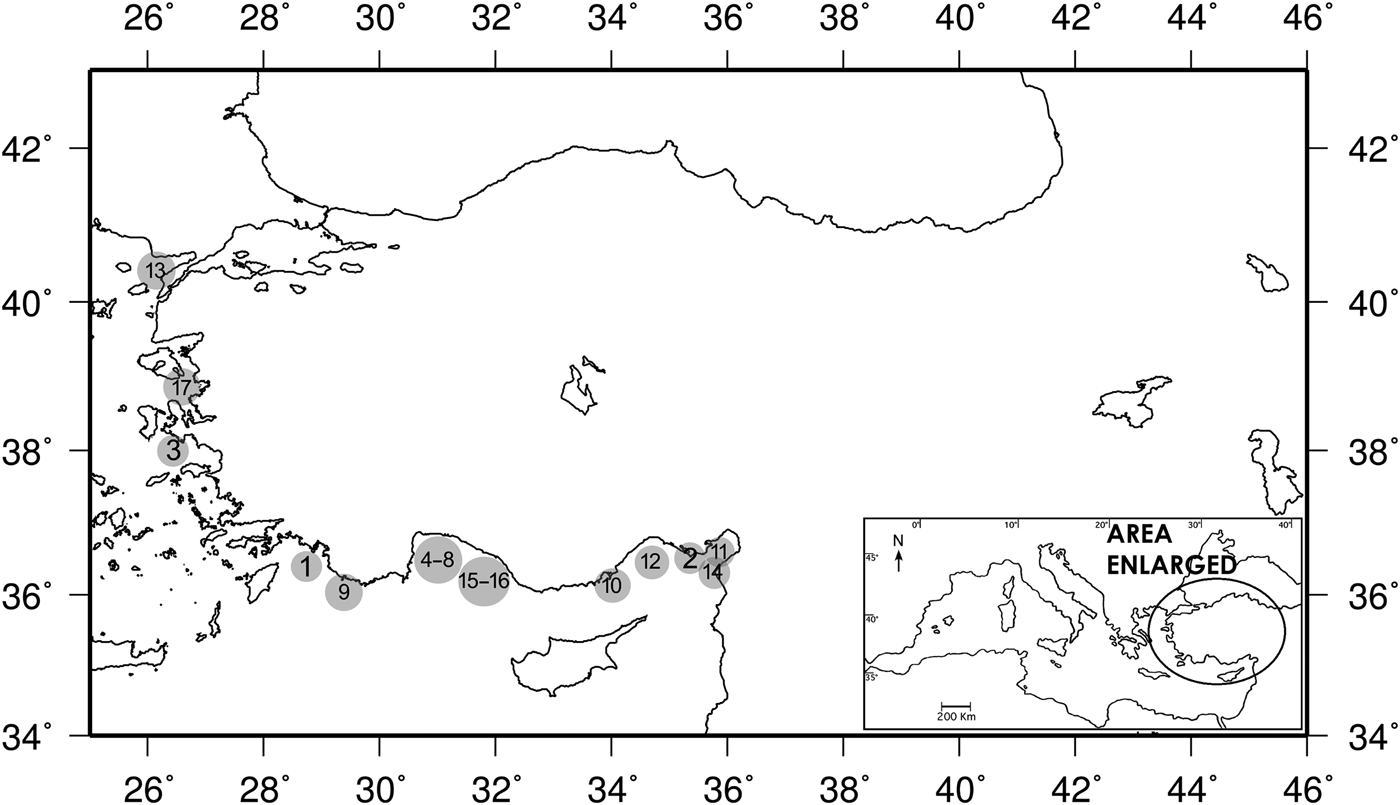
Data on Isurus oxyrinchus specimens examined in the present study were obtained from the following sources: (1) inventory studies on Turkey's marine fishes; (2) specimens preserved in private, public or university collections; (3) press, media or internet news on the capture of large sharks, in accordance with the good practice methods proposed by Bello et al. (Reference Bello, Causse, Lipej and Dulčić2014) for verifiable ichthyological records – a photograph clearly depicting the I. oxyrinchus specimen will accompany this; and (4) field surveys in fishing ports along the Aegean and Mediterranean coasts of Turkey (Figure 1). Whenever possible, the following data was recorded for the examined specimens: total length (TL, cm), weight (W, g), sex, date and locality of capture, and type of fishing gear. The TL represents a horizontal line from the tip of the snout to the tip of the upper lobe of the caudal fin, where the caudal fin is depressed to the body axis (Compagno, Reference Compagno2002). Only the precaudal length (PCL) was measured in taxidermied sharks due to shrinkage of the dried specimens. The PCL represents the length from the tip of snout to the upper origin of the caudal fin (Compagno, Reference Compagno2002). Two species of the genus Isurus occur in the Mediterranean Sea (oxyrinchus and paucus), and the primary diagnostic criteria separating these two species is the proportion of head length to pectoral fin length (Serena, Reference Serena2005). In the photographic identification of the species, Klonk Image Measurement software (Image Measurement Corporation) was used for image analysis of the aforementioned morphometric proportions. Species identification and nomenclature follows Compagno (Reference Compagno2002) and Serena (Reference Serena2005). The numbers of adults and juveniles were compared using a t-test (P < 0.05; statistical function of Microsoft Excel 2013), to clarify the possibility of a nursery ground of I. oxyrinchus in the study area (null hypothesis). Photographs and raw data of the examined specimens are deposited in the archives of IRS and are available for inspection on request.
Map showing the localities of historical and contemporary records of shortfin mako shark, Isurus oxyrinchus Rafinesque, 1810, off Turkey's Aegean and Mediterranean coasts. Numbers correspond to the specimen numbers provided in Table 1.

RESULTS
Species description
Based on the diagnostic criterion and morphometric proportions given by Compagno (Reference Compagno2002) and Serena (Reference Serena2005), all of the examined specimens (N = 7) were identified as Isurus oxyrinchus. The following species description is based on the examined specimens in the present study: a spindle-shaped moderately slender fusiform body, with an acutely pointed snout and relatively small eyes (Figure 2A, B). Ventrally, mouth U-shaped, with lower anterior teeth strongly protruding and horizontal on jaws, even when mouth is closed (Figure 2B); cusps of teeth with non-serrated cutting edges and flexed tips, 3rd anterior tooth is remarkably smaller than 1st and 2nd anterior teeth; in the examined specimens, 24–28 teeth on the upper jaws and 28–32 teeth on the lower jaws. Anterior length of pectoral fin is shorter than the head length (P1A and HDL, respectively; Compagno, Reference Compagno2002); in the examined specimens the ratio of P1A to HDL ranges between 1:1.56 and 1:2.15. Origin of the first dorsal fin is over or just behind the free rear tip of the pectorals. Apex of the first dorsal fin is somewhat rounded or pointed in juveniles (Figure 2A, B); apex of the first dorsal fin is pointed in adults. Caudal fin is lunate and there are strong keels on the caudal peduncle; no secondary keels on the caudal base. Coloration of the dorsal surface is brilliant- to greyish-blue and ventrally white; dorsal and ventral coloration is clearly separated with a line (Figure 2A); in new-borns and juveniles, undersides of pectoral fins with narrow dark bands on the rear margins and tip of snout with dark to black blotch, ventrally (Figure 2B).
Recent records off Turkey's coast
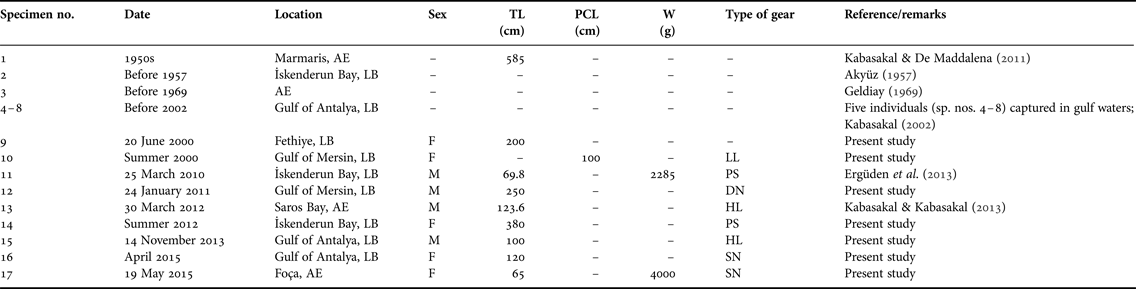
On 20 June 2000, a discarded female shortfin mako shark was found on the bottom by scuba divers during a dive off Fethiye coast, at a depth of 20 m (specimen number (sp. no.) 9; Table 1). According to a testimony given by the diver, TL of the shark was 200 cm. Following the Fethiye specimen, in summer 2000, a juvenile specimen of Isurus oxyrinchus was caught by a bottom long-line set only a few hundred metres off the coast in the Gulf of Mersin (sp. no. 10; Table 1). The PCL of this female was 100 cm and the taxidermied specimen is now preserved in a scuba diving store in İstanbul.
Historical and contemporary records of shortfin mako shark, Isurus oxyrinchus Rafinesque, 1810, off Turkey's Aegean and Mediterranean coasts. Specimen numbers correspond to the numbers on the map shown in Figure 1. AE, Aegean Sea; DN, drift net; HL, hand line; LB, Levantine Basin; LL, long line; PS, purse seine; SN, stationary net.
Following these two specimens, on 24 January 2011 a male shortfin mako shark was entangled in drift nets, 35 km off the coast, in the Gulf of Mersin (sp. no. 12; Table 1). The TL of the shark was 250 cm. Almost one year later, a huge female of 380 cm TL was caught by a commercial purse-seiner catching tuna fish in the Gulf of İskenderun (sp. no. 14; Table 1).
On 14 November 2013, a juvenile male shortfin mako shark was caught by a recreational hand-liner in coastal waters in the Gulf of Antalya (sp. no. 15; Table 1). The TL of the shark was 100 cm. Following this record, in April 2015, a juvenile female of 120 cm TL was caught by stationary nets set in coastal waters in the Gulf of Antalya (sp. no. 16; Figure 2A; Table 1). Finally, on 19 May 2015, a new-born female shortfin mako shark was caught in shallow waters off the coast of Foça (sp. no. 17; Figure 2B; Table 1). The TL of the new-born shark was 65 cm and its weight was 4000 g. On the ventral surface of the shark, a birth scar was visible in front of the pelvic girdle (Figure 2B). The historical and contemporary records of I. oxyrinchus from Turkish waters are presented in Table 1.
Among the recent records of I. oxyrinchus, juveniles (7) outnumbered adults (2); however, this difference did not reach statistical significance (P < 0.006).
DISCUSSION AND CONCLUSIONS
A review of the available literature and the results of the present study revealed that 17 specimens of Isurus oxyrinchus were caught between 1950 and 2013 (Figure 1; Table 1). Nine (52.9%) of these verified 17 catches were recorded after 2000, which is the result of an intensive monitoring program of large elasmobranchs, carried out by IRS. The historical and contemporary records of I. oxyrinchus from the eastern Mediterranean (Aegean Sea and Levantin Basin) are summarized in the following.
Based on observations mostly carried out in Athens's fish markets, Hoffman & Jordan (Reference Hoffman and Jordan1892) reported on a shortfin mako shark caught in Greek waters. Following this late 19th Century record of I. oxyrinchus, Konsuloff & Drensky (Reference Konsuloff and Drensky1943; in Papaconstantinou, Reference Papaconstantinou1988) recorded a shortfin mako shark off the Kavala coast in the northern Aegean Sea. Another historical Aegean record of I. oxyrinchus was reported by Geldiay (Reference Geldiay1969); however, the author did not provide any detailed information on the examined specimen. A huge shortfin mako shark of 585 cm TL, reported by Kabasakal & De Maddalena (Reference Kabasakal and De Maddalena2011), was caught in the 1950s off the Marmaris coast (south-eastern Aegean Sea, Turkey), and is assumed to be the largest specimen of I. oxyrinchus ever recorded worldwide. Kabasakal & Kabasakal (Reference Kabasakal and Kabasakal2013) reported on a juvenile shortfin mako shark caught in Saros Bay (north-eastern Aegean Sea, Turkey), followed by the incidental capture of a new-born specimen on 19 May 2015 off the coast of Foça (central Aegean Sea, Turkey), which confirms the contemporary occurrence of I. oxyrinchus in the Aegean Sea.
Records of I. oxyrinchus in the Levantine Basin date back to the 1950s. In April 1953, a shortfin mako shark was caught off the Israeli coast and this record was followed by the capture of four more specimens, of which lengths ranged between 59 and 142 cm (Ben-Tuvia, Reference Ben-Tuvia1971). In one of the earliest records of I. oxyrinchus from Turkish waters, Akyüz (Reference Akyüz1957) recorded a shortfin mako shark in the Gulf of İskenderun. In a previous inventory study on elasmobranchs from Turkey's seas, Kabasakal (Reference Kabasakal2002) reported on five shortfin mako sharks from the Gulf of Antalya, without providing any detailed information on specimens. According to Golani (Reference Golani, Başusta, Keskin, Serena and Seret2006), I. oxyrinchus is a rare to prevalent shark off the Israeli coast of the Mediterranean Sea. Isurus oxyrinchus has also been recorded off the coasts of Cyprus (Hadjichristophorou, Reference Hadjichristophorou, Başusta, Keskin, Serena and Seret2006) and Syria (Saad et al., Reference Saad, Ali, Seret, Başusta, Keskin, Serena and Seret2006). In one of the most recent records of I. oxyrinchus from the eastern Levantin Basin, Ergüden et al. (Reference Ergüden, Gürlek and Turan2013) reported on a young male and provided detailed information on the examined specimen. During a three-year survey of pelagic sharks incidentally caught by swordfish and tuna fisheries in the Mediterranean Sea, between 1998 and 2001, Megalofonou et al. (Reference Megalofonou, Damalas and Yannopoulos2005a) recorded 16 specimens of I. oxyrinchus (101.5–270.5 cm TL) in the eastern Mediterranean. In a more extensive study of the incidental catch and estimated discards of pelagic sharks from the swordfish and tuna fisheries in the entire Mediterranean Sea, Megalofonou et al. (Reference Megalofonou, Yannopoulos, Damalas, De Metrio, Deflorio, De La Serna and Macias2005b) recorded eight specimens of I. oxyrinchus in the Levantine Basin.
As it can be seen in Table 1, catches of I. oxyrinchus off Turkey's coast include specimens ranging from new-borns (sp. no. 17; Table 1) to huge adults (sp. no. 1; Table 1). Before the present study, a young male shortfin mako shark (69.8 cm TL), which was caught on 25 March 2010 in the Bay of İskenderun, was considered as the smallest free-swimming specimen ever recorded in Turkish waters (Ergüden et al., Reference Ergüden, Gürlek and Turan2013). With the capture of a new-born female off the coast of Foça on 19 May 2015, the smallest free-swimming specimen of I. oxyrinchus ever recorded in Turkish waters is now sp. no. 17 (65 cm TL; Table 1). On the other hand, the size of the huge shortfin mako shark reported by Kabasakal & De Maddalena (Reference Kabasakal and De Maddalena2011; sp. no. 1; Table 1), based on photographical evidence and image analysis, was 585 cm (577–619 cm TL), and it was assumed to be the largest specimen of I. oxyrinchus ever recorded worldwide. According to Compagno (Reference Compagno2002), the maximum observed TL and maximum estimated TL of I. oxyrinchus ranges between 396 and 408 cm, respectively. Although the maximum TL of I. oxyrinchus is 400 cm, the size of the specimens commonly ranged between 300 and 370 cm (Serena, Reference Serena2005). Since 2000, three shortfin mako sharks (370–390 cm TL) have been captured in Italian waters (Storai et al., Reference Storai, Zuffa and Gioia2001; Celona et al., Reference Celona, Pisticelli and De Maddalena2004). The maximum TL of 16 shortfin mako sharks caught in the eastern Mediterranean waters was 270.5 cm (Megalofonou et al., Reference Megalofonou, Damalas and Yannopoulos2005a). Finally, the huge specimen (445 cm TL) caught in September 1973 off Six-Fours les-Pleges (France; Capapé, Reference Capapé1977), was considered as the largest shortfin mako shark ever recorded worldwide, until the report on the Marmaris specimen was made by Kabasakal & De Maddalena (Reference Kabasakal and De Maddalena2011). During the present study, a huge female shortfin mako shark was caught by a purse-seiner in the Gulf of İskenderun (north-eastern Levantine Basin, Turkey; sp. no. 14; Table 1), and it considered to be one of the largest confirmed specimens of I. oxyrinchus ever recorded in the eastern Mediterranean. In a report on living marine resources of the eastern and southern Mediterranean, Bariche (Reference Bariche2012) states that the maximum TL of I. oxyrinchus is 400 cm.
According to Compagno (Reference Compagno2002), males reach maturity when they reach between 203 and 215 cm TL, and females, between 275 and 293 cm TL. Shortfin mako sharks measuring less than 200 cm TL are considered as adolescents. Therefore, with the exception of two specimens (sp. nos. 1 and 14; Table 1), the majority of the examined specimens in the present study are consisted to be juvenile and adolescent shortfin mako sharks. The size at birth of I. oxyrinchus varies between 60 and 70 cm TL (Mollet et al., Reference Mollet, Cliff, Pratt and Stevens2000; Compagno, Reference Compagno2002; Serena, Reference Serena2005; Ebert & Stehmann, Reference Ebert and Stehmann2013). Compagno (Reference Compagno2002) suggests that free-swimming individuals of I. oxyrinchus can be as small as 71 cm TL. The size of the shortfin mako shark recorded off Israel's coast in April 1953 (59 cm; Ben-Tuvia, Reference Ben-Tuvia1971) is smaller than the lower limit of size at birth of I. oxyrinchus reported by Compagno (Reference Compagno2002), Serena (Reference Serena2005) and Ebert & Stehmann (Reference Ebert and Stehmann2013). The size of the young male recorded by Ergüden et al. (Reference Ergüden, Gürlek and Turan2013; 69.8 cm TL) and the size of the new-born (65 cm TL) examined in the present study coincide with the reported size range at birth of I. oxyrinchus (Compagno, Reference Compagno2002; Serena, Reference Serena2005; Ebert & Stehmann, Reference Ebert and Stehmann2013).
The debate on the possibility of a breeding or nursery ground of lamniform sharks in the northern Aegean Sea off Turkey's coast began in 2008, when two new-born great white sharks, Carcharodon carcharias (Linnaeus, 1758), were incidentally caught in the Bay of Edremit (Kabasakal & Gedikoğlu, Reference Kabasakal and Gedikoğlu2008). Since 2008, captures of more new-born and adolescent great white sharks in the aforementioned region provide additional evidences supporting the possibility of this breeding or nursery ground (Kabasakal, Reference Kabasakal2014). In 2012, a juvenile shortfin mako shark (123.6 cm TL) was incidentally captured in Saros Bay (Kabasakal & Kabasakal, Reference Kabasakal and Kabasakal2013); however, authors stated that the first record of a juvenile shortfin mako shark in this region does not necessarily indicate a breeding or nursery ground of I. oxyrinchus in the northern Aegean Sea, and more evidence is needed to clarify this hypothesis, as in the case of C. carcharias. A similar emphasis was made by Ergüden et al. (Reference Ergüden, Gürlek and Turan2013), and authors stated that the occurrence of a young individual of I. oxyrinchus in İskenderun Bay does not necessarily indicate a nursery area. Ergüden et al. (Reference Ergüden, Gürlek and Turan2013) underlined the importance of monitoring the area to clarify its potential as a mating region. The occurrence of a new-born shortfin mako shark (65 cm TL; sp. no. 17; Table 1) off the coast of Foça provides new evidence to support the possibility of a mating region of I. oxyrinchus in the northern Aegean Sea. Since the difference between the numbers of adults and juveniles is statistically insignificant (P < 0.006), more specimens are required for examination in order to clarify the possibility of a nursery ground of I. oxyrinchus in the study area.
Referring to the map depicted in Figure 1, it can be clearly seen that the assumed nursery ground of lamniform sharks in the northern Aegean Sea has a diverse topography, including several small and large islands just a few kilometres off the coast and farther. Several authors investigating the nursery ground characteristics of I. oxyrinchus off the southern California and Mexican Pacific coast, have suggested an island-oriented movement pattern for young shortfin mako sharks due to biological requirements such as feeding (Holts & Bedford, Reference Holts and Bedford1993; Vélez-Marín & Márquez-Farías, Reference Vélez-Marín and Márquez-Farías2009). Therefore, the topography of this region, where the map is spotted with numerous islands, can be considered as an advantageous component of a nursery ground for I. oxyrinchus in the northern Aegean Sea; interisland cruising and island patrolling have been described for another lamniform shark, C. carcharias, based on a recent long-term telemetry study (Domeier & Nasby-Lucas, Reference Domeier and Nasby-Lucas2013).
In the present study, young shortfin mako sharks (65–123.6 cm TL; Table 1) were recorded off Turkey's Aegean and Mediterranean coasts almost all year round. Since all of these individuals were incidentally caught by coastal fishing gear, mostly deployed in shallow waters at depths between 10 and 20 m, coastal fishing activities create a clear threat to the survival of young individuals of I. oxyrinchus within the study area. The effects of fishing pressures have also been described for other large elasmobranchs occurring in this region (Kabasakal, Reference Kabasakal2007, Reference Kabasakal2008, Reference Kabasakal2010, Reference Kabasakal2013, Reference Kabasakal2014; Kabasakal & Karhan, Reference Kabasakal and Karhan2007; Kabasakal & Gedikoğlu, Reference Kabasakal and Gedikoğlu2008; Kabasakal et al., Reference Kabasakal, Yarmaz and Gedikoğlu2009, Reference Kabasakal, Dalyan and Yurtsever2011; Ergüden et al., Reference Ergüden, Gürlek and Turan2013, Reference Ergüden, Gürlek and Turan2015; Kabasakal & Kabasakal, Reference Kabasakal and Kabasakal2013).
Despite concerns about fishing pressures and the resultant protective efforts of shark enthusiasts, I. oxyrinchus is considered dangerous and responsible for unprovoked attacks on swimmers and boats (Bonfil & Abdallah, Reference Bonfil and Abdallah2004). Since the historical and contemporary records of I. oxyrinchus include several large individuals (TL ≥ 250 cm; Table 1) caught in the study area, the seasonal occurrence of both young and adult shortfin mako sharks off Turkey's Aegean and Mediterranean coasts should be monitored to clarify whether the shortfin mako shark is a resident or a vagrant species along this coastline. Today, the aforementioned coastline is intensively used for aquaculture, fishing and recreational purposes; therefore, the seasonal co-existence of man and the shortfin mako shark is a major concern, which could potentially jeopardize the survival of I. oxyrinchus, as is also the case for other large elasmobranchs occurring in the area (Kabasakal, Reference Kabasakal2007, Reference Kabasakal2008, Reference Kabasakal2010, Reference Kabasakal2013, Reference Kabasakal2014; Kabasakal & Karhan, Reference Kabasakal and Karhan2007; Kabasakal & Gedikoğlu, Reference Kabasakal and Gedikoğlu2008; Kabasakal et al., Reference Kabasakal, Yarmaz and Gedikoğlu2009, Reference Kabasakal, Dalyan and Yurtsever2011; Ergüden et al., Reference Ergüden, Gürlek and Turan2013, Reference Ergüden, Gürlek and Turan2015; Kabasakal & Kabasakal, Reference Kabasakal and Kabasakal2013).
In the Mediterranean Sea, the abundance of large predatory sharks has declined dramatically over the last two centuries (Ferretti et al., Reference Ferretti, Ransom, Serena and Lotze2008). Based on abundance and biomass data covering a time span of more than 50 years, Ferretti et al. (Reference Ferretti, Ransom, Serena and Lotze2008) concluded that I. oxyrinchus is one of the largest elasmobranchs, of which the largest declines were observed locally in the Mediterranean Sea. According to Megalofonou et al. (Reference Megalofonou, Yannopoulos, Damalas, De Metrio, Deflorio, De La Serna and Macias2005b), the life status of 77.4% of shortfin mako sharks incidentally caught in pelagic fisheries in the Mediterranean Sea varied between fair to dead, and only 22.6% of them were considered as good, which is an alarming situation for the survival of I. oxyrinchus in this region. Isurus oxyrinchus is now a ‘critically endangered’ shark in the Mediterranean Sea (Cavanagh & Gibson, Reference Cavanagh and Gibson2007).
Local declines in the abundances of large sharks is a major contributing factor to the overall declines of Mediterranean elasmobranchs. Therefore, as Soldo & Peirce (Reference Soldo and Peirce2005) previously proposed, shark management programs planned to be implemented in the entire Mediterranean should be followed by local ones. From an ecological perspective, elasmobranchs are vital components of the marine biota, where they occupy the role of top predators within marine food webs, providing a regulatory control that balances the ecosystem (Branstetter, Reference Branstetter1993). Therefore, it should be kept in mind that the decline of shortfin mako sharks, as well as other large sharks, could have drastic ecological consequences for the entire Mediterranean ecosystem.
ACKNOWLEDGEMENTS
I am grateful to the following persons for their generous help in collecting data and providing photographs of several shortfin mako sharks: Mr Halil Ataç, Mr Koray Akyol, Mr Tarkan Sevinçli and Mr Tahsin Ceylan. I am also grateful to two anonymous referees for their valuable contributions, which improved the content of the article. Very special thanks go to my wife, Özgür, and to my son, Derin, for their endless love and support.