Introduction
Lecanora sensu stricto is the core of the genus including taxa closely related to the type species, L. allophana Nyl. (Brodo & Vitikainen Reference Brodo and Vitikainen1984). It is characterized by the presence of atranorin, sometimes accompanied by usnic acid, oxalate crystals of different size and shapes in the amphithecium, and filiform conidia (Lumbsch Reference Lumbsch1995; Lumbsch et al. Reference Arup and Grube1995, Reference Lumbsch, Guderley and Elix1996, Reference Lumbsch, Messuti and Nash2003; Elix & Lumbsch Reference Elix and Lumbsch1996; Guderley Reference Guderley1999). The hypothecium colour in the core varies from hyaline over yellowish to red-brown and dark brown. The asci are of the Lecanora-type, containing simple, colourless ascospores. The thalli are crustose and the apothecial margins usually contain algal cells (Brodo Reference Brodo1984; Lumbsch Reference Lumbsch1994; Lumbsch & Elix Reference Lumbsch, Elix, McCarthy and Mallett2004; Ryan et al. Reference Ryan, Lumbsch, Messuti, Printzen, Sliwa, Nash III, Nash, Ryan, Diederich, Gries and Bungartz2004). The presence and size of crystals in the epihymenium and amphithecium and pigments in the epihymenium are important diagnostic features in this group of lichenized fungi (Lumbsch & Elix Reference Lumbsch, Elix, McCarthy and Mallett2004; Ryan et al. Reference Ryan, Lumbsch, Messuti, Printzen, Sliwa, Nash III, Nash, Ryan, Diederich, Gries and Bungartz2004). The types of amphithecia found in Lecanora s. str. species include: 1) allophana-type with small crystals in the algal-containing and cortical part of the amphithecium; 2) campestris-type with small crystals only in the algal-containing part of the amphithecium; 3) melacarpella-type with small and large crystals; and 4) pulicaris-type with large crystals. Types of epihymenia include: 1) chlarotera-type with coarse crystals in the epihymenium which are soluble in HNO3, pigmented or not, if pigmented, pigmentation soluble in KOH; 2) gangaleoides-type lacking crystals, olive-green-pigmented, pigmentation changing to green in KOH; 3) glabrata-type lacking crystals, red-brown pigmented, pigmentation insoluble in KOH; and 4) pulicaris-type with small crystals, brownish-pigmented with the pigmentation soluble or not in KOH and insoluble in HNO3 (Brodo Reference Brodo1984; Lumbsch Reference Lumbsch1994; Lumbsch et al. Reference Lumbsch, Feige and Elix1995, Reference Lumbsch, Guderley and Elix1996, Reference Lumbsch, Messuti and Nash2003; Guderley & Lumbsch Reference Guderley and Lumbsch1999; Lumbsch & Elix Reference Lumbsch, Elix, McCarthy and Mallett2004; Ryan et al. Reference Ryan, Lumbsch, Messuti, Printzen, Sliwa, Nash III, Nash, Ryan, Diederich, Gries and Bungartz2004). The genus has a worldwide distribution and comprises about 800 species. However, numerous species belong to other, unrelated groups and the genus in its current circumscription has been shown to be polyphyletic (Arup & Grube Reference Arup and Grube1998, Reference Arup and Grube2000; Grube et al. Reference Grube, Baloch and Arup2004).
Lecanora s. str. has received increased attention in South and South-East Asia, including revisions of species in Japan and India (Miyawaki Reference Miyawaki1988, Reference Miyawaki1994; Upreti & Chatterjee Reference Upreti and Chatterjee1997; Upreti Reference Upreti1998; Nayaka et al. Reference Nayaka, Upreti and Lumbsch2006). We have recently turned our attention to the taxonomy of Lecanora s. str. in Thailand with the description of a new species and new records (Papong et al. Reference Papong, Boonpragob and Lumbsch2011) and here summarize our research with a taxonomic survey of species of Lecanora s. str. found in Thailand. Previously, Wolseley et al. Reference Wolseley, Aguirre-Hudson and McCarthy(2002) reported nine species of Lecanora from Thailand. Subsequently, an additional thirteen species (Aptroot et al. Reference Aptroot, Saipunkaew, Sipman, Sparrius and Wolseley2007) plus four Lecanora species (Papong et al. Reference Papong, Boonpragob and Lumbsch2011) were found, bringing the number of known species to 23 before this study. In this contribution we describe a further new species, L. kansriae, record eight species new to Thailand, and correct four previous records. Consequently, 28 species of Lecanora s. str. are accepted here for Thailand.
Materials and Methods
This study is mainly based on collections made by the first author in Thailand and deposited in MSUT. Additionally, Thai material of Lecanora and type specimens of Lecanora and Vainionora spp. have been studied from the following herbaria: ABL, B, BM, CMU, F, RAMK, TNS, TUR-V and the private herbarium Sparrius. Hand-cut sections were examined on material mounted in water, a solution of KOH, and Lugol's solutions using a ZEISS Axioscope 2 plus compound microscope. HPTLC was performed with solvent systems A and C (Culberson Reference Culberson1972; Arup et al. Reference Arup, Ekman, Lindblom and Mattsson1993).
Results and Discussion
Key to species of Lecanora sensu stricto and allied taxa in Thailand
1 Saxicolous ... 2
Corticolous ... 8
2(1) Apothecia aspicilioid (remaining immersed in the thallus); thalline margin not visible ... L. subimmersa
Apothecia sessile (rarely immersed in the thallus when immature); thalline margin visible ... 3
3(2) Discs covered by a whitish grey pruina, flesh-coloured to pinkish ... L. farinacea
Discs epruinose, wax-coloured, orange, red-brown to brownish black ... 4
4(3) Hypothecium brownish red to dark brown ... 5
Hypothecium hyaline ... 6
5(4) Discs dark brown to brownish black; thallus containing arthothelin (C+ orange) ... L. flavoviridis
Discs dark red-brown, shiny; thallus containing lichesterinic acid, protolichesterinic acid and zeorin (C−) ... L. vainioi
6(4) Epihymenium granulose (chlarotera-type); apothecial discs orange-brown; thallus containing 2′-O-methylperlatolic acid ... L. plumosa
Epihymenium egranulose (glabrata-type); apothecial discs dark red-brown; chemistry variable ... 7
7(6) Thallus containing zeorin ... L. subimmergens
Thallus containing 2′-O-methylperlatolic acid ... L. pseudistera
8(1) Thallus sorediate ... 9
Thallus esorediate ... 10
9(8) Soredia whitish to whitish grey; thallus containing zeorin ... L. leproplaca
Soredia yellowish white; thallus containing usnic acid ... Lecanora sp.B
10(8) Hypothecium brownish yellow to reddish brown ... 11
Hypothecium hyaline to pale yellow ... 15
11(10) Epihymenium egranulose (glabrata-type) ... 12
Epihymenium granulose (chlarotera- or pulicaris-type) ... 13
12(11) Apothecial discs red-brown to dark brown; ascospores 9·5–14 µm long; thallus containing protoconstipatic acid and zeorin ... L. coronulans
Apothecial discs dark brown to blackish brown; ascospores 15·0–17·5 µm long; thallus containing lichesterinic acid and zeorin ... L. melaleuca
13(11) Apothecial discs pale brown to dark brown; epihymenium pulicaris-type; amphithecium pulicaris-type; thallus containing only atranorin ... Lecanora sp.C
Apothecial discs brown, yellow to pale red-brown or grey-brown; epihymenium chlarotera-type; amphithecium of different types; thallus containing other compounds as well as atranorin ... 14
14(13) Discs brown to red-brown; amphithecium melacarpella-type; thallus lacking 2′-O-methylperlatolic acid ... L. phaeocardia
Discs yellow to pale red-brown or grey-brown; amphithecium pulicaris-type; thallus containing 2′-O-methylperlatolic acid ... Vainionora flavidorufa
15(10) Discs relatively pale: orange-brown, yellowish brown or carneous or pinkish ... 16
Discs relatively dark: red-brown to dark red-brown ... 22
16(15) Discs covered by a whitish grey pruina; thallus containing depsidones (PD+ dark red-orange) ... L. caesiorubella
Discs epruinose or rarely slightly pruinose, lacking depsidones (PD−) except for L. kansriae ... 17
17(16) Epihymenium egranulose (glabrata-type); discs orange-brown to brown ... ... L. ulrikii
Epihymenium granulose (chlarotera- or pulicaris-type); disc colour variable ... 18
18(17) Epihymenium pulicaris-type; apothecial discs dark orange-brown to red-brown ... ... L. interjecta
Ephihymenium chlarotera-type; apothecial discs orange-brown ... 19
19(18) Thallus containing usnic acid as major constituent ... L. achroa
Thallus lacking usnic acid or usnic acid rarely present in traces ... 20
20(19) Discs orange-brown; thallus containing arthothelin (C+ orange) ... ... L. arthothelinella
Discs pale yellow, orange to orange-brown; thallus lacking arthothelin (C−) ... 21
21(20) Discs pale orange to yellowish brown; thallus containing gangaleoidin ... ... L. leprosa
Discs pale brown to orange or pale greenish brown; thallus containing 2′-O- methylperlatolic acid ... L. helva
22(15) Amphithecium with only small crystals (allophana- or campestris-type) ... 23
Amphithecium with large crystals, often also with small crystals (melacarpella- or pulicaris-type) ... 24
23(22) Amphithecium allophana-type; thallus containing 2′-O-methylperlatolic acid ... ... L. toroyensis
Amphithecium campestris-type; thallus containing stictic acid ... L. kansriae
24(22) Epihymenium granulose (chlarotera- or pulicaris-type) ... 25
Epihymenium egranulose (glabrata-type) ... 26
25(24) Epihymenium chlarotera-type; thallus containing gangaleoidin ... ... L. pseudargentata
Epihymenium pulicaris-type; thallus lacking gangaleoidin ... Lecanora sp.A
26(24) Thallus C+ orange, containing xanthones; thallus usually dispersed verrucose to verruculose ... 27
Thallus C−, lacking xanthones; thallus continuous to rimose-areolate ... 28
27(26) Amphithecium melacarpella-type; thallus containing zeorin and chodatin ... ... L. tropica
Amphithecium pulicaris-type; thallus containing roccellic acid and arthothelin ... ... L. austrotropica
28(26) Spores ellipsoid to broad, (5·5–)6·5–8·5 µm wide; apothecia 0·4–1·0 mm diameter; thallus containing gangaleoidin ... L. argentata
Spores ellipsoid to narrowly ellipsoid, 5·0–7·0 µm wide; apothecia 0·3–0·6 mm diameter; thallus containing zeorin ... L. ecoronata
The Species
Lecanora achroa Nyl
in Crombie, J. Bot. 14: 263 (1876); type: “Ins. Rodrigues”, 9.-12. 1874, Balfour (H-NYL 27475!—lectotype; H-NYL 27293!—isolectotype).
Synonyms and morphological descriptions: Lumbsch & Elix Reference Lumbsch, Elix, McCarthy and Mallett(2004), Lumbsch et al. Reference Lumbsch, Feige and Elix(1995).
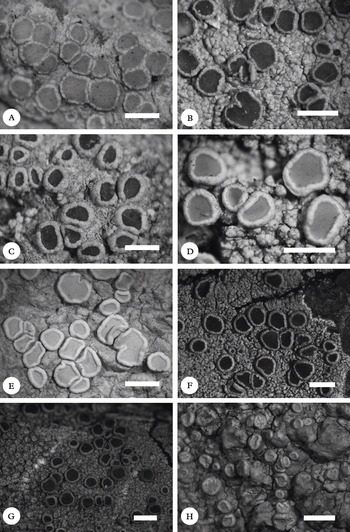
(Fig. 1A)
Habit of Lecanora species. A, L. achroa [Papong 6442 (MSUT)]; B, L. argentata [Papong 6041 (MSUT)]; C, L. arthothelinella [Papong 6553 (MSUT)]; D, L. austrotropica [Papong 6397 (MSUT)]; E, L. caesiorubella [Papong 6497 (MSUT)]; F, L. coronulans [Polyiam 4857 (RAMK)]; G, L. ecoronata [Aptroot 55198 (ABL)]; H, L. farinacea [Boonpragob 11862 (RAMK)]. Scale bars = 1 mm.

Chemistry. Arthothelin (minor or absent), atranorin (submajor), chloroatranorin (minor), 2′-O-methylperlatolic acid (major), traces of unidentified terpenes, and usnic acid (major).
Ecology and distribution. A corticolous species occurring on tree bark of Catanopsis acuminatissima, Dipterocapus obtusifolius, Mangifera indica and Wrightia arborea at an altitude ranging from 150 m to 1485 m in Thailand. This species has a pantropical distribution (Lumbsch & Elix Reference Lumbsch, Elix, McCarthy and Mallett2004; Ryan et al. Reference Ryan, Lumbsch, Messuti, Printzen, Sliwa, Nash III, Nash, Ryan, Diederich, Gries and Bungartz2004).
Notes. Lecanora achroa is characterized by small, orange-brown apothecial discs, small ascospores and the presence of usnic acid in the thallus. Morphologically, L. achroa resembles L. helva and L. leprosa in having relatively small apothecia with orange-brown discs. However, it differs from those species by a generally more greenish thallus colour and the presence of usnic acid instead of the 2′-O-methylperlatolic acid chemosyndrome (L. helva) or the gangaleoidin chemosyndrome (L. leprosa) (Lumbsch et al. Reference Lumbsch, Feige and Elix1995; Guderley Reference Guderley1999).
Selected specimens examined. Thailand: Maha Sarakham Province: Dun Lam Pan Non-hunting area, K. Papong 6050 (MSUT). Muk Dahan Province: Kham Cha-Ae District, Phu Pha Kud, K. Papong 6456 (F, MSUT). Kanchanaburi Province: Sai Yok District, Sai Yok Noi Waterfall, K. Papong 6445 (MSUT). Sakon Nakhon Province: Kham Hom Waterfall, Phu Pan National Park, K. Papong 6451 (F, MSUT); Phu Phan National Park, W. Khamtim, RU 11602 (RAMK); Rajabhat Sakon Nakhon University, W. Khamtim, RU 11586 (RAMK). Khon Kaen Province: Phu wueng District, K. Papong 6515 (MSUT). Buri Ram Province: Khao Loop, K. Papong 6812 (MSUT). Loei Province: Maung District, Baan Pongwowpattana, K. Papong 6995 (MSUT). Chiang Mai Province: Doi Fahompok National Park (Fang Hotspring), K. Papong 7138 (MSUT). Chiang Rai Province: Mae Sai, Doi Tung, K. Papong 7139 (MSUT). Nan Province: Khun Satan National Park, K. Papong 7156 (MSUT). Phrae Province: Aruni 23097 (RAMK). Chantaburi Province: Insula Koh Chang, 1900, Vainio 6182 (TUR-V).
Lecanora argentata (Ach.) Degel
in Nilsson, Ark. Bot. 24A: 78 (1931).—Parmelia subfusca f. argentata Ach., Meth. Lich.: 169 (1803); type: “…cum priori […in cortice arborum]” (H-ACH 1189A!—lectotypue.
Synonyms and morphological descriptions: Brodo Reference Brodo(1984), Guderley Reference Guderley(1999), Lumbsch & Elix Reference Lumbsch, Elix, McCarthy and Mallett(2004), Ryan et al. Reference Ryan, Lumbsch, Messuti, Printzen, Sliwa, Nash III, Nash, Ryan, Diederich, Gries and Bungartz(2004).
(Fig. 1B)
Chemistry. Atranorin (major), chloroatranorin (minor), 4-dechlorogangaleoidin (minor), gangaleoidin (major) and norgangaleoidin (minor).
Ecology and distribution. A corticolous species that occurs in various ecosystems in Thailand, such as dry dipterocarp forests, plantations, lower montane rainforests, secondary forests and wetland areas. It has a cosmopolitan distribution. This species grows in Thailand on the bark of different trees, including Catanopsis sp. and Dipterocapus obtusifolius.
Notes. Lecanora argentata is characterized by a non-granulose, red-brown epihymenium, the pulicaris-type amphithecium, and the presence of gangaleoidin in the thallus. Although it is similar to L. austrotropica and L. tropica, these species have smaller apothecia, and they contain xanthones and lack gangaleoidin.
Selected specimens examined. Thailand: Chiang Mai Province: Doi Weungpha National Park, K. Papong 7184 (MSUT). Maha Sarakham Province: Maung District, Walia Rukhavej Research Institute Ban Kieng, K. Papong 6036 (MSUT). Lamphun Province: Tung Hua Chang District, Aruni 23096 (RAMK). Nahon Ratchasima Province: Khao Yai National Park, between Ban Pra Du to Ban Jan Dong, C. Thunyagun 16158 (RAMK). Sakon Nakhon Province: Phu Phan National Park, W. Khamtim 11592 (RAMK).
Lecanora arthothelinella Lumbsch
J. Hattori Bot. Lab. 77: 71 (1994); type: Australia, New South Wales, Grassy Head Reserve, 5 km N of Stuarts Point, 24 Jan 1988, J. A. Elix 21837 (CANB!—holotype).
Morphological descriptions: Lumbsch Reference Lumbsch(1994), Lumbsch & Elix Reference Lumbsch, Elix, McCarthy and Mallett(2004).
(Fig. 1C)
Chemistry. Arthothelin (major), atranorin (major), chloroatranorin (minor), 2,4-dichloronorlichexanthone (minor), 4,5-dichloronorlichexanthone (minor), isoarthothelin (minor) and thiophanic acid (major).
Ecology and distribution. A corticolous species found only at high altitudes between 1500 and 2200 m in Thailand; also known from Australia, Papua New Guinea, Central and South America (Lumbsch Reference Lumbsch1994; Guderley Reference Guderley1999). It grows on the bark of Quercus ramsbottomii and other unidentified trees.
Notes. Lecanora arthothelinella can be distinguished by its orange-brown apothecial discs, comparatively large ascospores, and the presence of chlorinated xanthones. Lecanora helva also has pale apothecial discs, but that species has smaller apothecia, broader ascospores and the presence of the 2′-O-methylperlatolic acid chemosyndrome.
Specimens examined. Thailand: Chiang Mai Province: Kiew Mae Pan, Doi Inthanon National Park, K. Papong 6479 (MSUT). Loei Province: Phu Lung Wildlife Sanctuary, K. Vongchewarat 6553 (F); Doi Suthep-Pui National Park, highest point, Sun Ku, Sipman 48674 (B).
Lecanora austrotropica Lumbsch
J. Hattori Bot. Lab. 77: 71, (1994); type: Australia, Queensland, Eimeo Ck, Sunset beach, 14 Aug. 1976, G. N. Stevens (BRI!—holotype).
Morphological descriptions: Lumbsch Reference Lumbsch(1994), Lumbsch & Elix Reference Lumbsch, Elix, McCarthy and Mallett(2004).
(Fig. 1D)
Chemistry. Arthothelin (major), ±atranorin (submajor), ±chloroatranorin (submajor), 2,4-dichloronorlich-exanthone (minor), 2,5-dichloronorlichexanthone (minor) and 4,5-dichloronorlichexanthone (minor) and roccellic acid (major).
Ecology and distribution. A corticolous species occurring in Thailand on the bark of Dipterocapus sp., Ficus sp. and Neocinnamomum caudatum in lower montane rainforests, dry evergreen, dry dipterocarp forests and plantations.
Notes. Lecanora austrotropica is characterized by the non-granulose epihymenium, the small apothecia, the pulicaris-type amphithecium, and by its chemistry. It is morphologically similar to L. tropica which has an overlapping distribution; the latter has smaller ascospores and contains the chodatin chemosyndrome.
Specimens examined. Thailand: Chiang Mai Province: Phu Ping Royal Palace, Doi Sutep-Pui National Park, K. Papong 6325 (MSUT); Siriblhume Royal Garden, Doi Inthanon National Park, K. Papong 6407 (F, MSUT). Nahon Ratchasima Province: Khao Yai National Park, C. Thunyagun, RU 13532, 13573 (RAMK); the forest near Ban TV, W. Polyaim, RU 22254 (RAMK); checkpoint no.11, Khong Pakung, Khao Noi, W. Polyiam, RU 17113 (RAMK).
Lecanora caesiorubella Ach
Lichenogr. Univ.: 366 (1810); type: “Habitat in cortice arborum Americae septentrionalis” [North America], O. Swartz (UPS-ACH 644!—holotype).
Synonyms and morphological description: Lumbsch et al. Reference Lumbsch, Plümper, Guderley, Feige, Tibell and Hedberg(1997).
(Fig. 1E)
Chemistry. Atranorin (major), chloroatranorin (major), ±connorstictic acid (minor), ±conprotocetraric acid (minor), ±norstictic acid (major), ±protocetraric acid (major), ±salazinic acid (minor), ±stictic acid (minor), ±virensic acid (major), unidentified triterpenoid (traces) and zeorin (major).
Ecology and distribution. A widespread pantropical species that grows in Thailand on bark of free-standing trees, including Pyrus malus. It occurs in open habitats and on free-standing trees in lower montane rainforests and plantations.
Notes. Lecanora caesiorubella is characterized by the large apothecia with thick, flexuose margins and heavily pruinose apothecial discs and the presence of beta-orcinol depsidones of the norstictic and/or protocetraric acids chemosyndromes.
Selected specimens examined. Thailand: Chiang Mai Province: Mon Rong Mountain, K. Papong 6494A (MSUT); Royal Garden, Doi Inthanon National Park, K. Papong 6498 (F, MSUT); Doi Suthep-Pui National Park, Medicinal Herbs Garden, Sipman 48547 (B), Aptroot 55186, 55334 (ABL). Loei Province: Phu Kradueng National Park, K. Papong 6497 (MSUT).
Lecanora coronulans Nyl
Flora 59: 510 (1876); type: Cuba, Wright, Lich. Cub. 62, (H-NYL 27726!—lectotype; UPS!—isolectotype).
Synonyms and morphological description: Lumbsch et al. Reference Lumbsch, Guderley and Elix(1996).
(Fig. 1F)
Chemistry. Atranorin (major), chloroatranorin (minor), constipatic acid (minor), dehydroconstipatic acid (minor), protoconstipatic acid (major) and zeorin (major).
Ecology and distribution. Corticolous; rarely found in Thailand where it grows in a dry dipterocarp forest on the bark of Dipterocarpus intricatus. This pantropical species is also known from South and Central America and India. This is the first record of this taxon for Thailand.
Notes. It is characterized by a clear red-brown to dark brown apothecial disc, a glabrata-type epihymenium, and its chemistry. Lecanora coronulans is similar to L. phaeocardia but differs in having a granulose epihymenium and the presence of fatty acids. Other morphologically similar species include L. argentata, L. ecoronata and L. tropica. These are readily distinguished by the hyaline hypothecium, as well as chemical differences (L. argentata: gangaleoidin chemosyndrome; L. ecoronata: zeorin and unidentified terpenoids; L. tropica: zeorin and chodatin chemosyndrome).
Specimens examined. Thailand: Nakon Ratchasima Province: Khao Yai National Park, forest at the check point no. 11, Khong Pa Kung, Khao Noi, W. Polyiam, RU 17113 (RAMK).
Lecanora ecoronata Vain
Bolet. Soc. Broter. ser. 2, 6: 146 (1929/30); type: Moçambique, “prope Palma”, 1916, A. Pires de Lima 221 (TUR-V-33837!—holotype).
Morphological description: Lumbsch Reference Lumbsch(1994).
(Fig. 1G)
Chemistry. Atranorin (major), chloroatranorin (minor), unidentified terpenoids (traces) and zeorin (major).
Ecology and distribution. This corticolous species has been rarely collected in Thailand, where it is found in a lower montane rainforest on the bark of Quercus sp. It is known from Africa, Australia and East Asia.
Notes. Lecanora ecoronata is characterized by a red-brown to dark red-brown apothecial disc, pulicaris-type epihymenium and a hyaline hypothecium. This species is easily confused with L. tropica but differs in having narrower ascospores and lacking the chodatin chemosyndrome.
Specimen examined. Thailand: Chiang Mai Province: 12 km W of Chiang Mai, Doi Suthep-Pui National Park, Sun Ku summit, Aptroot 55198 (ABL). Sakon Nakhon Province: Phu Phan National Park, 1998, W. Khantim 11640 (RAMK).
Lecanora farinacea Fée
Essai Crypt. Ecorc. 117 (1824); type: “Ad corticem Cinchonarum” (G!—holotype).
Synonyms and morphological descriptions: Dickhäuser et al. Reference Dickhäuser, Lumbsch and Feige(1995), Lumbsch & Elix Reference Lumbsch, Elix, McCarthy and Mallett(2004).
(Fig. 1H)
Chemistry. Atranorin (major), chloroatranorin (minor), ±connorstictic acid (minor), ±norstictic acid (major), ±protocetraric acid (major) and ±salazinic acid (minor).
Ecology and distribution. A saxicolous species, which was found only once in Thailand in a lower montane rainforest. It is a widespread pantropical species that in the Southern Hemisphere extends into temperate regions.
Notes. The species is characterized by the whitish grey thallus, the heavily pruinose apothecial discs, the presence of the norstictic acid chemosyndrome and/or protocetraric acid, and the rather broad ascospores.
Specimen examined. Thailand: Loei Province: Phu Ruea National Park, Huai Phai waterfall-Tam Pra, Kansri et al. 11862 (RAMK).
Lecanora flavoviridis Krempelh
Flora 56: 470 (1873); type: Hong Kong, Rabenhorst fil. 1871/72 (UPS!—lectotype).
Morphological description: Lumbsch et al. Reference Lumbsch, Guderley and Elix(1996).
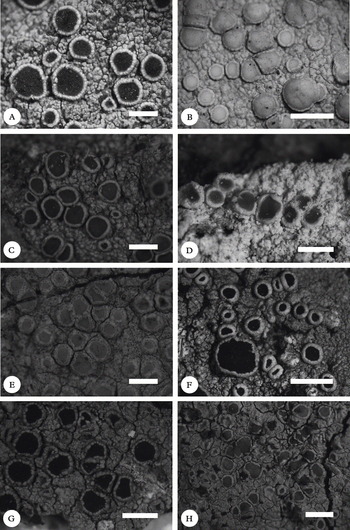
(Fig. 2A)
Habit of Lecanora species. A, L. flavoviridis [Papong 6505 (MSUT)]; B, L. helva [Papong 6444 (MSUT)]; C, L. interjecta [Papong 7143 (MSUT)]; D, L. leproplaca [Wolseley & Aguirre-Hudson 4869 (B)]; E, L. leprosa [Boonpragob 11859 (RAMK)]; F, L. melaleuca [Wolseley 1116 (BM)]; G, L. phaeocardia [Wolseley & Aguirre-Hudson 4873 (BM)]; H, L. plumosa [Papong 6959 (MSUT)]. Scales: A–H = 1 mm.

Chemistry. Arthothelin (major), atranorin (major), chloroatranorin (minor), 2,4-dichloronorlichexanthone (minor).
Ecology and distribution. This species is known only from South-East Asia. It grows on siliceous rock and has been found in Thailand in a lower montane rainforest.
Notes. This saxicolous species is characterized by a blackish brown epihymenium that turns green in KOH, broadly ellipsoid ascospores, and the presence of chloroxanthones.
Specimens examined. Thailand: Loei Province: on back of billboard at Phu Lung Wildlife Sanctuary, Praphuchamnoung 115, 121 (RAMK), 37 (F), 117 (MSUT).
Lecanora helva Stizenb
Ber. Thätigk. St. Gall. Naturw. Ges. 1888–89: 218 (1890); type: South Africa, Lydenburg, Transvaal, C. Wilms (ZT!—holotype).
Synonyms and morphological descriptions: Lumbsch & Elix Reference Lumbsch and Elix(1993, Reference Lumbsch, Elix, McCarthy and Mallett2004), Lumbsch Reference Lumbsch(1994), Guderley Reference Guderley(1999), Ryan et al. Reference Ryan, Lumbsch, Messuti, Printzen, Sliwa, Nash III, Nash, Ryan, Diederich, Gries and Bungartz(2004).
(Fig. 2B)
Chemistry. Arthothelin (minor), atranorin (major), chloroatranorin (minor), 2′-O-methylisohyperlatolic acid (trace), 2′-O-methylperlatolic acid (major) and 2′-O-methylsuperlatolic (trace).
Ecology and distribution. Corticolous; this is a common species in Thailand and occurs in a variety of habitats, including lower montane, tropical rainforests, dry dipterocarp forests and plantations. It is a pantropical species. This species grows in Thailand on bark of various trees, including Dipterocapus obtusifolius, Quercus ramsbottomii, Salix tetrasperma, and Pyrus malus.
Notes. Lecanora helva is characterized by small, orange to pale brown apothecial discs, the chlarotera-type epihymenium and pulicaris-type amphithecium, and the chemistry of the thallus. Morphologically, it is similar to L. achroa and L. leprosa, but those two species can be readily distinguished by their different chemistries, containing either usnic acid (L. achroa) or the gangaleoidin chemosyndrome (L. leprosa). Moreover, L. achroa has slightly larger ascospores.
Selected specimens examined. Thailand: Chiang Rai Province: Mae Sai District, Doi Tung, K. Papong 7144 (MSUT). Chiang Mai Province: Monthatan Waterfall Doi Sutep-Pui National Park, K. Papong 6356 (MSUT); 10 km W of Chiang Mai, Doi Suthep-Pui National Park, Aptroot 55310 (ABL). Sakon Nakhon Province: Kham Hom Waterfall, Phu Pan National Park, K. Papong 6452 (MSUT). Kanchanaburi Province: Sai Yok District, Sai Yok Noi Waterfall, K. Papong 6444 (MSUT). Muk Dahan Province: Kham Cha-Ae District, Phu Pha Kud, K. Papong 6441 (MSUT). Loei Province: Phu Kradueng National Park, K. Papong 6518 (MSUT). Uttaradit Province: Nam Pad District, Phu Soi Dao National Park, K. Papong 7007 (MSUT). Surat Thani Province: Ko Phangan, viii 1992, Aptroot (ABL).
Lecanora interjecta Müll. Arg
Nuovo Giorn. Bot. Ital. 23: 390 (1891); type: Australia, Queensland, Toowoomba, 1887, F. M. Bailey (G!—holotype).
Morphological descriptions: Lumbsch et al. Reference Lumbsch, Feige and Elix(1995), Lumbsch & Elix Reference Lumbsch, Elix, McCarthy and Mallett(2004).
(Fig. 2C)
Chemistry. Arthothelin (major), atranorin (minor), chloroatranorin (minor), 2,5-dichloronorlichexanthone (minor), 4,5-dichloronorlichexanthone (minor) and usnic acid (major).
Ecology and distribution. Corticolous; this species is here recorded from Thailand for the first time. Previously it was known only from Australia and the north island of New Zealand. In Thailand it occurs on the bark of Quercus ramsbottomii in a lower montane rainforest.
Notes. Lecanora interjecta is characterized by the presence of arthothelin and usnic acid in the thallus, the pulicaris-type epihymenium and dark orange-brown to red-brown apothecial discs.
Selected specimens examined. Thailand: Chiang Rai Province: Mae Sai, Doi Tung, K. Papong 7143 (MSUT).
Lecanora kansriae Papong & Lumbsch, sp.nov
MycoBank No.: MB561078
Sicut Lecanora toroyensis sed amphithecio typo “campestris” et thallo acido stictico continens differt.
Typus: Thailand, Chiang Mai Province, Doi suthep, chedi site San Khu 18°49′N, 99°54′E, alt. 1600 m, oak/chestnut forest, on bark of Quercus sp., 31 January 1993, B. Aguirre-Hudson & P. A. Wolseley 4862 (BM—holotypus).
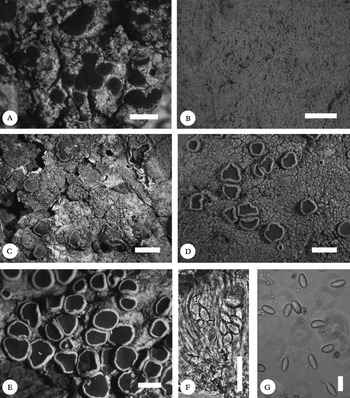
(Fig. 4 E, F & G)
Thallus dispersed-verrucose to verruculose or continuous, yellowish white to whitish grey, epruinose. Soredia absent. Prothallus not visible.
Apothecia sessile, 0·5–1·2 mm diam., discs pale to dark red-brown, epruinose, margins concolorous with the thallus, thick, verrucouse to verruculose. Cortex distinct. Amphithecium with small crystals (= campestris-type), soluble in KOH. Parathecium hyaline, inspersed with numerous small crystals soluble in KOH. Epihymenium red-brown, 10–15 µm thick, with small crystals (= pulicaris-type). Hymenium hyaline, with oil droplets. Hypothecium hyaline. Paraphyses sparingly branched and not to slightly thickened apically. Asci clavate, 8-spored. Ascospores ellipsoid, 17·5–20 × 10–12 µm.
Pycnidia and conidia not observed.
Chemistry. Atranorin (major), chloroatranorin (minor) and stictic acid (major).
Ecology and distribution. Corticolous; the new species occurs on bark of Quercus sp. in a lower montane Castanopsis and Quercus rainforest, at an altitude of c. 1600 m in the north of Thailand. So far the species is known only from the type locality.
Notes. Lecanora kansriae is characterized by a campestris-type amphithecium and a thallus containing stictic acid. Lecanora toroyensis and L. tropica are morphologically similar. Both species are readily distinguished, however, by their different chemistry and different amphithecial types: L. toroyensis contains 2′-O-methylperlatolic acid and has an allophana-type amphithecium and L. tropica contains the chodatin chemosyndrome and has a pulicaris-type amphithecium. The new species is placed here in Lecanora and not Vainionora, although we have not seen conidia. However, L. kansriae contains small crystals in the amphithecium and has a hyaline hypothecium, two characters that differ from Vainionora species.
Lecanora leproplaca Zahlbr
H. Magnusson & A. Zahlbruckner, Ark. Bot. 31A(6): 64 (1944); type: Hawaiian Islands, Koloa, Dec. 1909, A. Faurie 135 (BM!—isotype).
Morphological descriptions: Lumbsch Reference Lumbsch(1994), Lumbsch & Elix Reference Lumbsch, Elix, McCarthy and Mallett(2004).
(Fig. 2D)
Chemistry. Atranorin (major), chloroatranorin (minor), chodatin (major), demethylchodatin (major), 3-O-methylthiophanic acid (minor), thiophanic acid (minor), traces of unknown xanthones and zeorin (major).
Ecology and distribution. Corticolous; the species occurs on the bark of Dipterocapus obtusifolius in Thailand in a dry dipterocarp forest. This is the first record for Thailand of this pantropical taxon.
Notes. Lecanora leproplaca is characterized by a sorediate thallus, red-brown apothecial discs and a glabrata-type epihymenium. This species is closely related to L. tropica, which lacks soredia.
Selected specimens examined. Thailand: Uthai Thani Province: Khao Nang Rum, Khao Kiew, P. A. Wolseley & B. Aguirre-Hudson 4869 (B).
Lecanora leprosa Fée
Essai Crypt, Écorc. 118 (1824); type: Brazil, Rio de Janeiro, A. Glaziou 1921 (PC-FÉE!—neotype).
Synonyms and morphological descriptions: Brodo Reference Brodo(1984), Lumbsch & Elix Reference Lumbsch and Elix(1993, Reference Lumbsch, Elix, McCarthy and Mallett2004), Lumbsch Reference Lumbsch(1994), Guderley Reference Guderley(1999), Ryan et al. Reference Ryan, Lumbsch, Messuti, Printzen, Sliwa, Nash III, Nash, Ryan, Diederich, Gries and Bungartz(2004).
(Fig. 2E)
Chemistry. Atranorin (major), chloroatranorin (minor), chlorolecideoidin (minor), gangaleoidin (major), leoidin (minor) and norgangaleoidin (minor).
Ecology and distribution. This corticolous species is common in Thailand where it occurs on the bark of Dipterocapus obtusifolius, Mangifera indica and several palms in tropical rainforests and dry dipterocarp forests. It is a common, pantropical taxon.
Notes. Lecanora leprosa is characterized by orange to yellowish brown apothecial discs, a granulose epihymenium and the presence of the gangaleoidin chemosyndrome. It is morphologically similar to L. helva and L. achroa, which are both distinguished by their differing chemistries (L. helva: 2′-O-methylperlatolic acid chenmosyndrome, L. achroa: usnic acid).
Selected specimens examined. Thailand: Chiang Mai Province: Doi Saket District, Huai Hong Khrai Royal Project Developing Education Unit, K. Papong 6443 (F). Lamphang Province: Lamphang city, Saipunkaew 6 (CMU). Lamphun Province: Industrial Area 2, Saipunkaew 7.1 (CMU). Muk Dahan Province: Hnong Sung District, Phu Pan Tee, K. Papong 6735 (MSUT). Nakhon Si Thammarat Province: Si Khit Waterfall National Park, K. Papong 7084 (MSUT). Nahon Ratchasima Province: Khao Yai National Park, Nhong Khing area, Kansri et al. 21324 (RAMK). Chantaburi Province: Insula Koh Chang, Vainio 6079 (TUR-V).
Lecanora melaleuca (Müll. Arg.) Dodge
Beih. Nova Hedwigia 38: 22 (1971).—Lecanora subfusca var. melaleuca Müll. Arg., Bot. Jahrb. 20: 266 (1894); type: Tanzania, Usambara, Holst 2869 (G!—holotype).
Morphological description: Lumbsch et al. Reference Lumbsch, Guderley and Elix(1996).
(Fig. 2F)
Chemistry. Atranorin (major), chloroatranorin (minor), dehydroconstipatic acid (minor), lichesterinic acid (major), protodehydroconstpatic acid (minor), protolichesterinic acid (major) and zeorin (minor).
Ecology and distribution. This is a corticolous species that occurs on the bark of Shorea sp. in Thailand in a dry dipterocarp forest. This is the first record of this species from Asia.
Notes. Lecanora melaleuca is characterized by blackish apothecial discs, an egranulose epihymenium and narrowly ellipsoid ascospores. The species resembles L. coronulans but the latter species differs in lacking crystals in the parathecium and having broader ascospores.
Specimens examined. Thailand: Uthai Thani Province: Huay Kha Kaeng Wildlife Sanctuary, Kanjanavanit pot, 5W, P. A. Wolseley 1116 (BM).
Lecanora phaeocardia Vain
Suomal. Elain-ja Kasvist. Seuran Vanamon Julk. 1(3): 41 (1921); type: Thailand, near Raheng, Nong Boa, s. dat., C. C. Hosseus (TUR-V-5573!—holotype).
Morphological descriptions: Lumbsch et al. Reference Lumbsch, Guderley and Elix(1996), Lumbsch & Elix Reference Lumbsch, Elix, McCarthy and Mallett(2004).
(Fig. 2G)
Chemistry. Atranorin (major), chloroatranorin (minor), unknown secalonic acid derivative (minor) and an unknown fatty acid (minor).
Ecology and distribution. This corticolous species occurs on the bark of various trees, including Dipterocapus obtusifolius, several Euphorbiaceae, and Quercus ramsbottomii in Thailand in lower montane rainforests and dry dipterocarp forests. It is a pantropical taxon that is also known from Indonesia and Australia.
Notes. This species can be recognized by the brown apothecial discs, the chlarotera-type epihymenium, the relatively large ascospores, and its chemistry. Similar species include Lecanora austrotropica, L. tropica, and L. coronulans. The latter species can be distinguished by the presence of a glabrata-type epihymenium, while the other two species differ in having a hyaline hypothecium and in their xanthone containing chemistries (Lumbsch Reference Lumbsch1994; Lumbsch et al. Reference Lumbsch, Guderley and Elix1996; Lumbsch & Elix Reference Lumbsch, Elix, McCarthy and Mallett2004).
Selected specimens examined. Thailand: Chiang Mai Province: Doi Saket District, Huai Hong Khrai, K. Papong 6400 (MSUT); Doi Suthep, transect-Wat Palad, P. A. Wolseley & B. Aguirre-Hudson 4876 (B). Muk Dahan Province: Kham Cha-Ae District, Phu Pha Kud, K. Papong 6473 (MSUT). Sakon Nakhon Province: Phu Pan National Park, K. Papong 6492 (F). Nan Province: Paow District, Doi Phu Ka National Park, K. Papong 6987 (MSUT).
Lecanora plumosa Müll. Arg
Flora 65: 484 (1882); type: Australia, Queensland, Toowoomba, 1881, C. H. Hartmann L. 33 (G!—holotype; MEL!—isotype).
Morphological descriptions: Lumbsch Reference Lumbsch(1994), Guderley Reference Guderley(1999), Lumbsch & Elix Reference Lumbsch, Elix, McCarthy and Mallett(2004), Ryan et al. Reference Ryan, Lumbsch, Messuti, Printzen, Sliwa, Nash III, Nash, Ryan, Diederich, Gries and Bungartz(2004).
(Fig. 2H)
Chemistry. Atranorin (major), chloroatranorin (minor), 2′-O-methylisohyperlatolic acid (minor), 2′-O-methylperlatolic acid (major) and 2′-O-methylsuperlatolic acid (minor).
Ecology and distribution. A saxicolous species, which occurs in Thailand in dry diptercarp forests and lower montane rainforests. This is the first record of this species from Thailand. It is a pantropical species.
Notes. The saxicolous Lecanora plumosa is characterized by pale apothecial discs and the presence of 2′-O-methylperlatolic acid.
Specimens examined. Thailand: Muk Dahan Province: Hnong Sung District, Phu Pha Kam, K. Papong 6959 (MSUT). Nahon Ratchasima Province: Khao Yai National Park Khao Kaew, W. Khamtim, RU 13090 (RAMK).
Lecanora pseudargentata Lumbsch
J. Hattori Bot. Lab. 77: 127 (1994); type: Australia, Queensland, c. 59 km S of Maryborough, NE of Gunalda, E of Hwy 1, 22 August 1986, J. Hafellner 18604 & R. W. Rogers (GZU!—holotype).
Morphological descriptions: Lumbsch Reference Lumbsch(1994), LaGreca & Lumbsch Reference LaGreca and Lumbsch(2001), Lumbsch & Elix Reference Lumbsch, Elix, McCarthy and Mallett(2004), Ryan et al. Reference Ryan, Lumbsch, Messuti, Printzen, Sliwa, Nash III, Nash, Ryan, Diederich, Gries and Bungartz(2004).
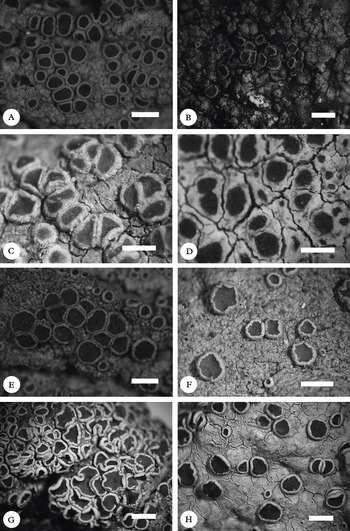
(Fig. 3A)
Habit of Lecanora species. A, L. pseudargentata [Papong 7188 (MSUT)]; B, L. pseudistera [Aguirre, James & Wolseley 2681 (BM)]; C, L. subimmergens [Papong 6431 (MSUT)]; D, L. subimmersa [Papong 7024 (MSUT)]; E, L. toroyensis [Osathanon 4858 (RAMK)]; F, L. tropica [Papong 6408 (MSUT)]; G, L. ulrikii [Papong 6476 (MSUT)]; H, L. vainioi [Lumbsch 19760f (F)]. Scales: A–H = 1 mm.

Chemistry. Atranorin (major), chloroatranorin (minor), 4-dechlorogangaleoidin (minor), gangaleoidin (major) and norgangaleoidin (minor).
Ecology and distribution. A corticolous taxon, which is recorded here for the first time from Thailand where it occurs on bark of Anisoptera costata and Dipterocapus obtusifolius, in dry dipterocarp and tropical rainforests. This pantropical species is also known from Australia and North, Central, and South America.
Notes. Lecanora pseudargentata is characterized by red-brown apothecial discs, a granulose epihymenium and the presence of gangaleoidin. Morphologically, it resembles L. tropica, L. austrotropica and L. ecoronata but is readily distinguished by different chemistries. None of them contain the gangaleoidin chemosyndrome, but L. tropica contains the chodatin chemosyndrome, L. austrotropica the arthothelin chemosyndrome, and L. ecoronata zeorin. Lecanora pseudargentata also resembles L. argentata, which contains gangaleoidin, but differs by having an egranulose epihymenium.
Selected specimens examined. Thailand: Uttaradit Province: Nam Pad District, Phu Soi Dao National Park, K. Papong 7000 (MSUT). Nahon Ratchasima Province: Khao Yai National Park, Kansri et al. 21284 (RAMK); Kong Kaew waterfall, C. Thunyagun 15395 (RAMK).
Lecanora pseudistera Nyl
Flora 55: 354 (1872); type: France, Ligugé, Poitiers, 1872, H. A. Weddell (H-NYL 27208!—lectotype).
Synonyms and morphological descriptions: Brodo Reference Brodo(1984), Lumbsch Reference Lumbsch(1994), Guderley Reference Guderley(1999), Lumbsch & Elix Reference Lumbsch, Elix, McCarthy and Mallett(2004), Ryan et al. Reference Ryan, Lumbsch, Messuti, Printzen, Sliwa, Nash III, Nash, Ryan, Diederich, Gries and Bungartz(2004).
(Fig. 3B)
Chemistry. Atranorin (major), chloroatranorin (minor), 2′-O-methylisohyperlatolic acid (major), 2′-O-methylperlatolic acid (major), ±2′-O-methylhyperlatolic acid (minor) and 2′-O-methylsuperlatolic acid (minor).
Ecology and distribution. This saxicolous species occurs in Thailand in a dry diptercarp forest. It is a cosmopolitan species known from all continents except Antarctica.
Notes. Lecanora pseudistera is characterized by a pulicaris-type amphithecium, glabrata-type epihymenium and the presence of 2′-O-methylperlatolic acid.
Specimen examined. Thailand: Uthai Thani Province: Huay Kha Khaeng Wildlife Santuary, Archaeological site, Aguirre, James & P. A. Wolseley 2681 (BM).
Lecanora subimmergens Vain
Bot. Mag. (Tokyo) 35: 51 (1921); type: Japan, Prov. Kozuke, 19 Feb. 1918, A. Yasuda 355 (TUR-V-6093!—holotype).
Morphological descriptions: Brodo Reference Brodo(1984), Lumbsch Reference Lumbsch(1994), Guderley Reference Guderley(1999), Lumbsch & Elix Reference Lumbsch, Elix, McCarthy and Mallett(2004), Ryan et al. Reference Ryan, Lumbsch, Messuti, Printzen, Sliwa, Nash III, Nash, Ryan, Diederich, Gries and Bungartz(2004).
(Fig. 3C)
Chemistry. Atranorin (major), ±chloroatranorin (trace), traces of unidentified fatty acid, traces of unidentified terpenes and zeorin (major).
Ecology and distribution. Saxicolous; it is here reported from Thailand for the first time, where it occurs in a dry diptercarp forest. A subcosmopolitan species, also known from Australasia, America and other parts of Asia.
Notes. Lecanora submimmergens is characterized by a non-granulose epithecium, pulicaris-type amphithecium, subimmersed to sessile apothecia and the presence of zeorin.
Selected specimens examined. Thailand: Muk Dahan Province, Kham Cha-Ae District, Phu Pha Kud, K. Papong 6431 (MSUT).
Lecanora subimmersa (Fée) Vain
Étude Lich. Brésil 1: 98 (1890).—Lecidea subimmersa Fée, Bull. Soc. Bot. France 20: 315 (1873); type: Brazil, Rio de Janeiro, 1869, A. Glaziou 3294 (M!—isotype).
Synonyms and morphological descriptions: Lumbsch Reference Lumbsch(1994), Lumbsch et al. Reference Lumbsch, Feige and Elix(1994), Lumbsch & Elix Reference Lumbsch, Elix, McCarthy and Mallett(2004), Ryan et al. Reference Ryan, Lumbsch, Messuti, Printzen, Sliwa, Nash III, Nash, Ryan, Diederich, Gries and Bungartz(2004).
(Fig. 3D)
Chemistry. Atranorin (major), chloroatranorin (minor), unidentified terpenes (trace) and zeorin (major).
Ecology and distribution. This is a saxicolous lichen occurring on shaded to somewhat exposed siliceous rocks. In Thailand it is found in lower montane rainforests and dry dipterocarp forests. This species has a pantropical distribution.
Notes. Lecanora subimmersa is easily distinguished from other Lecanora species in the area by its aspicilioid ascomata with red-brown to brown apothecial discs, a glabrata-type epihymenium and a reduced amphithecium.
Selected specimens examined. Thailand: Muk Dahan Province: Hnong Sung District, Phu Pha Kam, K. Papong 6964 (F), 7024 (MSUT). Nakhon Ratchasima Porvince: Pha Diew Dey, Khao Yai National Park, Lumbsch 19759 (F).
Lecanora toroyensis Zahlbr
Feddes Rep. 33: 52 (1933); type: Taiwan, Toroyen, Arisan, 24 Dec. 1925, Y. Asahina F 144 (W!—holotype).
(Fig. 3E)
Thallus dispersed-verrucose to verruculose, pale green to greenish grey, matt, smooth, epruinose, rarely glossy. Soredia absent. Prothallus not visible.
Apothecia sessile, 0·3–1·2 mm diam., discs dark red-brown to brownish red, epruinose, margins concolorous with the thallus, thick, entire, ±verrucose. Cortex indistinct, inspersed with small crystals. Amphithecium with numerous small crystals insoluble in KOH (= allophana-type). Parathecium hyaline, inspersed with numerous small crystals, soluble in KOH. Epihymenium reddish brown, 10–15 µm thick, with small crystals (= pulicaris-type) soluble in KOH. Hymenium hyaline. Hypothecium hyaline. Paraphyses sparingly branched and not too slightly thickened apically. Asci clavate, 8-spored. Ascospores broadly ellipsoid, 9–12 × 6·0–7·0 µm.
Pycnidia not observed.
Chemistry. Atranorin (major), chloroatranorin (minor) and 2′-O-methylperlatolic acid (major).
Ecology and distribution. This is a corticolous species growing on bark of Catanopsis sp., Dipterocapus obtusifolius, Quercus ramsbottomii and Plumeria acutifolia. It is found in Thailand in different forest types, including lower montane and tropical rainforest, secondary and dry diptercarp forests and plantations. This species is recorded here for the first time from Thailand. It was previously known from Taiwan.
Notes. Lecanora toroyensis is characterized by dark red-brown discs, an allophana-type amphithecium, a granulose epihymenium, and the presence of 2′-O-methylperlatolic acid. Morphologically similar is L. tropica, which is readily distinguished by a pulicaris-type amphithecium and the presence of the chodatin chemosyndrome. Among East Asian Lecanora s. str. species which have small crystals in the amphithecium, L. lecanactina Zahlbr. is similar but can be readily distinguished by smaller apothecia (usually 0·5 mm diam.), an egranulose epihymenium, and longer ascospores (up to 15 µm long) (Miyawaki Reference Miyawaki1988).
Selected specimens examined. Thailand: Chiang Mai Province: Doi Weungpha National Park, K. Papong 7213 (MSUT); Doi Fahompok National Park (Fang Hotspring), K. Papong 7197 (MSUT); Hui Kai Reservoiur, K. Papong 7202 (MSUT); Wat Palad temple, Doi Suthep, v 1998, Saipunkaew (B). Chiang Rai Province: Mae Sai District, Doi Tung, K. Papong 7210 (MSUT). Surat Thani Province: Ratchapapa Dam, K. Papong 7036 (MSUT). Kanchanaburi Province: Erawan National Park, Ta Lan Thum Soa, Kansri et al. 8650 (RAMK). Nahon Ratchasima Province: Khao Yai National Park, Ban Du Si Ta, Kansri et al. 21331 (RAMK). Sakon Nakhon Province: Phu Phan National Park, W. Khamtim RU 11629 (RAMK); Tak Province, Lan Sard, Aruni RU 23091 (RAMK).
Lecanora tropica Zahlbr
Cat. Lich. Univ. 5: 589 (1928). —Lecanora subfusca var. subcrenulata Nyl., Ann. Sci. Nat. Bot., sér. 5, 7: 310 (1867).—Lecanora subcrenulata (Nyl.) Nyl., Lich. Ins. Guineens. 15 (1889), nom. illeg., non L. subcrenulata Müll. Arg., Flora 71: 533 (1888); type: Colombia, Villeta, “Nova Granata”, A. Lindig (H-NYL 27567a !—lectotype).
Morphological descriptions: Lumbsch Reference Lumbsch(1994), Guderley Reference Guderley(1999), Lumbsch & Elix Reference Lumbsch, Elix, McCarthy and Mallett(2004), Ryan et al. Reference Ryan, Lumbsch, Messuti, Printzen, Sliwa, Nash III, Nash, Ryan, Diederich, Gries and Bungartz(2004).
(Fig. 3F)
Chemistry. Atranorin (major), chodatin (major), chloroatranorin (minor), demethylchodatin (submajor), 3-O-methylthiophanic acid (minor), thiophanic acid (minor) and zeorin (major).
Ecology and distribution. This corticolous species is widespread and common in Thailand. It occurs over a wide range of altitudes from lowland to over 1500 m and occurs in various ecoystems, such as lower montane and tropical rainforests, dry evergreen and dry dipterocarp forests, wetland forests and plantations. This is a pantropical species. The species grows on bark of various trees, including Catanopsis acuminatissima, Dalbergia cochinchinensis, Dipterocapus obtusifolius, Durio zibethinus, Mangifera indica, Quercus ramsbottomii, Plumeria acutifolia and Pyrus malus.
Notes. Lecanora tropica is characterized by a non-granulose epihymenium, dark red-brown apothecial discs and a thallus containing zeorin and chloroatranorin. This species is easily confused with L. ecoronata but can be distinguished by smaller apothecia and narrower ascospores and the absence of the chodatin chemosyndrome.
Selected specimens examined. Thailand: Loei Province: Phu Lung Wildlife Sanctuary, from Pha Chang Pan to Pha Somdet, K. Papong 6541 (MSUT); Tha Li District, Aptroot 16774 (ABL). Nong Kai Province: Bung Kla District, Phu Wao Wildlife Sanctuary, K. Papong 6411 (MSUT). Khon Kaen Province: Phu wueng District, K. Papong 6538 (MSUT). Sakon Nakhon Province: Kham Hom Waterfall, Phu Pan National Park, K. Papong 6415 (MSUT). Kanchanaburi Province: Sai Yok District, Sai Yok Noi Waterfall, K. Papong 6440 (MSUT). Chiang Mai Province: Monthatan Waterfall Doi Sutep-Pui National Park, K. Papong 6353 (MSUT); Doi Saket District, Huai Hong Khrai, K. Papong 6434 (MSUT); Mae Rim District, Queen Sirikit Botanic Garden, K. H. Moon 2293 & H. Kashiwadani (TNS). Muk Dahan Province: Kham Cha-Ae District, Phu Pha Kud, K. Papong 6425 (MSUT). Maha Sarakham Province: Walia Rukhavej Research Institute Ban Kieng, K. Papong 6049 (MSUT). Chantaburi Province: Tha Mai District, Durain Plantation, K. Papong 6435 (MSUT). Nan Province: Mai Suk San, viii 2004, Saipunkaew (CMU). Uttaradit Province: Nam Pad District, Phu Soi Dao National Park, K. Papong 7015 (MSUT). Lamphang Province: Ton Ka Muang Chum, v 1998, Saipunkaew (CMU). Lamphun Province: Industrial Area 2, v 1998, Saipunkaew (CMU). Uthai Thani Province: Huay Kha Khaeng Wildlife Santuary, Khao Nang Ram 6W, P.A. Wolseley 1156 (BM).
Lecanora ulrikii Papong & Lumbsch
in Papong et al., Lichenologist 43: 48 (2011); type: Thailand, Chiang Mai Province, Kaiw Mae Pan, Doi Inthanon National Park, K. Papong 6476 (MSUT!—holotype; F!—isotype).
Morphological description: Papong et al. Reference Papong, Boonpragob and Lumbsch(2011).
(Fig. 3G)
Chemistry. Atranorin (major), chloroatranorin (minor), 2,5-dichloronorlichexanthone, 2,7-dichloronorlichexanthone (traces), isoarthothelin (major) and usnic acid (major).
Ecology and distribution. A corticolous species occurring on bark of Catanopsis sp. in Thailand in montane forest types at altitudes ranging from 1500 to 3850 m; also known from Bhutan.
Notes. Lecanora ulrikii is characterized by orange-brown to brown apothecial discs, a clear to inspersed hymenium, a melacarpella-type amphithecium, glabrata-type epihymenium, and the presence of atranorin, usnic acid and the isoarthothelin chemosyndrome. Similar species include L. arthothelinella Lumbsch, L. pangerangoensis Zahlbr., and L. subcrenulata Müll. Arg. The latter species is readily distinguished by a different chemistry (isonotatic acid and 2′-O-methylperlatolic acid) and a chlarotera-type epihymenium (Guderley Reference Guderley1999). Lecanora arthothelinella and L. pangerangoensis may both contain usnic acid as minor substance, but can be distinguished by having a granulose epihymenium of the chlarotera-type and also a distinct amphithecial cortex without outgrowing hyphae (Lumbsch Reference Lumbsch1994; Lumbsch et al. Reference Lumbsch, Feige and Elix1995).
Selected specimen examined. Thailand: Loei Province: Phu Lung wildlife savagery, from Pha Chang Pan to Pha Somdet, P. Pornpom 65 (RAMK).
Lecanora vainioi Vänskä
Ann. Bot. Fenn. 23: 123. 1986; type: Brazil, Rio de Janeiro, Vainio 1855[=Lich. Bras. exs. 124] (TUR-V-5680—holotype).
Morphological descriptions: Vänskä Reference Vänskä(1986), Lumbsch et al. Reference Lumbsch, Guderley and Elix(1996).
(Fig. 3H)
Chemistry. Atranorin (major), 6α-acetoxyhopane-16β,22-diol (minor), chloroatranorin (minor), dehydroconstipatic acid (minor), epanorin (minor), lichesterinic acid (major), protodehydroconstipatic acid (minor), protolichesterinic acid (major), zeorin (major) and an unknown secalonic acid derivative (minor).
Ecology and distribution. A saxicolous taxon, which occurs in Thailand in open situations in dry dipterocarp forests, also known from the Neotropics.
Notes. Lecanora vainioi has been discussed in detail by Vänskä Reference Vänskä(1986). It is characterized by a glabrata-type epihymenium, narrow ascospores and the lack of xanthones.
Selected specimens examined. Thailand: Muk Dahan Province: Hnong Sung District, Phu Pha Kham, K. Papong 7032 (MSUT); Wat Tham Chao Pha, Phu Pha Kud, K. Papong 7134 (MSUT).
Lecanora sp. A
(Fig. 4A)
Habit of Lecanora species. A, Lecanora sp. A [Wolseley & Svasti 3139 (B)]; B, Lecanora sp. B [Sipman 48547 (B)]; C, Lecanora sp. C [Papong 6499 (MSUT)]; D, Vainionora flavidorufa [Hosseus 5598 (TUR-V−holotype)]; E–G, L. kansriae [Aguirre-Hudson & Wolseley 4862 (BM—holotype)]; E, habit; F, ascus; G, ascospores. Scales: A–E = 1 mm; F = 20 µm; G = 10 µm.

Thallus verrucose to verruculose or continuous, greenish grey to whitish grey, epruinose. Soredia absent. Prothallus not visible.
Apothecia sessile, 0·5–1·5 mm diam., discs dark brown to dark red-brown, epruinose, margins concolorous with the thallus, thick, entire, verrucose to verruculose. Cortex hyaline, inspersed with small crystals. Amphithecium with large crystals (= pulicaris-type) insoluble in KOH. Parathecium hyaline, inspersed with numerous small crystals soluble in KOH. Epihymenium brown, 10–15 µm thick, with small crystals soluble in KOH (= pulicaris-type). Hymenium hyaline with oil droplets. Hypothecium hyaline to pale yellow. Paraphyses sparingly branched and not to slightly thickened apically. Asci clavate, 8-spored. Ascospores ellipsoid, 15–17·5 ×8–10 µm.
Pycnidia and conidia not observed.
Chemistry. Atranorin only.
Ecology and distribution. A corticolous species, which was found in a lower montane rainforest in northern Thailand, growing on bark of Quercus sp.
Notes. Lecanora sp. A is characterized by dark brown to dark red-brown apothecial discs, a glabrata-type epihymenium and the absence of secondary metabolites in addition to atranorin. Morphologically similar species include L. toroyensis and L. tropica. However, these two taxa are readily distinguished by a different chemistry (L. toroyensis: 2′-O-methylperlatolic acid, L. tropica: chodatin chemosyndrome). The latter species also has a different amphithecial type and L. tropica has an egranulose epihymenium.The specimen probably represents an undescribed taxon, but since we have not seen any further specimens, we refrain from describing it and only refer to it with a provisional name.
Specimen examined: Thailand: Chiang Mai Province: Doi Inthanon National Park, summit bog 45.18, P.A. Wolseley & Svasti 3139 (BM).
Lecanora sp. B
(Fig. 4B)
Thallus thin, plane, continuous to rimose, yellowish white, epruinose. Soredia farinose, yellowish white to whitish grey, covering most of the thallus. Prothallus not visible.
Apothecia not observed.
Pycnidia and conidia not observed.
Chemistry. Atranorin and usnic acid.
Ecology and distribution. A corticolous, sorediate taxon, which was collected in Thailand in a lower montane rainforest on bark of Castanopsis sp., at an altitude of 1050 m.
Notes. Lecanora sp. B contains usnic acid and atranorin and has an entirely sorediate thallus. It does not belong to any of the Lecanora s. str. species with usnic acid known to us and is probably new. However, since we have not seen apothecia and the taxon is only represented by a single collection, we refrain from formally describing Lecanora sp. B.
Specimen examined: Thailand: Chiang Mai Province: Doi Suthep-Pui National Park, Medicinal Herbs Garden, Sipman 48547 (B).
Lecanora sp. C
(Fig. 4C)
Thallus verrucose to verruculose or continuous, greenish grey to whitish grey, epruinose. Soredia absent. Prothallus not visible.
Apothecia sessile, 0·5–1·2 mm diam., discs pale to dark brown, epruinose, margins concolorous with the thallus, thick, entire, verrucose to verruculose. Cortex hyaline, inspersed with small crystals. Amphithecium with large crystals (= pulicaris-type) insoluble in KOH. Parathecium hyaline, inspersed with numerous small crystals soluble in KOH. Epihymenium pale brown, c. 10–15 µm thick, with small crystals soluble in KOH (= pulicaris-type). Hymenium hyaline. Hypothecium pale brown to brown. Paraphyses sparingly branched and not too slightly thickened apically. Asci clavate, 8-spored. Ascospores, ellipsoid, 15–17 × 6–7·5 µm.
Pycnidia not observed.
Chemistry. Atranorin (major) and chloroatranorin (minor).
Ecology and distribution. A corticolous species that was found in a dry diperocarp forest in north-eastern Thailand, growing on bark of Dipterocapus obtusifolius.
Notes. Lecanora sp. C has a brown hypothecium, finely granulose epihymenium, and contains only the atranorin chemosyndrome. Morphologically similar is L. toroyensis and L. tropica but those two species have a different chemistry (L. toroyensis: 2′-O-methylperlatolic acid, L. tropica: chodatin chemosyndrome) and also differ in epihymenial (L. tropica: pulicaris-type epihymenium) or amphithecial characters (L. toroyensis with small crystals in the amphithecium). The sample might belong to Vainionora and preliminary molecular data suggest that it is closely related to V. flavidorufa (data not shown).
Specimen examined. Thailand: Sakon Nakhon Province: Kham Hom Waterfall, Phu Pan National Park, K. Papong 6499 (MSUT).
Excluded species and records based on misidentifications
Lecanora casuarinophila Lumbsch
Specimen examined. Thailand: Uthai Thani Province: Huay Kha Khaeng Wildlife Santuary, Khao Nang Ram 6W, P. A. Wolseley & Aguirre-Hudson 4868, P. A. Wolseley—1156 (BM).
Note. The Thai specimens that were cited by Aptroot et al. Reference Aptroot, Saipunkaew, Sipman, Sparrius and Wolseley(2007) belong to Lecanora tropica. No specimen belonging to Lecanora casuarinophila from Thailand has been found in this study.
Vainionora flavidorufa (Hue) Papong & Lumbsch, comb. nov
MycoBank No.: MB561079
Lecanora flavidorufa Hue, Bull. Soc. Bot. Fr. 36: 173 (1889); type: China, Yunnan, Delavay 3000 (PC!—holotype).
Lecanora lividicarnea Vain., Philipp. J. Sci. sect. C, 8: 100 (1913); type: Philippines, Luzon, Benguet, Pauai, 2100 m, Merrill 6650 (TUR-V-5599!—holotype).
Lecanora lividoglauca Vain., Ann. Soc. Zool. Bot. Fenn. 1(3): 41 (1923); type: Thailand [“Siam”], “in arboribus in summo monte Doi Sutip”, 1675 m, C. C. Hosseus 5598 (TUR-V-5598!—holotype).
Thallus thin to thick, plane, dispersed-verrucose to verruculose, yellowish white to whitish grey, epruinose. Soredia absent. Prothallus not visible.
Apothecia sessile, 0·5–1 mm diam., disc pale yellow to pale red-brown or grey-brown, not or slightly pruinose; margin concolorous with the thallus, thin, entire, sometimes ±verrucose. Cortex hyaline, ±gelatinous, inspersed with small crystals. Amphithecium with large crystals insoluble in KOH (= pulicaris-type). Parathecium hyaline, c. 15–20 µm thick, without crystals. Epihymenium dark red-brown to dark grey-brown, c. 10–15 µm thick; with numerous small crystals (= chlarotera-type), pigmentation rapidly soluble in KOH. Hymenium hyaline, 50–60 µm high. Hypothecium reddish brown. Paraphyses sparingly branched and thickened apically. Asci clavate, 8-spored. Ascospores ellipsoid, 10–16 × 5–8·5 µm, with thick ascospore walls.
Pycnidia immersed in the thallus; conidia bacilliform, 10–12 × 1 µm.
Chemistry. Atranorin, 2′-O-methylperlatolic acid, arthothelin and chloroatranorin.
Ecology and distribution. A corticolous species that is common in montane and lower montane rainforests and plantations in Thailand. This species grows on bark of various trees, including Anneslea fragrans, Catanopsis acuminatissima, Quercus ramsbottomii, and Prunus sp.
Notes. Vainionora flavidorufa has pale yellow to pale red-brown or grey-brown apothecial disc, brown hypothecium, chlarotera-type epihymenium, and presence of 2′-O- methylperlatolic acid and atranorin. This species has bacilliform conidia and hence belongs to Vainionora (Kalb Reference Kalb1991; Kalb & Elix Reference Kalb, Elix, Nash, Ryan, Diederich, Gries and Bungartz2004).
Hue Reference Hue(1889) gave an ascospore size of 15–20 × 11–13 µm for L. flavidorufa. However, the type specimen of that species has ascospores measuring 13–15·8 × 7–8·5 µm.
Selected specimens examined. Thailand: Chiang Mai Province: Kiew Mae Pan, Doi Inthanon National Park, K. Papong 6477 (MSUT); Mon Rong Mountain, K. Papong 6494B (MSUT); NW of Chiang Mai, Tung Joaw trail off road to Pae, L. B. Sparrius 8628; A. Aptoot 61201 (ABL); P.A. Wolseley & Aguirre-Hudson 4934-7 (BM); Chiang Dao Wildlife Sanctuary, pine ridge close to Huai Mae Gooh RFD station, D. Allen 474 (BM); Doi Suthep, Kings Palace, P. A. Wolseley & B. Aguirre-Hudson 4859 (B); Muang District, Doi Suthep, K. H. Moon 2389 & H. Kashiwadani (TNS). Loei Province: from Pha Chang Pan to Pha Somdet, Phu Lung Wildlife Sanctuary, Kansri et al. 67 (RAMK).
Lecanora insignis Degel
Specimen examined. Thailand: Chiang Mai Province: Doi Inthanon National Park, summit bog 45.18, P. A. Wolseley & Svasti 3139 (BM).
Notes. This specimen listed as L. insignis by Aptroot et al. Reference Aptroot, Saipunkaew, Sipman, Sparrius and Wolseley(2007) is discussed above as Lecanora sp. A. It may represent an undescribed taxon, but does not belong to the temperate L. insignis, which does not occur in Thailand.
Lecanora pulicaris (Pers.) Ach
Specimen examined. Thailand: Chantaburi Province: Insula Koh Chang, 1900, J. Schmidt (TUR-V 6182, 6183).
Note. This specimen listed as L. pulicaris by Wolseley et al. Reference Wolseley, Aguirre-Hudson and McCarthy(2002) belongs to Lecanora achroa. Hence, L. pulicaris should be excluded from the checklist of Thai lichens.
Lecanora subgranulata Nyl
Specimen examined. Thailand: Chantaburi Province: Insula Koh Chang, 1900, J. Schmidt (TUR-V 6096).
Note. This specimen listed as L. subgranulata by Wolseley et al. Reference Wolseley, Aguirre-Hudson and McCarthy(2002) belongs to Lecanora tropica, while L. subgranulata does not occur in Thailand.
This study was financially supported by The Thailand Research Fund and Office of the Higher Education Commission (MRG5280023—Khwanruan Papong) and a Scholarship of The Field Museum to KP. HTL would like to thank Mahasarakham University for a travel grant to visit the first author. We also express thanks to the curators of the following herbaria for sending us material in their care on loan for examination: ABL, B, BM, CMU, MSUT, RAMK, TNS, TUR-V. Thanks also to L. Sparrius for kindly sending material for our study. We are grateful to Johnathon Fankhauser (Minneapolis) for studying the chemistry of selected samples using HPLC.