INTRODUCTION
The watermill is one of the earliest methods of exploiting natural forces for power and therefore highly significant for our understanding of the development and adoption of new types of technology.Footnote 1 Watermills were first introduced in around the second century b.c. or earlier and it has been suggested that they were well established in all parts of the Empire by the first century a.d.Footnote 2 The traditional view that watermills were scarce in Roman Britain, a view apparently reinforced by the small number of excavated mills and the paucity of references in the classical texts, is now being challenged. The increase in literary references towards the end of the Roman period has been shown to be a result of how literary evidence survives, while the structural evidence for watermills is now gradually increasing in the UK and on the Continent.Footnote 3 More recently, it has been argued that while the earliest mills in Britain (such as those on Hadrian's Wall) were introduced by the army, the technology quickly became widespread.Footnote 4 It is difficult to argue with the logic that the army and/or state had access to the significant capital investment required, but how long did it take for the technology to spread into other spheres? Is it possible to look any further into the role that powered mills and centralised grain processing had in the Romano-British economy? Rotary querns are ubiquitous on Roman sites, being essential on a daily basis, but millstones indicate grain processing on a grander scale. Being able to distinguish millstones from rotary querns is key to understanding the nature of grain processing both on individual sites and on a broader scale. If we can determine how common powered mills were, we have a greater chance of understanding flour production and how it was organised in the Roman economy. Since the investment required to construct watermills was much greater than that required for animal-powered mills, and the output different, distinguishing between the two is also important.
Aside from assessments of classical texts and the structures themselves, the best evidence for mills is provided by the millstones associated with them. Other tools such as the iron fittings and footstep bearings are too few in number to be of much help: no iron rynd fittings have been recorded in this country to date, while iron spindles have only been identified at Silchester and Great Chesterford.Footnote 5 Footstep bearings are similarly uncommon, perhaps because they are difficult to identify, often being made from re-used querns.Footnote 6 Millstones are more useful because they survive in greater numbers, partly because they are relatively indestructible and can be re-used one or more times while often remaining recognisable as millstones.
In south-east/south-central England, there are a few published reviews of millstone distribution but all have fallen short of assessing the likely level of intensive milling in a broad geographical area. King's survey recorded 44 millstones (measuring 50+ cm) from 22 sites.Footnote 7 This is significantly less than the figure of 170 sites sometimes misquoted for his report, which also includes sites producing only rotary querns.Footnote 8 More recent reviews include one of Old Red Sandstone, which plotted 35 sites from England and Wales and another general review of south-east England, which plotted a total of 62 sites with millstones.Footnote 9 These surveys hint at a far greater spread of powered mills than suggested by the number of known structures and demonstrate the necessity for the survey provided here.
METHODOLOGY
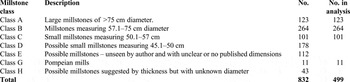
This paper focuses on the south, south-east and central counties of England highlighted in fig. 1, extending as far as Dorset in the south-west and Warwickshire/Cambridgeshire in the north. Millstones were allocated to a class based on the reliability of their identification, the key parameter being the diameter (Table 1). Full details of the analysis are included in Appendix 1 but to summarise, stones with a diameter greater than 57 cm seem certain to be millstones (Class B), while stones measuring over 50 cm are probably millstones but should be considered on a case-by-case basis (Class C). Smaller stones measuring 45–50 cm may have been mechanically operated and although they are not included in this analysis, they were allocated a class (D). A further class of ‘large millstone’ has also been suggested for stones that measure in excess of 75 cm (Class A). Pompeian mills (Class G) are included in the discussion in terms of dating and distribution but not in any analysis of size or features. The Pompeian mill (or donkey mill) comprises a large hour-glass-shaped upper stone which sits astride a conical lower stone; it is thus an entirely different class of mill than those being studied here.
CLASSES OF MILLSTONES

Those specimens without measurable diameter but which seem likely to have been greater than 50 cm in diameter on other criteria (for example because the surviving portion already measured in excess of 50 cm) are included. Specimens published as millstones on the basis of thickness only (Class H) and stones lacking supporting data (Class E) are not included in the main analysis. This approach will almost certainly mean that some millstones have been omitted, but it was felt necessary to ensure that only definite millstones were included. It is worth noting that many examples published as ‘millstones’ have been done so erroneously and are either, in fact, just rotary querns, or are too fragmentary for a conclusive identification and should be labelled as ‘possible’.
DESCRIPTION
There are 499 millstones of Classes A–C and G from 198 sites in the study area (Table 1 and Appendix 2). A further 178 stones are of a possible smaller millstone class (measuring up to 50 cm) and 155 stones have been identified as possible millstones of Classes E and H. Many of these retain no surviving edge and cannot be distinguished from rotary querns. The confirmed millstones of Classes A–C measure up to 120 cm in diameter and in surviving maximum thickness range from 2.7 to 19 cm. Two main forms can be recognised, the domed type (where the upper and lower surfaces are roughly parallel but are angled) and the flat type (with surfaces typically parallel but flat or nearly flat); both identified by Peacock.Footnote 10 A third type where the stone has a concave grinding surface and flat top or convex grinding surface and flat bottom can be classed as tapered. Upper millstones may also have a raised kerb around the circumference of the upper surface. Kerbs are most likely to occur on rotary querns of lava but also appear on millstones of Millstone Grit.
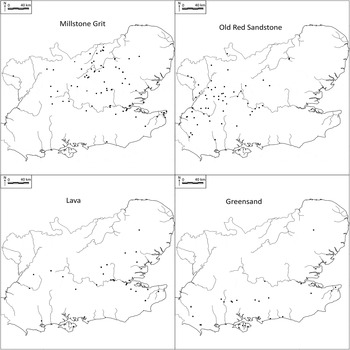
Four main lithologies were used for millstones in Roman Britain (Table 2 and fig. 1). These are Millstone Grit, Old Red Sandstone, Lava and Greensand. Since significant differences occur in form, features and distribution between the different lithologies, they will be discussed by stone type below.
Distribution of millstones by lithology. (Drawing: author)

NUMBERS OF MILLSTONES BY LITHOLOGY

OLD RED SANDSTONE
Old Red Sandstone (ORS) was used for the manufacture of rotary querns from the middle Iron Age and for millstones from the Roman period. The best documented of several sources is that at Penallt in the Forest of Dean (Glos.). Tucker studied seventeenth- and eighteenth-century production there and estimated that it could have produced up to 10,000 millstones; a quarry of this size could well have had its origins in the Roman period.Footnote 11 Although millstones of ORS have not been directly traced to specific quarries, they are thought to have been quarried and manufactured at Chesters Villa and other sources of ORS querns and millstones existed around Bristol and in the Mendips (Somerset).Footnote 12
A total of 106 millstones of ORS have been identified at 58 sites within the study area. This is a more extensive distribution than previously identified,Footnote 13 but shows the same pattern of an eastward spread from sources in the Forest of Dean and the Mendips, with the main concentration in Gloucestershire, Somerset (and Avon) and Wiltshire.
ORS millstones measure 3–16 cm thick and up to 90 cm in diameter (apart from a single exceptional stone from Frocester measuring 120 cm in diameter). The millstones are a mixture of domed, flat and tapered types. Only four examples from Vineyards Farm (1) and Kenchester (3) are kerbed. Most of the ORS millstones are dressed with pecking, occasionally deep-spaced or honeycomb pecking (Type 2 in Lepareux-Couturier's dressing typology) as at Ashton Keynes, Frocester and Tewkesbury.Footnote 14 ORS millstones occasionally have harped grooves in Somerset and Gloucestershire and, outside this apparently regional distribution, at Silchester.
Twelve millstones of ORS are from contexts dated to the early Roman period, however, nine of these are from late second-century contexts at Kenchester (Magna Castra) and it is worth noting that these are a variant of Lower Old Red Sandstone. The precise source for these stones has not been determined, but it is not from the typical Quartz Conglomerate of the Forest of Dean, since this is stratigraphically within the upper ORS.Footnote 15 Excepting Kenchester, there is a first-century millstone of Class C from Vineyards Farm, another of Class C from a second-century context at Coleshill, and one of Class A from an undated gully at Reading cut by a ditch of third/fourth-century date. A fourth millstone from Westbury is reputedly of LIA–ER date but the context information is unclear and it could be much later. The remaining examples are entirely from third- and fourth-century contexts. Setting aside the exceptional Lower ORS millstones from Kenchester, current evidence continues to support previous statements that the main ORS millstone industry was a relatively late development, perhaps not before the start of the third century, with only sporadic manufacture before that.
LAVA
Lava millstones were imported from the Continent and, although a detailed survey of the occurrence of lava querns has not yet been carried out, the evidence suggests that many of these querns were initially brought here as part of army equipment.Footnote 16 In some parts of the country this supply may have tapered off after the early Roman period, but in eastern areas such as Kent, they continued to be used throughout the Roman period and this pattern now looks increasingly likely elsewhere.Footnote 17
With geochemical analysis it is now possible to pinpoint the source of lava to the lava flow or specific quarry.Footnote 18 In Britain, however, this research is behind that of the Continent and little thin-section or geochemical analysis has been carried out on disc type millstones. Research on British Pompeian millstones reveals that they came from quarries in the Chaine des Puys in central France (Volvic, Auvergne) and from the Mayen area of the German Eifel hills, including the Bellerberg volcano.Footnote 19 It is likely that British disc querns and millstones were also produced in multiple quarries. Almost 40 years after David Peacock pointed out that an assumption of a Mayen source without proper analysis may have led to its use being over-represented,Footnote 20 this remains an area requiring significant further research.
Lava millstones are significantly less numerous than millstones of native materials. This may in part be due to the poor survival rates of lava querns in the soil conditions of some parts of the study area (such as Kent) and because they were often broken up for use as hardcore. The small number of lava millstones, however, argues against the idea that there was any particular link between the army and intensive milling, at least after they initially helped spread the technology.Footnote 21
Millstones of lava have been identified at 34 sites (49 examples, including 10 Pompeian mill fragments), mainly in Kent and London, and it is clear that lava millstones were distributed westward from the east coast, possibly up the river Thames. Lava millstones also occur along the south coast but their use does not appear to have penetrated far inland from there. In East Anglia, millstones are less commonly found than anywhere else in the study area but the emphasis on the use of lava in East Anglia and its poor survival rates may go some way to explaining the paucity of millstones in the region.
Lava millstones mostly occur on urban sites such as Verulamium, Silchester, Springhead and London and high-status sites such as Fishbourne. Pompeian mills from London and Silchester are securely dated to the first century, but other millstones have also been recovered from first-century contexts, for example at BathFootnote 22 and Mucking, and second-century contexts, such as those from Verulamium and Northfleet. It is likely that millstones of lava were introduced to Britain at the same time as Pompeian mills.
Lava millstones measure 4.2–12 cm thick and up to 1 m in diameter, although they typically range from 50 to 80 cm in diameter. Six millstones are domed, two are flat and two are tapered; the rest are of unknown form. Only three lava millstones are kerbed examples, measuring 50, 57 and 76 cm in diameter respectively from Springhead, Northfleet and Bath. Where the grinding surface can be recorded, the millstones mostly have harped grooving on the grinding surface; however pecking and radial grooving also occur. The eye of the upper stone is large at 13–15 cm but is significantly smaller on lower stones at between 1.8 and 5.2 cm.
MILLSTONE GRIT
No detailed analysis of the petrology of Millstone Grit (MG) millstones has been published, but quarries have been identified in Yorkshire at Wharncliffe (said to have produced thousands of flat disc querns), at Den Bank in the Rivelin valley and at Blackbrook in Derbyshire.Footnote 23 It is the most commonly recorded millstone material in the study area with 203 examples from 81 sites. Millstones measure 2.7–18 cm thick and up to 1 m in diameter. Although 13 examples measure in excess of 90 cm, they account for just under 8 per cent of all the measurable examples and the evidence suggests that the very largest millstones were not made in Millstone Grit. The stones are of domed, flat and tapered form with kerbs present on 16 examples. The grinding surfaces are dressed in a variety of ways, with no particularly dominant method.
Millstone Grit millstones achieve the greatest distribution of any of the millstone lithologies; however, they dominate in the northern area and, excepting Kent, are not commonly found south of the river Thames. Millstones of Millstone Grit are typically found in contexts of second- to fourth-century date but enough examples from first-century contexts are known to suggest a first-century origin for their production, including examples from Odell (a.d. 50–75), Ebbsfleet (a.d. 43–120), St Neots (first to early second century), Chignall (first century), and the Arrow Valley in Warwickshire (mid- to late first century).
GREENSAND
There are three well-documented sources of Greensand querns: the Folkestone quern factory in Kent, the quarry at Lodsworth in Sussex and the Pen Pits quarry in Wiltshire.Footnote 24 It is highly likely that Greensand querns were produced at multiple sources across Wessex and elsewhere.Footnote 25 As with ORS and MG, each of which also had multiple quarries and source areas, the Greensand has not been subdivided here by source.
A total of 61 millstones of Greensand have been recorded from 28 sites. They occur in a linear distribution across the south from Kent through Sussex, Hampshire (including the Isle of Wight) and Wiltshire to Somerset with a single example of Class C from Brandon Road, Norfolk. Greensand millstones have a clear distribution that relates to major exposures in Wessex and the Weald. Several sites can be clearly linked to their nearest source, for instance, Folkestone Beds Greensand occurs at Ickham, Pen Pits Greensand was used at Fullerton, and Lodsworth Greensand was exploited at Littlehampton. The isolated example in East Anglia is not far from outcrops of Greensand in that area, although it has not been directly provenanced.
Greensand millstones have the greatest variation in size measuring up to 120 cm in diameter and ranging from 3.2 to 18 cm in thickness. There are four particularly large millstones in Kent and Sussex from Ickham, Thanet Earth and West Blatchington. The largest of these, from Thanet Earth, may be unfinished, but they nonetheless suggest that the ultra-large size was focused in the far south-east; it is not clear if all four stones are from the same source of Greensand. Greensand millstones are mainly flat in form, though tapered and domed millstones do exist. No kerbed examples are known. Few of the Greensand millstones retain their surface dressing, but those that do have either harped grooving or concentric grooves. Only four Greensand millstones are of first- or second-century date, suggesting that millstone production in Greensand was mostly a late Roman activity. It is also worth noting that almost all the largest millstones of Class A were from late Roman contexts (one exception at Eton was of second- to fourth-century date).
OTHER LITHOLOGIES
This group includes all millstones recorded as sandstone or ‘other’ lithologies and those for which the stone type is not published (and which the author has not identified in person). As this is a disparate group of stone types, their distribution is not mapped or shown in detail, but a brief summary is supplied. A total of 48 sites produced 80 millstones comprising 40 of sandstone, 31 of unspecified lithology and 9 others. Many of the unspecified and sandstone querns may be varieties of Greensand, ORS or MG, but others may be from unknown sources in this country or on the Continent.
Millstones of ‘other’ lithologies are uncommon but include four of limestone and eight of other materials. Limestone millstones appear to have been used on sites very close to their probable source and include examples from Feltwell, Bath, a Quarr example from the Isle of Wight, and one of Hamstone at Ilchester. Other local stones were also used on occasion, such as Brandon Hill Grit at Gatcombe, Granite at Mucking (probably from an erratic), Kentish Rag at Canterbury (reputedly for a Pompeian mill), and a local siltstone at Rustington bypass.
Millstones in this group measure 3–19 cm thick and up to 106 cm diameter. They are mainly of domed or flat type, with one possible Pompeian mill (mentioned above) and two kerbed stones. Where dated, these millstones are mainly of late Roman date, the earliest examples being the siltstone example from Rustington bypass from a context dated to the late second century and a sandstone example from Bromham from a context dated to a.d. 150–70.
OVERVIEW
Distinct patterns of use can be observed (fig. 1). Broadly, Millstone Grit is favoured in the north of the study area, ORS in the west, Greensand in the south and lava in the east, although with considerable overlap between them. Most sites with multiple millstones mirror this overlap, with generally two or more stone types in use at any given mill. A single material was nonetheless dominant at most sites: Greensand at Fullerton; Millstone Grit at Tiddington, Stanwick and Colne Fen; ORS at Ashton Keynes, Frocester and Kenchester. It is perhaps no surprise that the stone type that dominates at these sites is from the nearest source. The presence of a single lithology at Kenchester, the only site with more than five millstones from a single source, may be related to the potentially short-lived nature of the mill.
A comparison between the different stone types reveals some trends. Lava and ORS products tend to be smaller in diameter — with 60 per cent and 70 per cent of all measurable examples respectively being under 70 cm in diameter and very few of either measuring in excess of 80 cm. In contrast, millstones of Greensand tend to be larger, with 65 per cent measuring 70 cm or more and 15 per cent being 90 cm or more. Millstones of Millstone Grit are more evenly distributed between the different size brackets. It is clear that the largest millstones were made in Greensand but that as a general rule, millstone production did not conform to a given set of dimensions. The variation in size (and weight) between millstones of different lithologies is quite considerable. Significant variation also exists within each individual lithology. It is possible to interpret the variation within a single lithology in a number of ways:
(1) each quarry made millstones to their own precise standards over a long period of time and the differences we see represent different quarries;
(2) all quarries in a region made millstones to a standard design for a relatively short period of time (decades rather than centuries) so the variation is between regions and chronologically;
(3) each quarry made millstones to their own standards for a relatively short period of time so the variation is between quarries and over time.
In all these cases, the standardisation that could have occurred within a quarry at a certain time, within a quarry over a long period of time, or between quarries at a given time is lost because we lack close provenancing and dating for the surviving millstones. Alternative explanations are that:
(4) none of the quarries standardised their millstone manufacture;
(5) a small number of quarries standardised their millstone manufacture.
The data available at present are insufficient to be absolutely sure, but the variation found within this study would appear to show that standardisation did not occur.
Millstones are more likely to be recovered from third- and fourth-century contexts than from first- or second-, but early Roman examples do occur. Approximately 20 per cent of dated examples are from first- or second-century contexts, although the bulk of these are of the second century and many of the first-century examples are of Pompeian style. Within this broad pattern, ORS and Greensand millstones seem to have been a late Roman innovation, with probable differences between the various quarries, while Lava and Millstone Grit millstones were unequivocally being produced and used during the early Roman period. This difference has implications for our understanding of the millstone and quern industries and would benefit from further investigation. Within this general trend, and excepting the very large Greensand millstones, there is no indication that larger millstones were introduced later. The dating of millstones alone would suggest that mills occurred in Britain from the first century but only infrequently and that they became a fixture in the Roman economy from the third century.
Stylistically, kerbed millstones are equally likely to be early or late Roman. Flat and domed millstones are more likely to be from late contexts; however both occur with regularity in early contexts (Table 3). This seems to conflict with previous analysis indicating that the domed types were earlier and the flat forms were later.Footnote 26 This is curious since a progression from angled surfaces to flat surfaces was a logical development with the understanding that gravity was not required to carry the flour to the edges of the millstone. Further scrutiny is required of the dating of different forms.
MILLSTONE FORMS BY PERIOD

DISCUSSION
Flour had a short shelf-life of about two months,Footnote 27 so each mill can only have served a relatively limited geographical area, perhaps the inhabitants of a villa estate, an official establishment or a single town and its hinterland, as suggested for the mill at Kenchester.Footnote 28 It is thus likely that mills would have been a more regular occurrence than currently indicated by the structural remains. This would seem to be borne out by the almost 500 proven millstones here, as well as a number of possible smaller millstones and many others too fragmentary to identify. But does the distribution of millstones reflect the distribution of mills?
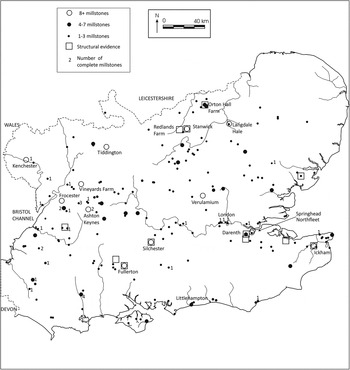
fig. 2 reveals a general distribution of millstones across the study area. Apparently blank areas on the distribution map probably reflect variation in the amount of excavation rather than real absences. When interpreting this map, we must consider the following:
(1) When can we assume that intensive milling actually occurred—how do we interpret the recovery of a single mill fragment?
(2) How were the mills powered?
(3) What were the millstones used for?
Distribution of all millstones. (Drawing: author)

INTERPRETING MILLSTONE FRAGMENTS
In simple terms, the more millstones recovered, the more likely it is that a mill was located nearby.Footnote 29 Connecting known mills to locally found millstone fragments might eliminate some of the findspots on the map; however, an examination of millstone distribution does not show an increased density around known mill sites. The possibility that this is because distribution patterns are significantly more widespread cannot be entirely discounted, but it is most likely that broken stones were discarded in the immediate vicinity of the mill.Footnote 30 If this is the case, we can reasonably suppose that sites with numerous millstones indicate the presence of a mill very nearby. We must balance this supposition, however, against the general size and condition of those fragments as well as their contexts of deposition. Re-use of millstone (and quern) fragments is extremely common and small fragments would have been relatively portable and well suited to use as hones or building stone. The smaller a fragment, and the more re-use it demonstrates, the further it might have travelled from its primary place of use, but equally the less likely it is to be large enough to record unequivocally as a millstone. Re-use is particularly relevant in areas that lack decent locally available stone — redundant millstones would have been valuable as a resource in their own right. Nonetheless, we must not discount single fragments entirely. The final deposition point of a millstone may not mark the precise location of a mill but its very existence indicates the presence of a mill somewhere. The general frequency of mills is thus probably reasonably well indicated by the number of millstone findspots.
Of the 191 sites with millstones, more than half (108) have produced only a single millstone, while 75 per cent have produced one or two fragments. A total of 36 sites have produced four or more fragments, of which 13 have eight or more (Table 4). These include the known mills at Fullerton, Ickham, Stanwick and Silchester, and sites with possible structural evidence of watermills such as Darenth, Kenchester and Dickets Mead. Other sites with multiple millstone fragments include Springhead, Northfleet (the site of a Saxon mill), Frocester, Ashton Keynes, Langdale Hale, Tiddington and Vineyards Farm. It has previously been suggested that Ashton Keynes acted as a secondary distributon centre and this theory still holds, although many of the querns demonstrate wear suggesting that milling was occurring on a significant scale.Footnote 31 The likelihood is that all these sites were associated with a mill.
SITES WITH MULTIPLE MILLSTONES

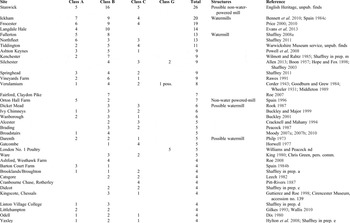
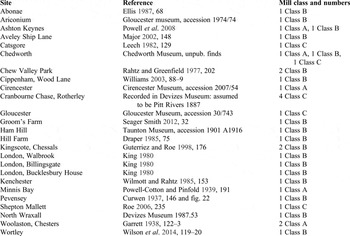
The probability that a mill was located very nearby is also increased in line with the surviving size of the millstone fragments — complete millstones can be taken as better evidence for the proximity of a mill than small fragments, since they would be more difficult to move. Exceptions to this rule apply — if the millstone was in a workshop for re-grooving or refitting of the mill-ryndFootnote 32 or in storage near the place of manufacture or secondary distribution centre. These exceptions are probably rare, however, and most complete millstones can be taken as strong evidence for the existence of a mill nearby. A total of 34 complete millstones are known from 25 sites (Table 5; fig. 2). Some of these have been recovered from sites near to known mills, such as an example at North Wraxall Villa close to Nettleton mill, but it is a reasonable assumption that most indicate the presence of a hitherto unknown mill.
LIST OF SITES WITH COMPLETE MILLSTONES

HOW WERE THE MILLS POWERED?
Although it was not the aim of this paper to analyse each site individually, some consideration of likely power sources is key to understanding intensive milling practices in Roman Britain. Although it is impossible to compare construction and maintenance costs for different types of mills, Wilson has calculated that a watermill would have an output of approximately five or more times that of a donkey mill.Footnote 33 A watermill would also have been cheaper to operate than an animal mill, since there would be no need to stable and feed any animals, but it would certainly have been more costly and complex to construct.
Without structural remains, it can be difficult to determine what powered a mill. For instance, a large number of millstones were recovered from contexts of first- to fifth-century date at Frocester. Possible evidence for a mill was recorded and none of the stones retain rynd slots. While there is a stream nearby, it is not known whether it could have powered a mill so, although the type will remain unresolved at present, the stones clearly demonstrate the existence of mill.
Without structural remains, there are various ways that might help determine the type of power that operated a mill. Peacock has suggested that domed millstones are most frequently associated with water powerFootnote 34 but analysis of the current dataset suggests the reality is less simple. Orton Hall Farm, Stanwick and Kenchester each produced millstones of both forms, while the millstones from the late Roman mill at Fullerton were principally flat. More analysis of millstone profiles from confirmed water- or non-water-powered mills will allow this question to be further investigated.
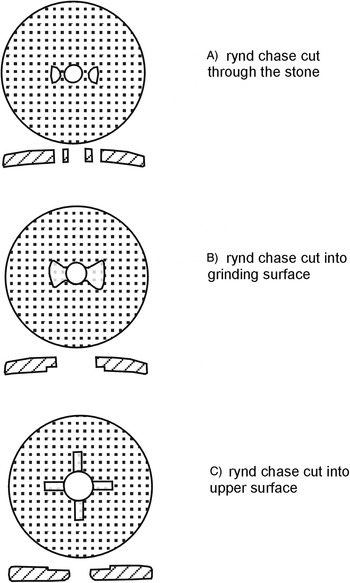
Another possible way of determining power source is by studying the type of rynd-chases on the millstones. There are three types of rynd-chases: those set into the under surface (underdrift), those set into the upper surface (overdrift), and those cut right through the stone (probably also overdrift).Footnote 35 Typical examples are illustrated in fig. 3. According to Spain, non-water power is indicated by stones that have rynd-chases set in the upper surface or all the way through the stone, because the weight of the upper stone cannot have been supported by the rynd. Instead its purpose must have been to attach beams ‘for transmitting the torque and turning the stone’.Footnote 36 Since rynd-chases cut into the upper stone or right through the upper stone are significantly more frequent than those cut into the grinding surface (approximately 4:1 in this dataset), the data would appear to suggest that non-water-powered mills were more prevalent than water-powered mills. However, the powering of millstones may not be so intrinsically linked to the position of the rynd-chase. At Kenchester, for example, the millstones have rynd-slots cut right through the stone, which would appear to suggest that they were operated from above and were thus animal-powered. The site was however, interpreted as a watermill based on the recutting of a stream at the same time as the first occurrence of millstones. It is possible that both types of mill existed in the town, but equally, it might indicate that these stones were used in a watermill.
Schematic illustration of rynd slots. (Drawing: author)

Accepting that the evidence of the rynd-chases should be used only in conjunction with other evidence, there are sites that can be interpreted as having had a watermill. Underdrift stones were found at Northfleet, Fishbourne and Snodland, all sites with the possibility of water power, although lacking contemporary structures. The remains of a Saxon mill were found at Northfleet, perhaps hinting at earlier activity of a similar nature and certainly showing that there was sufficient water to power a mill. At Fishbourne, doubt was cast on the suitability of the local stream,Footnote 37 but the existence of a mill during the medieval period discredits this. It is not unreasonable to suppose that the occupants of a site like Fishbourne would have had the resources to construct a watermill and would have benefited from one, even if the structural evidence for it has not been found. The villa at Snodland in Kent also produced an underdrift millstone but no structural remains. The building was on the banks of a river on which a later mill was located, eventually a paper mill, and described in the eighteenth century as a mill, malthouse and maltmill.Footnote 38
At other sites the rynd slots do not survive but water power was geographically feasible. Such sites include Rivenhall, Ivy Chimneys, Barton Court Farm, Littlecote, Darenth, Chew Valley, Chedworth, Wingham and Woolaston. In contrast, no stones unequivocally identified as millstones were found at Redlands Farm, but there was structural evidence for an early second-century watermill.Footnote 39 Some of the surviving fragments, however, could be from millstones (they were too fragmentary to identify as querns or millstones) and others might have been transferred for use at Stanwick when the Redlands Farm mill went out of use.
Despite the complexities of using the position of the rynd-chase to interpret what type of mill the stones came from, there is a case for the existence of a non-water-powered mill where evidence of overdrift stones survives. Millstones of this type are usually referred to as animal-powered but they may, in fact, have been powered by humans. There are three types of non-water-powered mills: human-powered with the aid of levers (Option 1), or gears (Option 2); or animal-powered (Option 3).Footnote 40 Three quarters of all surviving rynd slots are from overdrift stones, including examples from Chew Park, Silchester and Orton Hall Farm. The latter two sites also produced structural evidence for non-water power, supporting a link between the rynd-chase type and the power. In many cases one must look to other sources of evidence to determine what type of mill may have been in operation. While acknowledging that rivers will have changed course in two millennia, it would have been very difficult to construct watermills at sites lacking a suitable water source. Lengthy water channels or aqueducts could have been constructed in most settings in order to provide a sufficient head of water, but on many sites this investment will simply not have been justifiable. It is possible to infer the presence of a non-water-powered mill at sites such as Wortley, Grateley and Poundbury.Footnote 41
The most thoroughly published non-water-powered mill is that recorded at Orton Hall Farm.Footnote 42 A rynd slot set into the top surface of one of seven millstone fragments indicated that the stones were overdrift. In addition, three plinths each measuring 0.75 by 0.60 m and standing at least two courses high were interpreted as the housings for millstones.Footnote 43 The space between the plinths was sufficient for people but not animals to walk around and thus the conclusion was that these mills were human-powered with the use of beams.
At Stanwick, although plinths did not survive, there was an approximately circular worn area that Neal interpreted as resulting from animals' hoofs. He suggested it was a two-storey donkey mill, the animal on the ground floor driving millstones on the floor above.Footnote 44 At Silchester a large shed or room contained ‘circular bases of rough masonry, 4 or 4½ feet across and 2 feet high, three in each row, spaced 5 or 6 feet apart’, which were interpreted as the bases for millstones.Footnote 45 Silchester has produced fragments of both Pompeian and flatter-style millstones, so it is not apparent which were used in this setting, but either way, the stones can only have been operated by animal or human power.Footnote 46
WERE MILLSTONES USED TO PRODUCE FLOUR?
While the distribution of millstones is likely to be a reasonable reflection of the number of mills, some water-powered, some not, we must be careful not to directly correlate all of them with the production of flour. There is plenty of evidence that querns were used to grind a wide variety of substances, some edible and others not.Footnote 47 It is highly likely that a single household quern would have served multiple purposes. Rotary querns found in association with a dye house in Insula X at Silchester may, for example, have been used to grind up the roots of the madder before it was soaked in the vats.Footnote 48 At the Orsett Cock Enclosure, Major suggested that the millstones and querns might have been used in pottery manufacture as kickwheels or for grinding up tempering material. The frequent occurrence of querns on Romano-British kiln sites would appear to support this theory,Footnote 49 although pottery makers would still have needed to eat, and we must be careful not to assume that querns and millstones on industrial sites were always used for industrial purposes.Footnote 50 Rotary querns (and by extrapolation millstones) were also used to crush and grind metal ores such as lead, iron and silver.Footnote 51 The presence of rusty red deposits on the grinding surface might be an indication that a quern or millstone was used to grind iron ore, although iron can also leach out of the soil post-deposition.Footnote 52
The most significant alternative function of querns and millstones, however, is probably their use for the processing of grain intended for the production of malt for ale. Spikelets of spelt were soaked to encourage germination, then dried to halt this process, before being crushed or ground to separate the chaff and sprouted germs. There is some debate as to the effectiveness of grinding versus crushing, but there is no doubt that grinding could have been carried out with querns or millstones.Footnote 53
Evidence for malting is known from numerous sites, predominantly small towns and villas, through the presence of sprouted grains among the charred plant remains. On settlement sites it is difficult to determine whether the querns or millstones were used for grinding grain for flour or for malt or whether they were used for a combination of the two. There are sites, however, where querns and mills were found on sites with no occupational evidence. Weedon Hill in Buckinghamshire and Beck Row in Suffolk are two such examples. Weedon Hill produced seven quern fragments but no millstones, while Beck Row produced both querns and at least one millstone.Footnote 54
It was not within the remit of this paper to review all the environmental evidence from sites with millstones to determine the likelihood of grain processing for malt, but of sites known to the author with this evidence, more produced millstone fragments than did not. Millstones were associated with a structure interpreted as a malt-house at Stebbings Green in Essex, while Northfleet Villa in Kent was interpreted as a large-scale producer of malt and ale through the recovery of frequent germinated grain and sprouts.Footnote 55 At least some of the many querns and millstones found here must have been used for grinding grain for malt. An assemblage of spelt with a high proportion of sprouted grains from Tiddington in Warwickshire was interpreted as evidence that grain was malted.Footnote 56 Among almost 300 quern fragments from Tiddington were at least 11 millstone fragments (it is impossible to confirm many others because of their fragmentary condition). Sprouted grains found at Alcester were initially interpreted as grains spoiled by damp but could be evidence for malt production.Footnote 57 At Frocester, double ovens dating to the third to fourth century were interpreted as probable malting ovens and a grain-based economy is indicated from at least the mid-second century by a threshing-floor.Footnote 58 All but one of the millstones are from third- to fourth-century contexts, (the exception is dated to the second to third century), suggesting that the mill was in operation during the later Roman period and that only small-scale grinding occurred prior to that. The dating of the possible malting ovens suggests that some of the milling may well have been associated with malting.
All these sites produced significant numbers of millstone and rotary quern fragments, but other sites with smaller assemblages of millstones and rotary querns also had evidence for brewing, including Ilchester, Bancroft Villa, Catsgore, Houghton Down and Grateley. It is unclear how integrated the processes of preparing grain for flour and malt were and future research will need to address whether millstones were put to a different function from rotary querns or whether one or both were put to multiple uses at different times. The possibility of overlapping functions is suggested by the evidence at Catsgore where the roasting of spelt wort may have been one of several functions of the ovens; the drying of grain for both flour and malt may have occurred in the same ovens, although not at the same time.Footnote 59 Excavations at Grateley in Hampshire begin to provide some further clues to the relationship of grain for brewing and grain for flour. Two buildings constructed at Grateley in the middle of the third century each had a double oven at one end. The environmental evidence from the ovens revealed that the left-hand oven of each pair was used to ‘heat sprouted spelt wheat to prepare it for the malting process and beer making’. The right-hand oven was used at a higher temperature to ‘parch the spikelets of spelt to make the glumes brittle so that they could more easily be separated from the grain’.Footnote 60 The implication from this is that the processing of grain for flour and grain for malt were closely linked and that where we have evidence for one, we should consider it possible, if not probable, that the other also occurred. It is worth noting, however, that Cunliffe and Poole felt that some of the grain may have been processed on site and some at the nearby watermill at Fullerton. In this scenario, one possible arrangement is that the processing of grain diverged at this point, with grain destined for malting perhaps ground on site while that for flour went elsewhere.
CONCLUSIONS
The evidence suggests that mills, both water- and non-water-powered, were a common feature in the Romano-British landscape. There is likely to have been a mixture of both types and they may have existed concurrently in the same landscape as suggested by the evidence for both water- and non-water-powered mills at Kenchester and at Stanwick/Redlands Farm. Although both types of mills were used, Peacock suggests that watermills were the exception and that stones powered by human or animal power were the norm.Footnote 61 The evidence from this survey shows that overdrift stones are more common than underdrift, and on current evidence it seems that non-water-powered mills were more common. Unfortunately, the vast majority of stones are insufficiently complete, do not retain rynd-chases or are lower stones and cannot be used to answer this question. There is also apparently no correlation between the size and form of the stones and the type of mill in which they operated. Thus the only way to distinguish water- from non-water-powered mills is through detailed investigation on a site-by-site basis.
How then does the picture of intensive milling in Roman Britain fit with the widespread adoption of watermills envisaged for the first century?Footnote 62 The evidence presented here shows that powered mills were in use during the early Roman period, but not definitely that many of these were water-powered. The earliest confirmed underdrift millstones are from a context of second-century date at Bromham, while at Ickham one of the watermills was of second-century date as was the possible watermill at Kenchester. Both Pompeian style mills and flat/domed/tapered mills have been recovered from first- and second-century contexts and some of the latter types could have been associated with water power. Millstones from early Roman contexts are more likely to be overdrift, however, as at Clay Farm, East Kent Access Road, Rustington, Tiddington and Bath, suggesting that non-water-powered mills were in use earlier and in greater number than watermills.
The evidence suggests that intensive milling began on a small scale during the first century, perhaps with non-water-powered mills and developed slowly during the second century. It expanded significantly from the third century with the greatest intensity of milling during the later Roman period, as evidenced by the third- and fourth-century date of 80 per cent of all dated millstones in the present survey. This corresponds well with the dating available from the known watermills at Ickham (from the second century) and Haltwhistle and Fullerton (third to fourth century).Footnote 63
The distribution of millstones suggests that mills were a regular occurrence across the landscape. In some areas there appears to be a spacing of c. 10–20 km between mills; however, there is no certainty that these were all in operation concurrently and in other areas the distribution is much more variable. It is possible that, where required, more than one mill existed in close proximity, as at Stanwick and Redlands Farm, and Springhead and Northfleet, and it is likely that the area served by a mill was very variable depending on the type and size of mill and to whom it belonged. Intensive milling occurred on a variety of sites including small and large towns, villa sites, rural settlements and high-status sites.
The evidence clearly shows that the development of intensive milling practices may not always have been prompted by a need for the centralised production of flour. The evidence of late first- and second-century milling of malted grain at Northfleet indicates that the need for ale may have been a significant impetus behind the development of milling technology. Possibly it was a combination of the two; the oven system at Grateley highlights the relationship between malt and flour. A focus for future analysis of large quern and millstone assemblages will be relating their use to the environmental evidence. Only with this combination of research will we begin to unravel the relationships between powered mills, millstones and the grinding of grain for malt or flour.
What this survey has shown is that powered mills were a far more frequent occurrence than has previously been accounted for. Rotary querns remain far more common finds than millstones and it is unarguable that the majority of flour consumed in Roman Britain was produced on a small scale at the household level. Grain processing was, however, frequently centralised and intensively carried out. This suggests careful organisation of food supply. Further work to elucidate the power type of various mills will begin to unpick patterns of mill-type construction and use. This is significant, since although the decision to build a water-powered or non-water-powered mill was influenced first by geography, a main factor will have been the availability of finances and resources. A watermill would have required a far more considerable investment of time and money than a non-water-powered mill. The presence of a watermill is indicative of wealth, status and control of resources, whereas the construction of an animal-powered mill could have involved a simple single set of stones, or a more complex multiple arrangement.
APPENDIX 1: SOME CRITERIA FOR DISTINGUISHING BETWEEN QUERNS AND MILLSTONES
In order to analyse the distribution and use of Romano-British millstones, it was first necessary to establish criteria for identifying them, since relying on published identifications proved problematic. Fragments are often published as millstones without substantive data; this is unfortunate, since ‘millstone’ is a loose term, employed in different ways. In fact, the English Heritage thesaurus rather unhelpfully describes a millstone as ‘a large stone used to grind grain or similar’. Thus items are sometimes published as millstones when they are actually rotary querns, for example at Shakenoak.Footnote 64 Quern and millstone specialists generally agree that a rotary quern was hand operated, while a millstone was mechanically operated, but how precisely do we tell the two apart? Wikander writes that most powered stones from antiquity have diameters greater than 55 cm and, perhaps as a result of this statement, many specialists do choose this as their cut-off point.Footnote 65 Some surveys of European hydraulic millstones also suggest 55 cm as the smallest millstone diameter, yet others 57 cm.Footnote 66 In contrast, the largest rotary querns made at Blackbrook in Derbyshire measured 50 cm, while Lodsworth Greensand querns seem only to have been made up to 45 cm diameter.Footnote 67 Others choose 60 cm or 65 cm as a cut-off pointFootnote 68 and Peacock has recently said that: ‘There are no hard and fast rules, but querns, driven by hand, are usually less than 50 cm in diameter, while anything greater than 60 cm is best regarded a power mill.’Footnote 69
Since work investigating watermills is progressing apace, accurate identification of millstones will increase our understanding of how important mills were in the Roman economy. A database containing c. 4,500 rotary querns and millstones from the south-east of England, the Thames Valley, South Wales, the Midlands and north-west England was the starting point for this investigation. No analysis is included of querns and millstones in the north-eastern counties covered by the Yorkshire Quern Survey and beehive querns are excluded, so the conclusions do not relate to them.
WHAT IS THE DIFFERENCE?
Functionally, the difference between querns and millstones is clear — a rotary quern was rotated or semi-rotated/oscillated by hand. Millstones were rotated with the aid of some sort of mechanism, such as levers or gears, and operated with the use of additional power; in the Roman period that power source might have been multiple people, animals or water. But when it comes to identifying millstones in the archaeological record there are two issues:
(1) What are the distinguishing characteristics of millstones or rotary querns which allow them to be identified, when the diameter cannot be measured?
(2) At what diameter should we consider a stone to have been mechanically operated?
This paper analyses the evidence for diagnostic features on querns and millstones to determine if the boundary between the two can be more clearly defined. The following discussion assesses the usefulness of key features sometimes used to identify millstones. The features under consideration are: the presence of handle sockets, thickness, the presence of rynd-chases, the diameter of the feed pipe and hole in the lower stone, and the form of the hopper.
HANDLES
The key identifier of a rotary quern is the presence of a handle socket, since its only purpose can have been to hold a handle to turn the quern. Most surviving querns are fragments without handle fittings, but there are almost 300 querns in the database with them; these form the basis of the following analysis. Handle sockets can be set into the side of a quern, laid laterally across the top of the quern, or in a style unique to lava querns, through the kerb in an ‘elbow’-shaped handle hole. There does not appear to be a relationship between quern diameter and handle type. In some cases, notably puddingstone querns, rotary querns were turned by means of an iron band strapped around the quern into which a handle was fitted.Footnote 70 In such cases, a rotary quern need not have a handle socket at all, so a complete stone without a handle socket cannot necessarily be assumed to have been a millstone. Nonetheless, patterns of handle socket occurrence are an indicator of the general methods of turning.
Virtually all the querns with handle sockets in the database used here measure 50 cm in diameter or less. Two exceptions from Carlisle's Millennium site, however, measure 57 cm and 51 cm.Footnote 71 These larger examples from Carlisle may represent a different class of large quern from the North. Nonetheless, their existence demonstrates that it was possible to operate larger-diameter querns by hand and thus cannot be ignored. Taking that into account, the data indicate that stones measuring >57 cm are millstones and that stones measuring >50 cm are extremely likely to be millstones. Handle sockets continue to be rare on querns measuring 45.1–50 cm in diameter (11 examples), suggesting that many of these stones may also have been mechanically operated. Indeed, elsewhere on the Continent, the maximum size of rotary querns has been found to be 45 cm.Footnote 72
Millstones sometimes have sockets or holes set into the upper surface; these can be square or round and of varying number. Occasionally they are described as handle sockets, however their function is far less certain. Holes of this type have been recorded on a number of stones, including examples from Frocester, Staines and Thundersbarrow Hill.Footnote 73 Spain considered the purpose of these holes in detail when they occurred on millstones at Barton Court Farm.Footnote 74 He suggested various functions including filling them with lead or similar for balancing, the use of rods to support the hopper or iron leaded in place for lifting. A millstone from Silchester measuring 70 cm in diameter has two sockets in the upper surface containing iron rings supporting this last interpretation.Footnote 75 An alternative explanation is that pins in these holes were connected to the driving mechanismFootnote 76 but Spain concluded that the most likely interpretation is the use of a pin projecting from the hole to jog the feed hopper to ensure vibration to aid the grain supply to the stones.
In the database forming the basis for this study, only 24 Romano-British stones have these sockets. Three measure under 60 cm in diameter (55.7, 56 and 56 cm); the rest are larger stones. The indication is that, whatever the purpose of these sockets, they were associated with millstones rather than querns. It is worth noting, however, that ethnographic evidence from Scotland has shown that large querns, up to 75 cm in diameter, were operated by hand by two people using long sticks inserted into similar sockets.Footnote 77 As there is no direct evidence of this method being employed in Roman Britain, and because of the uncertainty regarding the purpose of these sockets on Roman stones, they have not been classified as handle sockets here. Taking into account the ethnographic evidence, however, a cautionary approach might be to distinguish millstones in excess of 75 cm in diameter as large millstones.
DIAMETER OF THE EYE
A reasonable hypothesis might be that the diameter of the feed pipe or eye increases with the diameter of the quern or millstone. It certainly seems unlikely that a small quern of say 35 cm diameter, would have had an eye measuring 20 cm since this would not leave much in the way of grinding surface. In order to test this hypothesis, all querns and millstones with measurable feed pipes and diameters were plotted. The stones were divided into groups based on the analysis of diameter and handle sockets above — millstones of >57 cm diameter, small millstones of 50.1–57 cm diameter, possible millstones of 45.1–50 cm diameter and rotary querns (45 cm diameter and under).
Analysis of the upper-stone data revealed a general correlation between feed-pipe and quern/millstone diameter. Stones with feed pipes measuring in excess of 10 cm are almost entirely millstones. Only three exceptions measure under 50 cm in diameter (42 cm:15 cm from Odell; 45 cm:11.2 cm from Wanborough; 49 cm:13 cm from Silchester). In addition, millstones measuring in excess of 75 cm in diameter all have feed pipes measuring >12 cm in diameter. At the other end of the spectrum, feed pipes measuring 7 cm or less are almost always found on rotary querns. Two exceptions measure 62 cm in diameter with a 4 cm feed pipe and 54 cm in diameter with a 7 cm feed pipe. The evidence shows that if an upper stone has a feed pipe exceeding 10 cm in diameter it is almost certainly a millstone, while if it is less than 7 cm it is probably from a rotary quern. This is a very useful typological detail that should aid the recording of querns and millstones.
The diameter of the eye of the lower stone, and whether it was perforated, was also examined. Since the perforation of the lower stone allowed for the tentering of the upper stone, it might be assumed that the improvement in technology associated with intensive milling would mean that the lower stones would always be perforated. Of 142 stones in the database with surviving central socket (partial perforation), only three have diameters in excess of 50 cm, two from Stanwick measuring 52 and 51 cm respectively and one from Gatcombe of 53 cm. This indicates that a partially perforated lower stone will always be a rotary quern. Fully perforated lower stones could be from either a quern or a millstone.
Analysis of the diameter of the perforation of the lower stone was also carried out. A detailed study of a set of lower millstones from Rome found their central holes to measure 12–16 cm,Footnote 78 while a study of lower millstones from around the Mediterranean found a range of 9–15 cm.Footnote 79 Rotary querns in the current dataset tend to have holes measuring less than 6 cm in diameter and the maximum they measure is up to 12 cm. However millstones in this dataset do not always have large holes and they can measure as little as 2 cm in diameter. What this analysis shows is that lower stones with eyes measuring over 12 cm are probably millstones but that a smaller-diameter eye on a lower stone does not guarantee that a fragment is from a rotary quern.
THICKNESS
Millstones, or ‘possible millstones’, are regularly recorded in the archaeological literature on the basis of the thickness of the fragment alone, for example at Wantage, Mildenhall and Springhead. This is a difficult criterion, since millstones naturally became thinner through use, meaning that it is not possible to identify a fragment as a rotary quern on the grounds that it is thin — even millstones can be worn very thin before being abandoned. In the north of England, where beehive querns continued in use through the early Roman period, this criterion alone would not work. In the south of England, excluding a small number of major assemblages (Cadbury Castle etc.), beehive querns are rare finds from Roman contexts and almost exclusively of Iron Age and first-century a.d. date. Thus thickness is more likely to be a distinguishing characteristic.
Analysis of stones with both recordable diameter and thickness (some 1,500 examples) showed broadly that there is no correlation between thickness and diameter except that stones measuring over 13 cm in thickness are always over 50 cm in diameter and do not have handle slots. At Blackbrook in Derbyshire where rotary querns of between 30 and 50 cm in diameter were manufactured, the blanks measured between 6.5 and 15 cm thick.Footnote 80 The evidence from Blackbrook suggests that to be cautious, 15 cm should be a size beyond which a stone could probably be defined as a millstone on the basis of thickness only. Since examples measuring more than 15 cm thick are rare, thickness is unlikely to be a useful criterion for identifying anything other than a very small number of millstone fragments.
RYND-CHASES
The shape of rynd-chases on Romano-British millstones has been discussed by Peacock who illustrates the most common different forms, including the dovetail, three separate holes, a cross and a square,Footnote 81 but a short comment on their possible use as a millstone identifier is required. The cutting of a rynd-chase into either the upper or lower surface of an upper stone, or right through the stone, is sometimes used as a criterion for identifying a millstone.Footnote 82 They do sometimes occur on rotary querns, however, and in some regions are quite common. Prominent examples include a large number of rotary querns with rynd-chases in the upper surfaces at UskFootnote 83 and examples with rynd-chases in the under surface at sites such as Tiddington (personal observation) and Carmarthen.Footnote 84 Initial observations suggest that where rynd-chases occur on rotary querns, they are much more likely to be of overdrift than underdrift form. Rynd-chases that are cut right through the stone rarely occur on rotary querns but as all types of rynd-chases do occur on querns, they cannot be used to identify a millstone. The fact that there are small stones with complex rynd-chases shows once again that the issue of stone size and power source is not easily resolvable. The question of the use of complex rynd fittings is an issue that will require further investigation.
OTHER FEATURES
Patterns and styles of preparing the grinding surface were examined but none were found to be unique to millstones or rotary querns. The stylistic addition of a kerb around the rim, a common feature on lava querns, also occurs on a number of millstones of Millstone Grit, Old Red Sandstone and other sandstones as well as infrequently on lava examples. These kerbed stones measure up to 1 m in diameter but most frequently measure between 70 and 85 cm. The existence of a kerb therefore cannot be used to distinguish between querns and millstones.
A more useful feature is the addition of a projecting hopper. These are an unusual feature of Romano-British querns but virtually never occur on stones measuring more than 45 cm in diameter. Peacock notes that projecting hoppers occur on lava mills from the Middle Ages of up to 60 cm diameterFootnote 85 but these fall beyond the chronological scope of this paper. Only three Romano-British examples with a diameter greater than 50 cm are known to the author — one from Carmarthen of 50 cm, one from Brading villa of 51.5 cm and one from Coleshill of 56 cm.Footnote 86 No millstones larger than 56 cm are known to the author to have projecting hoppers, making them a useful tool for distinguishing querns from millstones.
DIAMETER
Combining the evidence from all the typological features reveals a clear pattern. The largest quern with a handle socket indicates that 57 cm should be used as the maximum size for rotary querns (although these larger stones were only observed in northern assemblages). However, the very small number of querns over 50 cm in diameter with handles suggests that most stones over that diameter were probably mechanically operated. This gives an indication that distinguishing lines could be drawn at 50 cm and 57 cm. We can add to this the fact that there are few querns under 50 cm in diameter which have millstone-sized feed pipes; partial perforation of the lower stone ends at 50/52 cm; there is a distinction in the use of projecting hoppers at around 50 cm, and there is an apparent maximum diameter of 50 cm for querns at some known sources.Footnote 87 These smaller stones are clearly the most difficult to classify. As long ago as 1950, Cecil Curwen observed that such stones required ‘special study’ because they were seemingly too large for hand operation and yet very different from the larger millstones clearly associated with mechanised power.Footnote 88 The factors combined here begin to suggest that stones measuring over 50 cm in diameter are almost certainly millstones, in line with Wikander's observation that millstones can be as small as 48 cm.Footnote 89
It is worth noting that the two querns from Carlisle hint at a larger rotary quern type in the North than is typical in the South. Strong regional differences in quern use between southern and northern England are already known, in particular the continued use of beehive querns in the North well after they had fallen out of favour in the South. This continued use of the beehive quern in the North will almost certainly have had an impact on the design and size of flatter disc-style querns and millstones. Since northern querns were purposely not covered by the survey, and thus only small numbers were analysed for the purpose of this appendix, the criteria established here have not been rigorously tested on northern querns and millstones. The Carlisle querns suggest that the distinction between hand-operated and mechanically-operated stones might have been higher in the northern counties. Understanding where the distinction between rotary querns and millstones fell in the North is an area requiring further research.
CONCLUSIONS
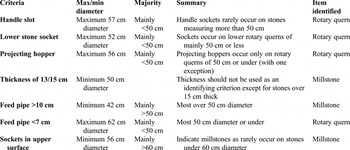
The purpose of this appendix was to consider how, as specialists, we distinguish a millstone fragment from that of a rotary quern. This distinction is important for our understanding of how the processing of grain contributed to the agricultural economy of Roman Britain. The analysis allows the following conclusions to be drawn (Table 6):
(1) Handle sockets rarely occur on stones measuring more than 50 cm in diameter;
(2) Projecting hoppers occur only on rotary querns (with one exception);
(3) Lower stones with partially perforated sockets measure 52 cm or less showing that sockets do not occur on millstones;
(4) Analysis of quern and millstone thickness demonstrates that except for millstones measuring over 15 cm thick (and identified by flat faces to distinguish them from beehive querns), thickness should not be used as a criterion for identifying millstones independently of other features;
(5) Rynd-chases are not unique to millstones and should not be used as identifying features; however, there is more work to do on when and where they were applied;
(6) Analysis of feed-pipe diameter in relation to overall diameter shows that there is a clear relationship between the two: stones with feed pipes measuring 10 cm or more are almost certainly millstones and those with feed pipes of 7 cm or less are rotary querns;
(7) Analysis of lower stone holes indicates that eyes measuring in excess of 12 cm only occur on millstones but that smaller holes can occur on both rotary querns and millstones.
SUMMARY OF MILLSTONE IDENTIFYING CRITERIA

Combining all the evidence leads us to the conclusion that stones with a diameter in excess of 57 cm are millstones. A separate large class of millstone should be allocated to stones measuring more than 75 cm in diameter. Stones with a diameter of 50.1–57 cm can be classed almost certainly as millstones. In order to ensure that data are more widely assessible in future, it is recommended that millstones be classified in published material. For example ‘a probable millstone (Class E) was recovered’.
APPENDIX 2: SITES WITH 1–3 MILLSTONES

ACKNOWLEDGEMENTS
The author gratefully acknowledges the support of Paul Booth, whose advice helped this paper take shape, and thanks Alex Smith of the Rural Settlement of Roman Britain project for some information on millstones. Thanks also go to the referees who provided comments that strengthened the paper. Any errors are the responsibility of the author.