Both the number of international human rights institutions and the number of countries participating in these institutions have risen dramatically in recent decades. This development has sparked a heated debate over why states choose to enter institutions that are designed to establish and monitor compliance with human rights standards. States bear what are often referred to as ‘sovereignty costs’ when they surrender discretion over national policies in order to adhere to the standards set by an international institution.Footnote 1 Considerable interest has been expressed in why a government would voluntarily elect to pay the sovereignty costs of participating in a human rights institution – especially accepting the constraints that the institution imposes on how a government treats its citizens – when it seemingly obtains no material gains from membership.
The costs of participation in a human rights institution depend on its design. Institutions characterized by obligation, precision, and delegation – features that are promoted by rule specificity, issue linkage, membership restrictions, formal reporting, monitoring of behavior, and enforcement procedures – place substantial constraints on members’ sovereignty.Footnote 2 Other human rights institutions, however, impose lower sovereignty costs on member states.Footnote 3 Human rights institutions are both widespread and heterogeneous. They include United Nations (UN)-sponsored human rights treaties as well as international organizations (IOs) designed to govern how countries treat individuals within their borders. A growing body of research has focused on government ratification of a small number of specific human rights treaties.Footnote 4 Yet much less attention has been paid to a larger (and growing) set of IOs that promote, advance, or enforce human rights – or to the variation in the costs to states of participation in such institutions.
We argue that democratizing states have a particular incentive to enter human rights institutions that extract more substantial membership costs. Bearing these costs signals that their commitment to liberal policies and the consolidation of democracy is not ‘cheap talk’. Emerging democracies can use these participation costs to help lock in liberal policies. Moreover, democratizing governments often respond to inducements from more established democracies to join such institutions. For all three reasons, these states are particularly likely to accede to human rights institutions that extract substantial participation costs. Stable democracies may also enter these institutions in response to domestic political pressures and in support of broader foreign policy goals, but they have fewer incentives to do so than emerging democracies. Autocracies (and autocratizing countries) have the weakest incentives of any regime type to join high-cost human rights institutions.
Using a new dataset on human rights institutions and an original measure of sovereignty costs, we generate some of the first cross-national evidence on why and when states seek membership in these institutions and how membership varies with institutional design. The results provide strong support for our argument. States engaged in a democratic transition are more likely than other regime types to join human rights institutions that levy extensive sovereignty costs on participants. Stable democracies and stable autocracies are both less likely than democratizing countries to enter into high-cost human rights institutions, although all three types of governments readily enter into low-cost institutions. Our results suggest that democratizing countries have a different motivation for seeking membership in human rights institutions than other countries do.
Regime Type and Human Rights Institutions
We argue that states experiencing a democratic transition are particularly motivated to pay the sovereignty costs associated with membership in human rights institutions, and that they are therefore drawn to institutions that impose especially high costs. Democratizing states are more likely than other states to incur higher sovereignty costs in order to signal that they are not engaging in cheap talk about human rights as well as to lock in domestic political reforms.
For the government of a democratizing country that sincerely wants to consolidate its democratic institutions, joining an international institution that insists its members safeguard the human rights of their citizens has various benefits. Respect for these rights is a keystone of democracy. Joining a human rights institution that extracts high costs enhances the credibility of the government's commitment to democratic reform and sends a credible signal to both domestic and foreign audiences that it is serious about such change. By contrast, mature democracies and dictatorships are less motivated to join high-cost institutions because membership infringes on their sovereignty and has few corresponding benefits.
As Moravcsik argues, governments seek binding commitments to human rights institutions, such as the European Convention on Human Rights, when the benefits of reducing uncertainty over future human rights policy exceed the sovereignty costs of membership.Footnote 5 Emerging democracies gain most from an external mechanism to help guide domestic policy because they have the strongest incentive to demonstrate that they intend to act democratically in the future – including an avowal to protect human rights. For the government of a democratizing country, the sovereignty costs associated with membership in a human rights institution lock in domestic reforms and reduce the likelihood that these reforms will be rolled back in the future. In contrast, both established democracies and dictatorships tend to oppose binding commitments to human rights.Footnote 6 Because established democracies already demonstrate respect for human rights, they are generally reluctant to bear the sovereignty costs of entering human rights institutions. Pressure from domestic interest groups sometimes prompts established democracies to join these institutions, but such governments have fewer incentives to do so than the governments of democratizing countries. And while autocratic governments could potentially benefit from participating in human rights institutions, unless they can be assured that the associated costs will be modest, they also tend to eschew membership.Footnote 7
Although we draw on Moravcsik's argument, his logic applies to a subset of institutions that extract high sovereignty costs by requiring members to surrender discretion over national policies. Not all human rights institutions impose high sovereignty costs on members. These costs vary across institutions, depending on their design. If there is a large degree of uncertainty about enforcement, delegation to an international agent will not tie the hands of government officials and thereby limit their ability to mistreat citizens. As such, we expect that democratizing states will be attracted to human rights institutions that impose high sovereignty costs; but contrary to Moravcsik, we do not expect these states to display a similar tendency to enter low-cost institutions more often than other types of states.
We also depart from Moravcsik by arguing that credible commitments are only one of several possible motivations for new democracies to join human rights institutions. For democratic consolidation to succeed, the public must believe that democratic reforms are genuine.Footnote 8 One way a new government can credibly signal its intention to carry through on reform is by joining international institutions.Footnote 9 In an emerging democracy in which citizens fear human rights abuses, the government can reassure a nervous public by entering institutions that regulate and monitor citizens’ treatment. Moreover, membership in these institutions can signal to other states, multinational firms, and transnational social movements that a new democracy is protecting human rights.Footnote 10
However, the clarity of a signal to support human rights is weakened if states join institutions that impose few costs. Because such institutions lack strong enforcement mechanisms and contain imprecise or minimal obligations, participation sends a less credible signal of a government's intentions to treat citizens humanely than membership in a higher-cost institution. This is not to say that lower-cost human rights institutions have no inherent value. Joining one can be costly if a government does not intend to abide by the agreement, but participation raises expectations that the government will respect human rights. This is especially true in the case of new democracies, for which being granted membership in an international institution is often a form of global recognition.Footnote 11 Moreover, the public in these countries is likely to be aware of such memberships, since participation in more liberal international institutions is a clear break from past authoritarian practice.Footnote 12 As Pridham notes in the case of Southern Europe, for example, ‘Undoubtedly, the citizens of [Southern Europe] felt gratification over being treated as equals by international partners … We may say that external policy practice has confirmed the credibility of the democratic decision-making structures’.Footnote 13 By reneging on international commitments, regardless of whether they are punished by other treaty members, some leaders risk a domestic political backlash.
Joining an international institution with a greater capacity for enforcement sends a clearer signal. Although any international commitment has the potential to create groups within society that will monitor the government's behavior and press it to adhere to the agreement, emerging democracies are more likely to prefer making commitments to organizations that extract sizable sovereignty costs. As Hathaway argues, the ‘expressive’ (signaling) benefits of joining an international institution become attenuated when the ‘instrumental’ (legal enforcement) possibilities are low.Footnote 14 While states gain some utility from signing low-cost human rights treaties, Hathaway shows that the difficulties associated with enforcing the treaties’ terms create a pooling equilibrium in which the act of signing such a treaty conveys no information about the intent of the signatories.
Making commitments that have a greater likelihood of being enforced – such as those stemming from membership in institutions that create precise obligations and mechanisms to enforce them – sends a clearer and stronger signal. Whereas scholars often treat establishing credible commitments and signaling as distinct processes, they are intimately related in the human rights realm. Less-credible commitments have low signaling value. If a country wants to make a costly commitment in order to increase the quality of the signal about its future intentions, then it is more likely to do so by joining high-cost human rights institutions, where the possibility of enforcement is greater, rather than by joining low-cost institutions.
The decision to enter a human rights institution – whether an IO or a treaty – is not driven by prospective members alone. There is also a supply side to this process, especially for IOs. Established democracies often provide inducements for emerging democracies to join such institutions, including financial assistance or the promise of future membership in more exclusive international organizations, such as the European Union (EU) or NATO.Footnote 15 The EU, for example, all but requires countries to enter various human rights treaties and organizations before being granted membership.
Our expectations regarding emerging democracies are clear. Although we cannot directly observe hand tying, signaling processes, or inducements, we can detect some implications of each of these factors. The underlying causal logic for each implies that states experiencing a democratic transition are more motivated to join human rights institutions with high sovereignty costs, and are less motivated to participate in institutions with lower sovereignty costs.
Our expectations about established democracies are less straightforward. Because there is little uncertainty about whether stable democracies will respect human rights, there is less need for them to signal future policy intentions. Domestic remedies also preclude the need for external solutions to problems that arise. Thus there is less reason for established democracies to join human rights institutions of any kind. As sovereignty costs increase, consolidated democracies are even more unlikely to join these institutions.Footnote 16
As a system of governance, however, democracy is not only consistent with respect for human rights, but it also provides opportunities for non-governmental actors to pressure the government.Footnote 17 In light of the premium placed on human rights in established democracies, interest groups may well press the government to join human rights institutions. Moreover, various established democracies have made promoting political liberalization and democracy abroad a foreign policy priority.Footnote 18 The Clinton, Bush, and Obama administrations have made this goal a pillar of US foreign policy. Indeed, when human rights institutions provide inducements for transitional states to become members, democratic participants often furnish these incentives. And because it is easier to provide these incentives as members of the human rights institution, established democracies may join such institutions.
Finally, we expect autocracies to avoid participation in high-sovereignty-cost institutions. These states often use human rights violations as a means to govern and redistribute resources. They have no direct incentive to protect human rights by delegating authority to an international institution that could credibly punish them for violations. Some dictators may join these institutions, feigning interest in human rights, if other linked benefits are large enough to offset the cost of membership. Yet if the cost of participating in these institutions is high, we expect that autocratic leaders will generally eschew membership. However, lower-sovereignty-cost institutions might attract non-democratic states.
In sum, we expect transitional democracies to display a pronounced tendency to join human rights institutions that place high costs on them. Consolidated democracies may also enter these institutions, but they have fewer incentives to do so. Autocracies should also enter less frequently, preferring lower-cost institutions that facilitate cheap talk.
Variations in Sovereignty Costs
For our purposes, human rights institutions are comprised of treaties concluded under the auspices of the UN as well as both universal and regional international organizations that seek to protect human rights. Although various observers agree that membership in human rights institutions imposes costs on states, some institutions are better than others at generating sovereignty costs.Footnote 19 We now turn to a discussion of the factors that affect the magnitude of these costs. We argue that human rights institutions marked by extensive precision, obligation, and delegation impose high sovereignty costs on participants.Footnote 20 Other institutions generate fewer sovereignty costs because they have weaker enforcement mechanisms, a lack of institutional capacity, or no formal reporting on human rights conditions in member states. As such, some institutional commitments to human rights, even if spelled out in a charter or agreement, may be cheap talk.
Precision
Institutions extract greater costs when their rules are more precise, since precise rules generally are not subject to interpretation or political maneuvering. Highly determinant rules clearly proscribe certain behaviors, while more general guidelines leave open the possibility of behavior that is inconsistent with the spirit of the commitment.Footnote 21 Yet because vague guidelines can be creatively interpreted, it may not be clear whether enforcement is called for.
In the case of human rights, these institutions are more precise when they make specific reference to human rights norms or when protecting human rights is their sole mission.Footnote 22 For example, the Inter-American Commission on Human Rights within the Organization of American States (OAS) makes specific references to the Inter-American Convention on Human Rights. Similarly, the Council of Europe draws on the European Convention on Human Rights for its legal authority. Whereas these institutions are highly precise, imprecise institutions make only vague references to the improvement of human rights, with no direct reference to actual human rights law. The League of Arab States and the International Organization for Migration, for example, both pledge to uphold human rights, but offer little specific detail on which rights and what laws or treaties are relevant.
Obligation
Institutions also entail greater sovereignty costs when they create more obligations for members. Obligations are voluntary legal commitments that indicate the ‘intent to be legally bound’.Footnote 23 Extensive obligation involves unconditional pledges to be bound, whereas little obligation is generated by mere recommendations or an intent to remain unbound by an agreement. The clearer and more binding the commitment, the more a state is obligated to act in a particular manner. Sovereignty costs are higher when these commitments are more binding and explicit, since the state is pledging via a legal instrument.
In terms of obligation, human rights institutions extract sovereignty costs in a variety of ways. First, while every organization and treaty in our sample addresses human rights, they vary in how formally they do so. Institutions extract costs when they explicitly create a formal apparatus to focus on human rights, because such an apparatus improves the odds that commitments to uphold human rights standards will be consistently and explicitly discussed by member states. The Latin American Parliament, for example, is marked by a relatively high level of obligation. It maintains a Commission on Human Rights, Justice, and Prison Policies. The Andean Parliament, by contrast, is characterized by a lower level of obligation. It pledges to ‘ensure respect for human rights’, but there is no formal part of the institution that deals with human rights issues.
Second, institutions create stronger obligations when they establish strict human rights or democracy requirements for membership.Footnote 24 Some organizations require countries to meet an existing standard of democratic governance or respect for human rights as a condition of membership. The EU is the most famous in this regard; its acquis communitaire reviews applicants to ensure their suitability for membership along many dimensions, including democracy and human rights.Footnote 25 In the same vein, the Southern African Development Community (SADC) stipulates that all members should ‘enshrine the principles of equal opportunities and full participation of the citizens’.Footnote 26 Most of the organizations (and all of the treaties) in our sample, however, do not have explicit membership criteria and therefore create relatively few explicit obligations for participating countries.
Delegation
Institutions characterized by widespread delegation also extract extensive sovereignty costs. Generally, delegation involves vesting third parties (in our case, human rights institutions or non-governmental organizations [NGOs]) with the authority to carry out tasks that could otherwise be performed by states. Among these tasks are dispute settlement, enforcement, and monitoring members’ behavior.Footnote 27 Delegation increases sovereignty costs through a number of channels, including the creation of monitoring and enforcement mechanisms to which members grant authority in the human rights arena.
First, shifting responsibility for monitoring compliance with human rights obligations to an institution is one aspect of delegation. Some institutions have a formal committee, subcommittee, working group, or equivalent body inside the organization that is formally charged with human rights reporting. For example, the Agencie de la Francaphonie issues a human rights report on each member every two years. The Commissioner of the Council of the Baltic Sea States also issues regular reports about respect for human rights and civil liberties. Yet many other institutions that attempt to protect human rights do not issue reports on members’ treatment of people.
Some institutions also promote frequent interaction over (and discussion of) human rights issues. Institutions that hold regular meetings, or have the ability to call ad hoc meetings on human rights issues, create higher sovereignty costs because they delegate control of this monitoring process to the international institution. For example, the Central European Initiative can call ad hoc meetings at the suggestion of its working groups, and the League of Arab States can convene emergency meetings at the request of its members.
Second, some human rights agreements specifically delegate enforcement of human rights to the international institution and its member states, rather than leaving enforcement as the exclusive purview of states. In particular, the African, Caribbean, and Pacific Group of States maintains that respect for human rights is an ‘essential element’ of co-operation and reserves the right to suspend the membership of countries that violate their commitment to human rights. Council of Europe members have also delegated significant enforcement power to that organization in the realm of human rights, since the European Court of Human Rights has the power to overturn domestic laws that it finds objectionable.
Delegating enforcement of the core UN human rights treaties often occurs through optional protocols, which gives international bodies the right to hear complaints from individual citizens of signatory countries. For example, the UN Convention on Civil and Political Rights (CCPR) and the Convention Against Torture (CAT) both contain optional language that, if adopted by a member state, delegates some enforcement and monitoring power to institutions associated with those two agreements. In the extreme, this delegation removes state control from monitoring the agreement. Clearly these institutional features create more obligations for members than institutions that have no formal reporting or monitoring procedure.
Finally, delegation is more extensive if NGOs are formally consulted when institutions take up human rights issues.Footnote 28 This increases the likelihood that states violating human rights standards will be publicly reproached by non-governmental third parties over which members have no control; states are much more likely to comply with their international human rights commitments when NGOs have a strong presence and the capacity to mobilize popular support.Footnote 29 Of course, human rights institutions vary widely in how much access they give NGOs. For example, the Convention on the Elimination of All Forms of Discrimination's body serves as a broker between national human rights delegations and NGOs. In the realm of international institutions, the African Commission on Human and People's Rights grants observer status to NGOs and reserves the right to consult with NGOs at any point. Many other institutions, however, have little to no role for NGOs.
Thus there is considerable variation in the design of human rights institutions. In the next section, we discuss our sample of human rights institutions and the operationalization of our key theoretical concept of sovereignty costs.
The Data
Human Rights Institutions
There is no existing dataset that we can draw on to test our argument. The most extensive dataset on international organizations was compiled by the Correlates of War (COW) Project,Footnote 30 but it does not suit our purposes particularly well. Many human rights IOs are emanations – organizations created by other organizations. The COW data, however, excludes all emanations, limiting its usefulness in creating a measure of commitment to human rights-related IOs.
To fill this gap, we identified and coded state membership in organizations that announced an intention to promote, advance or enforce human rights from 1945 to 2000. We identified these organizations by searching the 2000 Yearbook of the Union of International Associations (UIA) and examining every IO's stated ‘Goals and Aims’.Footnote 31 If the goals included a human rights program of any type, the organization was added to the sample. We then removed two types of organizations. First, we excluded organizations that were largely non-governmental rather than intergovernmental. The UIA included some organizations that consist almost entirely of individual citizens or experts who do not speak for or represent a government. Secondly, we excluded IOs that have rotating memberships. Some emanations from the UN, such as the Commission on the Status of Women, maintain a limited number of seats that rotate among states. While certain states may decide not to serve, it is more likely that membership in these cases is determined by other factors, such as the institutional rules of the parent body. We are interested only in human rights organizations that states actively decide to join.
Our sample of IOs is heterogeneous with respect to size, region, and scope of the organization's overall mission. For example, the sample includes the Organization for Security and Co-operation in Europe (OSCE), which is the world's largest regional security organization, with fifty-six participating states. Its Office for Democratic Institutions and Human Rights (ODIHR) is active in election observation, democratic development, human rights, tolerance and non-discrimination, and rule of law. Also included is the Organization for Economic Co-operation and Development, which aims to integrate human rights and development. The SADC works to ensure economic well-being, improve standards of living and quality of life, promote freedom and social justice, and foster peace and security for members. The League of Arab States attempts to strengthen political, cultural, economic and social programs among its twenty-two members. It now also monitors implementation of the updated Arab Charter on Human Rights. At first blush, our sample of IOs may seem overly broad. However, even organizations that do not have human rights as a central focus can impose significant sovereignty costs. We return to this issue later when we attempt to measure variations in human rights policies (monitoring, enforcement, etc.) among the institutions in our sample.
An important coding issue is related to international courts: some organizations create treaties and courts to enforce the treaties.Footnote 32 For example, the OAS created the American Convention on Human Rights and two organizations to enforce the treaty. The Inter-American Commission on Human Rights investigates violations of individuals’ human rights, monitors members’ behavior, educates publics and governments on human rights matters, recommends policies to protect human rights, and submits cases of violations for consideration in the Inter-American Court of Human Rights. However, the Court applies and interprets the treaty only in countries that accept its jurisdiction. For the purposes of our data, only states accepting jurisdiction are considered members.Footnote 33
We added data on membership in all UN human rights conventions, covenants, and protocols created between 1945 and 2000 to our data on IOs.Footnote 34 Our sample of treaties covers a diverse range of issues. For example, the Convention on the Prevention and Punishment of the Crime of Genocide requires state parties to enact the necessary legislation to provide effective penalties for people who commit genocide. Other treaties commit members to eliminate all forms of racial discrimination, prohibit torture, or protect the freedom of association and the right to organize.
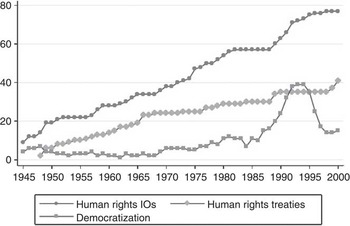
Figure 1 shows a time series of the human rights institutions that comprise our sample as well as the yearly number of democratic transitions, both of which we describe later. There is clear evidence of a rise in the number of such institutions from 1945 to 2000. The number of democracies in the world has steadily risen during this period as well, triggered by the beginning of the ‘third wave’ of democratization in the early 1970s and the collapse of the Soviet bloc.Footnote 35
Human rights institutions and democratization, 1945–2000

Sovereignty Costs
There is no agreed upon way of measuring the sovereignty costs that a human rights institution imposes on member states. Only one empirical study that we are aware of has developed such a measure. Cole gauges the extent of a state's obligation to human rights treaties by the state's level of membership – signing a treaty incurs a weaker obligation than ratifying – and the treaty's level of surveillance for monitoring compliance.Footnote 36 His study applies to three UN treaties. In an initial effort to design a more generalizable measure of institutional sovereignty costs that applies to both treaties and IOs, we code each institution in our sample based on the following ten indicators of precision, delegation and obligation.
Precision:
-
1. Is human rights the only issue (1) or is the institution multi-issue (0)? Institutions were coded as having human rights as the only issue in instances when all of the multiple issues center on human rights (for example, the institution's mission is democracy, human rights, and rule of law).
-
2. Any formal institution that focuses on human rights (1) or not (0)? Does a specific committee, subcommittee, working group, or equivalent focus on human rights? Also coded 1 if the entirety of the institution focuses on human rights.
-
3. Are human rights rules specific references to law (1) or general (0)? Coded as 0 if the institution only refers to human rights in very general terms. Coded as 1 if it makes a specific reference to a convention or treaty.
Delegation:
-
4. Does the institution engage in formal reporting (1) or not (0)? Institutions that had human rights-specific reporting or an annual report (general report) that included extensive coverage of human rights issues are coded as 1.
-
5. Does the institution hold annual meetings on human rights (1) or not (0)?
-
6. Does the institution have the ability to call ad hoc meetings (1) or not (0)? Meetings must have the ability to focus on human rights or human rights-related issues.
-
7. Are NGOs formally consulted (1) or not (0)? Coded as 1 if there are co-operative efforts or if an N60 is accorded observer-status.
Obligation:
-
8. Is there a built-in enforcement mechanism (1) or not (0)? Coded as 1 if a member state can be removed from the institution if it violates human rights, or if a court or similar body can rule in relation to human rights violations.
-
9. Does formal membership include a human rights requirement (1) or not (0)? Coded as 0 if documents mention ‘promotion of human rights’ as important to the institution, but states can join without meeting this criteria in advance.
-
10. Does formal membership include a democracy requirement (1) or not (0)? Coded as 0 if documents mention ‘promotion of democracy’ as important to the institution, but states can join without meeting this criteria in advance.
The first three items are included in order to assess the concept of precision: how clear are commitments to uphold human rights, and are those commitments grounded in specific international laws? Items 4–7 are included to capture the concept of delegation: how much power (that would normally reside at the state level) to monitor or gather information is given to the international institution (or related actors such as NGOs)? The final three items help measure obligation by addressing the expectations of enforcement prior to and after accession. Clearly, this is not an exhaustive list of the institutional design characteristics that affect sovereignty costs, and design features that tend to raise sovereignty costs may not always increase the actual costs borne by members. Nonetheless, there is ample reason to expect these ten characteristics to play a crucial role in shaping sovereignty costs. Focusing on them will allow us to take a useful first cut at the important task of measuring these costs.
The complete list of fifty-seven IOs and thirty-six treaties in our sample, together with the sovereignty-cost score for each institution, is available in the online appendix.Footnote 37 For each state, we code sovereignty costs in the year it accedes to a human rights institution. In all other years, sovereignty costs are assigned a value of 0. In any year when a given state joins more than one institution, we calculate the sum of the sovereignty cost scores of the institutions it entered.Footnote 38 For each institution, a higher score reflects greater precision, delegation, and obligation – and therefore higher sovereignty costs.Footnote 39
For example, the League of Arab States scores a 2 on our sovereignty cost index. It receives one point due to the Permanent Arab Committee for Human Rights, a formal institution created to monitor member states’ respect for human rights. It receives another point for its ability to call ad hoc meetings to discuss human rights or humanitarian situations within member states. It is coded 0 on each of the remaining eight categories described above. To take another illustration, the OSCE score an 8 on our sovereignty cost index. It has a permanent body to deal with human rights issues (1 point); it regularly publishes human rights reports concerning member states (1 point); holds several meetings each year to discuss human rights issues (1 point); can hold ad hoc meetings to address these issues (1 point); allows NGO consultation regarding human rights (1 point); conditions membership on the human rights behavior of its members (1 point); provides political enforcement for human rights standards (1 point); and finally, obligates member states to act consistently with the UN Charter, the UN Declaration of Human Rights and any UN Covenants that members states have signed (1 point).
To take an example from our treaty sample, the Convention on the Elimination of all forms of Discrimination Against Women (CEDAW) is coded as having a sovereignty cost score of 6. It receives one point each for its sole focus on human rights, the presence of a permanent internal institution dealing with human rights (the Committee on the Elimination of Discrimination Against Women), frequent meetings regarding human rights, the ability to call ad hoc meetings concerning human rights, the status given NGOs to consult with the Committee and the requirement of reporting on implementation efforts for members. If a state has joined CEDAW's first optional protocol, its sovereignty score would be higher (by 1 point) for the year a state acceded to that protocol.
We expect a positive relationship between democratization and our measure of weighted institutional memberships, since emerging democracies should seek membership in higher-sovereignty-cost institutions. Note that within our sample of treaties, we code all but two optional protocols as though they are independent institutions.Footnote 40 Moreover, sometimes these protocols have higher sovereignty costs associated with them than the treaties themselves. For example, the CAT optional protocol establishes a system of regular visits by independent international and national bodies to investigate allegations of torture in member states. If new democracies hope to create sovereignty costs through the UN treaty system, for example, we would expect them to sign these high-cost protocols. Thus we treat the decisions to accede to a treaty and to its related protocols as independent.
There are three exceptions to our optional protocol coding. In two instances, we treat optional protocols (to CEDAW and the first CCPR) as expanding the competence of the original treaty body that monitors member compliance. We treat declarations under Articles 21 and 22 of the CAT in a similar manner. In these cases, the expanded powers involve receiving and considering complaints from individuals or groups within its jurisdiction. Therefore in the year a state ratifies either of the two optional protocols or agrees to adhere to either of the optional CAT articles, their sovereignty-cost score is augmented by one point on our 0 to 10 scale.
A Statistical Model of Human Rights Institutions
To test our hypothesis about the influence of democratization on human rights institutions, we estimate the following model:
 $$no{ {\rm{Joining}}\ {\rm{HR}}\ {\rm{Institution}}\:\,= \, & {{\gamma }_0}\, + \,{{\gamma }_{\rm{1}}}{\rm{Democratization}}\, + \,{{\gamma }_{\rm{2}}}{\rm{Autocratization}}\, \cr & + \,{{\gamma }_{\rm{3}}}{\rm{Stable}}\ {\rm{Democracy}} \,+ \,{{\gamma }_{\rm{4}}}{\rm{Stable}}\ {\rm{Anocracy}}\, \cr & + \,{{\gamma }_{\rm{5}}}{\rm{\# Human}}\ {\rm{Rights}}\ {\rm{Institutions}}\, + \,{{\gamma }_{\rm{6}}}{\rm{\# IOs}}\, + \,{{\gamma }_{\rm{7}}}{\rm{Dispute}} \cr & + \,{{\gamma }_{\rm{8}}}{\rm{Year}}\, + \,{{\gamma }_{\rm{9}}}{\rm{Hegemony}}\, + \,{{\gamma }_{{\rm{10}}}}{\rm{Former}}\ {\rm{Communist}}\, \cr & + \,\mathop{\sum}\limits_{i\: = \:11}^{16} {{{\gamma }_i}{\rm Re}{\rm{gion}}\, + \,{{{\rm{{\repsilon}}}}_1}} $$
 $$no{ {\rm{Sovereignty}}\ {\rm{Costs}}\, = & \,{{{\rm{\rbeta }}}_{\rm{0}}}\, + \,{{{\rm{\rbeta }}}_{\rm{1}}}{\rm{Democratization}}\, + \,{{{\rm{\rbeta }}}_{\rm{2}}}{\rm{Autocratization}}\, + \,{{{\rm{\rbeta }}}_{\rm{3}}}{\rm{Stable}}\ {\rm{Democracy}} \cr & + \,{{{\rm{\rbeta }}}_{\rm{4}}}{\rm{Stable}}\,{\rm{Anocracy}}\, + \,{{{\rm{\rbeta }}}_{\rm{5}}}{\rm{\# Human}}\,{\rm{Rights}}\,{\rm{Institutions}}\, + \,{{{\rm{\rbeta }}}_{\rm{6}}}{\rm{Dispute}} \cr & + \,{{{\rm{\rbeta }}}_{\rm{7}}}{\rm{Year}}\, + \,{{{\rm{\rbeta }}}_{\rm{8}}}{\rm{Hegemony}}\, + \,{{{\rm{\rbeta }}}_{\rm{9}}}{\rm{Independence}}\, + \,{{{\rm{\rbeta }}}_{{\rm{10}}}}{\rm{Former}}\ {\rm{Communist}} \cr & + \mathop{\sum}\limits_{i\, = \,11}^{16} {{{\rbeta }_i}\,{\rm Re}{\rm{gion}}\, + \,{{{\rm{{\repsilon}}}}_2}} $$
In this study, the unit of analysis is the country-year. We simultaneously address each state's decision about whether to enter human rights institutions (Equation 1) and the sovereignty costs associated with those institutions (Equation 2). This is essential because past research has shown that democratizing states are more likely to join international institutions writ large.Footnote 41 Thus we want to separate the general decision to join an institution from the decision to join a particular type of institution.
Therefore the dependent variable in the first stage (Joining HR Institution) is the log of the odds that country i will join a human rights institution in year t. This variable is coded as 1 if a state joins a human rights institution in a given year, or 0 otherwise.Footnote 42
The second-stage dependent variable (Sovereignty Costs) is the sovereignty costs associated with any human rights institution that state i accedes to in year t. If state i joins multiple human rights institutions in a given year, the sovereignty-cost scores are summed across these institutions. If a state does not join a human rights institution in year t, its sovereignty-cost score for that year is 0.Footnote 43
To measure each state's regime type, we use a twenty-one-point index drawn from an updated version of the Polity IV dataset. The index ranges from 10 for the most democratic states to −10 for the most autocratic ones.Footnote 44 Previous studies have defined states as democratic if they score greater than 6 on this index in a given year, t. They have defined states with a score of less than −6 as autocratic. States with scores ranging from −6 to 6 are considered anocratic. Initially, we use these thresholds to create five indicator variables that measure regime change and stability over each five-year period.
In both equations, Democratization equals 1 if, between year t-5 and year t, a state makes a fundamental change in a democratic direction: from an autocracy to either an anocracy or a democracy, or from an anocracy to a democracy.Footnote 45 Autocratization equals 1 if a state makes a transition in an autocratic direction: from a democracy to either an anocracy or an autocracy, or from an anocracy to an autocracy. Stable Democracy equals 1 if a state remains democratic between years t-5 and t. Stable Anocracy equals 1 if a state remains anocratic during this interval, and Stable Autocracy equals 1 if a state remains autocratic during the interval. We exclude Stable Autocracy, which is arbitrarily designated the reference category. Consequently, the coefficients of the first four variables reflect the impact of each type of regime relative to being a stable autocracy. We expect the coefficient of Democratization to be positive in Equation 2, since our argument is that states experiencing a democratic transition are especially likely to enter human rights institutions that impose higher sovereignty costs on members. We also expect this coefficient to be larger than the coefficients of Autocratization, Stable Democracy, and Stable Anocracy.
Membership in any particular human rights institution is undoubtedly related to the existing set of institutions to which a state is a member. To this end, we control for possible ‘ceiling’ or ‘floor’ effects in such membership. As a state participates in a growing number of human rights institutions, the marginal benefit of joining another one may decline. Further, the number of human rights institutions that a state does not belong to declines as it joins more organizations and treaties, thereby reducing the number of institutions that it could enter. As such, #Human Rights Institutions may be inversely related to the change in institutional memberships and sovereignty costs. Alternatively, this relationship may be direct. States that participate in a large number of human rights institutions may be ‘joiners’, predisposed to enter as many of these institutions as possible.Footnote 46 Conversely, states that belong to few human rights institutions may have an aversion to joining more.
It is also possible that ‘ceiling’ effects or the propensity to be a ‘joiner’ are not limited to human rights institutions, but apply to international institutions more generally. If, for example, joiners are attracted to all types of international institutions, then states that belong to a large number of these institutions (regardless of the issue areas they cover) might display a propensity to enter human rights institutions. Similarly, states may join so many institutions that they hit a natural ceiling on the number of institutions in which they can fruitfully participate. To address this possibility, we also introduce #IOs in the first stage of the model, a count of the total number of international organizations that state i is a member of in year t.Footnote 47 The information used to generate this count is taken from the COW IGO data.Footnote 48
It is also crucial that we control for other factors that may prompt states to enter human rights institutions or influence their decisions about which institutions to join. First, Dispute is the number of militarized interstate disputes (MIDs) involving state i that are ongoing in year t, based on the MID 3.0 data.Footnote 49 Members of a human rights institution may be reluctant to grant membership to a state involved in interstate disputes, since its belligerence could adversely affect the institution. Moreover, if there is a perceived trade-off between national security and respect for individual liberties during times of conflict, it is unlikely that states would give priority to joining an institution that demands respect for human rights. This is especially likely to be true if the institution in question is intrusive (and thus generates higher sovereignty costs). Finally, if democratization is related to disputes, then it is important to account for MIDs in order to avoid any omitted variable bias.Footnote 50
Second, we include a trend (Year) in both model stages to ensure that any observed relationship between state regime type and human rights institutions does not stem from the spread of both democracy and international institutions over time.Footnote 51 In addition, since the number of high-sovereignty-cost institutions has increased over time, this variable will also guard against spurious findings with regard to sovereignty costs. Third, Hegemony measures the relative size of the largest state in the international system and is included in both stages. It is operationalized as the share of global military capabilities controlled by the largest state in the system (in this analysis, the United States) in year t, using the COW Material Capabilities data.Footnote 52 Past research has linked hegemony to the formation of international organizations.Footnote 53 Furthermore, the hegemon during the period covered here – the United States – often emphasized the need for countries to strengthen human rights and supported the establishment of various human rights bodies.
Fourth, Independence is the number of years state i has been an independent nation-state as of year t, based on the date of independence furnished by the COW Project.Footnote 54 Many newly independent states attempt to join international institutions early in their existence. There is also evidence that the time that has elapsed since independence is associated with transitions to democracy, suggesting that the variable should be included in our model to avoid conflating the influences of political independence and democratization.Footnote 55 It is included in the second stage of the model because it is likely that recently independent states will be more sensitive to the degree of sovereignty costs rather than their presence or absence, given the general desire of these states to join international institutions.
Fifth, many former communist states expressed a desire to join Western organizations after the Cold War, including those focused on human rights. This tendency is not at odds with our argument, but we need to ensure that these cases are not driving any observed correlation between democratization and membership in human rights institutions or between democratization and the desire to choose high-sovereignty-cost institutions. To this end, we introduce Former Communist, which equals 1 for states that were communist at some point during the post-World War II era, beginning in the year after the communist government fell. In addition, because many human rights IOs are regional, patterns of membership may be similar within geographic regions.Footnote 56 We therefore add regional indicator variables to the model.Footnote 57 In the first stage of the model, we also add a count of the years since joining any human rights institution to help account for temporal dependence in accession decisions.Footnote 58 Finally, each model contains a stochastic error term.
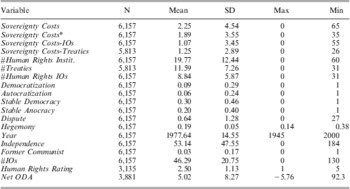
Descriptive statistics for the variables analyzed in this article are presented in Table 1. To estimate both stages of the model, we use a zero-inflated negative binomial specification. This zero-inflated count model allows for the simultaneous estimation of the decision of whether to enter a human rights institution (Equation 1) and the level of sovereignty costs accepted (Equation 2). Tests of statistical significance are based on standard errors that are clustered by country.Footnote 59
Descriptive Statistics

*Sovereignty cost scores for non-emanations only.
Results
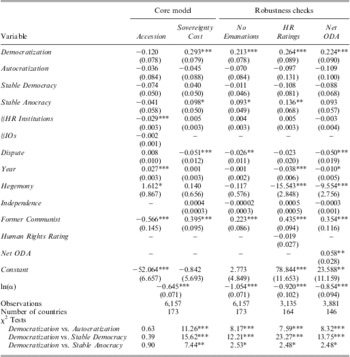
Table 2 presents the initial estimates of our models. The coefficient estimates in Column 1 refer to accession (the first-stage model), while the coefficient estimates in Column 2 refer to sovereignty costs (the second-stage model). Because we are using a zero-inflated estimation procedure, the coefficient estimates in Column 1 represent the probability of non-accession (that is, an observed value of 0), rather than the typical discrete outcome model that estimates the probability of a positive outcome. Thus negative coefficients represent an increased probability of joining a human rights institution. As such, it is not surprising that the coefficient estimate of Democratization in the table's first column is negative. Yet this estimated coefficient is not statistically distinguishable from any of the other regime-type coefficients or the reference category, which indicates that there is no pronounced difference between regime types in their propensity to join human rights institutions.Footnote 60
There are, however, very stark differences in the extent to which various regime types are drawn to institutions marked by extensive sovereignty costs. In Column 2, the estimated coefficient of Democratization is positive, statistically significant, and three times the size of any other regime-type coefficient. Moreover, these differences are highly statistically significant in the case of Autocratization, Stable Anocracy, and Stable Democracy (χ2 = 11.26, p < 0.01; χ2 = 7.44, p < 0.01; χ2 = 15.62, p < 0.01, respectively). States that have recently undergone a democratic transition display a greater tendency to enter higher-sovereignty-cost human rights institutions than any other type of country. These effects are substantively large. Based on our estimates, a state transitioning to democracy selects institutions that impose roughly double the sovereignty costs of those selected by other countries.Footnote 61
It is noteworthy that there are few differences among the remaining regime types. The estimated coefficients of Stable Democracy and Stable Anocracy are not statistically different from each other, although Stable Anocracy is distinguishable from the reference category. Autocratization is negative and not statistically distinguishable from the reference category. It is marginally significantly different from Stable Anocracy (χ2 = 2.66, p = 0.103), but not from Stable Democracy. Thus our initial analysis suggests that democratizing countries are more likely to join human rights institutions with higher sovereignty costs than other states are, and that few differences exist among these other states.
Turning to the control variables, the coefficient estimates are quite mixed across the two stages of the model. For example, while a higher number of memberships in human rights institutions (#Human Rights Institutions) promotes accession to other human rights institutions (accession/first stage), it has little bearing on the size of sovereignty costs accepted by new members. Further, states are increasingly likely to join additional human rights institutions as they gain membership in a growing number of IOs (#IOs).Footnote 62 This estimate, however, barely misses achieving statistical significance (p = 0.104).
Military disputes have little bearing on the choice to join these institutions, but do influence the sovereignty costs accepted by states that do join, as the estimate of Dispute is negative and highly statistically significant in the second stage of the model.Footnote 63 As hegemony wanes, states are more likely to join human rights institutions, possibly to lock in human rights standards and monitoring in the event that the hegemon (the United States, for this analysis) continues to falter. Yet waning hegemony has no influence on the sovereignty costs states are willing to accept. Finally, Former Communist states are especially likely to join human rights institutions and accept higher sovereignty costs.
Robustness Checks
Our initial results indicate that democratizing states are drawn to human rights institutions that impose high sovereignty costs on members, but that these costs have little bearing on the human rights institutions that other regime types enter. However, it is important to ensure that our findings are not an artifact of how we measured regime type. To this end, we replace Stable Democracy and Stable Anocracy with Regime Type, which is state i's score at time t on the twenty-one-point index of regime type that we described earlier. This approach will allow us to determine whether democratization influences the decision to join human rights institutions, after accounting for each state's institutional makeup in the year the decision is made. Note that when analyzing the effects of democratization and autocratization in these models, the reference category is now the combination of all stable regime types.
The results, which are omitted to conserve space, indicate that the coefficient estimate of Democratization is positive and statistically significant. Controlling for a state's regime type in year t, emerging democracies are more likely than autocratizing countries to enter human rights organizations (χ2 = 7.60, p < 0.01). Democratization also continues to have a strong substantive impact on the level of sovereignty costs accepted: the predicted level of these costs is twice as large for states that have undergone a democratic transition than for other states.Footnote 64
Next, we remove some human rights IO emanations from our sample of institutions. Membership in certain emanations is automatic when a state enters the parent organization. Including these emanations in our sample is entirely appropriate, since governments understand that the decision to join the parent IO is also a decision to join the emanation, and that these emanations involve the promotion or protection of human rights. Nonetheless, to make sure this coding procedure does not influence our results, we re-estimate our model after excluding membership in these automatic emanations.
As shown in the third column of Table 2, the estimated coefficient of Democratization is positive and statistically significant.Footnote 65 In addition, this estimate is statistically different from that of every other regime type analyzed here. The coefficient estimate of Democratization is smaller than in our previous analysis, but this is not unexpected. These automatic emanations can be viewed as another measure of sovereignty costs. States joining the OSCE, for example, recognize that they are also becoming members of ODIHR. Both of these institutions may serve to lock in the democratization process. Having different institutions embedded within an organization can increase the likelihood that it will enforce conditionality, investigate backsliding, or otherwise increase the sovereignty costs associated with membership.
Estimates of the Determinants of Human Rights Institutions Membership

Note: zero-inflated negative binomial estimation (with panel-corrected standard errors in brackets). Only second-stage estimates are shown in Columns 3–5. Estimates of regional fixed effects are excluded to save space. *significant at 10 per cent; **significant at 5 per cent; ***significant at 1 per cent. One-tailed tests are conducted for the χ 2 tests and the estimated coefficient of Democratization in the final four columns; two-tailed tests are conducted in all other cases.
We also address the possibility that our findings about institutions are driven by the EU, which has a long-standing commitment to human rights and several emanations that promote norms of justice. After removing all EU (or previously European Community) members from the sample, the coefficient estimate of Democratization in the sovereignty cost stage of the model is roughly equal to that of our initial estimates. It also remains positive, statistically significant and statistically different from the coefficient estimate for every other regime type indicator. Thus our results (which are omitted to conserve space) are not an artifact of the EU.
We also need to ensure that our findings are not undermined by omitted variable bias. One possible source of such bias is that a state's desire to protect human rights (or join institutions generally) could be linked to its transition toward democracy by a variable that causes both phenomena. Past research has linked economic wealth to both IO membership rates and transitions to democracy.Footnote 66 Consequently, we include Development, which is country i's per capita gross domestic product in year t, in both stages of our model and then re-estimate the model.Footnote 67
The results (also omitted to conserve space) indicate that including Development has little bearing on our previous results. The estimated coefficient of Development is positive and statistically significant in the first stage of the model, indicating that wealthier states are less likely to join human rights institutions (although the substantive effect is small). Development is positive in the second stage of the model, but does not achieve statistical significance. Most important for our purposes, however, is that the coefficient estimate of Democratization in the second stage remains positive and statistically significant (at the 0.01 level) and is statistically different than the coefficient estimates of Autocratization (χ2 = 10.35, p < 0.01), Stable Democracy (χ2 = 13.29, p < 0.01) and Stable Anocracy (χ2 = 5.28, p < 0.05).Footnote 68
Another possible source of omitted variable bias, highlighted by Hathaway, is that a state's existing record of human rights protection might affect its entrance into human rights institutions.Footnote 69 For instance, states with relatively poor human rights records may not wish to join a human rights institution, especially one that has the potential to generate high sovereignty costs. Moreover, if democratic or democratizing countries are more likely to respect human rights, this could have a confounding effect in our model. A state's record of respect for human rights could account for the observed relationships between democratization and democracy, on the one hand, and changes in human rights institution membership, on the other.
To address this possibility, we introduce a yearly measure of each state's respect for human rights into our initial models. This five-point index is constructed using annual data published by Amnesty International and measures the extent of murder, torture, forced disappearance, and political imprisonment in a given country.Footnote 70 As shown in the fourth column of Table 2, this new variable is not statistically significant in the second stage of our model (or in the first stage, which is omitted to conserve space). These results indicate that the extent of a state's repression does not influence changes in its portfolio of human rights institutions.Footnote 71 As such, human rights practices do not seem to influence membership patterns in human rights institutions, contrary to what some studies suggest.Footnote 72 More importantly, none of the regime type coefficient estimates vary in any meaningful way from the original estimates. The coefficient estimate of Democratization is positive and statistically different from the reference category, Stable Democracy, Stable Anocracy, and Autocratization.Footnote 73
Another potentially important omitted variable is foreign aid, since donor countries (especially democracies) could use such assistance to pressure states to democratize and join human rights institutions.Footnote 74 To address this issue, we introduce Net ODA to both stages of our model. This variable measures net development assistance received by state i in year t. Footnote 75
As shown in Column 5 of Table 2, the estimated coefficient of Net ODA is positive and statistically significant in the second stage of the model (it is not statistically significant in the first stage), indicating that recipients of greater development assistance join human rights institutions marked by comparatively larger sovereignty costs. Nonetheless, including this variable has little effect on Democratization. The coefficient estimate of Democratization remains positive, statistically significant, and significantly different from the other regime-type measures. Thus while foreign aid appears to play a role in the type of human rights institutions that recipient states join, this relationship has no bearing on the influence of democratization.Footnote 76
A final source of possible omitted variable bias is NGOs. Recall that as a part of our sovereignty cost measure, we determine whether NGOs can play a formal role in the IO or treaty. It is possible, however, that NGOs could play a more direct role in both promoting human rights and promoting membership in international institutions. We therefore add NGOs – a measure of the number of NGOs active in a state in a given year – to both stages of our model.Footnote 77
The estimates of this new model (omitted to conserve space) are remarkably similar to our base model. NGOs does not achieve statistical significance in either stage of the model. Moreover, its inclusion does not alter our previous findings: Democratization is positive, statistically significant, and statistically different from the other measures of regime type. Consequently, NGOs do not appear to exert an independent impact on accession to human rights institutions; nor do they influence the relationship between democratization and such institutions.
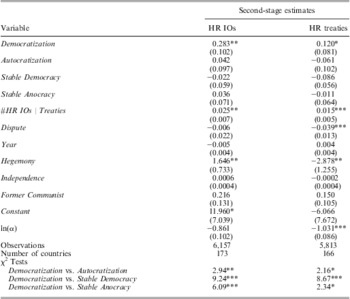
Finally, we separate our sample into treaties and IOs. Our argument is that a critical factor in a country's decision to join a human rights institution is whether the institution is designed to impose sovereignty costs. These costs vary across both treaties and IOs. However, membership rules for treaties and IOs differ. Many treaties offer open enrollment, while many IOs are selective about which countries they admit. To determine whether there are observable differences between joining treaties and IOs, we re-estimate our core empirical model twice: once including membership and sovereignty-cost decisions for IOs only, and once for these same decisions involving international human rights treaties. Table 3 presents the second-stage estimates of these two different models.
Estimates of the Determinants of Human Rights Treaty and IO Membership

Note: zero-inflated negative binomial count estimation (with panel-corrected standard errors in brackets). Only the second-stage estimates are shown. Estimates of regional fixed effects are excluded to save space. *significant at 10 per cent; **significant at 5 per cent; ***significant at 1 per cent. One-tailed tests are conducted for χ2 tests and the estimated coefficient for Democratization; two-tailed tests are conducted in all other cases.
Column 1 of Table 3 presents the estimates for the sample of IOs. These results are very similar to our core findings: the estimated coefficient of Democratization is positive and significantly different from the reference category and from each of the other regime-type variables.Footnote 78 Substantively, Democratization continues to have a large impact, increasing the sovereignty costs accepted by a state entering an IO by over 70 per cent.
Turning to the estimates of the treaty sample, found in Column 2 of Table 3, the results are substantively consistent, although somewhat weaker than our original estimates. The coefficient estimate of Democratization is statistically significant and statistically distinguishable from every other measure of regime type. Yet the substantive effect of a democratic transition is smaller for treaties than IOs. Democratization in the treaty sample increases the sovereignty costs accepted by a state by only about 30 per cent, less than half the impact it has on IOs. While these results might suggest that organizations provide stronger incentives for newly democratized states to commit to human rights than treaties, we are hesitant to draw this conclusion. Since some treaties create related IOs to deal with human rights issues, it is hard to draw a bright line between these institutional forms. Nonetheless, these results show that both IOs and treaties that are characterized by higher sovereignty costs tend to attract newly democratic states, and that this trend is more pronounced for IOs.
In sum, our results show that democratizing states accept higher sovereignty costs than other types of regimes. This holds while simultaneously controlling for the choice to enter a human rights institution in the first place. Stable anocracies also tend to accept higher sovereignty costs than stable democracies or autocratizing countries, but these differences are rarely statistically significant.
Conclusions
The rise of international human rights institutions has spawned a vigorous debate in the fields of international relations and international law. Many observers contend that these institutions create strong legal and normative structures that heavily shape state behavior, and thus that they tend to attract members that seek better (or already protect) human rights. Others hold that these institutions are often inconsequential and thus widely attract members that intend to violate human rights. This article engages the debate by exploring what types of states join what types of institutions. By developing a new dataset of human rights organizations to complement existing data on human rights treaties, and mapping variation in the sovereignty costs associated with participation, we tested several propositions concerning what provides the impetus for state membership in human rights institutions.
Arguments drawing on the logics of credible commitments, signaling, and inducements all lead us to expect that transitions to democracy will spur states to join human rights institutions that have substantial participation costs. In this article, we generated what we believe to be the first index of sovereignty costs associated with membership in human rights institutions. Our analysis of this measure yields substantial support for our argument that democratizing states are more likely than all other states to join higher-sovereignty-cost institutions, even when controlling for their underlying propensity to join any human rights institutions.
We have avoided the issue of whether high-cost human rights institutions improve respect for human rights in signatory states, but our analysis likely bears on that topic. Because of the significant possibility for selection (non-random treatment) effects, efforts to estimate compliance must begin with a serious effort to explicate why states join human rights institutions in the first place. A crucial consideration in this accession decision is domestic regime change. Democratizing states have reason to join particular types of human rights institutions, namely those that will provide the costliest (and therefore clearest) signal of intent to comply with human rights rules and standards. We believe our findings are important not only for those wanting to know which states join human rights institutions, but also for those asking to what end states join them.