Introduction
Neuropsychiatric symptoms (NPS) in dementia are highly prevalent in long-term care institutions (Selbaek et al., Reference Selbaek, Kirkevold and Engedal2007; Zuidema et al., Reference Zuidema, Derksen, Verhey and Koopmans2007c), and have important clinical consequences such as reduced quality of life for the patient, increased demands on staff resources, and increased job-related stress, burnout and staff turnover. Furthermore, NPS can result in the application of physical restraints and in injury to staff, other patients and/or the patient him/herself. There are five main clusters of NPS: agitation, psychosis, mood disorders, psychomotor agitation and apathy (Zuidema et al., Reference Zuidema, Jonghe, Verhey and Koopmans2007b), of which agitation most frequently results in distress to the patient and staff, often requiring intervention (Howard et al., Reference Howard, Ballard, O'Brien and Burns2001). A clear need exists to treat NPS, using psychosocial and/or pharmacological interventions.
The pharmacological treatment of NPS consists of various psychotropic drugs (PDs) (Margallo-Lana et al., Reference Margallo-Lana2001; Lee et al., Reference Lee2004; Pitkala et al., Reference Pitkala, Laurila, Strandberg and Tilvis2004; Kim and Whall, Reference Kim and Whall2006; Salzman et al., Reference Salzman2008; Kamble et al., Reference Kamble, Chen, Sherer and Aparasu2009), of which antipsychotics (APs) are the most frequently prescribed (Lovheim et al., Reference Lovheim, Sandman, Kallin, Karlsson and Gustafson2006; Selbaek et al., Reference Selbaek, Kirkevold and Engedal2007; Nijk et al., Reference Nijk, Zuidema and Koopmans2009; Kamble et al., Reference Kamble, Chen, Sherer and Aparasu2009). Other PDs such as antidepressants (ADP), anxiolytics (ANX), hypnotics (HYP), anticonvulsants (AC), and antidementia medication (ADM) drugs are also prescribed. Several studies, however, have shown that antipsychotics (AP) are often prescribed inappropriately (McGrath and Jackson, Reference McGrath and Jackson1996) and, in the absence of approved agents, many physicians have turned to off-label use (Lovheim et al., Reference Lovheim, Sandman, Kallin, Karlsson and Gustafson2006; Selbaek et al., Reference Selbaek, Kirkevold and Engedal2007; Nijk et al., Reference Nijk, Zuidema and Koopmans2009; Kamble et al., Reference Kamble, Sherer, Chen and Aparasu2010). In addition, PDs are prescribed to a majority of nursing home residents as a long-term treatment, sometimes for over a year (Koopmans et al., Reference Koopmans1996; Ruths et al., Reference Ruths, Straand and Nygaard2001) and, once started, frequently inadequately reviewed (Furniss et al., Reference Furniss, Craig and Burns1998), contributing to overuse of PDs. Recent evidence has indicated that APs have a limited benefit in long-term therapy, and severe side effects such as stroke and increased mortality (Ballard et al., Reference Ballard2009). The US Food and Drug Administration (FDA, 2008) and the UK Committee for Safety of Medicine (CSM, 2004) therefore issued serious safety warnings about the use of APs in elderly patients with dementia. Furthermore, a recent meta-analysis shows that the use of sedatives and HYP, ADP and benzodiazepines demonstrate a significant association with falls in elderly individuals (Woolcott et al., Reference Woolcott2009).
In the light of these recent safety and efficacy data, there is an urgent need to examine the nature, extent and patterns of psychotropic drug use (PDU) in nursing home residents with dementia. Insight into the use of PDs may provide valuable information, and may further reflect the extent to which clinicians actually apply guidelines (American Geriatrics Society and American Association for Geriatric Psychiatry, 2003). After the recent safety warnings on PDU in nursing home residents with dementia, however, very few prospective longitudinal studies have been published (Selbaek et al., Reference Selbaek, Kirkevold and Engedal2008; Sanfelix-Gimeno et al., Reference Sanfelix-Gimeno2009; Dorsey et al., Reference Dorsey, Rabbani, Gallagher, Conti and Alexander2010; Trifiro et al., Reference Trifiro2010), with mixed results. In addition, APs can be prescribed for psychosis but for several forms of agitation as well (i.e. multiple indications). Hence, additional studies are required to quantify PDU in nursing home residents with dementia. This study examined PDU in nursing home residents with dementia over a two-year period, the association with neuropsychiatric symptoms (NPS), and the variability across dementia types in nursing home residents with dementia. We hypothesized that PDU shows different patterns over time and across dementia subtypes, with high persistence rates of 50%.
Methods
In this prospective closed cohort study, residents were enrolled from 14 dementia special care units (SCU) in nine nursing homes in the Netherlands, which represent an average nursing home population. The residents’ elderly care physicians, who were involved in their daily care, systematically screened all residents for inclusion. Residents were considered for inclusion provided they: (1) met the Diagnostic and Statistical Manual of Mental Disorders fourth edition criteria for dementia (American Psychiatric Association, 1994); (2) had no history of life-threatening disease at the time of inclusion; and (3) had resided in the nursing home for at least four weeks. Baseline data were collected in 2006. Residents had a two-year follow-up and all assessments were administered at baseline and subsequently during four biannual follow up visits.
Residents' characteristics
Data on age, gender and length of stay in the special care unit were recorded. An etiological diagnosis was established by the elderly care physicians using international accepted criteria (McKhann et al., Reference McKhann1984; Román et al., Reference Román1993) and the Dutch consensus guidelines (CBO, 2005) for AD, VaD, mixed AD/VaD or other diagnosis (including dementia not otherwise specified). The first author (RBW) independently checked the eligibility and diagnosis of all residents by examining each patient's clinical notes. When disagreement arose, consensus meetings were organized to ensure the inclusion of all residents who met the aforementioned criteria.
Assessment of psychotropic drug use (PDU)
Data on PDU on the day of assessment were retrieved from the patients’ medical and pharmacist files. Drugs were classified using the Anatomical Therapeutic Chemical classification (ATC; Nordic Council on Medicines, 1990) and grouped into antipsychotics (AP No5A. . .) anxiolytics (ANX N05B. . .), hypnotics (HYP N05C. . .), antidepressants (ADP N06A. . .), anticonvulsants (AC No3A. . .), antidementia drugs (ADM N06A. . .), and any psychotropic drugs. Dichotomous categories of either “present” or “absent” were used to quantify PDU; prescriptions for incidental use were discarded.
Assessment of cognition and dementia severity
Cognitive functioning was assessed with the Mini-Mental State Examination (MMSE; (Folstein et al., Reference Folstein, Folstein and McHugh1975) and the Severe Impairment Battery-short version (SIB-s; Saxton et al., Reference Saxton2005). The SIB-s is a cognitive assessment instrument able to test cognition in individuals in the later stages of dementia. Scores range from 0 to 50 with higher scores denoting better cognition. The SIB-s has been translated and validated in a large group of Dutch nursing home residents with dementia (de Jonghe et al., Reference de Jonghe, Wetzels, Mulders, Zuidema and Koopmans2009). Severity of dementia was rated with the Global Deterioration Scale (GDS), which ranges from normal cognition (GDS stage one) to very severe cognitive decline (GDS stage seven) (Reisberg et al., Reference Reisberg, Ferris, Leon and Crook1982).
Assessment of NPS
NPS were assessed with the Neuropsychiatric Inventory–Nursing Home version (NPI-NH) (Cummings et al., Reference Cummings1994; Cummings, Reference Cummings1997). The NPI-NH was developed to be used by professional caregivers in institutions and is valid and reliable when administered by trained nursing staff (Wood et al., Reference Wood2000). The NPI-NH is a structured interview that includes 12 NPS: delusions, hallucinations, agitation, depression, anxiety, euphoria, apathy, disinhibition, irritability, aberrant motor behavior, night-time disturbances and appetite/eating changes. Both the frequency (F) and severity (S) of each symptom are rated on a four-point (1–4) and three-point (1–3) Likert scale, respectively. A separate score can be calculated for each symptom by multiplying the frequency and severity scores (to obtain the F × S score); resulting values range from 0 to 12 for each symptom. The addition of F × S scores reveals a total score that ranges from 0 to 144. The NPI-NH has been translated and validated in the Dutch setting (Kat et al., Reference Kat2002). RBW or a research assistant interviewed all licensed vocational nurses, who had been specifically assigned to individual residents and observed symptoms during a two-week period prior to assessment.
Analysis
The outcome measures were frequency parameters: point prevalence (baseline, follow-up, and cumulative), discontinuation, continuation, and (cumulative) new onset of PDU specified as users and non-users of the ATC-groups. Clinically relevant NPS (CR-NPS) measured with the NPI-NH were defined by Frequency (F) × Severity (S) ≥4 score for each individual symptom. Subclinical NPS (SC-NPS) was defined as F × S ≤ 3. Prevalence was defined as the proportion of residents with PDU at each assessment. The two-year cumulative prevalence was defined as the proportion of residents with PDU on at least one assessment over the two-year period. Discontinuation was defined as the proportion of residents who used PD at one assessment but not at the next assessment. PDU was defined as “continuous” if it was present on at least two subsequent assessments. New use of PD was defined as the proportion of residents using PD at one assessment but not on the preceding assessment. The cumulative rate of new onset PDU was defined as the proportion of residents who did not use PD at baseline but at any of the next assessments. Prevalences were presented as percentages of total group. Frequency parameters are presented as percentages on subgroup level. By definition, continuation and discontinuation add up to 100%. Utilization patterns of PD at successive assessments were calculated per dichotomized (0:SC-NPS or 1:CR-NPS) NPI symptom, e.g. 0: F × S ≤ 3 and 1: F × S ≥ 4. Multiple indications for AP were delusion, hallucinations, agitation, disinhibition, irritability and/or aberrant motor behaviour symptom. Multiple indications for ADP were depression and/or anxiety symptom. Combined indications for ANX were anxiety and/or agitation.
Statistical analysis was performed using the SPSS software, version 16 (SPSS 16.0.1 for Windows; SPSS Inc., Chicago, IL). Frequency parameters were calculated using SPSS macro syntax. The analysis was performed in the cohort that ultimately survived two-years of follow-up. To assess any possible bias due to loss-to-follow-up, differences between completers and non-completers were evaluated using Student's t-test or χ2 test.
Ethical considerations
This study was approved by the regional research ethics committee. The participants and/or their relatives and legal guardians were informed about the study and gave their written consent.
Results
Residents
The prospective cohort study included 290 residents (99% of all eligible residents), of whom 117 (40%) completed the two-year follow-up period (Table 1). Residents in our study sample were of advanced age, mostly female, had generally low levels of educational attainment and 62% had advanced dementia (GDS 6 and 7). Thirty-five percent of residents were diagnosed with Alzheimer's dementia (AD), only 11% with vascular dementia (VaD) and 1.7% with mixed AD/VaD. However, in 40% of cases the type of dementia was classified as “not otherwise specified”, which indicated that multiple brain pathologies might have been present. The number of residents in this study declined through successive assessments to n = 223, 191, 153 and 117 at 6, 12, 18 and 24 months respectively due to death (n = 159) or transfer to another SCU (n = 14). Non-completers were compared to completers: significantly more were female and were older at baseline, had higher NPI-NH total scores, higher apathy severity scores, and were prescribed hypnotics more often (see Table 1). At baseline, 11.1% of the completers had GDS 4, 26.5% GDS 5, 33.3% GDS 6, and 29.1% GDS 7. At 24 months these percentages had changed to 6.4% GDS 4, 13.6% GDS 5, 40% GDS 6, and 40% GDS7, indicating significant progression in dementia stage (χ2(9) = 78.138 p < 0.0001).
Demographic and clinical characteristics at baseline

*p < 0.05; ** p < 0.005
t = Student's t test; χ2 = chi square test; n = number; yrs = years; mn = mean; rg = range; MMSE = Mini-Mental State Examination (range: 0–30); SIB-s = severe impairment battery-short version (range: 0–50); SD = standard deviation; GDS = global deterioration scale; NH = nursing home; NPI = neuropsychiatric inventory (range: 0–144); F × S = frequency multiplied by severity (range: 0–12).
Psychotropic drug use
Overall PDU
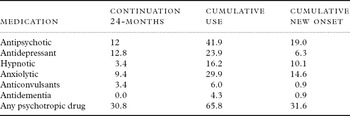
During the two-year follow-up, nearly two-thirds (66%) of residents were treated with any PD and almost one-third (31%) continued this treatment for two years (Tables 2 and 3). In addition, of all PD naive residents at baseline, about one-third (32%) started treatment during follow-up. Notably, more than half of the residents who were on PDs at baseline continued to be so all along the follow-up. Half of the residents received at least one PD (range: 48–56%), whereas one-fifth (range: 18–24%) received at least two PDs.
PDU in nursing home residents with dementia (prevalences on total group level; discontinuation, continuation, and new onset on subgroup level; n = 117).

T0–T4: successive assessments
a The ratio of residents without PDU at follow-up to residents with PDU at previous assessment.
b The ratio of residents with PDU at follow-up to residents with PDU at previous assessment.
c The ratio of residents with PDU at follow-up to residents without PDU at previous assessment.
PDU = psychotropic drug use; PD = psychotropic drug
PDU continuation in nursing home residents with dementia over all assessments (percentage on group level; n = 117)

PDU = psychotropic drug use
Antipsychotics
APs were most often prescribed, with prevalences of 26–31% during consecutive assessments. Overall, 42% of residents received APs at baseline or during follow-up. One out of eight residents (12%) were treated with an AP during the entire follow-up. About one out of five AP-naive residents at baseline started AP treatment during follow-up. Of all residents entering the study who were on APs, 43% persisted in using APs during the whole follow-up.
Antidepressants
Twenty-four percent of the residents were treated with ADPs, and one out of eight continued to receive ADPs through all four follow-up assessments, indicating that fewer residents started ADPs compared to APs, but were treated more continuously (persistence range: 82–92%). Indeed, of all residents who used ADPs at baseline, two-thirds continued usage during follow-up. Of ADP-naive residents at baseline, just one-sixteenth (6%) started treatment during follow-up.
Hypnotics
About one out of six residents (16%) were treated with HYPs and only 3% continued these throughout the follow-up. Nevertheless, once prescribed at baseline, half the residents continued to receive HYPs during follow-up. Ten percent of HYP-naive residents were treated at follow-up.
Anxiolytics
Residents received ANXs slightly more frequently (range: 15–19%) than ADPs but less persistently (range: 72–95%), indicating a slightly intermittent use. At the same time, 9% of residents continued to receive ANXs through follow-up suggesting a subgroup of persistent users. Indeed, half the residents receiving ANXs at baseline, continued to receive them throughout follow-up. Altogether, nearly 30% of residents received ANXs. One-seventh (15%) of residents who were ANX-free at baseline, received new-onset ANXs at follow-up.
Anticonvulsants
ACs were seldom prescribed (3–5%, cumulative use 6% and cumulative new onset 0.9%). Those residents using AC at baseline continued often to do so, with a continuation rate of 67–100%. Indeed, two-thirds of residents receiving ACs at baseline continued to receive them at all assessments.
Antidementia medication
ADM was rarely prescribed (range: 0–3%) or started (range: 0–2%) as can also be concluded from its cumulative use (4%) and cumulative new onset (1%). Residents remained for only a short period on ADM as discontinuation (range: 50–100%) was equal or higher than continuation (range: 0–50%).
Association between PDU and combined indications
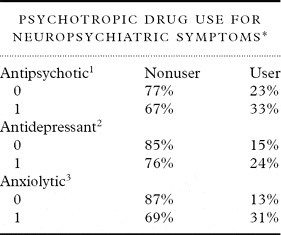
Table 4 shows utilization patterns of PDs per dichotomized NPS. In addition, since PDs can be prescribed for multiple indications, Table 4 shows PDU for multiple indications. This table indicates that a number of residents who show CR-NPS receive no PDs, whereas a number of residents showing SC-NPS are treated with PDs.
PDU per multiple NPS at baseline (NPI-NH-scores F × S; n = 117)

*0: F × S ≤ 3 1: F × S ≥ 4; percentages per dichotomy add up to 100%
PDU = psychotropic drug use; NPS = neuropsychiatric symptom; NPI-NH = neuropsychiatric inventory-nursing home; F × S = frequency multiplied by severity.
1symptom: either delusion, hallucinations, agitation, disinhibition, irritability and/or aberrant motor behaviour
2symptom: either depression, anxiety, delusion, hallucinations, and/or agitation,
3symptom: either anxiety and/or agitation
Association between PDU and etiological diagnosis
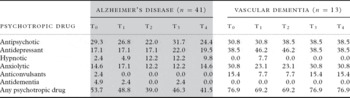
On average, residents with AD were prescribed more HYPs and ADM, whereas residents with VaD received relatively more frequent APs, ADPs, ANXs and ACs (Table 5). In addition, for any PD, a different utilization pattern was generally found with patients with VaD receiving more PD than those with AD (χ2(1) = 3.713, p = 0.054) (Table 5).
Psychotropic drug use per dementia subtype at successive assessments (prevalences on group level)

Discussion
This study examined the use of psychotropic medications in a large sample of nursing home residents with dementia following the FDA warnings for AP use in elderly people. We found that on average, PDU was highly prevalent and persistent in our study. No fewer than two-thirds of residents were treated with PDs at some stage during the two-year follow-up. Approximately a third of residents were treated with any PD for 24 months continuously. Remarkably, the majority of residents with moderate to severe neuropsychiatric symptoms did not receive antipsychotic medications. This finding may suggest that residents underwent different treatments or did not receive treatment at all. Similarly, depressed residents were often not on antidepressants, indicating under treatment, while non-depressed residents were treated with ADPs, possibly indicting overuse. Different PDU was found across the range of dementia diagnoses. Strengths of this study are the two-year follow-up period, the homogeneous sample and large sample size, thorough dementia diagnosis, and the systematic biannual assessments.
Our results are in line with previous reports. The high PDU at baseline has also been found in other studies (Koopmans et al., Reference Koopmans1996; Margallo-Lana et al., Reference Margallo-Lana2001; Kim and Whall, Reference Kim and Whall2006; Zuidema et al., Reference Zuidema, Derksen, Verhey and Koopmans2007c; Eggermont et al., Reference Eggermont, de Vries and Scherder2009). Kim et al. (Reference Kim, Lyons, Shin and Yoon2003) recruited residents in their study who were prone to exhibit NPS and found that ADPs were prescribed most frequently, followed by APs. Kamble et al. (Reference Kamble, Chen, Sherer and Aparasu2009) found that APs were prescribed in 33% of residents. Pitkala et al. (Reference Pitkala, Laurila, Strandberg and Tilvis2004) found that PDU and individual PDs were prescribed in 42% of residents with heterogeneous cognitive disorders admitted to acute geriatric wards. In this study, treatment with APs was discontinued in 20% of residents and some were on APs for two years. In Selbaek's study, discontinuation during one-year follow-up was 25% (Selbaek et al., Reference Selbaek, Kirkevold and Engedal2008). Notably, international guidelines state that an attempt should be made to discontinue or taper AP use among nursing home residents with dementia with NPS (American Geriatrics Society and American Association for Geriatric Psychiatry, 2003). Though depression prevalence and severity scores declined over time (Wetzels et al., Reference Wetzels, Zuidema, Jonghe, Verhey and Koopmans2010), no discontinuation of ADPs was observed. This could be because ADPs are prescribed not only for depression but for other indications as well, e.g. for aggression or psychosis (Pollock et al., Reference Pollock2007). In this study, a dissociation between symptoms and ADP prescriptions remained even after we adjusted for multiple indications (see Table 5), suggesting ADP overuse. Even though anxiety prevalence and severity scores declined over time (Wetzels et al., Reference Wetzels, Zuidema, Jonghe, Verhey and Koopmans2010), ANXs remained frequently prescribed. Dutch guidelines on NPS in nursing home residents with dementia state that ANXs should only be prescribed for a short period (Smalbrugge et al., Reference Smalbrugge2008). In contrast to our results, Selbaek et al. (Reference Selbaek, Kirkevold and Engedal2008) found higher percentages of ADM. His study, however, involved a substantial number of residents with mild dementia, who might respond better to cognitive enhancers than our sample of residents with more advanced dementia. Recent studies, however, found a positive impact of memantine on NPS in moderately severe to severe dementia (Wilcock et al., Reference Wilcock, Ballard, Cooper and Loft2008). As has been stated in an earlier study, ADM is not frequently prescribed in Dutch nursing homes (Zuidema et al., Reference Zuidema, de Jonghe, Verhey and Koopmans2007a); lack of awareness of recent effect studies on ADM and NPS might account for this discrepancy. At the same time, according to our study, NPS show both under- and overuse of PDs, as has been found in a previous study (Furniss et al., Reference Furniss, Craig and Burns1998). In their review, Furniss et al. (Reference Furniss, Craig and Burns1998) concluded that nursing home residents with dementia are prescribed more PDs than patients living at home, suggesting that nursing home residents are prone to PD overuse. These results suggest that efforts to screen residents for inadequate PDU should be undertaken.
In this study, as has been seen in an earlier study (Kim et al., Reference Kim, Lyons, Shin and Yoon2003), different prescription patterns were observed among residents with AD and VaD. This can be explained by different NPS profiles between AD and VaD, since residents with VaD show more depression and agitation and patients with AD more anxiety and apathy (Kim et al., Reference Kim, Lyons, Shin and Yoon2003). The use of ACs in VaD might be related to the emergence of post-stroke epilepsy. Even though a large proportion of residents had a diagnosis of dementia not otherwise specified, these results contribute to the growing evidence that different types of dementia are associated with different profiles of psychotropic drug use.
Prolonged treatment with PDs was highly prevalent. Regardless of recent safety warnings, PDU remains high (Trifiro et al., Reference Trifiro2010). Some debate exists concerning which factors are associated with PD prescription. PDU is associated with NPS (Lovheim et al., Reference Lovheim, Sandman, Kallin, Karlsson and Gustafson2006; Selbaek et al., Reference Selbaek, Kirkevold and Engedal2007; Nijk et al., Reference Nijk, Zuidema and Koopmans2009). Another explanation is that nursing staff or physicians inadequately review medication on a regular basis and therefore are unaware of the ongoing pharmacological treatment (Furniss et al., Reference Furniss, Craig and Burns1998). Intriguingly, the presence of NPS has not been found to be an independent predictor for PDU (Kim and Whall, Reference Kim and Whall2006). Indeed, that study showed a negative relationship between nursing staff and PDU, suggesting that PDU was used as a substitute for nursing staff. Furthermore, Kamble et al. (Reference Kamble, Chen, Sherer and Aparasu2009) found that a greater number of beds in the larger nursing home facilities was significantly associated with lower use of atypical AP, and Chen et al. (Reference Chen2010) found that, after adjusting for potential clinical indications, a culture of prescribing APs was related more to the nursing home than to the resident with dementia. Indeed, one study suggests that residents were treated to help the nursing staff (Lovheim et al., Reference Lovheim, Sandman, Kallin, Karlsson and Gustafson2006). Recent insight into the motivational and attitudinal commitment of nursing staff to work with residents with AD and agitation might contribute to this argument (Marshall, Reference Marshall2001; Ayalon et al., Reference Ayalon, Arean, Bornfeld and Beard2009). Staff tend to have little motivation (Marshall, Reference Marshall2001) and report a sense of helplessness or a preference for not working with residents with AD and agitation (Ayalon et al., Reference Ayalon, Arean, Bornfeld and Beard2009). Moreover, staff may disagree with the views of evidence-based practices for the management of AD and agitation (Ayalon et al., Reference Ayalon, Arean, Bornfeld and Beard2009) or even be unaware of recent thinking about dementia care (Marshall, Reference Marshall2001). As reported by nursing home physicians, the use of nonpharmacological methods is limited due to staff requests for medication and insufficient resources (Cohen-Mansfield and Jensen, Reference Cohen-Mansfield and Jensen2008). Overall, our results suggest that PDs are often used in the absence of NPS, that many residents with CR-NPS do not get pharmacological treatment, and that many others are treated with these medications for six months or up to two years. The emerging picture from all this is alarming and has far-reaching implications that warrant replication.
Some limitations of this study need to be discussed. First, biannual assessments do not measure what happens in between, thereby possibly biasing results. Our study, however, extends current knowledge with the use of biannual assessments. Secondly, no medication dosages were used and no “as needed” medications were registered. Thirdly, several potentially relevant drugs were not monitored in this study, such as beta-adrenergic receptor blockers which can be used for the treatment of agitation (Wang et al., Reference Wang2009). The study also did not take into account any combination of drugs from the same group. However, our study examined six subgroups of PDU illustrating high persistence and overuse as well as underuse. Fourthly, no multivariate analysis was performed to examine factors associated with psychotropic, antipsychotic, or antidepressant use to account for the level of NPS, gender or etiology. Fifthly, future studies should involve an analysis of PDU per SCU corrected for confounders (level of NPS, dementia diagnosis). Finally, the analyses were performed in the cohort that ultimately survived two-years of follow-up. Results might have been biased due to loss-to-follow-up.
Previous studies suggest that antipsychotics – like antidepressants, anxiolytics, and antidementia medications – are effective in the short term. The effect size is small but real. This must be taken into account in the risk benefit discussion of initiating and continuing therapy. However, great care should be taken to monitor pharmacological interventions in nursing home residents with dementia, especially in long-term treatment. PDs do not change the course of NPS (Ballard et al., Reference Ballard2001; Selbaek et al., Reference Selbaek, Kirkevold and Engedal2008) and our results of highly persistent PDU strongly support re-evaluation of pharmacological intervention. As a first-line management strategy for agitation, psychological interventions and staff-training programs are increasingly recommended, some of which have been shown to be efficacious (Ayalon et al., Reference Ayalon, Gum, Feliciano and Arean2006). When nonpharmacologic approaches fail to control NPS adequately, prudent PDU can be considered and should involve carefully targeted prescribing, given for short periods of time (up to three months), and reserved for severe and distressing symptoms (Salzman et al., Reference Salzman2008). In addition, constant monitoring should be undertaken with aim of dose reduction or discontinuation, and to assess drug-drug interactions. Owing to the multi-causal origin of NPS, a multidisciplinary approach (e.g. a geriatric psychologist, occupational therapist and well-trained and well-educated, specialized nursing staff) can help optimize care and symptom management. To increase the quality of prescribing and reduce potential serious side effects, it has also been suggested that pharmacists should periodically be involved in the management of PDU in elderly residents as they can improve resident care and be cost-effective (Furniss et al., Reference Furniss, Craig and Burns1998).
In conclusion, our study is the first to examine the two-year utilization pattern of PDU in nursing home residents with dementia following the publication of safety warnings. Efficacious drugs with potential harmful side effects were often prescribed for prolonged periods to those who are considered amongst the frailest of elderly persons. Importantly, physicians working in nursing homes should understand that residents, their families and nursing staff need to be advised about the best treatment strategies available. Great effort should be put into regularly monitoring the use of these drugs in residents with dementia, and to discontinue drugs whenever possible, with the ultimate aim of providing high-quality care and improving mental health care for nursing home residents with dementia. Our results warrant more research to understand why these medications are prescribed and their use continued.
Conflict of interest
None.
Description of authors' roles
R. Wetzels, S. Zuidema, F. Verhey and R. Koopmans initiated the study concept and design; R. Wetzels collected the data; R. Wetzels, S. Zuidema and J. de Jonghe analyzed the data; R. Wetzels wrote the paper; and it was critically reviewed by S. Zuidema, J. de Jonghe, F. Verhey and R. Koopmans.
Acknowledgment
This study was financed by the Joannes de Deo Foundation, Netherlands Organization for Health Research and Development (ZonMW), Foundation for the Promotion of Science in Nursing Home Care (SWBV), and the Department of Primary and Community Care of the Radboud University Nijmegen.