Introduction
The introduction of 2,4-D-resistant soybean and cotton provided growers a new active ingredient for POST weed management programs (Wright et al. Reference Wright, Shan, Walsh, Lira, Cui, Song, Zhuang, Arnold, Lin, Yau, Russell, Cicchillo, Peterson, Simpson, Zhou, Ponsamuel and Zhang2010). With the widespread cases of weed species resistant to glyphosate and herbicides that target acetolactate synthase and protoporphyrinogen oxidase throughout the U.S. Midwest and Midsouth (Bagavathiannan and Norsworthy Reference Bagavathiannan and Norsworthy2016; Kruger et al. Reference Kruger, Davis, Weller, Stachler, Loux and Johnson2009; Murphy et al. Reference Murphy, Larran, Ackley, Loux and Tranel2019; Plewa and Bissonnette Reference Plewa and Bissonnette2016; Regnier et al. Reference Regnier, Harrison, Loux, Holloman, Venkatesh, Diekmann, Taylor, Ford, Stoltenberg, Hartzler, Davis, Schutte, Cardina, Mahoney and Johnson2016; Schultz et al. Reference Schultz, Chatham, Riggins, Tranel and Bradley2015; Vieira et al. Reference Vieira, Samuelson, Alves, Gaines, Werle and Kruger2018b), 2,4-D–resistant crops could be a valuable tool to manage troublesome weeds (Legleiter et al. Reference Legleiter, Young and Johnson2018). In fact, 2,4-D alone or in mixture with glyphosate controlled glyphosate-resistant Palmer amaranth (Amaranthus palmeri S. Watson), waterhemp (Amaranthus tuberculatus var. rudis), horseweed (Conyza canadensis (L.) Cronquist var. canadensis), and common ragweed (Ambrosia artemisiifolia L.) (Kruger et al. Reference Kruger, Davis, Weller and Johnson2010; Manuchehri et al. Reference Manuchehri, Dotray and Keeling2017; Nandula and Tyler Reference Nandula and Tyler2016). 2,4-D plus glyphosate mixtures also controlled common lambsquarters (Chenopodium album L.), giant ragweed (Ambrosia trifida L.), giant foxtail (Setaria faberi Herrm.), and velvetleaf (Abutilon theophrasti Medik.) (Robinson et al. Reference Robinson, Simpson and Johnson2012).
There are benefits associated with the adoption of 2,4-D–resistant crops, but the technology also raises concerns regarding potential 2,4-D off-target movement during applications. With 2,4-D–resistant crops, the herbicide can now be sprayed to a greater proportion of the crop production area. 2,4-D is very active on sensitive broadleaf species even at lower rates, which could lead to severe injury and yield loss of sensitive crops, ornamentals, and vegetation (Egan et al. Reference Egan, Barlow and Mortensen2014; Kalsing et al. Reference Kalsing, Rossi, Lucio, Zobiole, Cunha and Minozzi2018; Kruger et al. Reference Kruger, Johnson, Doohan and Weller2012; Smith et al. Reference Smith, Ferrell, Webster and Fernandez2017). Spray drift is one of the most common routes for off-target movement during pesticide applications and can be defined as the part of the application (particles or vapor) deflected away from the target during or following applications (Matthews et al. Reference Matthews, Bateman and Miller2014). Many environmental factors and application techniques influence spray particle drift potential, including wind speed and direction, surrounding vegetation, spray droplet size, and equipment boom height (Hewitt Reference Hewitt2000; Nordby and Skuterud Reference Nordby and Skuterud1974).
Spray droplet size has been the primary management factor manipulated for reducing particle drift and is directly influenced by nozzle design, operating pressure, and physicochemical properties of the spray solution (Creech et al. Reference Creech, Henry, Fritz and Kruger2015; Hewitt Reference Hewitt2008; Hilz and Vermeer Reference Hilz and Vermeer2013; Schampheleire et al. Reference Schampheleire, Nuyttens, Baetens, Cornelis, Gabriels and Spanoghe2008). Applications of 2,4-D on soybean require the use of venturi nozzles having air-inclusion and preorifice components to reduce pressure during atomization, thereby increasing spray droplet size and reducing particle drift potential (Creech et al. Reference Creech, Henry, Fritz and Kruger2015; Dorr et al. Reference Dorr, Hewitt, Adkins, Hanan, Zhang and Noller2013). Spray drift reduction (particles and vapor) can also be achieved with the development of new emulsion formulations, including the glyphosate dimethylamine salt + 2,4-D choline pre-mixture formulation (Enlist Duo®, Corteva™ Agriscience, Wilmington, DE 19805) tested in this study (Antuniassi et al. Reference Antuniassi, Moreira, Chechetto, Pinheiro, Lucio, Fritz and Butts2016; Havens et al. Reference Havens, Hillger, Hewitt, Kruger, Marchi-Werle and Czaczyk2018; Kalsing et al. Reference Kalsing, Rossi, Lucio, Zobiole, Cunha and Minozzi2018; Li et al. Reference Li, Tank, Kennedy, Zhang, Downer, Ouse, Liu and Bernards2013).
Droplet velocity is another important but often overlooked component that directly influences application efficacy and spray drift potential (Al Heidary et al. Reference Al Heidary, Douzals, Sinfort and Vallet2014; De Cock et al. Reference De Cock, Massinon, Salah and Lebeau2017; Dorr et al. Reference Dorr, Kempthorne, Mayo, Forster, Zabkiewicz, McCue, Belward, Turner and Hanan2014; Nuyttens et al. Reference Nuyttens, Baetens, De Schampheleire and Sonck2007). Modeling efforts indicate that droplets with higher vertical velocities have less drift potential (Baetens et al. Reference Baetens, Nuyttens, Verboven, De Schampheleire, Nicolaï and Ramon2007; Reichard et al. Reference Reichard, Zhu, Fox and Brazee1992; Teske et al. Reference Teske, Bird, Esterly, Curbishley, Ray and Perry2002; Zhu et al. Reference Zhu, Reichard, Fox, Brazee and Ozkan1994). In general, droplets have their maximum velocity close to the nozzle and decelerate during transport to the target as a result of air resistance (Al Heidary et al. Reference Al Heidary, Douzals, Sinfort and Vallet2014; Dorr et al. Reference Dorr, Hewitt, Adkins, Hanan, Zhang and Noller2013). Smaller droplets decelerate more rapidly due to aerodynamic drag (less kinetic energy) compared with larger droplets (Butts et al. Reference Butts, Hoffmann, Luck, Kruger, Fritz and Butts2018a; Dorr et al. Reference Dorr, Hewitt, Adkins, Hanan, Zhang and Noller2013; Goering et al. Reference Goering, Gebhardt and Bode1972; Nuyttens et al. Reference Nuyttens, Baetens, De Schampheleire and Sonck2007, Reference Nuyttens, Schampheleire, Verboven, Brusselman and Dekeyser2009). Despite the larger droplets generated by venturi nozzles, the droplets had slower initial velocities because of the pressure drop caused by the air-inclusion and preorifice components (Dorr et al. Reference Dorr, Hewitt, Adkins, Hanan, Zhang and Noller2013).
Despite efforts surrounding proper nozzle selection (Creech et al. Reference Creech, Henry, Fritz and Kruger2015; Dorr et al. Reference Dorr, Hewitt, Adkins, Hanan, Zhang and Noller2013), new herbicide formulations and adjuvants (Antuniassi et al. Reference Antuniassi, Moreira, Chechetto, Pinheiro, Lucio, Fritz and Butts2016; Havens et al. Reference Havens, Hillger, Hewitt, Kruger, Marchi-Werle and Czaczyk2018; Hilz and Vermeer Reference Hilz and Vermeer2013; Kalsing et al. Reference Kalsing, Rossi, Lucio, Zobiole, Cunha and Minozzi2018; Li et al. Reference Li, Tank, Kennedy, Zhang, Downer, Ouse, Liu and Bernards2013), new spraying techniques (Butts et al. Reference Butts, Samples, Franca, Dodds, Reynolds, Adams, Zollinger, Howatt, Fritz, Hoffmann and Kruger2018c; Rodrigues et al. Reference Rodrigues, Campos, Creech, Fritz, Antuniassi, Kruger, Fritz and Butts2018), and strategies to mitigate spray drift (Foster et al. Reference Foster, Sperry, Reynolds, Kruger and Claussen2018; Ucar and Hall Reference Ucar and Hall2001; Vieira et al. Reference Vieira, Butts, Rodrigues, Golus, Schroeder and Kruger2018a), 2,4-D remains a herbicide associated with drift and crop injury complaints (Egan et al. Reference Egan, Barlow and Mortensen2014; Havens et al. Reference Havens, Hillger, Hewitt, Kruger, Marchi-Werle and Czaczyk2018). The hypothesis of this study was that differences in droplet size and droplet velocity could influence spray drift of Enlist Duo® applications with venturi nozzles. The objective of this study was to investigate the droplet size distribution, droplet velocity, and particle drift potential of Enlist Duo® applications with two commonly used venturi nozzles in a low-speed wind tunnel.
Materials and Method
Droplet Size Study
This study was conducted in a low-speed wind tunnel at the Pesticide Application Technology Laboratory (University of Nebraska–Lincoln, West Central Research and Extension Center, North Platte, NE). Droplet size distribution data were evaluated using a Sympatec Helos/Vario KR laser diffraction system (Sympatec, Clausthal, Germany) measuring 0.3 m from the nozzle tip to ensure full spray atomization (Butts et al. Reference Butts, Butts, Luck, Fritz, Hoffmann and Kruger2019; Henry et al. Reference Henry, Kruger, Fritz, Hoffmann, Bagley and Sesa2014). The system has an R7 lens that detects droplets in a range from 9 to 3,700 μm. Glyphosate plus 2,4-D choline pre-mixture solution was prepared with tap water and Enlist Duo® (Corteva Agriscience, Wilmington, DE) at 29.2 ml L−1 solution corresponding to a carrier volume of 140.3 L ha−1 (833.6 and 784.6 g ae ha−1 of glyphosate and 2,4-D, respectively). Enlist Duo® solution was sprayed with two venturi nozzles (approved for Enlist Duo® applications) at 276 kPa: an AIXR11004 nozzle (Air induction extended range flat fan, TeeJet® Technologies Spraying Systems, Glendale Heights, IL) and a TDXL11004 (TurboDrop XL flat fan, Greenleaf Technologies, Covington, LA) nozzle. Nozzles were arranged parallel with the wind tunnel and wind flow (horizontal). Nozzles were attached to an actuator and traversed vertically at a constant speed of 0.2 m s−1 to ensure the entire spray plume crossed the laser diffraction system. Applications were performed at a constant wind speed of 6.7 m s−1 (Butts et al. Reference Butts, Butts, Luck, Fritz, Hoffmann and Kruger2019; Henry et al. Reference Henry, Kruger, Fritz, Hoffmann, Bagley and Sesa2014).
The D V0.1, D V0.5, and D V0.9, which represent the droplet diameter such that 10%, 50%, and 90% of the spray volume is contained in droplets of lesser diameters, respectively, and the percentage of the spray volume with droplets <150 µm (driftable fines) were reported (Yates et al. Reference Yates, Cowden and Akesson1985). The relative span (RS), a dimensionless parameter that estimates the uniformity of droplet size, was calculated (Hewitt Reference Hewitt2008) (Equation 1).
 $${\rm{RS}} = {\rm{ }}{{\left( {{D_{{\rm{V0}}.{\rm{9}}}} - {D_{{\rm{V0}}.{\rm{1}}}}} \right)} \over {{D_{{\rm{V0}}.{\rm{5}}}}}}$$
The experiment was conducted in a completely randomized design with three replications (individual traverses through the laser). Droplet size data were subjected to ANOVA in SAS (SAS v. 9.4, SAS Institute, Cary, NC), and comparisons between nozzles were performed using Fisher’s protected LSD test (P ≤ 0.05). The D V0.1, D V0.5, and D V0.9 and RS were analyzed with a gamma distribution, whereas the driftable fines response variable was analyzed with a beta distribution (Butts et al. Reference Butts, Butts, Luck, Fritz, Hoffmann and Kruger2019; Stroup Reference Stroup2013). Back-transformed data are presented for clarity.
Droplet Velocity Study
This study was conducted in a low-speed wind tunnel at the Aerial Application Technology Laboratory located at the U.S. Department of Agriculture (USDA) Southern Plains Agricultural Research Center in College Station, TX (Butts et al. Reference Butts, Hoffmann, Luck, Kruger, Fritz and Butts2018a; Hoffmann et al. Reference Hoffmann, Fritz, Bagley, Kruger, Henry, Czaczyk and Sesa2014a). Enlist Duo® solution was prepared as previously described. Herbicide solution was sprayed with AIXR11004 and TDXL11004 nozzles at 276 kPa arranged parallel (horizontally) to the wind tunnel and wind flow. Wind tunnel applications were performed with a 1.0 m s−1 airstream to allow for one-directional droplet movement while not influencing droplet velocity.
A LaVision SprayMaster (LaVision, Ypsilanti, MI) droplet imaging system was set to Shadowography mode and used to simultaneously measure the droplet diameter and corresponding velocity. The Shadowography mode used a pulsed laser to backlight images, and paired images were recorded 10 µs apart. Droplet size and velocities were recorded 15 cm from the nozzle over a 19 by 19 cm area with an approximate 3-mm field depth and a droplet size measurement range between 60 and 2,000 µm. Each treatment was continuously sprayed for 68 s, which allowed for 300 paired images to be collected as the entire spray plume traversed the sampling area four times. DaVis Software (v. 7.2, LaVision) processed the images and returned a listing of each droplet detected and measured. Droplet velocity was calculated using a process previously described in the literature (Hoffmann et al. Reference Hoffmann, Fritz, Bagley, Kruger, Henry, Czaczyk and Sesa2014a).
The experiment was conducted in a complete randomized design. Droplet velocity data were subjected to ANOVA in SAS, and comparisons between nozzles were performed using Fisher’s protected LSD test (P ≤ 0.05). Both response variables were analyzed with a gamma distribution. Back-transformed data are presented for clarity. Droplet size and velocity paired measurements for each nozzle were also modeled using a nonlinear regression model with the dose–response package (drc) in R statistical software (R Foundation for Statistical Computing, Vienna, Austria) (Knezevic et al. Reference Knezevic, Streibig and Ritz2007; Ritz et al. Reference Ritz, Baty, Streibig and Gerhard2015). A three-parameter log-logistic model (Equation 2) was fit to the data:
 $${\rm{Droplet \ velocity }}\;\left( {{\rm{m}}\,{{\rm{s}}^{ - 1}}} \right) \!=\! d/1 + \exp \;\left[ {b\;\left( {\log \,x - \log \,e} \right)} \right]$$
in which b is the relative slope around the inflection point, d is the upper limit (m s−1), e is the inflection point (µm), and x is the droplet diameter (µm).
Particle Drift Study
This study was conducted in a low-speed wind tunnel at the Pesticide Application Technology Laboratory. Enlist Duo® solution was prepared as previously described with the addition of 1,3,6,8-pyrene tetra sulfonic acid tetra sodium salt (PTSA) fluorescent tracer (Spectra Colors Corporation, Kearny, NJ) at 1,000 ppm (Hoffmann et al. Reference Hoffmann, Fritz and Ledebuhr2014b). Herbicide solution was sprayed in the low-speed wind tunnel using two different nozzles (AIXR11004 and TDXL11004) at 276 kPa for 2 s (67.1 ml ± 0.6 standard error) under a 4.47 m s−1 airstream. Contrary to the droplet size and velocity studies, nozzles were arranged perpendicular to the wind tunnel and wind flow as in a real-life application scenario. Mylar cards (100 by 100 mm) (Grafix Plastics, Cleveland, OH) were used to collect downwind particle drift deposition at 0.5, 1, 2, 3, 6, 9, and 12 m from the nozzle. Water-sensitive papers (WSP) (52 by 76 mm) (Syngenta, Basel, Switzerland) were placed along with Mylar cards to collect spray drift deposition. Simultaneously, glyphosate-resistant soybean plants (V3 growth stage) were positioned at the same downwind distances to serve as biological indicators for spray particle drift. Applications were performed at 51-cm height in relation to Mylar cards, WSP, and soybean plants. The experiment had a complete randomized design with five replications. The treatment design was a factorial arrangement with nozzle type and downwind distances as factors. The study was conducted twice for soybean response to Enlist Duo® spray drift.
Mylar Cards
Mylar cards were collected after 1 min following applications and placed into prelabeled plastic zip-top bags. Zip-top bags with Mylar cards were placed in a dark container immediately following collection to avoid PTSA photodegradation. Spray particle drift deposition was determined for each Mylar card with fluorometric analysis at the Pesticide Application Technology Laboratory. Mylar cards were washed using 40 ml of a 9:1 solution of distilled water and 91% isopropyl alcohol. With the tracer completely suspended, a 1.5-ml aliquot was transferred to a glass cuvette and analyzed using a Trilogy® fluorimeter with a PTSA module (Turner Designs, Sunnyvale, CA). Relative fluorescence unit data were converted into micrograms of PTSA per cm2 (Mylar card) using a calibration curve for the tracer. A four-parameter Weibull model (Equation 3) was fit to deposition data using the drc package in R software:
 $$\eqalign{
& {\rm{PTSA}}{\mkern 1mu} {\rm{deposition}}{\mkern 1mu} \left( {\mu {\rm{g}}{\mkern 1mu} {\rm{c}}{{\rm{m}}^{ - 2}}} \right) = \cr
& c + \left( {d - c} \right)\exp {\mkern 1mu} \left( { - \exp {\mkern 1mu} \left\{ {b{\mkern 1mu} \left[ {\log {\mkern 1mu} \left( x \right) - \log {\mkern 1mu} \left( e \right)} \right]} \right\}} \right) \cr} $$
in which b is the slope at the inflection point, c is the lower limit of the model (µg cm−2), d is the upper limit (µg cm−2), x is the downwind distance from the nozzle (m), and e is the inflection point distance (m). A variance ratio (F-test) was conducted to determine whether individual or pooled nozzle-type models best fit the data (P ≤ 0.05) (Butts et al. Reference Butts, Vieira, Latorre, Werle and Kruger2018d; Oliveira et al. Reference Oliveira, Pereira, Ferreira, Santos, Knezevic and Werle2018).
Water-Sensitive Papers
WSP were collected after 1 min following applications and placed into prelabeled plastic zip-top bags. Zip-top bags with WSP were stored in a freezer (−20 C) until scanner analysis. WSP were digitally scanned at 600 dpi (Epson Perfection V600, Seiko Epson, Nagano, Japan) and analyzed for droplet size characteristics using Dropletscan software (WRK of Arkansas, Lonoke, AR) (Wolf Reference Wolf2003). Percent coverage, D V0.1, D V0.5, and D V0.9 were reported and subjected to ANOVA in SAS v. 9.4 software. Comparisons between treatments were performed using Fisher’s protected LSD procedure (P ≤ 0.05). D V0.1, D V0.5, and D V0.9 response variables were analyzed with a gamma distribution, whereas percent coverage was analyzed with a beta distribution. Back-transformed data are presented for clarity.
Soybean Plants
Glyphosate-resistant soybean seeds (39RY25, Dyna-Gro, Geneseo, IL) were planted into plastic tubes (1.5 L) containing commercial potting mix (Berger BM7 Bark Mix, Saint Modeste, QC, Canada) and maintained under greenhouse conditions (20 to 30 C with a 16-h photoperiod) at the Pesticide Application Technology Laboratory. Plants were supplied with water and fertilizer as needed (UNL 5-1-4 at 0.2% v/v, Wilbur-Ellis Agribusiness, Aurora, CO).
Plant aboveground biomass was harvested at 28 d after treatment and oven-dried at 65 C to constant weight. The biomass data were converted into percentage of biomass reduction as compared with the nontreated control. A four-parameter log-logistic model (Equation 4) was fit to the dry weight data using the drc package in R statistical software:
 $${\rm{Biomass}}\,{\rm{reduction }}\,\left( {\rm{\% }} \right) \!=\! c + \left\{ {d - c/1 + \exp \,\left[ {b\,\left( {\log \,x - \log \,e} \right)} \right]} \right\}$$
in which b is the slope at the inflection point, c is the lower limit of the model (fixed to 0%), d is the upper limit (fixed to 100%), x is the downwind distance from the nozzle (m), and e is the inflection point distance (m). The downwind distance that reduced plants biomass by 10% (D 10), 25% (D 25), and 75% (D 75) was estimated for each nozzle type. A variance ratio (F-test) was conducted to determine whether individual or pooled nozzle-type models best fit the data (P ≤ 0.05).
Results and Discussion
Droplet Size Study
Applications of Enlist Duo® with the TDXL11004 nozzle had larger D V0.1 (291 µm), D V0.5 (544 µm), and D V0.9 (825 µm) parameters compared with applications with the AIXR11004 nozzle (250, 464, and 709 µm, respectively) (Table 1). The TDXL11004 nozzle also produced less driftable fines (1.1%) compared with the AIXR11004 nozzle (2.0%). Both TDXL11004 and AIXR11004 nozzles had a similar RS (1.0). Similar results were reported by Ferguson et al. (Reference Ferguson, O’Donnell, Chauhan, Adkins, Kruger, Wang, Urach Ferreira and Hewitt2015), in which a TDXL11002 nozzle had greater D V0.5 compared with an AIXR11002 nozzle at 276 kPa across different solutions (water, clopyralid, and pinoxaden + methylated oil). Butts et al. (Reference Butts, Moraes, Kruger, Fritz and Butts2018b) reported that applications of water with a TDXL11004 nozzle had greater D V0.1, D V0.5, D V0.9, and less driftable fines compared with applications with an AIXR11004 nozzle at 276 kPa. Fritz et al. (Reference Fritz, Hoffman, Anderson and Goss2016) reported in a response surface-modeling analysis that applications (water + 0.25 % v/v of nonionic surfactant) with the TDXL nozzle had greater percentage of operating points (pressure and orifice size range) within “extremely coarse” and “very coarse” spray classifications compared with the AIXR nozzle. Therefore, based on the relationship between droplet size and particle drift, it would be expected that the TDXL11004 nozzle would have less particle drift potential compared with the AIXR11004.
Droplet size distribution for pre-mixture formulation of glyphosate plus 2,4-D (Enlist Duo®) applications with AIXR11004 and TDXL11004 nozzles at 276 kPa.a,b

a Abbreviations: D V0.1, D V0.5, and D V0.9: parameters that represent the droplet size such that 10%, 50%, and 90% of the spray volume is contained in droplets of lesser values, respectively; driftable fines: percent of spray volume that contains driftable fines less than 150 µm; RS: relative span, a dimensionless parameter that estimates the spread of a distribution.
b Means within a column followed by the same letter are not significantly different (P ≤ 0.05).
c The spray classifications for this study were based on reference curves created from reference nozzles data at the Pesticide Application Technology Laboratory as described by ASABE S572.1, where VC = very coarse, and XC = extremely coarse.
d AIXR11004, TeeJet® Technologies, Spraying Systems, Glendale Heights, IL 60139.
e TDXL11004, Greenleaf Technologies, Covington, LA 70433.
Droplet Velocity Study
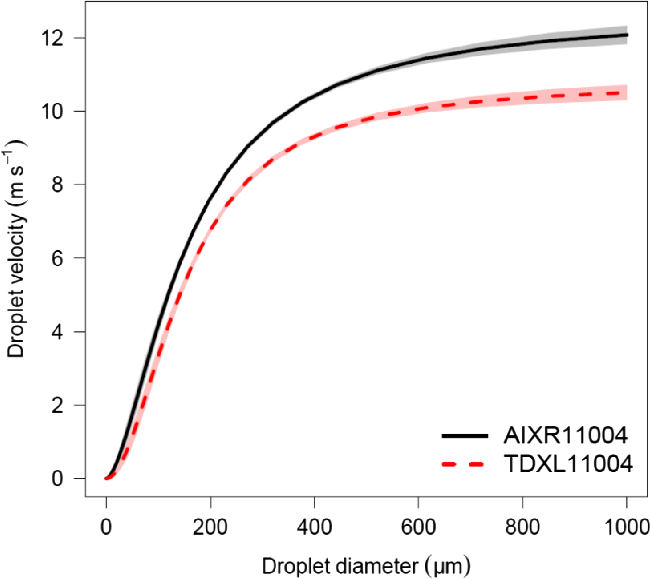
The TDXL11004 nozzle consistently had lower droplet velocities compared with the AIXR11004 nozzle throughout the entire spray droplet spectrum at 15 cm from the nozzle tip (Figure 1). When measured droplets from the TDXL11004 nozzle were averaged, the droplets had a lower droplet velocity (8.1 m s−1) compared with the droplets from the AIXR11004 nozzle (9.1 m s−1). When the average velocity for droplets less than 200 µm was analyzed, the TDXL11004 again produced droplets with lower velocity (5.8 m s−1) compared with the droplets from the AIXR11004 nozzle (6.6 m s−1).
Glyphosate plus 2,4-D pre-mixture (Enlist Duo®) spray droplet velocity (m s−1) regressed over spray droplet diameter (µm) using a three-parameter log-logistic model for the AIXR11004 and TDXL11004 nozzles. The shaded region indicates the 95% confidence limits.

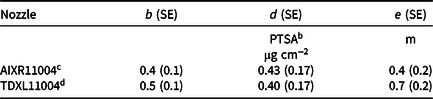
The droplet velocity models established for the TDXL11004 and AIXR11004 nozzles evaluated in this research were similar to asymptotic models for venturi and non-venturi nozzles reported in previous research (Butts et al. Reference Butts, Hoffmann, Luck, Kruger, Fritz and Butts2018a). The droplet velocity decreased with decreasing droplet sizes for both TDXL11004 and AIXR11004 nozzles partly due to aerodynamic drag, as previously reported (Butts et al. Reference Butts, Hoffmann, Luck, Kruger, Fritz and Butts2018a; Dorr et al. Reference Dorr, Hewitt, Adkins, Hanan, Zhang and Noller2013; Nuyttens et al. Reference Nuyttens, Schampheleire, Verboven, Brusselman and Dekeyser2009). Dorr et al. (Reference Dorr, Hewitt, Adkins, Hanan, Zhang and Noller2013) discussed that fine droplets tend to lose initial velocity and reach terminal velocity sooner than coarser droplets, whereas coarser droplets travel farther before reaching terminal velocity and have higher velocities than fine droplets. The parameter estimates for the log-logistic droplet velocity model as influenced by droplet diameter for the AIXR11004 and TDXL11004 nozzles are presented in Table 2. The upper limit (d) model parameter highlights the faster droplets produced by the AIXR11004 nozzle (12.7 m s−1) compared with the TDXL11004 nozzle (10.1 m s−1).
Log-logistic model parameter estimates and SEs for droplet velocity (m s−1) regressed over droplet diameter (µm) for pre-mixture formulation of glyphosate plus 2,4-D (Enlist Duo®) applications with AIXR11004 and TDXL11004 nozzles at 276 kPa.a

a The b parameter corresponds to the slope at the inflection point, the d parameter corresponds to the upper limit (m s−1), and the e parameter corresponds to the inflection point (µm).
b TeeJet® Technologies, Spraying Systems, Glendale Heights, IL 60139.
c Greenleaf Technologies, Covington, LA 70433.
The TDXL11004 venturi design, pre-orifice, and double-cap features that produced larger droplets are likely responsible for reducing the droplet velocity due to a greater pressure drop compared with the AIXR11004 during atomization. Dorr et al. (Reference Dorr, Hewitt, Adkins, Hanan, Zhang and Noller2013) reported the same trend in applications of different solutions (water, Agral 0.1%, and Roundup CT 1%) with air-inclusion nozzles, as the observed maximum droplet velocities were lower than the theoretical liquid discharge velocities, likely due to pressure loss through nozzles. Decreased vertical droplet velocity has been previously linked to increased spray drift potential (Baetens et al. Reference Baetens, Nuyttens, Verboven, De Schampheleire, Nicolaï and Ramon2007; Zhu et al. Reference Zhu, Reichard, Fox, Brazee and Ozkan1994). Contrary to the droplet size study, based on the droplet velocity relationship with particle drift, it would be expected that the TDXL11004 nozzle would have greater particle drift potential compared with the AIXR11004 nozzle, as it had lower droplet velocity. However, droplet size has often been considered a more important factor than droplet velocity for drift reduction, and little research has investigated the interaction between the two on measurable spray particle drift.
Spray Drift Deposition on Mylar Cards
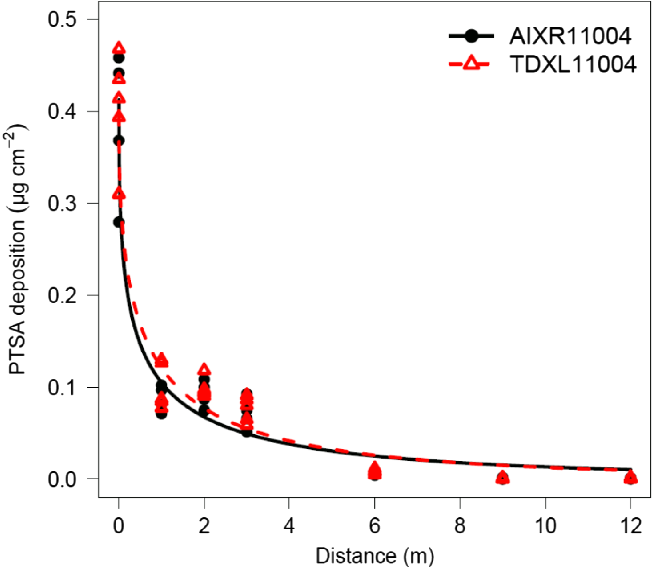
The particle drift potential of treatments reported in this study was consistent with previous wind tunnel studies investigating drift potential with air-inclusion nozzles (Figure 2) (Alves et al. Reference Alves, Kruger, Cunha, Santana, Pinto, Guimarães and Zaric2017a, Reference Alves, Kruger, Cunha, Vieira, Henry, Obradovic and Grujic2017b; Vieira et al. Reference Vieira, Luck, Amundsen, Gaines, Werle and Kruger2019). The parameter estimates for the Weibull drift deposition models for the AIXR11004 and TDXL11004 nozzles are presented in Table 3. The AIXR11004 and TDXL11004 nozzles had similar slopes at the inflection point (b), upper limits (d), and distance to 50% spray deposition (e) parameters. The F-test (P = 0.65) indicated no difference between the individual nozzle models and the pooled model for spray drift deposition; therefore, downwind spray drift deposition was similar between nozzles. These results indicate that although the TDXL11004 nozzle had larger spray droplet size, the slower spray droplet velocity could be influencing the nozzle particle drift potential. As a result, both TDXL11004 and AIXR11004 nozzles had similar spray drift deposition for the experimental conditions tested herein. Baetens et al. (Reference Baetens, Nuyttens, Verboven, De Schampheleire, Nicolaï and Ramon2007) reported in a computational fluid dynamics model study that droplet velocity had minor influence on spray drift (2.5% of deviation in drift deposits) compared with boom height and wind (speed and direction) for applications of water mixed with Brilliant Sulfo Flavine tracer. Another simulation drift model study indicated that water droplets (>80 µm) with higher initial velocities had reduced mean drift distances compared with droplets with smaller velocities, although droplet velocity differences of greater magnitude were tested when compared with differences observed in this study (Zhu et al. Reference Zhu, Reichard, Fox, Brazee and Ozkan1994). Reichard et al. (Reference Reichard, Zhu, Fox and Brazee1992) reported the same trend for droplets >200 µm in a computer simulation study investigating variables that influence spray drift.
PTSA (1,3,6,8-pyrene tetra sulfonic acid tetra sodium salt) deposition (µg cm−2) as influenced by downwind distance for glyphosate plus 2,4-D pre-mixture (Enlist Duo®) application drift with AIXR11004 and TDXL11004 nozzles using a four-parameter Weibull model.

Estimations of Weibull model parameters and SEs for spray particle drift deposition of glyphosate plus 2,4-D pre-mixture formulation (Enlist Duo®) applications with AIXR11004 and TDXL11004 nozzles at 276 kPa.a

a The b parameter corresponds to the slope at the inflection point, the d parameter corresponds to the upper limit (µg cm−2), and the e parameter corresponds to the inflection point distance (m).
b PTSA, 1,3,6,8-pyrene tetra sulfonic acid tetra sodium salt.
c TeeJet® Technologies, Spraying Systems, Glendale Heights, IL 60139.
d Greenleaf Technologies, Covington, LA 70433.
Spray Drift Deposition on Water-Sensitive Papers
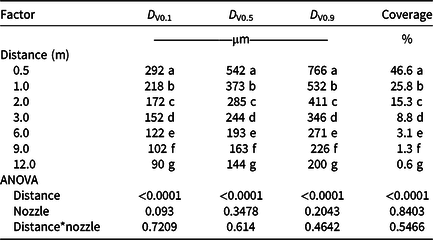
Downwind distance influenced the D V0.1, D V0.5, D V0.9, and spray drift coverage (P < 0.0001) on WSP, whereas nozzle type had no effect on these parameters (Table 4). The volumetric parameters (D V0.1, D V0.5, and D V0.9) decreased as the downwind distance was increased, indicating greater off-target movement of smaller droplets as previously reported (Alves et al. Reference Alves, Kruger, Cunha, Santana, Pinto, Guimarães and Zaric2017a, Reference Alves, Kruger, Cunha, Vieira, Henry, Obradovic and Grujic2017b; Bueno et al. Reference Bueno, Cunha and de Santana2017; Havens et al. Reference Havens, Hillger, Hewitt, Kruger, Marchi-Werle and Czaczyk2018; Johnson et al. Reference Johnson, Roeth, Martin and Klein2006; Vieira et al. Reference Vieira, Butts, Rodrigues, Golus, Schroeder and Kruger2018a; Zhu et al. Reference Zhu, Reichard, Fox, Brazee and Ozkan1994). The results corroborate the spray-deposition findings reported on Mylar cards, where both TDXL11004 and AIXR11004 nozzles had similar drift potential results despite the differences in spray droplet size and velocity. When averaged across nozzles, WSP positioned at 1-m downwind distance had 26% coverage, whereas WSP positioned at 9 m from the nozzle had 1.3% coverage. These results highlight the importance of adopting the 9-m buffer zone required in the Enlist Duo® label to minimize potential herbicide injury caused by glyphosate and 2,4-D drift on sensitive vegetation. Dropletscan was used with a default spread factor equation for water, as the study just included one spray solution and relative comparisons were made. The use of a proper spread factor for the Enlist Duo® solution would increase deposits’ sizing accuracy (Hoffman et al. Reference Hoffman, Fritz, Gizotti-de-Moraes, Guerrerio, Kruger and Edlund2018).
The droplet size (D V0.1, D V0.5, and D V0.9) and percent coverage of water-sensitive papers from spray particle drift of glyphosate plus 2,4-D pre-mixture formulation (Enlist Duo®) averaged across AIXR11004 and TDXL11004 nozzles in a low-speed wind tunnel.ab

a Abbreviations: D V0.1, D V0.5, and D V0.9: parameters that represent the droplet size such that 10%, 50%, and 90% of the spray volume is contained in droplets of lesser values, respectively.
b Means within a column followed by the same letter are not significantly different (P ≤ 0.05).
Soybean Biomass Reduction
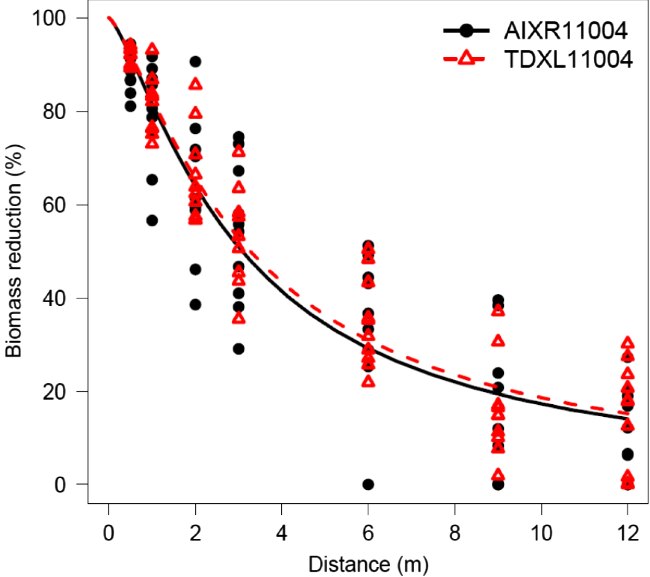
Soybean plants were very sensitive to 2,4-D exposure as previously reported (Egan et al. Reference Egan, Barlow and Mortensen2014; Kalsing et al. Reference Kalsing, Rossi, Lucio, Zobiole, Cunha and Minozzi2018) (Figure 3). The parameter estimates for the log-logistic biomass reduction models for the AIXR11004 and TDXL11004 nozzles are presented in Table 5. Plants had 50% biomass reduction (inflection point) for Enlist Duo® spray drift at 3.1- and 3.3-m downwind distance for the AIXR11004 and TDXL11004 nozzles, respectively. Despite the differences in droplet size, the log-logistic parameter estimates indicate that drift from both nozzles resulted in similar soybean biomass reduction downwind. The F-test (P = 0.76) indicated no difference between the individual nozzle models and the pooled model for soybean biomass reduction, suggesting similar soybean biomass reduction as a result of spray particle drift using both nozzles. As reported in the Mylar cards and WSP deposition studies, soybean biomass results suggest that the relatively minor, albeit slower droplet velocities of the TDXL11004 nozzle across the entire droplet spectrum compared with the AIXR11004 nozzle could have influenced the drift potential of the nozzle spray. As a result, both AIXR11004 and TDXL11004 nozzles had similar drift under the experimental conditions tested herein.
Soybean biomass reduction (%) as influenced by downwind distance for glyphosate plus 2,4-D pre-mixture (Enlist Duo®) application drift with AIXR11004 and TDXL11004 nozzles using a four-parameter log-logistic model.

Estimation of log-logistic model parameters, SEs, and distances with 10%, 25%, and 75% soybean biomass reduction prediction for glyphosate plus 2,4-D pre-mixture formulation (Enlist Duo®) spray drift with AIXR11004 and TDXL11004 nozzles at 276 kPa.a

a The b parameter corresponds to the slope at the inflection point, the e parameter corresponds to the inflection point distance (m); D 10, D 25, and D 75 correspond to the distance with 10%, 25%, and 75% soybean biomass reduction (m), respectively.
b TeeJet® Technologies, Spraying Systems, Glendale Heights, IL 60139.
c Greenleaf Technologies, Covington, LA 70433.
These results provide potential evidence that nozzle technologies that create larger droplet sprays with respect to other nozzles, but impart reduced initial droplet velocities to help the spray reach the target, may not result in the reduction in drift expected from the increased droplet sizes. These results are limited to the treatments and experimental conditions tested herein. Moreover, droplet velocity also plays critical role on spray deposition, retention, and consequent weed control in herbicide applications; therefore, managing this variable is complex (Dorr et al. Reference Dorr, Kempthorne, Mayo, Forster, Zabkiewicz, McCue, Belward, Turner and Hanan2014). This research does illustrate the importance of a holistic understanding of droplet dynamics within a spray application to fully comprehend the potential for spray particle drift. Although droplet size may be a primary factor influencing particle drift, this research shows that other factors, such as droplet velocity, and their interactions with droplet size can play a role in the drift potential of a pesticide application. Further studies are necessary to better understand the impact that droplet velocity at different distances downstream from the nozzle have on drift potential at field scale and to test how different tank solutions, sprayer configurations, sprayer speeds, and environmental conditions could influence the droplet size and velocity dynamics and subsequent drift potential of pesticide applications. Additionally, future particle drift-reduction strategies must not simply rely on changes in droplet size alone but instead account for all droplet dynamics.
Acknowledgments
This study was partially supported by Corteva™ Agriscience, Agricultural Division of DowDuPont, and partially supported by the Nebraska Agricultural Experiment Station with funding from the Hatch Multistate Research capacity-funding program, USDA National Institute of Food and Agriculture. The authors would like to thank CAPES (Brazilian Government Foundation) for the financial support to BCV(proc 013041/2013-04). The authors also would like to thank all undergraduate students, graduate students, and professional staff at the University of Nebraska–Lincoln who assisted with data collection and analysis. No conflicts of interest have been declared.