Implications
We demonstrate that water quality modelling should also be used to assess microbial risks for animals, and that combining hydrological and hydrodynamic models and implementing backwards modelling is useful for this purpose. The importance of on-farm control of diseases for animal and public health is illustrated, as well as the importance of human wastewater treatment. To obtain valid model outputs, detailed input data from surveillance of animal and human diseases are needed.
Introduction
Wastewater discharges, for example from municipal wastewater treatment plants, and agricultural activities, such as application of manure on arable land and grazing animals on pastures, may pose microbial risks to water sources used for drinking water supply and recreation. However, in addition to providing a potential source for microbial contamination, grazing animals may be recipients of microbes via contaminated water. Further, after being infected from microbes in water, grazing animals may provide subsequent sources of microbial contamination, such as seen in, for example, outbreaks of salmonella (Clark et al., Reference Clark, Fenwick, Nicol, Marchant, Swanney, Gill, Holmes, Leyland and Davies2004; Vanselow et al., Reference Vanselow, Hum, Hornitzky, Eamens and Quinn2007; Lahti et al., Reference Lahti, Ivarsson, Ågren, Thelander, Sjöland, Eriksson, Aspan, Szanto, Löfdahl, Plym Forshell and Wahlström2010).
Grazing animals are needed for maintaining certain nature reserves and promote biodiversity, and natural water sources often form part of these ecosystems. Pastureland outside nature reserves may also contain natural water sources that are utilised by the grazing animals regardless of the provision of clean drinking water in other locations on the pasture. Restricting the animals’ access to natural water sources may be costly as well as impractical.
There is a need to appropriately assess the risk of exposing grazing animals to microbes that could potentially spread via water in concentrations corresponding to infectious doses. Microbes from manure application on arable land, from faeces of grazing animals and from human wastewater can reach the animals’ water sources by transport through soil, but mainly via surface runoff, from the immediate vicinity or via streams, rivers and lakes. The complexity of the water transport processes and lack of quantitative input data hamper any direct assessment of this risk. However, the relative impact of different sources can be assessed by simulating the fate and transport of microbial pollutants in different catchments using water quality modelling (Oliver et al., Reference Oliver, Porter, Pachepsky, Muirhead, Reaney, Coffey, Kay, Milledge, Hong, Anthony, Page, Bloodworth, Mellander, Carbonneau, McGrane and Quilliam2016). Hydrological (also called catchment/watershed-scale) models have been widely applied to estimate the impacts of diffuse faecal sources in agricultural catchments worldwide (Jamieson et al., Reference Jamieson, Gordon, Joy and Lee2004; Bradford et al., Reference Bradford, Morales, Zhang, Harvey, Packman, Mohanram and Welty2013; Cho et al., Reference Cho, Pachepsky, Oliver, Muirhead, Park, Quilliam and Shelton2016). Hydrodynamic models have also been applied to estimate the impacts of particularly point faecal sources on water bodies (e.g. lakes, rivers, estuaries and coastal zones) used for drinking water production, recreation and shellfish growing in different countries (De Brauwere et al., Reference De Brauwere, Ouattara and Servais2014b; Dienus et al., Reference Dienus, Sokolova, Nyström, Matussek, Löfgren, Blom, Pettersson and Lindgren2016). Hydrological models simulate the processes within the catchment, while hydrodynamic models provide a detailed description of the processes within the water source. The output of the hydrological model, for example fluxes of water and microbes, can be used as input for the hydrodynamic model, in order to represent processes both within the catchment and the water source (Bougeard et al., Reference Bougeard, Le Saux, Pérenne, Baffaut, Robin and Pommepuy2011; De Brauwere et al., Reference De Brauwere, Gourgue, de Brye, Servais, Ouattara and Deleersnijder2014a; Sokolova et al., Reference Sokolova, Lindström, Pers, Strömqvist, Sternberg Lewerin, Wahlström and Sörén2018).
The aim of this study was to use hydrological and hydrodynamic models to describe the potential risk of exposing grazing animals to faecal pollutants that may be present in natural drinking water sources on their pastures, using three zoonotic faecal pathogens as model microbes and fictitious pastures in Sweden as examples.
Material and methods
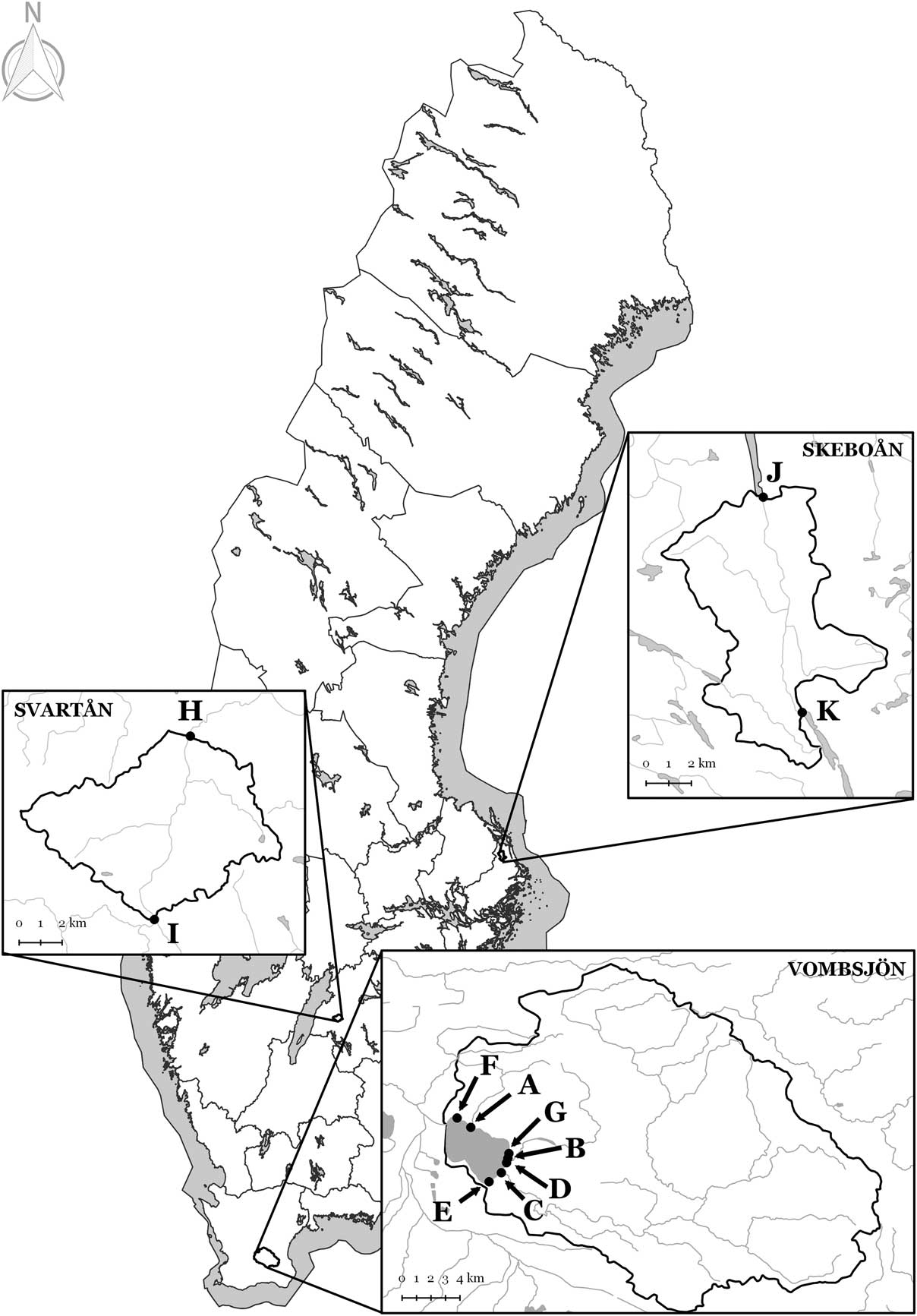
The study assesses two main aspects: (i) microbial contamination by manure from fertilisation or grazing, modelled by a hydrological model and a hydrodynamic model, and (ii) microbial contamination from human wastewater, modelled by using both models in a backward process (from end-point to source). The hydrological model, HYdrological Predictions for the Environment (HYPE), was used to simulate the pathogen dynamics in the rivers Skeboån and Svartån, as well as the tributaries to Lake Vombsjön: Björkaån, Torpsbäcken and Borstbäcken. The pathogen dynamics in Lake Vombsjön were simulated by the hydrodynamic model MIKE 3 FM, using the HYPE results for the tributaries as input. The geographical points for estimation of pathogen concentrations are shown in Figure 1.
Study areas for hydrological and hydrodynamic modelling. The outlined areas indicate catchment areas with simulated pathogen application on arable land or pastureland. For Lake Vombsjön, A to C indicate the inflow from the tributaries where outputs from the hydrological model also serve as input to the hydrodynamic model. D and E indicate the fictitious drinking water for grazing cattle (i.e. outputs from the hydrodynamic model). F and G indicate the fictitious release points of human wastewater. For Svartån, H indicates the location of the downstream fictitious drinking water point for grazing cattle and I indicates the fictitious release point of human wastewater. In Skeboån, J indicates the location of the downstream fictitious drinking water point for grazing cattle and K indicates the fictitious release point of human wastewater.

Pathogens
The three faecal pathogens Salmonella spp. (salmonella), verotoxin-producing Escherichia coli O157:H7 (VTEC) and Cryptosporidium parvum (C. parvum) were chosen as model organisms. They can all be shed in faeces from infected people and cattle and spread via water.
Salmonella bacteria represent one of the major global causes of human diarrhoeal disease (WHO, 2018). There are more than 2500 serotypes of the main subspecies Salmonella enterica subsp. enterica. People and animals are usually infected via consumption of contaminated food/feed or water. Infected individuals are often asymptomatic, but clinical infection with enteric as well as systemic symptoms are seen in both animals and humans. Owing to a long-standing national control programme in livestock, including mandatory notification and on-farm eradication of all detected cases, the prevalence of salmonella in Swedish animals is very low (Lahti et al., Reference Lahti, Ivarsson, Ågren, Thelander, Sjöland, Eriksson, Aspan, Szanto, Löfdahl, Plym Forshell and Wahlström2010; Ågren et al., Reference Ågren, Sternberg Lewerin, Wahlström, Emanuelson and Frössling2016). As a result of this, the level of environmental contamination by salmonella from animals is also low.
VTEC may cause serious enteric disease in humans, but infected cattle are asymptomatic carriers of the bacteria (Karmali et al., Reference Karmali, Gannon and Sargeant2010). People are mainly infected via contaminated food of animal origin, but outbreaks linked to vegetables contaminated by water are also reported. Outbreaks linked to cattle have occurred in Sweden, most cases occur from July to September (SVA, 2017). In Sweden, detection of infected animals is notifiable if linked to human cases, or if VTEC of clade 8 is identified (SVA, 2017).
This study also comprises the zoonotic cryptosporidium C. parvum, while species that are specific for human infections are not included. C. parvum causes enteric infection in people and young calves (<1 month). Young calves may shed large amounts of the parasites in their faeces, while older, subclinically infected animals shed negligible concentrations (Constable et al., Reference Constable, Hinchcliff, Done and Grünberg2017). C. parvum is endemic in Swedish cattle herds, at varying prevalence in different regions and different production systems (Silverlås et al., Reference Silverlås, Emanuelson, de Verdier and Björkman2009; Björkman et al., Reference Björkman, Lindstrom, Oweson, Ahola, Troell and Axen2015). In infected herds, almost all young calves become infected. Although cryptosporidiosis in humans is notifiable, the proportion of human cases caused by C. parvum is unknown, as identification to species level is rarely performed.
Study areas
The fictitious pastures for estimation of risks to grazing cattle were located adjacent to Lake Vombsjön, the rivers Skeboån and Svartån in Sweden. The lake was chosen based on location (agricultural area and surrounded by arable land and pastureland) and the fact that it was also subject to other studies in collaborating projects. Skeboån was also included in some collaborating projects, and Svartån had previously been implicated in salmonella outbreaks in cattle. The water sources and water catchment areas are shown in Figure 1. This figure also shows the fictitious points for wastewater release and cattle exposure on fictitious pastures.
Model inputs
Animal sources
Contamination from infected animals was simulated in two pathways: application of manure on arable land (fertilisation scenario) or manure from grazing animals on pasture (grazing scenario), as described in Sokolova et al. (Reference Sokolova, Lindström, Pers, Strömqvist, Sternberg Lewerin, Wahlström and Sörén2018). In short, the amounts of the pathogens salmonella, VTEC and C. parvum on arable land and pastures were estimated based on calculations of theoretical pathogen concentration in the faeces from infected animals, herd prevalence and within-herd prevalence (see Supplementary material S1). As detailed data could not be obtained, the concentrations in faeces were estimated by expert judgement based on published data. The estimated pathogen numbers were set to a worst-case scenario with two levels (‘medium’ and ‘high’), assuming endemic infection with high between-herd and within-herd prevalence (Sokolova et al., Reference Sokolova, Lindström, Pers, Strömqvist, Sternberg Lewerin, Wahlström and Sörén2018, Supplementary material S1).
In the fertilisation scenario, half of the yearly allowed manure load was assumed to be applied on all arable land in the catchment areas on 8 May 2012, before an event with high observed rainfall on 10 May 2012. This should be considered as a worst-case scenario. It was assumed that 90% of the manure originated from cattle, no reduction in pathogen content occurred during manure storage and before the rainfall 95% of the manure was ploughed into the soil, with 5% remaining on the soil surface.
In the grazing scenario, contaminated manure from the maximum number of cattle allowed (7 per hectare) was applied on all pastureland in the catchment areas during a 14-day period beginning on 10 June 2012, followed by an event with high observed rainfall on 24 June 2012. It was assumed that all pastureland in the area was grazed by cattle, 50% from dairy herds and 50% from beef herds, and that the number of beef calves below 2 months of age was 0.5 per hectare on 50% of the area (beef calves are the only calves that graze on pasture in Sweden). Again, this maximum load is a worst-case scenario.
Human sources
Contamination from human wastewater discharge was simulated by backwards modelling, estimating the number of pathogens required to be released from a fictitious wastewater discharge (see Figure 1) to reach a concentration high enough to cause infection in cattle drinking water at the points on the fictitious pastures (Figure 1). A set of simulations with fictitious release of wastewater were performed to assess the effect of hydro-meteorological conditions on the concentration of pathogens. For the lake, the simulations were performed for the conditions of different wind directions over the lake. For the rivers, the simulations were performed for the conditions of different stream flow magnitudes of the receiving river.
To put the results of the backwards modelling into perspective, reported data were used to calculate the potential pathogen concentrations in untreated wastewater from a fictitious Swedish wastewater treatment plant. For salmonella and VTEC, these calculations assumed 25 000 people living in the households connected to the wastewater treatment plant and used national incidence data, reported shedding durations and concentrations (Schönning et al., Reference Schönning, Westrell, Stenström, Arnbjerg-Nielsen, Hasling, Høibye and Carlsen2007; Sundström, Reference Sundström2010; SVA, 2017). For C. parvum, human incidence data could not be estimated (as the causative agent for human cryptosporidiosis is not reported on species level), but published data on concentrations in untreated wastewater were available and therefore used (Ottoson et al., Reference Ottoson, Hansen, Westrell, Johansen, Norder and Stenström2006; Public Health Agency, 2011). It was assumed that pathogen release occurred due to a single 24-h overflow in the wastewater treatment plant. Details are available as Supplementary material S1.
Water quality modelling
The fate and transport of pathogens within the study areas were simulated using process-based deterministic water quality modelling. The processes in the catchments of the studied rivers Skeboån and Svartån and of the tributaries of Lake Vombsjön were simulated using the hydrological model HYPE, while the circulation within Lake Vombsjön was simulated using the hydrodynamic model MIKE 3 FM. The hydrological and hydrodynamic models were validated by comparing the modelling results with observed discharge and water level data, respectively. Details are available in Sokolova et al. (Reference Sokolova, Lindström, Pers, Strömqvist, Sternberg Lewerin, Wahlström and Sörén2018) and as Supplementary material S2. HYPE was chosen because it is already set up to simulate high-resolution fluxes of water, nitrogen and phosphorus for the whole of Sweden, and it considers the hydrological response of several different land uses and soil types. The MIKE 3 FM model was chosen because it has been previously successfully applied to describe hydrodynamic conditions and contaminant fate and transport in lakes (Sokolova et al., Reference Sokolova, Pettersson, Bergstedt and Hermansson2013).
Hydrological model
The HYPE (Lindström et al., Reference Lindström, Pers, Rosberg, Strömqvist and Arheimer2010; http://hypecode.smhi.se/) model used simulates water and substances in soils, rivers and lakes. In addition to pure hydrological studies, the model has mainly been used for assessments of nutrients in surface water (Strömqvist et al., Reference Strömqvist, Arheimer, Dahné, Donnelly and Lindström2012; Yin et al., Reference Yin, Jiang, Pers, Yang, Liu, Yuan, Yao, He, Luo and Zheng2016). The use of HYPE for simulating the fate of pathogens in the environment has been described by Sokolova et al. (Reference Sokolova, Lindström, Pers, Strömqvist, Sternberg Lewerin, Wahlström and Sörén2018).
Land-based sources of pathogens in the model are either livestock manure applied to the land or manure from grazing animals. Pathogens are released from the source when exposed to rainfall and snowmelt. They may either infiltrate into the top soil or enter the stream network directly via surface runoff depending on water flow pathways. Pathogens infiltrating into the soil may, to a various degree, sorb to soil particles. The number of pathogens adsorbing or desorbing is driven by the difference between the concentration in soil water and an equilibrium concentration. Pathogens in the soil water may reach the stream via soil drainage. Pathogens discharged into the stream are routed with the water through the model’s network of streams and lakes. Exponential decay of pathogens is simulated in all model compartments, that is in the source, soil (both adsorbed and in the soil solute), lakes and rivers. Half-lives in the order of days or weeks are used for the pathogens simulated in this study. In reality, decay will be the sum of microbial die-off and growth, and depends on, for example, temperature and nutrient availability. Pathogens from point sources may be added to the surface water system. Input from point sources can be either constant during the simulation period or vary in time. A detailed description is found in Sokolova et al. (Reference Sokolova, Lindström, Pers, Strömqvist, Sternberg Lewerin, Wahlström and Sörén2018).
Hydrodynamic modelling
To simulate the water flows in the lake, the three-dimensional time-dependent hydrodynamic model MIKE 3 FM (MIKE Powered by DHI) was used. The model consists of continuity, momentum, temperature, salinity and density equations, and is closed using a turbulent closure scheme. The application of this model to Lake Vombsjön has been described by Sokolova et al. (Reference Sokolova, Lindström, Pers, Strömqvist, Sternberg Lewerin, Wahlström and Sörén2018). The model was set up to account for the hydrometeorological conditions (e.g. wind and precipitation on the lake surface), and to simulate the heat exchange between the atmosphere and the lake. The water density was formulated as a function of temperature. In order to simulate the pathogen fate and transport in Lake Vombsjön, the microbial water quality model ECO Lab was coupled to the hydrodynamic model of the lake. ECO Lab used flow fields from the hydrodynamic model to calculate the pathogen concentrations in the lake. The pathogen decay in the lake was described in the same way as in the HYPE model. Sedimentation of C. parvum oocysts in the lake was taken into account. It was conservatively assumed that the oocysts released into the lake were not attached to particles, thus the sedimentation velocity was specified as 0.03 m/day, which is the value suggested for free oocysts (Medema et al., Reference Medema, Schets, Teunis and Havelaar1998). It was assumed that resuspension does not occur.
Model outputs
The points where pathogen concentrations were estimated are shown in Figure 1. The models give a time series of pathogen concentration at these points, and the peak concentrations (maximum) were used as outputs. Assuming fictitious pastures with grazing cattle at these points, the estimated pathogen concentrations were compared to the estimated concentrations needed for infection of grazing cattle. The latter estimates were calculated based on reported infectious doses for salmonella (Aceto et al., Reference Aceto, Miller and Smith2011), VTEC (Cray and Moon, Reference Cray and Moon1995; Besser et al., Reference Besser, Richards, Rice and Hancock2002) and C. parvum (Zambriski et al., Reference Zambriski, Nydam, Wilcox, Bowman, Mohammed and Liotta2013) and assuming a daily consumption of 50 l of water for adult animals and 10 l for calves. Based on these calculations (for details see Supplementary material S1), the estimated pathogen concentrations required for infection of cattle were: 200 salmonella bacteria per litre for both adult cattle and calves; 200 000 and 30 VTEC bacteria per litre for adult cattle and calves, respectively; and 0.6 C. parvum oocysts per litre for calves.
Results
Animal sources
The maximum pathogen concentrations in the rivers (Skeboån and Svartån) and the tributaries to Lake Vombsjön (Björkaån, Torpsbäcken and Borstbäcken), as simulated by the HYPE model for the different scenarios, are shown in Table 1. For salmonella, none of the simulated concentrations exceeded the levels needed to infect grazing cattle. For VTEC, all the simulated concentrations in the tributaries to Lake Vombsjön exceeded the concentration needed to infect calves. For C. parvum, almost all the simulated concentrations, in the tributaries as well as in the rivers, exceeded the concentration needed to infect calves.
Simulated maximum concentrations (pathogen number/litre) in the tributaries to Lake Vombsjön (Björkaån, Torpsbäcken, Borstbäcken) and the rivers Skeboån and Svartån, based on hydrological modelling of worst-case scenarios of pathogen application to arable land and pastureland. Concentrations that could potentially exceed the infectious dose for grazing calves (up to 2 months old) are in bold. Letters A-J indicate the geographic location shown in Figure 1.

a Scenarios include salmonella, VTEC and C. parvum applied by fertilisation (fert) of arable land with contaminated manure or infected cattle grazing pastureland in the catchment areas. Medium and high refer to the input load in two worst-case scenarios.
b VTEC = verotoxin-producing Escherichia coli O157:H7.
The maximum pathogen concentrations at the two fictitious points for grazing animals by Lake Vombsjön, as simulated by the hydrodynamic model, are shown in Table 2. For C. parvum, the simulated concentration caused by contaminated water from the tributary Björkaån exceeded the concentration needed for infection of calves. For the other pathogens, the simulated concentrations did not exceed the estimated concentrations needed for infection of grazing cattle.
Simulated maximum concentrations (pathogen number/litre) at each estimation point in Lake Vombsjön (see Figure 1), based on hydrodynamic modelling of contamination from the tributaries (Björkaån, Torpsbäcken, Borstbäcken). Concentrations that could potentially exceed the infectious dose for grazing calves (up to 2 months old) are in bold.

a Scenarios include salmonella, VTEC and C. parvum applied by fertilisation (fert) of arable land with contaminated manure or infected cattle grazing pastureland in the catchment areas. Medium and high refer to the input load in two worst-case scenarios.
b VTEC = verotoxin-producing Escherichia coli O157:H7.
Human sources
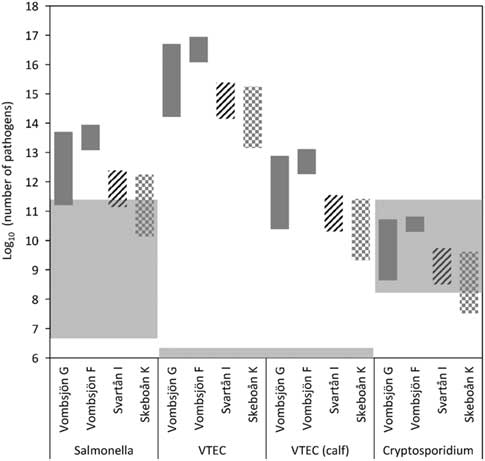
The results from the backwards modelling for Lake Vombsjön and backwards calculation of hydrological modelling outputs in the rivers Skeboån and Svartån are shown in Figure 2. The estimated pathogen loads that would have been needed at the release points to achieve infectious doses for cattle at the grazing points (see Figure 1) were mostly above the potential loads of salmonella and VTEC calculated to be present in a 24-h overflow from a medium size Swedish wastewater treatment plant (25 000 people), indicating that such an overflow is unlikely to cause infection with salmonella or VTEC in cattle grazing at the fictitious grazing points. In contrast, the required pathogen loads of C. parvum at the release points were below the potential loads of C. parvum in a 24-h overflow, indicating that such an overflow could potentially cause infection in calves grazing at the fictitious grazing points.
Number of pathogens that could, if released at each simulated point (F and G in Lake Vombsjön, I in river Svartån and K in river Skeboån) result in infection of grazing animals at point D in Vombsjön (full bars), point H in Svartån (striped bar) and point J in Skeboån (chequered bar). The range in the number of pathogens was obtained by studying the fictitious release of wastewater in a set of simulations to assess the effect of hydro-meteorological conditions. For the lake, the simulations were performed for the conditions of different wind directions over the lake. For the rivers, the simulations were performed for the conditions of different stream flow magnitudes of the receiving river. For geographic locations, see Figure 1. Pale grey squares show estimated pathogen loads that could be released during one 24-h overflow of untreated wastewater from a medium size Swedish wastewater treatment plant (serving 25 000 people). VTEC = verotoxin-producing Escherichia coli O157:H7

Discussion
Exposure of grazing animals to pathogens in their drinking water sources poses a risk to animal health. If infected, grazing animals may represent a source for further contamination and spread of pathogens. Hence, water quality modelling should not be restricted to human drinking water sources. The backwards modelling approach used in this study is novel and provides insight into the potential risks to animals from wastewater discharges. The wastewater discharge in this study, a single 24-h overflow of untreated wastewater, is not entirely realistic. This discharge was chosen as an initial worst-case scenario that could occur in extreme cases, but not to be expected on a regular basis. If the discharge period is reduced to, for example, 2.4 h, then the load is reduced by 1 Log10. For our scenario, this would mean that the salmonella concentration would be below what would be needed to infect grazing animals, while the risk of C. parvum infection in susceptible age categories would remain high even with a shorter discharge period. For a discharge of treated wastewater, the load is reduced according to the efficacy of wastewater treatment. According to a review by McMinn et al. (Reference McMinn, Ashbolt and Korajkic2017), the median reduction for bacteria is about 2.5 Log10, while in a study by Ottoson et al. (Reference Ottoson, Hansen, Westrell, Johansen, Norder and Stenström2006), the mean cyst reduction was 2.6 Log10. On the other hand, there are many reports of wastewater effluents containing large numbers of, for example, salmonella (El Boulani et al., Reference El Boulani, Mimouni, Mannas, Hamadi and Chaouqy2017).
Most estimates in this study assume a worst-case scenario. It is unlikely that such high pathogen loads would be obtained in the Swedish context, as the overall prevalence of salmonella and VTEC in livestock is far below the assumed herd prevalence in the scenarios. It is, however, not certain that prevalence will stay at such low levels in all regions, unless re-circulation via water is prevented and animal disease control programmes remain in place. Controlling zoonotic infections at herd level is still the most sustainable strategy for prevention of environmental contamination and subsequent human exposure.
In all modelling, theoretical outputs rely on valid and high-resolution input data. In this study, a lot of assumptions had to be made due to lack of data. Estimates based on expert opinion are expected to be biased based on the choice of experts (area of expertise, experience, culture and geography) as well as phenomena such as anchoring (deviation towards the most likely value). Estimates based on literature data may also be biased due to geographic location of the study, study design, etc., and therefore not fully applicable. In addition, the shedding and presence of faecal pathogens would be clustered in space and time (on animal, herd and regional level), and not, as assumed in the scenarios, evenly distributed in all manure applied onto the land. Further scenarios to account for this would have made the results more complicated and less useful, but this limits the direct use of the results as regards the output figures per se. In order to run the models, points for pathogen release and uptake by grazing cattle had to be specified. This affects the ability to draw general conclusions, as the results pertain to these specific locations. Moreover, no model can predict a real-life outcome in detail and this should be kept in mind when using outputs for risk assessment. The main value of the modelling approach lies in the possibilities to adjust inputs and assess the effect of various potential interventions.
No classic validation of the HYPE model’s ability to simulate pathogens has been carried out due to lack of data. The plausibility of the model is, however, corroborated by several studies. The flow model is extensively validated both in terms of river flow and also internal variables, such as ground water levels, evapotranspiration and snow depth. The partitioning of runoff into different flow pathway is very important for the runoff of pathogens from land to watercourses. Supporting evidence that the relative importance of different soil flow pathways can be accurately simulated with the HYPE model is given by the model’s ability to simulate nitrogen, phosphorus and oxygen-18 (18O). In addition, the simulation results and sensitivity analysis in Sokolova et al. (Reference Sokolova, Lindström, Pers, Strömqvist, Sternberg Lewerin, Wahlström and Sörén2018) also indicate that the model behaves in an expected way.
The potential for infection of grazing animals with faecal pathogens has implications for keeping animals on pastures with access to natural water sources. Fences to keep the animals away from water that may be contaminated by, for example, wastewater discharges could be a costly way to manage such risks. As demonstrated in this study, the potential risk needs to be assessed for each location. Backwards modelling could be used for estimation of the risk and how this can be changed by introducing various interventions. Such interventions may include adjusting the time periods when cattle are allowed to graze and/or when manure is applied to different patches of arable land based on weather forecasts, as well as reducing the frequency and magnitude of wastewater discharges. The cost-efficiency of different strategies to reduce the risks will depend on local circumstances.
Although the figures in the results of this study should not be taken ad notam, it is clear that if grazing animals are exposed to faecal pathogens in natural water sources, the infectious dose for most pathogens is more easily reached for calves than for adult animals. As young calves are also the main shedders of C. parvum in infected herds, it seems like a good general advice to avoid putting young calves on pastures adjacent to such water sources.
Acknowledgements
The study was funded by the Swedish Civil Contingencies Agency and the Swedish Water and Wastewater Association.
Declaration of interest
The authors declare no competing interest.
Ethics statement
No ethical approval was necessary as the study contains only theoretical and/or publicly available data.
Software and data repository resources
Information on the hydrological model set-up and flow data are available at https://www.smhi.se/klimatdata/hydrologi/vattenwebb. No other data are deposited in an official repository.
Supplementary materials
To view supplementary material for this article, please visit https://doi.org/10.1017/S1751731118003415