INTRODUCTION
Seedlings growing in the understorey of tropical forests may face a scarcity of resources: limited irradiance, nutrient-poor soils, and short, but pronounced, periods of drought (Richards Reference RICHARDS1996). Variation in irradiance is thought to be the primary driver of seedling dynamics, given the prominence of tree-fall gaps in tropical forests and the gradations in irradiance among gaps of different sizes (Denslow Reference DENSLOW1987), within single gaps, and as the canopy closes and shaded understorey conditions are re-established (Wright et al. Reference WRIGHT, MULLER-LANDAU, CONDIT and HUBBELL2003). A well-established trade-off between the ability of seedlings to survive in shade versus growing rapidly in higher light provides a mechanism that could facilitate species coexistence along forest light gradients (Baraloto et al. Reference BARALOTO, GOLDBERG and BONAL2005, Dalling & Hubbell Reference DALLING and HUBBELL2002, Davies Reference DAVIES2001, Kitajima Reference KITAJIMA2002). Perhaps because spatial variation in drought and soil fertility is less obvious than variation in irradiance, their roles in seedling growth have not been sufficiently studied, especially in the shaded understorey (reviewed in Burslem Reference BURSLEM and Swaine1996).
The shallow root system of seedlings makes them particularly susceptible to drought and nutrient-poor soils (Coomes & Grubb Reference COOMES and GRUBB2000). Most tropical forests, even aseasonal equatorial forests experience one or two droughts lasting > 2 wk per year (Burslem et al. Reference BURSLEM, GRUBB and TURNER1996, Walsh & Newbery Reference WALSH and NEWBERY1999, Windsor Reference WINDSOR1990). Seedlings growing in deep shade might be protected from factors that aggravate drought, such as warmer temperatures and increased vapour pressure deficit (Sack & Grubb Reference SACK and GRUBB2002). Nonetheless, drought increases the likelihood of seedling mortality, in particular, for species associated with wetter than drier habitats (Engelbrecht et al. Reference ENGELBRECHT, KURSAR and TYREE2005). Essentially all seedlings, including light-demanding and extremely shade-tolerant species, show positive growth responses to added nutrients when growing under ample irradiance and well-watered conditions (reviewed by Lawrence Reference LAWRENCE2003). It is a common belief, however, that seedlings growing slowly in deep shade will not utilize nutrients added to the soil; albeit, most of the evidence for this comes from plants grown individually in pots, where competition is absent and roots might be pot-bound (reviewed in Baker et al. Reference BAKER, SWAINE and BURSLEM2003). Shade-tolerant plant species that are able to maintain positive growth rates in the shaded understorey might benefit from increased soil nutrient availability to improve their ability to compete for light capture (Fahey et al. Reference FAHEY, BATTLES and WILSON1998, Meziane & Shipley Reference MEZIANE and SHIPLEY1999).
Here we examine the effects of water and nutrient augmentation on growth rates of three plant species in the understorey of an old-growth tropical moist forest in Panama. We used a shade-tolerant canopy tree (Tetragastris panamensis), a shade-tolerant understorey tree (Faramea occidentalis), and a shade-tolerant liana (Doliocarpus olivaceus) (Gilbert et al. Reference GILBERT, WRIGHT, MULLER-LANDAU, KITAJIMA and HERNANDÉZ2006). The three species were common throughout the study (providing replication), but otherwise distinctive in order to examine responses for plants with different traits (i.e. liana, understorey versus canopy at maturity). We hypothesized that relative growth rates (RGR) of seedling height and leaf number for the three species would respond differently to seasonal rainfall. We also expected to find that different combinations of water and nutrient augmentation would affect growth rates of seedling height and leaf number differently per species. Our approach was to experimentally irrigate and add nutrients to wild seedlings growing in the field. The results showed that soil resources influenced growth rates of the three distinctive plant species differently, suggesting that soil resources do contribute to niche differentiation.
METHODS
Study site and species
The study site was on Barro Colorado Island (BCI, 9°9′N, 79°51′W), Republic of Panama. BCI has a tropical monsoon climate in the Köppen system of climatic classification and supports tropical moist forest in the Holdridge life-zone system (Holdridge & Budowski Reference HOLDRIDGE and BUDOWSKI1956). Soil in the study site is a well-drained Alfisol (Yavitt & Wright Reference YAVITT and WRIGHT2002) derived from volcaniclastic sandstone (Johnsson & Stallard Reference JOHNSSON and STALLARD1989). The mineral soil is rich in calcium (Ca), magnesium (Mg) and sulphur (S), but poor in potassium (K) and phosphorus (P). The soil consists of 40% clay, 35% silt and 25% sand between 0- and 15-cm depth (Yavitt & Wright Reference YAVITT and WRIGHT2002). The mean monthly maximum temperatures at 1 m in the forest understorey vary by just 1 °C, from 27.4 °C in November to 28.8 °C in April (Windsor Reference WINDSOR1990). Annual precipitation averages 2614 mm. There are eight wet months with mean monthly rainfall between 240 and 423 mm and four dry months with mean monthly rainfall of 65, 31, 29 and 90 mm in January, February, March and April, respectively (Windsor Reference WINDSOR1990). As the dry season progresses, the gravimetric soil water content drops from 42% to 28% (Kursar et al. Reference KURSAR, WRIGHT and RADULOVICH1995) and soil water potentials can drop to < 2.0 MPa (Becker et al. Reference BECKER, RABENOLD, IDOL and SMITH1988).
Doliocarpus olivaceus Sprague & L. O. Wms. ex Standl. is a stem-twining liana with a woody, erect stem and relatively small leaves (10 cm2). It reaches the canopy in old-growth forests. As with most lianas, it is more common in the drier forests on the Pacific side of Panama (Condit et al. Reference CONDIT, AGUILAR, HERNANDEZ, PEREZ, LAO, ANGEHR, HUBBELL and FOSTER2004). Flowers occur in May and June, and fruits mature during the wet season, especially in September and October. Faramea occidentalis (L.) A. Rich. is an understorey tree. Although very common on BCI, it is more common in the drier Pacific-side forest in Panama (Condit et al. Reference CONDIT, AGUILAR, HERNANDEZ, PEREZ, LAO, ANGEHR, HUBBELL and FOSTER2004). Flowers occur from March to July, and fruits mature toward the end of the wet season. Tetragastris panamensis (Engler) O. Kuntze is a dioecious tree, very common in the moist forest of BCI (Condit et al. Reference CONDIT, AGUILAR, HERNANDEZ, PEREZ, LAO, ANGEHR, HUBBELL and FOSTER2004). Flowers occur in June and July, and the fruits mature during the following dry season. The seedlings of all three species are shade tolerant (Gilbert et al. Reference GILBERT, WRIGHT, MULLER-LANDAU, KITAJIMA and HERNANDÉZ2006). Hereafter we refer to the plant species by their generic name.
Irrigation experiment
The dry-season irrigation experiment took place during five consecutive dry seasons. Water drawn from Gatun Lake was delivered by sprinklers mounted 1.8 m above the ground, arranged in a hexagonal array at 15-m intervals, to two 2.25-ha treatment plots. The irrigation schedule maintained soil water potentials (20 cm depth) above −0.03 MPa compared to levels as low as −1.5 MPa in the control plots during the dry season. On average, irrigation deposited 30 mm wk−1 of water in each irrigated plot. Although solute concentrations in Gatun Lake are low, irrigation resulted in weekly nutrient augmentation of 45 mg Ca m−2, 7.5 mg Mg m−2, 15 mg K m−2, 45 mg N m−2 and 1.5 mg P m−2. The measurements described in this paper took place in the fifth year of the irrigation. The irrigation treatment is described in greater detail elsewhere (Wright Reference WRIGHT1991, Wright & Cornejo Reference WRIGHT and CORNEJO1990).
Field measurements
All seedlings were wildings occurring in 128 1-m2 quadrats located randomly in square 225-m2 subplots of each 2.25-ha plot. There were 32 quadrats in each of the four 2.25-ha plots; half received fertilizer, and the other half served as unfertilized controls. We used 83 Doliocarpus seedlings, 124 Faramea seedlings, and 129 Tetragastris seedlings.
We measured seedling: (1) heights, (2) number of leaves, and (3) for Tetragastris the number of leaflets in January, April and July 1991. We divided the study period into a 4-mo dry period from January to April and a 4-mo wet period from April to July. Individuals differed in size at the beginning of the study, so we estimated relative growth rates in height (RGRh) as (lnH1 – lnH0)/(t1 –t0), where H0 and H1 were initial and final heights (cm) and t1 – t0 was the time period (d). We used a similar equation to estimate relative growth rate of leaf number (RGRln).
Nutrient augmentation
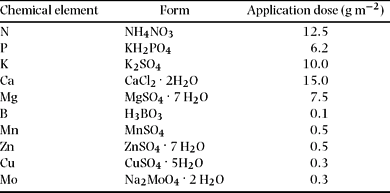
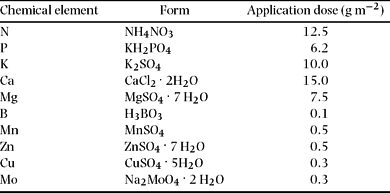
The dosage for fertilizers (Table 1) equalled the annual input from fine litter (leaves, flowers, fruits, wood < 2 cm in diameter, and ‘dust’) determined for the study site by Yavitt et al. (Reference YAVITT, WRIGHT and WIEDER2004). Chemicals were dissolved in 20 litres of water drawn from Gatun Lake and applied to each 1-m2 quadrat once in January 1991. Control 1-m2 quadrats received 20 litres of water from Gatun Lake at the same time.
Chemical elements, form and application dose in the nutrient augmentation treatment.
Light environment
Light conditions were characterized with high-contrast hemispherical photographs taken with a 2.8 f 8 mm fisheye lens placed 1 m above the ground over each seedling plot in March and again in July. The images were analysed with a system described in Becker et al. (Reference BECKER, ERHART and SMITH1989), for which canopy openness was the proportion of the canopy open to the sky. Values range from 0 for a completely closed canopy to 1.0 for an open sky.
Statistical analyses
We used a repeated-measures analysis of covariance (ANCOVA) to evaluate the response variable RGRh and RGRln. The main effects or grouping factors were species, irrigation and fertilization, the repeated-measures factor was season, and the covariate was canopy openness. We tested the homogeneity of slopes assumption of ANCOVA via tests of the canopy openness by species, irrigation, and fertilization interactions using type III sum of squares. All variables were log10-transformed prior to analysis to reduce heteroscedasticity and improve normality. Analyses were performed using Systat software.
RESULTS
Leaf fall from the canopy is highly seasonal on BCI and peaks early in the dry season. As a result, canopy openness, 1 m above the ground level, was greater during the dry season (0.58% openness) than during the wet season (0.34% openness) (tested using paired t-test; t = −5.00, df = 109, P < 0.001). Neither irrigation nor nutrient augmentation affected the degree of canopy openness.
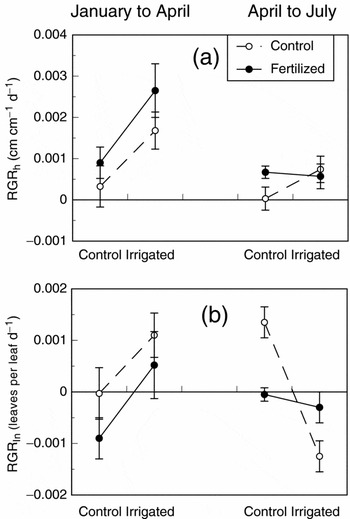
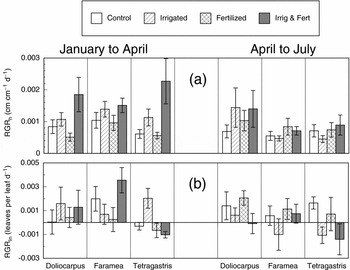
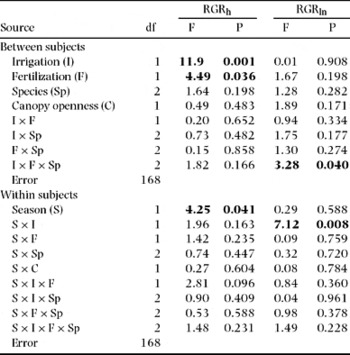
Dry-season irrigation and nutrient augmentation increased seedling height growth (RGRh) when evaluated across the three species (Figure 1, Table 2). In control plots, the smallest values for RGRh occurred during the wet season, and RGRh was several times greater in the dry season (Figure 2). Nutrient augmentation increased RGRh during the wet season to values comparable with those during the dry season. The effect of dry-season irrigation on RGRh carried over with larger values into the wet season, especially for Doliocarpus and Tetragastris. Overall, each of the species showed the largest RGRh during the dry season in the irrigated and nutrient addition treatments. Canopy openness did not have a significant effect on RGRh (P > 0.10).
The effects of season and the addition of water and nutrients on RGR of seedling height (a) and number of leaves (b). Seasons were the core dry season (January to April) and early wet season (April to July). The water manipulation had control and dry season irrigated treatments (along the abscissa). The nutrient manipulation had control (open circles and dashed lines) and nutrient augmentation (closed circles and solid line) treatments. Values are mean ± 1 SE.

The effects of season and the addition of water and nutrients on RGR of seedling height (a) and number of leaves (b) for Doliocarpus olivaceus, Faramea occidental and Tetragastris panamensis. Seasons were the core dry season (January to April) and early wet season (April to July). Values are mean ± 1 SE.

Results of repeated-measures analysis of covariance for RGR of seedling height (RGRh) and number of leaves (RGRln) for three plant species. Bold indicates P < 0.05.

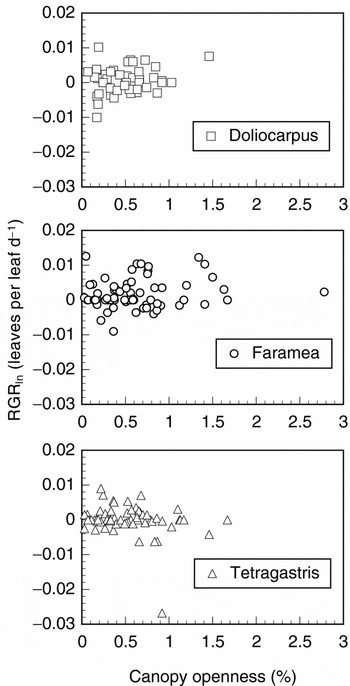
Seasons and treatments had very different effects on changes in plant leaf numbers (Figure 1, Table 2). In the control plots, for example, Doliocarpus and Tetragastris had net loss of leaves (negative RGRln) during the dry season, whereas Faramea had a positive RGRln during the same season (Figure 1, Figure 2). Dry-season irrigation prevented net leaf loss for Doliocarpus and Tetragastris. In contrast, dry-season irrigation had mixed effect on RGRln for Faramea; irrigation alone caused net leaf loss, but it did not when combined with nutrient augmentation. Dry-season irrigation had a negative effect on RGRln during the wet season, albeit, the negative effect was slightly reduced with nutrient addition. Nutrient augmentation during the wet season produced the largest RGRln for Doliocarpus. Neither canopy openness nor species had a significant effect on RGRln, although the canopy openness (during the dry season) × species interaction was significant (F2,163 = 3.38, P = 0.036), with a negative RGRln versus canopy openness for Tetragastris versus positive values for the other two species (Figure 3).
Relationship between canopy openness and relative growth rate for number of leaves for Doliocarpus olivaceus, Faramea occidental and Tetragastris panamensis.

DISCUSSION
Irradiance is regarded as the primary determinant of seedling growth rate in tropical forests. Indeed, Barberis & Tanner (Reference BARBERIS and TANNER2005) argued that seedling growth was ‘so limited by the very low light levels in the understorey that they were hardly limited by nutrient availability’. Several experimental studies have found that seedlings have a greater demand for soil resources when grown at high irradiance than at low irradiance (Ashton et al. Reference ASHTON, SINGHAKUMARA and GAMAGE2006, Cordero S. Reference CORDERO2000, Dalling & Tanner Reference DALLING and TANNER1995, Huante et al. Reference HUANTE, RINCON and CHAPIN1995, Lehto & Grace Reference LEHTO and GRACE1994, Peace & Grubb Reference PEACE and GRUBB1982, Thompson et al. Reference THOMPSON, KRIEDEMANN and CRAIG1992, Veenendaal et al. Reference VEENENDAAL, SWAINE, LECHA, WALSH, ABEBRESE and OWUSU-AFRIYIE1996). However, some plant species adapted to very low light levels might benefit from increased nutrient availability to increase their ability to compete for light (Fahey et al. 1998).
The three species that we studied showed greater height growth rates in the dry season than in the early portion of the wet season in control plots. Although the forest canopy is significantly more open during the dry season than wet season on BCI, suggesting that the seedlings responded to the increase in irradiance that accompanied the increase in canopy openness, the positive effects of dry-season irrigation and nutrient augmentation on height growth rate indicates that soil resources do constrain growth at this time of the year. Moreover, the additive effect of irrigation and nutrient augmentation on height growth rate for Doliocarpus and Tetragastris indicates demand for both water and nutrients. Barberis & Tanner (Reference BARBERIS and TANNER2005) concluded that water availability is more important than nutrients in the dry season in drier tropical forests, whereas nutrients are more important in the wet season and in forests on infertile soils. Our results indicate that this conclusion depends on plant species.
In a complementary study to ours, Bunker & Carson (Reference BUNKER and CARSON2005) found that dry-season irrigation increased seedling growth rates for 10 common species on BCI compared with unirrigated controls, but all of species had the same growth over a 1-y period, suggesting that unirrigated plants catch up by the end of the wet season. In contrast, we clearly observed carry-over effects of dry season irrigation on RGRh during the early portion of the wet season. In contrast, several years of dryseason irrigation changed soil structure, the water-holding capacity of the soil (Kursar et al. 1995), and soil nutrient retention capacity (Yavitt & Wright 2002). The soils on BCI shrink and develop visible cracks during the dry season, which undoubtedly disrupts root–soil contacts (Yavitt & Wright Reference YAVITT and WRIGHT2001). Since dry-season irrigation prevented soil drying and cracking, some plant species might grow better in the irrigated treatment because their roots have not been disturbed.
Hättenschwiler (2002) reported that a very large dose of NPK fertilizer had no effect on height growth for Doliocarpus, although fertilized individuals had more biomass than non-fertilized plants. We used a more chemically complete fertilizer at a much lower concentration than Hättenschwiler (2002) did, suggesting that either Doliocarpus height growth depends on elements other than NPK, or it grows better when nutrient concentrations increase moderately rather than grossly.
A similar positive effect of fertilizer on height growth rate in the forest understorey has been shown for plants in temperate forests (Beckage & Clark Reference BECKAGE and CLARK2003, Fahey et al. 1998). In particular, sugar maple (Acer saccharum) is a common shade-tolerant tree species in mesic northern temperate forests in North America, and it grows taller in soil-resource-rich sites in part because of greater soil N levels and water availability (Walters & Reich Reference WALTERS and REICH1997). Therefore, we conclude that drought and/or relatively infertile soils might slow the rate at which seedlings of certain shade-tolerant species grow taller even under the lowest irradiance conditions in the forest understorey.
Plants shed leaves based on trade-offs among physiology (C fixation rate over the life of the leaf), nutrient element concentration, construction and maintenance (respiration) costs and leaf structure (Kikuzawa Reference KIKUZAWA1991, Shipley et al. Reference SHIPLEY, LECHOWICZ, WRIGHT and REICH2006). Although leaf fall occurs predominantly in the dry season on BCI, drier soil is not necessarily the ultimate cue for leaf abscission (Wright 1991, Wright & Cornejo 1990). Our results showed that nutrient augmentation alone resulted in positive RGRln for Doliocarpus versus negative RGRln in the control treatment. Moreover, the effect of fertilizer on the number of leaves was equal to that caused by dry-season irrigation. In contrast, dry-season irrigation was much more effective than nutrient augmentation for maintaining leaves for Tetragastris, and nutrients along with irrigation decreased the response. Although we do not know the mechanism, empirical data do show a trade-off between leaf nutrient concentration (nitrogen in particular) and leaf longevity (Shipley et al. Reference SHIPLEY, LECHOWICZ, WRIGHT and REICH2006). We lack an explanation for Faramea in which irrigation or nutrient augmentation reduced RGRln during the dry season, but increased RGRln in the combined treatment.
Irrigation reduced RGRln for all three species in the wet season. This result contrasts the positive effect of irrigation on height growth rates, so apparently plants channelled carbon gain into height growth at the expense of leaves. Research on the way that water availability affects the partitioning of growth among shoots versus leaves (and roots) deals mostly with dry soils rather than wet soils (Poorter & Nagel Reference POORTER and NAGEL2000), so no mechanism is obvious. In contrast to our results, seedlings of Virola surinamensis did not show this height growth at the expense of leaf growth in irrigated plots during the wet season on BCI (Fisher et al. Reference FISHER, HOWE and WRIGHT1991). These different findings illustrate the different ways of partitioning the allocation of biomass for different plant species, or might reflect that the Virola measurements were made at the onset of the irrigation experiment, whereas our study was done after five years of irrigation when soil conditions had changed (Kursar et al. 1995). We speculate, however, that adequate soil resources favour height growth over leaf growth. Similarly, Ashton et al. (Reference ASHTON, SINGHAKUMARA and GAMAGE2006) found that two shade-tolerant plant species in an Asian tropical forest had greater height growth in soil with ever-moist conditions than periodic drought. Likewise they found that height growth coincided with less leaf area (Ashton et al. Reference ASHTON, SINGHAKUMARA and GAMAGE2006).
Although our study was limited to the shaded forest understorey, and we did not manipulate irradiance experimentally, natural variation in canopy openness during the dry season did affect leaf drop per species differentially (Figure 3). We do not offer explanations for why leaf drop by Tetragastris increased in response to canopy openness, but the results do emphasize the idiosyncratic responses among different plant species to subtle differences in canopy openness.
In summary, a key challenge in ecology is to understand and predict seedling establishment and growth (Swaine Reference SWAINE1996, Turner Reference TURNER1990), as seedlings represent the next generation of forest individuals. Most seedling studies utilize individuals grown in pots with simulated light, water and nutrient conditions. In this study, we took advantage of a large-scale, multi-year irrigation experiment in an old-growth forest on BCI. We also focused on shade-tolerant plant species adapted to life at very low light level, i.e. typical of the forest understorey. The positive and negative growth responses to water and nutrient augmentation in the dry season and in the wet season suggest several niche opportunities for these species (John et al. Reference JOHN, DALLING, HARMS, YAVITT, STALLARD, MIRABELLO, HUBBELL, VALENCIA, NAVARETTE, VALLEJO and FOSTER2007). Therefore, soil resources appear to play an important role in maintaining species coexistence lowland tropical forests.