INTRODUCTION
The bramble shark, Echinorhinus brucus (Bonnaterre, 1788), is a large, sluggish bottom shark sometimes ascending to shallow waters, but primarily a deep-water species, occurring on the continental and insular shelves and upper slopes, usually at depths from 18 to 900 m (Compagno, Reference Compagno1984), and also recorded at a depth of 1214 m in the Sea of Marmara (Kabasakal et al., Reference Kabasakal, Öz, Karhan, Çaylarbaşı and Tural2005).
Echinorhinus brucus is fairly common in the Atlantic, Indian and Pacific Oceans (Compagno, Reference Compagno1984). The species is known in western and central parts of the Mediterranean Sea (Tortonese, Reference Tortonese1956; McEachran & Branstetter, Reference McEachran, Branstetter, Whitehead, Bauchot, Hureau, Nielsen and Tortonese1984; Barrull et al., Reference Barrull, Mate and Bueno1999; Hemida & Capapé, Reference Hemida and Capapé2002; De Maddalena & Zuffa, Reference De Maddalena and Zuffa2003; Lipej et al., Reference Lipej, De Maddalena and Soldo2004; Serena, Reference Serena2005), but rare in the eastern part (Serena, Reference Serena2005; Golani et al., Reference Golani, Öztürk and Başusta2006). The first reports on the occurrence of the bramble shark in Turkish waters were from the first quarter of the 20th Century (Ninni, Reference Ninni1923; Deveciyan, Reference Deveciyan1926). Occurrence of E. brucus in the seas of Turkey has also been reported by Akşıray (Reference Akşıray1987).
In the present paper, three recent records of E. brucus from the Sea of Marmara are presented. Based on available data, current status of the species in the Sea of Marmara is discussed.
MATERIALS AND METHODS
The present study is part of a larger project (KANIT Project–Türk Sularında Yaşayan Köpekbalıklarının Tesbiti Projesi–Identifying the Sharks of Turkish Waters), which was initiated in 2000 by the Ichthyological Research Society (IRS). The first results of the E. brucus substudy have already been reported by Kabasakal (Reference Kabasakal2003) and Kabasakal et al. (Reference Kabasakal, Öz, Karhan, Çaylarbaşı and Tural2005).
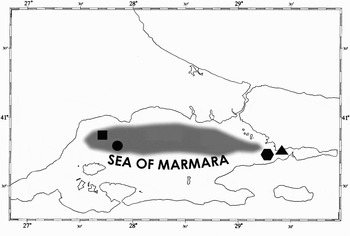
All of the three bramble sharks examined in the present study were captured by means of commercial fishing vessels operated in the Sea of Marmara (Figure 1). For each bramble shark, the following data were recorded: total length (TL), weight, sex, locality of capture, date of capture, depth of capture and type of fishing gear. Date and depth of capture, and type of fishing gear data were recorded from the fishing logs. Total length is the distance between the tip of the snout and the tip of the dorsal lobe of the caudal fin, where the caudal fin is placed in its natural position. During the present study, fishermen who landed the three bramble sharks were not permitted to eviscerate the specimens. Photographs of the examined specimens are kept in the archives of the IRS and available for inspection on request.
Map showing the localities of bramble shark, Echinorhinus brucus, captures in the Sea of Marmara. (•) denotes specimen reported by Kabasakal et al. (Reference Kabasakal, Öz, Karhan, Çaylarbaşı and Tural2005); (■) denotes present specimen No. 1; (▴) denotes present specimen No. 2; and ( ) denotes present specimen No. 3. Grey shaded area denotes locality of deep-sea trenches in the Sea of Marmara.

RESULTS AND DISCUSSION
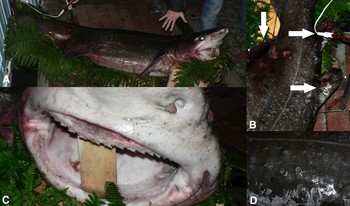
Fishing data of the examined specimens are presented in Table 1. The description of E. brucus from the Sea of Marmara is based on specimen No. 1 of the present study, as follows: body elongated and rather cylindrical, lateral line beginning at the level of the first gill opening and consisting of a marked furrow flanked on both sides by a cutaneous ridge (Figure 2A), head flattened above, ending with a broadly rounded snout, eyes are rather circular with a small spiracle behind them (Figure 2A), large nostrils with a long and acute nasal valve (Figure 2C), rather closer to mouth than to the tip of the snout, five pairs of relatively small gill slits, all located anteriorly to pectoral fin origin, first gill slits shorter than the following, no anal fin, dorsal fins located backward, first dorsal fin origin located over pelvic fins; first dorsal fin slightly larger than second (Figure 2B). Body colour is brownish on the dorsal to blackish on the ridges of the fins, with reddish violet shades, ventral side of the head pale to whitish. Dermal denticles are whitish. Body covered by numerous, sparse and irregularly distributed dermal denticles (Figure 2D), large, some fused into plates with one or two, even three cusps with 22 cm as diameter of the largest plate, margins not stellate but with slight furrows. Teeth in both jaws exhibiting a pointed medial cusp strongly oblique towards the commissure of the mouth (Figure 2C), medial cusp more developed in the medial series. An inner ridge of two to three smaller cusplets present on the medial teeth; one or two commissural cusplets may present on the outer ridge, 25 teeth in the upper jaw and 23 in the lower jaw.
Different views of bramble shark, Echinorhinus brucus, present specimen No. 1. (A) overall view of specimen; (B) dorsal fins (horizontal arrows) and the rear part of pelvic fins (vertical arrow); (C) ventral view of head; (D) buckler plates.

Fishing data of the examined bramble sharks, Echinorhinus brucus. TL, total length; W, weight.

The description of the specimen No. 1 agrees with Tortonese (Reference Tortonese1956), Bini (Reference Bini1967), Compagno (Reference Compagno1984), McEachran & Branstetter (Reference McEachran, Branstetter, Whitehead, Bauchot, Hureau, Nielsen and Tortonese1984), Bauchot (Reference Bauchot, Fischer, Bauchot and Schneider1987) and Lipej et al. (Reference Lipej, De Maddalena and Soldo2004), and confirms the identification of the species.
Lipej et al. (Reference Lipej, De Maddalena and Soldo2004) noted that E. brucus reaches 310 cm TL and sexual maturity occurs between 150 and 175 cm for males, and between 215 and 230 cm for females. The size of the specimen No. 1, 170 cm TL, suggests that it was a juvenile. Size of the examined females Nos 2 and 3, 225 and 250 cm TL respectively, coincide with the size-range of sexual maturity of E. brucus reported by Lipej et al. (Reference Lipej, De Maddalena and Soldo2004). Hemida & Capapé (Reference Hemida and Capapé2002) reported on an adult female of 254 cm TL, caught off the Algerian coast. Based on the capture of a gravid female bramble shark off Elba Island around 1985, De Maddalena & Zuffa (Reference De Maddalena and Zuffa2003) concluded that E. brucus could reproduce in the Mediterranean Sea.
Soldo (Reference Soldo2003) noted that the bramble shark is currently very rare in the Mediterranean, even locally extinct. Furthermore, Hemida & Capapé (Reference Hemida and Capapé2002) reported in their study that E. brucus had been recorded only in the western Mediterranean basin and not in the eastern part. Due to the absence of this shark species in the capture records since the 1980s, Kabasakal (Reference Kabasakal2002) suggested that E. brucus had probably disappeared from Turkish waters, but recent records of the species (Kabasakal et al., Reference Kabasakal, Öz, Karhan, Çaylarbaşı and Tural2005) and the present study showed that the bramble shark currently occurs in the area.
In the historical account made by Deveciyan (Reference Deveciyan1926), the author noted that the bramble shark was caught in high numbers in Turkish waters. Although, the author did not clearly mention the exact fishing locality of the bramble shark in the seas of Turkey, investigations carried out by Deveciyan were mostly focused on the Prebosphoric and Marmaric waters of İstanbul city. Thus, it can be suggested that the specimens of E. brucus mentioned by Deveciyan (Reference Deveciyan1926) had been caught in the Sea of Marmara.
The fact that E. brucus was caught and consumed at the beginning of the last century in Turkey is an evidence that species distribution overlapped with those of historical Turkish fisheries. The absence of E. brucus in contemporary Marmaric fishery could simply be due to the fact that the stocks might have changed their depth distribution in response to fishing pressure, by shifting in deeper waters. Echinorhinus brucus ranges from 18 to 1214 m (Compagno, Reference Compagno1984; Kabasakal et al., Reference Kabasakal, Öz, Karhan, Çaylarbaşı and Tural2005), and the depth range of current Marmaric fisheries covers the upper extremes of the depth distribution of the bramble shark, as in the cases of specimens Nos 2 and 3 (Table 1).
Currently, no general limitation is implemented on deep-sea fisheries over Marmaric bathyal grounds, as proposed for the protection of the Mediterranean deep-sea ecosystems below 1000 m (Tudela et al., Reference Tudela, Simard, Skinner and Guglielmi2004). Echinorhinus brucus is listed as B4 (species that show substantial historical declines in catches and/or have become locally extinct) by FAO (Serena, Reference Serena2005). Fricke et al. (Reference Fricke, Bilecenoğlu and Sarı2007) consider E. brucus as low priority for conservation action and data deficient in Turkish waters. Thus, fishery independent data to clarify the local status and sensitivity to human activities of E. brucus are necessary, before implementing any regulation for the conservation of the bramble shark in Turkish waters.