Whoever speaks of the Industrial Revolution speaks of …? According to Priya Satia it is guns that we should associate with modern economic growth. The thesis that the Industrial Revolution was borne of war is not a new one; in fact it is a steadily emerging and important focus of current research.Footnote 1 Satia’s thesis takes it one step forward by suggesting that twenty-first-century violence is borne of the Industrial Revolution. To what degree is this an argument that should be taken up by economic historians, or, more precisely, to what extent can economic history support this view? Although economists view the Industrial Revolution as the dawn of the miracle of economic growth, the processes and effects of that revolution have always been contentious in economic history, and commonly linked to exploitation, inequality, and the decline of the values of a moral economy.Footnote 2 Empire of guns sits within a burgeoning literature in histories of capitalism which associate the commencement of capitalism with industrialization, and slavery, racism, and inequality. An interpretation of Satia’s thesis is that the Industrial Revolution is to blame for modern terrorism as well; if so, then industrial capitalism is truly damned. By contrast, the trend in economic history over the last two decades has been to associate industrialization with enlightenment, technological innovation, and improved living standards.Footnote 3
As Satia charts very well in her opening chapter, the militarization of the British state and the Industrial Revolution were contemporaneous. State demand and investment in warfare undoubtedly brought about rises in trade and output. The demands of the state on British supply chains are part of the story that enables Satia’s claim that ‘Everyone participated in war manufacture’ (p. 4). The colonial and exploitative aspect of much of that trade is well documented, particularly in the northern Atlantic.Footnote 4 However, nobody has made a firm causal connection between the technological innovation involved in mechanization and factory production in the eighteenth century, and militarization.Footnote 5 The claim that ‘War made the Industrial Revolution’ (p. 2) is much harder to sustain on current evidence.
Economic historians will highlight three big problems for the Satia thesis. First, it is hardly credible that war or gun-making began with the Industrial Revolution; most introductions to economic history cite an explicit connection between economic and military expansion that goes back to the Romans, and explore the technological and production complementarities of the metallurgical relationship between mining, minting, and cannon from the Hundred Years War at the latest.Footnote 6 If gun-making and industrialization do have some kind of causal relationship, one would have expected the phenomenon of modern industrial capitalism to have commenced in the sixteenth century in Silesia at the latest.
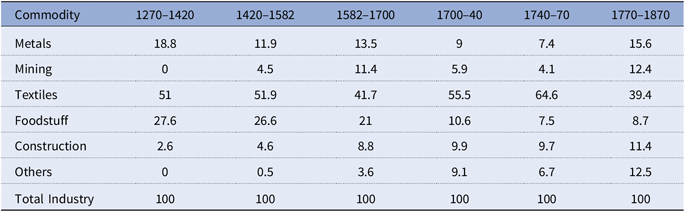
Second, there is no denying that in the first Industrial Revolution, as currently defined, the transformation in production occurred not in metallic trades and goods, but textiles. The innovations that economic historians have spent the last thirty years examining happened not in the ‘empire’ of recent feature but in Lancashire hills and towns, borne of long traditions in domestic wool and worsted production.Footnote 7 Table 1 shows just how dominant that growth in textiles was, but also that weight of output in metals declined through most of the classic Industrial Revolution period, and only grew after the late eighteenth century. It is easier than one might imagine to find support for the idea that the metallurgical trades were actually among the last to industrialize. The tools and components trades remained small, scattered, and workshop-based outside Birmingham and Boulton’s foundry until the mid nineteenth century.Footnote 8 Even after the introduction of the Siemens process in metals production, the factory production methods and organization that typified new capital–labour relations in the textile industry were only adopted slowly.Footnote 9
Weights of output in the industrial sector (percentages), 1270–1870

Source: S. N. Broadberry et al., British economic growth, Cambridge: Cambridge University Press, 2015, pp. 134–7.
Satia’s book highlights that metals, components, and armaments trades have been relatively neglected by economic historians. The crowding out thesis that she cites (p. 13) might suggest that the state managed production of guns and arms, but, as her research on Galton implies, production was a private-order affair. If Satia and others are going to continue to claim that the process of industrialization was responsible for the violent basis of the capitalist system of production then the known system of private subcontracts and trade finance, and the role of the contracting profiteering state within that, need serious research.Footnote 10 Moreover, it is not usually thought that England had any advantage in armaments or metallurgy – quite the opposite, in fact. If guns and war did have a causal effect on industrialization, then the oldest question – why England? – again presents itself. Satia’s work should challenge economic historians to put some numbers to the armaments trade in the eighteenth century. If the metal and components trades did not develop until the mid nineteenth century in England, what were the exceptional features of the English system that allowed this?
The most recent work in economic history has concentrated on very long-term growth, and in some ways has returned to the notion that industrial output was slow and growth in the eighteenth century less notable than we thought.Footnote 11 It is now the services sector in seventeenth-century England that has begun to command the attention of those interested in long-term growth.Footnote 12 By contrast, the history of capitalism narrative stresses the impact and terrible consequences of the classic Industrial Revolution period. After decades of rigorous theoretical empirical and substantive analysis, industrial capitalism has got a good press from economic historians because it is also associated with peace, with growth, with moderation, and with global security at the end of the twentieth century. Whether historians of capitalism can persuade a global audience that we should blame the emerging violence and extremism on it may depend on whether or not economic historians can engage with the different causal arguments that authors like Satia make. It is time for economic historians to engage meaningfully with ‘empire’ stories, and both research and make clear the causal connections between changes in production techniques and social and institutional change.