Introduction
In welfare states, most older adultsFootnote 1 have a pension and health insurance. Health care is usually accessible and a temporary or permanent psychological or physical difficulty does not systematically result in a change in income, for instance. In developing countries, however, where social policies do not cover the older population, it is often older persons’ health conditions that determine their participation in economic and social life (Antoine Reference Antoine2007). Older Africans are often stakeholders in multi-generational support systems, rooted in the family, in which they give and receive support (Antoine and Golaz Reference Antoine and Golaz2010; Attias-Donfut and Rosenmayr Reference Attias-Donfut and Rosenmayr1994; Golaz Reference Golaz2013; Lloyd-Sherlock Reference Lloyd-Sherlock2010). The household is an important unit to consider in this connection, embedding as it does readily available support mechanisms (Zimmer and Dayton Reference Zimmer and Dayton2005), yet most households in Africa are ‘open’ (Randall and Coast Reference Randall and Coast2015), especially those of older people. This means that support systems often include people outside the older person's household (National Academy of Sciences 2006). Support sometimes co-exists with a ‘discourse of neglect’ that may not reflect the reality of social and economic exchanges between generations (Cattell Reference Cattell, Weisner, Bradley and Kilbride1997). However, recent research on Africa raises the limits of family support systems with regard to older people in need, in the context of the HIV/AIDS epidemic (Knodel, Watkins and Van Landingham Reference Knodel, Watkins and Van Landingham2003; Seeley et al. Reference Seeley, Wolff, Kabunga, Tumwekwase and Grosskurth2009; Williams Reference Williams2003) and of rapid urbanisation (Aboderin Reference Aboderin2006; Apt Reference Apt2001). The dispersion of families through migration has also been noted as disrupting family support (Cattell Reference Cattell1993: 19). As schooling becomes important and available, there is usually a shift in the flow of working people's resources from the older to the younger generation (Caldwell Reference Caldwell, Hohn and Mackensen1982). Even when older adults have relatives around them, if they cannot work anymore their needs sometimes come into competition with those of younger family members (Golaz Reference Golaz2013). The ability of their support networks to help them overcome a loss in wellbeing depends not only on the human and economic resources of each individual in the network, but also on the priorities of each of them. As Apt (Reference Apt2002: 42) pointed out more than ten years ago – and the situation has not changed much since then – too little is known about the way older people and others support themselves in developing countries. The vulnerability of older people needs to be investigated with new urgency.
The term ‘vulnerability’, widely used since the 1970s, refers to different settings depending on academic culture, discipline and language (Schröder-Butterfill and Marianti Reference Schröder-Butterfill and Marianti2006; Thomas Reference Thomas2008). Discussing the vulnerability of older adults implies discussing the ‘resilience’ of older adults as well, a term directly imported from psychology to other social sciences. In this paper, vulnerable persons are individuals or groups of persons at risk of losing wellbeing. In contrast to vulnerable persons, resilient persons are those who actually recover from a shock when it occurs. Investigating vulnerability or resilience calls for analyses that go beyond the individual perspective to take into account different contextual and collective scales, such as the family, the neighbourhood and the community (Wild, Wiles and Allen Reference Wild, Wiles and Allen2013: 150), including older peoples’ support systems.
Objectives
The aim of this paper is to understand vulnerability among older adults in Uganda. Older people are sometimes considered vulnerable regardless of their personal resources. However, some older people may be in a better position to recover than others if this is at all possible. Leaving aside the relatively infrequent case of people with their own resources (e.g. older people with ample savings or a regular pension), we focus more specifically on two aspects of older peoples’ livelihoods: the structure and extent of their support systems and, in some cases, the powerful effects that incidents over the lifecourse may have on this support system in later life; and the resources available to an older person through his or her support system, in terms of both activities and location, as these lead to different levels of poverty and access to health care in old age.
Data and methods
This paper uses a corpus of 83 in-depth interviews conducted in seven different locations in Uganda with individuals aged 60 years and older or their close relatives. The data were collected as part of the Family and Solidarity project,Footnote 2 the HH-MM project (Household Management: The Implications of Standardised Data for Understanding Intergenerational Relations)Footnote 3 and the IGLEA project (Intergenerational Relations and Transmission of Land Rights in East Africa),Footnote 4 all three conducted between 2008 and 2012.
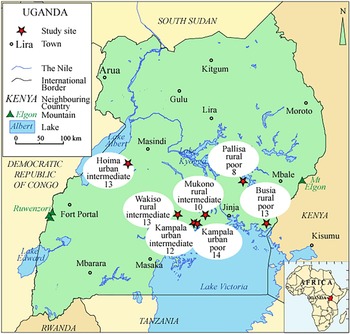
We targeted different types of study areas: four sites were located in rural settings; one in a small town, Hoima; two in different neighbourhoods of the capital city, Kampala (Figure 1). Different standards of living were represented in the sample, in both the capital city (one poor, one intermediate) and rural areas (two relatively poor, two intermediate). The rural areas were located at different distances/travel times from Kampala, ranging from 30 minutes (Mukono) to five hours by road (Busia); the two closest to the capital city have a higher standard of living than the two farthest away. The two rural field sites close to Kampala are located in Buganda, a patrilineal yet formerly neo-local society where young men used to go and request land away from their parents’ place. Households there are smaller than in the rest of the country. The two other rural sites were located further east, among the Samia, Basoga and Bagwere, patrilineal virilocal societies where land is usually shared with sons in a system of communal land ownership that results in larger households. The two sites in the capital city were diversified in terms of the spatial/social origin of their inhabitants and had recent as well as long-settled residents.
Map of Uganda showing the location of study sites.

We conducted 8–14 interviews in each location (Figure 1). The interviews focused on relationships and support within and outside the family or household, especially in relation to older people. Furthermore, we visited the study site of Mukono regularly over a period of three years to acquire a better understanding of the dynamics of social networks and residential arrangements over time.
Vulnerability and resilience in the Ugandan context
Generally, vulnerability is defined in relation to specific shocks or threats that may have an adverse impact on a person's life. Schröder-Butterfill and Marianti (Reference Schröder-Butterfill and Marianti2006) distinguish two possible sets of factors that differentiate vulnerable persons or groups from non-vulnerable ones in the event of a shock: exposure and coping capacity.
Shocks may be of two different types: exogenous events (political or natural disasters) and endogenous events (health problems, loss of income, loss of a close person, etc.). The latter type is more likely to happen to older adults than to other members of our societies. Non-communicable diseases are more frequent among aged persons than earlier in life and are often incurable, which conveys the idea that older people are less resilient than others when they encounter health problems, but this might not be the case for other health issues or other threats they might encounter.
‘Exposure’ broadly refers to conditions that would induce different probabilities of a person having to face a given threat. A person's degree of exposure is based on the individual and household characteristics that actually define a person ‘at risk’. Characteristics commonly taken into account include economic ones such as assets ownership, housing characteristics, employment status and remittance flows. It is worth noting that these are also often mobilised as poor/non-poor indicators. Poverty in itself is a risk factor (Williams Reference Williams2003: 212). However, exposure is not sufficient to define vulnerable persons, because even within the group of people who will actually face a threat, some might be in a position to overcome it through ‘coping mechanisms’, i.e. the capacity of a person or group to face and overcome the temporary loss of wellbeing caused by a shock.
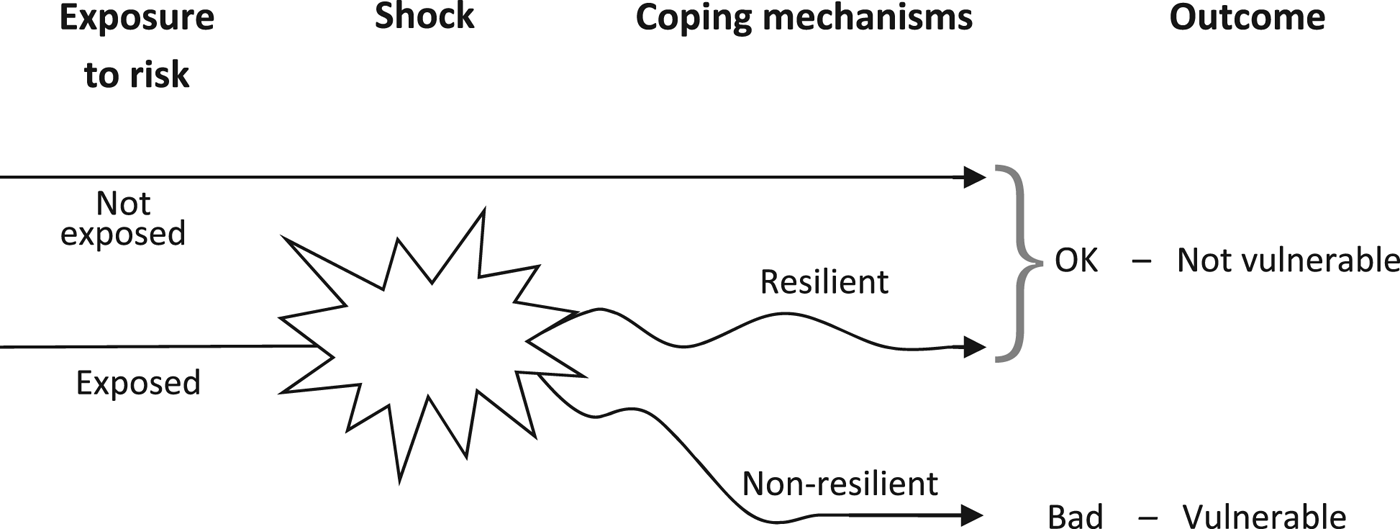
In this paper, we chose to define the concept of vulnerability as a combination of factors of exposure to a threat or shock plus inadequate recovery mechanisms (Figure 2). Resilience, meanwhile, can be defined as the conjunction of both exposure to threats and shocks and having sufficient recovery mechanisms. The threats faced by older people are similar to those of other age groups and range from political or natural disasters to accidents or illness of self or family member(s). But since health inevitably deteriorates in later life, health problems appear in our analytic framework as foreground elements in terms of exposure to risk as well as a potential shock and as an obstacle to recovery. In developing countries, many older people live below the poverty line, have limited material resources and limited access to proper health care. In the absence of individual capacities (savings, etc.) and strong social policies, many of an older person's coping mechanisms depend upon her or his social network (Schröder-Butterfill and Marianti Reference Schröder-Butterfill and Marianti2006). Older people's vulnerability and resilience alike need to be understood in light of different scales of analysis (Wild, Wiles and Allen Reference Wild, Wiles and Allen2013).
Old-age vulnerability analysis framework.

The Ugandan context
Uganda has one of the youngest populations in Africa. The civil war of the 1970s and 1980s and an AIDS epidemic that has lasted over 25 years have decimated the adult population. While the national HIV prevalence rate has never exceeded 14 per cent, it remains relatively high, currently standing at 7 per cent and showing a slight increase (Ministry of Health 2011: 101).
In response to international mobilisation campaigns (following the Madrid International Plan of Action on Ageing, MIPAA-2002), policies targeting older people are being developed in the country. A universal non-contributory system of social assistance grants for empowerment (SAGE) to assist the most vulnerable is still in the pilot phase. As part of the SAGE programme, Senior Citizen Grants are currently being tested in 14 pilot districts (considered as the poorest in the country); they target all persons aged 60 and over, or 65 and over depending on the district, and should eventually cover all people aged 60 and over unconditionally. The modest sums paid out (about US $8 per month) are very far from enabling older adults to meet all of their needs. However, they represent a significant form of aid in rural areas, where 94 per cent of older people lived in 2002 (Golaz and Rutaremwa Reference Golaz and Rutaremwa2011), many of them on subsistence farming and with little if any monetary income (Oxford Policy Management 2013).
Health care is officially free of charge in Uganda's public health centres and hospitals. Yet the rising demand for health care in the context of a fast-growing population, combined with the inefficiency of the public health system, plagued by corruption, makes it difficult at times to access these services and lowers their quality (Jitta, Whyte and Nshakira Reference Jitta, Whyte and Nshakira2003; McPake et al. Reference McPake, Asiimwe, Mwesigye, Ofumbi, Ortenblad, Streefland and Turinde1999). Traditional healers are often considered more efficient. The other alternative is the private sector, whose offer ranges from village clinics in some cases run by unqualified staff to a place in the best hospitals abroad (for the very few who can afford it).
Previous work on the vulnerability of older adults in Uganda has been of two kinds. On one hand, there are anthropological studies, which have contributed to an in-depth understanding of the mechanisms at play in old age. Whyte and Whyte (Reference Whyte and Whyte2004), studying livelihoods throughout the lifecycle from the late 1960s, show the intensity and reciprocity of relationships built over time between grandparents, their children and grandchildren in a rural community of eastern Uganda. In this long-term perspective, the role of AIDS in the dynamics of these relationships is not given much attention. Interviews collected in 1971 with older persons around Kampala in central Uganda – a different setting – also pointed up the importance of kinship in care for older people (Nahemow Reference Nahemow1979). Widows were found to be highly vulnerable, since they no longer had a husband to help support the family or protect their rights (Obbo Reference Obbo and Potash1986). More recent qualitative studies, broader geographically but with less depth, have underlined poverty as a recurrent concern in connection with older people, along with the role such persons play in caring for children and grandchildren affected by AIDS (Nankwanga, Neema and Philips Reference Nankwanga, Neema, Philips and Pranitha2013; Ssengonzi Reference Ssengonzi2009).
Quantitative data have also provided results, often in conjunction with qualitative fieldwork. In Masaka district, still in central Uganda but in a rural setting, demographic data have been collected for almost 25 years through different waves of an ethnographic study. These data have contributed to our understanding of how the AIDS epidemic has affected the wellbeing of older people; most notably, the epidemic has weakened their support network and led to their spending the few resources they have on caring for their own children (Seeley et al. Reference Seeley, Wolff, Kabunga, Tumwekwase and Grosskurth2009; Williams Reference Williams2003). In an urban setting, but still in the context of a study of the impact of HIV, quantitative and qualitative data were collected in and around the town of Entebbe, also in central Uganda; they clearly show the poverty of older people (Seeley et al. Reference Seeley, Zalwango, Mugisha, Kinyanda, Wake and Scholten2010).
The Masaka field site and the Entebbe cohort were recently used in collecting both qualitative and quantitative data on older people in the framework of the Well-being of the Older Population Study, the Ugandan component of the World Health Organization's Study on Global Ageing and Adult Health (Medical Research Centre and Uganda Virus Research Institute 2011).
Drawing on a survey conducted in six districts of Uganda, Ntozi and Nakayiwa (Reference Ntozi, Nakayiwa, Caldwell, Orubuloye and Ntozi1999) studied changes in family structure related to the HIV/AIDS epidemics and their disruption of the family network around older people. National data have been analysed to give a broader picture of the situation of older people in Uganda. Different vulnerability indicators were tested on the 1991 and 2002 population census data (Antoine and Golaz Reference Antoine, Golaz, Molmy, Sajoux and Nowik2011; Golaz and Rutaremwa Reference Golaz and Rutaremwa2011). Disabilities and ill health among older people were obtained using Uganda National Household Survey (UNHS) data (Wandera et al. Reference Wandera, Ntozi and Kwagala2014, Reference Wandera, Golaz, Kwagala and Ntozi2015). Perceptions related to old age (Najjumba-Mulindwa Reference Najjumba-Mulindwa2003) and the feeling of loneliness among older people (Nzabona, Ntozi and Rutaremwa Reference Nzabona, Ntozi and Rutaremwa2015) were analysed through specific quantitative surveys in different parts of the country. These studies all point to important regional variations in the situation of older people, their residential arrangements and possible social isolation.
Changing values
Our study sites in Uganda comprise people of different cultural backgrounds. As in the rest of East Africa, most families stem out of virilocal patrilineal societies where sons are entitled to some of their father's land. In agro-pastoral societies, for instance, older people used to live alongside their sons’ families. Sons and grandsons would take care of cattle and perform particularly demanding agricultural tasks; daughters-in-law and granddaughters were expected to provide care and do most domestic and agricultural work. This past ideal of a large local network in a virilocal patrilineal society, fundamental to the practice of primary-sector activities such as agriculture, cattle rearing and fishing, has been gradually transformed in connection with the expanding cash economy and the polarisation of job opportunities. For many today, it has been replaced by a diversified network in which non-local members play a key role, especially in providing cash for education and health care.
Although Buganda clans and lineages are patrilineal as in the rest of Uganda, residential mobility among the Baganda used to be high and was a norm for young married men. Neolocality implied more distant parent–son relationships than in the virilocal societies found in eastern and western Uganda. This reinforced the importance for a son of his mother's lineage, as he could seek support for settling in a new place from both maternal and paternal lineages. Nowadays, with higher pressure on land, people agree that it is not possible anymore to seek access to land anywhere else than on one's father's plot. Therefore, like everywhere else in the country, sons tend to be close to their parents if they are involved in agricultural activities. Interestingly, in Buganda, where land was titled more than a century ago, land rights are often family-based exactly as in the rest of the country and tend to remain under the control of older people.
Migration is often the only way to access (better) income if not employment. Education is usually required to access better opportunities. Children are expected to be able to support their parents when needed. Older adults are often based in rural areas. Although they still need domestic help for activities that require a lot of manpower, such as agriculture during peak seasons, these activities have become less and less attractive to the youth. Immediate cash income is more likely to be favoured, to the detriment of longer-term returns. Older people need cash as well, especially when it comes to accessing health care. In the case of Uganda, where family members are often missing, many dream of a large, diversified network of descendants that has access to both land and regular income. In this model network, each person would play a social and economic role, some providing care, some resources – food or money – and in turn receive from the others.
In quantitative surveys, married children are usually split off from their parents, regardless of living arrangements. Besides, no information is collected on the proximity of close relatives. When looking at the potential support received by an older person, this local level of support and care is usually not taken into account in survey analysis.
The vulnerability of older people
To understand the vulnerability of older people and the forms it takes, we now present nine case studies illustrating the diversity of economic and social conditions found in our sample. Although each case is unique, these examples are not exceptional. They highlight important aspects of older people's lives and possible vulnerability within their support systems.
Large family support systems
Rose, Footnote 5 a working widow with a large, diverse family (Central Region, rural, intermediate, 30 minutes from Kampala). Rose is a 75-year-old widow. She has had a total of ten children. To date, the eldest is dead, another has suffered from a physical disability since childhood, but four others are working, either locally or in Kampala, and the last four live in the United States of America (USA); two of them, daughters, work in the medical sector. After raising her children and several grandchildren, Rose now lives with one grandson and a niece aged ten who helps her with domestic chores. She runs a shop in the village centre and owns land nearby, where two of her sons live with their wives and children. Rose still works in the shop but is finding it more and more difficult to till the land and now leaves that to her daughters-in-law.
In our case studies, it is Rose who comes closest to having a large and close-knit family network. There are major differences in her children's standards of living. Rose seems to interact with all of them. Her economic dynamism enabled her to pay for her children's education. Her first daughter, who went to live in the USA, followed Rose's example and now contributes to her siblings’ education and helps them to look for work. Today, Rose continues to contribute to the welfare of her family in a broad sense, for instance by bringing up children. She is in contact with some of her own children daily, and can rely on them for care and agricultural produce. She relies on her employed children in case of need. Thus, although Rose's household only consists of two children and herself, she is not at all isolated; her diverse family network offers her security. She has access to farm produce at home and still has her own income through the shop. There are enough people around to care for her if needed, financial resources to pay her health-care bills and accommodation is available for her in town or abroad in case of a health issue.
James and Lucy,Footnote 6 a farming couple with a struggling family network (Wakiso, rural, intermediate, one hour from Kampala). James is 75 and Lucy about 65. They live in a modest house with their youngest daughter, who is a nursery school teacher, and three grandchildren. War has disrupted their children's education. They have lost adult children, including a son recently. Today only one of their other children has a regular income: he is a primary school teacher. Some of those children are farmers like their parents, and live nearby. Others work in Kampala, selling on markets. Thanks to their agricultural work and their daughter's salary, James and Lucy are now bringing up grandchildren: a grandson left by a deceased son and two granddaughters dropped off with them by unmarried daughters. Three other grandchildren from the neighbourhood are in their care during the day, including a one-year-old baby.
James and Lucy also have a wide network of descendants, but one with less means than Rose's. They are still active, contributing to the upbringing of grandchildren. They have access to care locally if needed, i.e. from their daughter at home and their sons’ families nearby. Although the family network includes children working in Kampala, none of their children are actually in a position to contribute financially to their wellbeing or to host them outside the area. In case of any difficulties in working, it is very likely that the local children will assist them and take over the management of their land. But should they have a need for health services, they might have trouble accessing them.
Even when support systems are of a smaller size, they often include different households
Lilian Footnote 7 has a small support system with strong bonds (Kampala, urban, intermediate). Lilian lives alone. She is 71 years old and has lived in Kampala for over 25 years. She does not work. Earlier she bought a small house close to the university with her husband in preparation for their children's studies. The civil war split up her family. Her husband and most of his friends were killed. In order to survive, she had to flee her rural home and her in-laws and take refuge in Kampala. She says that it was her church that helped them survive. Most of her children died of AIDS in the ensuing decade, leaving her with a single son. After raising her surviving children, she had to look after some of her orphaned grandchildren, with whom she has built strong bonds over time. Even though she lives alone most of the time, three of these grandchildren – now young women – live in the same neighbourhood. She relies on them for many things, especially daily services or emotional support. Her son is married and has three young children. Although that family lives relatively far away, her son has a job and works near her home. He comes round and assumes some of the financial burden of the small house she occupies. She relies on him for economic support when needed.
Lilian is now helping to raise her great-grandchildren: during school holidays, she takes in two great-granddaughters who are in boarding school for the rest of the year. Moreover, she gets a small income from renting out two rooms in her house, which provides her with enough cash to buy food and make small gifts – especially to the great-granddaughters – when she feels like it.
Lilian's support system in her old age is very limited. As mentioned, her family network has been disrupted by the war and by the HIV/AIDS epidemic, leaving her with a single son and grandchildren. However, the bonds that she has built over time with some of the grandchildren she brought up are very strong. She lives in Kampala, has a small but regular income and her son is in a position to support her financially. Although Lilian lives alone most of the time, she is not isolated, either socially or economically. Things were more difficult when she was younger and was expected to provide for her children and grandchildren.
Anita Footnote 8 (Kampala, urban, poor)
Anita is in her early seventies. She is divorced. She lives alone in one of the poor neighbourhoods of Kampala. She used to work, first as a housekeeper for an Indian family (back in 1962), then on markets. She does not work anymore.
Although her children were brought up in their father's home, in eastern Uganda, the fact that she lives in town enables her to see them. They often pass by on their way to the town markets. Another is in Europe and sends her money from time to time. Yet another actually has a small business close by. Grandchildren and friends visit her regularly and help when they can. An unrelated neighbour also gives her tea and sugar from time to time. However, the person who counts most for her is a nephew, for whom she has built a house on her plot. She paid his school fees herself when she was employed, and he now visits her every day and brings her food.
Anita's divorce a long time ago split her up from her children when they were small. The child–parent relationships suffered from that sudden separation, although she does see some of these now adult children from time to time. However, it is also clear that she has invested in the education of a nephew and expects more from him in her old age than from her own children. She values living in Kampala, where she has spent most of her life and where she can have her children visit her and be close to her nephew. Yet she does not stay there only by choice, but also because she has been rejected by both her husband's lineage and her own.
Nekesa Footnote 9 (Western Region, urban, four hours from Kampala)
Nekesa is 64 years old. She has been widowed for ten years. She is a home-based nurse who works on call. She lives in a rather big house in Hoima town with nephews, adult children and grandchildren. All the other household members are either studying or looking for employment. The house belongs to one of her sons, Albert, who works far away in a bigger town of western Uganda (Mbarara). Albert comes and visits every weekend. He is the economic pillar of the family, supporting the household and contributing to health-care fees (i.e. for his mother recently when she had a car accident) and school fees (for his children, brothers, orphaned cousins and nephews). He is divorced.
Nekesa and Albert have made an arrangement that is in both their interests. As the first born, Albert received the best education his parents could offer, and he in turn now contributes to the education of his brothers and sisters. Nekesa watches over the household, including Albert's children from a first union, while he works in another town. They form two households that are linked by strong economic and affective ties. Her recent accident shows how the support system functions: she was well taken care of. The fact that they live in a small town (Hoima) was crucial to her being able to access health services.
George and Mina, Footnote 10 a married couple who feel vulnerable (Central Region, rural, intermediate, 30 minutes from Kampala)
George is 75 years old. He lives with his wife, Mina, 70; they have been married for over 50 years and have several grandchildren. Of their nine children, only two are still alive, both daughters. The daughter who works in Kampala comes home regularly: she spends about one week per month with them. They cultivate a relatively large plot of land (two hectares). In a context of tenure insecurity, George is afraid of losing access to the land, their main source of food. The reason for this feeling is that he has no living son to take over responsibilities from him.
George and Mina have a limited support system, in which one daughter stands in the foreground. The case of George and Mina illustrates how being a couple consolidates the household on a daily basis, even when the partners are relatively old. The death of all their adult sons has left them with many grandchildren to bring up. The proximity to Kampala enables their daughter to commute between an urban job and their farm. At 75 George still bears the responsibility of securing resources for the future, for his grandchildren. He is the mainstay of the family. Their access to land is key to their livelihood; they would not be able to feed the grandchildren and pay their school fees without it. George speaks like someone younger than his age and develops strategies to overcome his family's vulnerability, vulnerability related to the fact that he has no son to take over the farm after him.
Support systems are sometimes limited to a single household
AnnaFootnote 11 and the benefits of a household made up of single women (Western Region, urban, four hours from Kampala). Anna is 77 years old and lives in Hoima town with her daughter Alice, 56, and a great-granddaughter, Nancy, aged 12. In the past, Anna developed a good relationship with one of her sons, Aron, with whom she and her husband were living. Together, they bought the land on which she now lives. However, she lost her husband and son 20 years ago to AIDS and later lost all her other children except the daughter with whom she now lives. That daughter divorced eight years ago and came to live with her mother, leaving her children with their father in a neighbouring district. The children come to visit from time to time.
The two women have also taken Aron's granddaughter, Nancy, into their care. Nancy's mother died shortly after birth. When her father began living with another woman, the great-grandmother decided to take care of Nancy. Anna, Alice and Nancy live together. The first sells charcoal, tomatoes and onions on the roadside; the second works during the day; the third goes to school and helps around the house. They are fairly isolated from the rest of the family.
Mariam Footnote 12 is not alone but has few resources (Eastern Region, rural, poor, five hours from Kampala)
Mariam is 63 years old and lives in a rural area with a son and four grandchildren aged 7–13. Apart from them, Mariam has no close relatives. All her other children have died. When Mariam's son separated from his wife, she left him with their four young children. Mariam raises them while her son works: he makes bricks on demand on other people's land and is sometimes absent for several days for his work. Mariam cultivates their small plot (less than half a hectare). They are able to have two meals a day but seem to have barely enough to eat. Mariam has been seriously ill and does not seem to have fully recovered from her illness. The children rely on her and she relies on her two granddaughters aged 10 and 11 years, without whom she could not cope on a daily basis. When she was sick, they had to leave school for a few months to take care of her.
Mariam has lost most of her family and is poor. Her support system is limited to her household – a son and his children. They survive on a very small piece of land thanks to her son's irregular cash input. Yet she is in a very difficult situation, which is likely to worsen, as shown by the decline in her health. Her illness affected both herself and the grandchildren, who temporarily dropped out of school at that time. Mariam's vulnerability is mainly economic – lack of resources – and is related to the fact that her family network has shrunk, especially due to the AIDS epidemic, leaving her with a local labourer as sole support.
John, Footnote 13 a lonely man (Central Region, rural, intermediate, one hour from Kampala)
John lives alone. He is about 70 years old and seemed unwell when we visited him. John had a wife and two daughters, and he has two granddaughters. His wife and daughters died and he never sees his granddaughters. He feels helpless and is very bitter about this. He does have a sister who lives on the next plot and who occasionally comes to see him, and the sister's grandchildren often come to see him and help him with household chores when staying with their grandmother during school holidays. A nephew brings him small gifts whenever he visits. With regard to resources, John lives on about 1.5 hectares – a rather large piece of land for a single person – planted with coffee and bananas. The income from the coffee has enabled him to hire someone to cultivate the rest of the land. He has enough to eat, to buy alcohol and pay for a few necessities, but he makes it clear that sugar is still beyond his means. The neighbours in the village give him some help from time to time. In fact, he is perceived as the poorest person in the village and is given charity.
John is alone and his support system broke down a long time ago. Alcohol abuse seems to have made his life more difficult, distancing him from his relatives. Although as a single man he has more resources than some entire families, they are barely enough for survival because he spends so much on alcohol. John feels isolated and does not know how to cope with his loneliness very well. He regrets not having his daughters around him. Contrary to what he suggests, the proximity of his sister is an important resource for him, especially due to the visits from her grandchildren. However, despite his sister's support, he is growing old alone, and for most things he has to fend for himself. This is particularly obvious when he is ill and walking alone with difficulty to the village health centre for treatment.
These nine case studies all point to the importance of networks that extend beyond the household, not just to different settings but also locally. Vulnerability is often related to gaps in support systems that then limit access to resources. But access to necessary resources in terms of care or financial support may also be limited in large and close-knit family networks, a situation related to poverty and location of network members.
Gaps in support systems within and beyond the household
From individuals to support networks
Only seldom do we find individuals who live alone and are not part of a support system that includes others. Together with a few other older people in Pallisa and Namutumba, John is the case we encountered closest to social exclusion. Neighbours always come into the overall picture as benefactors. John himself mentions the support he gets from his sister and her grandchildren. Yet those relationships are more distant than with a child, for instance. With regard to support systems, the different degrees of bonding have led us to narrow our focus to the most effective ties; that is, relationships that can be activated in case of need. The absence of descendants is usually the main issue in the cases encountered (in John's case, but also to a lesser extent for Anna, Mariam and George); it is the situation most likely to result in extremely limited support networks. Alcohol abuse might also explain the isolation that some older people experience in old age (John, for instance). In most cases, however, support networks in old age include other people, either within the household or outside it.
The household is, of course, of prime importance in the support network. People living together constitute the first providers of care and support. In most of the cases we encountered they share resources (except perhaps irregular first earnings of some young members in towns, like in Nekesa's household). In most cases the household is an economic unit and functions autonomously. Exchanges with other households or individuals are regular, in order to maintain close relationships and thus provide a major safety net in case of need, a net that will either foster resilience or not, depending on the capacities of the people involved and the strength of the bonds between them.
Different household types and structures result in differences in care and support. The presence of a spouse (for George and James), younger adults (for James, Nekesa, Anna, Mariam), children (for all except John) all play a role in an older person's wellbeing. When difficulties arise, being a co-habiting couple, like James and Lucy or George and Mina is certainly a guarantee of security, both economically and in terms of having a supportive daily presence and care. But the primacy of the household does not mean that people outside the household are not there or do not matter. Some, such as descendants of the oldest members or parents of the youngest ones, may be key to the relative wellbeing of household members.
Support systems very often include people outside the household. In some cases, many other persons and households are concerned; in others, just a few. In the case of older people, support systems usually include descendants’ households: sons and daughters and their families. But it is important to note that children are not always part of these arrangements (Anita, for example, feels somewhat distant from her children, although they seem to be in touch, and John's relationship with his daughters was broken when they were very young), and that other persons sometimes come into the picture (Anita's nephew, for instance).
In a context of high numbers of orphans and overall child mobility, many adults play parental roles to children other than their own. There is a continuum of situations ranging from occasional support to mentoring to full adoption. These parental roles open the way for a different type of relationship, in most cases ‘elective’ on one side or the other, like Anita's with her nephew or Anna and her daughter's with the girl they are hosting. Elective relationships sometimes take precedence over those with direct offspring, or just co-exist.
Very often adult children live away from their parents. Even in rural societies where land is shared at the family level, it is common for each married couple in the family to take care of a specific plot and function autonomously, as in James and Rose's families. Married children then tend to be neighbours, but have their own resources. Although a great deal of exchanges take place, of labour, farm produce, child care, etc., parents and their grown children form different households within a support system that encompasses all.
So in most cases, the support network includes different households, and sometimes the bonds between households are very strong and support comes from outside the individual household more than from within. This is especially the case when an older person's own household is small, for instance when an older woman lives alone or with a few grandchildren only: the grandchildren's parents or other descendants of the older person often provide more than the household itself can produce (cases of Anita, Lilian, Nekesa). Although taking the household structure and composition into account is absolutely necessary when studying the vulnerability of older people, the extent of their support systems beyond the household cannot be neglected.
What happens when the support network is limited
In reality, there is a continuum of situations from the ideally large support system to the most isolated and helpless people. It is important to remember that reconfigurations are sometimes possible and that changes do occur, especially when people are heading into a situation of need. For instance, Anita's children or nephew could be present if she needed them; John's granddaughters might reappear, etc. It is not our point to be alarmist here but rather to point out potential difficulties.
In our sample we find relatively wide networks – mainly family ones (Rose and James, and to a lesser extent Nekesa and Anita). However, many people in old age find themselves with few family members around them, although they are sometimes socially well integrated (George, Lilian, Anna). Others are less so (Mariam, John). Most of the older people we visited had lost some of their adult children, which meant losing potential sources of care and economic support. War and AIDS are two major disruptors; they have taken away children and grandchildren. However, relationships with living children can weaken or break and support for an older person is sometimes limited to a few persons only.
There are specific cases in which people may become more distant from each other. Poverty is an issue, with children struggling to make ends meet in town and not being able to meet their parents’ expectations or needs. However, distance also comes into account in our case studies: Lilian's family was split when its members took different sides during the war; separations and divorces have cut women off from their children in eastern and western Uganda (Anita, Anna's daughter, Mariam's daughter-in-law). In societies where children belong to the father's lineage, mothers may lose contact with their children in case of separation and find themselves isolated in old age if they have not developed other relationships, as we observed in families coming from the eastern part of the country especially.Footnote 14 These breaks in relationships affect the degree to which direct descendants are implicated in their parents’ situation: in Anita's case, although she sees her children often, she does not seem to be close to them. By hosting them, she is trying in a way to reconstruct a relationship that was broken by her divorce. These harsh separations from children seemed to be less of a problem in Buganda, where relationships between children and both parents seemed more balanced during and after separation.
However excluded from the lineage system daughters may be, especially in a time of increasing competition for resources, they are still present in Buganda (like George's daughter) and in other settings. They play an important role for their parents in terms of care but also economic support (Anna and George's daughters, for instance), and this assistance is also reciprocated.
Generally, independently of health issues, isolated people tend to come together. These situations, based on mutual support, can involve different generations (orphans and widowed grandmothers, but also people with few and distant relatives who decide to live together to escape living alone or in difficult circumstances, such as Anna and Lilian).Footnote 15 This works for everyone, at any age, and solves some of the problems of elder care. For Anna, the presence of her daughter and great-granddaughter are unquestionably beneficial. All three women were in precarious situations, and living together protects them. They are less vulnerable this way than they would have been had they stayed on their own. For Lilian, it is a much longer story: her relationships with her granddaughters have lasted through economically difficult times and repeated teenage pregnancies, creating a strong social contract between generations.
In addition to descendants or in their absence, the extended family is likely to be mobilised when needed (e.g. for John), without much being expected or demanded from them since these are more distant relatives who have their own children and households to look after. Solidarity at this level is not considered a social obligation but rather a favour and is at the discretion of the provider.Footnote 16 As explained, in rural areas neighbours are often relatives. In urban areas, or when neighbours are not relatives, poor older people often rely on charity from neighbours (Anita, John). The role of churches can also be noted (Lilian's and Anna's cases), and they are often mentioned as a replacement when the family fails in its role of security provider – and when the person in need accepts their help (John, for instance, did not).
Vulnerability within support systems
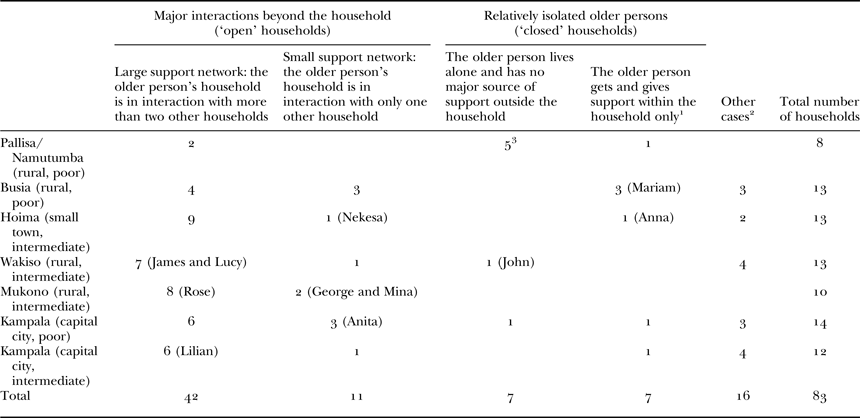
Most of our case studies lived in households ‘open’ to interactions and exchanges and were therefore part of support systems including more than just two households (Table 1), most of which link an older person's household to the households of his or her children and grandchildren, as in the cases of Rose and James, who have a large group of living descendants. This is also the case for Lilian, although her family has been quite shattered over the past 40 years or so. Only seldom is an older person totally isolated from direct descendants (John is one such case), but it is not uncommon to find very narrow-based support systems, sometimes limited to the single household (Mariam, Anna), sometimes composed of one household of close relatives only. The narrow base may be temporary (Nekesa, while her adult children are looking for employment) or more long term (Anita, George). Many older people like Mariam and George have lost most of their children to AIDS. Others, like John, Anna's daughter and to a lesser extent Anita, are cut off from some of their descendants due to conjugal separation.
Typology of support systems around older persons in our case studies (83 households)

Notes: 1. These households are often groupings of same-sex relatives who came together to consolidate forces and resources. 2. These interviews were all conducted with people who were not directly living with an older person; the information obtained is therefore not sufficient to provide a full picture of the support network around the older persons close to the respondent. 3. In one case, isolation was noted although relatives (a child and a grandchild) were living nearby.
However, people's ability to actually provide and receive care and support depends not only on the size of their network and the number of households involved but also on their own economic resources and the places involved.
People and places: securing access to resources
A strong network has resources at hand. The capacity of older people and their families to respond effectively in case of problems must be evaluated in relation to their resources. Lack of resources, especially money, results in lower reactivity when health problems occur, for instance, and is a major obstacle to recovery. However, having diversified resources often means that some network members are working far away; it induces a physical distance between members who work and those who do not.
Not all resources are monetary, however. While some network members might have access to a regular source of income (represented in our cases by Nekesa's son Albert, Rose's daughters in the USA and, to a lesser extent, George's daughter and Mariam's son), others may own land (all the rural older persons interviewed, James’ sons). Rural networks are common and suffer from having little cash at hand when needed (Mariam's network, for instance). On the other hand, urban ones have to rely mainly on cash income even to eat (Anita's, Lilian's, Anna's). Networks with both rural and urban members (Rose's, George's) have sources of both food and money.
Just as food is readily accessible or cheaper in rural settings, education and health also have different costs and quality levels, with some places offering better services than others. People in a situation of need tend to gather around better-off people. If Albert were not there, for instance, each of his dependants might cling to another person in a wider family network. Older people play a specific role here if they have access to land in rural areas (Rose, James, George, Mariam) or housing in town (Anita, Lilian, Anna) and can host those who need it, although in poor rural areas this can be associated with limited opportunities.
The most efficient support systems are wide and spread out over different types of places; they include members with secure jobs, most likely in towns, very exceptionally abroad. When they have both people close by and resources, older people have an effective social network. However, very often in Uganda, the network has taken a reduced form. The wider the network and the more diverse its resources (land, income), the less vulnerable its members. In some cases, a few people can form an effective support network without even living together. However, this is not always the case, especially when economic resources are limited.
Activities and income (older adults and other support system members)
In a context where most people are not eligible for pension funds, people do not retire or have to retire at any specific age. Our interviews confirm that people gradually stop working when health declines, as shown in the case of Mariam, whose activity has changed with her health status, and that older people in general have a tendency to continue working, especially in rural areas where they are involved in farming (George and Mina, James and Lucy) but also in other activities (Rose, Nekesa, Anna). As long as someone is healthy enough to work, he or she is expected to remain active and plan for others. Therefore, older people are not generally poorer in terms of resources than they were before age 60. They till the land and/or earn some income when possible. But the benefits of remaining active are fast absorbed by the needs of family networks that still weigh on older people: jobless sons (Nekesa), estranged daughters (Anna), orphaned grandchildren or just dropped-off grandchildren to bring up if their parents work or are trying to (re)build a life somewhere (Mariam, James, George and others).
Being assured of a regular income or source of means, monetary or other, is a security that some older people can count on. This is clearly the case for Rose, but even John in this regard is less vulnerable than others because his economic survival does not depend on his own labour. Employing someone is a security for him: he is less vulnerable than an older person who has to farm the land himself in order to eat. Thanks to the piece of land and coffee plantation, his income is not conditioned by his own labour.
In some cases (Nekesa's, for instance), the activities of older people are economically marginal in relation to their families’ livelihood. It is Albert, Nekesa's son, who has been supporting his large network of family members in the past years. Some of the older sons/cousins are graduate students and may get a job one day to contribute to the family. The balance is fragile, but it is working out for the moment, and their situation is likely to improve in the future. However, should anything happen to Albert in the short term, it would be difficult for his family to maintain their standard of living. People's relative wellbeing – including that of older people – sometimes depends on a single person with a job.
Securing resources is a fundamental aspect of the fight against vulnerability. When access to land has been secured, this is something the family network can fall back on. George feels vulnerable because he is afraid of losing this resource. Anita had problems in connection with her land as well, on her town plot: a neighbour claiming her land physically attacked and wounded her. If she had lost her land, she would have had nowhere to go, no way of hosting or even seeing her children, and nothing to offer her nephew.
Place makes a difference
But in many cases (Mariam, George and Mina, and others), the activities of older people are economically central to the support network. This is common in rural areas, especially close to Kampala, where young people prefer to leave farming to the older generation and seek ‘town opportunities’.Footnote 17 Older people then cultivate land with the help of the grandchildren in their care (Mina and George; and Mariam especially relies on her grandchildren now that she cannot work as much). Transmitting access to land to the next generation is an issue for some (George) because it matters both symbolically (the home farm often being the place where ancestors are buried) and economically.
Just as access to land is valuable in rural areas, so owning rooms in Kampala is an asset that can provide a regular income for older people living there (Lilian, Anita). A notable difference between older people lies in the distance from Kampala. Staying in Kampala often means having working children nearby and easier access to the national referral hospital, Mulago. Living close to Kampala increases the probability of having children who live there, seeing them from time to time and accessing the hospital more easily than others. The further away an older person is, the less likely it is that his or her children will be in a position to help or visit. The dispersion of an older person's network differs by distance to the capital city, rendering it – as well as cash resources – more or less accessible to that person. Proximity to the capital city is therefore to be considered in assessing the vulnerability of older adults.
While older people's place of residence is important given the advantages associated with having land in rural areas or housing in town, situations which make them economically independent and bring them closer to health services and their children, the places of residence of other members of the support system also determines the support they might provide. Having children or other close relatives in the capital city or even in a small town can in some cases be associated with a regular income and the possibility of staying there if needed (Nekesa, George, Rose), but it does not necessarily mean that those relatives are thriving. Some are not in a position to help (James's children in Kampala, for instance). Joblessness is common and cash resources are often very limited.
Conclusions
The complexity of interpersonal relationships forged over the lifecourse increases with age. In cases where these relationships last, older people find themselves at the head of a dense web of descendants, often spread out spatially, with different sources of livelihoods. But children sometimes die before their parents, and relationships get broken; older adults sometimes find themselves in uncomfortable situations because they themselves have to cope with difficulties and their close relatives are not in a position to provide the support they need. When personal resources and social policies are lacking, being part of a sufficiently wide and diverse support system is key to older people's resilience.
In most cases, then, the household is just one mesh in the safety net. However, in Uganda the family safety net is often incomplete; there are missing links – in some cases the strongest ties, those woven with greatest care, have disappeared abruptly. This isolates older people and their households from the rest of a society whose members are actively engaged in and needed by their own solidarity networks. In most cases, the support needed in exceptional times comes mainly from outside the immediate household. In order to assess the vulnerability of an older person, it is therefore necessary to take into account that person's social networks beyond the household, to find out whom he or she can count on and what resources can be mobilised. Inquiring about the existence and situation of descendants and other social relationships built with people over the lifecourse, which are sometimes even stronger than ties to children or grandchildren, is absolutely necessary.
Assessing a person's vulnerability, then, requires taking into account the resources of people around him or her. Exchanges are multifaceted and vary over time and in intensity and direction. Individual or household poverty indicators can be misleading in this regard. The efficiency of a support system depends on the relative ability of some of its members to cover the needs of others, which in turn depends on what those needs are, on the sources of income or wealth in the support system, and on its spatial dimensions. Dispersion of the support system does not necessarily weaken it; being spread out over both rural and urban areas often means having access to both cheap food and cash income. The centralisation of the public health system in Uganda, as well as that of the job market, makes the proximity of Kampala or, to a lesser extent, smaller towns an asset.
Rejection by one's family and the breaking up of relationships with all one's own children are very common in today's Uganda, in connection with divorce or children being born outside stable couples. The upbringing of a child might be felt as a burden for parents who sometimes have trouble making a living. But who will support those adults when they are older?
The financial transfer policy now being implemented in parts of the country, i.e. the provision of modest social assistance grants, not only helps combat poverty but also strengthens the social status of older people. These transfers reduce old-age vulnerability no matter what the health conditions or employment status of the older people concerned. Further studies in the pilot districts are required to assess how much the cash transfers are transforming support systems around older people. Nevertheless, while it is indisputable that monthly grants can help older people in need, these modest transfers can never cover hospital care, for example.
The particular needs of older people late in life have to be met by their families, and the majority of the population cannot afford to meet those needs. In terms of policy, poverty reduction among or around older people is one promising measure, but improving the effectiveness and the decentralisation of the public health system are other equally important ones that the government has still not been able to implement in an efficient way. In the face of predictable social and health problems due to future rapid population ageing, national governments would do well to improve this type of situation sooner rather than later.
Acknowledgements
Our research was jointly funded by the Economic and Social Research Council (ESRC, United Kingdom) and the Agence Nationale de la Recherche (ANR, France) under the collaborative research programme (RES 062-33-0007) entitled ‘Harmonised Households: The Implications of Standardised Data Tools for Understanding Intergenerational Relations’ (HH-MM). Additional funding was obtained from the Institut National d'Etudes Démographiques (INED, France) and the Institut de Recherche pour le Développement (IRD, France) for subsequent parts of the research. Earlier versions of this paper were presented at the congress of the International Association of Gerontology and Geriatrics (IAGG, Cape Town, 2012), the conference of the International Association of French Language Demographers (AIDELF, Ouagadougou, 2012) and in the INED research unit ‘Mobility, Housing and Social Networks’. We would also like to thank the editors and referees and the many other scholars who contributed to this paper during one of those occasions, as well as Claire Médard (IRD), Ernestina Coast (London School of Economics and Political Science) and Alexandra Fanghanel (University College London) who directly participated in data collection. This research was done after ethical clearance from the Uganda National Council of Science and Technology (clearance number SS2296). We anonymised all interviews to ensure confidentiality.