Caregiving-related early adversities (crEAs), including emotional abuse/neglect, exposure to violence in the home, physical abuse, and sexual abuse, are consistently linked with a significantly increased risk for mental health problems (e.g., Clark, Caldwell, Power, & Stansfeld, Reference Clark, Caldwell, Power and Stansfeld2010; Edwards, Holden, Felitti, & Anda, Reference Edwards, Holden, Felitti and Anda2003; Kessler et al., Reference Kessler, McLaughlin, Green, Gruber, Sampson, Zaslavsky and Williams2010). Underlying this increased risk for mental health problems are the more proximal emotional processes that ensue following exposures to crEAs and atypical development of cortical-subcortical brain circuitry (Teicher, Samson, Anderson, & Ohashi, Reference Teicher, Samson, Anderson and Ohashi2016). In this paper, I discuss these findings and present a hypothesis that expands current interpretations of the established links between crEA-related neurophenotypes and poor emotional health. Namely, I present the hypothesis that the medial prefrontal cortex (mPFC) and its connections with subcortical regions learn and maintain semantic-level affective knowledge from early caregiving environments, and by doing so, this neural circuitry generates predictions from schematized structures for future affective events. In this way, mPFC–subcortical circuitry may operate much in the way that has been described in the decision-making literature, integrating conceptual knowledge and learned value representations to drive behavior (Kumaran, Summerfield, Hassabis, & Maguire, Reference Kumaran, Summerfield, Hassabis and Maguire2009).
A Focus on Caregiving Adversities
For the purpose of the current paper, I focus on adversities specifically related to caregiving – that is, environmental characteristics that directly interfere with the parent–child relationship. My focus is in contrast to other sources of adversity (e.g., poverty, food scarcity, physical neglect, community factors, prenatal stress, racism, and bullying) that are discussed elsewhere in this issue (see Adams et al., 2020; Davis & Narayan, 2020; Pollak, 2020; and Reid & Danese, 2020 in this issue). While important, these forms of early adversities have less direct implications for the quality of the parent–child relationship. This focus on caregiving-related early adversities (crEA), as opposed to childhood adversities more broadly, follows the logic that psychosocial features of the caregiving environment that directly interfere with the parent–child relationship are especially threatening to the inter- and intra-personal processes that impact the origins of affective development and associated mental health. This is not to say that other adverse exposures could not have similar neurobehavioral correlates.
The strong link between crEAs and increased risk for later difficulties in emotion regulation has been explored from various angles, with brain and biological development becoming an increasing focus of many programs of research, in part because of the large technological innovations that have enabled noninvasive assessments of developing populations. These innovations have also fostered translation between nonhuman and human animal research, which has advanced the development of mechanistic models for understanding the pathways through which early adversity influences affective regulatory processes. As described below, this body of work has shown that crEAs are associated with atypical structure and function of midline cortico–subcortical circuitry (as compared to caregiving contexts without crEA exposure), that correlate with poor development of emotion regulation skills (Teicher et al., Reference Teicher, Samson, Anderson and Ohashi2016). The current paper considers these findings in the context of the proposed framework.
Affective Operations versus Affective Knowledge Content
The existing literature has made great strides in identifying how adversity-related differences in midline cortico–subcortical circuitry alter the emotional operations associated with crEA (that is, how emotions are generated, controlled, learned, and the like). What remains much less understood is the semanticized knowledge content (or the concept-level knowledge) that is supported by these developing brain circuits. There has been less attention paid to the abstracted representations and information supported by this neural circuitry that interacts with emotional perception, emotional reactivity, affective learning, and emotion regulation following crEA exposure. In the domain of intelligence, Guilford (Reference Guilford1982) and Wagner and Sternberg (Reference Wagner and Sternberg1984) distinguish between cognitive operations, content, and products. Operations include cognitive processes, memory, and evaluation skills; products include the transformations and implications of the knowledge; and semanticized knowledge content includes symbolic and semantic representations. The majority of literature on the behavioral correlates of cortico–subcortical circuit developmental following crEAs has focused on the operations of emotional behavior (e.g., reacting, controlling, appraising), and to a somewhat greater degree the products of the knowledge, with much less focus on the knowledge content (i.e., what meaning has been learned from experience).
Here, I hypothesize that crEAs’ impact on midline cortico–subcortical circuitry may alter not only the operations and products, but also the knowledge content (that is, the affective semantic representations) that has been abstracted from early experience. In other words, adverse caregiving experiences may impact emotional development through midline cortico–subcortical-based schematic representations related to the self and others. To quote Carolyn M. Newberger in her testimony to the United States Congress in 1991 regarding the impact of childhood maltreatment:
“It is not the acts alone that are traumatizing but their meaning to the child… Although we may treat the physical manifestations of abuse, it is the psychological manifestations that will continue to haunt us … in our mental hospitals, in violence in our streets, and in our families” and “Children make meaning of their abuse in many ways …. When we think of maltreatment outcomes as responses to how children explain what has happened to them, distinctions between abuse categories become somewhat artificial.” (Newberger Reference Newberger1991, pp. 27–28)
It is in recognizing this “meaning making” that researchers (Garbarino, Guttmann, & Seeley, Reference Garbarino, Guttmann and Seeley1986; Garrison, Reference Garrison1987; Hart & Brassard, Reference Hart and Brassard1987; Sanders & Becker-Lausen, Reference Sanders and Becker-Lausen1995) have endorsed the notion of “psychological maltreatment” as the toxic agent of crEAs. In this way, the abstracted meaning ensuing from maltreatment experiences may be a central agent that predicts poor affective outcomes of crEA exposure.
mPFC–Subcortical Connections and Affective Meaning Making
Roy, Shohamy, and Wager (Reference Roy, Shohamy and Wager2012) have proposed that making affective meaning from experienced events is, in large part, represented by cortico–subcortical circuitry, in particular in the ventral mPFC and its rich connections with subcortical regions. Conducting a factor analysis and a meta-analysis on studies involving the ventral mPFC, they present a conceptual synthesis that provides a parsimonious explanation for a unified neural function of what is a seemingly disparate array of behaviors supported by mPFC–subcortical circuitry including emotion regulation, valuation, self-processes, mentalizing, somatic markers, default-mode functions, and so on, that center on affective meaning representations.
Motivated by the striking overlap (described below) between mPFC–subcortical circuitry activity (a) that is known to support emotion regulation abilities in adulthood, (b) that is activated by caregiving stimuli during development, (c) that is altered following crEAs, and (d) that is engaged during semantic, schema-based representations (i.e., affective meaning), I present a hypothesis that the affective alterations following crEAs reflect the interpersonal emotional semantic memory structures that over the course of development, construct affective schemas that guide predictions about subsequent socio–emotional stimuli/contexts. I use this opportunity to review some of the literature on mPFC–subcortical circuit development following crEAs to illustrate the motivation behind this hypothesis. Note that different researchers use the term ventral mPFC differently, and there is no universally agreed upon demarcation for what constitutes “ventral” for this term. For the purposes of this paper, I will be referring to the mPFC broadly (focusing on the “less granular”, midline regions from the rostral dorsal anterior cingulate and extending ventrally) (Barbas & García-Cabezas, Reference Barbas and García-Cabezas2016; Roy et al., Reference Roy, Shohamy and Wager2012), rather than employ the term ventral mPFC. Future research is needed to determine whether this terminology should be updated.
As described in Ghosh and Gilboa (Reference Ghosh and Gilboa2014), schemas are higher-level knowledge structures that store an abstraction of multiple previous experiences. They allow for the retention of a multitude of information, but without the cost of storing every detail. Schemas evolve slowly over time, and are generally believed to be stable once consolidated. Interpersonal, affective schemas have been recognized by clinical and personality researchers as central to governing our emotions, our interpersonal relationships, and our own personal narratives (Messina, Sambin, Beschoner, & Viviani, Reference Messina, Sambin, Beschoner and Viviani2016). In this way, the concept of affective schemas is particularly helpful for understanding how affective meaning making arises from differential trajectories of mPFC–subcortical circuitry. In the current paper, I will discuss the merits of considering how affective schemas are biologically represented in the brain following crEA exposure.
mPFC–subcortical Circuitry Development Following crEAs
Aberrant mPFC–subcortical circuitry development has frequently been identified in altricial animals following poor early caregiving, including rodents, monkeys, and humans (Callaghan et al., Reference Callaghan, Meyer, Opendak, Van Tieghem, Harmon, Li and Tottenham2019a; Drury, Sanchez, & Gonzalez, Reference Drury, Sanchez and Gonzalez2016). In animal models, these crEA experiences have ranged widely including parental deprivation/prolonged separation, physically abusive parenting, variable foraging paradigms, electric shock paired with a caregiver, parental rejection, and insufficient bedding paradigms (e.g., Callaghan & Richardson, Reference Callaghan and Richardson2011; Callaghan et al., Reference Callaghan, Meyer, Opendak, Van Tieghem, Harmon, Li and Tottenham2019a; Howell et al., Reference Howell, Grand, McCormack, Shi, LaPrarie, Maestripieri and Sanchez2014; Mathew et al., Reference Mathew, Shungu, Mao, Smith, Perera, Kegeles and Coplan2003; Raineki, Moriceau, & Sullivan, Reference Raineki, Moriceau and Sullivan2010; Roth et al., Reference Roth, Raineki, Salstein, Perry, Sullivan-Wilson, Sloan and Sullivan2013; Walker et al., Reference Walker, Bath, Joels, Korosi, Larauche, Lucassen and Baram2017). In both nonhuman and human animals, early life stress has been associated with functional and structural differences in numerous subcortical regions, including amygdala, striatum, hippocampus, midbrain, thalamus/hypothalamus/pituitary, and insula (see reviews by Andersen & Teicher, Reference Andersen and Teicher2008; Hart & Rubia, Reference Hart and Rubia2012). Note that unlike studies that use animal models, human studies of early adversity often include both crEAs and non-caregiving-related adversities, (usually because both types often co-occur in the samples that are studied). Thus, it is not always possible to be specific when reviewing the literature. This paper aims to focus on crEAs, and when appropriate and feasible, I will distinguish between the two types in the subsequent discussion.
Numerous subcortical regions have rich structural and functional connections with mPFC, which serves to integrate and coordinate information from all subcortical regions through direct projections (Roy et al., Reference Roy, Shohamy and Wager2012). Perhaps unsurprisingly, due to its strong, hierarchically organized connectivity with subcortical regions that are highly stress-sensitive, mPFC has also frequently demonstrated differential development following adverse caregiving in nonhuman and human samples (Chocyk, Majcher-Maslanka, Dudys, Przyborowska, & Wedzony, Reference Chocyk, Majcher-Maslanka, Dudys, Przyborowska and Wedzony2013; Marusak et al., Reference Marusak, Thomason, Peters, Zundel, Elrahal and Rabinak2016; Tottenham & Gabard-Durnam, Reference Tottenham and Gabard-Durnam2017). In rodents, crEA has caused altered development between subcortical regions and mPFC as measured by several metrics, both at the systems level as well as the cellular/molecular level (Bolton et al., Reference Bolton, Molet, Regev, Chen, Rismanchi, Haddad and Baram2017; Guadagno et al., Reference Guadagno, Kang, Devenyi, Mathieu, Rosa-Neto, Chakravarty and Walker2018; Rincon-Cortes & Sullivan, Reference Rincon-Cortes and Sullivan2016; Sarabdjitsingh, Loi, Joels, Dijkhuizen, & van der Toorn, Reference Sarabdjitsingh, Loi, Joels, Dijkhuizen and van der Toorn2017; Seidel, Poeggel, Holetschka, Helmeke, & Braun, Reference Seidel, Poeggel, Holetschka, Helmeke and Braun2011; Teissier et al., Reference Teissier, Le Magueresse, Olusakin, Andrade da Costa, De Stasi, Bacci and Gaspar2020; Yan et al., Reference Yan, Rincon-Cortes, Raineki, Sarro, Colcombe, Guilfoyle and Castellanos2017). It has also been demonstrated that these alterations to mPFC following crEA include changes at the epigenetic level (Blaze & Roth, Reference Blaze and Roth2013) and may even alter the “intended” functional role of these circuits. For example, early caregiving stress has been shown to inappropriately activate a set of newly discovered corticotropin releasing hormone-expressing neurons in the amygdala (projecting to mPFC and nucleus accumbens) which has been shown to be causally associated with adversity-related anhedonia (Bolton et al., Reference Bolton, Molet, Regev, Chen, Rismanchi, Haddad and Baram2017; Itoga et al., Reference Itoga, Chen, Fateri, Echeverry, Lai, Delgado and Xu2019).
In monkeys, emotionally rejecting and abusive parenting has been shown to be causally related to changes in structural development of amygdala (Howell et al., Reference Howell, Grand, McCormack, Shi, LaPrarie, Maestripieri and Sanchez2014), hippocampus, and brainstem regions (Howell et al., Reference Howell, McCormack, Grand, Sawyer, Zhang, Maestripieri and Sanchez2013) as well as structural changes in uncinate fasciculus, which connects temporal lobe to prefrontal regions. Peer rearing (i.e., raised without a parent) produces structural changes in mPFC (Spinelli et al., Reference Spinelli, Chefer, Suomi, Higley, Barr and Stein2009), and monkeys raised by mothers exposed to a stressful variable foraging paradigm exhibited alterations to neuronal integrity and metabolism, membrane structure and glial function, and cerebral glutamate content in mPFC ten years later in adulthood (Mathew et al., Reference Mathew, Shungu, Mao, Smith, Perera, Kegeles and Coplan2003).
In humans, meta-analyses, largely conducted with data from adults with retrospective reports of a wide range of early adversities (often including those that extend beyond those that are just caregiving-related), have shown structural and functional differences in subcortical regions including amygdala, insula, hippocampus, and parahippocampal regions (Heany et al., Reference Heany, Groenewold, Uhlmann, Dalvie, Stein and Brooks2018; Lim, Radua, & Rubia, Reference Lim, Radua and Rubia2014). Another meta-analysis that restricted its search to adversity that was social in nature identified functional differences in subcortical regions (e.g., amygdala, striatum, thalamus) in both adults older than 18 years as well as children and adolescents (Mothersill & Donohoe, Reference Mothersill and Donohoe2016). This study also identified group differences in functional activity of prefrontal, midline, and temporal cortices. Across a large number of studies, altered structural development and function of fronto-limbic and fronto-striatal circuitry (see Teicher et al., Reference Teicher, Samson, Anderson and Ohashi2016 for review) has been identified in infants, children, and adolescents who experience the types of parental maltreatment that interferes with a healthy parent–child relationship (partial list e.g., Anderson & Teicher, Reference Anderson and Teicher2004; Anderson et al., 2008; Choi, Jeong, Rohan, Polcari, & Teicher, Reference Choi, Jeong, Rohan, Polcari and Teicher2009; De Bellis et al., Reference De Bellis, Keshavan, Shifflett, Iyengar, Beers, Hall and Moritz2002; Gee et al., Reference Gee, Gabard-Durnam, Flannery, Goff, Humphreys, Telzer and Tottenham2013; Graham, Fisher, & Pfeifer, Reference Graham, Fisher and Pfeifer2013; Hanson, Hariri, & Williamson, Reference Hanson, Hariri and Williamson2015a; Hanson, Knodt, Brigidi, & Hariri, Reference Hanson, Knodt, Brigidi and Hariri2015b; Hanson, Nacewicz, et al., Reference Hanson, Nacewicz, Sutterer, Cayo, Schaefer, Rudolph and Davidson2015c; Hanson et al., Reference Hanson, Chung, Avants, Shirtcliff, Gee, Davidson and Pollak2010; Hart & Rubia, Reference Hart and Rubia2012; Kopala-Sibley et al., Reference Kopala-Sibley, Cyr, Finsaas, Orawe, Huang, Tottenham and Klein2018; Lupien et al., Reference Lupien, Parent, Evans, Tremblay, Zelazo, Corbo and Seguin2011; Lyons-Ruth, Pechtel, Yoon, Anderson, & Teicher, Reference Lyons-Ruth, Pechtel, Yoon, Anderson and Teicher2016; Maheu et al., Reference Maheu, Dozier, Guyer, Mandell, Peloso, Poeth and Ernst2010; McCrory et al., Reference McCrory, De Brito, Kelly, Bird, Sebastian, Mechelli and Viding2013; Mehta et al., Reference Mehta, Golembo, Nosarti, Colvert, Mota, Williams and Sonuga-Barke2009; Mehta et al., Reference Mehta, Gore-Langton, Golembo, Colvert, Williams and Sonuga-Barke2010; Silvers et al., Reference Silvers, Lumian, Gabard-Durnam, Gee, Goff, Fareri and Tottenham2016; Tottenham et al., Reference Tottenham, Hare, Quinn, McCarry, Nurse, Gilhooly and Casey2010, Reference Tottenham, Hare, Millner, Gilhooly, Zevin and Casey2011). In addition, the mPFC demonstrates functional and structural differences as a function of adverse care in both developmental samples and adults (Cohen et al., Reference Cohen, Grieve, Hoth, Paul, Sweet, Tate and Williams2006; Gorka, Hanson, Radtke, & Hariri, Reference Gorka, Hanson, Radtke and Hariri2014; Kitayama, Quinn, & Bremner, Reference Kitayama, Quinn and Bremner2006; Morey, Haswell, Hooper, & De Bellis, Reference Morey, Haswell, Hooper and De Bellis2016; Mueller et al., Reference Mueller, Maheu, Dozier, Peloso, Mandell, Leibenluft and Ernst2010; Philip et al., Reference Philip, Sweet, Tyrka, Price, Bloom and Carpenter2013; Thijssen et al., Reference Thijssen, Muetzel, Bakermans-Kranenburg, Jaddoe, Tiemeier, Verhulst and Van Ijzendoorn2017; van Harmelen et al., Reference van Harmelen, van Tol, van der Wee, Veltman, Aleman, Spinhoven and Elzinga2010, Reference van Harmelen, van Tol, Dalgleish, van der Wee, Veltman, Aleman and Elzinga2014). In yet another meta-analysis that focused its search on mPFC–amygdala circuitry, Marusak et al. (Reference Marusak, Thomason, Peters, Zundel, Elrahal and Rabinak2016) report on the consistency with which mPFC–amygdala connectivity shows aberrations for individuals exposed to childhood adversity (that could include adversities that extend beyond crEAs), identifying both subgenual and perigenual anterior cinculate regions as a site of convergence. Importantly, these mPFC differences were also associated with behavioral problems along the internalizing spectrum, including anxiety and affective disorders, which are commonly identified in individuals exposed to crEAs.
The links between parenting-related adversity and altered midline cortical development may provide a mechanism that in addition explains alterations to default mode network connectivity and its associations with internalizing problems commonly identified following childhood maltreatment (Philip et al., Reference Philip, Sweet, Tyrka, Price, Bloom and Carpenter2013; Wang et al., Reference Wang, Dai, Peng, Tan, Ding, He and Li2014). Consistent with the hypothesis that crEAs increase the risk for mental health problems via altering development of mPFC connectivity, resilience to psychopathology despite early adversity exposure has been associated with improved ability to regulate emotions through mPFC–subcortical downregulation (Moreno-Lopez et al., Reference Moreno-Lopez, Ioannidis, Askelund, Smith, Schueler and van Harmelen2020). Similarly, greater flexibility in resting state connections between mPFC with amygdala despite exposure to early adversity disrupted the link between adversity-related amygdala connectivity with dorsolateral PFC and blunted cortisol reactivity (Kaiser et al., Reference Kaiser, Clegg, Goer, Pechtel, Beltzer, Vitaliano and Pizzagalli2018).
Traditionally, these mPFC–subcortical differences following crEAs in both human and nonhuman animal studies have been understood within the framework of poor development of emotional operations or processes (e.g., emotion regulation, reactivity, perception, learning) (Pechtel & Pizzagalli, Reference Pechtel and Pizzagalli2011; Tottenham, Reference Tottenham2015). However, such operation-level explanations do not address understanding the content knowledge that is represented in these regions. The proposed perspective, that mPFC–subcortical circuitry represents affective schemas generates at least three types of questions: What is the affective “knowledge” that is supported by these circuits? How was the knowledge acquired? What are the computational consequences of these knowledge structures?
mPFC–subcortical Circuitry is Involved in Schematized, Semantic Memories
Cognitive neuroscience has routinely identified midline cortico-subcortical circuitry as the neural basis of affective schematic knowledge. In reviewing the literature on mPFC activations, Roy et al. (Reference Roy, Shohamy and Wager2012) refer us to the wide variety of behavioral domains – including threat learning, emotion regulation, episodic/semantic memory, economic valuation, and self- versus other-cognition – in which mPFC–subcortical activations have been identified, all which converge on schematic “meaning making” processes. They argue that while subcortical regions are needed for basic forms of learning and valuation, mPFC is responsible when the meaning of events has to be inferred from the situation. That is, mPFC and its subcortical connections construct affective schemas from precise configurations of cues and facilitate recall from similar past situations and abstract features to guide prospection about potential future outcomes.
In the cognitive domain, schemas have been defined as higher-level knowledge structures that store and organize abstracted information from past (multiple) experiences and influence subsequent attention, memory, and interpretation of information (Ghosh & Gilboa, Reference Ghosh and Gilboa2014; Markus & Zajonc, Reference Markus and Zajonc1985). Additional support for the mPFC's role in this behavior comes from Baldassano, Hasson, and Norman's (Reference Baldassano, Hasson and Norman2018) study examining neural patterns in response to schematic narratives. In this study, participants were presented with multiple story lines that shared a common schematic event (e.g., going through the airport) yet all varied widely in characters, details, and perceptual events. Moreover, some stories were presented as audiovisual clips and others were presented as a spoken narration. Despite all these variations, Baldassano et al. (Reference Baldassano, Hasson and Norman2018) identified a common pattern in mPFC activity that was sensitive to overall script structure. These authors concluded that the mPFC codes for the structure of situations in high-dimensional space, abstracting away from the particular details of each story, activating a representation of the type of situation (i.e., the schema) being perceived.
Models have been developed to explain how these semantic-level schemas are constructed. Let us focus on hippocampally learned memories as an example. Researchers have described that the hippocampus forms and replays episodic events. Over time, interactions between the hippocampus and prefrontal cortex support the assimilation of these memories into schemas (Preston & Eichenbaum, Reference Preston and Eichenbaum2013).This process of information transfer has been termed “semanticization” (Sommer, Reference Sommer2017). In particular, the trace transformation hypothesis (Meeter & Murre, Reference Meeter and Murre2004; Winocur & Moscovitch, Reference Winocur and Moscovitch2011) and the complementary learning systems framework (McClelland, McNaughton, & O'Reilly, Reference McClelland, McNaughton and O'Reilly1995; O'Reilly, Bhattacharyya, Howard, & Ketz, Reference O'Reilly, Bhattacharyya, Howard and Ketz2014) propose that over time and repeated experiences, episodic memory is semanticized and accompanied by a relative shift from subcortical to cortical representations (Tompary & Davachi, Reference Tompary and Davachi2017). This process involves an extracting of the regularities across episodic memories, such that the association of cues to their initial learning context is eventually lost, but instead replaced with a more stable and transformed form (Squire, Genzel, Wixted, & Morris, Reference Squire, Genzel, Wixted and Morris2015; Sweegers, Takashima, Fernandez, & Talamini, Reference Sweegers, Takashima, Fernandez and Talamini2014). Subsequently, mPFC engages meaningful representations for the related memories (Preston & Eichenbaum, Reference Preston and Eichenbaum2013). From this point forward, external sensory information is given meaning by activation of associated internal (semanticized, schematic) information (Aurell, Reference Aurell1979; Neisser, 1967). When consolidated schemas require modification (e.g., because of a violation in expectations), they must be adapted (Piaget, Reference Piaget1955), and this adaptation has been proposed to be the result of a prediction error-based learning mechanism (e.g., Ghosh & Gilboa, Reference Ghosh and Gilboa2014).
In the same way that “cold” cognitions can be semanticized, Roy et al. (Reference Roy, Shohamy and Wager2012) propose that similar principles may be at play with regard to affective schemas. Motivated by the observation that the mPFC emerges as a site of convergence across tasks that involve the representation of abstract rules and by the view of the mPFC as part of a broad network that comprises an “internal/conceptual” semantic network (Binder, Desai, Graves, & Conant, Reference Binder, Desai, Graves and Conant2009), they propose that perhaps interactions between mPFC and subcortical regions support abstract learning in the affective domain. The mPFC plays a large role in abstracting representations (predictions, learning, memory, stimulus-response associations) about the nature (patterning, rules, expectations) of learned/experienced stimuli/contexts (including threat learning and regulation, reinforcement learning and valuation, memory and learning, autonomic and endocrine changes, representations of self, social cognition, and pain). Similarly, the somatic marker hypothesis endorses the notion that decision making is a process that is influenced by somatic marker signals represented in ventral mPFC that arise in bioregulatory processes, including those that express themselves in emotions and feelings. That is, the mPFC plays a key role in mediating the behavioral–neural circuit integrating semantic encoding of external stimuli and internally stored motivational aspects of experience to form a separate controller of behavior (Bechara, Damasio, & Damasio, Reference Bechara, Damasio and Damasio2000). For these reasons it has also been suggested that, as in the case of “cold” cognition (Tompary & Davachi, Reference Tompary and Davachi2017), interactions between subcortical regions involved in emotion and the mPFC play a role in consolidation of semantic-level affective memories (LaBar, Reference LaBar2003; Markowitsch & Staniloiu, Reference Markowitsch and Staniloiu2011; Nieuwenhuis & Takashima, Reference Nieuwenhuis and Takashima2011).
The concept of affective schemas has been a focus within the clinical literature; Messina et al. (Reference Messina, Sambin, Beschoner and Viviani2016) explain that the clinical field recognizes that the motivating and affect-eliciting properties of experience are stored in its schematic memory traces (Greenberg & Pascual-Leone, Reference Greenberg and Pascual-Leone2006). They go on to suggest that individual differences in emotion regulation (e.g., rigid and exaggerated emotional responses vs reflective, flexible responses) may ensue from the organization of semantic-level learning. Revising maladaptive affective schemas is central to many psychotherapeutic practices. Young, Klosko, and Weishaar (Reference Young, Klosko and Weishaar2003) have pointed out that neurobiological models of the bidirectional relationship between mPFC and subcortical regions (e.g., Etkin, Egner, & Kalisch, Reference Etkin, Egner and Kalisch2011; Likhtik & Paz, Reference Likhtik and Paz2015) are consistent with models in the clinical literature in which schema activation triggers (adaptive or maladaptive) “coping responses.” Izard et al. (Reference Izard, Woodburn, Finlon, Krauthamer-Ewing, Grossman and Seidenfeld2011), who also notes the parallels between mPFC–subcortical connectivity behavior and the activation of emotional schemas, explain that emotion-eliciting stimuli in the environment operate to activate these learned emotional schemas, and by doing so are activating memories that created those schemas, even without conscious appraisal (Ellsworth & Scherer, Reference Ellsworth, Scherer, Davidson and Goldsmith2003).
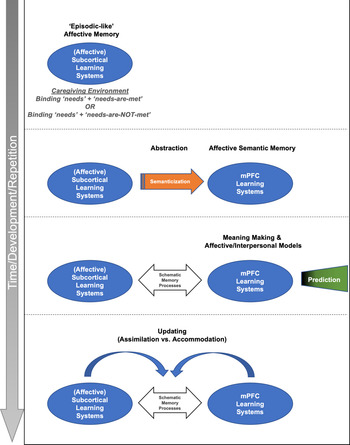
Given the nature of emotional processes and the “episodic-like” learning that is supported by subcortical neurobiology (with amygdala learning being a prime example), perhaps semanticizing processes in the affective domain do not depend on explicit, or conscious, processes. Affective learning can happen without conscious awareness (Raio, Carmel, Carrasco, & Phelps, Reference Raio, Carmel, Carrasco and Phelps2012), yet the learning can be robust and influence behavior. This is important since maltreatment experiences are more likely to occur prior to the onset of explicit memory; that is, the highest rate of victimization of children occurs in their first few years of life (U.S. Department of Health & Human Services & Administration on Children, 2020). Younger age is more likely associated with maltreatment and yet these early events can have enduring consequences on later brain function and behavior. Perhaps early affective (episodic-like) learning that is supported by subcortical systems, although not explicitly encoded or accessible, semanticizes in a similar manner to that described for explicit memory processes and consolidates within mPFC–subcortical circuitry development (see Figure 1). If this hypothesis were to receive support, it would anticipate the altered representation of affective schemas within these circuits following crEA exposure and the accompanying altered predictions that reflect the learned schematized content. Newly encountered information would either be assimilated into existing schematic structures (if consistent enough with predictions), or if it violated expectations strongly enough, could result in schematic accommodation.
Early caregiving adversity and neurobiological “meaning making.” Hypothesized model of medial prefrontal cortex (mPFC)–subcortical circuitry involved in caregiving-related meaning making and prediction. Time/Development/Repetition runs from top to bottom. Earlier developing affective subcortical learning systems bind information about the caregiving environment. Note that the “episodic-like” affective memories do not require explicit memory processes. With repeated instances, time, and brain development, these memories are abstracted from their original contexts and semanticized into schema-based memories supported by connections between mPFC and subcortical regions. The “meaning making” supported by these schematic structures generate predictions about newly encountered stimuli. The bottom panel shows how newly encountered information will either be assimilated into existing schematic structures or will violate the structures enough to lead to schematic accommodation.

mPFC–subcortical Connections are Involved in Schema-based Prediction
A major function of schema-based representations based in mPFC–subcortical circuitry is giving rise to predictions about the world. Roy et al. (Reference Roy, Shohamy and Wager2012) argue that meaning making occurs when the mPFC synthesizes information into a gestalt representation of how an individual is situated in the environment, which then drives predictions about future events. For example, the facilitating effects of priming an individual with a picture of an apple on the ability to predict the word “apple” coincide with increased mPFC activity (Dikker & Pylkkanen, Reference Dikker and Pylkkanen2013). Similarly, temporarily disrupting function of mPFC via transcranial magnetic stimulation disrupts the priming effect of a word like “happy” on the recognition of a subsequent happy face (Mattavelli, Cattaneo, & Papagno, Reference Mattavelli, Cattaneo and Papagno2011). In her embodied predictive interoception coding hypothesis, Feldman-Barrett has proposed that the mPFC, due to its agranular neural composition, helps generate predictions (together with other visceromotor centers) to modulate attentional, sensory and behavioral responses to “homoestatically relevant” stimuli (Barrett & Simmons, Reference Barrett and Simmons2015). According to this view, predictions are made not only about encountered stimuli, but predictions generated by the affective impact of similar sensations from the past (i.e., memory) will bias even the initial perception of the stimuli. There is an established literature demonstrating memory's influence on future behavior and decision making (Duncan & Shohamy, Reference Duncan and Shohamy2016), and in the domain of affective schemas, the memories may be remote, emotional, and not necessarily explicitly accessible (Thimm, Reference Thimm2010). By this logic, early developing representations are abstracted from past experiences and compute the anticipated regularities of the current environment to guide future socio–emotional behaviors, representations, and thoughts.
Schematic Memory from Early Caregiving Guides Prediction
The recognition that early experiences produce a memory trace that guides future social and affective behavior is central to Bowlby's construct of the “internal working model” (Bowlby, Reference Bowlby1969; Bretherton, Reference Bretherton1992). He defined internal models’ function as the cognitive and affective maps (beliefs/schemas) about interpersonal relationships, which are accessed “to transmit, store, and manipulate information that helps making predictions as to how set-goals (of attachment) can be achieved” (p. 80). That is to say, early attachment relationships produce inter- and intra-personal affective predictions; recent neuroscientific advances might suggest that they are doing so via development of mPFC–subcortical circuitry.
As explained by Bretherton (Reference Bretherton1992), within an individual's internal working model of the world, models of self and caregiver are especially salient. In infancy, all primary needs (hunger, temperature, hygiene, affect modulation) depend on a caregiver, for an infant cannot regulate these functions alone. It is established that infants readily detect patterns, perceive contingencies, anticipate future events, and generate predictions (Haith, Hazan, & Goodman, Reference Haith, Hazan and Goodman1988; Saffran & Kirkham, Reference Saffran and Kirkham2018). Therefore, a responsive caregiving environment that is sensitive to the needs of the infant should produce an association between the infant's needs and the responsiveness of the environment (and the agency that accompanies this association) – that is a “needs + needs-are-met” (i.e., regulation) association is learned. The individual is likely to develop an internal working model of self as valued and agentic. In contrast a nonresponsive and/or harsh caregiving environment is an environment that fails to regulate the infant, and therefore produces the association between “infant's needs” to a rule of “nonregulation.” Over time and repetition, these “episodic-like” associations may semanticize into schematic working models, generating predictions about the attachment figure's likely behavior and predictions about the affective world more generally. Attachment theory holds that these predictions (i.e., the internal working model) carry forward with the individual into adolescence and adulthood and are applied to subsequent interpersonal and emotional encounters. The content knowledge learned and stored in the internal working model is therefore of great consequence to future affective development (Bretherton, Reference Bretherton1992). Note that there is nothing about the neuroscientific perspective presented in this paper that precludes the notion that multiple caregivers can contribute to schematic representations. In fact, it is possible that neuroscientific tools may provide insight into questions such as “In the context of multiple caregivers, is one caregiver the predominant cue for model development? Are multiple, parallel representations of each caregiver generated? Are these representations “averaged” across caregivers? Does the neurobiology construct a single “caregiving” model that considers, weights, and represents cues from all caregivers?”.
Putting it all Together: Bridging Caregiving-related Schemas and mPFC–subcortical Circuitry Meaning Making
Although Bowlby's ideas emerged prior to the advent of the field of cognitive neuroscience, there are striking parallels between the conceptualization of the internal working model and the meaning making functions of mPFC–subcortical connections. I lay out here the possible mechanisms by which mPFC–subcortical circuitry supports caregiving-constructed schemas. Developing subcortical regions may support learning during the “episodes” that link infant's needs to the likelihood of receiving regulation from the caregiving environment, much in the manner as has been described for other types of affective learning (see Roy et al., Reference Roy, Shohamy and Wager2012). Over time and with repeated instances, information from the discrete events is lost, while the abstracted information “semanticizes” and through a consolidation process, the semanticized-level schemas become maintained within the connections between subcortical regions and mPFC (see Figure 1). The abstracted rules supported by mPFC and its subcortical connections then guide predictions (about stimuli, actions, value, etc.) that are activated for subsequently encountered affective stimuli.
Further motivation for drawing this parallel comes from studies showing that caregiving-constructed schemas share characteristics with and operate with similar parameters as cognitive schemas. For example, infants will exhibit violations in expectations (as measured by looking time) when presented with “attachment” scenes that are inconsistent with their established predictions (Johnson, Dweck, & Chen, Reference Johnson, Dweck and Chen2007; Johnson et al., Reference Johnson, Dweck, Chen, Stern, Ok and Barth2010). In addition to producing prediction errors, individual differences in attachment schemas have been shown to bias attention in a schema-consistent manner (Kirsh & Cassidy, Reference Kirsh and Cassidy1997). Attachment schemas have also been shown to predict memory biases for recalling positively versus negatively-valenced information in a schema-consistent manner (Belsky, Spritz, & Crnic, Reference Belsky, Spritz and Crnic1996). Taken together, the behavioral properties of caregiving-constructed schemas are strikingly similar to cognitive schemas.
Parental cues activate mPFC–subcortical circuitry during development
The neurobiology of caregiving-constructed schemas may use the same substrates as those studied in schematic meaning-making. Consistent with the hypothesis that mPFC and its subcortical connections represent caregiving-constructed schemas, it has been shown that parents routinely engage mPFC and subcortical connections in their offspring across altricial species. For example, presentation of parental cues or parental presence itself has been shown to modulate mPFC, hypothalamus (Conner et al., Reference Conner, Siegle, McFarland, Silk, Ladouceur, Dahl and Ryan2012), amygdala (Dehaene-Lambertz et al., Reference Dehaene-Lambertz, Montavont, Jobert, Allirol, Dubois, Hertz-Pannier and Dehaene2010; Gee et al., Reference Gee, Gabard-Durnam, Telzer, Humphreys, Goff, Shapiro and Tottenham2014; Tottenham, Shapiro, Telzer, & Humphreys, Reference Tottenham, Shapiro, Telzer and Humphreys2012), as well as ventral striatum (Guassi Moreira & Telzer, Reference Guassi Moreira and Telzer2018; Telzer, Ichien, & Qu, Reference Telzer, Ichien and Qu2015) during human development. These cues also act to strengthen connectivity between these subcortical regions and the mPFC (Guassi Moreira & Telzer, Reference Guassi Moreira and Telzer2018), and strengthening between amygdala and mPFC is enhanced for children and adolescents with greater feelings of “security” with their parent (Gee et al., Reference Gee, Gabard-Durnam, Telzer, Humphreys, Goff, Shapiro and Tottenham2014). In rodents, parental cues specifically modulate activity in amygdala, striatum, hippocampus, and mPFC during development (Al Ain et al., Reference Al Ain, Perry, Nunez, Kayser, Hochman, Brehman and Sullivan2017; Bock, Riedel, & Braun, Reference Bock, Riedel and Braun2012; Moriceau & Sullivan, Reference Moriceau and Sullivan2005, Reference Moriceau and Sullivan2006; Ziabreva, Poeggel, Schnabel, & Braun, Reference Ziabreva, Poeggel, Schnabel and Braun2003). It is possible that these phasic activations to parental cues occurring in daily life are supporting the semanticizing process of interpersonal affective information. The learning of “episodic-like” affective associations with caregiving may be represented in low-level subcortical learning systems. Over repetition and time, these initially subcortical memories become semanticized, or transferred, to schematic abstractions represented by subcortical connections with mPFC (see Figure 1).
By this logic, in the context of early caregiving adversity, affective knowledge would also be constructed and supported within these circuits, but with altered content. This contention is supported by studies that demonstrate aberrant mPFC–subcortical responses to the parent – across multiple altricial species (rodents, monkeys, humans) – following early caregiving adversity. For example, crEA (via parental separation and institutional caregiving) is followed by atypical responding of the amygdala and mPFC to parental cues (Callaghan et al., Reference Callaghan, Gee, Gabard-Durnam, Telzer, Humphreys, Goff and Tottenham2019b; Olsavsky et al., Reference Olsavsky, Telzer, Shapiro, Humphreys, Flannery, Goff and Tottenham2013). Rodent models of both abuse (fear conditioning) and insufficient bedding paradigms (which increase abusive physical treatment and decreased time with mother) have similarly been associated with altered neural responses to the mother in pups (Opendak et al., Reference Opendak, Theisen, Blomkvist, Hollis, Lind, Sarro and Sullivan2020; Raineki, Cortés, Belnoue, & Sullivan, Reference Raineki, Cortés, Belnoue and Sullivan2012; Robinson-Drummer et al., Reference Robinson-Drummer, Opendak, Blomkvist, Chan, Tan, Delmer and Sullivan2019) – typically alterations in amygdala function appear developmentally earlier, which is then followed by aberrant responses in the mPFC responses at older ages (Robinson-Drummer et al., Reference Robinson-Drummer, Opendak, Blomkvist, Chan, Tan, Delmer and Sullivan2019). This last finding is consistent with the model presented in Figure 1 showing that the parental cue activates subcortical learning systems developmentally earlier than mPFC. In fact, one rodent study showed that when stress is specifically associated with the parent, the amygdala is most likely to be uniquely targeted at young ages (Raineki et al., Reference Raineki, Opendak, Sarro, Showler, Bui, McEwen and Sullivan2019). It has been previously suggested that these aberrant responses to parents following early caregiving adversity might be the result of truncated sensitive periods for these neural circuits (Gee et al., Reference Gee, Gabard-Durnam, Flannery, Goff, Humphreys, Telzer and Tottenham2013; Miller et al., Reference Miller, Ho, Humphreys, King, Foland-Ross, Colich and Gotlib2020), which would prematurely terminate parental effects on developing neurobiology (Callaghan & Tottenham, Reference Callaghan and Tottenham2016; Callaghan et al., Reference Callaghan, Gee, Gabard-Durnam, Telzer, Humphreys, Goff and Tottenham2019b), and there is strong support from the rodent literature of adversity-related accelerated development in mPFC–subcortical development (Bath, Manzano-Nieves, & Goodwill, Reference Bath, Manzano-Nieves and Goodwill2016; Callaghan & Richardson, Reference Callaghan and Richardson2011, Reference Callaghan and Richardson2012, Reference Callaghan and Richardson2014; Honeycutt et al., Reference Honeycutt, Demaestri, Peterzell, Silveri, Cai, Kulkarni and Brenhouse2020; Moriceau, Shionoya, Jakubs, & Sullivan, Reference Moriceau, Shionoya, Jakubs and Sullivan2009; Ono et al., Reference Ono, Kikusui, Sasaki, Ichikawa, Mori and Murakami-Murofushi2008). At the level of meaning making, these neurobiological differences may reflect differences in affective knowledge following adverse caregiving. For an infant or young child in the care of a harsh and/or nonresponsive caregiving environment, they experience an environment that fails to regulate their needs (albeit through potentially different channels for physical vs emotional maltreatment). As noted by Beebe and Steele (Reference Beebe and Steele2013), because infants are highly sensitive to ways that their behaviors are contingently responded to (Beebe et al., Reference Beebe, Jaffe, Markese, Buck, Chen, Cohen and Feldstein2010; DeCasper & Carstens, Reference DeCasper and Carstens1981), caregiving environments that include overstimulation, intrusiveness, inconsistency, or particularly high or low levels of responsiveness, predict insecure outcomes (Feldman, Reference Feldman2007; Isabella & Belsky, Reference Isabella and Belsky1991; Jaffe, Beebe, Feldstein, Crown, & Jasnow, Reference Jaffe, Beebe, Feldstein, Crown and Jasnow2001; Malatesta, Culver, Tesman, & Shepard, Reference Malatesta, Culver, Tesman and Shepard1989). That is, associations between “needs” and “nonregulation” (or as Bowlby called it a “comfortless” environment; Bowlby, Reference Bowlby1973) strengthen for the developing infant. These learned affective associations with “nonregulation” should be represented in low-level subcortical learning systems, and over repetition and time, their abstractions will become semanticized and consolidated into representations within subcortical connections with mPFC (Figure 1).
Common Affective Meaning Making Despite Experiential Heterogeneity?
In humans, it is challenging to isolate subtypes of maltreatment that any one child experiences in part because maltreatment subtypes typically co-occur and in part because some subtypes are more “invisible” than others (e.g., emotional maltreatment might be more difficult to measure than physical maltreatment; Wolfe & McGee, Reference Wolfe and McGee1994), despite emotional maltreatment's highly pernicious nature and its high comorbidity with most other forms of maltreatment (Spinazzola et al., Reference Spinazzola, Hodgdon, Liang, Ford, Layne, Pynoos and Kisiel2014). In addition, adversities related to the quality of parent–child relationships are frequently combined with those adversities that, although highly detrimental to child development, may not be directly associated with parent–child relationship quality (e.g., poverty, community violence, failure to provide). (Note that “failure to provide” is debatable here; while failure to provide adequate food, hygiene, clothing, shelter, medical care, and so on undoubtedly represents poor care of the child, it is yet unclear whether these acts disrupt the parent–child relationship in the same way as other crEAs.) Moreover, an added difficulty is the different definitions and interpretations (although well motivated) that researchers can have for subtypes – for example, some papers might consider both acts of emotional commission and omission as “emotional abuse” (Kaufman & Cicchetti, Reference Kaufman and Cicchetti1989), whereas other papers might combine emotional neglect with physical neglect (see Norman et al., Reference Norman, Byambaa, De, Butchart, Scott and Vos2012), while still others might have different interpretations all together (McGee, Wolfe, & Wilson, Reference McGee, Wolfe and Wilson1997). The current paper is not meant to address whether different subtypes or different dimensions have unique developmental outcomes (e.g., Manly, Kim, Rogosch, & Cicchetti, Reference Manly, Kim, Rogosch and Cicchetti2001; McLaughlin, Sheridan, & Lambert, Reference McLaughlin, Sheridan and Lambert2014; Wolfe & McGee, Reference Wolfe and McGee1994) – surely there will be unique patterns of outcomes linked to specific experiences (see McLaughlin et al., Reference McLaughlin, Sheridan and Lambert2014). Instead, I ask whether at the same time that we can appreciate experience-specific outcomes of adverse caregiving, we can simultaneously appreciate that there can be parallel processes of developmental equifinality when it comes to affective meaning making (Cicchetti & Blender, Reference Cicchetti and Blender2004; Cicchetti & Rogosch, Reference Cicchetti and Rogosch1996; Hanson, Nacewicz, et al., Reference Hanson, Nacewicz, Sutterer, Cayo, Schaefer, Rudolph and Davidson2015c; Tottenham, Reference Tottenham2020). Developmental equifinality describes similar developmental endpoints arising from dissimilar starting points. That is, two children who experience seemingly different forms of caregiving maltreatment, may nonetheless share a final common pathway in terms of the meaning they extract from experiences of adverse care. Equifinality's complementary process, multifinality, describes two children having the same experience yet exhibiting different outcomes. Perhaps meaning making following similar experiences also contributes to our understanding of multifinality.
The notion that crEAs can lead to the differential construction of affective schemas has been supported by extensive literature (Cicchetti, Reference Cicchetti2002; Cicchetti & Doyle, Reference Cicchetti and Doyle2016), as has the notion that affective schemas increase or decrease vulnerability for mental health problems (Ayduk, Downey, & Kim, Reference Ayduk, Downey and Kim2001) For example, what have been called maladaptive interpersonal affective schemas (Moosavian & Nejati, Reference Moosavian and Nejati2018) can develop into etiological factors for depression risk (Kendler, Hettema, Butera, Gardner, & Prescott, Reference Kendler, Hettema, Butera, Gardner and Prescott2003), poor use of social support (Brown, Andrews, Harris, Adler, & Bridge, Reference Brown, Andrews, Harris, Adler and Bridge1986), and a tendency toward subservience (Gilbert, Reference Gilbert2006). When examined during development, Ross and Hill (Reference Ross and Hill2002) as well as Cabeza de Baca, Barnett, and Ellis (Reference Cabeza de Baca, Barnett and Ellis2016) have described “unpredictability” schemas – a pervasive belief that people are unpredictable and the world is chaotic – as emerging from unpredictable family or neighborhood environments. Unpredictable environments during development have been strong predictors of later mental health problems (Baram et al., Reference Baram, Davis, Obenaus, Sandman, Small, Solodkin and Stern2012; Martin, Razza, & Brooks-Gunn, Reference Martin, Razza and Brooks-Gunn2012; Taylor, Lehman, Kiefe, & Seeman, Reference Taylor, Lehman, Kiefe and Seeman2006), perhaps in part because unpredictability itself is distressing for infants (Gunnar, Leighton, & Peleaux, Reference Gunnar, Leighton and Peleaux1984), whereas predictability provides some sense of control over the world (Mineka & Hendersen, Reference Mineka and Hendersen1985) which has been shown to have long-term benefits for socio–emotional development (Mineka, Gunnar, & Champoux, Reference Mineka, Gunnar and Champoux1986). An open question is whether such schemas arising from unpredictable environments are (a) schemas of unpredictability or (b) schemas with poor integrity (due to the difficulty in semantically abstracting reliable information from the world). Ross and Hill (Reference Ross and Hill2002) have argued that these schemas result in a constellation of beliefs and behaviors (e.g., external locus of control, low sense of mastery, pessimism, future discounting, diminished interpersonal trust, hostility, vigilance) that increase the risk for internalizing and externalizing problems. O'Dougherty Wright, Crawford, and Del Castillo (Reference Wright, Crawford and Del Castillo2009) provided evidence that maladaptive interpersonal schemas mediated the association between early emotional maltreatment (both emotional neglect and abuse) and internalizing symptoms in young adults.
If mPFC–subcortical connections support representations of nurturing and regulating caregiving-constructed schemas, then the argument goes that these connections also support representations of adverse, nonregulating caregiving-constructed schemas. Altered mPFC–subcortical circuit function is commonly associated with crEAs, as described earlier, and these neurobiological differences have been associated with the poor emotion regulation often observed in individuals with a history of crEA. Within the currently proposed theoretical framework, these altered activation patterns observed in emotion regulation neurobiology may reflect a “reactivation” of the established caregiving-constructed schema. That is, an early caregiving environment that does not regulate the infant's needs (either through acts of commission or omission) will result in the formation of “needs + needs-are-not-met” associations, and more complex abstractions from these simpler associations will ultimately transfer to and be supported by “meaning making” mPFC–subcortical circuitry. Subsequent affective and/or interpersonal provocations should reactivate the affective schematic memories, resulting in predictions about the current event informed by the schema-based memory. This schema-generated prediction manifests as what we typically call “poor emotion regulation.” There are several possible routes from adversity-related schemas to poor emotion regulation. For example, perhaps if schemas are constructed from early uncertainty, the individual cannot reliably draw on any one schema (because there is no firm/consistent/stable schema to draw on), and his/her own emotional behavior and the reaction from the world will be unpredictable. Alternatively (but not orthogonally), the predictions that dysregulation is a likely outcome of any affective homeostatic imbalance may bias the individual towards expectations of negative affect and poor emotion regulation.
Schema-based Perspectives Generate New Hypotheses/Questions and Provide Additional Understanding
This theoretical perspective on mPFC–subcortical circuitry generates several hypotheses/questions about behavior following crEAs. For example, can schema-based patterns be identified in mPFC–subcortical circuitry as reflecting caregiving histories? Would prediction errors operate in the same way to update learning when schema-inconsistent information is encountered?
Consideration of schema-based knowledge might provide an additional level of understanding for the poor learning and decision making that is sometimes observed following a history of early adversity. For example, maltreatment has been associated with poor reinforcement learning. Guyer et al. (Reference Guyer, Kaufman, Hodgdon, Masten, Jazbec, Pine and Ernst2006) have shown that children exposed to crEAs were less likely to alter behavior in response to reward likelihood; Hanson et al. (Reference Hanson, van den Bos, Roeber, Rudolph, Davidson and Pollak2017) have shown that physical abuse is associated with poorer associative learning in a probabilistic reward learning task; using the “Pinata Task” researchers have shown that institutional care was associated with less likelihood of modulating behavior as a function of reward (Sheridan et al., Reference Sheridan, McLaughlin, Winter, Fox, Zeanah and Nelson2018); and food insecurity (although not considered a type of crEA in the context of the current paper) has been associated with lower reward performance, as indicated by a smaller total number of stars earned (Dennison et al., Reference Dennison, Rosen, Sambrook, Jenness, Sheridan and McLaughlin2019). At the same time that early adversity tends to be linked with weaker associative learning of rewards with cues, its role in aversive conditioning is less consistent, and at times shows enhancements. Fear-learning behavior (discriminating a dangerous from a safe cue) does not differ between youth with a history of institutional care and those without (Silvers et al., Reference Silvers, Lumian, Gabard-Durnam, Gee, Goff, Fareri and Tottenham2016); similarly, children (Jovanovic et al., Reference Jovanovic, Nylocks, Gamwell, Smith, Davis, Norrholm and Bradley2014) and adults with a history of a broad range of traumas (including those unrelated to caregiving) also discriminated cues in a fear-learning task (Norrholm et al., Reference Norrholm, Jovanovic, Olin, Sands, Karapanou, Bradley and Ressler2011). Posttraumatic stress disorder symptoms were associated with even better discrimination in female children (Gamwell et al., Reference Gamwell, Nylocks, Cross, Bradley, Norrholm and Jovanovic2015) and resistance to updating in adulthood (i.e., less amenable to extinction) (Gamwell et al., Reference Gamwell, Nylocks, Cross, Bradley, Norrholm and Jovanovic2015). Children recruited from a high-risk sample (due to a range of trauma exposure including those unrelated to caregiving) showed poor discrimination of fear cues, whereas maternal availability enhanced children's discrimination (van Rooij et al., Reference van Rooij, Cross, Stevens, Vance, Kim, Bradley and Jovanovic2017). In a sample of children and adolescents ranging in age from 6–18 years-old, poor fear conditioning was observed following a history of physical abuse, sexual abuse, and/or domestic violence (McLaughlin et al., Reference McLaughlin, Sheridan, Gold, Duys, Lambert, Peverill and Pine2016). However, 4–7 year-old children exposed to violence (i.e., threats in the form of physical abuse, domestic violence, and community violence) exhibited fear learning, perhaps even better at earlier ages than a low-exposure group (Machlin, Miller, Snyder, McLaughlin, & Sheridan, Reference Machlin, Miller, Snyder, McLaughlin and Sheridan2019). These authors raise the possibility that early exposure to such threats may accelerate fear learning at early ages.
This pattern of results is potentially consistent with the notion that affective schematic structures bias attention and learning in schema-consistent ways. If so, then prediction error learning will be biased (either impaired or facilitated) based on the priors that differ for individuals with a history of early adversity. Through several experiments, Pollak and colleagues have shown that children with a history of physical abuse exhibit attentional biases reflecting environmentally-sculpted priors. Namely, physical abuse has been associated with a greater likelihood of attributing anger to emotional faces (Pollak, Cicchetti, Hornung, & Reed, Reference Pollak, Cicchetti, Hornung and Reed2000), requiring less perceptual information to identify angry faces (Pollak & Sinha, Reference Pollak and Sinha2002), greater selective attention for angry faces (Pollak & Tolley-Schell, Reference Pollak and Tolley-Schell2003), and greater attention to angry faces and voices (Shackman, Shackman, & Pollak, Reference Shackman, Shackman and Pollak2007). These studies from Pollak and colleagues highlight an important aspect of experimental design when examining the schematic priors that participants possess; these studies include multiple affective conditions, which allows for the examination of statistical interactions (i.e., physically abused children were not globally impaired, but instead showed enhanced recognition of angry faces, and diminished recognition of sad faces); note also that neglected children did show global impairments, theoretically reflecting their weak priors about facial expressions. The interaction effect supports the notion that crEA-related schemas generate specific predictions about encountered socio–emotional stimuli, rather than a global processing deficit. Condition X Group dissociations should continue to be investigated in future studies to identify how pre-existing schemas might generate experience-unique predictions.
Individuals who experience crEAs are at risk for an exaggerated distrust of others (Holmes & Lyons-Ruth, Reference Holmes and Lyons-Ruth2006). Might mPFC–subcortical-based schemas be generating predictions of distrust? At face value, this weak “trust” schema (trust in other people, the self, and the world) could contribute to increased anxiety/depression, decreased regulatory control, and altered decision making under conditions of uncertainty (e.g., risk taking). Some authors have described risk taking as the most proximal behavioral outcome or expression of trust in the environment (Colquitt, Scott, & LePine, Reference Colquitt, Scott and LePine2007). Using the balloon analogue risk taking task (Lejuez et al., Reference Lejuez, Read, Kahler, Richards, Ramsey, Stuart and Brown2002), Loman, Johnson, Quevedo, Lafavor, and Gunnar (Reference Loman, Johnson, Quevedo, Lafavor and Gunnar2014) found that both institutional caregiving and foster caregiving were associated with decreased risk taking; within the post-institutionalized youth, decreased risk-taking was associated with greater conduct problems and depression symptoms. Herzberg et al. (Reference Herzberg, Hodel, Cowell, Hunt, Gunnar and Thomas2018) also found that adolescents adopted at older ages were less risk taking on this task, which was associated with structural differences in mPFC (i.e., anterior cingulate cortex). On this same task, Kopetz et al. (Reference Kopetz, Woerner, MacPherson, Lejuez, Nelson, Zeanah and Fox2019) again observed decreased risk taking, which was not ameliorated by moving from institutional care to family-based care. Humphreys et al. (Reference Humphreys, Lee, Telzer, Gabard-Durnam, Goff, Flannery and Tottenham2015) examined risky choices during a modified version of this task (with experimental conditions that varied by “harshness”). Youth with a history of institutional caregiving were less risk taking – that is, they tended to cash in accumulated earnings earlier, which hindered earnings under “less harsh” conditions (i.e., one that allowed for greater exploration) but benefitted their earnings under “harsh” conditions. This replicable pattern of decreased risk taking is consistent with a schema of distrust. Decreased trust behaviors were again identified in a trust game for adolescents with a history of institutional caregiving, who “shared” fewer coins with a peer in a trust game and were more likely to quickly adapt their sharing behavior to peers’ defections and reciprocations (Pitula, Wenner, Gunnar, & Thomas, Reference Pitula, Wenner, Gunnar and Thomas2017). The authors speculate on the “assumptions” of untrustworthiness that the adolescents with a history of institutional care might have had during the game. When the trust of the environment is called into question, children are more likely to prioritize immediate reinforcement (over delayed) (Kidd, Palmeri, & Aslin, Reference Kidd, Palmeri and Aslin2013; Ma, Chen, Xu, Lee, & Heyman, Reference Ma, Chen, Xu, Lee and Heyman2018; Moffett, Flannagan, & Shah, Reference Moffett, Flannagan and Shah2020). This delayed discounting can contribute to behavior that appears impulsive and poorly controlled in individuals exposed to adverse early caregiving (e.g., Ellis & Del Giudice, Reference Ellis and Del Giudice2014; Hostinar, Stellern, Schaefer, Carlson, & Gunnar, Reference Hostinar, Stellern, Schaefer, Carlson and Gunnar2012).
The current framework also generates hypotheses about whether schematic representations in mPFC–subcortical circuitry provide additional, more meaning-making explanations for the longer term emotional/social difficulties following crEA exposure (Hanson, Nacewicz, et al., Reference Hanson, Nacewicz, Sutterer, Cayo, Schaefer, Rudolph and Davidson2015c; Humphreys et al., Reference Humphreys, Gabard-Durnam, Goff, Telzer, Flannery, Gee and Tottenham2019; Thomason & Marusak, Reference Thomason and Marusak2017; VanTieghem & Tottenham, Reference VanTieghem and Tottenham2017). The risk for long-term mental health problems are apparent even once the adverse caregiving environment is removed (for a review, see Golm et al., Reference Golm, Maughan, Barker, Hill, Kennedy, Knights and Sonuga-Barke2020; Gunnar, Reference Gunnar, Nelson and Luciana2001). There is some evidence that the longer-term mental health problems following crEAs are mediated by developmental cascades involving subsequent life challenges (e.g., peer relationships, negative life events) (Golm et al., Reference Golm, Maughan, Barker, Hill, Kennedy, Knights and Sonuga-Barke2020). Does the likelihood of experiencing these mediating factors vary depending on one's interpretations and predictions about the world? Which mental health problems might be associated with these affective schemas generated by crEAs – only attachment-related behaviors? Internalizing problems? Externalizing problems? Axis II personality disorders?
Might other forms of childhood adversity (non-caregiving related) also generate or contribute to existing affective schemas? Most likely the answer to this question will be that they do. Future work could address whether there is some priority of one-type of schema over another depending on the affective contexts that activated the schema. Future work could also address whether caregiving-generated schemas influence the nature and development of these other adversity-related schemas.
Finally, there is the question of neuroplasticity and schema accommodation. First, is there a sensitive period for the construction of these mPFC–subcortical-based schemas? There is evidence of sensitive periods for environmental influence on these neural substrates (Andersen et al., Reference Andersen, Tomada, Vincow, Valente, Polcari and Teicher2008; Pechtel, Lyons-Ruth, Anderson, & Teicher, Reference Pechtel, Lyons-Ruth, Anderson and Teicher2014). Might these data provide additional guideposts for studies examining moments of plasticity for mPFC–subcortical caregiving-related schemas? Once these schemas are constructed, can they be accommodated by schema-incongruent information? If so, how many presentations of incongruent information or how potent does the new information need to be for accommodation? This question has significant implications for interventions targeting mental health problems following crEA exposure. High quality family experiences are important for socio–emotional development of all children, but it may be especially important for children with a history of crEA exposure (e.g., Callaghan et al., Reference Callaghan, Gee, Gabard-Durnam, Telzer, Humphreys, Goff and Tottenham2019b; DePasquale, Raby, Hoye, & Dozier, Reference DePasquale, Raby, Hoye and Dozier2018; Koss, Lawler, & Gunnar, Reference Koss, Lawler and Gunnar2020; Vantieghem et al., Reference Vantieghem, Gabard-Durnam, Goff, Flannery, Humphreys, Telzer and Tottenham2017), and adoptive and foster parent support groups often discuss the notion of needing to parent their children “differently.” Sattler and Font (Reference Sattler and Font2018) showed that at-risk children may need especially supportive environments to overcome the risks that they experience, perhaps reflecting the significant challenge of accommodating mPFC–subcortical-based schemas constructed from adverse caregiving experiences. Cues related to caregiving can vary in their potency. For example, Seltzer, Ziegler, and Pollak (Reference Seltzer, Ziegler and Pollak2010) showed that while maternal cues (both voice-only contact and voice + physical + nonverbal contact) were effective in increasing oxytocin metabolites in children during a stressor, the full complement of voice + physical + nonverbal comfort resulted in the swiftest return to baseline of a the stress-related hormone (cortisol). Relatedly, Ditzen et al. (Reference Ditzen, Neumann, Bodenmann, von Dawans, Turner, Ehlert and Heinrichs2007) showed that voice of a male partner alone was not enough to reduce cortisol and heart rate during a stressor in women, while touch did. There is evidence that more potent cues can be especially important in higher-risk samples; Lougheed, Koval, and Hollenstein (Reference Lougheed, Koval and Hollenstein2016) showed that mothers’ touch was especially effective in reducing their daughters’ stress-activated autonomic nervous system arousal in dyads with lower relationship quality. In support of this idea, large improvements in the caregiving environment has significant impact on mental health of children, often mediated through attachment-processes (Fisher & Kim, Reference Fisher and Kim2007; Hostinar & Gunnar, Reference Hostinar and Gunnar2015; Lind, Lee Raby, Caron, Roben, & Dozier, Reference Lind, Lee Raby, Caron, Roben and Dozier2017; McLaughlin, Zeanah, Fox, & Nelson, Reference McLaughlin, Zeanah, Fox and Nelson2012) and associated neural circuitry (Callaghan et al., Reference Callaghan, Gee, Gabard-Durnam, Telzer, Humphreys, Goff and Tottenham2019b). These results showing that strong families help ameliorate mental health outcomes for children exposed to prior crEAs provide additional support for the idea that caregiving related schemas can be modified by new affective information, perhaps through a mechanism involving prediction error learning.
Concluding Remarks
Early adverse caregiving is one of the leading (and theoretically preventable) causes of mental health problems around the globe, and neuroscientific advances have revealed the neurobiological targets of these experiences. While examination of brain–behavior associations have traditionally focused on affective processes supported by adversity-related differences in mPFC–subcortical circuitry, here I address the affective knowledge content. The current paper asks about the semantic level knowledge that is supported by adversity-related differences in mPFC–subcortical circuitry. Specifically, it posits a hypothesis that developing mPFC–subcortical circuitry encodes semantic-level knowledge that reflects the early caregiving environment and by doing so, generates predictions and biases behavior in accordance with these memory structures. This hypothesis is motivated by research findings across four different lines of work that converge on mPFC–subcortical neuroanatomy, including the neurobiology of emotion regulation processes in adulthood, the neurobiology that is activated by caregiving cues during development, the neurobiology that is altered by early adverse caregiving, and the neurobiology of semantic-based meaning making.
Although this paper serves to raise questions, rather than answer them, there are already hints in the literature to support the notion that early caregiving environments play a central role in constructing mPFC–subcortical-based memory structures, whose predictions guide (at times maladaptive) socio–emotional behavior following early adverse caregiving. Nonetheless, future studies are clearly needed to characterize these neurobiologically-mediated memory structures and their knowledge content, how this knowledge generates neural predictions, and how this knowledge interacts with the affective processes (e.g., appraising, regulating) known to be targeted by early caregiving adversities. While there will be multitudes of experiences (beyond caregiving) that generate affective schemas for any one child, those related to caregiving may be a central and/or primary source. This level of understanding may also be useful in bridging the fields of cognitive neuroscience and learning together with clinical practice. For example, might information gleaned about the neural bases of prediction error driven learning, mPFC-updating, and semantic retrieval be leveraged to change affective schemas and personal narratives that are constructed from adversity? Conversely, might clinical science and practice inform models in cognitive neuroscience about the plasticity, content, and ecological parameters of affective schemas? Understanding the developmental mechanisms that contribute to mPFC–subcortical meaning making may reveal more answers about how to accommodate these processes following exposures to early adverse caregiving.
Acknowledgments
The author would like to acknowledge Megan Gunnar for the many thoughtful conversations that have generated ideas in this work and Adriana Galvan for her helpful reviewing and edits on this manuscript. The content is solely the responsibility of the authors and does not necessarily represent the official views of the National Institute of Mental Health.
Funding Statement
This work was supported by National Institutes of Mental Health grant R01MH091864.
Conflicts of Interest
None.