Impairments in cognitive functioning are a core feature of schizophrenia with deficits seen throughout the course of illness including at the first episode (Barch et al. Reference Barch, Carter, Braver, Sabb, MacDonald, Noll and Cohen2001; Bilder et al. Reference Bilder, Goldman, Robinson, Reiter, Bell, Bates and Lieberman2000; Mesholam-Gately, Giuliano, Goff, Faraone, & Seidman, Reference Mesholam-Gately, Giuliano, Goff, Faraone and Seidman2009; Saykin et al. Reference Saykin, Shtasel, Gur, Kester, Mozley, Stafiniak and Gur1994) and in adults with chronic schizophrenia (Barch & Ceaser, Reference Barch and Ceaser2012; Fioravanti, Carlone, Vitale, Cinti, & Clare, Reference Fioravanti, Carlone, Vitale, Cinti and Clare2005; Green, Kern, Braff, & Mintz, Reference Green, Kern, Braff and Mintz2000; Nuechterlein et al. Reference Nuechterlein, Barch, Gold, Goldberg, Green and Heaton2004). Impairments are consistently reported in a broad range of cognitive domains including processing speed, verbal learning, working memory, cognitive control, visual integration and reinforcement learning (Butler, Silverstein, & Dakin, Reference Butler, Silverstein and Dakin2008; Dickinson, Ramsey, & Gold, Reference Dickinson, Ramsey and Gold2007; Gold et al. Reference Gold, Waltz, Matveeva, Kasanova, Strauss, Herbener and Frank2012; Lee & Park, Reference Lee and Park2005; Lesh, Niendam, Minzenberg, & Carter, Reference Lesh, Niendam, Minzenberg and Carter2011; Macdonald & Carter, Reference Macdonald and Carter2003; Minzenberg, Laird, Thelen, Carter, & Glahn, Reference Minzenberg, Laird, Thelen, Carter and Glahn2009; Silverstein, Kovács, Corry, & Valone, Reference Silverstein, Kovács, Corry and Valone2000). The relationship between antipsychotic medications and cognitive functioning has been examined (Goldberg et al. Reference Goldberg, Goldman, Burdick, Malhotra, Lencz, Patel and Robinson2007; Harvey & Keefe, Reference Harvey and Keefe2001; Keefe et al. Reference Keefe, Bilder, Davis, Harvey, Palmer, Gold and Lieberman2007a; Mishara & Goldberg, Reference Mishara and Goldberg2004) with research suggesting that medications currently and commonly prescribed to individuals with schizophrenia have either minimally beneficial (Goldberg et al. Reference Goldberg, Goldman, Burdick, Malhotra, Lencz, Patel and Robinson2007; Keefe et al. Reference Keefe, Sweeney, Gu, Hamer, Perkins, McEvoy and Lieberman2007b; Lesh et al. Reference Lesh, Tanase, Geib, Niendam, Yoon, Minzenberg and Carter2015; Meltzer & McGurk, Reference Meltzer and McGurk1999; Spagna et al. Reference Spagna, Dong, Mackie, Li, Harvey, Tian and Fan2015) or potentially even slightly deleterious effects on cognitive performance (Élie et al. Reference Élie, Poirier, Chianetta, Durand, Grégoire and Grignon2010; Hori et al. Reference Hori, Noguchi, Hashimoto, Nakabayashi, Omori, Takahashi and Kunugi2006; Spohn & Strauss, Reference Spohn and Strauss1989; Uchida et al. Reference Uchida, Rajji, Mulsant, Kapur, Pollock, Graff-Guerrero and Mamo2009). However, limited work has examined reinforcement learning and visual integration in those off medications. Moreover, limited work has examined the degree to which cognitive impairments are present among unmedicated individuals with chronic schizophrenia using cognitive tasks derived from cognitive neuroscience. The current study, conducted as part of the Cognitive Neuroscience Test Reliability and Clinical applications for Serious mental illness (CNTRaCS) Consortium, examined whether pervasive deficits in cognitive functioning are seen in individuals off as well as on medications across a wide range of cognitive domains.
A number of studies have confirmed the presence of impairments among individuals not taking medications on measures of memory, processing speed and cognitive control (Barch, Carter, MacDonald, Braver, & Cohen, Reference Barch, Carter, MacDonald, Braver and Cohen2003; Braff & Saccuzzo, Reference Braff and Saccuzzo1982; Cadenhead et al. Reference Cadenhead, Geyer, Butler, Perry, Sprock and Braff1997). However, there is limited work examining individuals with schizophrenia off medications in other cognitive domains impaired in schizophrenia, such as reinforcement learning. For example, research has shown impairments in the ability to learn from reward in medicated schizophrenia patients (Barch et al. Reference Barch, Carter, Gold, Johnson, Kring, MacDonald and Strauss2017; Cicero, Martin, Becker, & Kerns, Reference Cicero, Martin, Becker and Kerns2014; Culbreth, Westbrook, Xu, Barch, & Waltz, Reference Culbreth, Westbrook, Xu, Barch and Waltz2017; Dowd, Frank, Collins, Gold, & Barch, Reference Dowd, Frank, Collins, Gold and Barch2016; Gold et al. Reference Gold, Waltz, Matveeva, Kasanova, Strauss, Herbener and Frank2012; Murray et al. Reference Murray, Cheng, Clark, Barnett, Blackwell, Fletcher and Jones2008; Strauss et al. Reference Strauss, Frank, Waltz, Kasanova, Herbener and Gold2011; Waltz, Frank, Robinson, & Gold, Reference Waltz, Frank, Robinson and Gold2007), however, less is known about reinforcement learning in unmedicated patients. Reinforcement learning is thought to be critically dependent on the subcortical dopamine system (Maia, Reference Maia2009; Montague, Dayan, & Sejnowski, Reference Montague, Dayan and Sejnowski1996; Schultz, Reference Schultz2007, Reference Schultz2016a, Reference Schultz2016b), which is modulated by many, if not all, of the medications used to treat psychosis (Amato, Vernon, & Papaleo, Reference Amato, Vernon and Papaleo2018). There are some hints in the literature that reinforcement learning is disrupted even among unmedicated individuals with schizophrenia (Juckel et al. Reference Juckel, Schlagenhauf, Koslowski, Wüstenberg, Villringer, Knutson and Heinz2006; Reinen et al. Reference Reinen, Van Snellenberg, Horga, Abi-Dargham, Daw and Shohamy2016; Schlagenhauf et al. Reference Schlagenhauf, Huys, Deserno, Rapp, Beck, Heinze and Heinz2014; Stoy et al. Reference Stoy, Schlagenhauf, Sterzer, Bermpohl, Hägele, Suchotzki and Ströhle2012), though sample sizes have been small. Thus, additional work is needed in larger samples to assess whether deficits in reinforcement learning are present amongst unmedicated individuals with schizophrenia, and if so, whether the magnitude of such deficits differs from those seen among medicated individuals with schizophrenia.
Visual integration is another domain of cognitive functioning that has consistently shown deficits in individuals with schizophrenia (Butler et al. Reference Butler, Abeles, Silverstein, Dias, Weiskopf, Calderone and Sehatpour2013; Butler, Silverstein, & Dakin, Reference Butler, Silverstein and Dakin2008; Silverstein et al. Reference Silverstein, All, Kasi, Berten, Essex, Lathrop and Little2010, Reference Silverstein, Berten, Essex, Kovacs, Susmaras and Little2009, Reference Silverstein, Harms, Carter, Gold, Keane, MacDonald and Barch2015, Reference Silverstein, Keane, Barch, Carter, Gold, Kovács and Strauss2011) demonstrating impairments in their ability to integrate visual stimulus elements into a unified visual representation. While the bulk of studies have included medicated individuals with schizophrenia, two studies examining unmedicated patients suggest that these impairments are evident in unmedicated patients as well (Frith, Stevens, Johnstone, Owens, & Crow, Reference Frith, Stevens, Johnstone, Owens and Crow1983; Keri, Kiss, Kelemen, Benedek, & Janka, Reference Keri, Kiss, Kelemen, Benedek and Janka2005). Moreover, studies examining the relationship between visual integration and chlorpromazine equivalence suggest that medication is independent of performance (Knight, Reference Knight, Walker, Dworkin and Cornblatt1992; Silverstein et al. Reference Silverstein, All, Kasi, Berten, Essex, Lathrop and Little2010, Reference Silverstein, Berten, Essex, Kovacs, Susmaras and Little2009; Spencer et al. Reference Spencer, Nestor, Perlmutter, Niznikiewicz, Klump, Frumin and McCarley2004). However, these studies have relatively small sample sizes and thus additional work is needed to confirm the presence of impairments in visual integration among unmedicated individuals with schizophrenia.
In addition to examining those individuals off medications, type of medication has also been examined. Treatment of schizophrenia often involves medications associated with a high anticholinergic burden. Anticholinergic medications can adversely affect learning and memory by blocking the muscarinic M1 acetylcholine receptors (Everitt & Robbins, Reference Everitt and Robbins1997; Seeger et al. Reference Seeger, Fedorova, Zheng, Miyakawa, Koustova, Gomeza and Wess2004; Tzavara et al. Reference Tzavara, Bymaster, Felder, Wade, Gomeza, Wess and Nomikos2003). Indeed research in aging and dementia populations taking anticholinergic medications supports this decrement in memory (Boustani, Campbell, Munger, Maidment, & Fox, Reference Boustani, Campbell, Munger, Maidment and Fox2008; Fox et al. Reference Fox, Richardson, Maidment, Savva, Matthews, Smithard and Brayne2011). Studies in schizophrenia suggest a similar pattern, wherein memory and attention deficits appear to worsen as anticholinergic burden increases (Calev, Reference Calev1984; Eum et al. Reference Eum, Hill, Rubin, Carnahan, Reilly, Ivleva and Bishop2017; Hitri, Craft, Fallon, Sethi, & Sinha, Reference Hitri, Craft, Fallon, Sethi and Sinha1987; Minzenberg, Poole, Benton, & Vinogradov, Reference Minzenberg, Poole, Benton and Vinogradov2004; Perlick, Stastny, Katz, Mayer, & Mattis, Reference Perlick, Stastny, Katz, Mayer and Mattis1986; Strauss, Reynolds, Jayaram, & Tune, Reference Strauss, Reynolds, Jayaram and Tune1990; Tracy, Monaco, Giovannetti, Abraham, & Josiassen, Reference Tracy, Monaco, Giovannetti, Abraham and Josiassen2001). In a double-blind study, Baker, Cheng, and Amara (Reference Baker, Cheng and Amara1983) found evidence that patients taken off anticholinergic medications for 2 weeks showed greater memory performance relative to those who remained on their original medication regiment, though memory performance was reduced relative to controls even among those not taking anticholinergics. Further, Vinogradov et al. (Reference Vinogradov, Fisher, Warm, Holland, Kirshner and Pollock2009) found that serum anticholinergic levels were associated with poorer performance on working memory and verbal learning and that anticholinergic serum level was associated with a lower response to cognitive remediation training. Thus, across studies, findings suggest that anticholinergic burden is associated with impaired memory, learning and attention and that medication withdrawal may result in improvements relative to those maintaining their original medication regime. Importantly, the bulk of these studies were limited to learning and attention batteries focused on neuropsychological tests. To our knowledge, there have been no studies examining relationships between anticholinergic status and reinforcement learning. Further, limited studies have examined this relationship across a battery of cognitive tasks developed from cognitive neuroscience.
The current study had several goals. The primary goal was to examine whether individuals with schizophrenia off medications, as well as those on anti-psychotic medications showed impairments relative to healthy controls across a wide array of cognitive domains in which people with schizophrenia have consistently demonstrated impairment, using behavioral tasks derived from the cognitive neuroscience literature. These domains included: reinforcement learning, visual integration, processing speed, verbal learning, working memory, cognitive control, visual integration and relational encoding and retrieval. As a secondary goal, we also examined associations between cognitive performance and anticholinergic burden.
Method
Participants
Participants were recruited across five sites as part of the CNTRaCS Consortium: Maryland Psychiatric Research Center, University of Maryland; University of California, Davis; Rutgers University; University of Minnesota, Twin Cities; and Washington University in St Louis. All participants provided written informed consent to the protocol approved by the local Institutional Review Board.
Participants included 148 medicated individuals with schizophrenia or schizoaffective disorder, 48 unmedicated individuals with schizophrenia or schizoaffective disorder (SZ) and 75 control participants (CON). Exclusion criteria included: (1) history of significant head trauma or neurological disease (2) history of the pervasive developmental disorder (3) diagnosis of substance dependence or abuse in the last 6 months (4) score below 6 on the Wechsler Test of Adult Reading [WTAR; (Wechsler, Reference Wechsler2001)] (5) failing a drug or alcohol screen administered the day of testing. Additional criteria for the medicated SZ group included no medication changes in the month prior to study participation. The unmedicated group was recruited from the community and consisted of people meeting inclusion criteria for the patient group. In addition, unmedicated participants were not required to be medication naïve, rather they self-reported that they had not taken medication for at least 1 month prior to their participation in the study. Additional criteria for CON included: (1) no personal or 1st degree relative with a history of schizophrenia, schizoaffective, or bipolar disorder; (2) no current major depression or dysthymia; and (3) no current psychotropic medication.
Diagnostic status was confirmed using the Structured Clinical Interview for DSM-IV-TR SCID conducted by masters-level clinicians. Individuals with SZ were also assessed for general psychiatric symptoms using the Brief Psychiatric Rating Scale (Overall & Gorham, Reference Overall and Gorham1962). Negative symptoms were assessed using the Clinical Assessment Interview for Negative Symptoms (CAINS) (Kring, Gur, Blanchard, Horan, & Reise, Reference Kring, Gur, Blanchard, Horan and Reise2013) which includes a Motivation and Pleasure (MAP) and Expression (EXP) subscale, with higher scores indicating greater impairment. To assess functioning, participants completed the UCSD-Performance-Based Skills Assessment (UPSA) (Harvey, Velligan, & Bellack, Reference Harvey, Velligan and Bellack2007) and the Specific Levels of Functioning Scale (SLOF) (Schneider & Struening, Reference Schneider and Struening1983) which includes both a self-report and informant report of those close to the participant. Only a subset of participants had informant data collected (Medicated = 100; Unmedicated = 21).
Chlorpromazine equivalency doses were calculated for each participant taking medications using published conversion formulas (Woods, Reference Woods2003). Anticholinergic load was based on Minzenberg et al. (Reference Minzenberg, Poole, Benton and Vinogradov2004) which includes two scales indexing anticholinergic load: a pharmacological index established from in vitro acetylcholine receptor bindings studies and a clinical index based on expert clinicians' ratings of anticholinergic side effects of medications. Both pharmacological and clinical index were calculated for each participant. Only findings based on the Clinical Index are reported in the current study; however, the two indices were highly correlated (r = 0.81, p < 0.001) and the same pattern of findings was observed using either index.
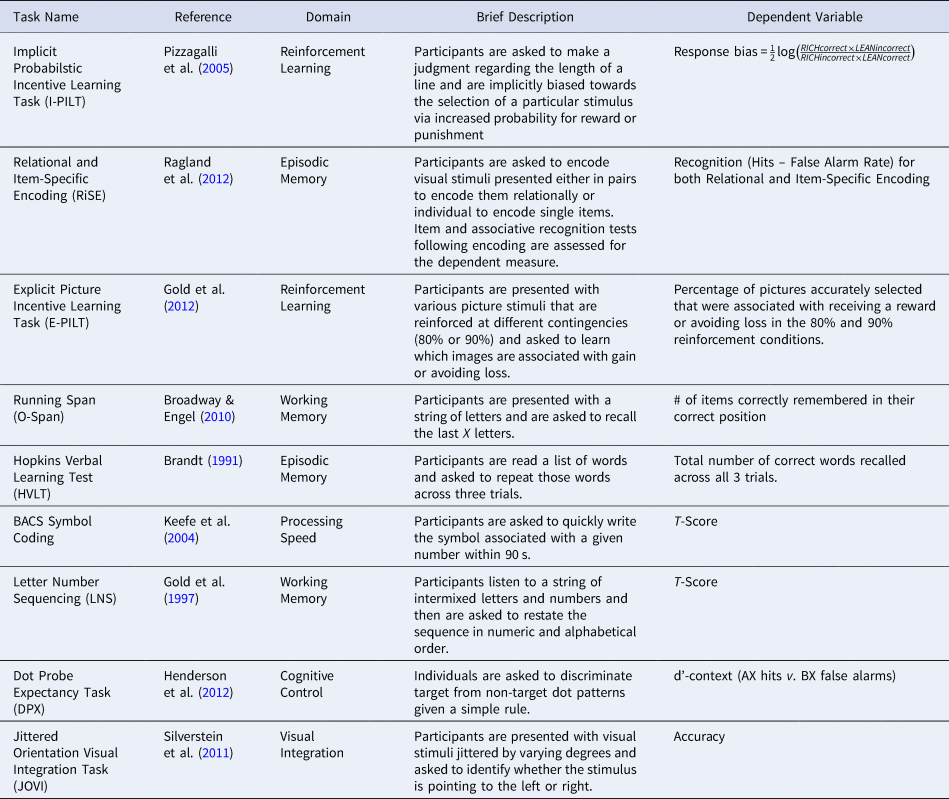
Procedure
As shown in Table 1, participants completed nine tasks measuring a broad range of cognitive functioning. Each task has been described in detail in earlier reports (Barch et al. Reference Barch, Carter, Gold, Johnson, Kring, MacDonald and Strauss2017; Brandt, Reference Brandt1991; Gold, Carpenter, Randolph, Goldberg, & Weinberger, Reference Gold, Carpenter, Randolph, Goldberg and Weinberger1997; Henderson et al. Reference Henderson, Poppe, Barch, Carter, Gold, Ragland and MacDonald2012; Keefe et al. Reference Keefe, Goldberg, Harvey, Gold, Poe and Coughenour2004; Pizzagalli, Jahn, & O'Shea, Reference Pizzagalli, Jahn and O'Shea2005; Ragland et al. Reference Ragland, Ranganath, Barch, Gold, Haley, MacDonald and Carter2012; Silverstein et al. Reference Silverstein, Berten, Essex, Kovacs, Susmaras and Little2009) and all tasks are described in Table 1. Tasks were administered in a fixed order across participants as presented in Table 1. As the overarching study assessed test-retest reliability, participants completed the same task on multiple visits, with parallel forms used for memory testing. The current study focused all analyses on participants' first session data.
Task Description in order of administration

Data analysis
Primary ANCOVA analyses included group (CON, Unmedicated, Medicated) as a between-subject factor, with age and WTAR score entered as covariates, using post-hoc contrasts for pairwise comparisons. We then conducted analyses in a subset of the groups matched for age, to confirm that age was not confounding the results. Next, we conducted partial correlation analyses examining the relationship between task performance, chlorpromazine equivalency and anticholinergic load, while entering symptom variables of interest (positive symptoms, negative symptoms and disorganization symptoms) as covariates. Follow-up analyses were conducted within the patient groups (Unmedicated, Medicated) to examine the potential role of BPRS positive symptoms, disorganization symptoms and negative symptoms. False discovery rate correction was used to correct for multiple comparisons (Benjamini & Hochberg, Reference Benjamini and Hochberg1995).
Results
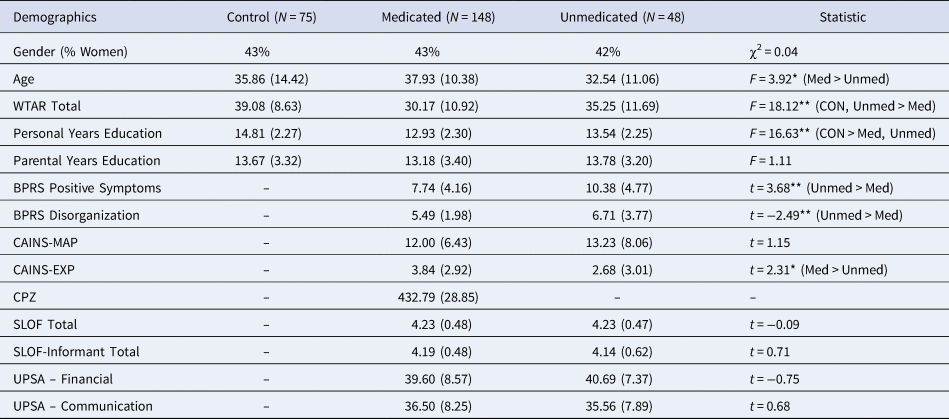
Demographic information
As shown in Table 2, the unmedicated group was significantly younger than the medicated and CON groups (F (2,271) = 4.22, p < 0.05), while the medicated group had a lower WTAR score (F (2,271) = 17.09, p < 0.001). Age and WTAR were included as covariates in analyses to account for between-group differences. In regard to symptom variables (Table 2), the unmedicated group reported more positive symptoms relative to the medicated group; however, they also displayed less emotional blunting. There were no significant differences between medicated and unmedicated patients in functioning as reported on the SLOF or UPSA.
Subject Demographics
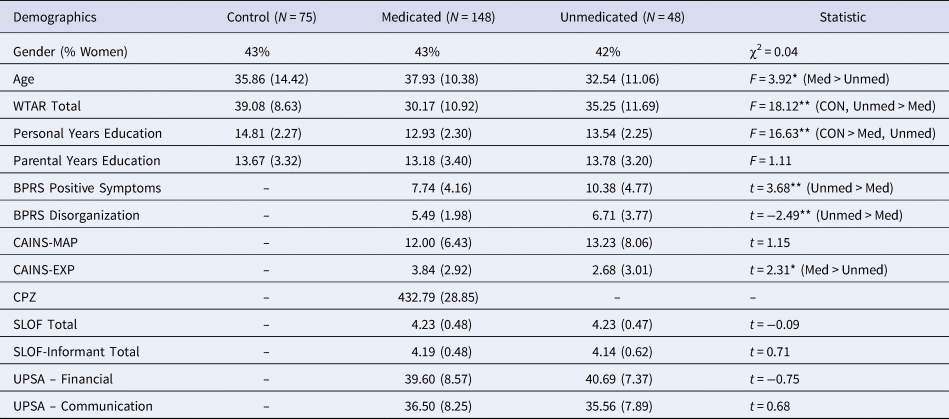
CON, Control; Unmed, Unmedicated; Med, Medicated; * p < 0.05;** p < 0.01.
Implicit and explicit reinforcement learning
IPILT
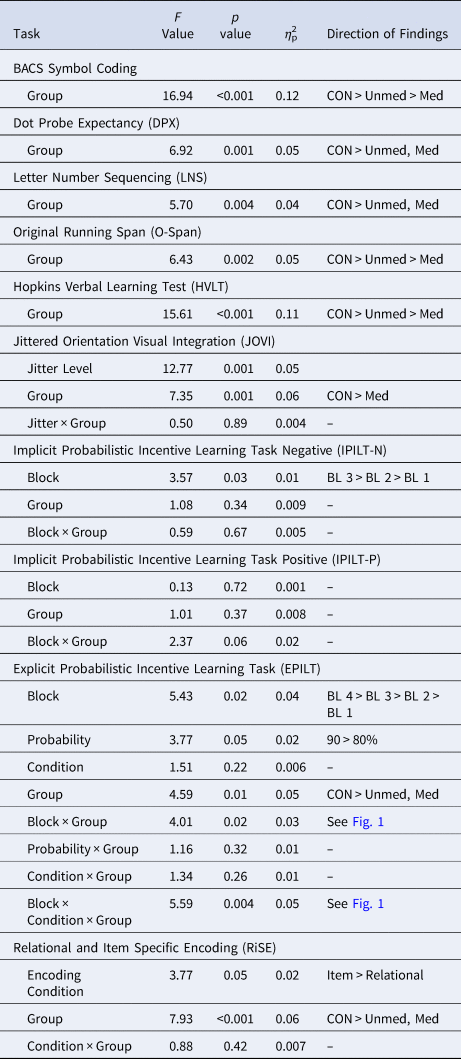
As shown in Table 3, we analyzed the IPILT using a repeated-measures ANOVA with Block as a within-subject factor and Group (CON, unmedicated, medicated) as a between-subject factor. When looking at positivity bias we saw the main effect of Block showing greater bias towards positive response across later blocks. There was no Group or Block × Group interaction. When looking at negative biases on the IPILT-N, we found no Block, Group or Block × Group interaction.
Group differences between Controls, Unmedicated and Medicated participants
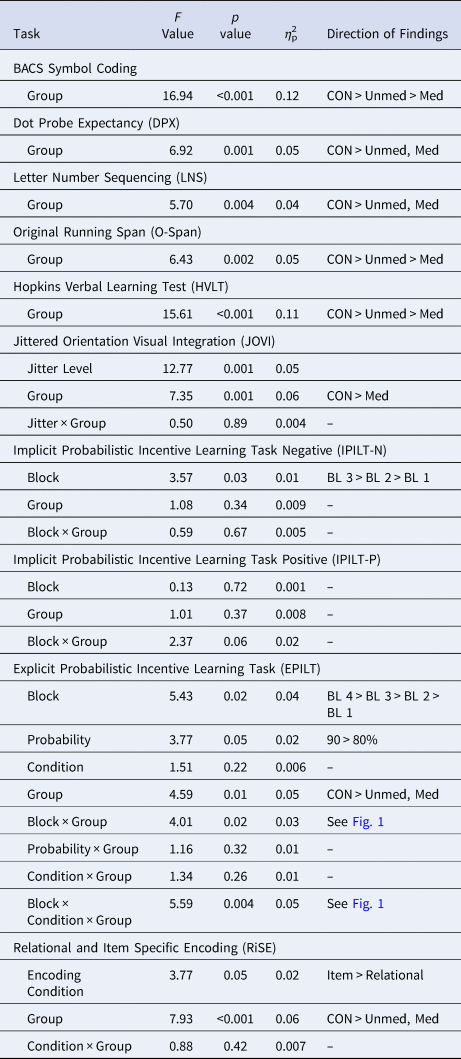
CON, control; Unmed, unmedicated; Med, medicated; BL, block; Age and WTAR included as covariates in above models.
EPILT
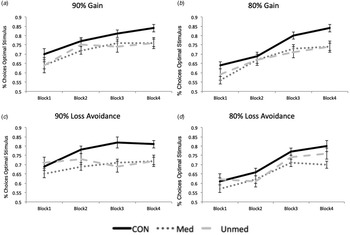
We conducted a repeated-measures ANOVA with Block (4); Condition (Reward, Loss) and Probability (90/10 v. 80/20) as within-subject factors and group (control, unmedicated, medicated) as a between-subjects factor. As shown in Fig. 1, we found significant main effects of Block and Probability with better performance across blocks and in the 90% probability condition. A main effect of Group showed that controls performed better than both the unmedicated and medicated patient groups. These main effects were qualified by interactions between Group, Block and Condition (Table 3). Follow-up analyses indicated that controls performed significantly better across later blocks, which was most pronounced in the Reward conditions wherein the magnitude of difference between the two patient groups and controls was larger (see Fig. 1). There were no significant differences between the medicated and unmedicated groups.
CON, control; Med, medicated Schizophrenia; Unmed, unmedicated Schizophrenia. Panel A and B display performance on the explicit probabilistic incentive learning task (EPILT) by group in the 90 and 80% probability gain conditions by group. Panel C and D display performance on the 90 and 80% probability loss avoidance conditions.

Visual integration
We conducted a repeated-measures ANOVA on accuracy with orientational jitter level as a within-subject factor and Group (CON, unmedicated, medicated) as a between subject factor (Table 3). We found the main effect of Group wherein medicated patients performed more poorly relative to controls and unmedicated patients (ps < 0.05), while we saw a trend of unmedicated patients performing more poorly than controls (p = 0.06). There was no Jitter Level × Group interaction, which is consistent with prior studies (Silverstein et al. Reference Silverstein, Berten, Essex, Kovacs, Susmaras and Little2009, Reference Silverstein, Harms, Carter, Gold, Keane, MacDonald and Barch2015, Reference Silverstein, Keane, Barch, Carter, Gold, Kovacs and Strauss2012).
Processing speed
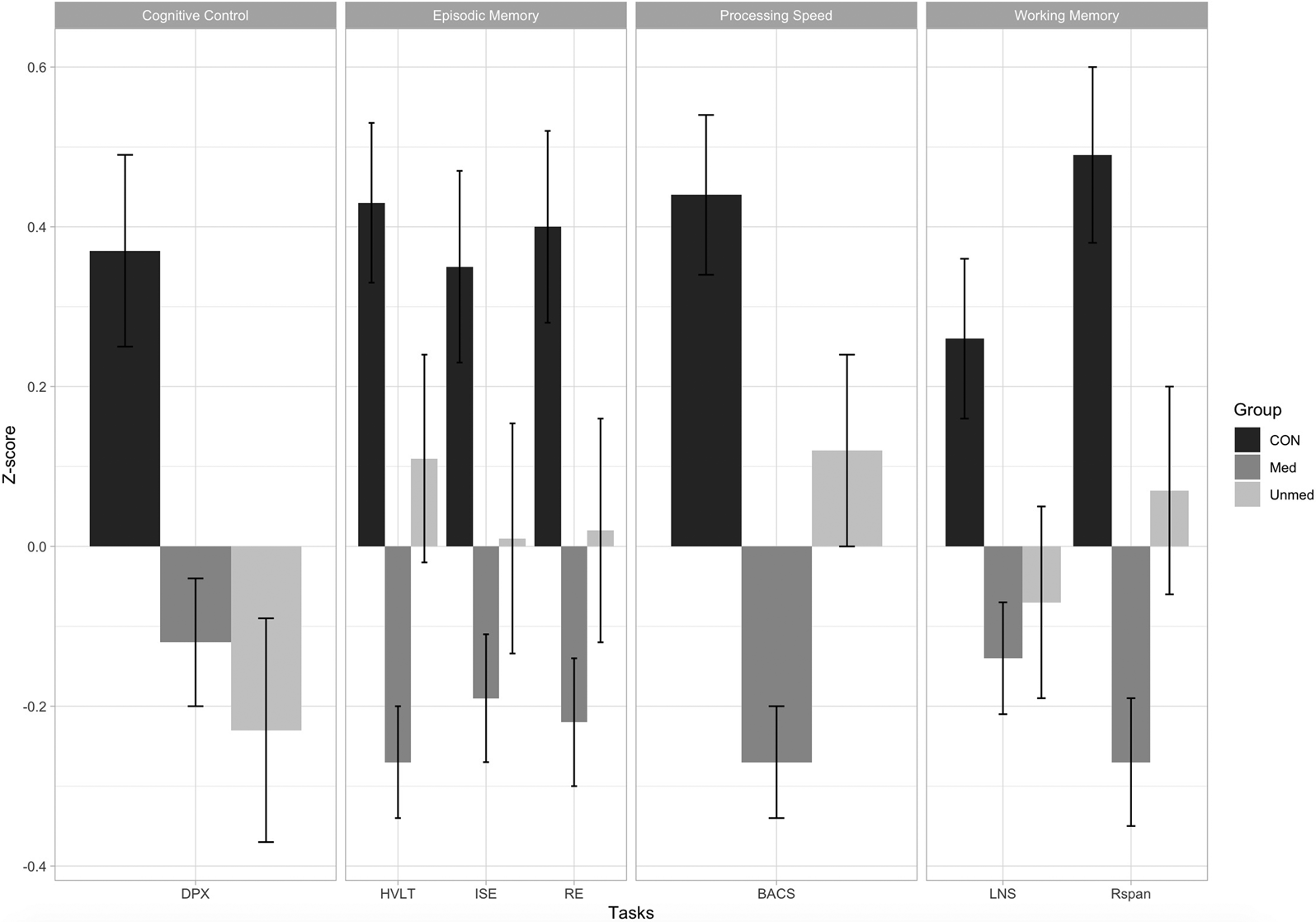
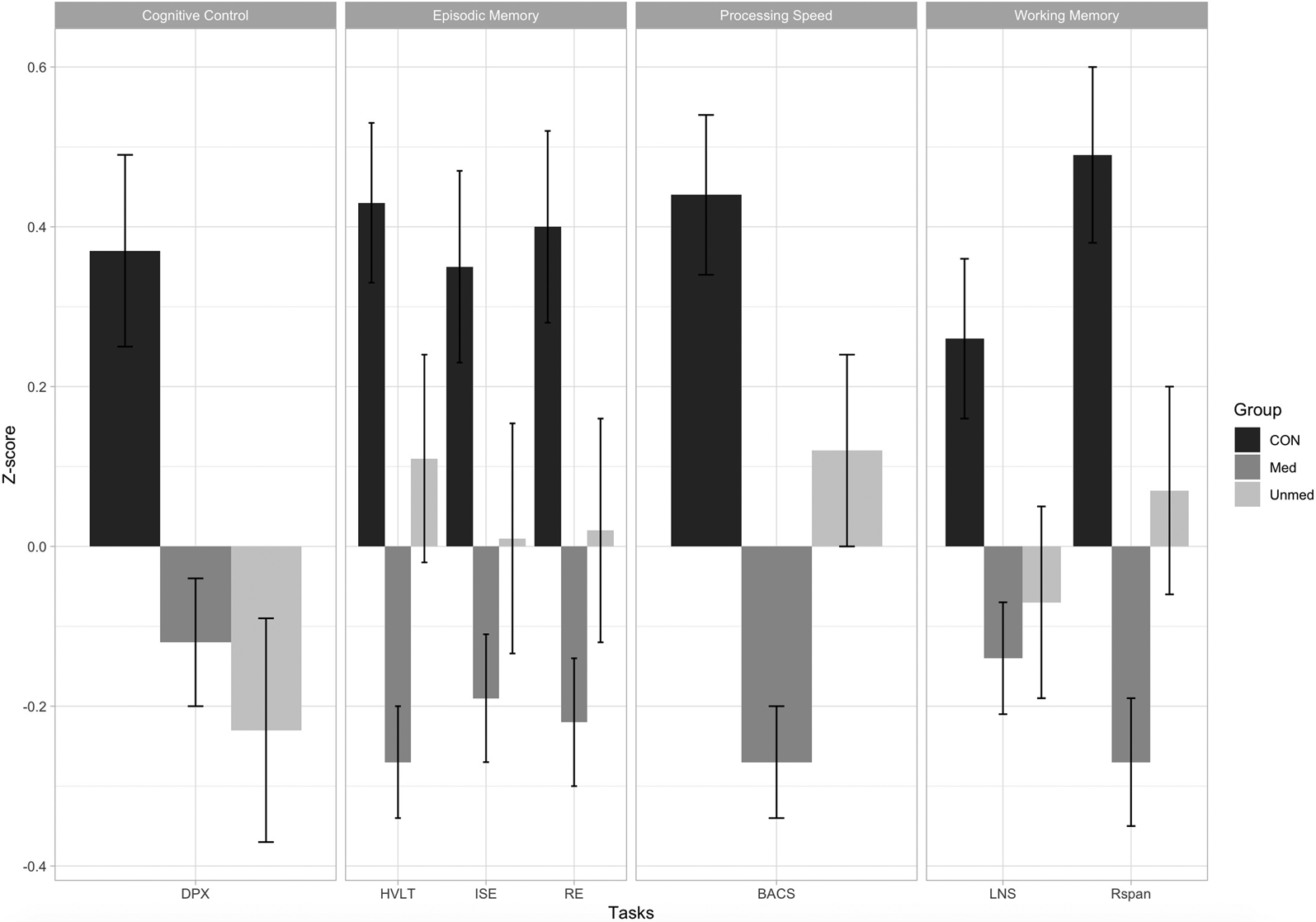
As shown in Table 3 and Fig. 2, an ANOVA with BACS Symbol Coding score as the dependent variable indicated a main effect of Group (CON, medicated, unmedicated) demonstrating higher scores among the controls, followed by the unmedicated SZ group, and the medicated group (all pairwise comparisons significant p < 0.05).
CON, control; Med, medicated Schizophrenia; Unmed, unmedicated Schizophrenia; DPX, Dot Probe Expectancy; HVLT, Hopkins Verbal Learning Test; ISE, Item-Specific Encoding; RE, Relational Encoding; BACS, BACS Symbol Coding; A-Span, Adaptive Running Span; LNS, Letter Number Sequencing; RSpan, Running Span. Performance on cognitive tasks assessing cognitive control, episodic memory, processing speed and working memory are presented. Scores were standardized to create z-scores for display purposes.
Cognitive control
An ANOVA with d-prime (d’) on the DPX task as the dependent variable (Table 3) indicated a main effect of Group. Post-hoc analyses indicated that both the unmedicated and medicated groups had significantly lower d’ scores relative to controls (p < 0.001). There was no significant difference between the medicated and unmedicated groups (p = 0.78).
Working memory
An ANOVA with LNS total score as the dependent variable indicated a main effect of Group (Table 3). Follow-up analyses showed that CON scored significantly higher than both patient groups (ps < 0.001), with no significant differences between the medicated and unmedicated groups (p = 0.13). Examining Run Span Score revealed a significant effect of Group with controls performing significantly better than both patient groups (ps < 0.05). The unmedicated group performed significantly better than the medicated group (p < 0.05).
Episodic memory
For the HVLT (Table 3), we found a significant main effect of Group (CON, unmedicated, medicated) with controls outperforming both patient groups (ps < 0.05). The unmedicated patients performed significantly better than the medicated group (p < 0.001).
For the RISE (Table 3), we conducted a repeated-measures ANOVA with encoding condition (Item-Specific Recognition Accuracy, Relational Recognition Accuracy) as a within subject variable and Group as a between subject variable. There was a main effect of condition with participants showing lower performance on the relational recognition task relative to the item recognition task. A significant effect of Group with both medicated and unmedicated groups showed impairments in both conditions relative to controls (ps < 0.05). There were no significant differences between the medicated and unmedicated groups (p > 0.20)
Analyses in age-matched group
Given that age is known to be related to performance across cognitive domains, we examined whether our findings relating to group differences in unmedicated, medicated and control participants remained when looking at subsets of the participants' groups matched for age. We created groups matched on age by sequentially removing older participants in the control and medicated SZ groups until there was less than 1-year difference between groups (F (2,194) = 0.16, p = 85). As shown in online Supplementary Table S1, the patient groups still had a lower WTAR score (F (2,194) = 6.82, p < 0.005) than controls, however, there was no significant difference between the patients' groups (p = 0.61).
When examining the age matched group (CON, unmedicated, medicated), we once again found that CON participants outperformed both the unmedicated and medicated groups across the majority of tasks including processing speed (F(2,190) = 15.06, p < 0.001, η p2 = 0.14), cognitive control (F (2,188) = 6.95, p < 0.005, η p2 = 0.07), letter number sequencing (F (2,190) = 12.41, p < 0.001, η p2 = 0.12), original running span (F (2,192) = 6.69, p < 0.05, η p2 = 0.07), verbal learning (F (2,191) = 13.93, p < 0.001, η p2 = 0.13), item-specific encoding (F (2,192) = 4.91, p < 0.01), relational encoding (F (2,192) = 7.46, p < 0.005), visual integration (F(2,191) = 6.45, p < 0.005, η p2 = 0.07) and explicit reinforcement learning (F (2,191) = 3.31, p < 0.05, η p2 = 0.04). Similar to the analyses in the entire sample, there were no main effects of the group when examining implicit reinforcement learning. Age-matched medicated participants performed more poorly than unmedicated participants on the HVLT (p < 0.05), item recognition (p < 0.05) and visual integration (p < 0.05)
Relationship between cognitive performance to chlorpromazine and anticholinergic load among medicated patients
When comparing CPZ dose and task measures (online Supplementary Table S2), we found significant relationships that survived multiple comparison correction between CPZ and processing speed (r = −0.35, p < 0.01), HVLT (r = −0.35, p < 0.01), LNS (r = −0.30, p < 0.01) and running span (r = −0.30, ps < 0.01) suggesting that higher CPZ load was related to poorer performance across tasks.
As shown in Supplementary Table S2, we found that HVLT was related to anticholinergic load such that greater anticholinergic load was associated with poorer verbal learning. However, this finding did not remain significant after correcting for multiple comparisons using FDR correction. Further, we conducted an exploratory stepwise analysis entering anticholinergic load in Step 1 and group in Step 2 to predict HVLT, and while the first step was significant (r = 0.26, r 2 = 0.067, p < 0.005), when the group was entered into the model, group was significant (p < 0.05) while the anticholinergic load was a trend (p = 0.08).
Examining potential symptom effects within patient groups
Finally, we examined whether including positive symptoms, motivation and pleasure, and expressive deficits influenced differences between patient groups (unmedicated and medicated) within each task. While symptom variables were related to some task performance metrics, the overall pattern of group differences remained the same when entering positive and negative symptoms into analyses.
Discussion
The goal of the current study was to examine unmedicated individuals with schizophrenia, as well as those on medications, relative to controls across a range of well-validated cognitive measures. We found that across all but two of the cognitive domains assessed, both unmedicated and medicated patients showed impairments in performance relative to healthy control participants. Further, across every measure other than implicit reinforcement learning, unmedicated patients showed impairments relative to controls, though this was a trend level for visual integration.
While the bulk of the literature examining cognitive deficits in schizophrenia has been conducted on medicated samples, current findings suggest that, regardless of medication status, adults with chronic schizophrenia show deficits in tasks assessing processing speed, cognitive control, working memory, relational encoding and retrieval, visual integration and explicit reinforcement learning relative to healthy controls. These findings of cognitive impairment in unmedicated patients are consistent with previous literature showing deficits in working memory, cognitive control and attention in a young at-risk sample (Wood et al. Reference Wood, Pantelis, Proffitt, Phillips, Stuart, Buchanan and McGorry2003), in first-episode samples (Hutton et al. Reference Hutton, Puri, Duncan, Robbins, Barnes and Joyce1998; Minzenberg et al. Reference Minzenberg, Firl, Yoon, Gomes, Reinking and Carter2010; Nejad et al. Reference Nejad, Ebdrup, Siebner, Rasmussen, Aggernæs, Glenthøj and Baaré2011) and in recent-onset medication-naïve individuals with schizophrenia (Daban et al. Reference Daban, Amado, Bourdel, Loo, Olié, Poirier and Krebs2005; Lussier & Stip, Reference Lussier and Stip2001). Our findings of impairments among unmedicated individuals on an explicit reinforcement learning task are notable, as there have been concerns that medications that block D2 receptors could be creating some of the impairments in this domain. The current findings are consistent with Reinen et al. (Reference Reinen, Van Snellenberg, Horga, Abi-Dargham, Daw and Shohamy2016) who found blunted prediction error responses in unmedicated patients relative to controls, suggesting that medication is not driven by antipsychotic medication alone. While not in unmedicated samples, studies examining reinforcement learning in at-risk and first-episode patients (Chang, Waltz, Gold, Chan, & Chen, Reference Chang, Waltz, Gold, Chan and Chen2016; Murray et al. Reference Murray, Cheng, Clark, Barnett, Blackwell, Fletcher and Jones2008; Waltz et al. Reference Waltz, Demro, Schiffman, Thompson, Kline, Reeves and Gold2017), who have presumably a shorter duration of exposure to antipsychotics than chronic samples, also show a pattern of reinforcement deficits relative to controls. However, in a sample of medicated patients Insel et al. (Reference Insel, Reinen, Weber, Wager, Jarskog, Shohamy and Smith2014) found a relationship between dose and lose-shift patterns, suggesting that higher doses were related to a greater likelihood to shift choice following negative feedback and in neural response when learning from loss but was not related to learning from the reward. Thus, while our findings suggest that unmedicated patients show deficits in reinforcement learning relative to controls, it will be important for future work to look at the relationship between medication and pattern of responding to feedback.
Deficits in visual integration in both medicated and unmedicated groups are notable, as deficits in visual integration have been shown to be related to illness duration (Keane, Paterno, Kastner, & Silverstein, Reference Keane, Paterno, Kastner and Silverstein2016) raising the possibility that medication may be linked to deficits; however, only a handful of previous studies have examined the relationship in unmedicated groups. The present findings suggest that unmedicated and medicated individuals show a deficit relative to controls. These findings are consistent with prior research that did not find a relationship in medicated patients between chlorpromazine equivalence and integration (Grove et al. Reference Grove, Yao, Mueller, McLaughlin, Ellingrod, McInnis and Tso2018; Keane et al. Reference Keane, Paterno, Kastner and Silverstein2016; Silverstein et al. Reference Silverstein, Berten, Essex, Kovacs, Susmaras and Little2009) and consistent with previous studies showing deficits in unmedicated patients relative to controls (Frith et al. Reference Frith, Stevens, Johnstone, Owens and Crow1983; Keri et al. Reference Keri, Kiss, Kelemen, Benedek and Janka2005). Thus, our findings extend previous research suggesting that impairments in visual integration are an aspect of schizophrenia present even among unmedicated individuals with schizophrenia.
Even though we found strong evidence for cognitive impairment among unmedicated individuals with schizophrenia, there were some differences between medicated and unmedicated individuals. Medicated patients had somewhat greater deficits on measures of processing speed, working memory, visual integration and verbal learning relative to unmedicated patients. These patient subgroup differences remained after controlling for symptom domains that differed between groups, including positive and negative symptoms. However, our primary goal was to examine deficits in unmediated individuals and the individuals with schizophrenia were not randomly assigned to medicated v. unmediated groups. While findings in relationship to differences between unmedicated and medicated patient groups are intriguing, it is important to consider a number of variables that may be driving these between group differences and which may also be leading to mixed findings within the literature. Similar to a number of other studies, in the present study we took a naturalistic approach to the investigation, recruiting people who had been off antipsychotic medications for at least 1 month. Given that antipsychotic medication adherence rates are poor with people going on and off medications frequently, our samples are likely representative of the population (Byerly, Nakonezny, & Lescouflair, Reference Byerly, Nakonezny and Lescouflair2007). However, because they were not randomly assigned to medication groups, there are a number of group differences which may be important in helping to explain distinctions in cognitive functioning. For example, those taking medications were older, had lower WTAR scores and had more expressive negative symptom deficits. While our results held when controlling for estimated IQ, age and symptom variables, it is not possible to completely rule out an influence of these variables. It is also likely that other differences between these groups not captured in the current data may underlie these differential patterns of cognitive performance. For example, it may be the case that those taking antipsychotics in the current study may have had additional comorbid disorders that further impair functioning. While we saw no significant group differences on measures of functioning such as the UPSA or SLOF, there may be other categories of functioning not being fully captured. Nonetheless, the modest difference we saw between medicated and unmedicated individuals needs to be considered in light of the robust deficits we saw in all cognitive domains among unmedicated individuals, other than implicit reinforcement learning, which was not impaired in either medicated or unmedicated patients.
The present study had several limitations. First, as noted above, individuals with schizophrenia were not randomly assigned to medication groups, indeed the majority of studies in this area are not in randomized control trials. Instead, participants were under the care of their own mental health providers, thus medication type and dose varied between subjects. While this lends to the generalizability of findings, this also minimizes our ability to examine specific drug-related effects. Further, the lack of random assignment to the medication condition led to the medicated and unmedicated groups differing in age. While differences in age were unlikely to have led to null findings between patient groups, they could play a role across tasks in the present study (Braver & Barch, Reference Braver and Barch2002; Hori et al. Reference Hori, Noguchi, Hashimoto, Nakabayashi, Omori, Takahashi and Kunugi2006; McKendrick, Weymouth, & Battista, Reference McKendrick, Weymouth and Battista2010; Naveh-Benjamin, Hussain, Guez, & Bar-On, Reference Naveh-Benjamin, Hussain, Guez and Bar-On2003; Roudaia, Bennett, & Sekuler, Reference Roudaia, Bennett and Sekuler2008). It will be important for future studies to design studies that address these limitations including randomization and better characterization in naturalistic studies to understand potential differences in the medicated and unmedicated samples that may be leading to differences in findings. Finally, individuals in the unmedicated group were not medication naïve; rather they were required to be off medications for at least 1 month prior to participation. Thus, it could be the case that medication naïve individuals with schizophrenia may show a different pattern of impairments v. those in the present study.
Taken together, the present findings show that individuals with schizophrenia, both unmedicated and medicated, have pervasive deficits across a range of cognitive domains including reinforcement learning, processing speed, cognitive control, working memory, verbal learning, and relational encoding and retrieval. In some domains these deficits appear to be more slightly more pronounced in medicated patients (though still clearly present in unmedicated individuals), particularly on tasks assessing processing speed and verbal learning. However, the fact that the unmedicated individuals showed cognitive impairments in all of the same domains impaired in medicated individuals, even if in some cases to a slightly lesser degree, adds to the body of literature suggesting that cognitive deficits are an enduring aspect of schizophrenia, present in those both on and off antipsychotic medications.
Supplementary material
The supplementary material for this article can be found at https://doi.org/10.1017/S003329172000286X
Acknowledgements
The authors would like to thank the participants in this study, who gave generously of their time and the many staff who helped complete this project. Funding for this study was provided by NIMH ROI1s MH084840 (DMB), MH084826 (CSC), MH084821 (JMG), MH084861 (AWM) and MH084828 (SMS). Author EKM had full access to all study data and takes responsibility for the integrity of the data and accuracy of the data analysis. EKM performed the data analysis. All authors developed the study concept and design and aided in interpretation and provided critical revisions. All authors approved the final version of the paper for submission.
Conflict of interest
EKM has no conflicts to report. JMG has received grants from National Institutes of Health (NIH), receives royalty payments from Brief Assessment of Cognition in Schizophrenia, and has acted as a consultant to Acadia, Amgen, AstraZeneca, GlaxoSmithKline, Hoffman LaRoche, Merck, Pfizer and Solvay. CSC has received research grants from the National Institutes of Health (NIH), the Brain and Behavior Foundation, the Burroughs Wellcome foundation, GlaxoSmithKline and the Robert Wood Johnson Foundation and has been an external consultant for Lilly, Merck, Pfizer, Roche and Servier. SL has received research grants from the National Institutes of Health (NIH) and the National Science Foundation. AWM has received research grants from the National Institutes of Health (NIH) and the Brain & Behavior Research Foundation. JDR has received research grants from the National Institutes of Health (NIH), the Brain & Behavior Research Foundation, the EJLB Foundation, and the Robert Wood Johnson Foundation. SMS has received research grants from the National Institutes of Mental Health (NIMH), The Brain & Behavior Research Foundation, the van Ameringen Foundation, the Jacob and Valeria Langaloth Foundation, the New England Research Institutes, the New York State Office of Mental Health, the New Jersey Division of Mental Health and Addiction Services, The Lavelle Fund for the Blind, diaMentis, Inc., Janssen Pharmaceutica, AstraZeneca, and Pfizer. DMB has received grants from the Brain & Behavior Research Foundation and the National Institutes of Health (NIH).