Introduction
Mental disorders are responsible for a significant proportion of the total global burden of disease and are a leading cause of years lived with disability worldwide (Whiteford et al. Reference Whiteford, Degenhardt, Rehm, Baxter, Ferrari, Erskine, Charlson, Norman, Flaxman, Johns, Burstein, Murray and Vos2013; Charlson et al. Reference Charlson, Baxter, Dua, Degenhardt, Whiteford and Vos2015). However, the resources allocated to addressing mental disorders have been grossly insufficient, inequitably distributed and inefficiently used. The result is a large treatment gap, with more than 75% of persons in low- and middle-income countries (LMICs) without access to services (Burns, Reference Burns2015; Lund, Reference Lund2015; Lund et al. Reference Lund, Alem, Schneider, Hanlon, Ahrens, Bandawe, Bass, Bhana, Burns, Chibanda, Cowan, Davies, Dewey, Fekadu, Freeman, Honikman, Joska, Kagee, Mayston, Medhin, Musisi, Myer, Ntulo, Nyatsanza, Ofori-Atta, Petersen, Phakathi, Prince, Shibre, Stein, Swartz, Thornicroft, Tomlinson, Wissow and Susser2015), including access to medicines for mental disorders (Cameron et al. Reference Cameron, Ewen, Ross-Degnan, Ball and Laing2009, Reference Cameron, Roubos, Ewen, Mantel-Teeuwisse, Leufkens and Laing2011, Reference Cameron, Bansal, Dua, Hill, Moshe, Mantel-Teeuwisse and Saxena2012; Mendis et al. Reference Mendis, Fukino, Cameron, Laing, Filipe, Khatib, Leowski and Ewen2007; Wagenaar et al. Reference Wagenaar, Stergachis, Rao, Hoek, Cumbe, Napua and Sherr2015).
A number of intergovernmental initiatives in recent years have aimed to reduce the treatment gap and enhance the capacity of Member States to improve access to medicines, particularly for mental disorders. In May 2013 the 66th World Health Assembly adopted WHO's Comprehensive Mental Health Action Plan 2013–2020 (World Health Organization, 2013). The Mental Health Action Plan builds upon the work of WHO's Mental Health Gap Action Programme (mhGAP) (World Health Organization, 2008), which includes evidence-based guidelines for MNS disorders. These guidelines include recommendations on appropriate use of medicines for mental disorders (Barbui et al. Reference Barbui, Dua, van Ommeren, Yasamy, Fleischmann, Clark, Thornicroft, Hill and Saxena2010, Reference Barbui, Dua, Harper, Tablante, Thornicroft and Saxena2015; Dua et al. Reference Dua, Barbui, Clark, Fleischmann, Poznyak, van Ommeren, Yasamy, Ayuso-Mateos, Birbeck, Drummond, Freeman, Giannakopoulos, Levav, Obot, Omigbodun, Patel, Phillips, Prince, Rahimi-Movaghar, Rahman, Sander, Saunders, Servili, Rangaswamy, Unutzer, Ventevogel, Vijayakumar, Thornicroft and Saxena2011; Barbui & Tansella, Reference Barbui and Tansella2013).
In 2014, the 67th World Health Assembly adopted a resolution on access to essential medicines (World Health Organization, 2014), which urged Member States to improve national policies for the selection of essential medicines and to promote their availability, affordability and appropriate use. In 2015, the sustainable development goals highlighted access to safe, effective, quality and affordable essential medicines as a component of universal health coverage (Bigdeli et al. Reference Bigdeli, Laing, Tomson and Babar2015).
Following the precedent set by these important initiatives, the Gulbenkian Mental Health Platform, an initiative of the Calouste Gulbenkian Foundation and the WHO Department of Mental Health and Substance Abuse, developed a document on access and use of psychotropic medicines intended for use as a manual by policy-makers, public health professionals and clinicians working in regional health offices, national health ministries, or at the district level, and in charge of planning improvements to the mental health systems in LMICs (Barbui et al. Reference Barbui, Dua, Kolappa, Saraceno and Saxena2016; WHO & Calouste Gulbenkian Foundation, 2016). Building on the work conducted for this document, the aim of the present article is to highlight existing barriers to accessing medicines for mental disorders, and present a set of key actions to improve access and appropriate use, particularly in LMIC. We developed a 4 × 4 framework for mapping the components of access across four levels of the health system.
Demand and supply constraints to accessing medicines for mental disorders
The concept of access is generally described as the timely use of services according to needs (Peters et al. Reference Peters, Garg, Bloom, Walker, Brieger and Rahman2008). For mental disorders, prerequisites for regular access to medicines are adequate budget expenditure and availability of services with the capacity to treat mental disorders (Pankevich et al. Reference Pankevich, Posey Norris, Wizemann and Altevogt2014). Globally the mean expenditure for mental disorders is slightly less than 3% of the total health budget, and country income levels do not fully account for the lower levels of funding for mental disorders. In many LMICs, the number of outpatient health care services with the ability to treat mental disorders is exceedingly low, proving to be a major infrastructural barrier to appropriate access and use of medicines (World Health Organization, 2015a ).
In addition to these large funding constraints, numerous other barriers are particularly relevant to medicines for mental disorders (Barbui, Reference Barbui2015; Kishore et al. Reference Kishore, Kolappa, Jarvis, Park, Belt, Balasubramaniam and Kiddell-Monroe2015; Nose et al. Reference Nose, Turrini and Barbui2015; Barbui & Chattherjee, Reference Barbui and Chattherjee2016). These barriers stem from the demand side and/or the supply side (Ensor & Cooper, Reference Ensor and Cooper2004); demand constraints influence individuals’, households’ and communities’ ability to use services, while supply constraints are aspects of health services and the health sector that hinder service uptake (Bigdeli et al. Reference Bigdeli, Jacobs, Tomson, Laing, Ghaffar, Dujardin and Van2013).
The demand for psychotropic medicines is affected by the acceptability of mental health treatments and by the level of awareness of mental health problems within communities. Related to this, data consistently shows that stigma, discrimination, or other socio-cultural factors make help-seeking behaviour insufficient or inadequate, in many LMIC (Ensor & Cooper, Reference Ensor and Cooper2004; Jacobs et al. Reference Jacobs, Ir, Bigdeli, Annear and Van2012). In addition, lack of awareness about treatment options is a relevant demand-side constraint. In those who access medicines for mental disorders, side effects, limited insight and cognitive functioning, as well as the long-term nature of many severe mental disorders, which may have significant consequences in terms of duration and cost of services, may negatively influence treatment adherence. Finally, in many areas, the geographical distance from healthcare providers could represent an additional barrier (World Health Organization, 2005).
The supply of medicines for mental disorders can be particularly challenging, as the low level of current use of psychotropic medicines may lead supply chain actors to believe the true demand is low (Barbui, Reference Barbui2015; Barbui & Chattherjee, Reference Barbui and Chattherjee2016). Additionally, prohibitive costs to health systems and end-users in populations with no financial protection or health insurance, as well as regulations of controlled medicines in some countries present impediments (Bigdeli et al. Reference Bigdeli, Peters and Wagner2014). Further, the selection of essential medicines and development of robust evidence-based guidelines can be especially difficult for mental disorders, as many psychotropic medicines with partially overlapping characteristics are available on the market (Kirsch & Moncrieff, Reference Kirsch and Moncrieff2007).
Access to medicines framework
WHO characterised four dimensions of access to medicines: rational selection, affordable prices, sustainable financing and reliable health and supply system, with quality assurance and management systems assumed to underpin all access components (Center for Pharmaceutical Management, 2000; World Health Organization, 2004). In more recent years the framework has been further developed, in particular following the recognition that access to medicines should be considered within a broader attempt to accelerate the achievement of universal health coverage. A health systems approach situates medicines against the full complexity of a health system to visualise how interventions in the pharmaceutical sector influence the rest of the health system and vice versa (Bigdeli et al. Reference Bigdeli, Peters and Wagner2014). Within this new framework, access to medicines would depend on which medicines are (1) selected for inclusion on a national essential medicines list, and whether they are (2) available, (3) affordable and (4) appropriately used (World Health Organization, 2009; Bigdeli et al. Reference Bigdeli, Peters and Wagner2014).
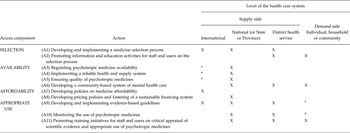
For each of these four access components, priority actions may be organised as a function of four different health care levels, three of which belong to the supply side and one to the demand side: (1) international; (2) national, regional, or province; (3) district; and (4) community, household, or individual (Bigdeli et al. Reference Bigdeli, Jacobs, Tomson, Laing, Ghaffar, Dujardin and Van2013). A 4 × 4 framework may therefore be developed to conceptualise at which level actions may be activated for each access component (Table 1).
4 × 4 framework mapping the components of access across four levels of the health system

* Guidance is provided by international organisations, such as the World Health Organization.
† According to guideline production methodology, representatives of patients, families and the wider society should be included in guideline development process.
‡ As part of monitoring activities, research projects should be implemented with active participation of service users.
Actions promoting rational selection
Rational selection refers to the careful selection of medicines based on best available evidence to inform clinical practice, as well as to ensure economic viability of healthcare systems. Because of its considerable impact on the quality of care and the cost of treatment, rational selection of medicines is considered to be one of the most cost-effective means of improving health care. For mental disorders, rational selection is particularly challenging, as many psychotropic medicines are duplicative or non-essential, being minor variations of originator products with unclear therapeutic advantages over other medicines already in the market. In many cases, new medicines are released without enough information on comparative efficacy and tolerability, leaving uncertainty as to whether these new medicines are more effective, similarly effective or even less effective as compared with others already in use (Barbui & Bighelli, Reference Barbui and Bighelli2013a , Reference Barbui and Bighelli b ). Further, newer psychotropic medicines are considerably more expensive than older medicines.
Action 1: developing a medicine selection process
A first action is the development of a reliable, accountable and transparent selection process, to select a number of medicines to license, as well as to define which of the licensed medicines are essential. As no public sector or health insurance system can afford to supply or reimburse all medicines that are available on the market, essential medicines lists at both the international and national levels are useful in setting priorities for all aspects of the pharmaceutical system (Table 1). An example at the international level is the WHO Model List of Essential Medicines, while the European Medicines Agency in Europe, the Food and Drug Administration in the USA or the Brazilian National Health Surveillance Agency in Brazil are the examples of agencies selecting medicines for registration at a country level.
The process by which psychotropic medicines are selected is of critical importance. It should be consultative and transparent, with explicit selection criteria and published application procedures. Those involved in the selection process should report any potential conflicts of interest. Applications should be accessible to both professionals and the public, with reasons for accepting or rejecting a new medicine reported on a dedicated website. This approach may be applied to any level within the health-care system, depending where a selection process is functioning and operating: at district level, in hospitals, or at a state or national level.
The concept of essential medicines is intended to be flexible and adaptable to many different situations, including private and public sectors and at different levels of the health care system (World Health Organization, 2002). For example, the WHO Model List of Essential Medicines may be used as a guide for developing lists of essential medicines for one health facility (for example, a hospital), group of facilities, health district, or nation. Many non-governmental organisations and international non-profit supply agencies have also utilised the same concept to select a limited number of medicines (World Health Organization, 2002; van Ommeren et al. Reference van Ommeren, Barbui, de Jong, Dua, Jones, Perez-Sales, Schilperoord, Ventevogel, Yasamy and Saxena2011).
Action 2: promoting information and education activities for staff and end-users
As the credibility of the selection process is likely to have a profound influence on access to psychotropic medicines, a second action refers to the provision of adequate and regular information to professionals and users on how the system works, on rules governing the inclusion of new medicines, and on national and/or local officials taking responsibility for its proper functioning (Table 1). Lack of access to independent information on medicines can have negative consequences, especially if information supplied by the pharmaceutical industry through mailings, visits by pharmaceutical representatives and industry-sponsored meetings is the only type of information available to prescribers and the public.
Actions promoting availability of psychotropic medicines
Availability pertains to the timely obtainability of quality medicines in the public and private sector. Despite recent progress, availability of medicines for mental disorders remains a major challenge globally. In African countries, for example, the WHO-AIMS study of mental health systems found that only 14% had at least one psychotropic medicine available in all public health facilities (McBain et al. Reference McBain, Norton, Morris, Yasamy and Betancourt2012). In Nigeria, even after a 15-year program focused on the scale-up of mental healthcare treatment in primary care settings, the majority of public health facilities did not have routine availability of essential psychotropic medicines (Saraceno et al. Reference Saraceno, van Ommeren, Batniji, Cohen, Gureje, Mahoney, Sridhar and Underhill2007), while a recent study in Sofala, Mozambique, found that essential psychotropic medicines are routinely unavailable at public health facilities: only 7 of 12 district warehouses and 11 of all 24 health facilities (and 10 of 12 health facilities with trained staff) had availability of at least one medicine in each category (Wagenaar et al. Reference Wagenaar, Stergachis, Rao, Hoek, Cumbe, Napua and Sherr2015).
Action 3: developing a medicine regulation process
Once a reliable selection process is functioning, a psychotropic medicine regulation system, usually part of a national medicine authority, needs to be developed to implement measures that may affect the degree of availability of medicines at different levels of the health care system (Table 1). Some of these measures may be particularly relevant for regulating access to medicines for mental disorders and require tough decisions on the following aspects:
-
• Whether only doctors or also other professionals can prescribe psychotropic medicines, including initial and subsequent prescriptions. For example, in South Africa, Ghana and some parts of East Africa, nurses and other non-doctor medical professionals are able to prescribe legally. The legal sanction to prescribe is often limited to certain drugs, sometimes in specific circumstances or programmes (Eaton, Reference Eaton2008). Regulations may be used to allow trained paramedical workers such as nurses, and in some cases, village health workers, to prescribe certain types of medicines (World Health Organization, 2005).
-
• Availability in public and private sectors and level of the health system where medicines for mental disorders may be accessed. For example, the WHO mhGAP Intervention Guide underlines that it is a widely shared but mistaken idea that all mental health interventions are sophisticated and can only be delivered by highly specialised staff, while research in recent years has demonstrated the feasibility of delivery of pharmacological and psychosocial interventions in non-specialised health-care settings (World Health Organization, 2015b ). A national medicine regulatory authority should establish the level of the health care system and the conditions under which a medicine may be prescribed, taking into consideration efficacy, safety, adverse effects, costs and feasibility issues. In several low-income settings, medicines are only offered in selected secondary and tertiary health facilities, which translate to decreased availability.
-
• Whether medicines for mental disorders should be labelled for use in individuals with specific diagnoses. This may mean that a formal diagnosis should be made before treatment is prescribed, and that not all individuals may receive that medicine.
-
• Whether some medicines for mental disorders should be subject to regulations relating to controlled medicines. As there is a mistaken view that all medicines for mental disorders are potentially drugs of abuse, it should be extremely clear, which medicines require storage in double-lock cupboards, signatures in a register to record movement and a label of specialist drugs, which means that primary health care workers cannot prescribe them.
Action 4: implementing a reliable supply system
A functioning and reliable supply system is needed to translate into practice what national regulatory authorities advise (Table 1). As reported by WHO, designing an efficient system for procuring, storing and distributing medicines is challenging and important to ensure effective supplies (World Health Organization, 2005). It makes little sense for countries to keep a monopoly on supply, as this may render them unable to fulfil requests. As such, WHO has suggested that an effective medicines supply system depends on an appropriate mix of public, private and NGO procurement, storage and distribution services (World Health Organization, 2004). Depending on the organisation of the health care system, these approaches may vary considerably with respect to the role of government and that of the private sector.
Action 5: implementing a reliable quality-control system
As part of this supply system, a reliable quality control system should be implemented. Although international standards for the quality of medicines are becoming stricter, up to 15% of all sold medicines globally may be of insufficient quality, and in parts of Africa and Asia this figure exceeds 50% (Cockburn et al. Reference Cockburn, Newton, Agyarko, Akunyili and White2005). Poor quality medicines is a term inclusive of counterfeit, substandard and degraded medicines, as well as medicines that fail chemistry analysis, but with insufficient information to determine whether they are counterfeit, substandard, or degraded (Newton et al. Reference Newton, Amin, Bird, Passmore, Dukes, Tomson, Simons, Bate, Guerin and White2011). As an example of successful policy actions, in 2005 the Nigerian National Agency for Food and Drug Administration and Control implemented the following actions to eradicate fake medicines and other substandard regulated products: staff re-orientation and motivation; restructuring and modernization of regulatory processes; public enlightenment campaigns; stopping importation of fake drugs to Nigeria at source; increasing surveillance at all ports of entry; mopping up what is already in circulation; regular monitoring of Good Manufacturing Practice of local manufacturers; streamlining and strict enforcement of registration guidelines (Akunyil, Reference Akunyil2005). As a result of these actions, the number of fake medicines was reduced by over 80%, and a culture of transparency and accountability was progressively implemented (Akunyil, Reference Akunyil2005).
Action 6: developing a community-based system of mental health care and promoting help-seeking behaviours
The geographical location of health services may heavily influence the availability of medicines for mental disorders. The mhGAP initiative underlines the feasibility of delivery of mental health interventions, including medicines for mental disorders, in non-specialised health-care settings. According to this model, primary health care is considered the foundation for high-quality mental health care. Where mental health is integrated into primary care, access is improved, mental disorders are more likely to be identified and treated, and comorbid physical and mental health problems are more likely to be managed in a seamless way (World Health Organization, 2009). Health care services may also implement ad hoc outreach initiatives to increase access to treatment for people with more disabling mental disorders, based on the assertive community treatment model or on similar approaches (Thornicroft & Tansella, Reference Thornicroft and Tansella2003).
On the demand side, actions should be activated to promote help-seeking behaviour (Table 1) (Ensor & Cooper, Reference Ensor and Cooper2004; Jacobs et al. Reference Jacobs, Ir, Bigdeli, Annear and Van2012). In sub-Saharan Africa, where the demand for psychotropic medicines is particularly low, the following initiatives have been suggested: improve help-seeking through public education, enhance detection and treatment of mental disorders through provider training focused on improving skills and reduce negative attitudes, and reform the health system so that the few specialists available can spend more time providing supervision and support to first-line providers (Pankevich et al. Reference Pankevich, Posey Norris, Wizemann and Altevogt2014). In order to address the need for increased and improved training and education of providers and managers, implementation of the mhGAP Intervention Guide and training modules might be a strong first step (Zaidi et al. Reference Zaidi, Bigdeli, Aleem and Rashidian2013).
Actions promoting affordability of psychotropic medicines
As many mental disorders require long-term regular pharmacological treatment, the cost of medicines may constitute a relevant barrier for the health care system, which might not be able to bear the overall economic burden in the long-term, and for the end-users, who might not afford the final price of available medicines.
Action 7: developing international agreements on medicine affordability
At the international level, affordability of medicines is affected by a number of international agreements, such as for example the international agreement on Trade-Related Aspects of Intellectual Property Rights (TRIPS) (Table 1). The TRIPS agreement applies to countries that adhere to the World Trade organization and requires patent protection for all products for a minimum duration of 20 years, without any special consideration for pharmaceuticals. As patent protection awards exclusive rights to an invention, it prevents generic competition and thus also prevents low-cost generic medicines from becoming accessible to populations. Although all of the psychotropic medicines on the WHO list of essential medicines are off-patent and therefore available at low-cost via multiple producers, newer medicines that may be added at a future date may be prohibitively expensive as a result of patent protections. Therefore, advocating for better medicine affordability even when they are not off-patent may be considered a key international-level action.
Action 8: developing pricing policies and a sustainable financing system
At the national level, developing a sustainable financing system is a key priority action. Affordable prices can be pursued through a number of mechanisms (World Health Organization, 2004), including competitive bulk procurement by generic name, which is now a major policy in most essential medicines programmes and in large hospitals in both developed and developing countries. Further, it is important to include mental health treatment and medicines in benefit packages under reimbursement systems, in countries where such systems exist (World Health Organization, 2015c ).
Actions promoting appropriate use of psychotropic medicines
The concept of appropriate use of medicines refers to the expectation that individuals receive medicines that are appropriate to their clinical needs, in doses that meet their own individual requirements, for an adequate period of time and at the lowest cost to them and their community (World Health Organization, 1985). Examples of irrational use of psychotropic medicines include prescribing or dispensing too many medicines per patient, prescribing inappropriate dosages, poor adherence to correctly prescribed medications, incorrect usage of non-psychotropic medications to treat mental disorders, as well as misuse, underuse, or overuse (Padmanathan & Rai, Reference Padmanathan and Rai2016; Xiang et al. Reference Xiang, Ungvari, Correll, Chiu and Shinfuku2016).
Action 9: developing or adopting evidence-based guidelines
A first priority action to promote appropriate use of psychotropic medicines is the development, or local adaptation, of evidence-based clinical guidelines. Clinical guidelines consist of systematically developed statements to help prescribers make decisions about appropriate treatments for specific clinical conditions. At the international level, for example, within the context of the mhGAP initiative, WHO has developed recommendations (i.e. guidelines) on interventions for the management of mental and neurological priority conditions, following the Grading of Recommendations Assessment, Development and Evaluation (GRADE) methodology (Barbui et al. Reference Barbui, Dua, van Ommeren, Yasamy, Fleischmann, Clark, Thornicroft, Hill and Saxena2010, Reference Barbui, Dua, Harper, Tablante, Thornicroft and Saxena2015).
Once a new set of recommendations has been developed, or existing guidelines have been adopted at a health system level, these should be implemented. Implementing evidence-based guidelines may be a challenging task, as there is limited evidence on how guidelines should be implemented to maximise benefits at sustainable costs (Grimshaw et al. Reference Grimshaw, Thomas, MacLennan, Fraser, Ramsay, Vale, Whitty, Eccles, Matowe, Shirran, Wensing, Dijkstra and Donaldson2004; Barbui et al. Reference Barbui, Girlanda, Ay, Cipriani, Becker and Koesters2014).
Action 10: monitoring the use of psychotropic medicines
As discrepancies between treatment recommendations and everyday clinical practice have frequently been highlighted (Haynes et al. Reference Haynes, Devereaux and Guyatt2002), a second priority action is monitoring the use of psychotropic medicines through the development of permanent monitoring infrastructures. At the national (or State or Province) level, medicine consumption and expenditure is usually monitored using drug sales data. These are routinely collected by independent sources on nationally representative samples of wholesalers and community pharmacies. As these monitoring systems are based on aggregate data, they cannot provide information on individuals receiving a particular category of medicines. It is therefore not possible to draw individual-level inferences without giving rise to errors in interpretation (ecological fallacy). To overcome these limitations, health care systems may routinely use databases with individual-level data. These databases, usually developed for managements, claims, administration and planning, cover large groups of individuals and generate data that are of value in pharmacoepidemiological research (Sorensen et al. Reference Sorensen, Johnsen and Norgard2001).
Locally, district medical officers may be interested in auditing prescribing habits in order to check the degree of coherence between what is recommended by evidence-based guidelines and what is actually done. It may therefore be of interest to develop monitoring systems able to collect information on medicine use, and, if feasible, to link these data with hard outcome indicators. The development of such infrastructures may be seen as a quality requirement for health care systems that want to hold themselves as accountable.
Action 11: promoting training initiatives for staff and end-users on critical appraisal of scientific evidence and appropriate use of psychotropic medicines
The acquisition of basic methodological skills in the critical assessment of research reports is a key action, as it can significantly influence interpretation of the evidence base, which can in turn affect national guidelines, training materials and eventually, prescribing practices. Training is more successful if it is problem-based, concentrates on common clinical conditions, takes into account previous knowledge, attitudes and skills, and is targeted to appropriate prescribing. The efficacy of training was investigated by a Cochrane review, which assessed whether teaching critical appraisal skills to health professionals led to changes in processes of care, patient outcomes, health professionals’ knowledge of how to critically appraise research papers, or all three. The review included three studies involving 272 people. It found that low-intensity critical appraisal teaching interventions in healthcare populations may result in beneficial gains (Horsley et al. Reference Horsley, Hyde, Santesso, Parkes, Milne and Stewart2011). Another review found that among practicing health professionals interactive online courses with guided critical appraisal showed significant increase in knowledge and appraisal skills (Young et al. Reference Young, Rohwer, Volmink and Clarke2014).
Additionally, basic training in appropriate use of psychotropic medicines for medical and paramedical students is a pre-requisite for the establishment of good future prescribing habits. Further, continuing education of health care professionals is another step for the establishment and maintenance of good prescribing habits. The term continuing education refers to activities that serve to maintain, develop, or increase knowledge, skills and performance expertise needed for professional development and to ensure optimal patient care. The efficacy of training was investigated by a landmark systematic review of randomised controlled trials of formal didactic and interactive education activities, which included 14 studies and 17 interventions. Nine generated positive changes in professional practice, and three of four interventions altered health care outcomes in one or more measures. Interactive and mixed educational sessions were associated with a significant effect on practice. Techniques such as case discussion, role-play and hands-on practice sessions were effective in changing performance of health care professionals. Sequenced sessions of learn-work-learn in which education may be translated into practice and reinforced at a further session had a positive impact (Davis et al. Reference Davis, O'Brien, Freemantle, Wolf, Mazmanian and Taylor-Vaisey1999). These findings were more recently reinforced by a Cochrane review, which included randomised controlled trials of different educational strategies that reported an objective measure of professional practice or healthcare outcomes (Forsetlund et al. Reference Forsetlund, Bjorndal, Rashidian, Jamtvedt, O'Brien, Wolf, Davis, Odgaard-Jensen and Oxman2009).
Concluding remarks
This article presents a set of key actions that health care systems might consider, based on their current systems and organisation, to overcome existing barriers to accessing medicines for mental disorders. Activating these actions may represent an unique opportunity to address the broader issue of increasing access to treatments and care for mental disorders, as current lack of attention to mental disorders is a central barrier across all domains of the 4 × 4 access framework. Health care systems should be encouraged to address mental disorders in the context of their overall health needs and national programs.
Access to psychotropic medicines therefore offers the chance of transformative improvement in health and the opportunity for re-engagement in society for people with mental illnesses (Wessells, Reference Wessells2015; Whitley, Reference Whitley2015). By working at all levels of the health system, it may be possible to offer this essential component of mental health care to all who can benefit.
Acknowledgements
We acknowledge the contribution of a number of international experts who provided feedback and comments during the development of this document.
Financial Support
This work was financially supported by the Gulbenkian Global Mental Health Platform, an initiative of the Calouste Gulbenkian Foundation jointly conducted with the Department of Mental Health of the Faculty of Medical Sciences (NOVA University of Lisbon). Technical support and collaboration was provided by the World Health Organization Department of Mental Health and Substance Abuse.
Conflict of interest
None.
Disclaimer
T.D. and S.S. are staff members of WHO. The authors alone are responsible for the views expressed in this article and they do not necessarily represent the decisions, policy, or views of WHO.
Availability of data and Materials
References of articles described in this review are reported in the reference section. All WHO documents are free access following the links reported below.