The Gerreidae family is formed by approximately 44 species in eight genera: Diapterus, Eucinostomus, Eugerres, Gerres, Parequula, Pentaprion, Ulaema and Xystaema (Nelson, Reference Nelson2006). The genus Gerres is the most abundant with 28 species (Robertson & Allen, Reference Robertson and Allen2002). Among these species, yellowfin mojarra Gerres cinereus (Walbaum, 1792) is perhaps the most widely distributed species, found in tropical areas on both coasts of America; in the Atlantic from Bermuda and Florida to Brazil, including the islands of the Antilles (Castro-Aguirre et al., Reference Castro-Aguirre, Espinosa Pérez and Schmitter-Soto1999); on the eastern Pacific, they occur from Bahía Magdalena (24.5°N 112°W) on the west coast of Baja California Sur and north of Isla Tiburón (29°N) in the Gulf of California to as far south as Punta Callao (~13°S ~77°W), Peru (Chirichigno & Vélez, Reference Chirichigno and Vélez1998; Robertson & Allen, Reference Robertson and Allen2002), including the Galápagos Islands (Grove & Lavenberg, Reference Grove and Lavenberg1997).
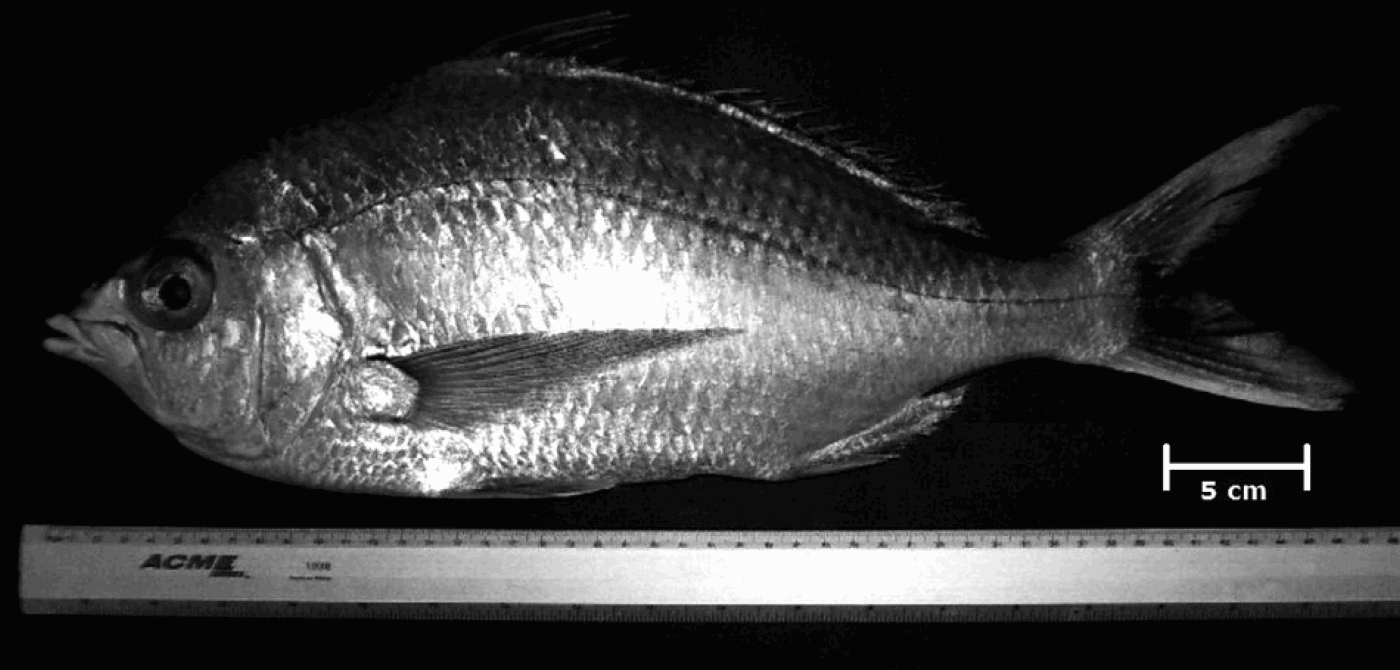
Yellowfin mojarra is a carnivorous species of first and second order, feeding on plants, fish, molluscs, crustaceans, aquatic insects, annelids, copepods, ostracods, and other organisms (Yáñez-Arancibia, Reference Yánez-Arancibia1978). Its body colour is silver-white; includes eight or nine dark-bluish vertical bars that fade to barely discernible, diffuse dark lines running along the length of its body; and the stomach is pale white in colour. It has long pectoral fins extending beyond the anus and almost reaching the beginning of the anal fin (Figure 1). Pelvic, pectoral, and anal fins have a yellowish tone (Bussing, Reference Bussing and Fischer1995; Robertson & Allen, Reference Robertson and Allen2002). It usually inhabits sandy and muddy bottoms in coastal areas and is very abundant in protected coastal areas, such as lagoons and estuaries; areas required for the development of juveniles (Yáñez-Arancibia, 1978; Castro-Aguirre et al., Reference Castro-Aguirre, Espinosa Pérez and Schmitter-Soto1999). Occasionally, they are part of the catch associated with shrimp fishing in the neritic zone (Tapia-García & García-Abad, Reference Tapia-García, García-Abad and Tapia-Garcia1998). They have even been captured at depths of 107 m (Amezcua-Linares, Reference Amezcua-Linares1996). This species is captured in coastal zones where fishermen employ fish-casting lines and casting, trawl and drag nets.
External appearance of yellowfin mojarra Gerres cinereus (CICIMAR-CI 6416).

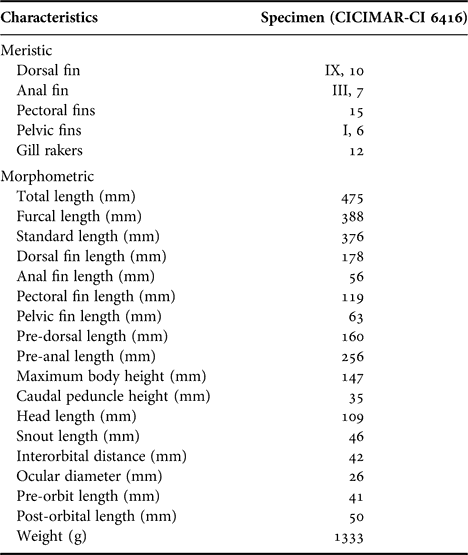
This specimen was captured on 18 July 2007 off the coast of Todos Santos (23°25′N 110°21′W) at a depth of 3 fathoms by an 8-cm mesh drag net. The catalogued specimen was deposited in the ichthyological collection of the Centro Interdiciplinario de Ciencias Marinas, IPN, in La Paz, Baja California Sur, (BCS) Mexico (CICIMAR-CI 6416). This specimen is a mature female, 475 mm long weighing 1333 g (Table 1).
Morphometric and meristic characteristics of yellowfin mojarra Gerres cinereus.

The size of yellowfin mojarra found along the west coast of Mexico range from 101 mm in Bahía de La Paz (González-Acosta et al., 2006) to 380 mm off the coast of Jalisco (Espino-Barr et al., Reference Espino-Barr, Cabral-Solís, García-Boa and Puente-Gómez2004) and the Galápagos Islands (Grove & Lavenberg, Reference Grove and Lavenberg1997). Our specimen represents a recorded increase of 95 mm. In the Laguna de Términos (~18.5°N ~91.5°W), adjacent to the Gulf of Mexico, specimens reach 159 mm (Aguirre-León & Yáñez-Arancibia, Reference Aguirre-León and Yáñez-Arancibia1986); off the islands of the Antilles specimens range from 178 mm (Bouchon-Navaro et al., Reference Bouchon-Navaro, Bouchon, Kopp and Louis2006) to 410 mm (Gilmore & Greenfield, Reference Gilmore, Greenfield and Carpenter2002). On a worldwide basis, this new specimen represents a 65 mm increase over all previously reported specimens.
Antuna-Mendiola et al. (Reference Antuna-Mendiola, Castro-Aguirre, De la Cruz-Agüero and Ortiz-Galindo2003), among others, suggest that this species in the eastern Pacific corresponds to Gerres simillimus (Regan, 1908), and should probably be considered a synonym or subspecies of G. cinereus (Walbaum, 1792), a valid species for the Atlantic. Other species in this genus, particularly G. oblongus (Cuvier, 1830) and G. argyreus (Bloch & Schneider, 1801), both from Indo-Pacific (Woodland, Reference Woodland, Fischer and Bianchi1984), are recorded to reach 400 mm. Hence, our specimen, at 475 mm, represents a new length record for all members of the Gerreidae family.
ACKNOWLEDGEMENTS
We thank the members of the fishing co-operative of Punta Lobos in Todos Santos for their help in our surveys. Primary funding for this project came from SAGARPA (Grant 2003-C01-179) with additional funds from CIBNOR (Project C-130).