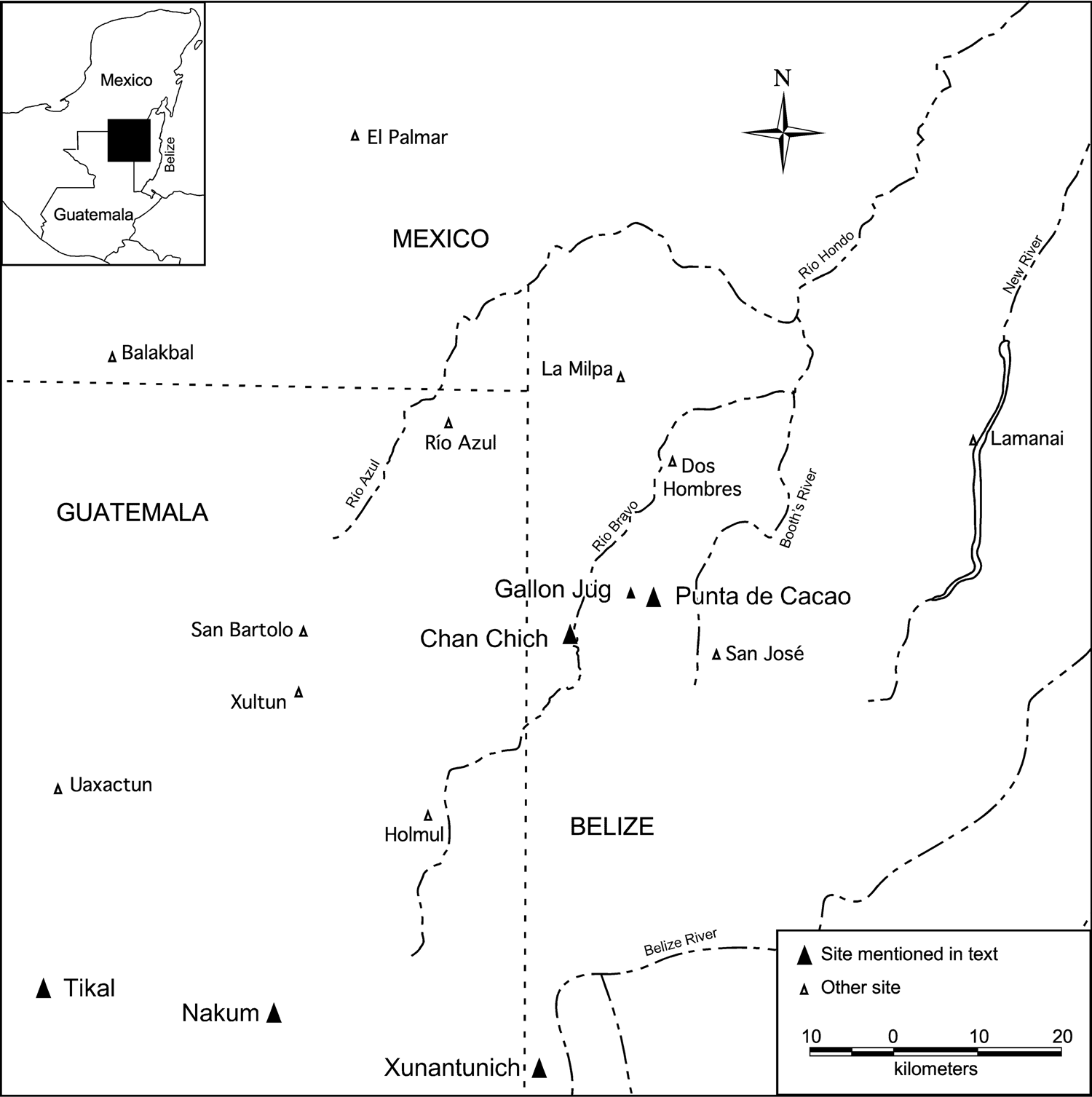
Recent research at the ancient Maya site of Gallon Jug in northwestern Belize documented multiple patolli boards incised into a plaster floor on a platform in Courtyard B-1, an elite residential group (Figure 1). Patolli, found at sites throughout Mesoamerica, are interpreted as game boards for leisure, gambling, or ritual practices (Walden and Voorhies Reference Walden, Voorhies and Voorhies2017). They represent the holistic worldview of the ancient Maya, because they combine accessing the supernatural through ritual practice with the informal act of gaming. The patolli from Gallon Jug are located in an apparent residential context and not in monumental religious architecture.
Map showing the locations of regional sites and those mentioned in the text.

Background
Ethnohistoric records and early Spanish chroniclers provide some social context and descriptions of patolli among the Aztec (Durán Reference Durán and Heyden1971 [1574–1579]:Plate 32; Sahagún Reference Sahagún, Anderson and Dibble1979:29). Aztec patolli consisted of a cross-shaped board divided into smaller squares. Though the number of squares varies in colonial documents, it seems that the goal was to move colored pebbles around the track based on the casting of patol bean dice (hence the name “patolli”). The value of each cast and the number of squares one could move depended on the arrangement of the beans that had been cast (Walden and Voorhies Reference Walden, Voorhies and Voorhies2017). Swezey and Bittman (Reference Swezey and Bittman1983:373–388) documented five styles of patolli boards: Type I, a cross-and-frame board with looped corners; Type II, a cross-and-frame board; Type III, a circular board with an interior cross; Type IV, a miscellaneous category; and Type V, a cruciform-style track divided into squares. These types have been recognized archaeologically across Mesoamerica, though the cross-and-frame board (Type II) is the most common type found in the Maya region (Walden and Voorhies Reference Walden, Voorhies and Voorhies2017:202).
The boards themselves, particularly the cross-shaped board used by the Aztecs, likely represent the quadripartite division of the cosmos (Durán Reference Durán and Heyden1971 [1574–1579]). Many archaeological examples of patolli are oriented to the cardinal directions, supporting the idea that the boards were cosmograms: symbolic representations of space and time (Hendon and Joyce Reference Hendon, Joyce, Hendon and Joyce2004:326). Though the chroniclers make it clear that patolli was a social gambling game, ethnographic (Verbeek Reference Verbeek1998), archaeological (Aveni Reference Aveni2001:148–152), and ethnohistoric (Boone Reference Boone and Keber2000) evidence connects patolli to cosmology, ritual, and divination.
Patolli in the Maya Lowlands
Architectural contexts from the Maya region bolster the interpretation that patolli are associated with ritual practices. Many patolli from the Lowland Maya region are in structures with a religious function, such as temples, or in structures where rituals may have been enacted, such as elite residences, ritual buildings, or “men's houses” (Gallegos Gómora Reference Gallegos Gómora1994; Johnson and Johnson Reference Johnson and Martindale Johnson2021; Walden and Voorhies Reference Walden, Voorhies and Voorhies2017). For example, Structure C-6 at Chan Chich was interpreted as an elite residence that assumed a ceremonial function with the remodeling of a room that housed the burial of an important individual in a bench on which a cross-and-frame patolli was carved (Harrison Reference Harrison and Houk2000).
Walden and Voorhies (Reference Walden, Voorhies and Voorhies2017:Figure 12.4) found that the majority of documented patolli in the Maya Lowlands come from the central precincts of civic-ceremonial centers, including temples, elite residences, and administrative buildings. These architectural contexts all share a sense of ritual and exclusivity, with spatial configurations that would have allowed only a few participants.
A small number of known patolli are found in civic structures in peripheral residential areas. At Chan, in the Belize Valley, patolli were carved into the floor of a civic building interpreted as a locale of adjudication and divination (Robin et al. Reference Robin, Meierhoff, Kosakowsky and Robin2012:146). Patolli are also found in eastern structures of residential groups—architecture connected to ritual and cosmology—further indicating that the boards are associated with practices connecting the living to cosmic ancestral forces. The architectural context of patolli in the Maya Lowlands connects the boards to divination, community leadership, and the cosmos.
Archaeological Research at Gallon Jug
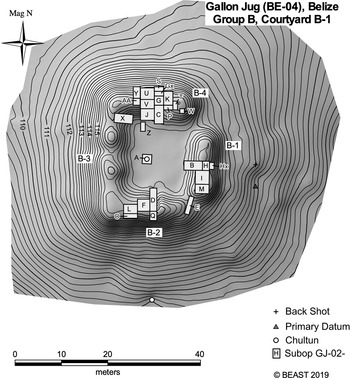
Gallon Jug may be a minor center associated with Punta de Cacao, 2.7 km to its east. Our work at Gallon Jug is still preliminary; prior to 2019 we had only mapped and conducted limited testing at the site core. During our 2019 season we investigated a residential group, Courtyard B-1, located 165 m east of the Gallon Jug Main Plaza (Figure 2). Courtyard B-1 consists of four structures built around a shared patio (Table 1) on a partially modified hill. Three structures (Structures B-2, B-3, and B-4) form a horseshoe-shaped opening to the east, which is delimited by a freestanding structure (Structure B-1). The arrangement leaves open the northeastern and southeastern corners but overall lends a sense of limited access to the group. Preliminary ceramic analysis identified Late and Terminal Classic period ceramic types, which we discuss later. Based on our current dataset we are unable to refine further the date of the final occupation phase.
Topographic map of Courtyard B-1 at Gallon Jug showing 2019 excavation units.

Courtyard B-1 Structures Architectural Information.

Structure B-4: Architectural Context
Structure B-4 forms the northern edge of Courtyard B-1 at Gallon Jug (Figure 2). A poorly preserved 3 m wide stairway would have allowed access to the structure from the patio, with an entrance framed by plastered balustrades. A 1 m high masonry wall delineated the summit room of the structure, which featured a plastered floor with no internal walls or benches. A lack of vault stones in the collapse debris indicates that the low walls likely supported a perishable superstructure. Our excavations established the room's width (2.7 m) but did not determine its total length; the portion we cleared measured 9.25 m long. We exposed the final phase architecture, but earlier replastering events of the summit floor are clearly visible in eroded sections, suggesting that the structure underwent some modifications during its use. We recovered a significant artifact deposit from the summit floor.
Artifact Deposit
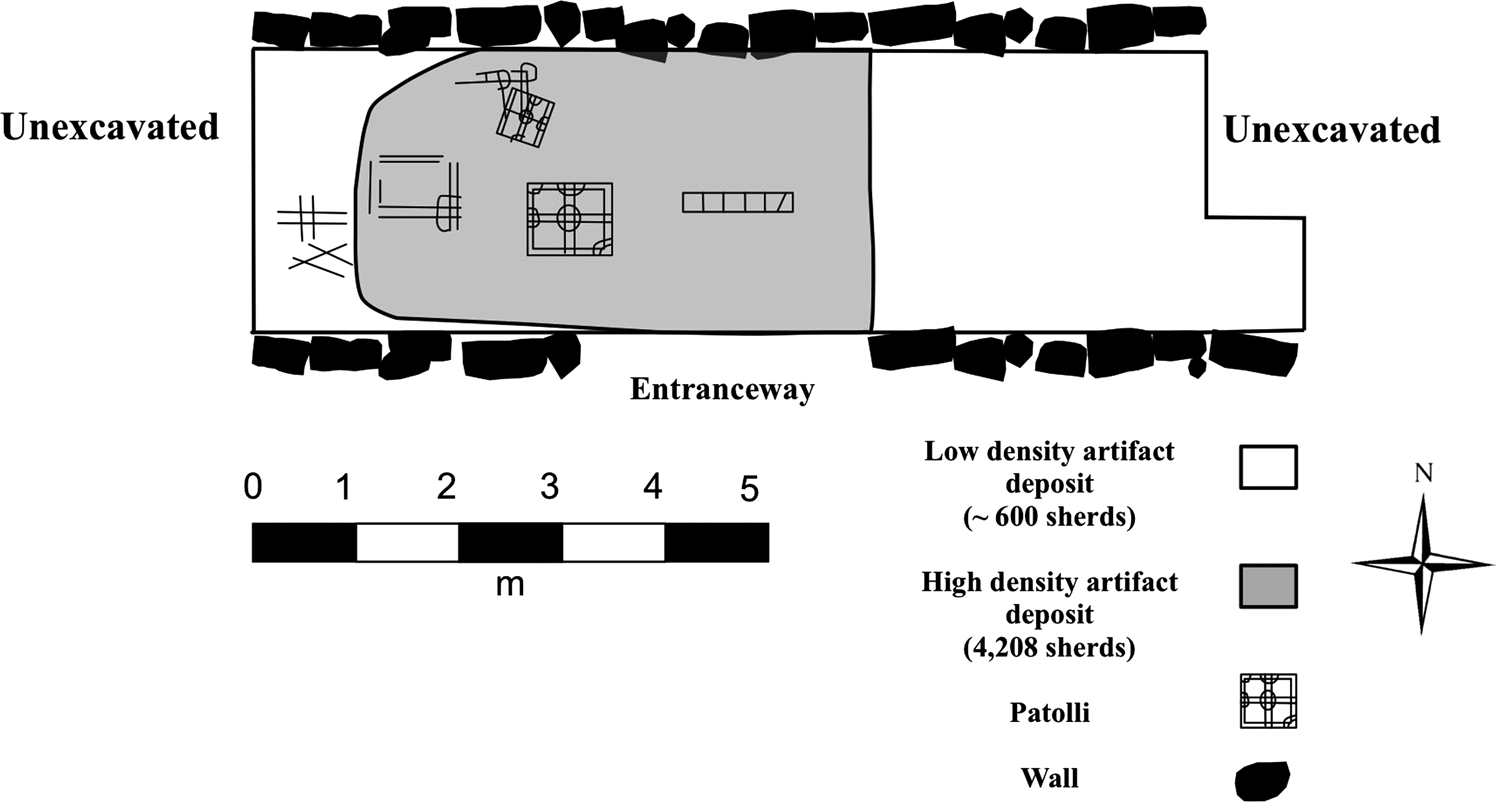
We collected 4,208 ceramic sherds from an area of roughly 12.24 m2 on the floor of Structure B-4. The deposit measured 0.67 m thick from the ground surface to the stucco floor, with the densest sections in the central and western zones of the structure (Figure 3). Analyzed rim sherds (n = 483) date to the Late and Terminal Classic Tepeu 2/3 ceramic sphere; they include bowl forms (56%), unslipped jars (28%), slipped jars (4%), dishes (5%), and a few vase forms. Types include Cambio Unslipped jars, small Tinaja Red bowls, large Subin Red bowls, and Achote Black bowls. Bowl forms were likely used for food preparation, serving, or both. The lack of ritual forms such as vases or censer fragments points to a standard household ceramics assemblage, rather than a feasting event. Several rim and base fragments that were able to fit together suggest that a singular depositional event could have produced the midden.
Plan map of the excavated portions of Structure B-4 (drawing by Claire Novotny).

In addition to ceramics, the assemblage included chert oval bifaces and debitage, broken obsidian blades, and mano and metate fragments. The density of artifacts declined substantially in the eastern zone of the room (Figure 3), but the deposit may continue in the unexcavated zone to the west.
Patolli
We first encountered a patolli in the central excavation trench (Subop G), and we identified several more as we excavated the western units. The patolli cover an area of approximately 15 m2 and are all oriented north–south. Preservation of the floor's plaster and the incised boards varies widely across the exposed portion of the room. Although it is difficult to securely date graffiti like patolli, ceramics from the deposit just described date to the Late and Terminal Classic periods, indicating that the patolli boards may have been carved then or earlier (Novotny et al. Reference Novotny, Copper, Novotny and Houk2019). Loosely grouped into three sections, the patolli boards incised into the floor of Structure B-4 vary in style and dimension, but at least two fit with previously identified patolli styles.
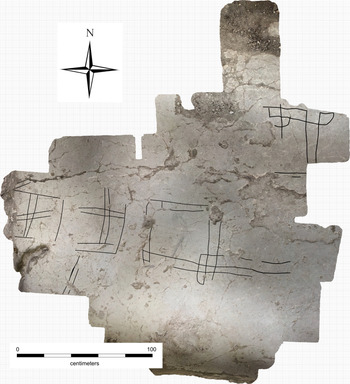
The western section measures 1.41 × 1.67 m and includes at least five paired lines oriented roughly north–south that are bisected by pairs of lines to form what may be eroded Type II boards. The lines vary from 0.31 m to 0.80 m long (Figure 4). One short section forms a 0.20 × 0.10 m rectangular shape divided into two rows of three square boxes. These might be part of an eroded cross-and-frame board (Type II), similar to the patolli at Chan Chich, or they could be another type of graffiti.
Structure from Motion orthophoto of the western zone of patolli (orthophoto based on photographs by Mark Willis, Brett A. Houk, and Claire Novotny; tracing by Claire Novotny).

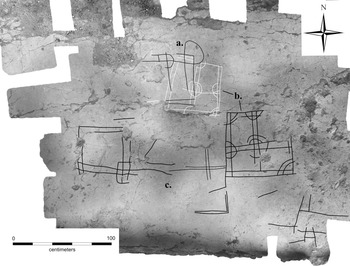
The central section measures 2.37 × 2.45 m and includes at least three patolli, among other lines running east–west and north–south and forming curvilinear shapes (Figure 5). The northern portion of the section has part of a cross-and-frame board with two looped corners (Type I), which measures 0.62 × 0.77 m (Swezey and Bittman Reference Swezey and Bittman1983). Other lines crosscutting this pattern seem to form a cross-and-frame board (Type II) and may have been incised at a different time than the Type I board, suggesting that there were multiple incising events.
Structure from Motion orthophoto of the central zone of patolli showing Type I (a), II/III (b), and eroded Type II (c) boards (orthophoto based on photographs by Mark Willis, Brett A. Houk, and Claire Novotny; tracing by Claire Novotny).

South of the Type I board is a second cross-and-frame board with variations that measures 0.63 × 0.63 m (Figure 5). It resembles the Type III board style (Swezey and Bittman Reference Swezey and Bittman1983: 387), except that style has a circular frame, whereas this board is square with a circle in the middle and curvilinear elements at the corners. Perhaps this is a hybrid example of Types III and II.
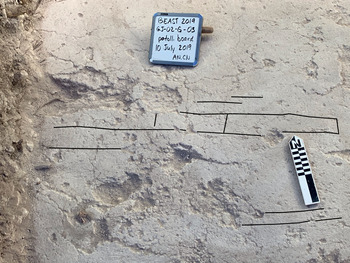
The eastern section measures 1.69 × 1.76 m and includes several horizontal, paired rectilinear lines (Figure 6). These could be eroded cross-and-frame boards (Type II) or other graffiti.
Photograph of eroded Type II boards in the eastern zone (photograph by Claire Novotny).

Discussion
The patolli described here are the only ones encountered from Gallon Jug. They add to the corpus of known boards that date to the Classic period in the Maya Lowlands (Gallegos Gómora Reference Gallegos Gómora1994; Harrison Reference Harrison and Houk2000; Johnson and Johnson Reference Johnson and Martindale Johnson2021; Robin et al. Reference Robin, Meierhoff, Kosakowsky and Robin2012; Walden and Voorhies Reference Walden, Voorhies and Voorhies2017). Type II is the most common in the Maya Lowlands, with examples from Xunantunich, Tikal, Nakum, and Chan Chich, among many other sites. Type I boards are relatively rare in this region, though there are newly discovered examples from northeastern Honduras (Fecher Reference Fecher2019).
The patolli boards in Gallon Jug are predominantly Type II-style boards, according to Swezey and Bittman's (Reference Swezey and Bittman1983) typology; however, there is a partial Type I board incised onto the floor in the central section, but only its eastern loops are preserved. The Type II/III hybrid board is intriguing because it may combine two styles, one of which (Type III) is uncommon in the Maya region. Furthermore, it seems rare in the Maya Lowlands for multiple types to occur together in one architectural context (see Walden and Voorhies Reference Walden, Voorhies and Voorhies2017:Table 12.1).
Though other structures in the courtyard group likely functioned as residences, Structure B-4 seems to fall somewhere between a public and private space. It does not match the architectural pattern of elite residences, whose interior spaces are restricted and include benches and either dividing walls or architectural features indicating the division of space, such as curtain-rod holders (Hendon Reference Hendon1991:900–902). The relatively open architectural space suggests that the structure facilitated social interactions among those invited into Group B-1. Playing patolli in this context could be connected to ritual divination, leadership, or leisure.
The artifact deposit includes ceramic types and stone implements that are part of a household inventory. The ceramic deposit was not mixed with architectural debris, which suggests that it was placed in the room while the building was still standing. The horizontal extent of the ceramic deposit aligns strikingly with the patolli boards, suggesting to us that the deposit is directly associated with the patolli. Both features may have been created as part of a termination ritual (see Aimers et al. Reference Aimers, Hoggarth and Awe2020:69).
Finally, the Gallon Jug patolli expand our understanding of the spatial distribution of patolli boards in the Maya Lowlands. In contrast to the other known sites featuring patolli, Gallon Jug is a minor center with fairly modest civic-ceremonial architecture. Courtyard B-1 is spatially discrete and was likely a private space. Architecturally, Structure B-4 is not restricted, featuring a wide staircase and entryway, no internal walls, and likely a perishable superstructure. Its architectural context suggests a place to host groups of people, perhaps for activities of ritual expression. The co-occurrence of different types of boards in one location may indicate a gathering of people from different locales around the time of abandonment of the site. Therefore, Structure B-4 may have been a specialized structure built as part of a household group, whose residents may have hosted gatherings featuring patolli games as a strategy to facilitate community leadership and the connection to cosmology.
Acknowledgments
We would like to thank Dr. John Morris and the Institute of Archaeology, Government of Belize, for permitting the excavations discussed in this report. We are grateful to the Bowen family for allowing access to Gallon Jug. Alphawood Foundation, Texas Tech University, and Kenyon College funded the 2019 field season. We would also like to thank the staff, field school students, and workers who assisted in collecting the data included in this report. Thank you to Fred Valdez Jr. for analyzing the ceramics and Mark Willis for photographing the patolli boards. We thank Tomás Gallareta Cervera for editing the Spanish abstract. We are grateful for the comments from three anonymous reviewers that strengthened and refined this report.
Data Availability Statement
The artifacts discussed in this article are stored at the Chan Chich Archaeological Project storage facility at Chan Chich Lodge, Belize. Drawings and photographs of patolli are available from the authors on request.