Introduction
This article has four major goals. First, I wish to inquire into an apparent paradox about the effects of liberalization on corruption. Why have those institutional changes that were designed to end corruption—ending the era of licences and controls, and implementing in its place a new regime of free markets and deregulation—resulted in its increase? Second, I advance a typology of corruption that locates the structural reasons why corruption in India is concentrated in particular domains. Third, I attempt to disrupt a common transition narrative about stages of development. The historical experience of development shows that, as a country gets wealthier, vertical forms of corruption that depend on extracting rent in many small transactions from large segments of the population disappear, and are replaced largely or entirely by horizontal forms of corruption, in which politicians and government officers extract rents from elites in business and commercial sectors.Footnote 1 In the last few decades, the experience of Asian countries such as Japan, Taiwan, South Korea, Singapore, Malaysia, and Thailand shows that everyday forms of corruption either disappear rapidly in the course of two or three decades or greatly diminish, but grand corruption flourishes and increases in importance. Although India has grown rapidly in the last two and a half decades, this development trajectory is not visible: vertical corruption continues to flourish whilst horizontal corruption appears to have grown rapidly as well. Finally, I argue that we must pay attention to the affective relations between citizens and the state. Pervasive vertical corruption has increased cynicism and distrust of government, fuelling popular anger against corruption, but also proved to be a durable mechanism for forging ties of patronage with politicians and bureaucrats that allow subaltern people to survive. These sentiments often operate at cross-purposes with each other, but may under the right circumstances be mobilized for political and institutional change.
The most important such conjunction in recent years fuelled a memorable anti-corruption campaign: the Anna Hazare movement. Anna Hazare, a social worker, launched a fast against corruption on 5 April 2011. The fast was called off after four days, but enormous crowds gathered at the Jantar Mantar in Delhi, launching a new social movement. This movement was enthusiastically and favourably covered by the news media.Footnote 2 Establishment politicians in different parties dismissed this movement as a small, elitist group that had no mass base. Important congress leaders interviewed on television said that, if the movement truly had the population's backing, then its leaders should contest the elections and change things through a parliamentary process rather than by street protests. Scepticism shaded into contempt in the manner in which the movement was dismissed. The main demand of the movement was to pass a bill for a Jan Lokpal (an ombudsman) who had the authority to investigate any official for corruption.Footnote 3
Subsequently, one group, led by Arvind Kejriwal, broke away from the movement to launch the Aam Aadmi Party (AAP). The main difference that arose between the Anna Hazare movement and the AAP was the question of whether people in the movement should seek power by contesting elections and, if successful, form a government. Against all odds, the AAP won 28 seats in the elections for Delhi state, upsetting the long-established government of Chief Minister Sheila Dixit. Kejriwal fought the election in Dixit's ward and defeated her. The AAP was asked to form the government, supported by the Congress. After a chaotic and eventful 49 days in office, Kejriwal's government resigned.Footnote 4 It subsequently failed to win a single seat in the Lok Sabha elections in 2014 despite receiving over 30 per cent of the votes in Delhi.Footnote 5 Notwithstanding that setback, in the state assembly elections in February 2015, the AAP swept the elections, winning a record 67 seats out of 70 while capturing 54 per cent of the popular vote.Footnote 6
There has been a great deal of discussion about the Anna Hazare movement and the rise of the AAP in the Indian media, in scholarly journals, and on various blogs and websites. I think that the popular enthusiasm for the movement caught its founders and supporters by surprise, and the phenomenal success of the AAP in the 2015 elections exceeded the expectations of even its most fervent supporters. No party had earlier managed such a massive victory, not even well-established parties like the Congress and the Bhartiya Janta Party (BJP). One would be hard-pressed to come up with a previous example of a new, issue-based political party in India that has been so phenomenally successful. Moreover, the fact that this particular party was centrally interested in corruption raises the question of why corruption has become such an important issue at this historical juncture.Footnote 7
Two related hypotheses can be offered for why corruption has become so politically and socially important now. The first hypothesis is that corruption has increased markedly in the past few decades, although commentators differ as to when such an increase first became visible. Some locate it with Nehru's toleration of corruption in the early years of Independence, others locate the growth of corruption to the Bofors scandal in 1986, while still others see it as having risen sharply with the second UPA government.Footnote 8 The second hypothesis gestures to the growing importance of corruption in public discourse and in the representation of politics. By this line of reasoning, it is not clear whether the protests against corruption are registering an increase in corruption or whether they reflect a growing intolerance of corruption in public life, particularly articulated by the educated, urban, middle class but by no means restricted to that demographic category.Footnote 9
The perception that corruption is ‘increasing’ might indicate either that more corrupt acts are taking place or that perceptions of corruption are changing, or a mix of both. Any notion that corruption has ‘increased’ refers to some metric by which it can be measured. If one took the number of major scandals that have erupted in recent years, there do appear to be more national scandals involving bribe-taking and misallocation of public assets. It would also appear that the sums of money that have been misappropriated are getting larger. A short list of recent scandals about corruption would include: Coalgate, the 2G scam, the Commonwealth Games (CWG) scam, the Adarsh Society scam, the DIAL scam, iron ore mining scams in Karnataka and Goa, and so on.Footnote 10 However, once again, we have to ask whether there are more scams happening now or whether highly competitive news media, hungry for new content, are more aggressively reporting scandals than previously.Footnote 11 Surprisingly, despite these two rough-and-ready indicators that corruption is increasing—a greater number of scandals and larger sums of money involved—there is little systematic evidence about aggregate levels of corruption in the scholarly literature.Footnote 12
What can we say for certain about corruption in recent years? I argue that the nature, extent, reach, and domain of corruption have profoundly altered since the liberalization of the Indian economy in 1991. Thus, institutionally, corruption has not remained the same as before. There is one important sense in which liberalization contributed to the reduction of corruption. Under the ‘licence-control’ Raj, the number of places where rents could be extracted was extremely large because industrialists had to obtain a government licence not only to open a new business, but also to expand an existing one. By doing away with most of these controls, liberalization shrank the points at which bribes could be collected. Liberalization was also accompanied by the rapid expansion of services and other industries, many in new sectors such as Information Technology (IT), where already established, routine mechanisms of rent extraction were not in place. There is thus no doubt that the number of ‘pressure points’ where government officials can extract rents has diminished.Footnote 13
If the number of pressure points where bribes can be extracted has fallen, why then does it appear that there is more corruption now than before liberalization? After liberalization, the economy has expanded more rapidly and, although the points at which rents can be extracted are fewer, the sums that are available for extraction are much higher. The amount of money at stake in something like the telephony spectrum is enormous—much larger than it was in corruption scams when the overall economy was smaller. For instance, in constant dollars, the 2G scam involved sums that were five times as much as Bofors (Figure 1) and the figures mentioned for Coalgate were at least an order of magnitude larger than Bofors. Because industrial growth rates have been high, the size of the service and manufacturing sectors has grown exponentially, making much larger sums of money available for extraction as rent. Second, as tax revenues have grown, so has the scale of government expenditure, and the much bigger sums involved in expenditures on infrastructure and social programmes opens ups the possibility of large-scale diversions (a point that I will elaborate on later).
Is corruption increasing?

A typology of corruption
If, as I have argued above, the sources of rent extraction have narrowed, where are they concentrated? I develop a typology of corruption by observing that almost all recent corruption scandals fall into one of four categories, each connected with a source of rent extraction by bureaucrats and politicians. The first revolves around the acquisition and sale of land, the second around the construction of infrastructure, the third around the sale of public assets such as the phone spectrum, and the fourth concerns massive new programmes on welfare and defence spending. I will now elaborate on each of these in turn.
Land acquisition and land sales
It is not surprising that so many recent controversies and conflicts have revolved around land. Over 68 per cent of India's population is still rural and, although we know that a large proportion of the rural population does not make its living primarily from agriculture, ties to the land are still strong.Footnote 14 Apart from the landless, all rural residents, even those with miniscule plots, have some ties to the land. For example, during harvest time, absenteeism increases dramatically at manufacturing facilities, no matter where such factories are located, because workers abandon their workstations to head to their villages for the harvest. Especially in agriculturally rich areas, every square inch of land is accounted for and, unsurprisingly, people who have small plots pay a great deal of attention to the boundaries of their land. In the areas of the Gangetic plain where I did most of my fieldwork, ploughing a furrow on the neighbour's side of the boundary line led to bitter feuds, often resulting in physical violence.
The reason this little ethnographic detail becomes so important is that it makes the purchase of land for industrial purposes, or infrastructure needs, a difficult, contentious, and politically charged affair. Most agricultural land is ‘protected’ by non-convertibility clauses. Land zoned for agriculture cannot be ‘converted’ to be used for a manufacturing facility, used to set up a Special Economic Zone (SEZ) or technology park, employed for building malls, high-rise apartment blocks, private villas, golf courses, luxury hotels, and so on. A golf course or a technology park that needs 150 acres of land may involve purchasing land from tens of smallholders. When Tata Motors was trying to acquire approximately 1,000 acres of land in Singur, West Bengal, it had to negotiate with 1,800 sharecroppers as well as several hundred landowners.
Working closely with people in the land bureaucracy, politicians can, for a fee, help re-zone agricultural land to make it available for other uses. They can also, for an additional fee, ‘persuade’ agriculturalists to part with their land and allow that land to be consolidating into blocks. Although there are very few cases where frontline politicians are caught threatening landowners to sell their land, goons who threaten landowners are often known to have ‘political backing’ for their activities. There is almost certainly some rent collection by politicians in the business of land consolidation for non-agricultural uses. The money extracted by corruption in the land business also helps fuel speculative investment in land.
The acquisition of land is a very complex political task—one that requires a great deal of local knowledge. Large corporations and big builders rarely get into the messy business of acquiring land. They leave that task to ‘brokers’, who are mostly low-level politicians and thugs good at bribing people and threatening landowners. Political support at higher levels is necessary to neutralize the ability of the victims to turn to the police for help or restitution.Footnote 15 Successful land consolidation places tremendous informational demands about the complexities of ‘local’ life—power relations, kin ties, caste connections, and family dynamics. Such knowledge is not easily gathered by a large corporate entity, and it is precisely this asymmetry in social knowledge and information about community dynamics that provides another space for politicians to extract rents in the land sector.Footnote 16
Infrastructure projects
The second area where recent scandals have highlighted rent extraction concerns the construction of infrastructure. The effort to make India a world-class country has meant that ambitious new schemes of infrastructural development are announced daily. Such projects are made feasible by the increased tax revenues that have accompanied the rapid growth rates in the Indian economy, particularly in its organized (i.e. tax-paying) sector.
I want to draw attention to two aspects of infrastructure projects. The first is that infrastructure is an old sector with a long history, with well-established norms that stabilize the ‘leakage’ from the system. The rush to build new infrastructure (airports, metros, internet cable networks, raised highways, flyovers, and so on) opens up possibilities of siphoning off large sums of money even if that share is below the historical norm. For example, the norm for leakage in road-building in India through the PWD (Public Works Department) has been about 30 per cent.Footnote 17 That is why the state of roads in India compares unfavourably even when put next to countries like Pakistan where corruption levels are also high. High and stable levels of corruption, therefore, result in potholed roads made from substandard materials that have to be resurfaced every year after the monsoon. Yearly allocations for ‘maintaining’ roads are easier to obtain and approve than a larger initial investment in a well-built road, because continuous roadwork involves a steady stream of money to the PWD bureaucracy and the politicians in charge.Footnote 18
What I am suggesting is that ‘new’ infrastructure may display proportions of leakage that are significantly lower than the old infrastructure but that, because of the rush to build new infrastructure, the opportunities for extracting rents are multiplying rapidly. The example of the scandal that surrounded the Commonwealth Games and the Delhi Airport are instructive about how this model of rent extraction operates.
The 2010 Commonwealth Games were held in Delhi on 3–14 October. As often happens with big infrastructure projects in India, the preparations were well behind schedule until 2009. In the last year, there was a big push to finish all the work on time. The end budget for the games escalated by 700 per cent between 2003 and 2010. More than US$ 2 billion dollars were eventually spent on the Games alone and, if one includes the sums spent on infrastructure development, the estimate is closer to US$ 10 billion (Business Today), although the official figure given by S. Jaipal Reddy, the urban development minister, was only US$ 4.8 billion.
The amount of money misappropriated is unknown; however, an estimate of US$ 500 million to US$ 1 billion is certainly not beyond the realms of possibility. It was claimed that Suresh Kalmadi, the chairman of the organizing committee of the games, who was subsequently jailed, had misappropriated Rs 70,000 crores (US$ 12 billion) (Figure 2). Although this figure was widely circulated, it is extremely unlikely to be correct, because a sum that large would exceed most estimates of the total expenditure on the Games.
Suresh Kalmadi, Chairman, Commonwealth Games.

Other spectacular examples of corruption in infrastructure projects are to be found in the construction of the Delhi International Airport and the expressway linking Delhi to Agra (the Yamuna Expressway). Both these scandals are closely connected to the politics of land. In the case of the Delhi airport, the private company that had been chosen to build, operate, and run the airport—the Delhi International Airport (P) Ltd, or DIAL—was leased government land at an annual rate of Rs 100 (US$ 2). The Comptroller and Auditor General (CAG)'s office alleged that, in so doing, the government had given away potential revenues of US$ 29 billion over 60 years.Footnote 19 Once again, although it was insinuated that such a giveaway may have been accompanied by kickbacks, no proof surfaced of any wrongdoing.
The Yamuna Expressway scandal also involved a PPP (public–private partnership), in which a private company agreed to build an expressway connecting Delhi to Agra. In exchange for paying for the construction cost and maintenance of the expressway, the company was given a tract of land along the side of the expressway in which it could develop commercially profitable enterprises such as apartment blocks, technology parks, and shopping centres. Farmers whose land lay in the area to be occupied by the project plans sold their land because they feared that, if they did not do so, their land would be seized under eminent domain, and they would only be paid a nominal price for it. However, after the expressway was begun, land prices in the area shot up. The farmers who had earlier sold their land then protested that they were not paid the true market value for their land. Political parties in the opposition in the state of Uttar Pradesh seized upon this opportunity to mobilize support by encouraging protests in the streets. The police were ordered to fire into the protestors, which resulted in the death of some peasants. The situation soon escalated into a major scandal. In this case, too, although there was no explicit proof that rents were collected in the bidding process for the expressway, it was widely suspected that large sums of money changed hands for the project to proceed.Footnote 20
As we can see from these cases, infrastructure development is often associated with corruption in at least three different ways. First, there are kickbacks to be collected in the bidding process that may be quite significant. Second, infrastructure development often depends on acquiring and rezoning land, and this is where political help is necessary before the project begins or during its construction, which may lead to further opportunities for rent collection. Finally, politicians and senior bureaucrats benefit from a kind of insider knowledge that has to do with the location of new infrastructure projects. They learn about the exact location of these projects before the general public because they are often in a position to determine where such projects are to be located. Before such projects are announced publicly, it is alleged that a lot of land surrounding the project is purchased in ‘benami’ transactions.Footnote 21 The location of an airport, or the route of a metro line, is altered in such a way as to lie adjacent to land that already belongs to powerful politicians or has been recently acquired by politicians and senior bureaucrats.
Thus, corruption in infrastructure and corruption in land dealings often intersect in practice, and are tied together in unexpected and complementary ways. As investment in infrastructure goes up (either through government expenditure or PPPs), we can expect that corruption ‘scandals’ will continue, and perhaps even intensify. However, even though infrastructure investment is rising, India still lags significantly other developing countries. Given the small tax base, and given the expenditures on social programmes and handouts to elite groups, it is unlikely that infrastructure investments will jump sharply in the short run but we can confidently predict that scandals associated with infrastructure are yet to reach maturity.
Sale of public assets
The largest scandals about corruption in the recent past have revolved around the sale of public assets. This concerns areas like the phone and television spectrum, and the sale of mining rights. The scandals with the largest monetary figures attached to them have all devolved around such sales. In these cases, assets over which the state has monopoly power (because they are ‘natural’ monopolies) that are supposed to be auctioned to the highest bidder are sold at a much lower price in exchange for a kickback. This is done by giving some companies insider information, or by rigging the auction process to exclude competitors, or by granting rights to an illegitimate company in which the politician or his family have a significant share. What is interesting about these scandals is that both the beneficiaries and losers are large capitalist enterprises. In other words, politicians and bureaucrats are being paid to rig the rules favouring one capitalist over another. In the process, however, the public exchequer is being deprived of large sums of money that could potentially fund redistributive social programmes or badly needed infrastructure. Thus, the loss from such rigging is not only to the competitors of the company that manages to secure the winning bid, but to ordinary people through the loss of resources that could be used for life-enhancing government programmes.
Recently, the two biggest such scandals have been the 2G scam and the scandal over the sale of coal-mining rights (dubbed ‘Coalgate’ in the Indian media). Briefly recalling the 2G scam, it involved the sale of the mobile telephony spectrum in early 2008. It is alleged that then Telecom Minister A. Raja moved up the date for applications by one week, from 1 October 2007 to 25 September, and selectively informed companies that he favoured that the deadline had been changed. Then, using the government's first-come first-served rule, he declared that the licences had already been granted. The CAG estimated the loss to the exchequer by undervaluing the sale price of the spectrum to be worth US$ 29 billion. It is alleged that A. Raja personally received US$ 500 million in bribes. He was subsequently charged with criminal breach of trust by a public servant and jailed. M. K. Kanimozhi, the daughter of M. Karunanidhi, the chief minister of Tamil Nadu, who headed the party to which Raja belonged, was also arrested for being the ‘active brain’ behind the scam.
‘Coalgate’ was about the selling of blocks of coal deposits to private and public-sector companies. Coal blocks were allocated to public-sector and private companies if they could make the case that they needed a captive mine for setting up a power plant or a steel mill. In 1992, the Ministry of Coal put up a list of 143 coal blocks that were available for sale. Instead of being auctioned, these blocks were allocated by a Screening Committee to particular companies for an undisclosed price. The CAG estimated that this resulted in a windfall gain to the companies worth US$ 31 billion.Footnote 22 In his government's defence, Manmohan Singh argued that a process of competitive bidding was strongly opposed by the opposition parties that ruled most of the states that had coal blocks. The state governments were against competitive bidding because they felt that it would increase the cost of coal and thus adversely impact the development of industries in their states. In this case, too, allegations of corruption have been made but no evidence of bribe-taking has been substantiated, and no individuals named. In a classic bureaucratic manoeuvre that usually signals wrongdoing at high levels, nearly 150 files pertaining to the allocation of coal blocks between 1993 and 2004 are missing from the relevant ministry.Footnote 23 On 24 September 2014, the Supreme Court revoked the allocation of 214 out of 218 coal blocks allocated since 1993 on the grounds that such allocations were made improperly.Footnote 24
Such examples of crony capitalism differ from the Eastern European case during the transition period in one important regard. Unlike those cases, where state companies were sold off at giveaway prices to friends and relatives of the new leaders, the sale of public-sector companies has proceeded at a very slow rate.Footnote 25 State leaders have, on the whole, avoided selling off public-sector assets because they have been afraid of labour unrest. Unions in public-sector factories have historically been very strong and, instead of confronting them by selling public-sector companies, the government has supported capital accumulation by preventing the rise of militant unionism in areas where the economy has expanded most rapidly, most notably in the service industries.
Welfare and defence spending
Since the rural employment guarantee scheme (MGNREGA) that was launched in 2005 was credited with helping re-elect the UPA government in 2009, there has been a rush to create new programmes that provide a safety net to help reduce the stubbornly persistent proportion of people who live below the poverty line. The National Food Security Act, popularly known as the Right to Food Act, was passed in 2013.Footnote 26 It was launched with great fanfare in time for the elections. It became the most expensive social programme ever launched in India, and one of the most expensive such programmes in the developing world. In 2014–15, the budget for the National Food Security Act was fixed at Rs 115,000 crores (approximately US$ 20 billion). The budget for Employment Program MGNREGA in 2012–13 was Rs 33,000 crores (US$ 5.6 billion). Other programmes have also been planned, launched, or extended. These include the programmes for basic education (Sarv Shiksha Abhiyan, with an allocation of Rs 27,258 crores (US$ 4.7 billion); a programme to provide mid-day meals in schools, with an allocation of Rs 13,215 crore (US$ 2.3 billion), extending the Integrated Child Development Services (ICDS) programme to make it ‘universal’, namely extended to every block in the country, with a budget of Rs 16,432 crores (or US$ 3 billion); Bharat Nirman, a programme for building rural infrastructure at Rs 4,529 crores (US$ 777 million); the National Rural Health Mission funded at Rs 18,206 crores (US$ 3 billion) in 2013–14; the Total Rural Water and Sanitation Program at Rs 15,260 crores (US$ 2.6 billion); and a slum eradication programme called the Jawaharlal Nehru National Urban Renewal Mission, with a budget of Rs 7,060 crores (US$ 1.2 billion). There exists a large Public Distribution System (PDS) that supplies poor people with food, which is subsidized to the tune of Rs 115,000 crores (about US$ 20 billion). In addition, the creation of an official category of Below Poverty Line (BPL) status comes with a host of subsidies and grants.
The large outlays for many of these programmes are accompanied by complaints of ‘leakage’. For example, the Planning Commission estimated that 58 per cent of the materials supplied to the PDS are diverted.Footnote 27 Money and commodities are routinely misappropriated by politically and administratively powerful individuals. However, it would be a mistake to lump this as yet another example of ‘elite capture’ because of the countervailing tendencies of republican populism, government transparency, and lower-class activism. The ‘system’ of corruption works in India not because some elites have captured the state, but because the spoils of corruption are widely shared by people in political and bureaucratic offices. The existing system of rent collection thus has wide support among those in bureaucratic and political office.Footnote 28
Another area of ‘grand’ corruption is in defence procurement and supplies for the armed forces. I have lumped it together with ‘social spending’ because these are two large areas of government expenditure, consuming just over 30 per cent of the budget. All around the world, defence spending is plagued by corruption because the veil of secrecy on expenditures on ‘national defence’ makes it much harder to investigate misappropriation. In India, one of the biggest corruption scandals was associated with defence spending—the Bofors scam of 1986. It was alleged that the prime minister at that time, Rajiv Gandhi, had received kickbacks on the deal, which involved the sale of 410 155 Howitzer field guns for US$ 285 million. The kickbacks amounted to Rs 64 crores (US$ 51 million), and the name ‘Bofors’ and the figure of 64 crores became synonymous with corruption, leading to Rajiv Gandhi's defeat at the polls in 1989.Footnote 29 More recently, another matter involving defence spending—the AgustaWestland helicopter-purchasing scandal— has once again engulfed the Gandhi family in controversy.Footnote 30
Defence procurement remains an area where massive corruption is suspected, but little of it finds its way into the news. As India has become one of the world's ten largest military spenders, with an annual budget of US$ 47 billion, the scale of contracts has increased exponentially, as have the opportunities for kickbacks.Footnote 31 However, the armed forces are relatively autonomous and politicians are not as central to who gets contracts and how the military spends its money except in the case of purchases of foreign equipment. Therefore, military expenditures are not necessarily a source of income and patronage for the political class, and this makes them quite different from social programmes, which do serve such a function.
All of the examples above—land acquisition and land sales, infrastructure projects, the sale of public assets, and welfare and defence spending—have stressed what has been called ‘grand’ corruption or ‘horizontal’ corruption.Footnote 32 Land acquisition and welfare spending are the places where horizontal and vertical forms of corruption meet. The ‘leakages’ in welfare spending and in the PDS have a direct impact on the everyday lives of the poor, by denying them what is rightfully theirs. However, if we think of the areas of social life in which poor and middle-class people are most affected by corruption, it has to do with what is known as ‘retail’ corruption or vertical corruption.
Vertical and horizontal corruption in narratives of development
Also known as retail corruption, ‘small-scale’ corruption (as opposed to grand corruption), and petty corruption, vertical corruption refers to the myriad forms in which rent extraction permeates the everyday lives of most people living in India today. Examples include bribes given to land-record officials to record a land transferFootnote 33 ; the paying of a hafta (weekly payment) to police in Mumbai to allow street hawkingFootnote 34 ; or obtaining a connection to the municipal water supply by bribing officials and politicians.Footnote 35 In short, it is almost impossible for a resident to survive without paying a bribe. Bribes are not just paid for ‘speed money’ (to get work done faster), or to get to the head of a line; they are also needed to get routine work done and to receive routine services from government agencies.
India is not unique in having a culture of retail corruption. There are two important functions served by such vertical corruption. First, vertical corruption takes money from thousands of small contributions and creates large pools at higher levels of bureaucracy and politics. Small bribes aggregated over a large population can add up to substantial resources that serve not only to enrich bureaucrats, but also to provide politicians with the resources that they need to contest elections. The expense of elections can be gauged from the fact that the BJP, the party out of power in the 2014 Lok Sabha election, spent an estimated Rs 5,000 crores (US$ 850 million).Footnote 36 One can only speculate that the Congress, the party in power, collected even more money for electoral purposes.Footnote 37
Second, the money collected through vertical corruption is distributed to all the functionaries of the state. Thus, vertical corruption serves to redistribute resources from citizens to the bureaucracy. In turn, politicians are able to use the bureaucracy as a giant patronage machine, because political control over appointments and transfers enables politicians to draw large rents from bureaucrats, and to place their supporters in key offices.Footnote 38
There exists little incentive, therefore, for politicians to attempt to reduce retail corruption. Doing so will lose them the support of the bureaucracy, which is essential to governing, and it also robs them of the resources they need to contest elections, and enrich themselves.Footnote 39 In fact, money collected from vertical corruption was the primary mode of financing the political system until the beginning of ‘market reforms’ in 1991. Although the ‘licence-control’ Raj allowed for an almost infinite number of points where rents could be extracted, the slow rates of growth did not enable ‘horizontal’ corruption to become a source of large rents. In cases such as Bihar (detailed by Witsoe 2013), vertical corruption did not serve to bring bureaucrats and politicians together. Rather, rising lower-caste political mobilization created endemic conflicts between politicians and their helpers on the one side and upper-caste bureaucrats on the other. Taking advantage of the relative unfamiliarity about administration of the new political class, upper-caste bureaucrats increased their corrupt activity.Footnote 40 Paradoxically, the replacement of collusion between politicians and bureaucrats with conflict resulted in an increase in vertical corruption rather than its diminishment.
A common feature of the historical experience of development is that, as nation-states become richer, vertical forms of corruption gradually disappear and are replaced almost entirely by horizontal ones. These historical trajectories thus suggest a ‘corruption transition’ as nation-states move from middle-income status to high-income status. The same development narratives see horizontal corruption being replaced by ‘the rule of law’ during this transition. Such a trajectory is implicit in Transparency International's ranking of countries by levels of corruption: it demonstrates a strong correlation between perceived levels of corruption and national wealth. The countries perceived to have the least amount of corruption are also liberal-democratic, capitalist nation-states where the ‘rule of law’ prevails.Footnote 41
The rule of law transforms formerly illicit contributions to parties for political campaigns, and payments to politicians to introduce or change legislation, by a due process that enables unfettered campaign contributions and lobbying. We thus expect to see two transitions as nation-states move from middle-income status to high-income status. Retail corruption disappears because those holding political office no longer need to funnel small sums of money when they can collect large sums from a few sources (horizontal corruption). Bureaucrats’ salaries rise and the cost of vertical corruption increases as surveillance becomes better. There is less incentive for bureaucrats to take small sums of money from a large number of people because dealing with many people increases the chances of being caught. When middle-income countries become rich, horizontal corruption is replaced by legal mechanisms that achieve the same ends but are made ‘transparent’, thereby reducing further the taint of illegality and illegitimacy.
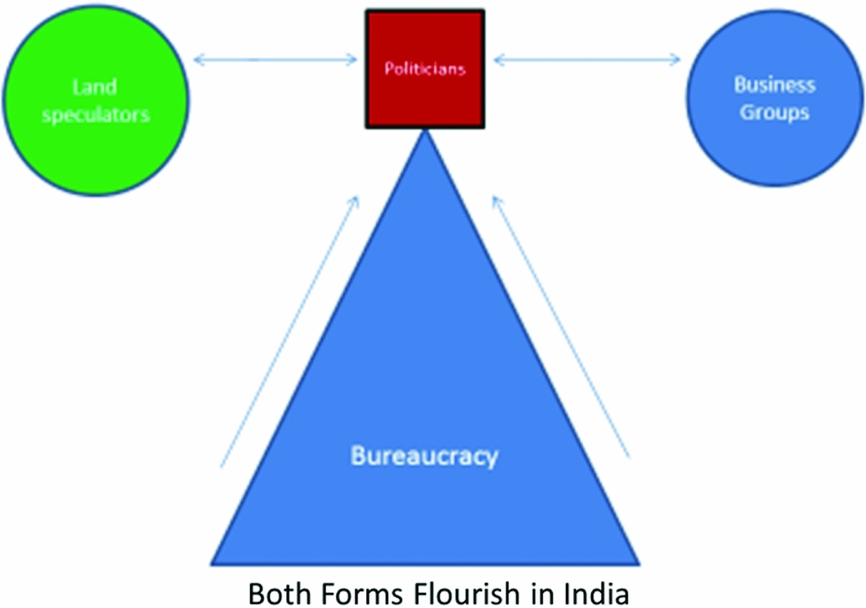
In India today, horizontal, elite forms of corruption are more fully developed than ever before, as evidenced in the corruption scandals detailed above. However, this has not been accompanied by the decline of retail or vertical corruption. What we see, in fact, is that both forms of corruption now bloom together (Figure 3). Moreover, another very important trend has been the universalization of corruption. After the demise of one-party rule, when the first non-Congress government was formed at the centre in 1975, the system of political competition has resulted in a pattern in which the incumbent party is usually defeated at the polls.Footnote 42 Unlike other democracies where incumbency provides a distinct advantage to a party and a candidate, incumbency in India confers a disadvantage. In such a situation, reaching a tacit agreement with the other parties that it is legitimate to collect the ‘spoils’ of rule allows for orderly competition because all parties know that their turn will come in the next election cycle. Not only does this result in a culture of tolerance for the corruption of the ruling party; it also means that the current ruling party does not raise a fuss when the opposition, once they come to power, start extracting rents.Footnote 43 It also leads to a tolerance of rent collection being undertaken by opposition leaders, as the controversies around Nitin Gadkari when he was out of power have made clear.Footnote 44 Being in the opposition is no longer an impediment to facilitating the business of business, or of conducting deals involving land development as a private investor, although the lack of direct power does constrain the ability to grant favours to one business party over another.
System of corruption in India.

India has a unique culture of corruption that mixes forms of horizontal and vertical corruption rarely seen together in other national contexts, affecting poor and rich alike, but in very different ways. The Indian case thus calls the historical narratives of corruption transitions into question. The question of why vertical corruption has not withered away is difficult to answer, but I have suggested at least a few reasons for such an outcome: the widespread sharing of the spoils of corruption in the bureaucracy and amongst the political class; the low chance of being caught and punished for indulging in corrupt acts; and, finally, the willingness of the opposition not to go all out to reap political benefits from corruption scandals because they expect the party in power to reciprocate when they take over the government after the next election.
What effects do such forms of corruption have on the state, on citizens, and, most importantly, on the relation between the state and its citizens?
Affective relations between the state and its citizens
There is a qualitative difference between vertical and horizontal corruption that is very important for questions of legitimacy. Horizontal, grand corruption happens outside the public eye. It depends upon a lack of transparency, of course, but, equally importantly, on a lack of publicity. Were it not for the machinery of publicity—television, newspapers, reporters, and so on—and were it not for the circulation of representations of corruption, grand corruption would be invisible. One could argue that horizontal corruption does more to ruin the lives and livelihoods of poor people than vertical corruption, but its negative consequences occur outside the line of sight of most citizens. When horizontal corruption is exposed, it is usually due to structural antagonisms among the elite, of internecine competition between fractions of capital, and conflict among different strata of elites, such as those with cultural capital versus those with money capital. When such conflicts are well managed, high levels of horizontal corruption can co-exist with high levels of state legitimacy.
In those rare high-profile cases of horizontal corruption in which prominent politicians or bureaucrats are jailed, it is usually for one of two reasons. Someone has to be made a scapegoat, and being in the hot seat usually means that one is taking the risk for a person higher up who cannot risk being exposed in this way. Thus, A. Raja was widely seen as M. Karunanidhi's front man, but the senior politician was unscathed, whereas Raja went to jail. Second, and more importantly, a high-profile case is usually motivated by conflicts over the sharing of the embezzled money. Many people believe that Raja and Y. S. Jaganmohan Reddy, YSR's son, who were both imprisoned were being punished for not funnelling enough money up the hierarchy.Footnote 45
In contrast to horizontal corruption, vertical or retail corruption does not depend upon the revelatory activities of elite intermediaries. It is experienced by poor and rich alike on an everyday basis. However, contrary to what we might expect, vertical corruption is not always delegitimizing of regimes. It sometimes enables poor and subaltern peoples to establish relations with street bureaucrats or with politicians, and often serves to cement patron–client relations. As several scholars have pointed out,Footnote 46 at least some of the money collected by politicians through vertical corruption is redistributed during elections in the form of gifts to individual voters or to entire village or caste communities in a putative exchange for votes. Vertical corruption therefore has historically been one of the mechanisms by which the ‘potlatch’ of elections is celebrated—how the ‘festivals of democracy’ are materially realized.Footnote 47
Thus, persistent and extensive retail corruption may engender a wide range of sentiments in the citizenry that may paradoxically alienate the population from the state at one moment and at the same time foster close bonds between residents and bureaucrats or politicians at others. If the overall affective relation is such that it produces a pervasive distrust of government agencies and officials, it is likely to result in a cynicism about the state. A cynical and distrustful population, in turn, is less likely to support state programmes. Without a citizenry interested in making programmes work, there is very little ‘pressure from below’ to reform government programmes and agencies. Political pressure from the top, when combined with citizens’ groups pushing for transparency and accountability from below, can effectively squeeze the bureaucracy and stop corruption. However, if citizens are disaffected and cynical, they will see any effort to organize as useless, and any attempt at reform as doomed to failure. This sets up a vicious cycle and makes the capture of rents by bureaucrats a self-fulfilling prophecy.Footnote 48
Another major sentiment often found among politically ascendant, urban-based middle classes is anger at being taken advantage of by bureaucrats and politicians. Why has the post-liberalization cohort of urban, middle-class people been less willing to accept petty corruption than previous generations? Three possible reasons spring to mind. First, because they occupy the leading edge of an economy shaped by the centrality of knowledge industries and the service sector, the emerging middle class has a great deal of cultural capital, and is unwilling to see itself as inferior to the bureaucracy. One can see that the leadership of the AAP was drawn largely from this class of urban, educated people with high levels of educational capital, some of whom (for example, Arvind Kejriwal and Kiran Bedi) quit the upper echelons of the bureaucracy for jobs in the non-profit sector. Second, the experience of transnational work and travel has made this class of people aware that people in other nation-states largely live free of petty corruption. The main exemplars here are not the United Kingdom, United States of America, or Australia, but Singapore, Dubai, and China. Because they want to get results quickly, many in this group are attracted to authoritarian populism and susceptible to the siren call of a development dictatorship. Third, it is not surprising that so much of the middle-class anti-corruption activism is actualized through the employment of transparency laws, such as the Right to Information. Transparency laws reverse the traditional relation between bureaucrats and citizens. Faced with educated, activist citizens, bureaucrats cannot resort to their habit of treating citizens and clients with contempt. Transparency laws actualize the forgotten dictum that officials are there to serve the people, that they are servants of the people—government servants. The Right to Information has been a critical toolkit in middle-class anti-corruption activism.
However, anger at corruption is not limited to the middle class. One of the biggest mistakes made by established political parties and left intellectuals about the Anna Hazare movement was to dismiss it as merely a middle-class phenomenon. The notion was that elections would prove that the movement lacked broad popular support and that it was only attractive to a small group of very vocal people who had the means to organize and protest. The issue was further confounded by the focus of the Hazare movement on horizontal corruption rather than the everyday forms of corruption that oppress people in their daily lives. Focusing on the big scams, and prosecution of high-level politicians and bureaucrats, was unlikely to make better the life of the bank clerk, the software engineer, or the rickshaw puller. There was a mismatch between the reason people were protesting and the topics around which their protests were focused.
Dismissing the Anna Hazare movement misread the relationship between citizens and the state. The movement was diffusely, and confusedly, expressing popular anger at corruption—a sentiment that drew upon a deep wellspring of emotion.Footnote 49 This anger is felt even more deeply by the poor than the middle class because access to food, housing, water, medical care, education, and jobs is being denied to them because of corruption. The plethora of rights-bearing legislation merely states in a formal manner what has been promised by the deepening of substantive democracy in the last half-century. The first step in this process was the silent revolution that led to the ascendance of lower-caste parties in the heartland of brahmanical North India.
What Witsoe has documented for Bihar is true for the other most populous state in India, Uttar Pradesh, as well. The rise of backward caste parties changed the relationship between lower-caste rural peoples and state institutions. Although the bureaucracy has continued to be dominated by higher castes, the rise of lower-caste politicians enabled subaltern groups to access state services by appealing to the political overlords of the bureaucracy. Through an elaborate system of patronage, lower-caste people could appeal to their legislator to access state services that were sometimes reserved for them but to which they did not have access because of a hostile or uncaring bureaucracy. Patron–client relations within a democratic, electoral framework thus helped deliver goods and services to subaltern groups.
However, there is another dynamic that has an important bearing on this subject. When I did fieldwork in rural U.P. in the 1980s and 1990s, there were relatively few lower-caste bureaucrats in government offices. Most of the places reserved for lower castes in state institutions lay vacant, from the Block Office to educational institutions to the local hospital. Although lower-caste parties had ascended to political power, they were often resisted by a recalcitrant bureaucracy (Witsoe). Thus, one of their most important agendas was to staff the bureaucracy with as many lower-caste people as were eligible. For instance, the Anganwadi programme that I studied had hired so few lower-caste workers that it was ordered to fill all future vacancies with lower-caste women. For politicians, such an agenda, in addition to changing the composition of the bureaucracy, also served an important patronage function in providing jobs for supporters. However, even qualified lower-caste applicants had to pay bribes to politicians to secure government jobs. Seizing upon this fact, upper-caste groups inside and outside the bureaucracy vehemently linked the growth of bureaucratic corruption with the intake of lower-caste groups.
Anand and Björkman's work on water, and Anjaria's on street hawkers in Mumbai, demonstrates the importance of organizing, negotiation, and patronage in the lives of marginal inhabitants of India's cities. These recent ethnographies of the state show that the fashioning of a neoliberal city imagined by the ascendant middle class is challenged by its subaltern denizens through organized involvement in politics to seek patronage from elected officials, and through negotiations with bureaucrats that also might involve the exchange of money for services.Footnote 50 Although patronage is not going away, does the rise of the AAP signal a parallel development in the deepening of democracy, whereby subaltern people expect to be provisioned with goods and services as a matter of right rather than as a favour obtained through a patron's mediation? Contradictory tendencies might well be at work whereby corruption is simultaneously to be fought against as an evil except when it helps one to survive. Such contradictory evaluations are not restricted to subaltern groups, but pervade the life of all classes in urban India.
In most countries that rank low in Transparency International's corruption index, the ‘perception’ that corruption is low may be due to a combination of factors. First, these nation-states have pushed corruption out of the everyday lives of most people and into the realm of elite politics. Second, they have legalized forms of bribery and influence peddling, so that it hides comfortably and respectably behind the ‘rule of law’. Third, by socializing risky corporate behaviour, and privatizing the profits from such behaviour, national governments systematically reallocate income and wealth upward. In exchange, politicians receive campaign contributions, and positions on corporate boards if they are unlucky to lose an election. In the global North, horizontal corruption has devastated the life of its middle-class and poor citizens, and produced a generation of young people who have a precarious existence. However, it is rendered ‘invisible’ by the magic of legal frameworks, political rhetoric, and agencies that produce representations that are purchased by the very wealth that is generated by such corruption. Denunciations of the ‘1 per cent’ are not always presented in the language of horizontal corruption: in terms of corporate welfare, the buying of public office, kickbacks to the upper class involved in military spending, and so on. The result is that, for most people, it is not possible to articulate horizontal corruption as something that affects them immensely and with devastating impact. Rather, such anger is diffusely expressed in terms of distrust and cynicism about government on the one side (the Tea Party) and against the 1 per cent (capitalist class) on the other. That horizontal corruption makes government less effective in keeping schools running, bridges maintained, affordable medical care available, or the social net tight, and that it changes the rules of the game so that a very small minority usurps the entire social surplus, is rarely mentioned.
I am arguing that we need to pay attention to the specificity of forms of corruption in India because the way that corruption works is very different from what one finds in the G-7 countries. However, the difference is not between high levels of corruption in one setting and low levels in others. Rather, it is about the forms that corruption takes, and whether the primary mechanisms are vertical or horizontal.
Studying corruption cross-culturally is a fraught issue because one cannot stop with institutional analysis. One has to consider the meanings and understandings of corruption employed by people in their everyday lives. However, understandings of corruption depend on the circulation of representations of corruption, as well as on the changing affective relations between citizens and the state.Footnote 51 In other words, ‘corruption’ is a complex sign that brings together institutional change, the circulation of representations, and the emotional attachment between people and the state.
In providing a broad overview of corruption in India today, my aim is not merely to provide a typology of the different domains in which corruption has flourished, but also to ask why it appears to have increased sharply after ‘market-friendly’ reforms were put into place whose goal was to reduce corruption. The distinction between vertical and horizontal corruption helps us understand that new forms of intra-elite corruption have been added to existing forms of vertical or retail corruption rather than replacing them. Paying close attention to such a situation underscores the need to understand historical transformations not merely in terms of developmental trajectories and path dependency, but also as arising due to historically contingent alignments of political forces, economic interests, and affective relations. On the one hand, the deep bureaucratic entrenchment of the system of retail corruption in India makes it difficult for reformist governments and middle-class movements to take effective action against it. On the other hand, there is both a great deal of popular anger against corruption and an acceptance that it is necessary in order to enable lower-class and lower-caste groups access to the state through political clientism. As social scientists, we are ill-equipped to deal with the role of affect and emotion in social life, and that is why most of the writing on corruption and on political institutions more generally is so divorced from those issues. However, without seeing them as integral to institutional change, our understanding of many important political phenomena such as corruption can be seriously askew.