The pygmy mussel Xenostrobus securis (Lamarck, 1819) is endemic to brackish-water environments of southern Australia and New Zealand. During the past two decades, it has been progressively recorded in a number of brackish-water biotopes along the Italian coasts of the Adriatic Sea (Lazzari & Rinaldi, Reference Lazzari and Rinaldi1994; Sabelli & Speranza, Reference Sabelli and Speranza1994; Russo, Reference Russo2001), in the lagoons of the Mediterranean coast of France (Zenetos et al., Reference Zenetos, Gofas, Russo, Templado and Briand2004), and in the Ria de Vigo (Galicia, Spain) (Garci et al., Reference Garci, Trigo, Pascual, González, Rocha and Guerra2007). In addition, since the 1970s, X. securis was observed in Japanese waters, where it was incorrectly re-described as Limnoperna fortunei kikuchii (Habe, 1981) (Kimura et al., Reference Kimura, Tabe and Shikano1999). Recently, Giusti et al. (Reference Giusti, Dell'Angelo, Sosso and Schiaparelli2008) found individuals of X. securis in a brackish-water canal located in proximity of the port of Leghorn (Ligurian Sea, Italy). This bivalve possesses many bio-ecological characteristics of invasive species and it is, therefore, considered a potential pest (Streftaris & Zenetos, Reference Streftaris and Zenetos2006). Its life-span is relatively short (about one year) and usually it lives in high-density populations (Wilson, Reference Wilson1969). Its presence can provoke several problems. In fact, high-density populations living on muddy bottoms can smother the native infaunal community (Zenetos et al., Reference Zenetos, Gofas, Russo, Templado and Briand2004), can act as a key host for pathogens of commercially important species (Pascual et al., Reference Pascual, Villalba, Abollo, Garci, González, Nombela, Posada and Guerra2009), and can compete with them for space and food (Garci et al., Reference Garci, Trigo, Pascual, González, Rocha and Guerra2007; Santaclara et al., Reference Santaclara, Espiñeira and Vieites2007). Moreover, being able to sustain high densities of individuals, X. securis can heavily contribute to the fouling of submerged structures, pipelines, ropes, and boat hulls (Garci et al., Reference Garci, Trigo, Pascual, González, Rocha and Guerra2007). Given its peculiar ecological traits, X. securis is listed among the ‘100 Worst Invasive Species’ in the Mediterranean (Streftaris & Zenetos, Reference Streftaris and Zenetos2006).
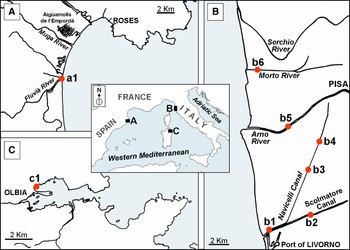
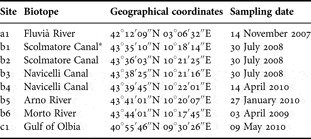
In the present paper we report records of X. securis in six western Mediterranean brackish-water localities, of which five are new. We monitored the newly established populations in the brackish-water biotopes present along the coast from the port of Leghorn to the mouth of the Serchio River, within the perimeter of the Regional Park of Migliarino, San Rossore, Massaciuccoli (northern Tuscany, Italy) (http://www.parcosanrossore.it). In particular, we focused our attention on: (i) the Scolmatore Canal, which helps reduce flooding of the Arno River by collecting part of its waters in case of exceptional rain falls and in direct communication with the port of Leghorn (Sites b1 & b2); (ii) the Navicelli Canal, opening in to the Scolmatore Canal, historically leading to the Arno River and now coming to a dead end in the proximity of the town of Pisa (Sites b3 & b4); (iii) the Arno River, passing through Pisa (Site b5); and (iv) the Morto River, a draining canal located north of Pisa (Site b6) (Figure 1; Table 1).
Location of Xenostrobus securis sampling sites in the western Mediterranean. (A) Northern Catalonia (Spain); (B) northern Tuscany (Italy); (C) north-eastern Sardinia (Italy).

Details of the new records of Xenostrobus securis in western Mediterranean coastal biotopes. Site definitions are as in Figure 1.

*, Site previously recorded by Giusti et al. (Reference Giusti, Dell'Angelo, Sosso and Schiaparelli2008).
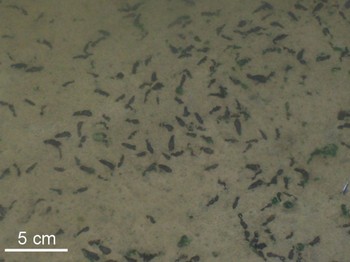
Xenostrobus securis was very abundant at Site b1 in the Scolmatore Canal. Here the species formed mixed mussel beds with Mytilus galloprovincialis on the walls of the canal. Garci et al. (Reference Garci, Trigo, Pascual, González, Rocha and Guerra2007) observed the same situation for their Station 3 in the Ria de Vigo. Moreover, the same authors reported a differential vertical distribution of M. galloprovincialis and X. securis on intertidal rocky substrates, the first occupying the upper limit, the latter being more abundant on the lower limit. The different tidal excursions in the two locations may account for the discrepancy of vertical distribution. At Site b2 hard substrates were exclusively colonized by X. securis that formed extensive mussel beds on the muddy bottom of the canal (Figure 2).
Posterior rims of mud dwelling individuals of Xenostrobus securis in the Scolmatore Canal at a depth of approximately 30 cm.

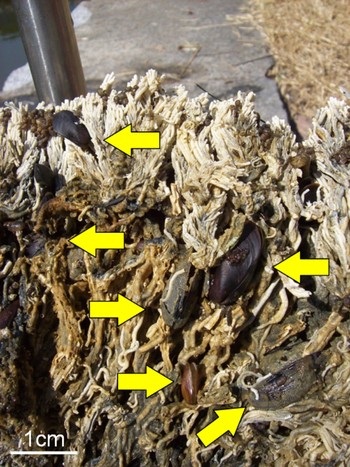
Monitoring of the stretch of Navicelli Canal passing through the US Army Garrison Camp Darby was not possible because access is forbidden. Nonetheless X. securis was found both on the walls at the southernmost end of the canal (Site b1), and at various sites north of the military base (Sites b3 & b4). Reasonably, the species should be present in the stretch of the canal included in the military base. At Site b3 X. securis is present both on the walls of the canal and within the serpulid reefs formed by the tube-dwelling polychaete Ficopomatus enigmaticus (Figure 3). At Site b4 we found the northern limit of the species' distribution in the Navicelli Canal. Here isolated individuals of X. securis were found on the walls of the canal along with the barnacle Balanus eburneus. In the Arno River (Site b5) several isolated individuals of X. securis were found attached underneath floating pontoons along with other fouling organisms (Figure 4). In the Morto River (Site b6) a few individuals were sampled on the walls of the river. Interestingly, we observed that the individual density of X. securis population in the area between the port of Leghorn and the Morto River has increased substantially in the last two years, confirming the high adaptive and invasive capability of this species.
Individuals of Xenostrobus securis living within a reef constructed by the calcareous tube-dwelling serpulid polychaete Ficopomatus enigmaticus in the Navicelli Canal.

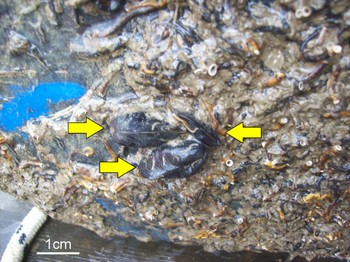
Individuals of Xenostrobus securis amongst other fouling organisms on the submerged portion of a floating pontoon in the Arno River.

During a sampling campaign aimed at surveying brackish-waters biodiversity on a larger spatial scale, we observed X. securis in the following two sites where the species was unrecorded: (i) the Gulf of Olbia (north-eastern Sardinia, Italy; Site c1); and (ii) at the mouth of the Fluvià River (northern Catalonia, Spain; Site a1). At Site c1, specimens of X. securis where found attached to small rocks, along with the other alien mytilid Musculista senhousia. Site a1 is located within the perimeter of the Aigüamolls de l'Empordà Natural Park (http://www20.gencat.cat/portal/site/parcsnaturals). At that site individuals of X. securis were found attached to submerged ropes in a small marina.
The arrival of this species in the Adriatic Sea was related to intense shellfish farming in the area (Occhipinti-Ambrogi, Reference Occhipinti-Ambrogi2000; Zenetos et al., Reference Zenetos, Gofas, Russo, Templado and Briand2004). In recent years, other alien bivalves such as Theora (Endopleura) lubrica and M. senhousia have been recorded in the port of Leghorn, which Giusti et al. (Reference Giusti, Dell'Angelo, Sosso and Schiaparelli2008) considered a ‘hotspot’ of alien species. From the port of Leghorn X. securis must have spread into the adjacent suitable biotopes. Given that its larvae cannot survive in seawater (Wilson, Reference Wilson1968), the colonization of the Arno and Morto Rivers should have occurred by the rafting of adults or mediated by boats, as proposed for other invasive organisms (Johnson et al., Reference Johnson, Ricciardi and Carlton2001). The imminent construction of a new marina in the vicinity of the mouth of the Arno River opens new possibilities for the potential spread of this rapidly spreading species.
Xenostrobus securis is an ecosystem engineer species, namely a foundation species that alters biotic and abiotic factors in the environment and modifies, maintains and creates habitats (Jones et al., Reference Jones, Lawton and Shachak1994). Previous studies have shown that a number of ecologically similar mytilids are important ecosystem engineers (i.e. Commito & Dankers, Reference Commito, Dankers and Reise2001; Crooks, Reference Crooks2002; Commito et al., Reference Commito, Celano, Celico, Como and Johnson2005). Xenostrobus securis can be considered an autogenic engineer sensu Jones et al. (Reference Jones, Lawton and Shachak1994), given that the species is able to significantly change the environment via their living or dead shell clumps. The role of the elements included in this category of ecosystem engineers is important due to their cascading effect on resident biota (Crooks, Reference Crooks2002).
The presence of this species in other Mediterranean brackish-water environments cannot be excluded and closer monitoring of such biotopes is needed, given the ecological alterations this species may provoke to the pre-existing biological communities, as well as the negative impact as a fouling element.
ACKNOWLEDGEMENTS
We wish to thank the Regional Park of Migliarino, San Rossore, Massaciuccoli (Tuscany, Italy) for giving us permission to carry out sampling within the park area. We also wish to thank B. Rackley for critical revision of an early draft of the manuscript.