INTRODUCTION
The Arabian Sea is one of the most biologically productive regions of the world's oceans and the semi-annual reversal of winds associated with the monsoon system results in two distinct periods of elevated biological activity, the South-west Monsoon and North-east Monsoon that occur in summer and winter, respectively (Wiggert et al., Reference Wiggert, Hodd, Banse and Kindle2005). In each case the surface layer becomes nutrient enriched and supports large-scale blooms and elevated rates of primary productivity (Barber et al., Reference Barber, Marra, Bidigare, Codispoti, Halpern, Johnson, Latasa, Goericke and Smith2001). The winter component of this annual cycle is referred to as the North-east (winter) monsoon (NEM), that typically occurs from November to early March and is characterized by a cool, dry north-easterly wind flow that emanates from the atmospheric high pressure region situated behind the Tibetan Plateau (Wiggert et al., Reference Wiggert, Murtugudde and McClain2002). These cool, dry winds that propagate across the Arabian Sea extract heat from the surface layer and cause excessive evaporation over precipitation. When combined with reduced incoming solar radiation and high ambient salinity, they drive convective mixing in the northern Arabian Sea and trigger the upward transport of nutrients from the base of the mixed layer and upper thermocline (Banse, Reference Banse, Haq and Milliman1984; Wiggert et al., Reference Wiggert, Jones, Dickey, Weller, Brink, Marra and Codispoti2000; Prasannakumar et al., Reference Prasannakumar, Ramaiah, Gauns, Sarma, Muraleedharan, Raghukumar, DileepKumar and Madhupratap2001). Mesoscale cold core eddies are also reported to augment biological production in NEAS (Sarangi, Reference Sarangi2012). Entrainment of nutrients in the surface waters results in massive algal blooms that occur annually along the open ocean waters of NEAS (Banse & McClain, Reference Banse and McClain1986). From the ocean colour imageries of NEAS, it was observed that these blooms are a recurrent phenomenon during winter/spring inter-monsoon periods (Sarangi et al., Reference Sarangi, Chauhan and Nayak2005; Dwivedi et al., Reference Dwivedi, Raman, Parab, Matondkar and Nayak2006). The main causative organism of these open ocean blooms was the dinoflagellate Noctiluca scintillans (Macartney) Kofoid & Swezy, with its autotrophic prasinophyte endosymbiont Pedinomonas noctilucae (Matondkar et al., Reference Matondkar, Bhat, Dwivedi and Nayak2004; Gomes et al., Reference Gomes, Goes, Matondkar, Parab, Al-Azri and Thoppil2008, Reference Gomes, Matondkar, Parab, Goes, Pednekar, Al-Azri, Thoppil, Wiggert, Hood, Naqvi, Smith and Brink2009, Reference Gomes, Goes, Matondkar, Buskey, Basu, Parab and Thoppil2014; Madhu et al., Reference Madhu, Jyothibabu, Maheswaran, Jayaraj and Achuthankutty2012). As winter conditions start receding by mid March, gradual stabilization of the water column occurs. Meanwhile spring inter-monsoon onset occurs and further nutrient input from deep waters is impeded. However the massive nutrient input during the winter monsoon period maintains the mixed layer productive during the early phase of spring inter-monsoon. This sustains the open ocean blooms during Early Spring Inter-Monsoon (ESIM) along the NEAS.
Previously many attempts have been made to characterize the winter-time production along the Northern Arabian Sea (Banse & McClain, Reference Banse and McClain1986; Prasannakumar et al., Reference Prasannakumar, Ramaiah, Gauns, Sarma, Muraleedharan, Raghukumar, DileepKumar and Madhupratap2001). Recent studies on the region are mainly satellite-based observations and have provided some information on the production variability in the region (Sarangi et al., Reference Sarangi, Chauhan and Nayak2005). In spite of all these works, in situ observations on physico-chemical and biological features of NEAS are meagre and limited. An integrated approach to study the biophysical coupling is lacking. In this study, in situ observations on physico-chemical and biological variables during late winter and early spring inter-monsoon of years 2009, 2011 and 2012 were analysed. The hydrobiological responses of the open ocean environment of NEAS during late winter monsoon and succeeding spring inter monsoon were examined in detail.
MATERIALS AND METHODS
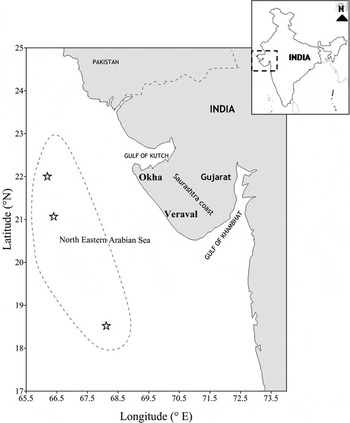
The study was conducted along the North Eastern Arabian Sea (NEAS) during late winter (February 2009, 2011) and early spring inter-monsoon (mid March–April 2009, 2011 and 2012) onboard FORV ‘Sagar Sampada’ as a part of the Marine Living Resources Programme. Sampling was carried out along the offshore waters of 22°N, 21°N and 18°N latitudes in NEAS. The study area and sampling locations are shown in Figure 1. Meteorological parameters such as air temperature (AT), wind speed and wind direction were obtained through the Automated Weather Station onboard FORV ‘Sagar Sampada’. Vertical profiling of parameters such as temperature, salinity and density was done using a Conductivity–Temperature–Depth profiler (CTD – Seabird 911 plus) attached with sensors for understanding oceanic processes. The value at 5 m depth in the vertical profile of the CTD was considered for the determination of Sea Surface Temperature (SST), Sea Surface Salinity (SSS) and Density (sigma t). This depth is chosen to eliminate any possible bias in the profile data due to ‘skin effects’ at the ocean surface (Fairall et al., Reference Fairall, Bradley, Godfrey, Wick, Edson and Young1996). Mixed Layer Depth (MLD) was determined using density criterion (Shetye et al., Reference Shetye, Gouveia, Shenoi, Shankar, Vinayachandran, Sundar, Michael and Nampoothiri1996; Madhupratap et al., Reference Madhupratap, Gauns, Ramaiah, Prasannakumar, Muraleedharan, De Sousa, Sardessai and Muraleedharan2003) where the density from the 5 m depth rises by 0.2 units (0.2 kg m−3). Monthly composite daytime SST of MODIS Aqua, obtained from ERDAAP (http://coastwatch.pfeg.noaa.gov/erddap/) for the year 2009 to 2012 was used to study inter-annual variations.
Map showing the study area and the symbol ( ) denotes station locations.

The water samples were taken using Niskin bottles (12-litre capacity) attached to the rosette sampler of CTD for chemical and biological analysis of various parameters. Major nutrients were analysed using a segmented flow Auto Analyzer (SKALAR) onboard by following UNESCO-JGOFS protocol (1994). Chlorophyll a measurements was made spectrophotometrically (Parsons et al., Reference Parsons, Maita and Lalli1984) using UV-Visible spectrophotometer (PERKIN ELMER Lambda 25). Surface microphytoplankton (>20 µm) samples were collected by filtering ~30 l of surface water through 20 µm net and the filtrates were immediately analysed onboard for live materials and then fixed with 1–3% formaldehyde–Lugol's iodine solution for further laboratory analysis. Quantitative estimation and species identification of microphytoplankton was done by employing Sedgewick–Rafter counting cell (1 ml in triplicate) under Nikon Eclipse E200 microscope following standard identification keys (Allen & Cupp, Reference Allen and Cupp1935; Subrahmanyan, Reference Subrahmanyan1959a, Reference Subrahmanyanb; Tomas, Reference Tomas1997; Karlson et al., Reference Karlson, Cusack and Bresnan2010). Mesozooplankton samples were collected by Multiple Plankton Net (MPN – Hydro-Bios, 200 µm mesh size). The mesozooplankton samples were collected from depths such as mixed layer, thermocline layer, bottom of thermocline–300 (BT–300), 300–500 and 500–1000 m. For the present study the samples from mixed layer were only considered, as a major fraction of secondary standing stock is represented in this layer. Mesozooplankton biomass was estimated by the Displacement Volume method. For this, the mesozooplankton sample was filtered through a piece of clean, dried netting material (200 µm mesh size). The interstitial water was removed with blotting paper. The filtered mesozooplankton was then transferred with a spatula to a measuring cylinder with a known volume of 4% buffered formalin solution. The displacement volume was obtained by recording the volume of fixative in the measuring jar displaced by the mesozooplankton (Goswami, Reference Goswami2004). After measuring the biovolume samples were preserved in 4% neutralized formalin and later analysed at group level in the laboratory. Principal component analyses (PCA) based on correlation matrix of various environmental and biological parameters were carried out using PRIMER v.6 software.
RESULTS
Observations during 2009
LATE WINTER MONSOON 2009 (LWM 2009)
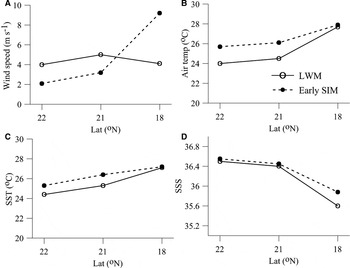
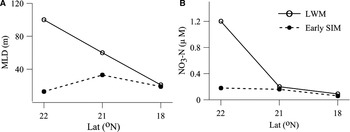
Cool dry north-easterly winds with an average speed 5.5 m s−1 (Figure 2A) were prevalent along the offshore waters of NEAS (22°N and 21°N). Air temperature (AT) showed significant latitudinal variation (increase) from north to south (24.3 to 27.7°C) (Figure 2B). Sea surface temperature (SST) was 24.6 ± 0.3°C along the offshore waters at 22°N and 21°N that increased to 27.16°C towards the south (18°N) (Figure 2C). High saline surface waters (36.47 ± 0.1) were observed along the offshore waters at 22°N and 21°N (Figure 2D) showing the presence of Arabian Sea High Saline Water (ASHSW). The depth of the mixed layer reached to >100 m in the northern offshore waters that shoaled up to ~20 m towards the south (Figure 3A). Thus the persisting environmental conditions substantiate that winter cooling existed along the northern latitudes of NEAS. Nutrient characteristics showed high nitrate concentrations along the region of winter cooling. Surface nitrate values in the northern offshore regions were ≥1 µM (1.2 ± 0.5 µM). Nitrate profiles showed that about 1–2 µM nitrate was available throughout the upper 50 m of the water column but decreased (0.17 µM) towards the south (Figure 3B).
Physical parameters along NEAS during Late Winter Monsoon (LWM) and early Spring Inter-Monsoon (ESIM) of 2009. (A) Wind speed; (B) air temperature; (C) sea surface temperature; (D) sea surface salinity.

Variations in (A) mixed layer depth (MLD) and (B) surface nitrate (NO3-N) during Late Winter Monsoon (LWM) and early Spring Inter-Monsoon (ESIM) of 2009.

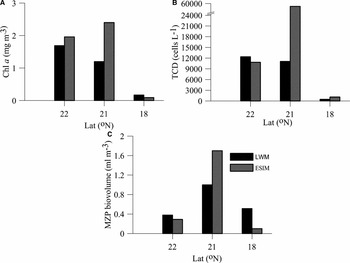
Distribution pattern of surface chlorophyll a observed comparatively higher values (~1.5 mg m−3) towards the northern regions (Figure 4A). Concomitant to the chlorophyll a pattern, the microphytoplankton abundance was also higher (~1.24 × 10⁴ cells l−1) in the region, which decreased towards the south (~500 cells l−1) (Figure 4B). Community analysis of microphytoplankton observed the dominance of diatoms (97%). Major diatoms contributing towards the community were Rhizosolenia hebetata, Chaetoceros lorenzianus, Guinardia striata etc. Dinoflagellates were fewer in numerical abundance consisting of armoured dinoflagellates (Peridiniphycidae) along with few cells of Noctiluca scintillans. Peridiniphycidae included Gonyaulax polygramma, Ceratium spp., Protoperidinium spp., etc. Towards the southern extent of NEAS with comparatively higher SST and shallow MLD, Trichodesmium erythraeum filaments were identified.
Standing stock of primary and secondary producers along NEAS during 2009. (A) Chlorophyll a; (B) total cell density of microalgae; (C) mesozooplankton biovolume.

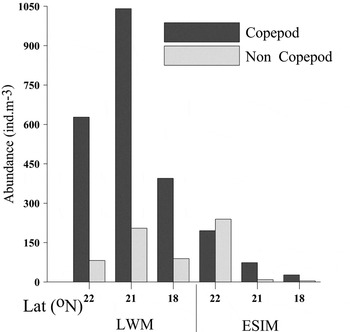
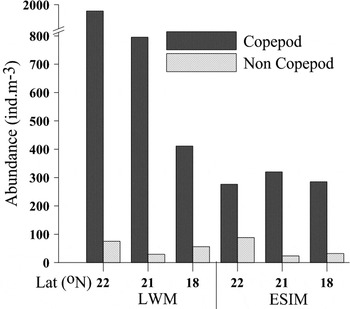
Mesozooplankton (MZP) biovolume was comparatively lower (0.38 ml m−3) along the offshore region at 22°N (Figure 4C). Towards south the biovolume increased (~1 ml m−3). The mesozooplankton community was represented by 18 taxa in the mixed layer, and copepods formed the predominant group contributing 86% to the community (Figure 5). The maximum abundance (1246 ind. m−3) of mesozooplankton, with copepods as dominant group (1041 ind. m−3) was observed along the offshore regions at 21°N. Other abundant taxa were represented by ostracods, chaetognaths, appendicularians and polychaetes in considerable abundance in the mesozooplankton community.
Numerical abundance of mesozooplankton component along NEAS during Late Winter Monsoon and early Spring Inter-Monsoon of 2009.

EARLY SPRING INTER-MONSOON 2009 (ESIM 2009)
Wind pattern was quite inconsistent; however it was north to north-westerly with an average speed of 5.1 m s−1 (Figure 2A). Consistently AT also varied from 25.05 ± 0.92°C in the northern region to 27.7°C towards the southern extent of NEAS (18°N) (Figure 2B). The hydrography of NEAS during ESIM period (mid March 2009) was characterized by elevated SST. SST showed an increasing trend from north (25.3°C) to south (27.2°C) with a latitudinal variability of 1.5 to 2°C increase from offshore waters of north to south (Figure 2C). Along the northern offshore waters higher SSS of 36.6 was observed (Figure 2D), this indicates the presence of ASHSW. MLD shoaled up to <50 m and surface waters column nitrate was ~0.1 µM (Figure 3A, B).
Surface chlorophyll a varied from 1.9 to 2.4 mg m−3 (Figure 4A). Maximum chlorophyll a along the offshore waters of 21°N was due to a multispecies bloom dominated by dinoflagellate Noctiluca scintillans (2.4 × 10⁴ cells l−1) and the diatoms (2.6 × 10⁴ cells l−1) with total cell density 5.1 × 10⁴ cells l−1 (Figure 4B). The diatoms were represented by Navicula sp., Rhizosolenia hebetata, Rhizosolenia spp., Thalassiosira sp., etc. In the offshore regions devoid of Noctiluca scintillans bloom, diatoms dominated the phytoplankton community and were mainly represented by Rhizosolenia hebetata.
The mesozooplankton biovolume varied from 0.29 to 1.7 ml m−3 (Figure 4C) along the northern region with maximum towards the offshore regions of 21°N. Presence of gelatinous zooplankton contributed to the high biovolume here. Generally copepods (~200 ind. m−3) formed the dominant taxa (Figure 5) and the non-copepods were mainly represented by ostracods along the northern offshore regions and the others were pteropods, appendicularians, euphausiids, polychaetes, amphipods and siphonophores.
Observations during 2011
LATE WINTER MONSOON 2011 (LWM 2011)
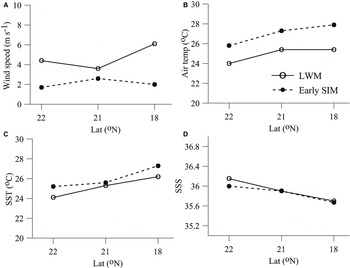
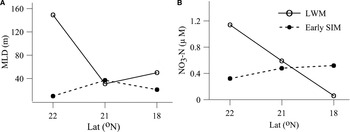
During the period (February 2011) cool dry north-easterly winds (average 5 m s−1) prevailed over the offshore waters of NEAS (Figure 6A). AT showed a gradual increase from north (23.76 ± 0.21°C) to south (25.4°C) (Figure 6B). The distributional pattern of SST showed a latitudinal variation of ~2°C from north (24.1 ± 0.24°C) to south (26.2°C) (Figure 6C). ASHSW (salinity 36.07 ± 0.15) were present along the surface offshore waters. The depth of the mixed layer reached to ~150 m (Figure 7A). Surface nitrate values were higher (1.13 ± 0.62 µM) towards 22°N and 21°N (Figure 7B) that sustained uniformly throughout the upper 75 m of the water column and towards the south the values decreased to 0.06 µM.
Physico-chemical parameters along NEAS during Late Winter Monsoon and early Spring Inter-Monsoon of 2011. (A) Wind speed; (B) air temperature; (C) sea surface temperature; (D) sea surface salinity.

Variations in (A) mixed layer depth (MLD) and (B) surface nitrate (NO3-N) during Late Winter Monsoon (LWM) and early Spring Inter-Monsoon (ESIM) of 2011.

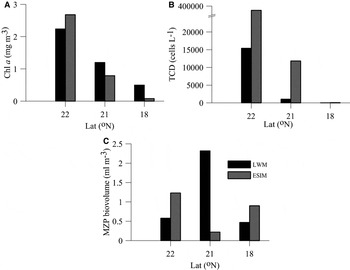
Comparatively high surface chlorophyll a (2.4 mg m−3) was observed along the offshore waters of 22°N that decreased (0.56 mg m−3) towards the south (Figure 8A). Microphytoplankton cell densities were maximum along 22°N (~1.5 × 10⁴ cells l−1) (Figure 8B) and were represented by dinoflagellate Noctiluca scintillans (80%, cell density 1.2 × 10⁴ cells l−1) and diatoms (3.7 × 10³ cells l−1). Diatom community was represented by various species of Chaetoceros mainly C. lorenzianus, Thalassiosira sp., Rhizosolenia hebetata etc.
Standing stock of primary and secondary producers along NEAS during 2011. (A) Chlorophyll a; (B) total cell density of microalgae; (C) mesozooplankton biovolume.

Mesozooplankton biovolume varied from 0.5 to 2.3 ml m−3 with a maximum along 21°N (Figure 8C). Although considerable biovolume was only observed at the bloom location (0.58 ml m−3) (22°N) exceptional high abundance of copepods (1754 ind. m−3) contributed chiefly to the high abundance of mesozooplankton taxa in the region (Figure 9). Non-copepods were represented by chaetognaths, siphonophores, amphipods, polychaetes, ostracods, appendicularians and euphausiids.
Numerical abundance of mesozooplankton component along NEAS during Late Winter Monsoon and early Spring Inter-Monsoon of 2011.

EARLY SPRING INTER-MONSOON 2011 (ESIM 2011)
Winds were predominantly northerly (1.46 m s−1) during the period of observation (late March 2011) (Figure 6A). AT varied from 25.63 ± 0.6°C in the north to 27.9°C in the south (Figure 6B). SST also observed an increasing trend (~2°C) from north (25.12 ± 0.1°C) to south (27.4°C) (Figure 6C). SSS varied from 35.6 to 36 (Figure 6D). MLD shoaled up to <45 m (Figure 7A) in the open ocean waters suggesting the gradual stabilization of the water column. The average surface nitrate concentration along the offshore waters was 0.4 ± 0.09 µM (Figure 7B). The physico-chemical characteristics prevailing along the region showed that winter characteristics have subsided with the onset of spring inter-monsoon features.
The surface chlorophyll a along the offshore waters of 22°N was 1.72 ± 0.85 mg m−3 and the values decreased towards the south (0.1 mg m−3) (Figure 8A). Consistently microphytoplankton abundance was ~3.1 × 10⁵ cells l−1 along 22°N offshore (Figure 8B). The community consisted of both diatoms and dinoflagellates in bloom cell densities. The diatom Haslea was observed to be abundant (3.1 × 10⁵ cells l−1) along with Noctiluca scintillans (1.6 × 10³ cells l−1) bloom patches. The abundance of microphytoplankton decreased towards the south, reaching <100 cells l−1 towards 18°N.
Mesozooplankton biovolume decreased (average 0.64 ± 0.40 ml m−3) during ESIM compared with LWM (0.95 ± 0.91 ml m−3). However, the maximum biovolume was observed along the offshore waters at 22°N (1.23 ml m−3) (Figure 8C). Among the mesozooplankton taxa copepods were the dominant group (300 ind. m−3) and the relative contribution varied from 75% to as high as 95% (Figure 9). The non-copepod taxa among the mesozooplankton community were the primary carnivorous group including chaetognaths and amphipods.
Observations during 2012
EARLY SPRING INTER-MONSOON 2012 (ESIM 2012)
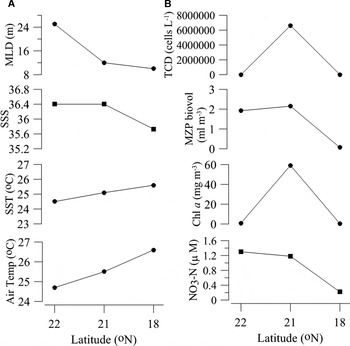
The meteorological data during the period (late March 2012) showed predominantly northerly winds (3.7 ± 1.3 m s−1). AT varied from 24.82 + 0.4 to 26.6°C from north to south of NEAS. SST also observed a similar pattern and SSS was on average 36 (Figure 10A). MLD shoaled up to <30 m in the region. Nutrient characteristics of the area showed higher surface nitrate (NO3-N) concentrations (1.25 ± 0.09 µM) and were almost uniform in the upper water column up to 30 m (Figure 10B).
Latitudinal variations in (A) hydrographic parameters – air temperature, SST, SSS, MLD and (B) chemical and biological parameters – nitrate, chlorophyll a, mesozooplankton biovolume, total cell density of microalgae during early Spring Inter-Monsoon of 2012 along NEAS.

Exceptionally high surface chlorophyll a (59.2 mg m−3) was identified along the offshore waters at 21°N (Figure 10B) owing to the bloom of dinoflagellate N. scintillans (3.7 × 10⁶ cells l−1). The extension of the bloom was up to the offshore areas at 20°N with a decreased abundance (6.4 × 10⁴ cells l−1). Along with the Noctiluca blooms abundance of diatoms Haslea sp. (1.8 × 10⁴ cells l−1) and Cylindrotheca closterium (2.89 × 10⁶ cells l−1) were observed. Other diatoms present throughout the study region were Chaetoceros spp., Proboscia alata, Pseudo-nitzschia spp. etc. Dinoflagellates identified along the region other than Noctiluca scintillans include Ceratium spp., Protoperidinium spp., Gonyaulax polygramma etc.
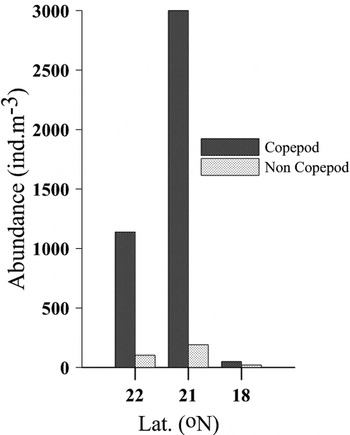
The biovolume of mesozooplankton ranged from 0.75 to 2.15 ml m−3 (Figure 10B). The region of intense bloom had high mesozooplankton standing stock (2.15 ml m−3) corresponding to the maximum chlorophyll and microphytoplankton abundance. Copepods were the major contributing taxa (97%, ~3000 ind. m−3) to the mesozooplankton community (Figure 11). Among the non-copepods, chaetognaths formed the predominant group in all transects, and the maximum abundance (125 ind. m−3) was in concurrence with high biovolume. Other non-copepods were represented by siphonophores, amphipods, appendicularians, decapods, euphausiids and lucifer. In the southern flank (20°N) of the core bloom area (21°N) abundance of gelatinous zooplankton occurred consisting mainly of medusa.
Numerical abundance of mesozooplankton component along NEAS during early Spring Inter-Monsoon of 2012.

A revisit to the offshore regions of NEAS after a period of one week (late March–early April 2012) observed relatively higher AT (26.99 ± 0.7°C), weak north-westerly winds (4.27 ± 1.02 m s−1), increased SST (26.21 ± 0.49°C) and shallow MLDs (7–21 m). The surface nitrate concentrations were below detectable levels (<0.05 µM) along the offshore waters of NEAS. During the revisit, bloom of Noctiluca scintillans was along the offshore areas of 19°N latitude, showing a southward shift of the bloom patches. Noctiluca bloom was with cell density 4.5 × 10⁶ cells l−1 and was a monospecific proliferation. The chlorophyll a concentration along the Noctiluca bloom area was 24.81 mg m−3. Mesozooplankton biovolume was low compared with the previous observation and ranged from 0.19 to 1.50 ml m−3. However the maximum mesozooplankton biovolume coincided with the intense bloom of Noctiluca due to high abundance of Chaetognatha, but comparatively low mesozooplankton numerical abundance (586 ind, m−3). Copepods dominated the community followed by chaetognaths, amphipods, appendicularians and euphausiids.
Inter-annual variations
Monthly averaged satellite SST from MODIS-Aqua for the study area showed comparatively higher SST during 2009 (average 26°C) than that of 2011 (average 25.5°C) and 2012 (24.5°C). Due to the lack of field data during winter 2012, variability in biological response was considered between winter 2009 and 2011. In situ SST during winter monsoon of 2011 observed a decrement of ~1°C than that of 2009. The intensity of winter mixing also observed significant variability with deeper MLDs during 2011 (>100 m) than that of 2009 (~80 m). Extensive mixing of the upper water column led to more input of nitrate into the surface waters (average 1.64 + 0.7 µM in 2011 compared with ~1 + 0.34 µM in 2009), and these differences were reflected in the biological responses of the area. The average surface chlorophyll a during winter 2011 was much higher (varying from 1.2–2.24 mg m−3) than in 2009 (~1 mg m−3). Microphytoplankton abundance was observed to be higher during 2011 (1.5 × 10⁴ cells l−1) than in 2009 (1.2 × 10⁴ cells l−1). Considering the winter monsoon microphytoplankton composition, the bloom of dinoflagellate Noctiluca scintillans was more intense during 2011 (1.4 × 10⁴ cells l−1) than in 2009 (~200 cells l−1). Furthermore, a significant increase was also evident in the secondary standing stock, with a twice higher biovolume (average 1.44 ± 1.23 ml m−3) during 2011 when compared with 2009 (average 0.69 ± 0.43 ml m−3). The difference in the response can be attributed primarily to the environmental variables thereby leading to alteration at all trophic levels.
DISCUSSION
The northern part of the Arabian Sea corresponds to a region of high biological production during winter monsoon (North-east Monsoon). Numerous previous attempts have been made to understand the dynamics of winter production in the area (Banse & McClain, Reference Banse and McClain1986; Banse, Reference Banse1987; Madhupratap et al., Reference Madhupratap, Prasannakumar, Bhattathiri, Kumar, Raghukumar, Nair and Ramaiah1996b; Prasannakumar et al., Reference Prasannakumar, Ramaiah, Gauns, Sarma, Muraleedharan, Raghukumar, DileepKumar and Madhupratap2001). However the present study delineates the hydrobiological responses of NEAS during winter monsoon emphasizing Late Winter Monsoon (LWM) and also towards Early Spring Inter-Monsoon (ESIM). The physicochemical as well as biological (primary and secondary) observations were incorporated to obtain the salient features of the NEAS ecosystem. Exploring NEAS from north (22°N) to south (18°N) provides identification of spatial variations in the production pattern of the region.
Winter monsoon characteristics were prominent along NEAS during Late Winter Monsoon (LWM) period. The observations during LWM (February) of 2009 and 2011 showed the occurrence of cool dry north-easterly winds with an average speed of ~5 m s−1 along the offshore waters of NEAS. Air temperature was also found to be low (23–24°C) during the periods, similarly with that of SST pattern (24–25°C). These cool dry winds lead to increased evaporative cooling of the sea surface resulting in the formation of a dense water mass (ASHSW), which on sinking deepens the mixed layer depths (Prasannakumar & Prasad, Reference Prasannakumar and Prasad1999). Barrier layer (BL) was absent or very thin during late winter observations. Characterization of mixed layer by Wiggert et al. (Reference Wiggert, Jones, Dickey, Weller, Brink, Marra and Codispoti2000) along NEAS during WM observed deepening of MLD to >100 m. The current study during LWM observed deepening of MLD to ~140 m and conjointly the meteorological and sea surface parameters ascertained the existence of moderate to strong convective mixing along NEAS.
The open ocean waters of NEAS remains less productive, nearly oligotrophic during summer monsoon as well as inter-monsoon periods (Bhattathiri et al., Reference Bhattathiri, Pant, Sawant, Gauns, Matondkar and Mohanraju1996). The physical mixing processes triggered with alternations of monsoons results in the injection of nutrients towards the euphotic column. Among the nutrients, nitrate is of particular importance due to its immediate relationship with new and regenerated production (Sambrotto, Reference Sambrotto2001). Nitrate (NO3-N) concentration along the surface as well as in the upper water column acts as a signature of the intensity of convective mixing (Bange et al., Reference Bange, Naqvi and Codispoti2005). During the LWM period high nitrate concentrations (>1 µM) were observed along the offshore areas of NEAS, particularly towards the northern extent. This increased nitrate concentration in concert with the availability of ample sunlight catalyses the biological production along NEAS during winter monsoon. Since illumination appears to be a non-limiting factor for production in tropical basins (Barber et al., Reference Barber, Marra, Bidigare, Codispoti, Halpern, Johnson, Latasa, Goericke and Smith2001), with the input of nutrients by mixing process, in the absence of cloudy overcast biological production increases. Since the intensity of winter mixing is pronounced in the north and decreases towards the south, the pattern of distribution of nutrient and subsequent biological production decreased towards the southern extent (18°N). Consistently waters at 22°N showed higher surface as well as column nitrate concentration that decreased southward.
As the NEAS became conditioned by the winter cooling and associated eutrophication high chlorophyll a concentrations persisted along the open ocean waters. Significantly high chlorophyll a concentrations were observed along the offshore waters of NEAS during the late phase of winter monsoon. The nutrient input resulting from the extensive winter convection supports the high phytoplankton standing crop along the region particularly towards the offshore waters. Average surface chlorophyll a along NEAS during LWM was 1.16 ± 0.75 mg m−3. The offshore regions of NEAS characterized by convective mixing and nutrient input supported maximum surface chlorophyll a (~2 mg m−3).
ESIM observations appeared to be in continuation with the NEAS responses towards winter monsoon. With the increase in SST (>26°C) and shoaling of MLD (<40 m), further nutrient input towards the euphotic column ceased with the onset of spring inter-monsoon. During this period ‘detrainment blooms’ are promoted by the shallow mixed layer with increased depth-average light intensity and with the support of nutrients brought up during lengthy winter-time mixing (McCreary et al., Reference McCreary, Kohler, Hood and Olson1996). Exceptionally higher chlorophyll a concentrations were identified during the ESIM, particularly during 2012 (~59 mg m−3).
The biological responses towards the winter cooling and associated convective mixing observed increased phytoplankton standing stock mainly towards the northern-most regions of NEAS where mixing was optimum. The division rates of phytoplankton has been reported to be less than 2 days during NEM (Banse, Reference Banse1988) and this increased growth rate favoured rapid proliferations of phytoplankton in the well mixed nutrient-enriched waters. The study observed that open ocean waters off 22°N sustained comparatively higher phytoplankton standing stock with respect to chlorophyll a as well as cell densities. The abundance decreased southward with the slackened mixing process.
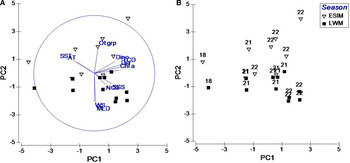
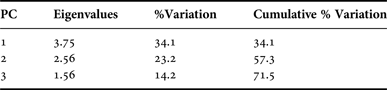
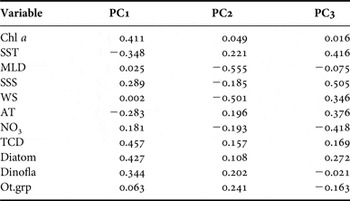
Principal component analysis (PCA) of the hydrobiological characteristics of NEAS showed that the axis PC1, 2 and 3 obtained high eigenvalues contributing to greater than 70% of the cumulative % variance (Table 1). The variables chl a, SSS and TCD has the highest positive load towards PC1 (Table 2). The negative loading towards PC1 was attributed mainly by SST and AT. This supports the observation that increased chlorophyll a and thereby phytoplankton abundance was towards the region of low SST and AT. These regions were also characterized by high saline surface waters. The offshore waters of the 22°N region during the LWM were lying close to this axis (Figure 12A, B). Most of the observations during ESIM were lying towards PC2 axis which had higher loads of variables such as MLD, WS and NO3-N.
(A) PCA analysis for the hydrobiological variables along NEAS during Late Winter Monsoon and Early Spring Inter-Monsoon; (B) distributions of stations along PC axis.

Eigenvalues and variance obtained for PCA matrix for each axis.

Variable loadings for PC1, 2 and 3.

The varied attempts to quantify the primary production along NEAS observed either diatoms (Sawant & Madhupratap, Reference Sawant and Madhupratap1996; Latasa & Bidigare, Reference Latasa and Bidigare1998) or the dinoflagellate Noctiluca scintillans (Matondkar et al., Reference Matondkar, Bhat, Dwivedi and Nayak2004; Gomes et al., Reference Gomes, Goes, Matondkar, Parab, Al-Azri and Thoppil2008) as the major contributors towards winter production. The present study identified production pockets along NEAS with higher abundance of Noctiluca scintillans and unlike these areas there were increased diatoms throughout the northern extent of NEAS. These Noctiluca blooms occurred either in association with diatoms or monospecifically as single species blooms. The diatoms were mainly represented by Rhizosolenia hebetata, Haslea spp., Cylindrotheca closterium etc.; this varied with years, with inter-annual variability observed in the dominant diatoms species. However, Noctiluca scintillans was recognized as the signature organism of winter convective mixing associated biological responses along NEAS.
The year wise analysis of LWM and ESIM responses observed intensification of Noctiluca blooms with years. Exceptionally high chlorophyll a accompanied with higher abundance of Noctiluca during 2012 and comparatively intense bloom during 2011 than that of 2009 suggests that the intensity and expanse of bloom varies with years. The massive occurrence of Noctiluca green tide has gained attention during the last 10 years (Matondkar et al., Reference Matondkar, Bhat, Dwivedi and Nayak2004; Gomes et al., Reference Gomes, Goes, Matondkar, Parab, Al-Azri and Thoppil2008, Gomes et al., Reference Gomes, Goes, Matondkar, Buskey, Basu, Parab and Thoppil2014) and prior to these findings, diatoms were considered to be the major contributors towards winter blooms along NEAS (Sawant & Madhupratap, Reference Sawant and Madhupratap1996). The analysis of the biological responses during LWM and ESIM strongly suggests occurrence of diatoms mostly towards winter monsoon as well as LWM and as the systems starts stabilizing, the outbreak of Noctiluca scintillans blooms occurs. Even before ESIM, localized patches of Noctiluca occur along NEAS but they establish themselves as extensive blooms during ESIM as spring blooms or detrainment blooms.
The responses of secondary producers towards the winter cooling and associated primary production is intriguing regarding the mesozooplankton community during winter and succeeding spring. Mesozooplankton standing stock is supposed to be constant year round along the Arabian Sea, this being referred to as the ‘Arabian Sea Paradox’ (Madhupratap et al., Reference Madhupratap, Gopalakrishnan, Haridas, Nair, Aravindakshan, Padmavati and Shiney1996a). Later re-evaluation of this phenomenon questions its logical applicability along the eastern Arabian Sea (Jyothibabu et al., Reference Jyothibabu, Madhu, Habeebrehman, Jayalakshmy, Nair and Achuthankutty2010). Mesozooplankton standing stock with respect to the numerical abundance showed higher abundance during LWM that decreased towards ESIM. This variation was more or less correlated with the occurrence of Noctiluca blooms, with higher numerical abundance and biovolume along non-bloom open ocean regions that decreased in diversity and abundance towards the region of intense phytoplankton bloom zones. Consistent with this the region along 22°N (northern-most extent of NEAS) had comparatively lower mesozooplankton standing stock than 21°N, the former being a region of intense algal bloom. The community composition of zooplankton also observed abundance of large-sized copepods (Calanoides carinatus, Pleuromamma indica) and gelatinous zooplankton (Salpa, Thalia democratica) during the intense bloom events rather than multi-group assemblages. The avoidance of the bloom area by the majority of the zooplankton group owing to the unpalatability of bloom species, due to their large size and external metabolites produced, can be considered as possible reasons for this (Padmakumar et al., Reference Padmakumar, SreeRenjima, Fanimol, Menon and Sanjeevan2010).
Similar to Noctiluca scintillans, blooms of large diatoms also influence the mesozooplankton standing stock. During late winter 2009, the mesozooplankton biomass was very low in the area where abundance of Rhizosolenia hebetata was observed and was represented by large copepods. This might be due to the avoidance of the area by the majority of zooplankton, owing to the unpalatability of these centric diatoms Rhizosolenia because of their large size (size: diameter 8–29 µm and length 210–490 µm) and spiny nature. Thus mesozooplankton community structure showed significant variations between the seasons as well as between the years in response to phytoplankton abundance. Apparently direct relationship with mesozooplankton and phytoplankton cannot be emphasized due to the operation of microbial loop in the marine food chain (Azam, Reference Azam1998). However the abundance of pico, nano plankton and bacterial production are reported to be lower during the north-east monsoon along NEAS (Prasannakumar et al., Reference Prasannakumar, Ramaiah, Gauns, Sarma, Muraleedharan, Raghukumar, DileepKumar and Madhupratap2001) and found to increase during spring inter-monsoon (Garrison et al., Reference Garrison, Gowing, Hughes, Campbell, Caron, Dennett, Shalapyonok, Olson, Landry, Brown, Liu, Azam, Steward, Ducklow and Smith2000). In this regard the dependence of mesozooplankton towards phytoplankton is considerable, particularly during the winter monsoon season.
Inter-annual variability was observed in the SST pattern of NEAS during LWM with lower SST during 2011 than in 2009. Significant variations were identified in the production pattern with higher biological production during 2011. This clearly highlights the dynamic relationship of biological compartments and physical processes in the marine ecosystem. The response at the secondary trophic level which is considered to be composed of the major primary consumers also exhibited strong intra-seasonal as well as inter-annual variations. Thus the variability in environmental components particularly winter monsoon-related convective mixing in this context explicitly substantiates the influence of physical forcings on the productivity of the ecosystem.
Bio-physical coupling plays a prominent role in the sustenance of an ecosystem. Such an interrelation is clearly evident from the present study along the NEAS ecosystem. The physical process of mixing during the NEM imparts significant influences on the thermohaline characteristics, nutrient biogeochemistry and biological production along NEAS. Winter mixing and associated nutrient input result in increased biological production. This results in the abundance of the dinoflagellate Noctiluca scintillans as well as diatoms with varied species assemblages. Enhancement of primary standing stock seems to have influenced secondary producers, the zooplankton community. They were observed to be less diverse with high abundance along the northern extent of NEAS characterized by intense winter mixing. However with the onset of spring as blooms intensify their abundance decreases. The study observes inter-annual variability in the hydrographic features of NEAS during winter monsoon and these variations were clearly reflected in the biological responses. Thus the hydrobiology of NEAS ecosystem can be considered as an ideal expanse to study the primary and secondary responses towards mesoscale environment changes.
ACKNOWLEDGEMENTS
The authors are grateful to all the participants of FORV ‘Sagar Sampada’ cruises along Northern Arabian Sea for the help rendered in sampling.
FINANCIAL SUPPORT
The study was conducted under the Marine Living Resources (MLR) programme of Centre for Marine Living Resources & Ecology (CMLRE) funded by the Ministry of Earth Sciences, Govt. of India, New Delhi.