Introduction
This contribution is part of a comprehensive project dedicated to elucidating the species and generic taxa of Peloniinae (Opitz Reference Opitz2010: 97). At the onset of this project, I found it relatively easy to recognise obvious generic differences, but now I have an assortment of species that do not fit into any of the previously established generic definitions. I considered the shape of the maxillary and labial terminal palpomeres, the tarsal unguis, the tibial spur formula, and the structure of the spicular fork as important characteristics (Opitz Reference Opitz2010: 48) for delimiting the genera considered herein. Based on these characteristics, I have determined that the species in question may be classified into four genera, which form a monophyletic group: Ambitus Opitz, new genus, Ampleris Opitz, new genus, Pseudichnea Schenkling, and Sirpa Opitz, new genus.
Materials and methods
This study is based on the adult anatomy of 62 specimens. One specimen of Pseudichnea eliminata Schenkling and one of Sirpa skelleyi Opitz, new species, were completely disarticulated to investigate the more cryptic generic characters. These characters are shared among the taxa in the Pseudichnea complex. The shape of the antennal capitulum, shape of the pronotum, development of the elytral strial punctation, and characteristics of the aedeagus were used to interpret reproductive isolation (Standfuss Reference Standfuss1896: 115; Dobzhansky Reference Dobzhansky1937: 312; Mayr Reference Mayr1963: 19). Line illustrations were produced with a Wild M5 stereoscopic microscope with camera lucida attachment (Leica, Wetzlar, Germany). Procedures involving dissection, terminology, illustration, and measurements are similar to those described in Opitz (Reference Opitz2004: 7). Photographs of habitus illustrations were taken with a Leica Z 16 APO microscope equipped (Leica) with JVC KY-F75U-CCD camera and controlled by Syncroscopy Auto Montage software (Cambridge, United Kingdom). The SEM micrographs were produced with a Scanning Electron Microscope-S-3500N (Hitachi Science Systems, Tokyo, Japan. The locality records of specimens noted in this study are verbatim.
In Opitz (Reference Opitz2010), I provided a hypothesis of phylogeny for the major lineages within the Cleridae. This phylogeny was based on the morphology of mesodermal and ectodermal organs, micromorphology of the integument, and the external morphology of various larvae. This represents the most extensive morphological treatise known to date for assessment of the higher taxa within the Cleridae. The results yielded six major groups for those clerid taxa characterised by having a reduced 4th tarsomere, which is the classification scheme followed here: Epiphloeinae, Tarsosteninae, Peloniinae, Enopliinae, Neorthopleurinae, and Korynetinae. The subfamily Peloniinae has the following characteristics: 4th tarsomere reduced, without trichobothria, antenna inserted at the front of the ocular notch, antennal capitulum usually very long and usually highly lobate, and the dorsolateral carina conjoins the pronotal hem at the posterior angle of the pronotum.
This paper is a continuation of a project about the world generic taxa of Peloniinae; the sequence of papers involved is: Opitz (Reference Opitz1998, Reference Opitz2009, Reference Opitz2014a, Reference Opitz2014b). The tibial spur formula of these small beetles proved valuable as an indicator of generic status (Opitz Reference Opitz2010), and will need to be examined in order to successfully use the key to taxa presented below. To get a clear view of the tibial spurs, I softened the beetles in hot soapy water and cleaned them in an ultrasonic cleaner (Branson 12, Branson Manufacturer, Danbury, Connecticut, United States of America). To get a clear view of the spurs, the beetles were examined while still under water, and then point mounted. Someone attempting to run specimens through the key will have to go through similar steps.
Repository of specimens. Arnett et al. (Reference Arnett, Samuelson and Nishida1993) was my source for codens of specimen repositories. Some codens were modified due to institutional name changes. Specimens are deposited in: CNCI – Canadian National Collection of Insects, Ottawa, Ontario, Canada (Serge Laplante). FSCA – Florida Collection of Arthropods, Gainesville, Florida. United States of America (Paul E. Skelley). IMLA – Fundacion Miguel Lillo, San Miguel de Tucumán, Argentina (Virginia Colomo de Correa). JEWC – James E. Wappes personal collection, San Antonio, Texas, United States of America. JNRC – Jacques Rifkind personal collection, Valley Village, California, United States of America. MCNZ – Fundação Zoobotânica do Rio Grande do Sul, Museu de Ciências Naturais, Porto Alegre, Rio Grande do Sul, Brasil (Maria H. M. Galileo). MNHN – Museum d’Histoire Naturelle, Entomologie, Paris, France (Antoine Mantilleri). MNKM – Museo de Historia Natural Noel Kempff Mercado, Universida Autonoma “Gabriel Rene Moreno”, Santa Cruz de la Sierra, Bolivia (Julieta L. Arias). MUCR – Museo de Insectos, Centro de Investigaciones en Protección de Cultivos, Escuela de Fitotecnia, Universidad de Costa Rica, San José, Costa Rica (Humberto Lezama Ulate). NHRS – Swedish Museum of Natural History, Stockholm, Sweden (Bert Viklund). RHTC – Robert H. Turnbow personal collection, Fort Rucker, Alabama, United States of America. SDEI – Senckenberg Deutsches Entomologisches Institute, Müncheberg, Germany (Stephan Blank). WFBM – William F. Barr Entomological Museum, University of Idaho, Entomology Division, Moscow, Idaho, United States of America. WOPC – Weston Opitz personal collection, Gainesville, Florida, United States of America.

Ambitus Opitz, new genus
Type species. Ambitus anticus Opitz, new species. Here designated.
Diagnosis. The elongate prothorax will distinguish this genus from other genera treated in this work.
Description. Size : Length 5.0 mm; width 1.2 mm. Form : Elytra narrow rectangulate, posterior angle narrowly rounded. Integumental colour : Antenna black; mouthparts brown; cranium, prothorax, pterothorax, and legs black; abdomen yellow; elytra tricolourous, anterior half mostly red and with dark infuscation, middle with narrow oblique white transverse fascia, posterior half black. Vestiture : Integument highly setose, funicular antennomeres slightly setose, cranium and pronotum densely vested with decumbent and erect setae, elytra densely vested with short secondary setae and primary setae; legs highly setose. Head : Cranial setose punctation cribrate; eyes bulging, coarsely faceted, not deeply incised along frontal margin; antenna (Fig. 29) capitate, inserted at level of eye incision (=ocular notch); antennal carina prominent, comprised of 11 antennomeres, scape robust, pedicel rotund, funicular antennomeres subquadrate, capitulum long, 9th and 10th antennomeres about as long as combined length of funicle; labrum not deeply incised; mandible, maxilla, and labrum well developed, maxillary and labial terminal palpomere subsecuriform; gula triangular. Thorax : Pronotum elongate (Fig. 43), side margins with very small tubercle, anterior margin linear, prebasal depression feebly developed, dorsolateral carina not extended to anterior margin of pronotum, carina joins pronotal hem at pronotal posterior angle. Elytra rectangulate, sides strongly deflexed, elytral pit not present, posterior angles sharply rounded, discal carinae not present, asetiferous punctation seriate, striae end at elytral middle. Mesoscutellum quadrate. Protibial anterior margin not spinous; ungues with denticle; tibial spur formula 0-2-1; tarsal pulvillar formula 3-3-3, metabasitarsal pulvillus very small. Abdomen : Six visible sternites; pygidium rounded distally in male. Male genitalia : Aedeagus short, tegmen feebly sclerotised, broadly lobate distally; phallus feebly sclerotised; spicular fork comprised of two narrow plates that do not coalesce, intraspicular plate narrow and long.
Distribution. This monotypic genus is known only from Santa Cruz, Bolivia.
Etymology. The generic name Ambitus (=stretch) is a Latin name. The name refers to the lengthy forebody of this beetle and is masculine in gender.
Ambitus anticus Opitz, new species
Figures 29, 43, 81, 98.
Holotype. ♂. “Bolivia, Santa Cruz, 4-5 km N Achira, Rd. to Amboro, 12-13-Oct. 2000, Wappes & Dozier” (MNKM).
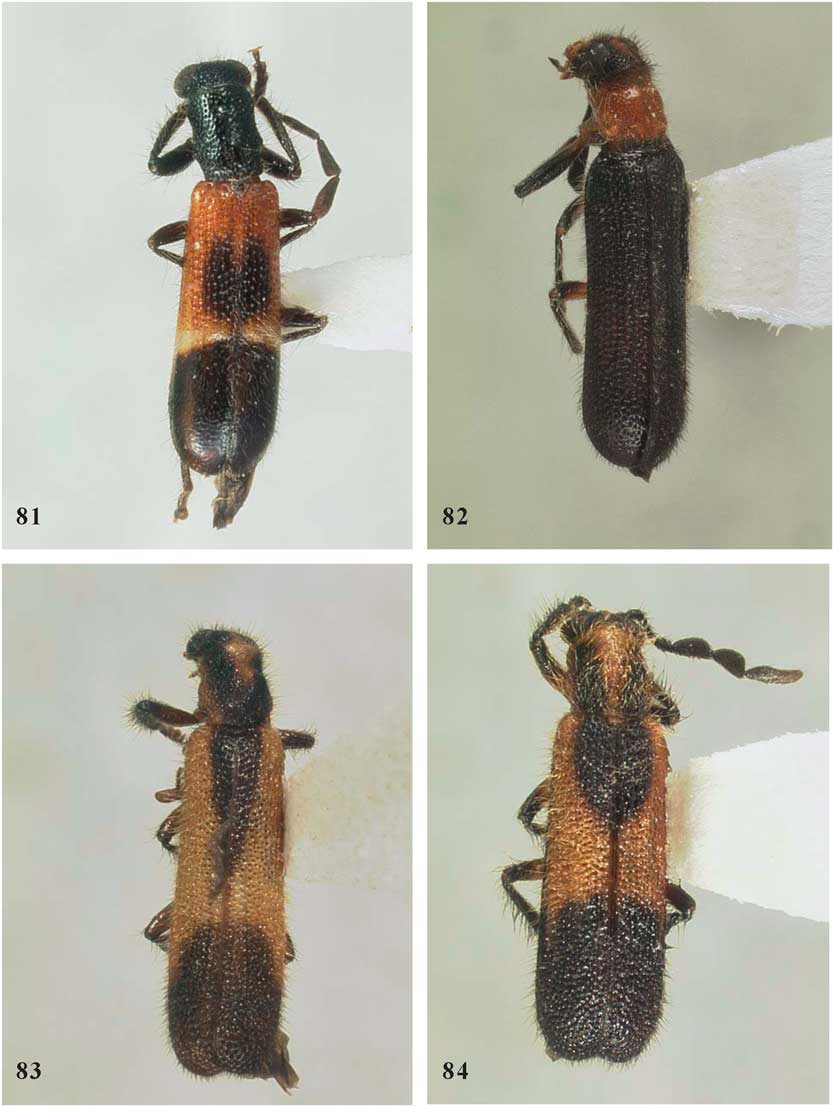
Diagnosis: The tricoloured elytra, as depicted in Figure 81, will distinguish the members of this species from others treated herein.
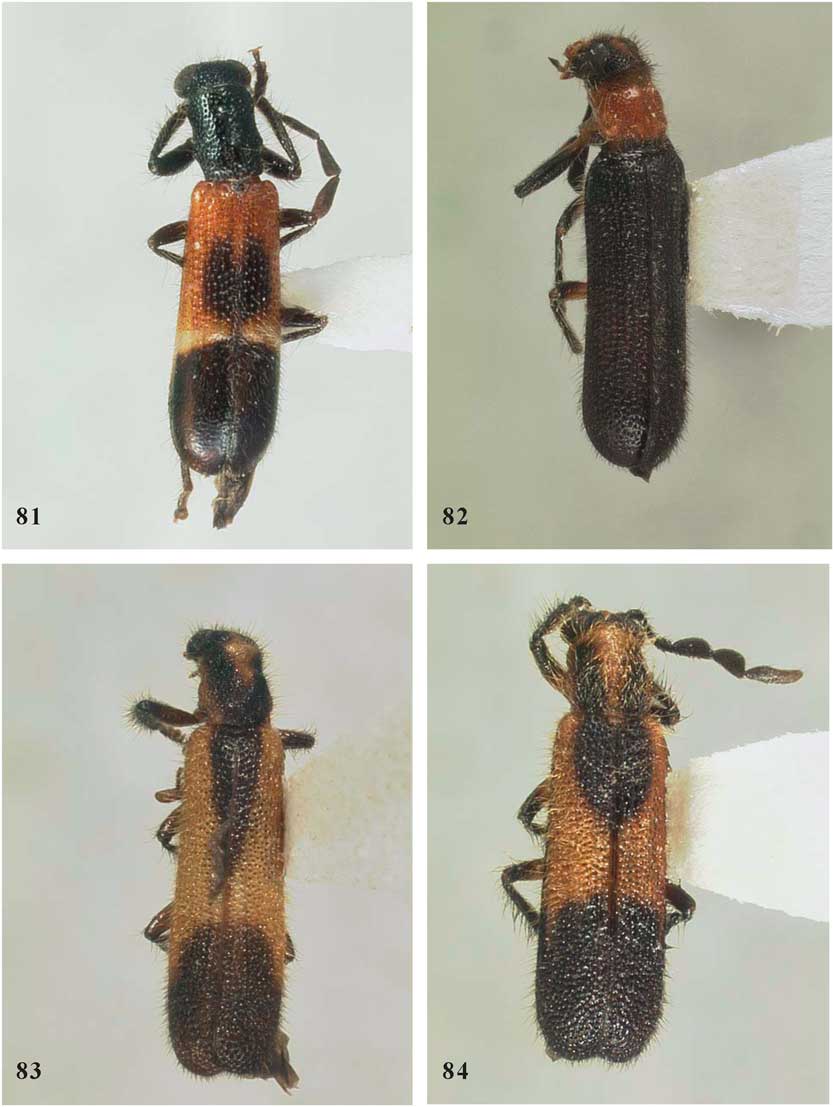
Description. Size : Length 5.0 mm; width 1.2 mm. Form : As in Figure 81 . Colour : Antenna black; mouthparts brown; cranium, prothorax, pterothorax, and legs black; abdomen yellow; elytra tricolourous, anterior half mostly red and with dark infuscation, middle with narrow oblique white transverse fascia, posterior half black. Head : Antennal capitulum long (Fig. 29), each capitular antennomere about as long as combined length of funicular antennomeres; antennal carina prominent; EW/FW 20/25. Thorax : Pronotum (Fig. 43) elongate, disc with glabrous interstitial spaces, anterior margin linear, side margin with shallow tubercle; PW/PL 50/70; elytra strongly deflexed at sides, punctation seriate and end at elytral middle; EL/EW 225/35. Abdomen : Male pygidium rounded distally; aedeagus slightly sclerotised; phallic plates slightly sclerotised, with rounded lobes.
Natural history. The holotype was collected in October.
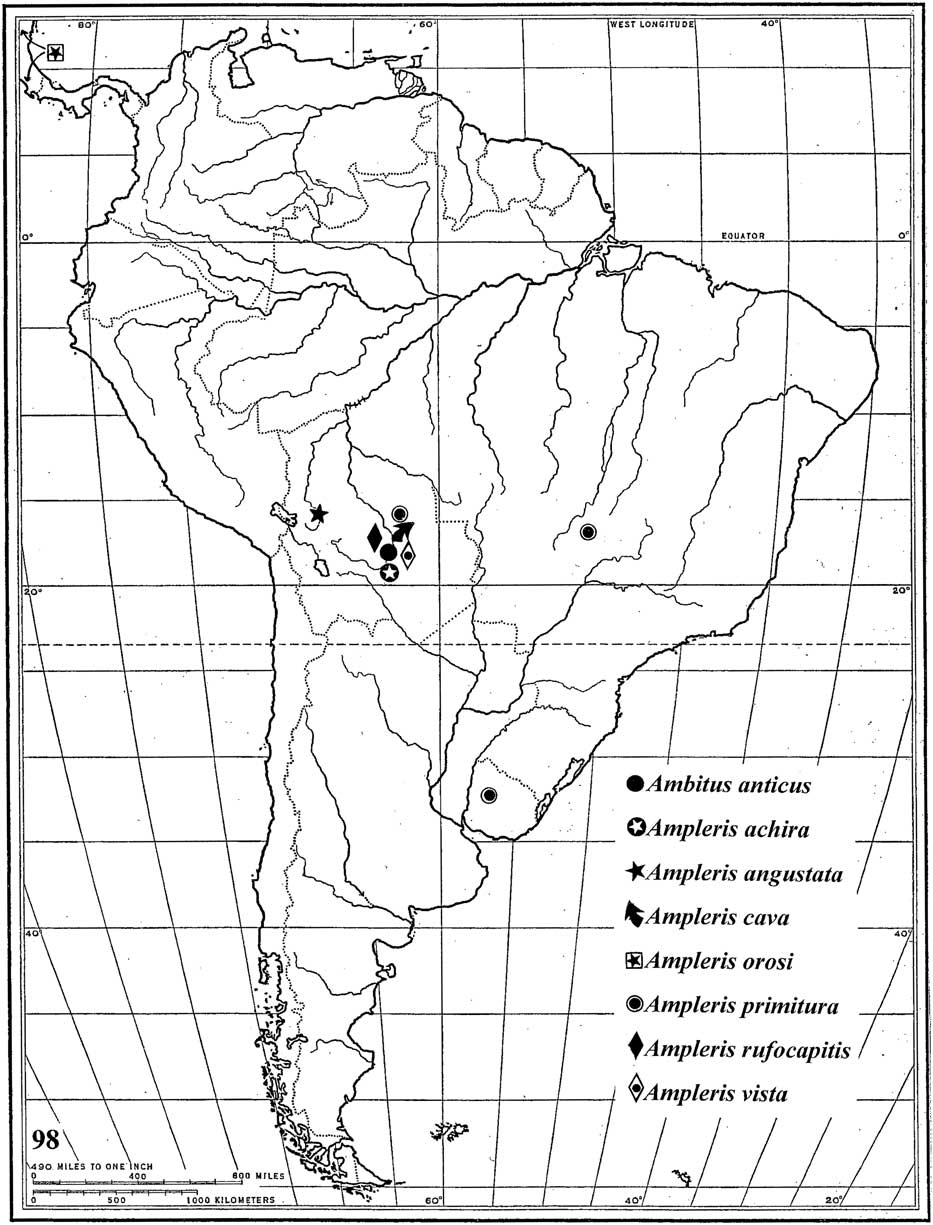
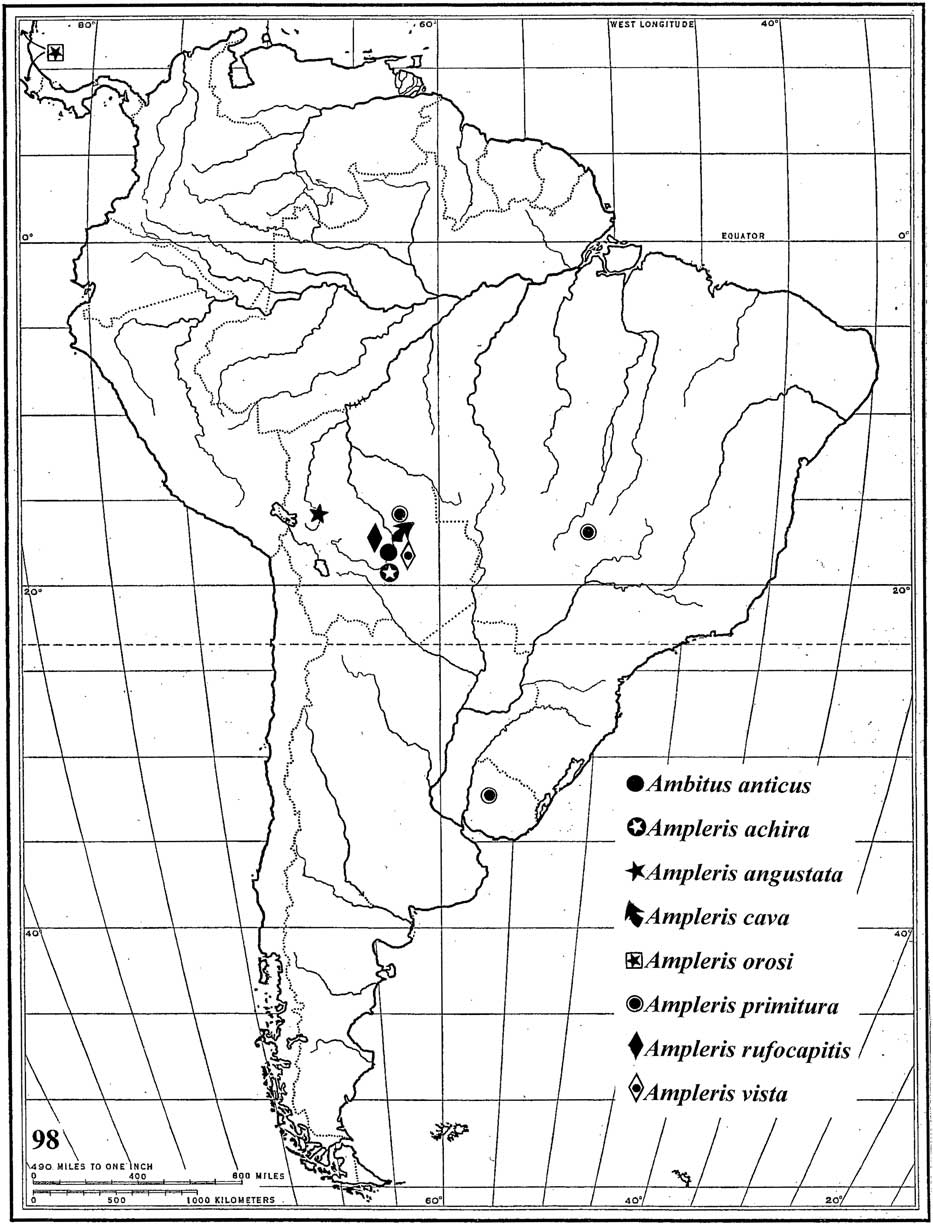
Distribution (Fig. 98). Known only from Santa Cruz, Bolivia.
Etymology. The specific epithet anticus (=the “a” part) is a Latin adjective. The name refers to the extensive length of the forebody
Ampleris Opitz, new genus
Type species. Ampleris primitura Opitz, new species. Here designated.
Diagnosis. In the members of this genus the terminal palpomeres of the maxilla and labium are usually subsecuriform, rarely subdigitiform, the unguis lacks a denticle, and spicular plates are disconnected. This combination of characteristics will distinguish the members of this genus from the superficially similar specimens of Pseudichnea Schenkling and Sirpa Opitz, new genus.
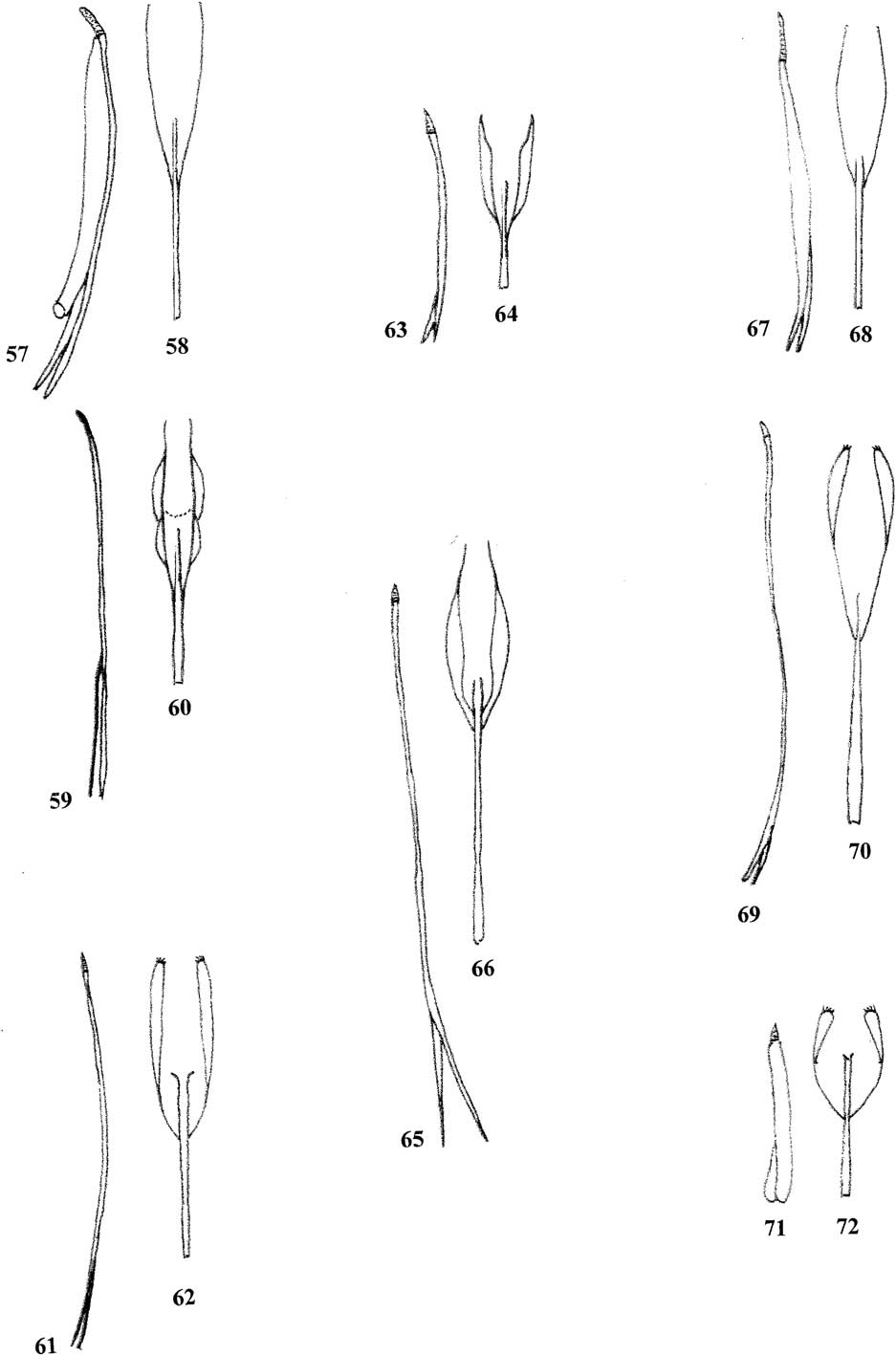
Description. Size : Length 4.0–7.0 mm; width 1.3–2.0 mm. Form : Elytra rectangulate, posterior angle narrowly rounded. Integumental colour : Antenna black; mandible black, other mouthparts flavotestaceous, maxillary and labial terminal palpomeres brown; cranium black and flavotestaceous; pronotum black and flavotestaceous; elytra black, with an aeneous tinge, or black and flavotestaceous; legs black or brown, or black and flavotestaceous; pterothorax and abdomen black. Vestiture : Integument highly setose, funicular antennomeres slightly setose, cranium and pronotum densely vested with decumbent and erect setae, elytra densely vested with short secondary setae and primary setae; legs highly setose. Head : Cranial setose punctation cribrate; eyes bulging, coarsely faceted, not deeply incised along frontal margin; antenna (Fig. 30) capitate, inserted at level of eye incision (=ocular notch); antennal carina prominent, comprised of 11 antennomeres, scape robust, pedicel rotund, funicular antennomeres quadrate or triangular, capitulum long, 9th and 10th antennomeres about as long as combined length of funicle; labrum not deeply incised; mandible, maxilla, and labrum well developed, maxillary and labial terminal palpomeres subdigitiform; gula triangular. Thorax (Fig. 44): Pronotum quadrate, side margins with tubercle, anterior margin linear, prebasal depression feebly developed, dorsolateral carina not extended to anterior margin of pronotum, carina joins pronotal hem at pronotal posterior angle; elytra rectangulate, sides strongly deflexed, elytral pit present or not, posterior angles sharply rounded, discal carinae not present, asetiferous punctation seriate or subseriate; mesoscutellum quadrate; protibial anterior margin not spinous; ungues without denticle; tibial spur formula 1-2-1; tarsal pulvillar formula 3-3-3, metabasitarsal pulvillus very small. Abdomen : Six visible sternites; pygidium usually rounded distally in males and females; rarely incised in males. Male genitalia (Figs. 57, 58): Aedeagus short, tegmen feebly sclerotised, narrowly lobate distally; phallus more sclerotised; spicular fork comprised of two narrow plates that do not coalesce, intraspicular plate narrow and long.
Distribution: The members of this genus range from Honduras, Costa Rica, Bolivia, and Brazil.
Etymology: The generic name Ampleris is a Latin compound name that stems from ampla (=great) and eris (=work). The name refers to the considerable difficulty with the classification of these beetles and is feminine in gender.
Ampleris achira Opitz, new species
Figures 30, 44, 57, 58, 82, 98.
Holotype. ♀. “Bolivia, Santa Cruz, Rd. to Amboro above Achira, 10-11-Oct. 2006, Wappes, Nearns, & Eya”. A second label reads: “Ag. Cut/burn area, 18°07.43'S 063° 47.98'W, Elevation 1940 meters” (MNKM).
Paratypes. Two specimens. “Bolivia: Santa Cruz, Rd. to Amboro above Achira, Ag. Cut/burn area, 18°07.43'S 063° 47.98'W, 10-11-X- 2006, 1940 m., Wappes, Nearns, & Eya” (JEWC, 1); “Santa Cruz, 4 km N Bermejo, 16-21-X-2007, 1000 m, J. Wappes & A. Cline” (WOPC, 1).
Diagnosis. The pronotal arch is infuscate or black as is the pronotal collar. The rest of the body is black. These features distinguish the members of this species from congeners.
Description. Size : Length 5.2 mm; width 1.2 mm. Form : As in Figure 82. Colour : Cranium mostly black, lower frons, clypeus, cranial venter, and triangular macula on the vertex, flavotestaceous; pronotum mostly flavotestaceous, pronotal arch infuscate, and pronotal collar black; legs bicolourous, flavotestaceous at base, black in remainder. Head : Antennal capitulum long (Fig. 30), each capitular antennomere longer than combined length of funicular antennomeres; antennal carina prominent; EW/FW 24/28. Thorax : Pronotum (Fig. 44) quadrate, disc with glabrous tumescences, anterior margin linear, side margin with shallow tubercle; PW/PL 62/62; elytra strongly deflexed at sides, elytral pit not present, punctation seriate and extended to elytral apex; EL/EW 230/35. Abdomen : Female pygidium deeply incised distally, male pygidium rounded distally; aedeagus (Figs. 57, 58) slightly sclerotised; phallic plates very thin.
Variation: Size: length 4.0–5.2 mm; width 1.0–1.2 mm.
Natural history. Specimens were collected during October at 1000 and 1940 m.
Distribution (Fig. 98). Known only from Santa Cruz, Bolivia.
Etymology. The specific epithet achira is a noun in apposition and refers to the type locality.
Ampleris angustata Opitz, new species
Figures 31, 45, 59, 60, 83, 98.
Holotype. ♂. “Cochabamba (Bolivie) (Bolivia) Germain” (MNHN).
Diagnosis. The anterior region of the pronotal disc has a triangular flavotestaceous macula. This characteristic will distinguish the members of this species from known congeners.
Description. Size : Length 6.0 mm; width 1.7 mm. Form : As in Figure 83. Colour : Cranium mostly black, venter and epicranium testaceous; pronotum bicolourous, lower sides and anterior region testaceous, remainder testaceous; mesoscutellum black; elytral epipleural margin light brown, basal half of sutural margin black, posthumeral testaceous macula extended to discal two-thirds. Head : Antennal capitulum long (Fig. 31), each capitular antennomere shorter than combined length of funicular antennomeres; antennal carina prominent; EW/FW 18/25. Thorax : Pronotum subquadrate (Fig. 45), anterior margin linear, side margin with tubercle; PW/PL 65/68; elytral disc strongly deflexed at sides, elytral carina absent, elytral pit present; punctation subseriate and extended to elytral apex; EL/EW 260/45. Abdomen : Male pygidium not incised distally; aedeagus (Figs. 59, 60) slightly sclerotised; phallic plates very thin.
Distribution (Fig. 98). Known only from the type locality.
Etymology. The specific epithet angustata (=narrow) is a Latin adjective, in reference to the slender form of this beetle.
Ampleris cava Opitz, new species
Figures 33, 46, 61, 62, 84, 97, 98.
Holotype. ♂. “Bolivia, Santa Cruz, Buena Vista vic, Flora & Fauna Hotel, 22-26/X/02, Morris/Wappes” (MNKM).
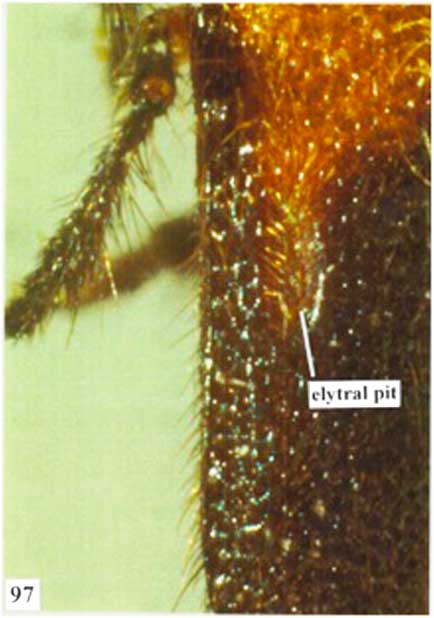
Diagnosis. The narrow, elongate depression on the sides of the elytral disc, at about elytral posterior two-thirds, will distinguish the members of this species from congeners.
Description. Size : Length 6.0 mm; width 1.7 mm. Form : As in Figure 84. Colour : Cranium bicolourous, eyes rimed by black, rest of cranium testaceous. Pronotum bicolourous, disc near middle with two black lines, remainder testaceous; elytra bicolourous, mostly black, with broad testaceous fasciae that meet at sutural margin and extends anteriorly to humeral angle at sides; legs bicolourous, testaceous at base and black in remainder. Head : Antennal capitulum long (Fig. 33), each capitular antennomere about as long as combined length of funicular antennomeres; antennal carina prominent; EW/FW 20/25. Thorax : Pronotum quadrate (Fig. 46), anterior margin linear, side margin with well-developed tubercle; PW/PL 75/75; elytra strongly deflexed at sides, elytral pit present, punctation subseriate and extended to elytral apex; EL/EW 250/60. Abdomen : Male pygidium rounded distally; aedeagus (Figs. 61, 62) slightly sclerotised; phallic plates very thin.
Natural history. The holotype was collected in October.
Distribution (Fig. 98). Known only from Santa Cruz, Bolivia.
Etymology. The specific epithet cava is a Latin noun that stems from cavus (=hole). The name refers to the depression on the posterolateral aspects of the elytral disc.
Ampleris orosi Opitz, new species
Figures 34, 47, 63, 64, 85, 98.
Holotype. ♂. “Est. Mariza, 600 m, lado O Vol. Orosi, Prov. Guan., Costa Rica, Tr. Malaise, 1988” (MUCR).
Paratype. One specimen. “Honduras: Francisco Morazon: 25.5 km SSW Talanga, 3-VI-1993, R. Turnbow” (RHTC).
Diagnosis. The pronotum is bicolourous. It has a broad testaceous line at the middle of the disc and a narrow testaceous macula at the lower sides. The remainder of the pronotal disc is black. These traits will distinguish the members of this species from congeners.
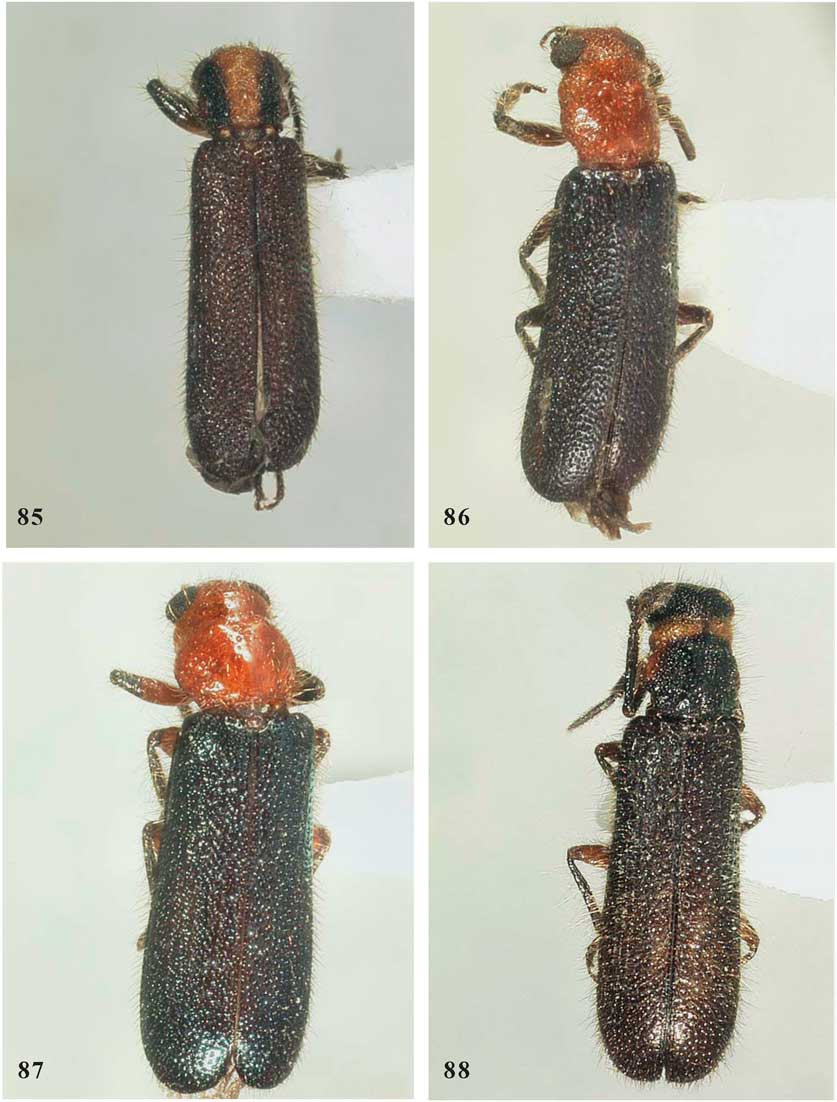
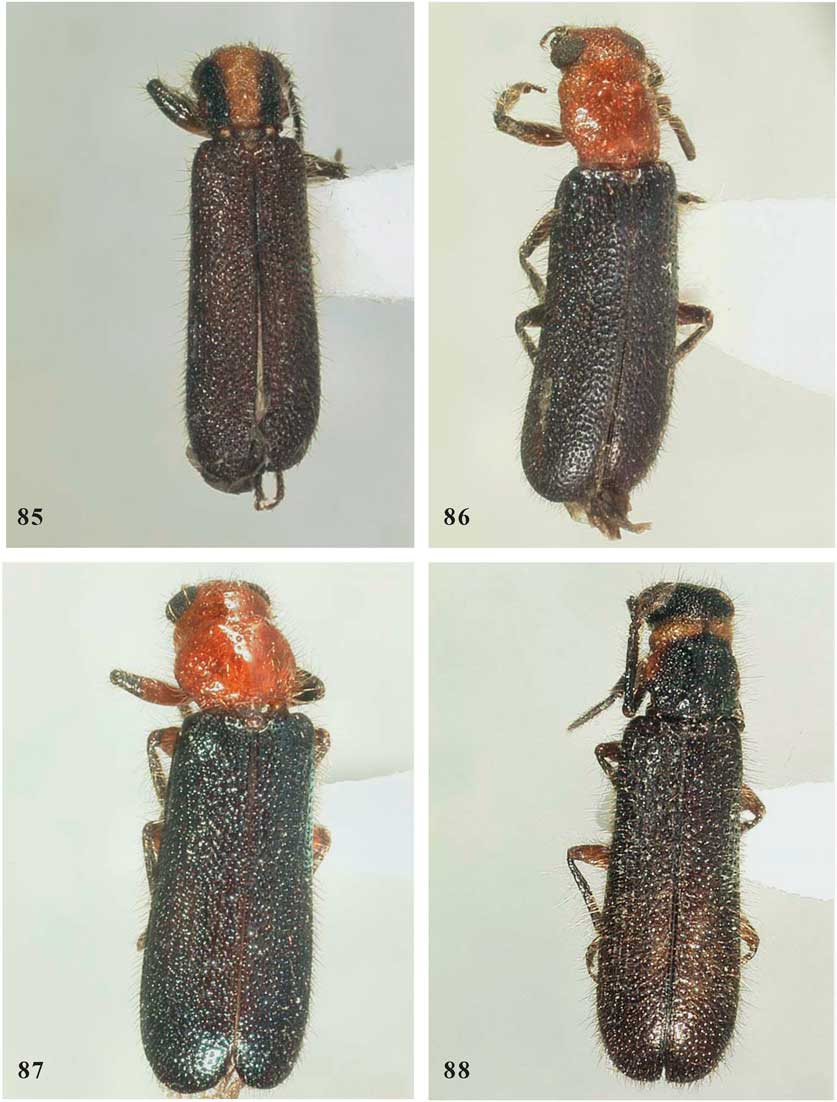
Description. Size : Length 4.5 mm; width 1.2 mm. Form : As in Figure 85. Colour : Cranium bicolourous, mostly black, frons with narrow testaceous line that extends to vertex, clypeus and cranial venter testaceous; pronotum bicolourous, with broad testaceous line at middle of disc, lower sides with narrow testaceous macula, remainder black. Head : Antennal capitulum long (Fig. 34), each capitular antennomere about as long as combined length of funicular antennomeres; antennal carina prominent; EW/FW 15/22. Thorax : Pronotum (Fig. 47) quadrate, disc with glabrous interstitial spaces, anterior margin linear, side margin with well-developed tubercle; PW/PL 60/60; elytra strongly deflexed at sides, elytral pit present, punctation subseriate and extended to elytral apex; EL/EW 200/38. Abdomen : Male pygidium rounded distally; aedeagus (Figs. 63, 64) short and broad; phallic apex large.
Variation. Size: length 4.5–5.5 mm; width 1.2–1.7 mm. The narrow elongate depression at the posterolateral region of the elytral disc is not present in the female paratype.
Natural history. The paratype was collected in June.
Distribution (Fig. 98). Known only from Honduras and Costa Rica.
Etymology. The specific epithet orosi is a noun in apposition and refers to the type locality.
Ampleris primitura Opitz, new species
Figures 32, 48, 65, 66, 86, 98.
Holotype: ♂. “Bolivia, Santa Cruz, 4–6 km SSE Buena Vista, F &F Hotel, 3–8 October 2004 Wappes & Morris” (MNKM).
Paratypes. Three specimens. “Bolivia: Santa Cruz: 4-6 km SSE Buena Vista, F & F Hotel, 22-31-X-2002, Wappes & Morris” (JEWC, 1). “Brazil: Triumfo, RS, Canal Polo Maricapai, 06-I-2000” (MCNZ, 1): “Goias: Jatai, XI-1972, F. M. Oliveira” (WOPC, 1).
Diagnosis. The members of this species and those of Ampleris rufocapilla have a red forebody. However, in specimens of A. primitura the legs are completely black whereas in specimens of A. rufocapilla the femora are partially testaceous.
Description. Size : Length 6.0 mm; width 1.7 mm. Form : As in Figure 86. Colour : Cranium, prothorax, and mesoscutellum red; elytra, mesothoracic leg and metathoracic leg black. Head : Antennal capitulum long (Fig. 32), each capitular antennomere as long as or longer than combined length of funicular antennomeres, last antennomere particularly elongate; antennal carina prominent; EW/FW 22/32. Thorax : Pronotum (Fig. 48) quadrate, disc with glabrous tumescences, anterior margin linear, side margin with tubercle; PW/PL 85/85; elytral disc strongly deflexed at sides, elytral pit present, punctation seriate and extended to elytral apex; EL/EW 260/50. Abdomen : Male pygidium not incised distally; aedeagus (Figs. 65, 66) slightly sclerotised; phallic plates very thin.
Variation. Size: length 4.0–7.0 mm; width 1.3–2.0 mm. In the Brazilian specimens the mesoscutellum is black
Natural history. Specimens were collected during October, November, and January.
Distribution (Fig. 98). Known only from Bolivia and Brazil.
Etymology. The specific epithet primitura (=depression) is a Latin noun. The name refers to the slender depression on the sides of the elytral disc.
Ampleris rufocapilla Opitz, new species
Figures 35, 49, 87, 98
Holotype. ♀. “Bolivia, Santa Cruz, Cord. Prv., Rd. to Itai, 83 km N. Camiri, 890 m 17-18 December 2011”. A second label reads: “19°20'S 63°28'W, Wappes, Lingafelter & Woodley” (MNKM).
Diagnosis. The members of this species and those of Ampleris primitura have a red forebody. However, in specimens of A. primitura the legs are completely black whereas in specimens of A. rufocapilla the femora are partially testaceous.
Description. Size : Length 7.0 mm; width 2.0 mm. Form : As in Figure 87. Colour : Cranium, prothorax, and mesoscutellum red; elytra black, aeneous luster; legs bicolourous, femora mostly red, tibiae and tarsus black. Head : Antennal capitulum long (Fig. 35), each capitular antennomere as long as or longer than combined length of funicular antennomeres; antennal carina prominent; EW/FW 25/40. Thorax : Pronotum (Fig. 49) quadrate, disc with glabrous tumescences, anterior margin linear, side margin with shallow tubercle; PW/PL 96/96; elytra strongly deflexed at sides, punctation subseriate and extended to elytral apex; EL/EW 95/102. Abdomen : Female pygidium not incised distally.
Distribution (Fig. 98). Known only from the type locality.
Etymology. The specific epithet rufocapilla is a Latin compound feminine name that stems from rufus (=red) and caput (=head). The name refers to the colouration of the cranium.
Ampleris buenavista Opitz, new species
Figures 36, 50, 67, 68, 88, 98.
Holotype. ♀. “Bolivia, Santa Cruz, 4–6 km Buena Vista, F & F Hotel, 27-29-Oct. 2000, Wappes & Morris” (MNKM).
Paratypes. One specimen. Bolivia, Santa Cruz, Potrerillos del Guenda, Preserva Natural 40 km NW Santa Cruz, 17°40'S63°27'N, 30-IX-3-X-2007, 370 m, Wappes & Morris (JEWC, 1).
Diagnosis. Only the pronotal arch is flavotestaceous as are the anterior angles of the pronotum. The rest of the body is black. These features distinguish the members of this species from congeners.
Description. Size : Length 5.0 mm; width 1.2 mm. Form : As in Figure 88. Colour : Only the pronotal arch is flavotestaceous as are the anterior angles of the pronotum, clypeus, and cranial venter; other structures are black. Head : Antennal capitulum long (Fig. 36), each capitular antennomere longer than combined length of funicular antennomeres; antennal carina prominent; EW/FW 20/25. Thorax : Pronotum (Fig. 50) quadrate, disc with glabrous interstitial spaces, anterior margin linear, side margin with well-developed tubercle; PW/PL 66/66; elytra strongly deflexed at sides, elytral pit not present, punctation seriate and extended to elytral apex; EL/EW 220/40. Abdomen : Female pygidium deeply incised distally, male pygidium rounded distally; aedeagus (Figs. 67, 68) slightly sclerotised; phallic plates very thin.
Variation. Size: length 4.0–5.0 mm; width 1.0–1.2 mm. The flavotestaceous region behind the pronotal anterior angles varies in size.
Natural history. Specimens were collected within a time frame between September and October, at 370 m.
Distribution (Fig. 98). Known only from Santa Cruz, Bolivia.
Etymology. The specific epithet buenavista is a noun in apposition and refers to the type locality.
Pseudichnea Schenkling, Reference Schenkling1900
Pseudichnea Schenkling, Reference Schenkling1900: 400. Corporaal Reference Corporaal1950: 272. Type species: Pseudichnea eliminata
Schenkling, Reference Schenkling1900: 400. By original designation.
Diagnosis. In the members of this genus the terminal palpomeres of the maxilla and labium are subsecuriform, the unguis has a denticle, and spicular plates are connected. This combination of characteristics will distinguish the members of this genus from the superficially similar specimens of Ampleris Opitz and Sirpa Opitz.
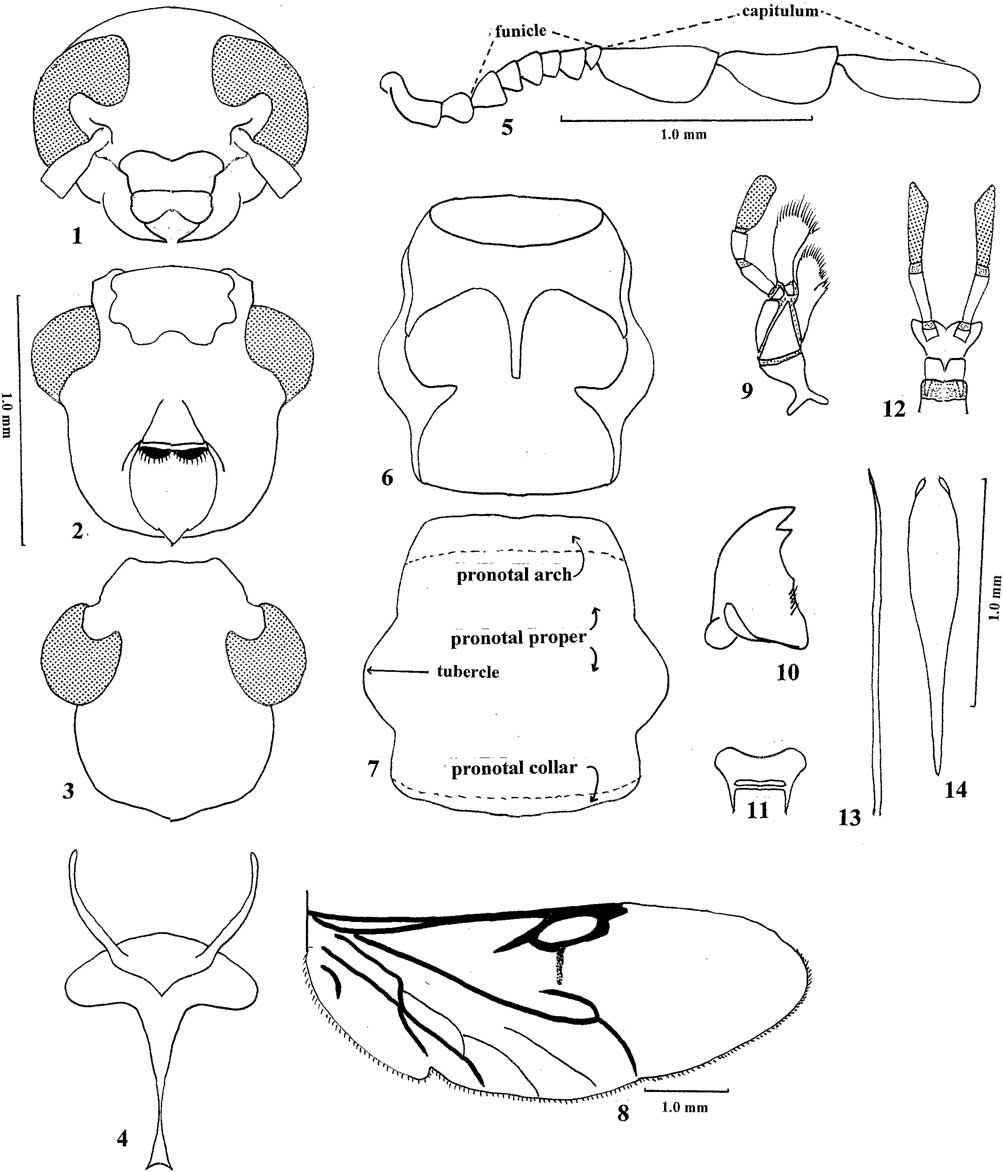
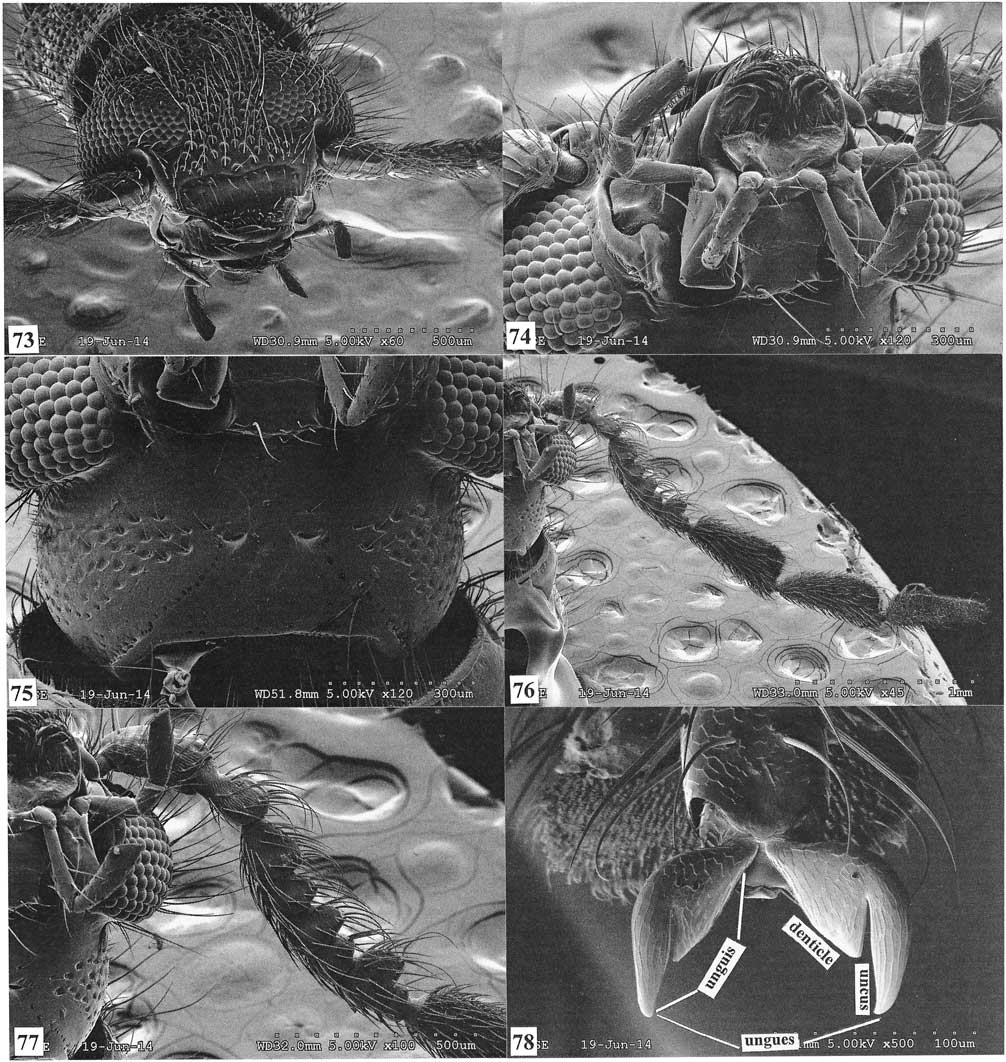
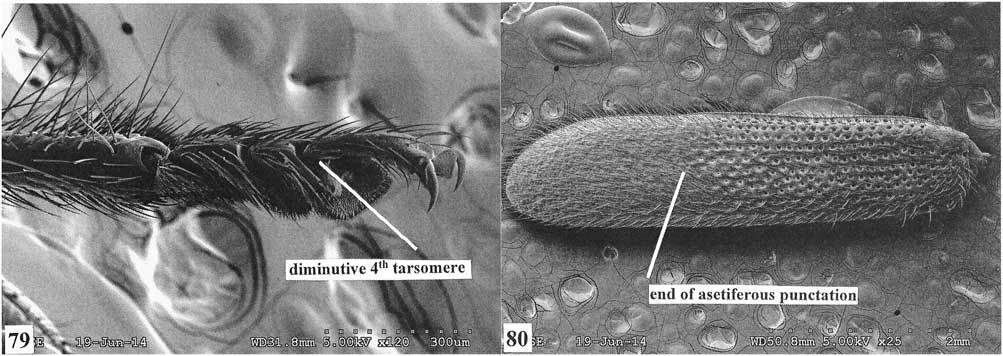
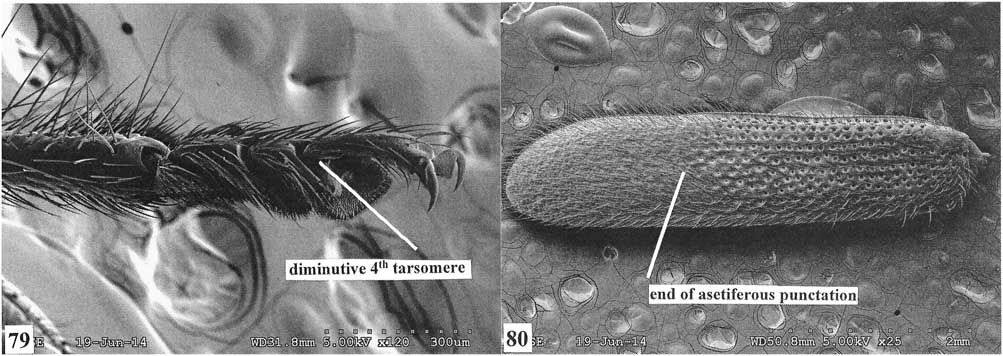
Redescription. Size : Length 3.0–7.0 mm; width 1.2–2.0. Form : Elytra rectangulate, posterior angle narrowly rounded. Integumental colour : Antenna black; mandible black, other mouthparts flavotestaceous, maxillary and labial terminal palpomeres brown; cranium black or black and flavotestaceous; pronotum brown or black and flavotestaceous; elytra black or brown, or black and flavotestaceous; legs black or brown, or black and flavotestaceous; pterothorax and abdomen black or brown. Vestiture : Integument highly setose, funicular antennomeres highly setose, cranium and pronotum densely vested with decumbent and erect setae, elytra densely vested with short secondary setae and primary setae; legs highly setose. Head (Figs. 1–3, 73, 75): Cranial setose punctation cribrate; eyes bulging, coarsely faceted, not deeply incised along frontal margin. Antenna (Figs. 5, 76, 77) capitate, inserted at level of eye incision (=ocular notch); antennal carina prominent, comprised of 11 antennomeres, scape robust, pedicel rotund, funicular antennomeres transverse-triangular, capitulum long, about 3 times longer that length of funicular antennomeres combined. Labrum (Fig. 11) not deeply incised. Mandible (Fig. 10) elongate, robust, dens poorly developed. Maxilla (Fig. 9) well developed, laterolacinia present, terminal palpomere subsecuriform (Fig. 74). Labium (Fig. 12) well developed, terminal palpomere subsecuriform or subdigitiform (Fig. 74); gula triangular. Thorax : Pronotum quadrate (Figs. 6, 7), side margins with tubercle, anterior margin linear, prebasal depression feebly developed, dorsolateral carina not extended to anterior margin of pronotum, carina joins pronotal hem at pronotal posterior angle; metendosternite with furcal lamina (Fig. 4). Elytra rectangulate (Fig. 80), sides strongly deflexed, elytral pit not present, posterior angles sharply rounded, discal carinae not present, asetiferous punctation subseriate or not. Mesoscutellum transverse. Protibial anterior margin not spinous; ungues with denticle (Fig. 78); tibial spur formula 0-1-1; tarsal pulvillar formula 3-3-3, metabasitarsal pulvillus very small (Fig. 79). Metathoracic wing as in Figure 8. Abdomen : Six visible sternites; pygidium usually rounded distally in males and females; rarely incised in males. Male genitalia (Figs. 13, 14): Aedeagus short, tegmen feebly sclerotised, lobate distally; phallus more sclerotised; spicular fork comprised of two narrow plates that are connected at base, intraspicular plate narrow and long.
Distribution. The members of this genus range from Honduras to Brazil.
Pseudichnea acia Opitz, new species
Figures 37, 51, 89, 99.
Holotype. ♀. “Brasil (Brazil), F. Sahl.” (NHRS).
Diagnosis. The epipleural and sutural margins are yellow. This characteristic will distinguish the members of this species from known congeners.
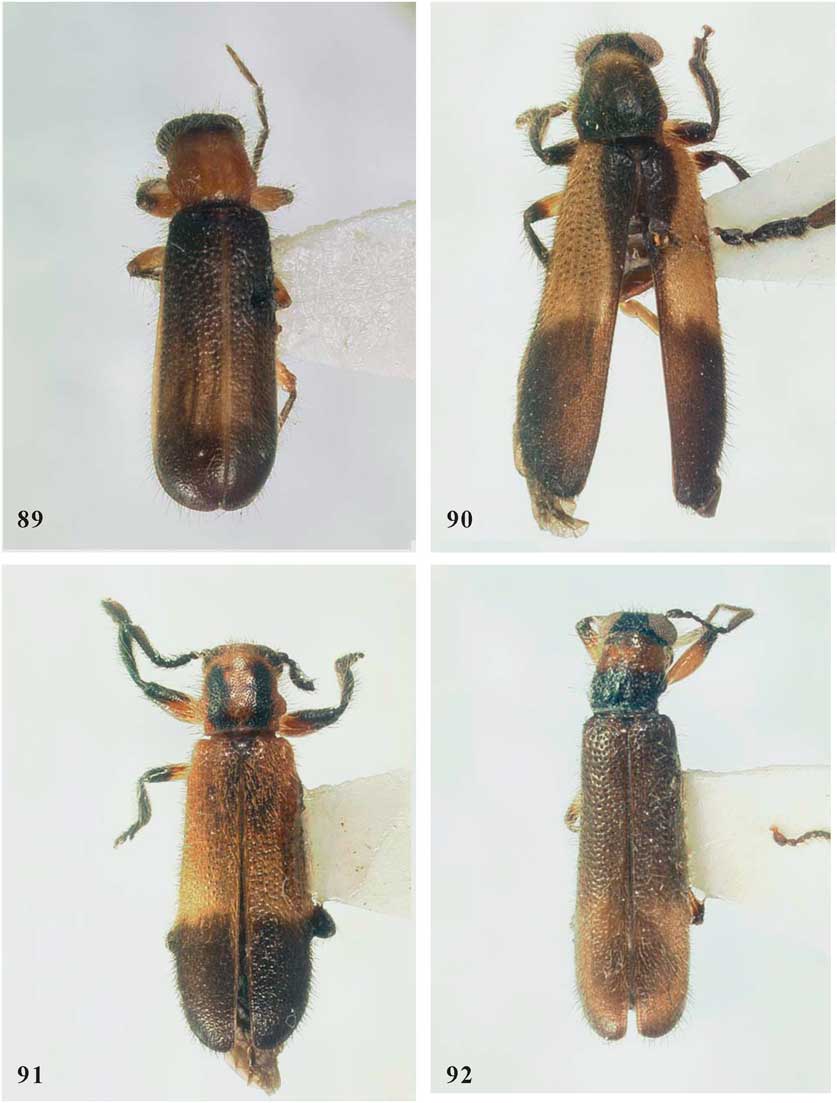
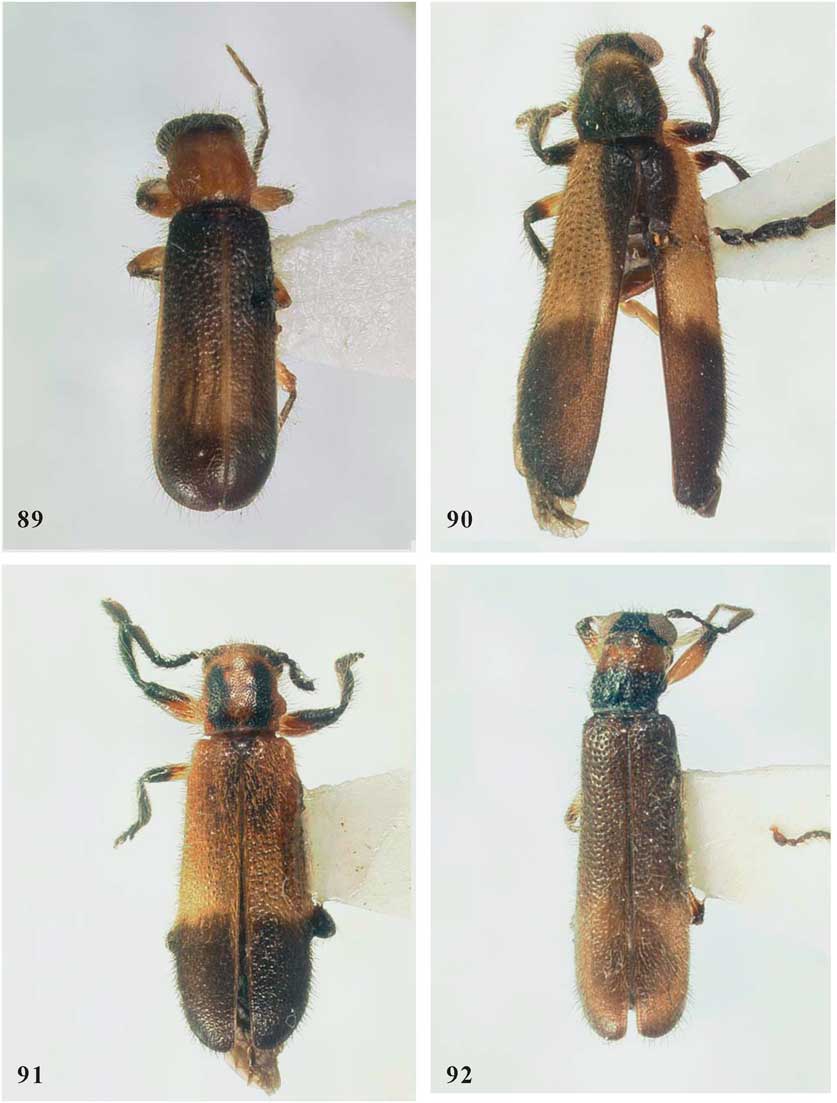
Description. Size : Length 5.0 mm; width 1.7 mm. Form : As in Figure 89. Colour : Cranium mostly black, venter testaceous; pronotum bicolourous, mostly flavotestaceous, arch and collar infuscate; mesoscutellum testaceous; elytra brown, epipleural and sutural margins yellow. Head : Antennal capitulum long (Fig. 37) and particularly slender, each capitular antennomere about as long as combined length of funicular antennomeres; antennal carina prominent; EW/FW 20/26. Thorax : Pronotum (Fig. 51) quadrate, anterior margin linear, side margin with tubercle; PW/PL 73/73; elytral disc strongly deflexed at sides; punctation subseriate and extended to elytral posterior 2/3; EL/EW 240/50. Abdomen : Female pygidium truncate, not incised distally.
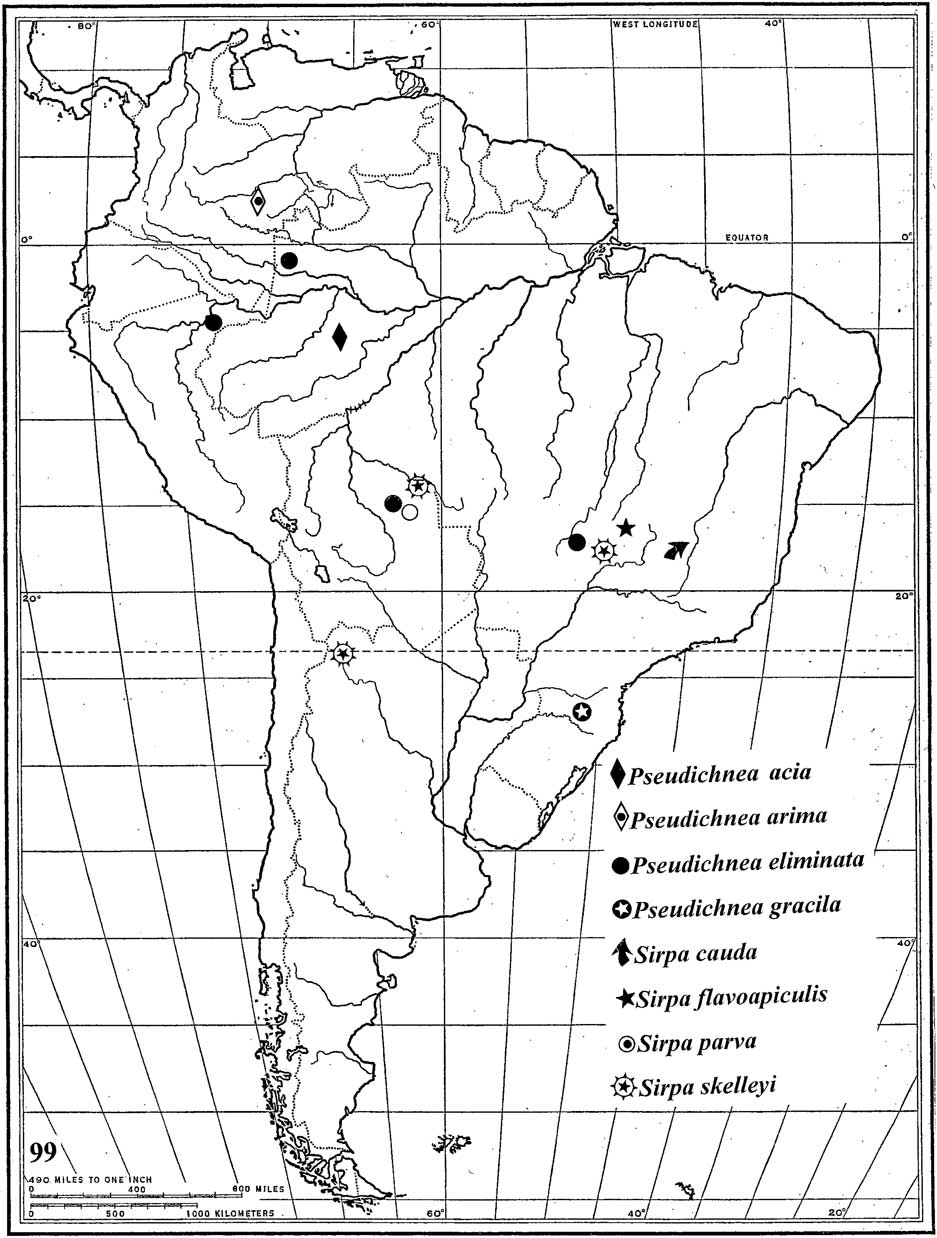
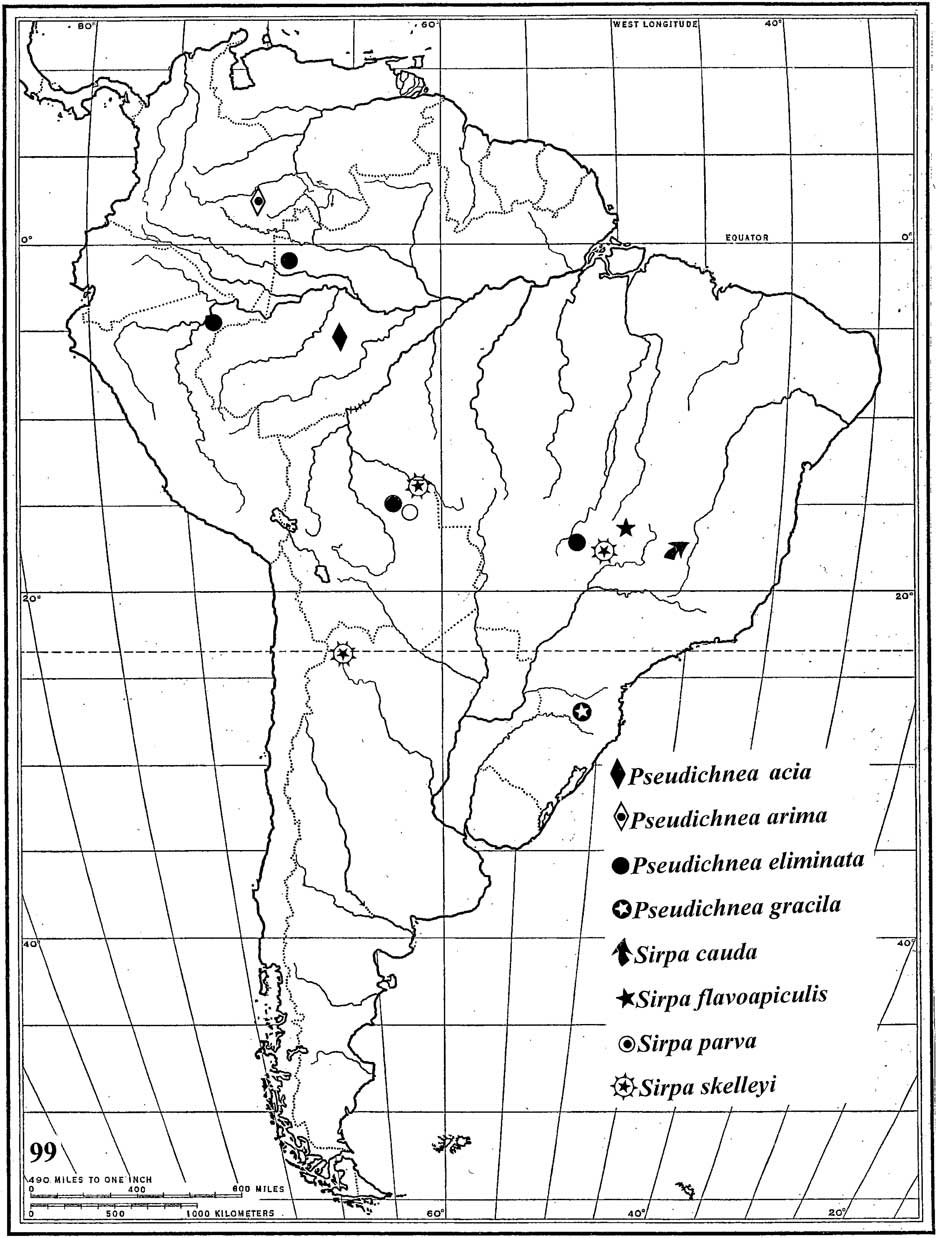
Distribution (Fig. 99). Known only from the type locality.
Etymology. The specific epithet acia (=thread, for a needle) is a Latin noun. The name refers to the slender form of the capitulum.
Pseudichnea arima Opitz, new species
Figures 42, 52, 69, 70, 90, 99.
Holotype. ♂. “La Trinidad, Sirata Arima Valley (Colombia), 800', VIII-29-1961, at light, J. Bouseman” (FSCA).
Diagnosis. The elytral punctate striae end at middle of disc. This characteristic will distinguish the members of this species from congeners.
Description. Size : Length 8.0 mm; width 2.3 mm. Form : As in Figure 90. Colour : Cranium mostly black, venter and epicranium flavotestaceous; pronotum mostly black, lower sides and anterior margin testaceous; mesoscutellum black; elytra with long posthumeral testaceous macula outlined in black. Head : Antennal capitulum long (Fig. 42), each capitular antennomere about as long as combined length of funicular antennomeres; antennal carina prominent; EW/FW 33/25. Thorax : Pronotum (Fig. 52) quadrate, anterior margin narrower than posterior margin, side margin with tubercle; PW/PL 90/90; elytral disc strongly deflexed at sides, elytral carina absent; punctuation striae terminate at middle; EL/EW 340/80. Abdomen : Male pygidium not incised distally; aedeagus (Figs. 69, 70) slightly sclerotised; phallic plates very thin.
Natural history. The holotype was collected in August, at 244 m.
Distribution (Fig. 99). Known only from the type locality.
Etymology. The specific epithet arima is a noun in apposition and refers to the type locality.
Pseudichnea eliminata Schenkling, Reference Schenkling1900
Pseudichnea eliminata Schenkling, Reference Schenkling1900: 400. Corporaal Reference Corporaal1950: 272. Holotype ♀. “Goyas (Bras)” (Brazil) (SDEI).
Diagnosis. Within Pseudichnea only in P. eliminata and in P. arima is there an oval black macula at the base of the elytral disc. In P. eliminata specimens, the pronotum is not distinctly narrowed anteriorly as it is in those of P. arima.
Description. Size : Length 6.0 mm; width 2.0 mm. Form : As in Figure 91. Colour : Cranium mostly testaceous, lower frons and region behind eyes black; pronotum mostly testaceous, with two paralateral black lines; mesoscutellum black; elytra bicolourous, posterior third black, anterior two-thirds mostly testaceous, slightly infuscate at base. Head : Antennal capitulum long (Fig. 5), each capitular antennomere as long as combined length of funicular antennomeres; antennal carina prominent; EW/FW 27/27. Thorax : Pronotum (Figs. 6, 7) quadrate, anterior margin not projected at middle, side margin of disc with well-developed tubercle; PW/PL 90/90; elytral disc strongly deflexed at sides, punctures seriate, striae end at distal two-thirds; EL/EW 305/50. Abdomen : Aedeagus (Figs. 13, 14) slightly sclerotised.
Variation. Size: length 5.0–8.0 mm; width 1.5–2.0 mm. The oval black macula at the base of the elytral disc varies in expression as does the definition of the two black lines on the pronotal disc.
Natural history. Specimens were collected during October and November, at altitudes ranging from 370 to 400 m. Specimens were collected using a blacklight.
Distribution (Fig. 99). In addition to the holotype, I examined 23 specimens from: “Bolivia: Santa Cruz, 3.7 km SSE Buena Vista, Hotel Flora & Fauna, 430 m, 14-19-X-2000, tropical transition forest, M. C. Thomas”; “Santa Cruz, 3.7 km SSE Buena Vista, Hotel Flora & Fauna, 430 m, 14-19-X-2000, tropical transition forest, M. C. Thomas”; “Santa Cruz, 3.7 km SSE Buena Vista, Hotel Flora & Fauna, 430 m, 23-26-X-2000, M. C. Thomas”; “Santa Cruz, 3.7 km SSE Buena Vista, Hotel Flora & Fauna, 430 m, 14-19-X-2000, tropical transition forest, M. C. Thomas”; “Santa Cruz, 3.7 km SSE Buena Vista, Hotel Flora & Fauna, 430 m, 5-15-XI-2001, 17° 29.949'S63°33.152'W, M. C. Thomas & B. K. Dozier”; “Santa Cruz, 3.7 km SSE Buena Vista, Hotel Flora & Fauna, 430 m, 14-19-X-2000, tropical transition forest, M. C. Thomas”; “Santa Cruz, 4-6 k SSE Buena Vista, F&F Hotel, 17-19-X-2000, Wappes & Morris”; “Santa Cruz, 3.7 km SSE Buena Vista, Hotel Flora & Fauna, 430 m, 14-19-X-2000, tropical transition forest, M. C. Thomas”; “Santa Cruz, 4-6 k SSE Buena Vista, F&F Hotel, 22-31-X-2002, Wappes & Morris”; “Santa Cruz, 3.7 km SSE Buena Vista, Hotel Flora & Fauna, 430 m, 14-19-X-2000, tropical transition forest, M. C. Thomas”; “Santa Cruz, 4-6 k SSE Buena Vista, F&F Hotel, 1-8-XI-2002, J. E. Wappes”; “Santa Cruz, 3.7 km SSE Buena Vista, Hotel Flora & Fauna, 430 m, 14-19-X-2000, tropical transition forest, M. C. Thomas”; “Santa Cruz, 4-6 k SSE Buena Vista, F&F Hotel, 13-16-XI-2003, Wappes, Morris & Nearns”; “Santa Cruz, 3.7 km SSE Buena Vista, Hotel Flora & Fauna, 430 m, 14-19-X-2000, tropical transition forest, M. C. Thomas”; “Santa Cruz, Potrerillos del Guenda, Preserva Natural, 17°40'S 63°27'W, 17-22-X-2007, 370 m, J. Romero”; “Santa Cruz, 4 km N Bermejo, Ref. Los Volcanes, 18°06'S 63°36'W, 16-21-X-2007, J. Wappes & A. Cline”; “Santa Cruz, 40 km NW Santa Cruz de la Sierra, 17°40.26'S 063°27.44'W, 5-20-XI-2004, blacklight, B. K. Dozier”; “Santa Cruz, snake farm, 16-22-X-2006, 400 m, Wappes, Nearns, & Eya”. “Peru: Loreto Pr., 160 km NE Iquitos, Explornapo Camp, Rio Sucusari, 2 km from Rio Napo, 27-31-VIII-1992, P. E. Skelley”. “Brazil: Amazones, Tarapote”. Specimens are deposited in JEWC, FSCA, SDEI, and WOPC.
Pseudichnea gracila Opitz, new species
Figures 38, 53, 92, 99.
Holotype. ♂. “Pinhal, S. Cat., Brazil, Dec. 1947” (FSCA).
Diagnosis. The anterior half of the pronotum forms a broad flavotestaceous band. This characteristic will distinguish the members of this species from known congeners.
Description. Size : Length 6.0 mm; width 1.2 mm. Form : As in Figure 92. Colour : Cranium mostly black, venter testaceous; pronotum bicolourous, anterior half flavotestaceous, posterior half black; mesoscutellum black; elytra brown. Head : Antennal capitulum long (Fig. 38), each capitular antennomere about as long as combined length of funicular antennomeres; antennal carina prominent; EW/FW 24/18. Thorax : Pronotum (Fig. 53) quadrate, anterior margin linear, side margin with tubercle; PW/PL 65/65; elytral disc strongly deflexed at sides, elytral carina absent; punctures subseriate and extended to elytral posterior 2/3; EL/EW 250/40. Abdomen : Female pygidium not incised distally.
Distribution (Fig. 99). Known only from the type locality.
Etymology. The specific epithet gracila (=slender) is a Latin adjective. The name refers to the slender form of this beetle.
Sirpa Opitz, new genus
Type species. Sirpa skelleyi Opitz, new species. Here designated.
Diagnosis. In the members of this genus the terminal palpomeres of the maxilla and labium are subdigitiform, the unguis has a denticle, and spicular plates are disconnected. This combination of characteristics will distinguish the members of this genus from the superficially similar specimens of Ampleris and Pseudichnea.
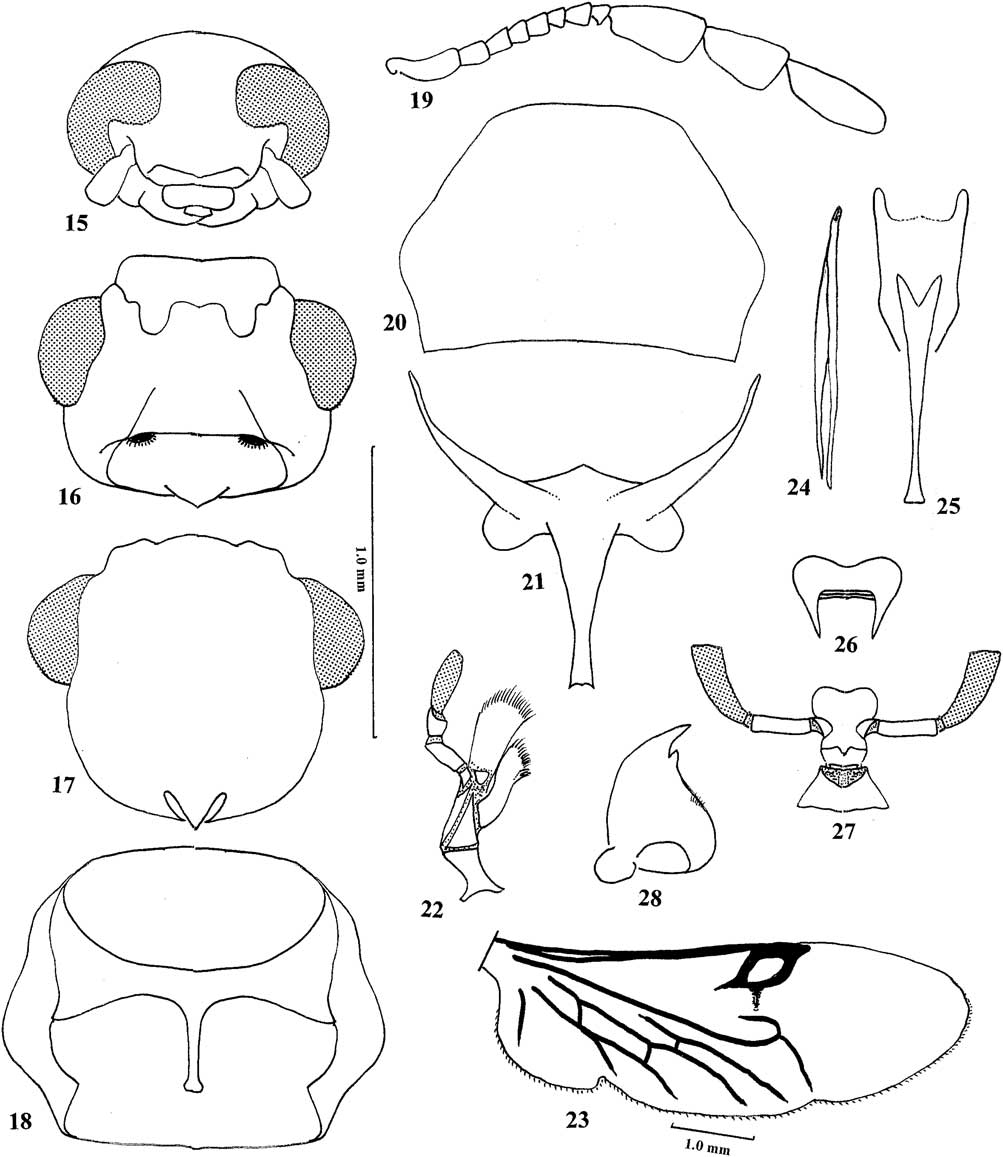
Description. Size : Length 4.0–7.0 mm; width 1.2–2.2 mm. Form : Elytra rectangulate, posterior angle narrowly rounded. Integumental colour : Antenna black; mandible black, other mouthparts flavotestaceous, maxillary and labial terminal palpomeres brown; cranium unicolourous black or bicolourous, when bicolourous black and flavotestaceous; pronotum unicolourous red or bicolourous, when bicolourous black and testaceous; elytra unicolourous, black, or bicolourous, when bicolourous black and flavotestaceous, elytral apex rarely white; legs unicolourous, black or brown, or bicolourous, when bicolourous black and flavotestaceous; pterothorax and abdomen black. Vestiture : Integument highly setose, funicular antennomeres slightly setose, cranium and pronotum densely vested with decumbent and erect setae, elytra densely vested with short secondary setae and primary setae; legs highly setose. Head (Figs. 15–17): Cranial setose punctation cribrate; eyes bulging, coarsely faceted, not deeply incised along frontal margin; antenna (Fig. 19) capitate, inserted at level of eye incision (=ocular notch); antennal carina prominent, comprised of 11 antennomeres, scape robust, pedicel rotund, funicular antennomeres subquadrate, capitulum short or long, 9th and 10th antennomeres about as long as combined length of funicle or shorter than combined length of funicular antennomeres; labrum not deeply incised; mandible (Fig. 28), maxilla (Fig. 22), and labrum (Fig. 26) well developed, maxillary and labial terminal palpomere subdigitiform; gula triangular. Thorax : Pronotum usually quadrate (Figs. 18, 20), rarely transverse, disc usually convex rarely subconvex, side margins with tubercle, tubercle expression variable, anterior margin linear, prebasal depression feebly developed, dorsolateral carina not extended to anterior margin of pronotum, carina joins pronotal hem at pronotal posterior angle. Metendosternite with furcal lamina (Fig. 21). Elytra rectangulate, sides strongly deflexed, elytral pit not present, posterior angles sharply rounded, discal carinae not present, asetiferous punctation seriate or subseriate. Mesoscutellum quadrate; protibial anterior margin not spinous; ungues without denticle. Tibial spur formula 1-2-1; tarsal pulvillar formula 3-3-3, metabasitarsal pulvillus very small; metathoracic wing as in Figure 23. Abdomen : Six visible sternites; pygidium usually rounded distally in males and females; rarely incised in males. Male genitalia (Figs. 24, 25): Aedeagus short, feebly sclerotised, broadly lobate distally; phallus well sclerotised; spicular fork comprised of two narrow plates that do not coalesce, intraspicular plate narrow and long.
Distribution. The members of this genus range from Bolivia to Argentina.
Etymology. The generic name sirpa (=enigma) is a Latin name. The name refers to the considerably difficulty I encountered when determining the generic placement of the species in this genus and is feminine in gender.
Sirpa cauda Opitz, new species
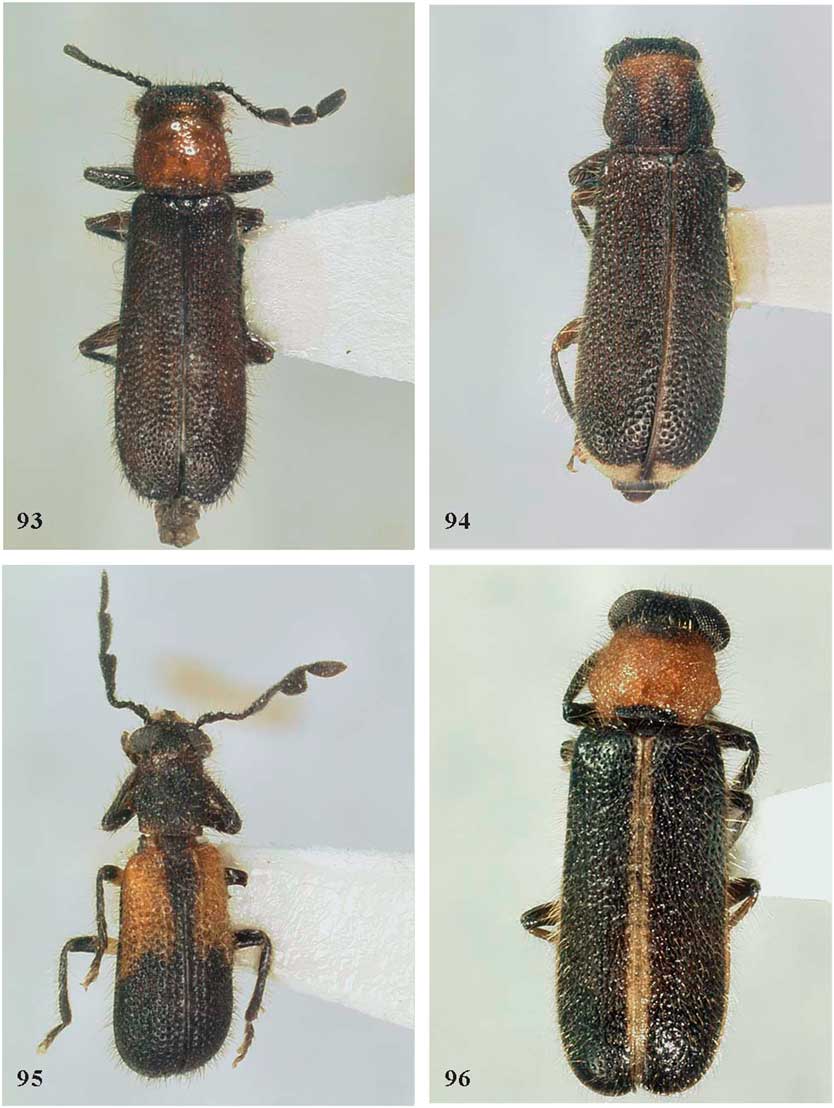
Figures 39, 54, 93, 99.
Holotype. ♀. “Brésil (Minas), Sertão de Diamantina, Faz. Das Melancias, E. Gounelle, 10-11-1902” (MNHN).
Diagnosis. The short and triangular shape of antennomeres 9 and 10 will distinguish the members of this species from congeners.
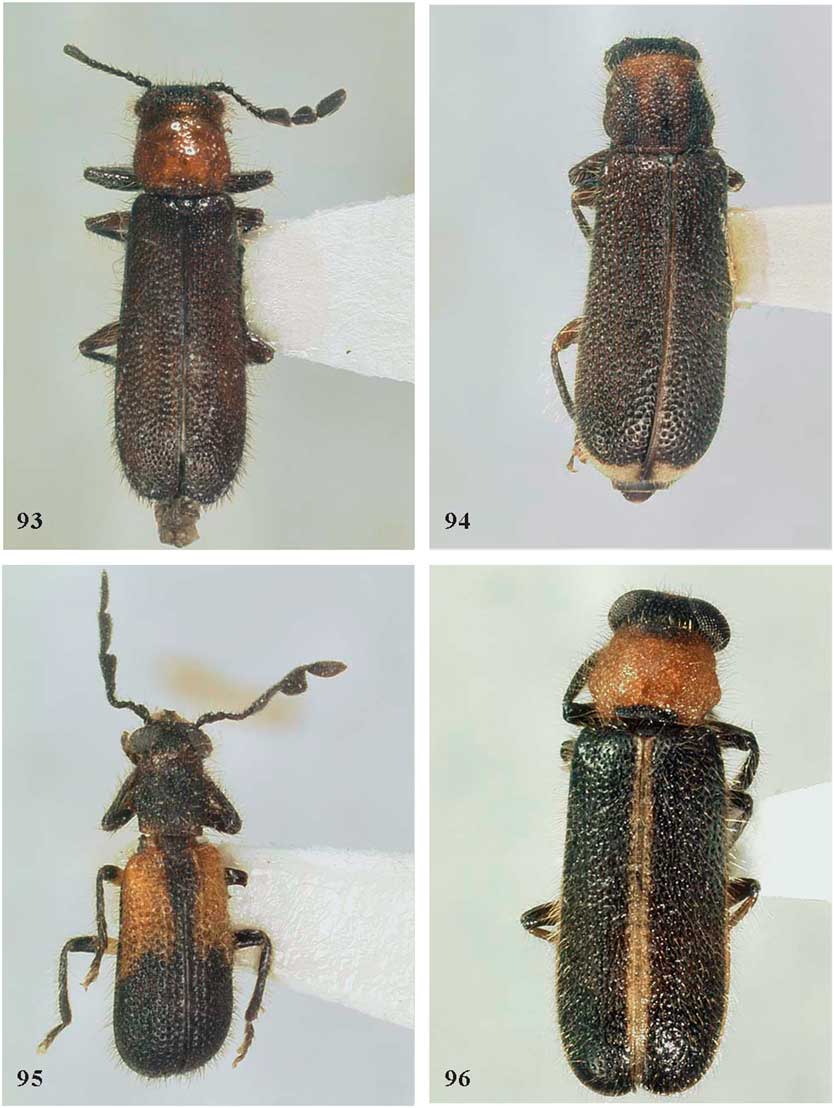
Description: Size : Length 5.5 mm; width 1.5 mm. Form : As in Figure 93. Colour : Cranium mostly black, gular region testaceous; pronotum testaceous; elytra and legs dark brown. Head : Antennal capitulum short (Fig. 39), each capitular antennomere shorter than combined length of funicular antennomeres; antennal carina prominent; EW/FW 22/32. Thorax : Pronotum (Fig. 54) quadrate, anterior margin linear, side margin with shallow tubercle; PW/PL 77/77; elytra strongly deflexed at sides, punctate seriate and extended to elytral apex; EL/EW 240/40. Abdomen : Female pygidium large, incised distally.
Natural history. The holotype was collected in November.
Distribution (Fig. 99). Known only from Minas Gerais, Brazil.
Etymology. The specific epithet cauda (=tail) is Latin noun and should be treated as a noun in apposition. The name refers to the extraordinary large female pygidium.
Sirpa flavoapiculis Opitz, new species
Figures 40, 55, 94, 99.
Holotype. ♀. “Brazil, 4 km W Brazilia, DF, 24-XI-1970, J. M. & B. A. Campbell” (CNCI).
Diagnosis. The white macula on the elytral apex will distinguish the members of this species from congeners.
Description. Size : Length 5.5 mm; width 1.8 mm. Form : As in Figure 94. Colour : Cranium black; pronotum brown; mesoscutellum brown; elytra bicolourous, mostly brown, epipleural margin and elytral apex white. Head : Antennal capitulum short (Fig. 40), each capitular antennomere shorter than combined length of funicular antennomeres; antennal carina prominent; EW/FW 20/35. Thorax : Pronotum (Fig. 55) transverse, disc convex, anterior margin linear, side margin with shallow tubercle; PW/PL 87/81; elytral disc strongly deflexed at sides; punctation striae subseriate and extended to elytral apex; EL/EW 230/50. Abdomen : Female pygidium not incised distally.
Natural history. The holotype was collected in November
Distribution (Fig. 99). Known only from Brazil.
Etymology. The specific epithet flavoapiculis is a Latin compound name that stems from flavus (=yellow) and apiculus (=point). The name refers to the white-yellow macula on the elytral apex.
Sirpa parva Opitz, new species
Figures 41, 56, 71, 72, 95, 99.
Holotype. ♂. “Bolivia: Santa Cruz, Potrerillo del Guenda, 20/23/X-2011, Skillman & Wappes”. A second label reads: “Snake Farm, 17°40'S63°27'W, 370-400 meters” (MNKM).
Paratypes. Five specimens. “Bolivia: Santa Cruz, 3.7 km SSE Buena Vista, Hotel Flora and Fauna, 405 m, 5-15-XI-2001, 17°29.949'S63°33.152'W, M. C. Thomas & B. K. Dozier, tropical transition forest” (FSCA, 2; WOPC, 1); “Santa Cruz, 3.7 km SSE Buena Vista, Hotel Flora and Fauna, 405 m, Santa Cruz, Buena Vista, F & F Hotel, 7-10-X-2004, Morris & Wappes” (JEWC, 1); “Santa Cruz, 3.7 km SSE Buena Vista, Hotel Flora and Fauna, 405 21-25-Xi-2003, Morris, Nearns, Wappes” (WFBM).
Diagnosis. These beetles are comparatively small, being less than 5 mm in length. This characteristic will distinguish the members of this species from congeners.
Description. Size : Length 4.0 mm; width 1.2 mm. Form : As in Figure 95. Colour : Cranium black; pronotum brown; mesoscutellum black; elytra bicolourous, mostly black, with posthumeral testaceous macula. Head : Antennal capitulum long (Fig. 41), each capitular antennomere longer than combined length of funicular antennomeres; antennal carina prominent; EW/FW 25/20. Thorax : Pronotum (Fig. 56) quadrate, anterior margin narrower than posterior margin, side margin with tubercle; PW/PL 65/65; elytral disc strongly deflexed at sides, elytral carina absent; punctate striae subseriate and extended to elytral apex; EL/EW 180/50. Abdomen : Male pygidium not incised distally; aedeagus (Figs. 71, 72) short, tegminal lobes fimbriate.
Natural history. Specimens were collected during October and November; three from a tropical transitional forest at 405 m, one at an altitude between 370 and 400 m.
Distribution (Fig. 99). Known only from Santa Cruz, Bolivia.
Etymology. The specific epithet parva (=little) is a Latin adjective. The name refers to the small size of these beetles.
Sirpa skelleyi Opitz, new species
Figures 15–28, 96, 99.
Holotype. ♂. “Bolivia: Santa Cruz, Potrerillo del Guenda, 350–400 m, 7–9 Sept 2012. A second label reads: J. Wappes, P. Skelley, T. Bonaso, at light, 17°40'S63°27'W” (MNKM).
Paratypes. Eight specimens. “Bolivia: Santa Cruz: Dpt. Potrerillos del Guendá, 7-9-IX-2012, at light, 17°40'S 63°27'W” (FSCA, 1; WOPC, 1); “Santa Cruz: Dpt. Potrerillos del Guendá, Snake Farm, 17°40'S 63°27'W, 21-24-X-2011, 350–400 m., Wappes & Skillman” (JEWC, 1); “Santa Cruz, Buena Vista, 18-25-X-1992, E. Giesbert (FSCA, 1); “Santa Cruz, 3.7 km SSE Buena Vista, Hotel Flora 7 Fauna, 23-26-X-2000, 430 m, tropical transition forest, M. C. Thomas” (FSCA, 1). “Brazil: Goyas, Rio Verde “(MNHN, 1). “Argentina: Tucuman: Cruz Alta, La Soledad, 10-XII-1965, E. Bucher” (IMLA, 1); “Salta, Dpto. Anta Salta Forestal, Sector 11, 50 km E Las Lajitas, 23-31-I-1980, R. Golbach” (JNRC, 1); “Dpto. Anta Salta Forestal, 50 km E J. V. Gonzales, 15-22-I-1980, R. Golbach” (WOPC, 1).
Diagnosis. These beetles and those of Sirpa flavoapiculis are notably robust and have a convex pronotal disc. But, specimens of S. flavoapiculis have a white macula on the elytral apex, which is not the case in S. skelleyi specimens.
Description. Size : Length 6.0 mm; width 2.0 mm. Form : As in Figure 96. Colour : Cranium bicoloured, frons and venter testaceous, remainder black; pronotum bicolourous, mostly testaceous, infuscate at base on central region of pronotal arch; mesoscutellum black; elytra bicolourous, mostly black, epipleural and sutural margins flavotestaceous. Head : Antennal capitulum short (Fig. 19), each capitular antennomere shorter than combined length of funicular antennomeres; antennal carina prominent; EW/FW 35/25. Thorax : Pronotum (Figs. 20, 21) transverse, disc convex, anterior margin linear, side margin with shallow tubercle; PW/PL 105/80; elytral disc strongly deflexed at sides; punctate striae subseriate and extended to elytral apex; EL/EW 290/80. Abdomen : Male pygidium not incised distally; aedeagus (Figs. 24, 25) short, tegminal lobes obtuse.
Natural history. Specimens were collected during October, November, and December, at 350–430 m. They were captured with a light trap.
Distribution (Fig. 99). Known from Bolivia, Brazil, and Argentina.
Etymology. The specific epithet skelleyi is a patronymic dedicative. It honors Paul E. Skelley of FSCA for his diverse contributions to entomology.
Discussion
Elsewhere (Opitz Reference Opitz2004: 61), I discussed the difficulties that one may encounter when one attempts to decipher the evolutionary relationships within certain groups of Cleridae. I observed that some variations of morphologic characteristics in Cleridae are minimal, and furthermore that whatever structural diversity does exists may not always be suitable for predictions of evolutionary relationships. These concerns are relevant to the taxa included in this work: variations are few, and, at this point, cannot be subjected to an analysis of apotypy or plesiotypy. I hope that the evolutionary relationships of the genera included herein may be delineated in a future work that will deal with the world genera of Peloniinae.
Little information is available about the natural history of these beetles. Nevertheless, morphological observations, particularly those based on mouthpart structure, allow us to speculate that they are predatory. Their leg construction, especially the development of the tarsal pads and ungues, suggest that they are lignicolous beetles that inhabit the woody components of arboreal vegetation, a niche in which they presumably pursue bark-beetle prey. Such an anatomical/niche correlation was well established among checkered beetle species of Plocamocera Spinola (Opitz Reference Opitz2004: 13). A peculiar elytral structure, the elytral pit (Fig. 97) is found among males of Ampleris angustata, A. cava, A. orosi, and A. primatura. It is not present in the examined male of A. achira or in males of A. vista. It was not possible to establish the presence of this organ in A. rufocapilla, for which there were no male specimens available. Because the elytral pit is variable in shape, and appears on different lateral locations on the elytra, conjecture as to its evolutionary significance is difficult. However, its functionality is probably associated with the dynamics of female to male chemical attraction.
Because the material used in this study was primarily the result of collecting in Bolivia, it is difficult to make any broad statements about the biogeography of these beetles. However, I was able to abstract certain information from notations on specimen labels: specimens collected north of the equator were taken during the middle months of the year, whereas those gathered south of the equator were obtained during the latter part of the year. Specimens were collected by beating low-lying tree vegetation or with a blacklight along forest edges. These beetles were captured at elevations that varied from 244 to 1940 m; most of the specimens were collected at or about an altitude of 500 m.
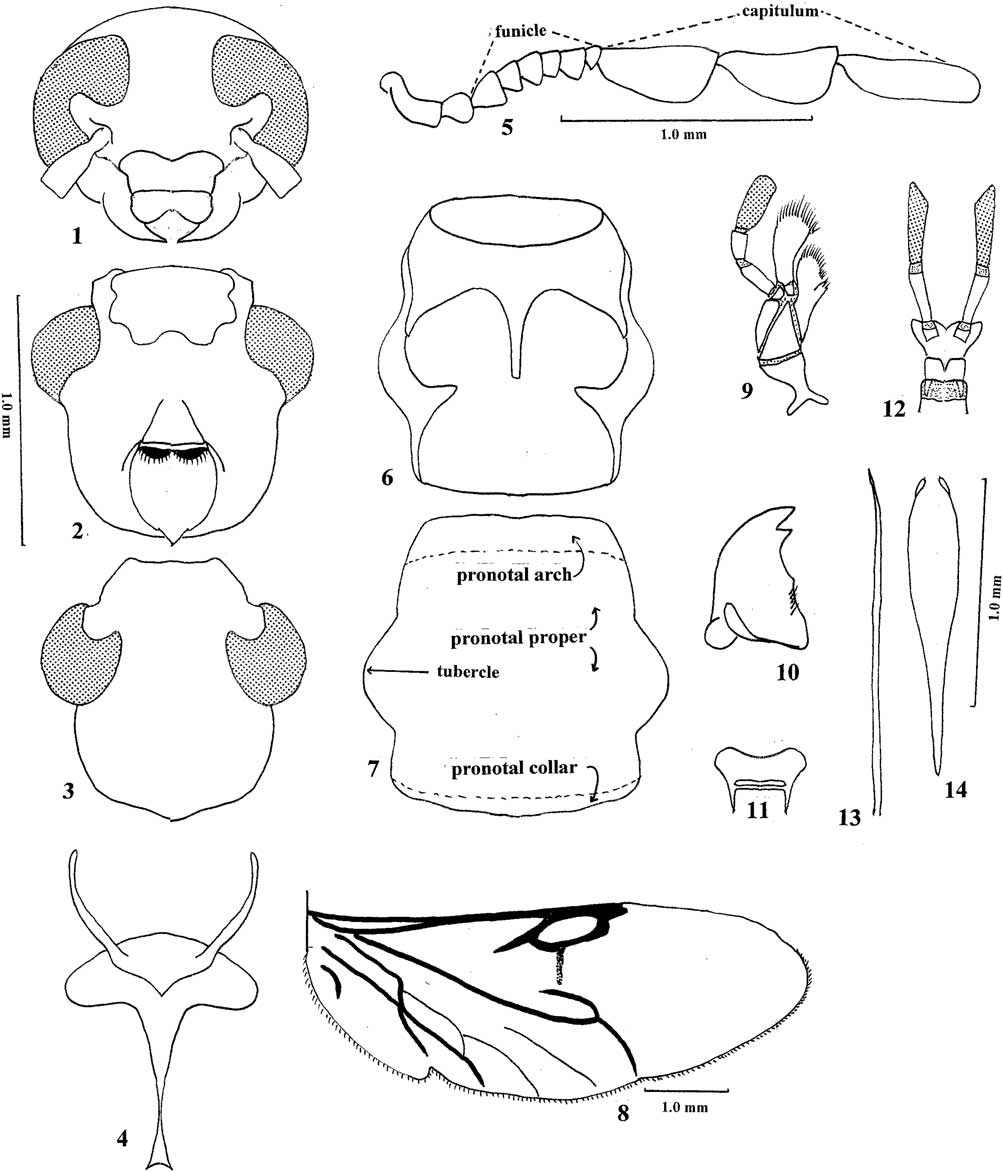
Pseudichnea eliminata. 1. Head, frontal view. 2. Head, ventral view. 3. Head, dorsal view. 4. Metendosternite. 5. Antenna. 6. Pronotum, ventral view. 7. Pronotum, dorsal view. 8. Metathoracic wing. 9. Maxilla. 10. Mandible. 11. Labrum. 12. Labium. 13. Phallus. 14. Tegmen.
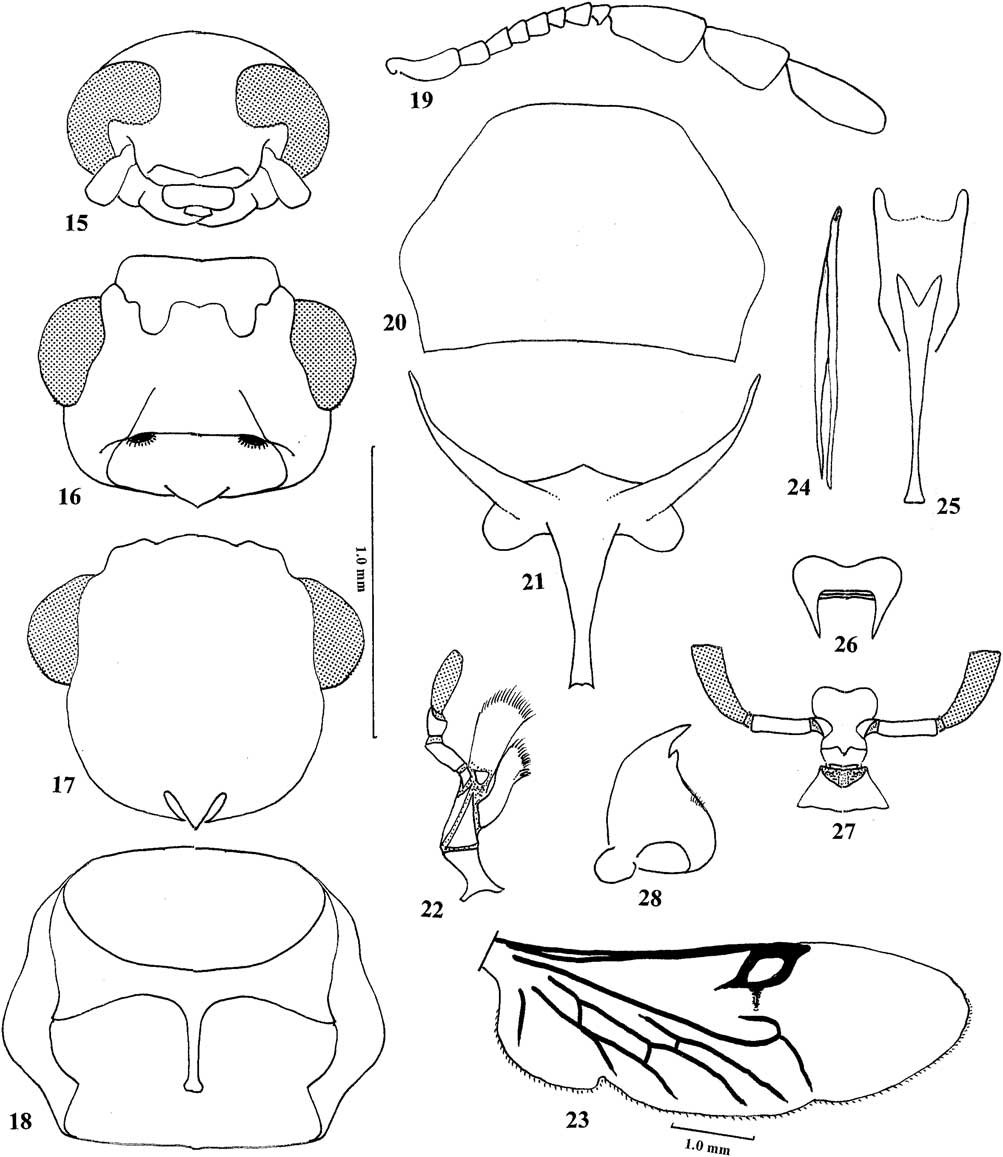
Sirpa skelleyi. 15. Head, frontal view. 16. Head, ventral view. 17. Head, dorsal view. 18. Pronotum, ventral view. 19. Antenna. 20. Pronotum, dorsal view. 21. Metendosternite. 22. Maxilla. 23. Metathoracic wing. 24. Phallus. 25. Tegmen. 26. Labrum. 27. Labium. 28. Mandible.
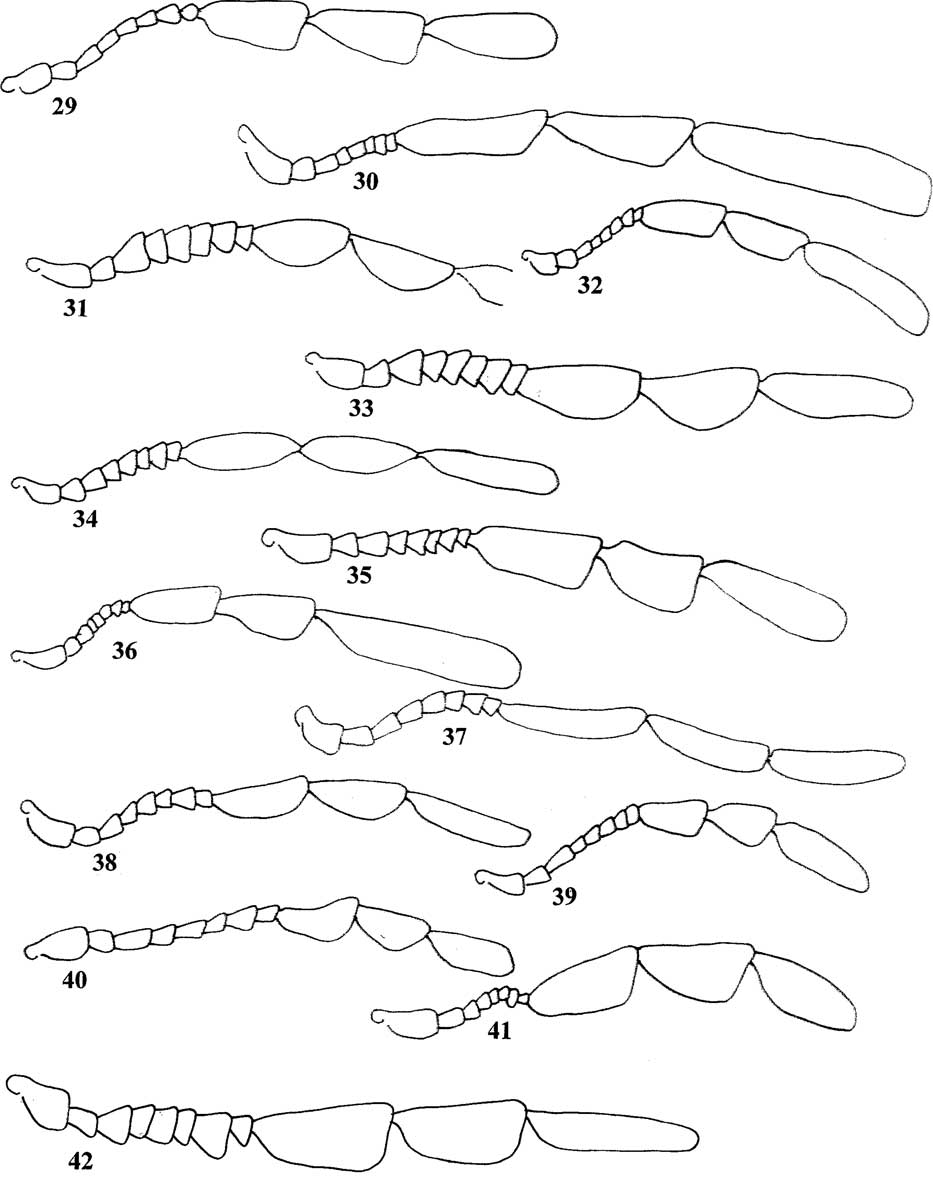
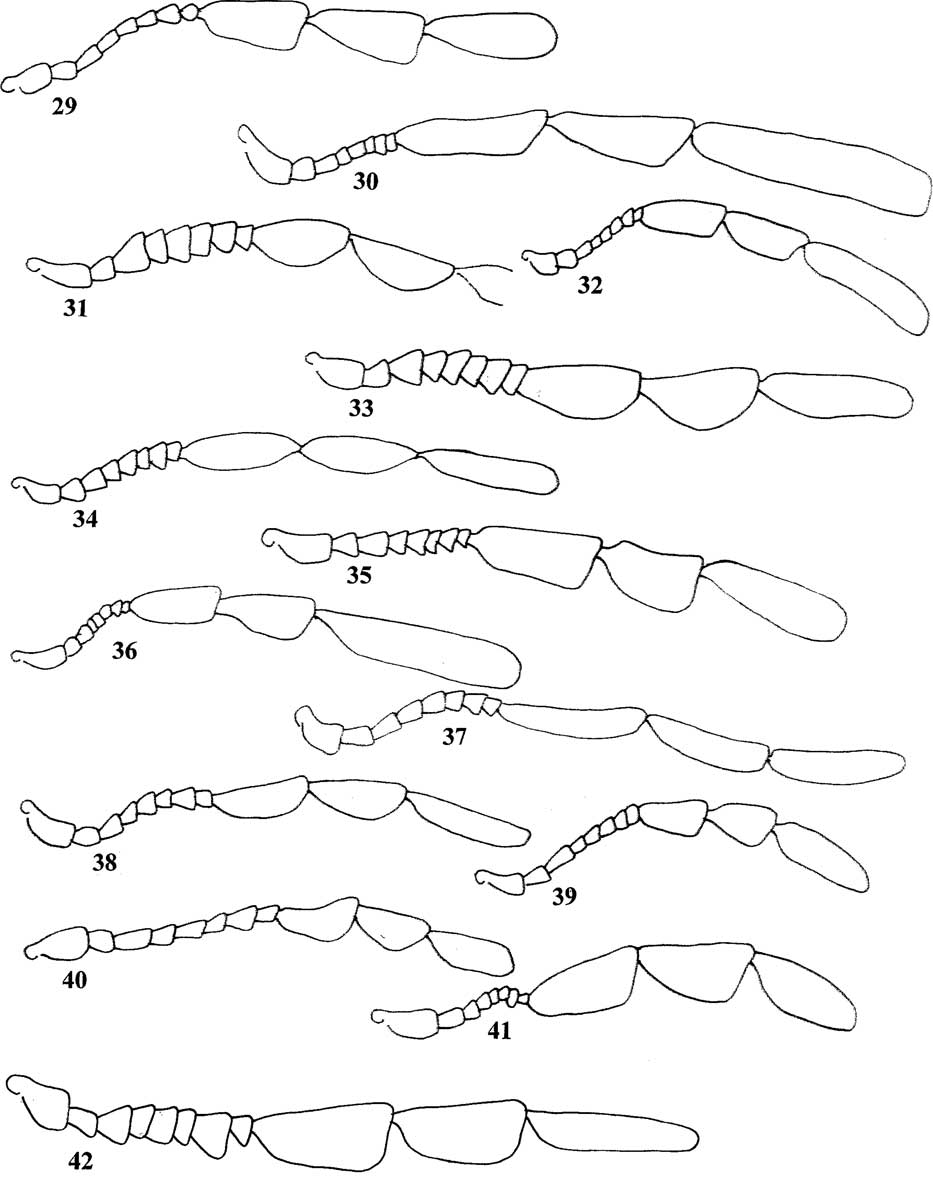
Antenna of 29. Ambitus anticus. 30. Ampleris achira. 31. Ampleris angustata. 32. Ampleris primitura. 33. Ampleris cava. 34. Ampleris orosi. 35. Ampleris rufocapitis. 36. Ampleris vista. 37. Pseudichnea acia. 38. Pseudichnea gracila. 39. Sirpa cauda. 40. Sirpa flavoapiculis. 41. Sirpa parva. 42. Pseudichnea arima.
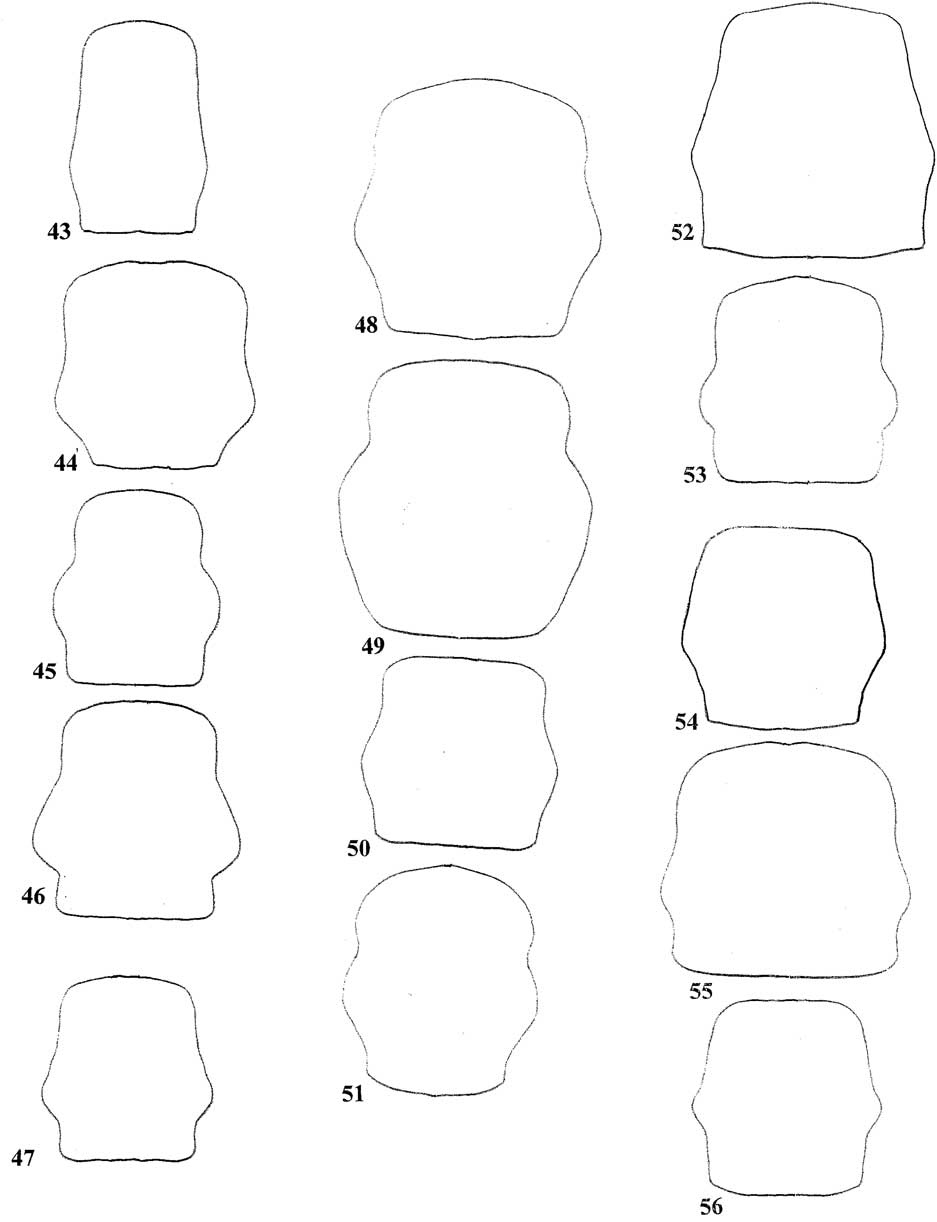
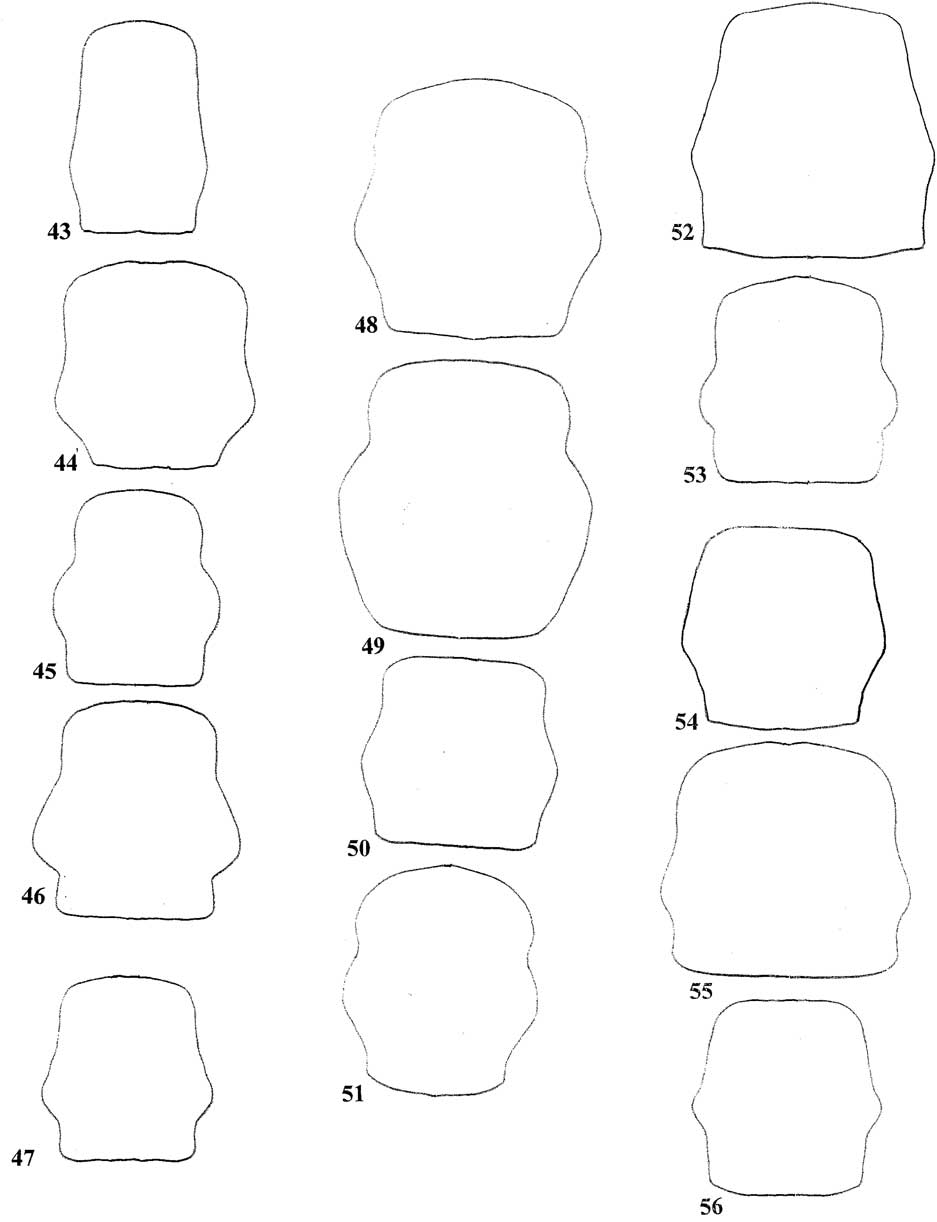
Pronotum of 43. Ambitus anticus. 44. Ampleris achira. 45. Ampleris angustata. 46. Ampleris cava. 47. Ampleris orosi. 48. Ampleris primitura. 49. Ampleris rufocapitis. 50. Ampleris vista. 51. Pseudichnea acia. 52. Pseudichnea arima. 53. Pseudichnea gracila. 54. Sirpa cauda. 55. Sirpa flavoapiculis. 56. Sirpa parva.
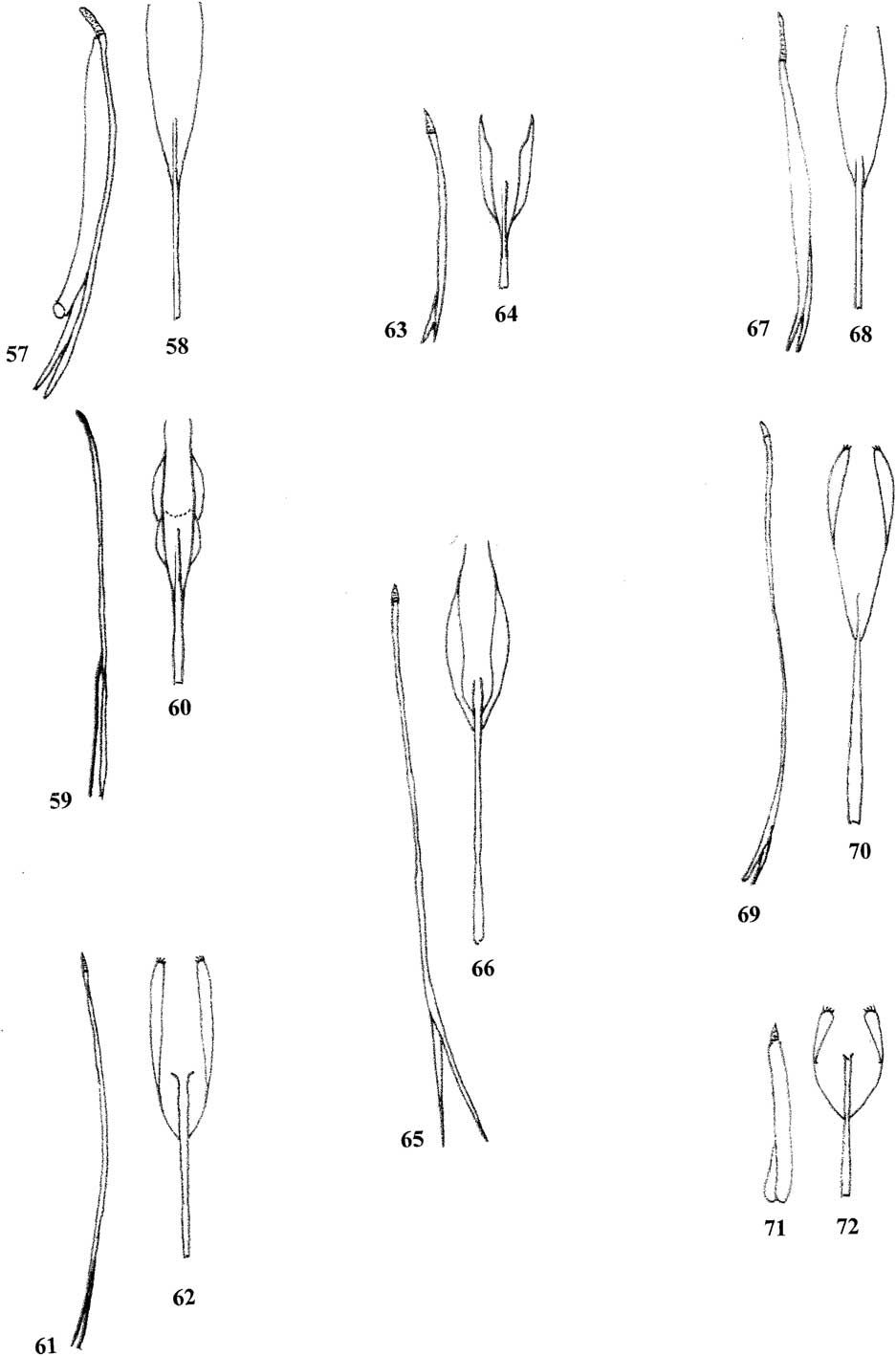
Aedeagi. 57. Ampleris achira, phallus. 58. Ampleris achira, tegmen. 59. Ampleris angustata, phallus. 60. Ampleris angustata, tegmen. 61. Ampleris cava, phallus. 62. Ampleris cava, tegmen. 63. Ampleris orosi, phallus. 64. Ampleris orosi, tegmen. 65. Ampleris primitura, phallus. 66. Ampleris primitura, tegmen. 67. Ampleris vista, phallus. 68. Ampleris vista, tegmen; 69. Pseudichnea arima, phallus. 70. Pseudichnea arima, tegmen. 71. Sirpa parva, phallus. 72. Sirpa parva, tegmen.
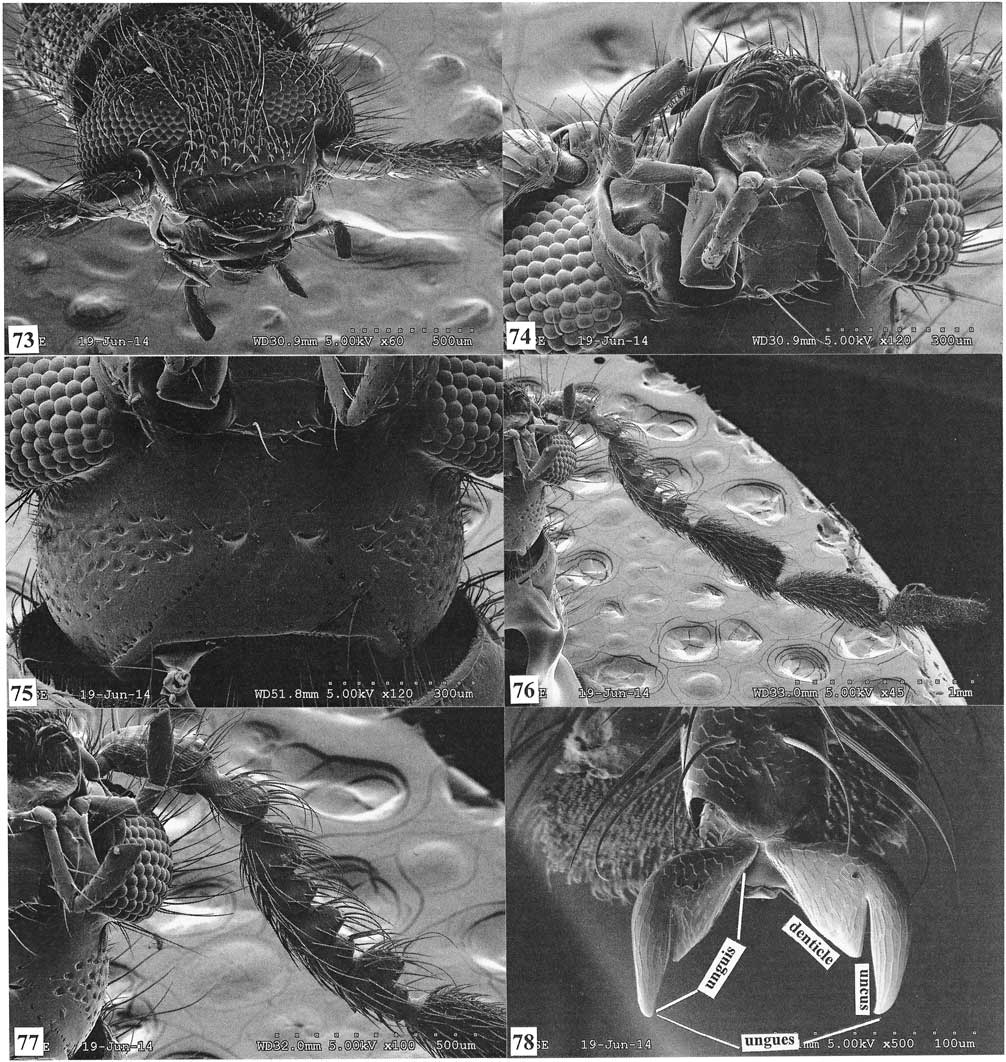
Pseudichnea eliminata. 73. Head, dorsal view. 74. Mouthparts. 75. Head, ventral view. 76. Antenna. 77. Antennal funicle. 78. Ungues.
Pseudichnea eliminata. 79. Metatarsus. 80. Elytra.
Habitus of 81. Ambitus anticus. 82. Ampleris achira. 83. Ampleris angustata. 84. Ampleris cava.
Habitus of 85. Ampleris orosi. 86. Ampleris primitura. 87. Ampleris rufocapitis. 88. Ampleris vista.
Habitus of 89. Pseudichnea acia. 90. Pseudichnea arima. 91. Pseudichnea eliminata. 92. Pseudichnea gracila.
Habitus of 93. Sirpa cauda. 94. Sirpa flavoapiculis. 95. Sirpa parva. 96. Sirpa skelleyi.
Elytra of Ampleris cava.

Geographical distribution of species of Ambitus and Ampleris.
Geographical distribution of species of Pseudichnea and Sirpa.
Acknowledgements
I am indebted to the curators noted in the Repository of specimens section, who entrusted me with material in their charge. My gratitude to Andrew Smith for supporting the publication of this work and to the anonymous reviewers of the draft manuscript. My thanks to the Kent Hampton for assistance with the SEM photographs. A special thanks to Michael C. Thomas for his assistance with the electronics of the habitus photographs and to Jean Menier for the French translation of the abstract.