INTRODUCTION
Ancient DNA research has evolved markedly since the first pioneering studies were published in the 1980s. While these early studies typically retrieved relatively short regions of mitochondrial DNA from museum, or Holocene age, specimens (e.g. Higuchi et al. Reference Higuchi, Bowman, Freiberger, Ryder and Wilson1984; Pääbo et al. Reference Pääbo, Gifford and Wilson1988) near-complete genomes are now routinely being sequenced from Pleistocene age remains (Der Sarkissian et al. Reference Der Sarkissian, Allentoft, Ávila-Arcos, Barnett, Campos, Cappellini, Ermini, Fernández, da Fonseca, Ginolhac, Hansen, Jónsson, Korneliussen, Margaryan, Martin, Moreno-Mayar, Raghavan, Rasmussen, Velasco, Schroeder, Schubert, Seguin-Orlando, Wales, Gilbert, Willerslev and Orlando2015). Moreover, the ever-expanding set of substrates from which ancient DNA has been retrieved (Green and Speller, Reference Green and Speller2017) is allowing new insights into diverse aspects of the past, such as palaeofaunas (Grealy et al. Reference Grealy, McDowell, Scofield, Murray, Fusco, Haile, Prideaux and Bunce2015), ancient oral microbiomes (e.g. Weyrich et al. Reference Weyrich, Duchene, Soubrier, Arriola, Llamas, Breen, Morris, Alt, Caramelli, Dresely, Farrell, Farrer, Francken, Gully, Haak, Hardy, Harvati, Held, Holmes, Kaidonis, Lalueza-Fox, de la Rasilla, Rosas, Semal, Soltysiak, Townsend, Usai, Wahl, Huson, Dobney and Cooper2017), palaeodiets (e.g. Wood et al. Reference Wood, Wilmshurst, Richardson, Rawlence, Wagstaff, Worthy and Cooper2013a) and palaeoenvironments (Anderson-Carpenter et al. Reference Anderson-Carpenter, McLachlan, Jackson, Kuch, Lumibao and Poinar2011; Parducci et al. Reference Parducci, Bennett, Ficetola, Greve, Suyama, Wood and Pedersen2017).
The extraction, amplification, sequencing and analysis of DNA molecules from long-dead organisms present several unique challenges. As a result of natural degradation processes, DNA from old specimens is usually present at a much lower copy number than in recent specimens (Pääbo et al. Reference Pääbo, Poinar, Serre, Jaenicke-Despres, Hebler, Rohland, Kuch, Krause, Vigilant and Hofreiter2004), and is therefore at risk of contamination by modern DNA (Yang and Watt, Reference Yang and Watt2005; Skoglund et al. Reference Skoglund, Northoff, Shunkov, Derevianko, Pääbo, Krause and Jakobsson2014). Moreover, DNA molecules break into shorter fragments over time and accumulate damage that can alter nucleotide sequences (Brotherton et al. Reference Brotherton, Endicott, Sanchez, Beaumont, Barnett, Austin and Cooper2007; Sawyer et al. Reference Sawyer, Krause, Guschanski, Savolainen and Pääbo2012). Early ancient DNA research was hampered by a poor understanding of these issues and several claims of antediluvian DNA (>1 million years old, sensu Lindahl, Reference Lindahl1993) have since been disproven (Hofreiter et al. Reference Hofreiter, Serre, Poinar, Kuch and Pääbo2001). Authentication criteria have subsequently been developed to help improve the rigor of ancient DNA research, including the use of specialized ancient DNA facilities, inclusion of negative controls in PCR experiments, ensuring reproducibility and providing independent replication of results (Cooper and Poinar, Reference Cooper and Poinar2000; Hofreiter et al. Reference Hofreiter, Serre, Poinar, Kuch and Pääbo2001; Gilbert et al. Reference Gilbert, Bandelt, Hofreiter and Barnes2005).
Although somewhat challenging, the study of DNA from ancient specimens represents an approach that can provide certain insights about the past that are unattainable by other means (Rizzi et al. Reference Rizzi, Lari, Gigli, De Bellis and Caramelli2012; Leonardi et al. Reference Leonardi, Librado, Der Sarkissian, Schubert, Alfarhan, Alquraishi, Al-Rasheid, Gamba, Willerslev and Orlando2017; Cole and Wood, Reference Cole and Woodin press). Ancient DNA research provides us with a ‘real-time’ view of ecological and evolutionary processes that otherwise could only be inferred from current genetic variation (Krause and Pääbo, Reference Krause and Pääbo2016), or for which the signal in modern gene-pools may be completely obliterated (Orlando and Cooper, Reference Orlando and Cooper2014). For example, assessment of the genetic diversity within a species through time has been used to reconstruct population dynamics associated with major climatic and environmental change in the past (e.g. Shapiro et al. Reference Shapiro, Drummond, Rambaut, Wilson, Matheus, Sher, Pybus, Gilbert, Barnes, Binladen, Willerslev, Hansen, Baryshnikov, Burns, Davydov, Driver, Froese, Harington, Keddie, Kosintsev, Kunz, Martin, Stephenson, Storer, Tedford, Zimov and Cooper2004; Rawlence et al. Reference Rawlence, Metcalf, Wood, Worthy, Austin and Cooper2012) and ancient DNA has provided key evidence for the cryptic extinction of hitherto unknown species diversity (e.g. Boessenkool et al. Reference Boessenkool, Austin, Worthy, Scofield, Cooper, Seddon and Waters2009; Soubrier et al. Reference Soubrier, Gower, Chen, Richards, Llamas, Mitchell, Ho, Kosintsev, Lee, Baryshnikov, Bollongino, Bover, Burger, Chivall, Crégut-Bonnoure, Decker, Doronichev, Douka, Fordham, Fontana, Fritz, Glimmerveen, Golovanova, Groves, Guerreschi, Haak, Higham, Hofman-Kamińska, Immel and Julien2016). To date, ancient DNA studies have had a significant taxonomic bias towards humans and other vertebrates (see Fig. 1 in Parducci et al. Reference Parducci, Bennett, Ficetola, Greve, Suyama, Wood and Pedersen2017), yet there is also the clear potential for ancient DNA to be used to better understand invertebrate communities of the past (e.g. Thomsen et al. Reference Thomsen, Elias, Gilbert, Haile, Munch, Kuzmina, Froese, Sher, Holdaway and Willerslev2009). Parasites, in particular, are one group of invertebrates that have already received some attention from ancient DNA studies. Here, I review the use of ancient DNA to study ancient parasites and then pay a particular focus on the DNA barcoding of ancient parasites (the amplification and sequencing of short variable DNA regions for the purpose of taxonomic identification). I discuss some of the challenges and options around primer design for DNA barcoding of parasites from ancient samples and explore some of the potentially exciting insights into the evolution and ecology of parasites that ancient DNA barcoding could provide.
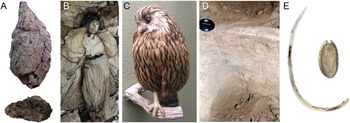
Some sources of historic or ancient parasite DNA: (A) coprolites and pellets; (B) mummies and burial sediments (from Shin et al. Reference Shin, Oh, Lee, Lee, Yim, Kim, Lee, Lee, Lee and Seo2012, reprinted with permission of Elsevier); (C) museum specimens; (D) sediments, such as from nesting or shelter sites; (E) specimens of ancient parasites or eggs.

ANCIENT PARASITE DNA
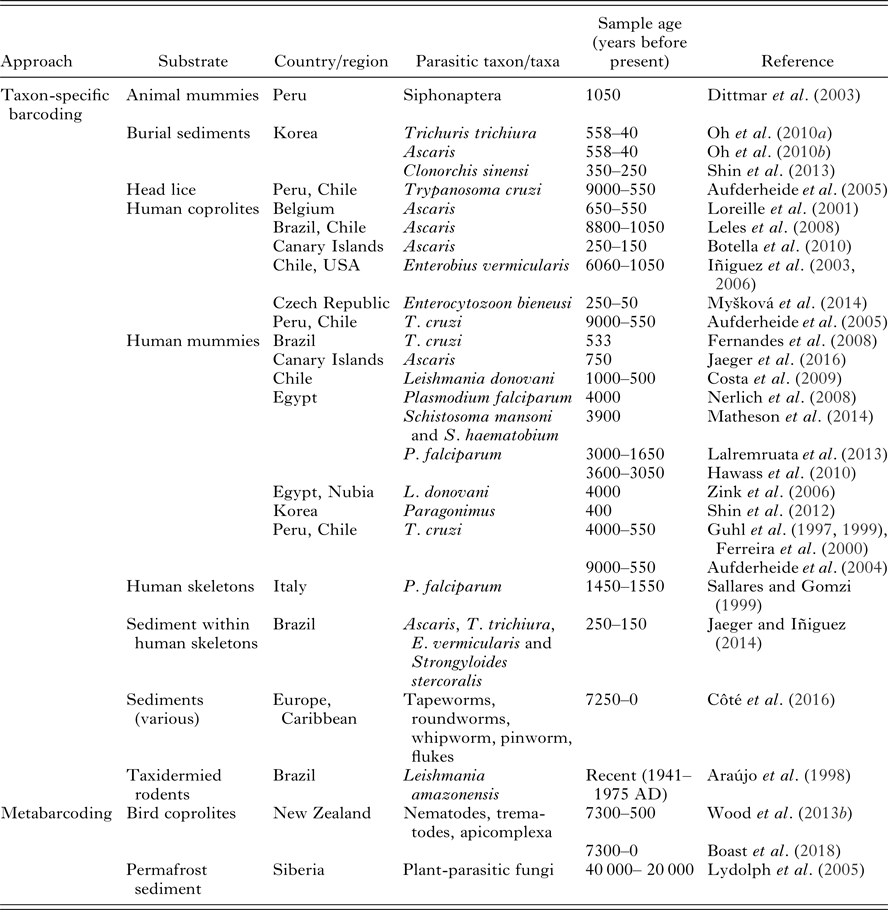
The development of the polymerase chain reaction (PCR) technique in the early 1980s paved the way for DNA barcoding studies. The potential for this technique to contribute to the field of palaeoparasitology was quickly realized (Pääbo et al. Reference Pääbo, Higuchi and Wilson1989; Hedges and Sykes, Reference Hedges and Sykes1992), though the first successful attempts to retrieve DNA from historic parasite specimens were not reported until the 1990s. Persing et al. (Reference Persing, Telford, Rys, Dodge, White and Spielman1990) recovered DNA of the Borrelia burgodorferi bacterium from museum specimens of deer ticks (Ixodes dammini) collected during the 1940s, to demonstrate the likely presence of Lyme disease in invertebrate vectors in the USA prior to its official recognition. The contemporaneous presence of the bacterium within hosts was confirmed through DNA analysis of museum specimens of the white-footed mouse (Peromyscus leucopus) by Marshall et al. (Reference Marshall, Telford, Rys, Rutledge, Mathiesen, Malawista, Spielman and Persing1994). Four years later DNA of the trypanosome Leishmania amazonensis was successfully amplified from taxidermied rodent specimens in museum collections (Araújo et al. Reference Araújo, Reinhard, Bastos, Costa, Pirmez, Iñiguez, Vicente, Morel and Ferreira1998), and Sallares and Gomzi (Reference Sallares and Gomzi1999) reported obtaining Plasmodium falciparum DNA sequences from 5th Century Roman skeletons. The temporal range of recoverable parasite DNA was expanded greatly by Guhl et al. (Reference Guhl, Jaramillo, Yockteng, Vallejo and Arroyo1997, Reference Guhl, Jaramillo, Vallejo, Yockteng, Cárdenas-Arroyo, Fornaciari, Arriaza and Aufderheide1999) and Ferreira et al. (Reference Ferreira, Britto, Cardoso, Fernandes, Reinhard and Araújo2000), who recovered DNA of the protozoan Trypanosoma cruzi (responsible for Chagas disease) from South American mummified humans dating back to 4000 year before present (yrs BP). A few years later this record was extended back to approximately 9000 years BP (Aufderheide et al. Reference Aufderheide, Salo, Madden, Streitz, Buikstra, Guhl, Arriaza, Renier, Wittmers, Fornaciari and Allison2004). This remains the oldest DNA from a parasite with an animal host, though DNA sequences attributed to plant parasites have been recovered from sediment cores extending back 40 000 years (Lydolph et al. Reference Lydolph, Jacobsen, Arctander, Gilbert, Gilichinsky, Hansen, Willerslev and Lange2005) (Table 1).
Examples of studies that have used DNA barcoding approaches to study ancient parasites

Since the year 2000, ancient parasite DNA has been recovered from a range of different substrates (Fig. 1) including both human (Loreille et al. Reference Loreille, Roumat, Verneau, Bouchet and Hänni2001; Iñiguez et al. Reference Iñiguez, Reinhard, Araújo, Ferreira and Vicente2003, Reference Iñiguez, Reinhard, Goncalves, Ferreira, Araújo and Vicente2006; Leles et al. Reference Leles, Araújo, Ferreira, Vicente and Iñiguez2008) and animal (Wood et al. Reference Wood, Wilmshurst, Rawlence, Bonner, Worthy, Kinsella and Cooper2013b; Boast et al. Reference Boast, Weyrich, Wood, Metcalf, Knight and Cooper2018) coprolites, the content of cesspits (Myšková et al. Reference Myšková, Ditrich, Sak, Kváč and Cymbalak2014), mummified tissues (Dittmar et al. Reference Dittmar, Mamat, Whiting, Goldmann, Reinhard and Guillen2003; Zink et al. Reference Zink, Spigelman, Schraut, Greenblatt, Nerlich and Donoghue2006; Fernandes et al. Reference Fernandes, Iñiguez, Lima, Mendoça de Souza, Ferreira, Vicente and Jansen2008; Nerlich et al. Reference Nerlich, Schraut, Dittrich, Jelinek and Zink2008), burial sediments (Oh et al. Reference Oh, Seo, Chai, Lee, Kim, Park and Shin2010a, Reference Oh, Seo, Lim, Lee, Lee, Lee and Shinb; Shin et al. Reference Shin, Oh, Lee, Chai, Lee, Hong, Lee and Seo2013) and permafrost soils (Lydolph et al. Reference Lydolph, Jacobsen, Arctander, Gilbert, Gilichinsky, Hansen, Willerslev and Lange2005). Much of this work has focused on extracting parasite DNA from preserved human remains (e.g. human mummies and coprolites), mainly in specimens from Egypt (e.g. Zink et al. Reference Zink, Spigelman, Schraut, Greenblatt, Nerlich and Donoghue2006; Nerlich et al. Reference Nerlich, Schraut, Dittrich, Jelinek and Zink2008; Hawass et al. Reference Hawass, Gad, Ismail, Khairat, Fathalla, Hasan, Ahmed, Elleithy, Ball, Gaballah, Wasef, Fateen, Amer, Gostner, Selim, Zink and Pusch2010; Lalremruata et al. Reference Lalremruata, Ball, Bianucci, Welte, Nerlich, Kun and Pusch2013; Matheson et al. Reference Matheson, David, Spigelman and Donoghue2014), Korea (e.g. Oh et al. Reference Oh, Seo, Chai, Lee, Kim, Park and Shin2010a, Reference Oh, Seo, Lim, Lee, Lee, Lee and Shinb; Shin et al. Reference Shin, Oh, Lee, Lee, Yim, Kim, Lee, Lee, Lee and Seo2012, Reference Shin, Oh, Lee, Chai, Lee, Hong, Lee and Seo2013) and South America (e.g. Dittmar et al. Reference Dittmar, Mamat, Whiting, Goldmann, Reinhard and Guillen2003; Iñiguez et al. Reference Iñiguez, Reinhard, Araújo, Ferreira and Vicente2003, Reference Iñiguez, Reinhard, Goncalves, Ferreira, Araújo and Vicente2006; Fernandes et al. Reference Fernandes, Iñiguez, Lima, Mendoça de Souza, Ferreira, Vicente and Jansen2008; Leles et al. Reference Leles, Araújo, Ferreira, Vicente and Iñiguez2008; Costa et al. Reference Costa, Matheson, Lachetta, Llagostera and Appenzeller2009) (Table 1). Accordingly, the most intensively studied taxa have been those commonly associated with prehistoric human populations in those regions, particularly those responsible for parasitic diseases (e.g. Ascaris, P. falciparum, T. cruzi, Leishmania donovani) (Table 1).
DNA barcoding of ancient parasites
A wide range of PCR primers exists for the identification of modern parasite taxa. However, the size of the barcode regions amplified by many of these limits their usefulness for ancient samples, where post-mortem fragmentation of DNA molecules is an issue (Allentoft et al. Reference Allentoft, Collins, Harker, Haile, Oskam, Hale, Campos, Samaniego, Gilbert, Willerslev, Zhang, Scofield, Holdaway and Bunce2012). Therefore, primers that amplify shorter regions of DNA tend to have better success with ancient samples, as demonstrated by the fact that around half the primer combinations that have been used to retrieve DNA from ancient parasites amplify regions of 200 bp or less in size (Table 2). This is in contrast to modern DNA barcoding regions, for example, the barcode region widely used for animals that is 658 bp in length (Folmer et al. Reference Folmer, Black, Hoeh, Lutz and Vrijenhoek1994; Hebert et al. Reference Hebert, Cywinska, Ball and deWaard2003). However, in several instances relatively long DNA barcode regions (>400 bp) have been successfully amplified from ancient parasite remains (Table 2). It is possible that some ancient parasite remains may include desiccation resistant structures (e.g. thick egg shells, cuticles), and the effect of these on enhancing DNA preservation through reducing exposure of the DNA to physical and chemical degradation processes (Alaeddini et al. Reference Alaeddini, Walsh and Abbas2010) may be worthy of future investigation.
A selection of PCR primers that have been used for the identification of ancient parasites

a Sizes reported in Xiao et al. (Reference Xiao, Escalante, Yang, Sulaiman, Escalante, Montali, Fayer and Lal1999).
b Sizes reported in Sulaiman et al. (Reference Sulaiman, Fayer, Bern, Gilman, Trout, Schantz, Das, Lal and Xiao2003).
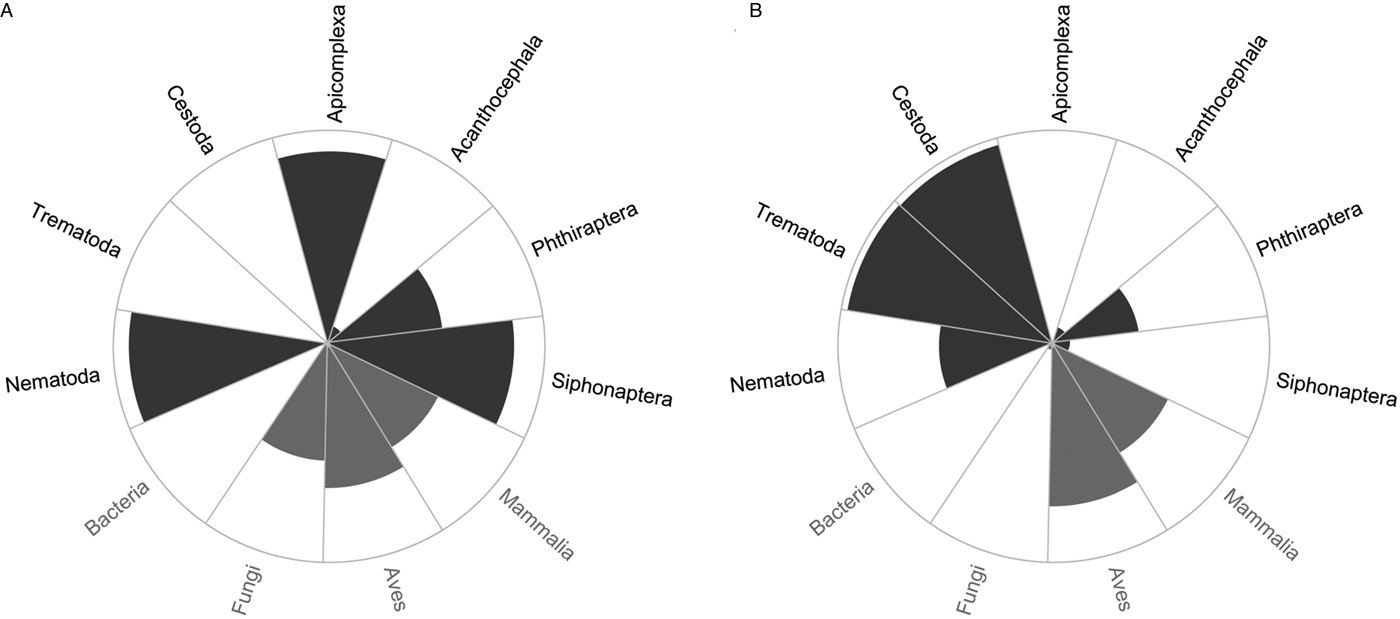
While most studies on ancient parasite DNA have applied PCR primers with high specificity (often genus-level) to detect parasite taxa of interest (taxon-specific barcoding approach in Table 1), DNA metabarcoding using universal primers together with cloning or high-throughput sequencing have also revealed a diversity of parasitic taxa in some ancient samples (e.g. Sallares and Gomzi, Reference Sallares and Gomzi1999; Lydolph et al. Reference Lydolph, Jacobsen, Arctander, Gilbert, Gilichinsky, Hansen, Willerslev and Lange2005; Wood et al. Reference Wood, Wilmshurst, Rawlence, Bonner, Worthy, Kinsella and Cooper2013b; Boast et al. Reference Boast, Weyrich, Wood, Metcalf, Knight and Cooper2018) (Table 2). However, the need for ancient DNA metabarcoding primers to target relatively short DNA regions means that it is not usually possible to achieve the same degree of taxonomic resolution typical of modern specimens, and sequences may only be able to be attributed to genera or families of parasite taxa (e.g. Wood et al. Reference Wood, Wilmshurst, Rawlence, Bonner, Worthy, Kinsella and Cooper2013b). Moreover, as parasites represent a diverse and polyphyletic assemblage of taxa, creating parasite-specific ancient metabarcoding primers is also a challenging prospect. Universal, or domain-specific, metabarcoding primers such as Nem18SF/Nem18SR, Nem18SlongF/Nem18SlongR (Table 2) and Euk_1391f/EukBr (Amaral-Zettler et al. Reference Amaral-Zettler, McCliment, Ducklow and Huse2009) target relatively short regions and can detect a broad range of parasite taxa (Wood et al. Reference Wood, Wilmshurst, Rawlence, Bonner, Worthy, Kinsella and Cooper2013b; Boast et al. Reference Boast, Weyrich, Wood, Metcalf, Knight and Cooper2018), but are not specific to parasites (Fig. 2). The taxonomic biases of universal primers can be tested using reference sequence databases (e.g. Fig. 2) and are important to understand when interpreting the sequencing results for reconstructing ancient parasite communities.
In silico performance of PCR primers that have been used for 18S rRNA metabarcoding of ancient parasite communities: (A) Nem18Slong and (B) Nem18S (Wood et al. Reference Wood, Wilmshurst, Rawlence, Bonner, Worthy, Kinsella and Cooper2013b; Boast et al. Reference Boast, Weyrich, Wood, Metcalf, Knight and Cooper2018). Each segment represents 0–100% coverage (matches to eligible sequences) of sequences of that particular taxonomic group in the RefNR collection of the SILVA SSU r126 database. Analyses were performed using TestPrime 1.0 (https://www.arb-silva.de/search/testprime/). A maximum of two nucleotide mismatches per primer was allowed. Parasitic groups are shown in dark grey, while selected non-target groups are shown in light grey.

APPLICATIONS AND INSIGHTS
Parasite detection and community reconstruction
DNA barcoding provides a molecular means for detecting the presence of parasite taxa in ancient samples. Most studies of ancient parasites so far have used barcoding specifically for this application. Often DNA barcoding can compliment other techniques, such as to confirm the identity of a taxon identified by microscopic analysis (e.g. Loreille et al. Reference Loreille, Roumat, Verneau, Bouchet and Hänni2001; Shin et al. Reference Shin, Oh, Lee, Chai, Lee, Hong, Lee and Seo2013). However, DNA barcoding can also provide the sole evidence for the presence of a parasite in the absence of microscopic evidence (e.g. Leles et al. Reference Leles, Araújo, Ferreira, Vicente and Iñiguez2008), particularly for microbial parasitic taxa where microscopic remains may not preserve (e.g. Ferreira et al. Reference Ferreira, Britto, Cardoso, Fernandes, Reinhard and Araújo2000; Zink et al. Reference Zink, Spigelman, Schraut, Greenblatt, Nerlich and Donoghue2006). Metabarcoding allows entire ancient parasite communities to be reconstructed, and when applied to multiple host species can provide insights into parasite characteristics such as host-specificity (Wood et al. Reference Wood, Wilmshurst, Rawlence, Bonner, Worthy, Kinsella and Cooper2013b; Boast et al. Reference Boast, Weyrich, Wood, Metcalf, Knight and Cooper2018). Information about the parasites that once inhabited now rare or extinct species potentially has important implications for species conservation and de-extinction, particularly considering the range of benefits conferred to hosts from their parasites (Maizels and McSorley, Reference Maizels and McSorley2016; Spencer and Zuk, Reference Spencer and Zuk2016; Wood et al. Reference Wood, Perry and Wilmshurst2017; Selbach et al. Reference Selbach, Seddon and Poulin2018).
Human parasites
DNA barcoding studies of ancient human remains, including mummified tissues (e.g. Hawass et al. Reference Hawass, Gad, Ismail, Khairat, Fathalla, Hasan, Ahmed, Elleithy, Ball, Gaballah, Wasef, Fateen, Amer, Gostner, Selim, Zink and Pusch2010) and coprolites (e.g. Botella et al. Reference Botella, Vargas, de la Rosa, Leles, Reimers, Vicente and Iñiguez2010), and sediments associated with human burials (e.g. Oh et al. Reference Oh, Seo, Chai, Lee, Kim, Park and Shin2010a), have revealed a wealth of information about the parasites of prehistoric human populations. Human parasites have been the focus of the majority of palaeoparasitological work (including DNA barcoding) to date, and several in-depth reviews of prehistoric human parasites are available on this topic (e.g. Araújo and Ferreira, Reference Araújo and Ferreira2000; Gonçalves et al. Reference Gonçalves, Araújo and Ferreira2003; Araújo et al. Reference Araújo, Reinhard, Ferreira and Gardner2008; Anastasiou and Mitchell, Reference Anastasiou and Mitchell2013; Côte and Le Bailly, Reference Côté and Le Baillyin press). Briefly, such studies have provided important evidence for the prevalence of different parasitic diseases within prehistoric populations (e.g. Aufderheide et al. Reference Aufderheide, Salo, Madden, Streitz, Buikstra, Guhl, Arriaza, Renier, Wittmers, Fornaciari and Allison2004; Jaeger et al. Reference Jaeger, Gijón-Botella, Del Carmen Del Arco-Aguilar, Martín-Oval, Rodríguez-Maffiotte, Del Arco-Aguilar, Araújo and Iñiguez2016), including instances where prevalence rates have remained remarkably constant over several millennia (e.g. Aufderheide et al. Reference Aufderheide, Salo, Madden, Streitz, Buikstra, Guhl, Arriaza, Renier, Wittmers, Fornaciari and Allison2004) or have been subsequently altered by landscape modification (e.g. Lalremruata et al. Reference Lalremruata, Ball, Bianucci, Welte, Nerlich, Kun and Pusch2013). By combining DNA barcoding analysis of tissues, coprolites and ectoparasites from the same mummified individuals, it has also been possible to gain insights into potential prehistoric transmission pathways for human parasites (Aufderheide et al. Reference Aufderheide, Salo, Madden, Streitz, Dittmar de la Cruz, Buikstra, Arriaza and Wittmers2005). Moreover, the detection of certain parasites within mummies or coprolites from indigenous cultures can provide information on the timing of parasite dispersal events relating to prehistoric human migration events (Araújo et al. Reference Araújo, Reinhard, Ferreira and Gardner2008).
Co-evolution and climate change
With DNA dating back to the Middle Pleistocene (ca. 450–800 000 years ago) having been sequenced (Willerslev et al. Reference Willerslev, Cappellini, Boomsma, Nielsen, Hebsgaard, Brand, Hofreiter, Bunce, Poinar, Dahl-Jensen, Johnsen, Steffensen, Bennike, Schwenninger, Nathan, Armitage, de Hoog, Alfimov, Christl, Beer, Muscheler, Barker, Sharp, Penkman, Haile, Taberlet, Gilbert, Casoli, Campani and Collins2007; Orlando et al. Reference Orlando, Ginolhac, Zhang, Froese, Albrechtsen, Stiller, Schubert, Cappellini, Petersen, Moltke, Johnson, Fumagalli, Vilstrup, Raghavan, Korneliussen, Malaspinas, Vogt, Szklarczyk, Kelstrup, Vinther, Dolocan, Stenderup, Velazquez, Cahill, Rasmussen, Wang, Min, Zazula, Seguin-Orlando and Mortensen2013), and a theoretical preservation limit of DNA of about 1 million years (Allentoft et al. Reference Allentoft, Collins, Harker, Haile, Oskam, Hale, Campos, Samaniego, Gilbert, Willerslev, Zhang, Scofield, Holdaway and Bunce2012), there is plenty of temporal scopes to study long-term processes (occurring on century- or millennial-timescales) involving parasites. For example, it is thought that many parasites may be prone to decline or extinction in the face of future climate change, yet how different parasite taxa might respond to this threat is not well understood (Cizauskas et al. Reference Cizauskas, Carlson, Burgio, Clements, Dougherty, Harris and Phillips2017). Some insights into these responses might be gained through studying parasite DNA within temporal sequences of host remains (e.g. coprolites) that span past periods of climate change. Moreover, co-evolution of parasites and their hosts is another long-term process for which ancient DNA may provide informative insights. Araújo and Ferreira (Reference Araújo and Ferreira2000) also recognized this potential, stating that the ability to compare ancient and modern parasite genomes would help resolve aspects of parasite origins, evolution, dispersion, virulence and pathogenicity. While examples of this exist for microbial pathogens of humans (e.g. Bos et al. Reference Bos, Schuenemann, Golding, Burbano, Waglechner, Coombes, McPhee, DeWitte, Meyer, Schmedes, Wood, Earn, Herring, Bauer, Poinar and Krause2011) and plants (e.g. Haas et al. Reference Haas, Kamoun, Zody, Jiang, Handsaker, Cano, Grabherr, Kodira, Raffaele, Torto-Alalibo, Bozkurt, Ah-Fong, Alvarado, Anderson, Armstrong, Avrova, Baxter, Beynon, Boevink, Bollmann, Bos, Bulone, Cai, Cakir, Carrington, Chawner, Conti, Costanzo, Ewan and Fahlgren2009), analyses of ancient parasite genomes have yet to be published.
Co-extinction
The extinction of a species is seldom a discrete event. Ever since Darwin mused on the inter-related fates of Malagasy orchids and their specialist moth pollinators (Darwin, Reference Darwin1862), scientists have been aware of how the extinction of one species might create a ripple effect throughout an ecosystem, precipitating secondary declines among associated obligate mutualists, predators, prey or parasites (Brodie et al. Reference Brodie, Aslan, Rogers, Redford, Maron, Bronstein and Groves2014). In extreme instances, the extinction of one species can directly cause the ‘co-extinction’ of others that were ecologically dependent upon it (Stork and Lyal, Reference Stork and Lyal1993; Brodie et al. Reference Brodie, Aslan, Rogers, Redford, Maron, Bronstein and Groves2014). Parasites are a group considered particularly prone to co-extinction (Bush and Kennedy, Reference Bush and Kennedy1994; Dunn et al. Reference Dunn, Harris, Colwell, Koh and Sodhi2009) as they can be highly sensitive to population declines and fragmentation of their host species (Bush and Kennedy, Reference Bush and Kennedy1994; Poulin and Morand, Reference Poulin and Morand2004; Lafferty, Reference Lafferty2012). Given the diversity of parasites that inhabit every animal species, and that each of these parasite communities contain a certain proportion of host-specific taxa (Poulin and Morand, Reference Poulin and Morand2004; Strona and Fattorini, Reference Strona and Fattorini2014), it is perhaps no surprise that some authors have claimed a greater number of species may be lost through the process of co-extinction than through all other primary causes (e.g. hunting, habitat destruction) combined (Koh et al. Reference Koh, Dunn, Sodhi, Colwell, Proctor and Smith2004; Dunn et al. Reference Dunn, Harris, Colwell, Koh and Sodhi2009).
Parasite co-extinction is therefore clearly an important process in terms of biodiversity loss, yet a robust estimate of the relative magnitude of co-extinction remains elusive (Dunn, Reference Dunn and Turvey2009; Dunn et al. Reference Dunn, Harris, Colwell, Koh and Sodhi2009; Colwell et al. Reference Colwell, Dunn and Harris2012). The development of such an estimate has been impeded by a paucity of empirical data for the co-extinction process (Dunn et al. Reference Dunn, Harris, Colwell, Koh and Sodhi2009; Colwell et al. Reference Colwell, Dunn and Harris2012), partly a result of difficulties in studying a process that can occur over decades or centuries (Brooks et al. Reference Brooks, Pimm and Oyugi1999; Pimm and Raven, Reference Pimm and Raven2000). Ecological network models have therefore become the principal tool for studying the co-extinction process, yet their ability to make accurate predictions remains to be critically tested. This is exemplified by significant disagreement between the high rates of co-extinction predicted in most theoretical studies (e.g. Koh et al. Reference Koh, Dunn, Sodhi, Colwell, Proctor and Smith2004; Bascompte and Jordano, Reference Bascompte and Jordano2007; Vieira et al. Reference Vieira, Cianciaruso and Almeida-Neto2013; Vieira and Almeida-Neto, Reference Vieira and Almeida-Neto2015) and the relatively few co-extinctions that have been observed in nature (Dunn et al. Reference Dunn, Harris, Colwell, Koh and Sodhi2009; Powell, Reference Powell2011; Strona et al. Reference Strona, Galli and Fattorini2013); giving rise to the so-called ‘paradox of missing co-extinctions’.
Ancient DNA barcoding has a lot to offer in this regard, and parasites may be the ideal group on which to study the co-extinction process. The ability to amplify and sequence the DNA of parasites from ancient faunal remains (such as those shown in Fig. 1) provides a new means for reconstructing the parasite diversity within declining host-species through time, essentially providing a ‘real-time’ view of how parasite communities have responded to changes in host densities in the past (Wood et al. Reference Wood, Wilmshurst, Rawlence, Bonner, Worthy, Kinsella and Cooper2013b; Boast et al. Reference Boast, Weyrich, Wood, Metcalf, Knight and Cooper2018). Empirical data from palaeoparasitology could, therefore, help strengthen our understanding the co-extinction process, leading to improved modelling of ecological networks, and better predictions about future risk of co-extinction in threatened species (Dunn et al. Reference Dunn, Harris, Colwell, Koh and Sodhi2009; Moir et al. Reference Moir, Vesk, Brennan, Keith, Hughes and McCarthy2010; Lafferty and Hopkins, Reference Lafferty and Hopkins2018).
Concluding remarks
Numerous studies have now proven DNA barcoding to be an effective technique for detecting parasite taxa in ancient remains. A wide range of barcode regions has been used for identifying ancient parasite taxa, with PCR primers ranging from those with genus-level specificity to more universal primers with metabarcoding applications (Table 2). The ability to identify parasites in ancient remains, and to characterize how parasite faunas have changed through time, can provide insights into parasite responses to climatic and environmental change, habitat fragmentation (i.e. declining host populations) and processes such as co-evolution and co-extinction. High-throughput sequencing has yet to be applied in a widespread and systematic way to characterizing ancient parasite communities, yet the detection of parasite DNA in studies using such approaches demonstrates its potential (e.g. Khairat et al. Reference Khairat, Ball, Chang, Bianucci, Nerlich, Trautmann, Ismail, Shanab, Karim, Gad and Pusch2013; Rivera-Perez et al. Reference Rivera-Perez, Cano, Narganes-Storde, Chanlatte-Baik and Toranzos2015; Côté et al. Reference Côté, Daligault, Pruvost, Bennett, Gorgé, Guimaraes, Capelli, Le Bailly, Geigl and Grange2016; Boast et al. Reference Boast, Weyrich, Wood, Metcalf, Knight and Cooper2018).
Financial Support
This work was supported by the Royal Society of New Zealand Marsden Fund and Core Funding for Crown Research Institutes from the New Zealand Ministry of Business, Innovation and Employment's Science and Innovation Group.