INTRODUCTION
Bilingual children sometimes show influence from the non-target language, or cross-linguistic influence, even when in a monolingual mode (Grosjean, Reference Grosjean and Nicol2001; Yip & Matthews, Reference Yip and Matthews2000, Reference Yip and Matthews2007). For example, a Spanish–English bilingual child might use a periphrastic possessive construction in English, like the bracelet of the girl, more often than an English monolingual because the periphrastic construction is the only one available in Spanish (Hulk & van der Linden, Reference Hulk, van der Linden, Kellerman, Weltens and Borgaerts1996). Cross-linguistic influence (hereafter CLI) has been documented in syntax (Döpke, Reference Döpke1998; Hulk & Müller, Reference Hulk and Müller2000; Hulk & van der Linden, Reference Hulk, van der Linden, Kellerman, Weltens and Borgaerts1996; Liceras, Fuertes & de la Fuente, Reference Liceras, Fuertes and de la Fuente2012; Paradis & Navarro, Reference Paradis and Navarro2003; Serratrice, Reference Serratrice2007; Yip & Matthews, Reference Yip and Matthews2000, Reference Yip and Matthews2007; Zwanziger, Allen & Genesee, Reference Zwanziger, Allen and Genesee2005), morphology (Foroodi-Nejad & Paradis, Reference Foroodi-Nejad and Paradis2009; Nicoladis, Reference Nicoladis2003), lexicon (Keith & Nicoladis, Reference Keith and Nicoladis2013), phonology (Ball, Müller & Munro, Reference Ball, Müller and Munro2001; Fabiano & Goldstein, Reference Fabiano and Goldstein2005; Kehoe, Lleó & Rakow, Reference Kehoe, Lleó and Rakow2004; Lleó, Reference Lleó2002), and even fixed expressions (Elder & Nicoladis, Reference Elder and Nicoladis2012).
Until recently, the explanation for this phenomenon has focused on syntax (Döpke, Reference Döpke1998) or the interface between syntax and some other aspect of language, like pragmatics (Hulk & Müller, Reference Hulk and Müller2000) or semantics (Liceras et al., Reference Liceras, Fuertes and de la Fuente2012). A commonality shared by all of these approaches is the assumption that CLI can appear when both of a bilingual's languages have similar structures and at least one of the languages has more than one option. For example, in English, a possessive construction can be formed by adding the morpheme -'s to the possessor, like the girl's dog, or by a periphrastic construction, like the dog of the girl. In Spanish, the only way to form a possessive is periphrastically, like el perro de la niña ‘the dog of the girl’. According to these approaches, CLI would be more likely in the English possessives of a Spanish–English bilingual (i.e. lots of periphrastic possessive constructions) because there are different options in English and one of those options is shared with Spanish.
These approaches focus on syntax, leaving CLI with regard to other units of linguistic description largely or wholly unexplained. Moreover, several studies have shown counter-evidence to the predictions. There are some studies showing that CLI can sometimes occur in the absence of cross-linguistically shared constructions and options within at least one language (Nicoladis, Reference Nicoladis2003, Reference Nicoladis2012; Yip & Matthews, Reference Yip and Matthews2000). For example, Nicoladis (Reference Nicoladis2012) showed that in possessive constructions, French–English bilinguals produced more instances of the order appropriate in the other language in both of their languages, even though French allows only one order. Furthermore, at least one study has reported the absence of CLI in the presence of shared constructions across languages and options in both languages (Nicoladis, Rose & Foursha-Stevenson, Reference Nicoladis, Rose and Foursha-Stevenson2010). These results suggest that there may be more to CLI than simply the structure of bilinguals' two languages.
Nicoladis (Reference Nicoladis2006, Reference Nicoladis2012) proposed that additional constraints in predicting CLI may come from processing. For speech production, for example, many processing models assume that speakers initially access the concepts related to the message they want to say and then the grammatical/morphological/lexical frame (lemma level) to convey this message, and finally the phonology corresponding to the lemma level choices (Levelt, Roelofs & Meyer, Reference Levelt, Roelofs and Meyer1999). CLI would result from competition between a bilingual's two languages, at the lemma level for grammatical, morphological, or lexical CLI and at the phonological level for phonological CLI. There is extensive evidence that bilinguals' two languages are active and compete, even when bilinguals are in a monolingual mode (Gollan & Silverberg, Reference Gollan and Silverberg2001; Grosjean, Reference Grosjean and Nicol2001, Reference Grosjean2010). The degree of activation/competition may be related to the target language for the particular context, with lesser activation/competition when processing in a monolingual mode and more activation/competition when processing in a bilingual mode (Grosjean, Reference Grosjean and Nicol2001). Applying a speech production model to CLI, CLI can be conceptualized as a kind of speech error. According to this model, we can predict that a bilingual child's two languages will compete when two languages have similarities at the lemma level, regardless of whether there are options in one or both languages, predicting CLI in both languages. The primary purpose of the present study is to test whether bilingual children's CLI is best explained solely by structural similarities and differences across languages, or additionally by constraints that arise from the processing system.
Another factor that could affect CLI is frequency, either in the input and/or in children's usage/knowledge. Researchers working in different theoretical frameworks have considered the possibility that frequency may play a role in children's CLI (Hulk & Müller, Reference Hulk and Müller2000; Lleó, Reference Lleó2002; Nicoladis, Reference Nicoladis2012). Lleó (Reference Lleó2002) argued that frequency in the input might explain some aspects of phonological acquisition and CLI in bilingual children. It is also possible that the language that a child knows better and uses/hears more frequently (i.e. dominant language) influences his/her weaker language. In support of this possibility, Yip and Matthews (Reference Yip and Matthews2000) found that dominance plays a role in the directionality of CLI, with a child showing more CLI in English during the period in which Cantonese was the dominant language for the child (see also Nicoladis, Reference Nicoladis2012, for another finding linking dominance as operationalized in terms of proficiency within a language with CLI). However, other studies, also relying on measures of proficiency within a language, have found little or no effect (Nicoladis, Reference Nicoladis2006; Nicoladis et al., Reference Nicoladis, Rose and Foursha-Stevenson2010). A secondary purpose of the present study is therefore to test whether bilingual children's vocabulary size within a language predicts their CLI.
The bilingual children who participated in this study spoke both Welsh and English. We elicited attributive adjectival constructions from the children, because the order of these adjectives relative to the modified nouns differs in Welsh and English. In Welsh, attributive adjectives typically appear postnominally, as in eliffant gwyrdd ‘elephant green’ (Deuchar, Reference Deuchar2005, Reference Deuchar2006). There is one exception, the adjective hen ‘old’. This adjective consistently appears prenominally, as in hen iawn ‘old book’. In English, attributive adjectives typically appear prenominally, as in green elephant (see Nicoladis, Reference Nicoladis2006). There are a few exceptions, such as adjectives borrowed from French (like general in governor general, or errant in knights errant) and heavy adjectival expressions (like the muffin heavier than a cement truck). We assumed that preschool English-speaking children were unlikely to know about these exceptions (following Nicoladis, Reference Nicoladis2006).
Previous research with Welsh–English bilinguals has focused on adults, showing that they are sensitive to the differences between the two languages in adjectival placement. Welsh–English bilingual adults tend to avoid code-switching between nouns and attributive adjectives, creating an embedded language island in order to avoid the conflict between the Welsh and English ordering (Deuchar, Reference Deuchar2005, Reference Deuchar2006). Adult bilinguals are more likely to code-switch for predicative adjectives than attributive adjectives, where the word order in both languages converges (see also Davies & Deuchar, Reference Davies, Deuchar, Breitbarth, Lucas, Watts and Willis2010).
This study
The primary purpose of the present study is to test whether CLI would be manifested in Welsh–English bilingual children's production of adjectival constructions. Welsh and English attributive adjectival constructions show virtually no overlap, with Welsh adjectives (except hen ‘old’) appearing postnominally and English adjectives prenominally. If CLI can be predicted on the basis of the shared structures alone (e.g. Döpke, Reference Döpke1998), then children should only rarely reverse adjectival constructions in either language, and no more often than English monolingual children. Note that monolingual Welsh children are rare, even in northern Wales (see Gathercole, Reference Gathercole2007, for a brief description of the sociolinguistic setting), so we did not include a monolingual Welsh comparison group. In contrast, if CLI results from competition between two languages (Nicoladis, Reference Nicoladis2012), then the bilingual children should reverse more adjectival constructions than English monolingual children and show fairly equivalent rates of reversals in their two languages.
The secondary purpose of this study was to test if CLI were related to children's proficiency in the target language. If so, then we predicted that there would be negative correlations between the target language vocabulary scores and reversals.
METHODS
Participants
Thirty Welsh–English bilingual children (14 girls, 16 boys) between three and six years old growing up in northern Wales participated in this study. The average age of the children was 4;10. Previous studies have shown that bilingual and monolingual children make few errors in adjectival ordering from the age of two years on (see review in Nicoladis & Rhemtulla, Reference Nicoladis and Rhemtulla2012). We allowed a wide age range since age has not been linked to CLI within this age range (Nicoladis, Reference Nicoladis2006) and we will present the correlations between the children's age and CLI in the results. All children had been hearing both languages since birth. All children heard Welsh at home and were learning English from a variety of sources, including at home and in the community. According to parental report, all the children spoke Welsh better than English.
As a comparison group, we included twenty-eight monolingual English children (9 girls, 19 boys), also between the ages of three and six years. The average age of the children was 4;08. These children were growing up in a predominantly English-speaking part of Canada. While the English dialects of the monolingual children and the bilingual children have some differences (as in lexical items like pants instead of trousers and the frequency of usage of some kinds of compound words; see Murphy & Nicoladis, Reference Murphy and Nicoladis2006), we have no reason to think that the dialects differ on adjectival construction ordering. According to parental report, these children did not hear any language other than English on a regular basis. There was no significant difference between the two language groups on age in months (t < 1, n.s.).
The children's gender had no significant effect on their rate of reversals of adjectival constructions and was not considered in the main analyses.
Materials
The bilingual children were given a normed vocabulary test in Welsh (Gathercole, Thomas & Hughes, Reference Gathercole, Thomas and Hughes2008) and the British Picture Vocabulary Scale (Dunn, Dunn, Whetton & Burley, Reference Dunn, Dunn, Whetton and Burley1997) in English. The parents of the bilingual children also completed a brief report on their impressions of their child's language dominance. The monolingual children were given the Peabody Picture Vocabulary Test, IIIA (Dunn & Dunn, Reference Dunn and Dunn1997). This test has been standardized on a North American population. The average raw score of the monolinguals on this test was 68·0 (SD = 19·4). The average standard score of the monolinguals was 106·3 (SD = 11·4), slightly higher than the normed standard of 100. We do not analyze the results of the vocabulary test with the monolingual children here, as we had no predictions regarding monolinguals' ordering of adjectival constructions and their vocabulary.
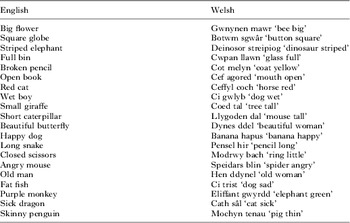
To elicit adjectival constructions, we created twenty pictures for each language, targeting adjectives that children were likely to know (see Table 1 for target constructions). We aimed at choosing adjectives in Welsh and English that had similar meanings, although paired with different nouns in the two languages. In English, the pictures were the same as used in Nicoladis (Reference Nicoladis2006). Most of the pictures for Welsh were those used for French in Nicoladis (Reference Nicoladis2006). After consulting with a native speaker of Welsh, some of the pictures were replaced since they were unlikely to elicit adjectives in Welsh or were simply infelicitous.
Target items in English and Welsh

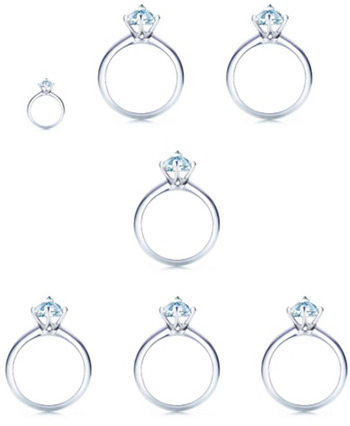
In each of the pictures, there was crucially one item that differed on one target characteristic (see Figure 1). For example, using the picture in Figure 1, the experimenter would be looking for the child to label the target ring as small ring or ring small. Attributive adjectives are often used to differentiate a particular referent from others (Waxman & Klibanoff, Reference Waxman and Klibanoff2000).
Example of test Item ‘little ring’.

Procedure
For all children, the testing took place in a quiet corner or area of their daycare, preschool, or nursery.
For the bilingual children, the Welsh and English sessions were both completed on different days by different experimenters, about a week apart. The experimenters were native speakers of the language of the session. They spoke enough of the other language to record any instances of naming the pictures in the other language. In each session, the children first completed the vocabulary test in the target language. They were then presented with twenty pictures, one at a time. For each picture, the experimenter pointed out all of the non-target items, naming them with an adjective in a predicative construction (e.g. for the picture in Figure 1, “Look at all these rings! These rings are big.”). Then, pointing to the target item, the experimenter asked, “What's this?” If the child did not name the target object with an adjective and noun, the experimenter asked, “What else could you call it?” Regardless of the child's response to that second elicitation, the experimenter then went on to the next item.
The procedure for the monolingual children was the same as the English session for the bilingual children.
Coding
The analyses concern only the items for which the children produced an adjectival construction in naming, regardless of whether this was the first or the second elicitation attempt for an item. In almost all cases, it was the first elicitation that was used (the second elicitation was used once for a bilingual child in Welsh, not at all for the bilingual children in English, and once each for two monolingual children). Following Nicoladis (Reference Nicoladis2006), the English word one was counted as a noun. We also recalculated the statistics for this study without including one as a noun. While the overall pattern of results with CLI held up between languages and relative to monolinguals, there was a lot more variability in the bilinguals' English rates of CLI. The high degree of variability could be due to the fact that without one as a noun, the number of adjectival constructions the bilingual children produced in English was significantly lower than in Welsh.
For each child, only one type of adjectival construction was included in the analyses. For example, if a child said the big one for several items, we only included that ordering once in the analysis. Most but not all of the children's responses were in the target language of the session. In the English session, they averaged 1·4 (SD = 2·5) adjectival constructions in Welsh and 7·9 (SD = 6·1) in English. In the Welsh session, they averaged 0·6 (SD = 1·1) adjectival constructions in English and 8·8 (SD = 5·8) in Welsh. As the ordering of these constructions was not noticeably different from the strings produced in the target-language session, we grouped all the children's English responses together on the one hand and all the children's Welsh responses on the other.
Overall, the bilingual children produced an average of 7·9 (SD = 6·1) adjectival constructions in English and 10·7 (SD = 6·9) in Welsh. This difference did not reach statistical significance on a paired t-test (t(29) = 1·84, p = ·08). The monolingual children produced an average of 16·7 (SD = 4·6) adjectival constructions, significantly more than the bilingual children in English (t(56) = 6·12, p < ·001).
A reversal was counted in English for producing the adjective after the noun (e.g. snake big). A reversal was counted in Welsh for producing the adjective before the noun (e.g. llawn diod lit. ‘full drink’ to refer to a full glass), including for the word hen ‘old’, which typically appears prenominally in adult speech. All of the 11 children who produced hen in an adjectival construction produced it postnominally.
Before collecting data, we had thought that the bilingual children might produce a lot of reversals in Welsh because of the adjective hen that typically appears prenominally. In other words, by the very existence of a single prenominal adjective, children might think that Welsh allows prenominal adjectives. This possibility seems unlikely given that all the children placed this adjective postnominally. We ran the statistics without the items with hen and found the same pattern of results with regard to CLI.
Since the identification of CLI has generally been in terms of how children themselves analyze their languages (Hulk & Müller, Reference Hulk and Müller2000), we categorized the postnominal uses of hen as correct for the analyses we present. In other words, since all of the children who used hen did so postnominally, we concluded that these Welsh-speaking children have analyzed Welsh as typically placing adjectives postnominally. As there was a non-significant trend for the children to produce more adjectival constructions in Welsh than in English and a significant difference between the monolingual and bilingual children, we calculated the percentage of reversals out of the total number of adjectival constructions for every child in each language.
RESULTS
The bilingual children scored significantly higher on the Welsh vocabulary test (M = 65·0; SD = 37·2) than on the English vocabulary test (M = 20·4; SD = 18·2), (t(28) = 5·28, p < ·001). Only two children scored higher in English than in Welsh. The Pearson product-moment correlation between children's age and English vocabulary was positive and significant (r(28) = 0·587, N = 30, p = ·0007). The correlation between children's age and their Welsh vocabulary did not reach significance (r(28) = 0·319, N = 30, p = ·09).
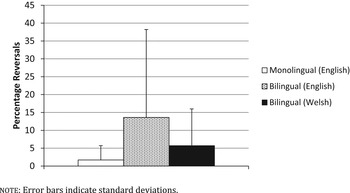
Figure 2 summarizes the percentages of reversals by the monolingual and bilingual children. The monolingual children did produce some reversals in English (6 out of the 28 children produced at least one reversal; M = 1·7%; SD = 4·0%). Eleven of the 30 bilingual children produced at least one reversal in English (M = 13·6%; SD = 24·6%) and 9 in Welsh (M = 5·7%; SD = 10·3%). The bilingual children produced significantly more reversals in English than the monolingual children (t(53) = 2·53, p = ·015). On a paired t-test, the rates of reversals in Welsh and English did not differ statistically from each other (t(27) = 1·52, p = ·14). For the bilingual children, both the percentages of English reversals (t(26) = 2·87, p = ·008), and of Welsh reversals (t(27) = 2·94, p = ·007), were significantly different from zero on a one-sample t-test.
Average (SD) percentage reversals of adjectival constructions.

Table 2 summarizes the Pearson product-moment correlations between age and vocabulary measures and the percentages of reversals in each language for the bilingual children. The only correlation that reached significance was a positive correlation between age and reversals in English, indicating that the number of reversals increased with age (r(28) = 0·455, N = 30, p = ·012). Note that the correlation between Welsh vocabulary and Welsh reversals was negative and just missed significance (r(28) = −0·359, N = 30, p = ·051), and the correlation between Welsh vocabulary and English reversals was positive and not significant (r(28) = 0·338, N = 30, p = ·068). That is, there was a non-significant trend for the children with bigger Welsh vocabularies to produce more reversals in English and fewer reversals in Welsh. This trend was not observed with English vocabulary.
Pearson product-moment correlations between age and vocabulary measures and percentages of reversals in each language for bilingual children

notes: *p < ·05; †p < ·06.
Five children did not produce adjectival constructions in both languages, either not in English (N = 3) or not in Welsh (N = 2). Out of the children who produced adjectival constructions in both languages, many produced no reversals in either language (N = 7). Some bilingual children produced reversals only in English (N = 9), some only in Welsh (N = 7). Only two bilingual children produced reversals in both languages.
DISCUSSION
The primary purpose of this study was to test whether cross-linguistic influence (CLI) was better explained solely by the structure of bilingual children's languages or also by processing constraints. Recall that one explanation of CLI is that it occurs when a bilingual's two languages share linguistic constructions (overlap) and that there are some options in at least one language (e.g. Hulk & Müller, Reference Hulk and Müller2000). Attributive adjectives appear postnominally in Welsh, with the exception of hen ‘old’, and prenominally in English. In this study, all the children who produced hen did so postnominally, suggesting that there is no overlap in adjective–noun constructions for children. If shared structures alone predict CLI then there should have been no CLI in the present study. However, the Welsh–English bilingual children in this study produced reversals in both languages, significantly more than English monolingual children. There were no significant differences between the bilinguals' two languages on the percentage of reversals and the rate of reversals in both languages was significantly above zero. The occurrence of CLI in the absence of overlap has been observed in other studies as well (Nicoladis, Reference Nicoladis2003, Reference Nicoladis2012; Yip & Matthews, Reference Yip and Matthews2000).
A speech production model could account for the observed CLI in the absence of shared grammatical structures by assuming competition between the two languages. That is, the very fact that bilinguals have access to different linguistic constructions that can convey similar meanings leads to competition for production. This competition leads to occasional speech errors in the form of reversals of adjectives and nouns for the target language. Also consistent with this explanation was the finding that the majority of the adjectival constructions that the children produced in both languages were in the conventional order for the target language. The low rates of CLI are consistent with the idea that CLI is a kind of speech error (Nicoladis, Reference Nicoladis2006, Reference Nicoladis2012). Speech errors are more common among young children than adults (Wijnen, Reference Wijnen1992) and may, at least in some cases, be a sign of children's active attempt to figure out how their language works (Kuczaj, Reference Kuczaj1977). These kinds of error would be expected to decrease in everyday speech production as bilinguals get older. Indeed, adult Welsh–English bilinguals seem to make few errors in adjective–noun ordering in their two languages, including creating embedded language islands for code-switching (Deuchar, Reference Deuchar2005, Reference Deuchar2006).
One surprising finding in this study was that the children's age was a significant predictor of CLI in English. In other words, the older the bilingual children, the more reversals they produced in English. The children's age also predicted English vocabulary: the older the children, the bigger their English vocabulary. In contrast, the children's Welsh vocabulary was the best predictor of when children avoided reversals in Welsh. To understand these results, two other facts may be important. First, the children were, as a group, highly dominant in Welsh, their home language, with their knowledge of English increasing with age. Second, while the difference was not significant, they did make more reversals in English than in Welsh (see Figure 2). As such, the children have developed a stronger grammatical knowledge of Welsh and are more prone to CLI in English, with older children showing a stronger trend in this direction. A longitudinal study could clarify if this were the case.
A secondary purpose of the present study was to explore the relationship between CLI and proficiency (e.g. Yip & Matthews, Reference Yip and Matthews2000). In this study, we predicted that this relationship would translate to negative correlations between vocabulary scores and reversals. While there was a near significant negative correlation between Welsh vocabulary and reversals in Welsh, English vocabulary scores were not correlated with reversals in either English or Welsh. This result adds to the growing literature showing that the language dominance of individual children alone does not predict CLI (Döpke, Reference Döpke1998; Gathercole, Reference Gathercole2007; Nicoladis, Reference Nicoladis2006, Reference Nicoladis2012; Yip & Matthews, Reference Yip and Matthews2000). Note that, as a group, the children were dominant in Welsh and showed a slightly (though not significantly) higher percentage of reversals in English. This finding could indicate that dominance may be playing a role in CLI, but not at the level of the individual. That is, knowing the dominance of a group of children may allow a prediction of higher rates of CLI in the non-dominant language for that group, on average, but not which individuals will manifest CLI. If so, then the variable findings with regard to dominance can also be interpreted within a speech production model. Speech errors are infrequent, even in young children (Wijnen, Reference Wijnen1992), and probabilistic (Ferreira & Dell, Reference Ferreira and Dell2000). So, knowing something about people (their age, for example) can predict that speech errors might appear, but that prediction is far from perfect. Bilingual children's language dominance may not contribute to CLI in an important enough way to predict which individuals will show CLI, but we might be able to predict that CLI is more likely to appear within a group of bilinguals who show the same dominance pattern (e.g. highly Welsh dominant vs. highly English dominant; see Nicoladis, Reference Nicoladis2006, for such an example).
In sum, we have argued that cross-linguistic influence in bilingual children is the result of competition between the two languages during processing, or a kind of speech error. As with other speech errors, CLI may be more likely to be manifested at an age (or phase) when children are still actively constructing their linguistic knowledge. CLI may be more likely to appear in children's non-dominant language within a group of bilingual children who have similar dominance profiles.