

Tryptophan is an essential amino acid for monogastric animals. It is a metabolic precursor of neurotransmitters, such as serotonin and melatonin, and also of niacin (vitamin B3)(1).
Alterations in the serotonin metabolic pathway have been implicated in the pathophysiology of several behavioural disorders such as aggression, depression and anxiety. A relationship between low concentrations of 5-hydroxytryptohan in the cerebrospinal fluid and aggression(Reference Edwards and Kravitz2–Reference Reisner, Mann and Stanley4) has been suggested. DeNapoli et al. (Reference DeNapoli, Dodman and Shuster5) showed that a low-protein diet supplemented with tryptophan might help in managing canine aggression problems. However, Bosch et al. (Reference Bosch, Beerda and Beynen6) showed that there was no effect of tryptophan supplementation (5·70 g/100 g DM) on the behaviour of anxious dogs. Therefore, the influence of dietary tryptophan intake on the behaviour of pathologically anxious or chronically stressed dogs remains to be established.
Besides its proposed effect on behaviour, some studies in growing pigs have shown that tryptophan supplementation can result in a significant increase in food intake(Reference Eder, Peganova and Kluge7–Reference Henry, Seve and Colleaux9). One of the proposed mechanisms of action is through the influence on mRNA expression and secretion of hormones in the stomach, intestine and other organs, which may then regulate food intake by cooperation with the nervous system(Reference Meister10). Ghrelin is one of the gut peptide hormones(Reference Geary11–Reference Ukkola14), which has been shown to be affected by long-term administration of tryptophan in growing pigs(Reference Zhang, Yin and Li15). In the present study, tryptophan supplementation resulted in elevations of both feed intake and serum ghrelin, thus suggesting that tryptophan may have an effect on feed intake via this hormone.
Since long-term tryptophan supplementation in dogs has been proposed by DeNapoli et al. (Reference DeNapoli, Dodman and Shuster5) as a helpful therapy to treat patients with behavioural problems, it is of interest to examine possible side effects of this treatment on food intake and also to assess whether there is any change in serum ghrelin in response the treatment. Thus, the aim of the present study was to assess whether long-term tryptophan supplementation increases voluntary food intake in dogs and to observe whether this was accompanied by a change in serum ghrelin.
Materials and methods
Experimental animals
Institutional guidelines for the care and use of animals were followed, and all the experimental procedures involving animals were approved by the Internal Animal Care and Use Committee of the Universitat Autònoma de Barcelona (Cerdanyola, Spain). An animal behaviour specialist regularly assessed the health and welfare of the dogs. The dogs were placed individually in temperature-controlled kennels at the Veterinary School (Universitat Autònoma de Barcelona), with an elevated platform for them to rest. Fresh water was available at all times. All dogs underwent a physical examination by a veterinarian at the beginning and at the end of the study to ensure they were in good health.
A total of sixteen Beagle dogs, between 1 and 7 years of age, were randomly distributed into two experimental groups, resulting in eight animals (four males and four females) per treatment. The control group (body weight 13·1 (se 1·13 kg) was fed the experimental diet throughout the study. The treatment group (Trp; body weight 14·5 (se 0·68) kg) was fed the same experimental diet as the control and was supplemented orally with tryptophan (Indukern S.A., Barcelona, Spain) in a capsule (1 g/dog per d). At the time of the meal, the control group did not receive a capsule. Animals were fed once a day according to their respective body weight (110 × (body weight)0·75). Food intake was controlled daily. Animals were weighed monthly during the experimental period.
Experimental period and diets
The experimental period was 121 d long. From days 0 to 23, the dogs were transitioned from their regular maintenance food to the experimental food (1646 kJ/100 g, with an energy distribution of 12 % protein, 37 % fat and 51 % carbohydrates on a metabolisable energy basis, and with a tryptophan concentration of 0·176 g/100 g as is). The protein level in the experimental food is above the National Research Council's recommended allowance(1). The supplementation with tryptophan was conducted from days 23 to 103.
Ghrelin analysis
Blood samples were obtained in order to determine total ghrelin (Total ghrelin RIA kit; Linco Research, St Charles, MO, USA) in the morning of days 23 and 96 at 08.00 hours just before feeding. These samples were obtained by jugular venepuncture, and serum was obtained after centrifugation. The samples were stored at − 20°C until analysis.
Voluntary food intake test
A voluntary food intake test was performed from days 99 to 103. The test was performed as follows: 600 g of a maintenance diet (1646 kJ/100 g, energy distribution: 18 % protein; 38 % fat; 44 % carbohydrates on a metabolisable energy basis) was supplied during 20 min twice per day (at 09.00 and 18.30 hours). After 20 min, the remaining food was collected and the refusal weight was recorded. No additional food was provided to the animals. The first day was considered as an adaptation day and was thus not included in the statistical analysis.
Statistical analysis
Serum ghrelin concentrations and voluntary food intake data were analysed by ANOVA with a commercial statistical program (SAS® version 9.1; SAS Institute Inc., 2002, Cary, NC, USA). The principal effects were the treatment group, the day and the interaction between group and day. A P value of 0·05 was considered significant.
Results
Effects of tryptophan supplementation on voluntary food intake
The average total food intake during the voluntary food intake test was 376·3 (se 32·58) g/dog per d for the control group and 569·6 (se 31·07) g/dog per d for the Trp group (P = 0·017). The average food intake is expressed kg metabolic weight (body weight elevated to 0·75) and tended to be higher in the Trp group v. the control group (58·0 (se 5·37) g/kg metabolic weight per d for the control group and 77·5 (se 3·65) g/kg metabolic weight per d for the Trp group, P = 0·074). There were no differences in food intake among the 4 d of the test (P = 0·419). The interaction between day and experimental group was not significant either (P = 0·363). Table 1 shows the average total food intake per kg metabolic weight for each day of the voluntary food intake test.
(Mean values with their standard errors)
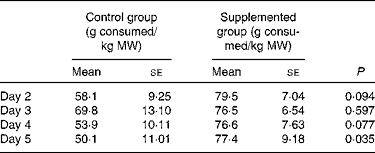
MW, metabolic weight.
Effects of tryptophan supplementation on total serum ghrelin concentration
The average total serum ghrelin concentration on day 23, at the beginning of tryptophan supplementation, was 3516·5 (se 872·35) pg/ml for the control group and 3363·6 (se 496·23) pg/ml for the Trp group (P = 0·998). Total serum ghrelin concentration on day 96, before the voluntary food intake test and after 81 d of tryptophan supplementation, was 1877·9 (se 272·80) pg/ml for the control group and 2724·2 (se 774·48) pg/ml for the supplemented group, as shown in Fig. 1 (P = 0·759). There was a significant effect of time, with a decrease in serum ghrelin after 81 d in both groups (P = 0·009).
Effects of tryptophan (Trp) supplementation on total ghrelin levels. Total ghrelin level was measured. Values are means, with their standard errors represented by vertical bars (n 8). Mean values were not significantly different for group (P = 0·660). Mean values were significantly different for day (P < 0·01). Control ( ), Trp (
 ), supplemented group (pg/ml).

Discussion
The present study aimed to investigate the effect of tryptophan supplementation on voluntary food intake in dogs and to observe whether this effect, if observed, was related to serum ghrelin concentrations. The voluntary food intake test in the present study suggests that tryptophan supplementation in dogs eating a low-protein diet, at the doses used, tends to result in a higher food intake compared with dogs eating a low-protein diet alone. That response has been observed in weanling pigs(Reference Zhang, Yin and Li15), where dietary tryptophan supplementation induced a significant increase in food intake in these species. In the present study, the supplementation period of tryptophan was 21 d. In pigs, the long-term administration of tryptophan induced higher plasma ghrelin levels. In the same study with pigs, they found increased serum ghrelin in the supplemented group. However, we did not observe this relationship in the present study.
It is important to mention that the present study is part of a larger project whose main goal is to study the effect of tryptophan supplementation on different biochemistry markers related to canine aggression. The availability of dietary tryptophan to the brain is largely dependent on the composition of the ingested diet, in particular the ratio of tryptophan to other large neutral amino acids(Reference Spring, Chiodo and Bowen16). The concentration of tryptophan in the central nervous system can be increased either by increasing plasma tryptophan or by lowering plasma concentrations of large neutral amino acids(Reference Bosch, Beerda and Hendriks17). For this reason, the experimental diet in the present trial was lower in protein compared with standard canine maintenance diets. This could have affected the present results regarding serum ghrelin, since plasma ghrelin levels can be dependent on diet composition, since one study in human subjects has found that a low-protein, high-fat diet resulted in decreased plasma ghrelin concentration(Reference Erdmann, Lippl and Schusdziarra18). As mentioned, the protein concentration of the experimental diet was lower than the protein concentration of the dogs' regular maintenance diet (0·81/100 v. 1·56 g/100 kJ metabolisable energy). The diet switch from a standard maintenance diet to a low-protein diet during the experimental period may explain the drop in serum ghrelin concentration from days 23 to 96. However, the decrease in ghrelin levels was higher in the control group than in the supplemented group.
In conclusion, the present study shows that long-term tryptophan supplementation at the doses used (1 g/dog per d) tended to increase voluntary food intake in dogs, which was not correlated with increases in total serum ghrelin. The effect of longer or shorter supplementation times and different doses is at this point unknown, and so is the effect of tryptophan supplementation on other hormones involved in food intake and satiety regulation (such as leptin and cholecystokinin).
Acknowledgements
We thank Tura Ferrer (Centre de Biotecnologia Animal i Teràpia Gènica) for her collaboration in total ghrelin determination. We would like to thank Indukern S.A. and the Ajinomoto Group for their kind donation of tryptophan. We also thank the Servei de Granges i Camps Experimentals de la Universitat Autònoma de Barcelona for their service and assistance during the experiment. The present study was funded by internal departmental funds (Animal and Food Science). There are no conflicts of interest between the authors. The contribution of each author to the study was as follows: V. F. and M. D. B. participated in the study design and in the writing of the manuscript. G. G.-O., V. M. M. and X. M. participated in the study design. C. V. and M. H. participated in the writing of the manuscript.



